Tuesday, May 21, 2013

Maitani's Jewel

P1040369a

Typecast135

Great Jobs001a

Trellis001a

UNM001a

Post-Script: These images are scans from the lab prints, not the negatives, so they probably aren't as sharp as they'd otherwise be. The XA2 is truly pocketable, even fitting inside my front denim jeans pocket, yet is "full-frame" in sensor size. There are few other classic compact film cameras that I've desired to own, the XA2 being a good combination of fine optics with classic Japanese engineering and design. True, it's no Leica, but then again a Leica could not be put inside one's jeans pocket, and would be much heavier as well (not to mention expensive).

I like these classic 20th century jewels of mechanical engineering, they remind of why I like manual typewriters, especially portables, as they represent a careful balance between mechanical sophistication, useability and portability.

Monday, May 20, 2013

"Coming Home"

Blog

I don't know how long it's been since I've eaten here, Devon Taylor says to himself, barely sipping at his coffee, basking in the steam's warmth against his cold face, cupping his cold, dry hands against the mug's heat. Outside Loser's Blend, crows cawed and pecked at debris along the curbside, while across the street busriders and pedestrians exchanged places. It had been a week since returning and he was still finding his place back in town. Portland had been fun, but wasn't for him. Something magnetic-like keeps drawing him back to Albuquerque, his home town.

He looks up from the wiggling reflections in the black coffee, past the rim of the cup and its rising steam, past the room's length and aromas, through the dingey window beyond, past the pedestrian and motor traffic on the street, past the skyline of cluttered buildings and crystal-clear sky beyond, past the rim of the world itself, his thoughts cloudy and indistinct.

A noise, close by, awakes him from his diffuse revery, something distant yet familiar. A typewriter. A goddamned typewriter.

Earlier, in a cloudy haze of confused thoughts and memories, he had arrived, ordered coffee and sat down oblivious to the world around him, automatically tuning out the typical coffee shop noises of the kitchen's clattering and the patrons' subtle but insiduous keyboard clickings, yet here it was, loud and insistent, seemingly louder now that he was paying attention to it, like neighbors' noises late at night in his cheap apartment - the more you tried to tune it out, the more you ended up paying undue attention to it, like some trick of the mind whose solution he had yet to master.

There it was again, that click-clacking and then the occasional but predictable 'ding' of a bell. He sets his cup down on the wobbly table and looks around at those seated about him.

There he is, the bearded figure at the corner table of potted plants adjacent to the window, typing up a storm, little turquoise-green machine set in front of him, his fingers in an elevated posture, arcing through space to find their target upon the dainty, mechanical keyboard. Click-clack. Ding.

Well, I'll be damned.

Curiosity being his constant weakness, and born out of an innate need for other people and some long-repressed fear of solitude - the last few years having taught him hard lessons of self-sufficiency while on the road - he persists against his normally shy nature, arising from his seat, coffee sloshing a little torus of brown liquid upon the worn formica, walking over to the corner table with the bearded man and turquoise typewriter and stands there, just stands there staring silently in disbelief.

The typing continues another 20 or so seconds and then abruptly stops, fingers hovering above keys, the bearded man looking up over the rim of his glasses like some school teacher from long ago, frozen in midsentence.

"Yes?"

"Ah, don't mean to bother you, but I was just wondering..."

"The typewriter. You were wondering about the typewriter, right?" He lowers his hands to the table, then takes a sip of coffee from a tan mug crazzed with tiny fissures.

"I get asked this at least once per day. Goes with the territory; the price you pay, I suppose, for bringing out a typewriter into public. Name's Gene. Gene Willard."

A rough, harry paw is extended, which Devon hesitantly takes, reciprocating with the best manly handshake he can muster, like some ad hoc but persistent male custom or ancient tribal ritual, seemingly outdated and ackward but still seemingly necessary.

"Sit down," drawls Gene, making room on the table. "And go get yourself a refill of coffee."

Devon does as he's instructed, almost automatically, pausing only long enough to consider the ramifications of these unspoken rules of engagement, so oddly familiar to him, always playing the role of the passive one, born out of habit or insecurity - or necessity - only realizing, halfway to the counter, that his cup's still nearly full.

There is some indistinct latin guitar music playing from the little dust-encrusted speaker high up in the corner of the room, a spider's web connecting the speaker's faux-wood finish to the wall's rough plaster.

Devon is sitting across from Gene, sipping at his coffee and watching him finish his paragraph, little hammers flying up to smash ribbon against paper, mechanical linkages intricate and obscure busily at work, click-clack-thunk, the table vibrating in response as Gene slings the carriage back with a confident precision, thoughts forming letters, letters forming words, words forming sentences and paragraphs via the intermediary of fingers upon keys, ink upon paper, direct and physically real, words that only exist here, right now, in this dingey university-area coffee shop.

"Done," Gene proclaims, releasing paper from machine with a twist of a knob and a flurish of soft, mechanical clicks, holding it up before himself like a proud papa's newborn child, scanning it briefly before precisely folding it into thirds and stuffing it into an envelop, which he licks shut, then addresses with a fountain pen retrieved from somewhere deep inside the folds of his jacket.

"A letter," Devon declairs. "I didn't think anybody wroter letters any more."

"They don't. But I do. I'm not just anybody. It's something I prefer, ink on paper. Plus, I like these machines, the way they feel and sound, their industrial-like functionality. I suppose you could call me a hipster if you want, but I've been typing on machines like this way before there were hipsters."

"But you do see the practical benefit of a computer, right? I mean, if you had your choice between using the one or the other?"

"Given the choice, I'd prefer to type, which is why I'm here, typing this here letter to this danged arts foundation." Tongue in corner of mouth, he finishes addressing the envelop, then applies a stamp he retrieved from a little leather notebook, securing it with a solid press of his fist.

"So, you're an artist, I gather?"

"Well, not really. Or, I suppose you could call me that, though the term is really kind of meaningless. If a person's graduated from university with an arts degree, then you could call him or her a pedigreed artist. But if a person has no such pedigree, but creates art anyway, are they still an artist?"

"I suppose only their public can say for sure," Devon hypothesizes, his cup now nearly empty.

"And if you have no public? What then? Does art exist absent an audience? Is it intrinsic, does it exist on its own, or is it only the context between a creator and a participant? Weighty questions, no?"

Devon sits across the small table from Gene, both sipping their coffee and reflecting on these thoughts whilst outside on the sidewalk a group of skateboarders dismount and have a seat at a table to smoke and chat, and pigeons peck at specks on the sidewalk, oblivious to the turquoise typewriter at the table through the stained window.

Breaking the silence at last, Devon sets down the cup and introduces himself, exhanging brief biographies like two long-lost friends meeting for the first time ever.

Time passes, cups are drained and filled and drained again, while a seemingly never-ending stream of customers cycle in and through Loser's Blend.

"You don't suppose I could have a try at that thing do you?"

"Why sure. Always pleased to have the opportunity to set the hook."

"Set the hook?"

"You'll see. Here." And with that, Gene spins the little machine around, setting it in front of Devon, and gives him a brief lesson in typewriter operation.

And that was how Devon Taylor came back home, only to become a typewriter geek.

And if you were to stop by Loser's Blend yourself on a cold and blustery day, be very careful of what you pay attention to, because you might find Gene or Devon - or myself - sitting at some little corner table, typing up a storm with our click-clack-ding resonating upon the dingy, coffee-stained wooden floors, waiting for yet another long-lost, newfound friend to come home.

Post-Script: Another installment in a series of short stories that I've come to call the "Loser's Blend Mythos." The largest part of this mythos is a fledgling novelette set in a distopian, post-apocalyptic, cyber-punk future, but it's sat languishing for several years. I do need to get back to work on it. Oh, and in case you were wondering, the name Loser's Blend for the fictional coffee shop is based on a very real place called Winning Coffee, check it out.

This piece was written on my AlphaSmart Neo, a great stand-alone writing tool, the closest thing yet to a portable electronic typewriter minus the printing mechanism, with a "real" keyboard. Which is ironic, I suppose, given the subject matter of this piece being about manual typewriters. Which reminds me, did you all catch the NBC News piece Sunday night about the manual typewriter renaissance?

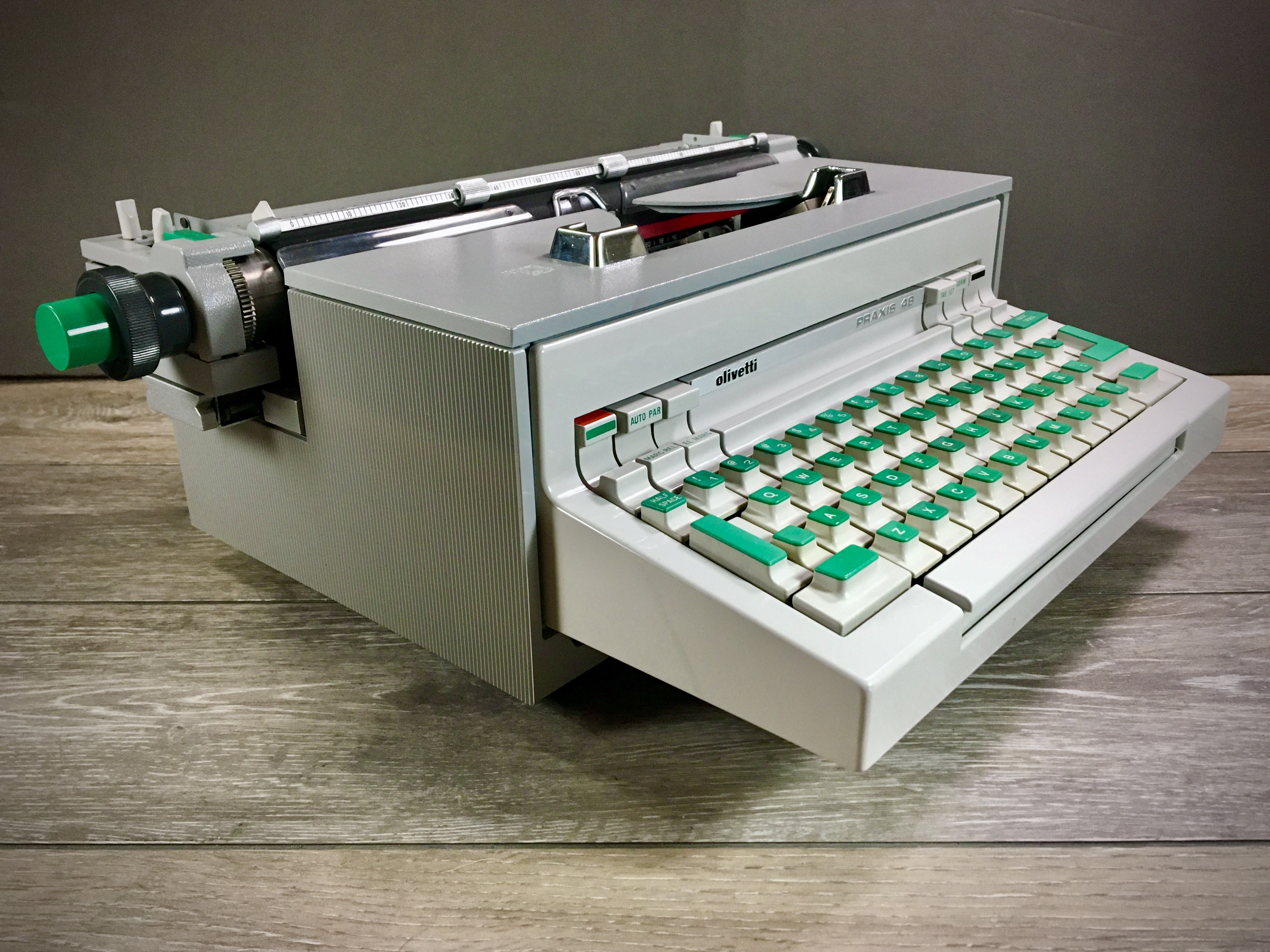
The little green typewriter mentioned in this story is, as most typewriter geeks can assume, an Olivetti Lettera 22, illustrated in the iPad Hipstamatic photo at the top.

Monday, May 13, 2013

Swamp Cooler Season

P1040329a

Typecast134

Post-Script: Of course, there's a bit more involved in restarting one's cooler, but I left out the additional details to keep the length of the piece to one sheet of paper, and to keep from boring all but the most hardware-obsessed. There are "old-school" style swamp coolers with thin pads on three or four sides (depending if it's downdraft or sidedraft style), and the newer "Master Cool" style coolers with one thick pad, which I have, and which seem to do a better job of cooling. Then there is the matter of cleaning rust and scale from the cooler. Mine is pretty rust-free, as the water tray is a thick plastic piece, but the "old school" designs were just painted metal troughs, prone to rusting, and would have to be scraped and sanded and painted with a marine coating every year. Fun stuff, especially if you waited too late in the season before starting, in which case you'd be up on a hot roof in 90+ degree heat.

Regarding editing this down from the original first draft, you wouldn't necessarily go out of your way to remove entire lines and paragraphs (like I did) if writing this in ASCI directly to the computer. Typecasting like I do often involves creating text in page-sized chunks, convenient for posting as a consistently-sized graphical image, so it's often inconvenient to have to add a partial second page.

Another example of how typewritering (that's a new word) is different from keyboarding into a computer is when you have to make a carriage return to finish off a paragraph, and would otherwise be stuck with a short bit of text on an otherwise empty line, it offers a good opportunity to add additional verbiage, since that line is already started anyway. So one's writing ends up being distorted by the mechanics of fitting words into lines and paragraphs on paper. My first draft was done in 1-1/2 line spacing on the little endless roll of paper, which is a lot more stream-of-consciousness than typing up a neat final version for scanning.

Typecast via Olympia SM-9, image of close-up of swamp cooler pads being wetted via Lumix G5 (you were wondering what that picture was about, right?)

Monday, May 06, 2013

Number Crunchers

P1040263a(HP21)

P1040268a(Rockwell 9TR)

P1040267a(HP11C)

Typecast133

Post-Script: I still use these three calculators, rotating them in and out like I do my manual typewriters. My most common use for them is when resizing images in my blog, like I'm doing now. When I copy the links from Flickr they're 800 pixels wide, but I resize them to 650 wide to fit within my Blogger template, and therefore have to calculate their respective heights to maintain proper aspect ratio (650/800 times their original height). Both HPs use RPN logic, so I keep my skills active with this now nearly obsolete operating system; even HP has conceded as much, since their current scientific calculators offer the option of both RPN and algebraic systems, keeping RPN alive for use oldsters from an earlier era.

As for the Casio fx-48 mentioned in the piece, a quick ebay search reveals none available as of this writing, they being as rare as hens teeth, which provides yet another reminder of how easy it is to take for granted what we have today, and the temporality of all things.

Post-Post-Script: Here's a link to a great vintage calculator page.

And here's a link to an image of the Casio fx-48.

Here's a link to the book "Games Calculators Play," an attempt to familiarize the average person with these then popular devices, which reminds me of the subsequent revolutions of the VCR and personal computer, both of which also required some education before the public would soon become comfortable with them. Then followed the DVD, MP3 players, and the smartphone/tablet revolution of today. But it was really all started, back in the early 1970s, by the pocket calculator craze, which I was a part of.

Tuesday, April 30, 2013

Pinhead Day

Two001a

Typecast131

ThreeThirteen001a

Typecast132

Post-Script: It has been a long time since I've printed in the darkroom onto silver gelatin paper, and it felt very good to return to my first love. Yes, twiddling with images on the computer can seem much easier, until hours have passed and you have little to show for it, certainly not finished prints, whereas this printing session, though only a few hours long, produced eight nice prints and the promise of doing much more of this in the future. The pinhole enlargements were surprisingly sharp, and it has once again encouraged me to expose some film in one of my fine glass-lensed medium format cameras soon, and have another go of print-making under the red lights.

Typecast via Olympia SM9, images are scans of silver gelatin prints.

Monday, April 22, 2013

The Day the Zero Killed the Microwave

P1040187a

Typecast130

Post-Script: The oven was ruined, and it's now been replaced by a newer model with a similar Minute Plus cooking feature, which we are ever faithful to use, while the carcass of the ruined oven remains in the storage shed, awaiting some disposal or recycle, but which also serves as some testimony to the power of that seemingly insignificant number zero to transform and make its presence known in surprising ways.

All stories should have a moral for us to absorb as a lesson, ours being that zero ain't nothing, it would seem.

Typecast via Olympia SM9 (and malfunctioning Epson scanner software that had to be fiddled with late in the evening), image via Lumix G5.

Post-Post-Script: The Epson scanner software threw this error message: "escndv.exe has encountered a problem and needs to close." Indeed. Like, right out of the blue. It was working one day, and the next its "escndv" is on the fritz. So I fiddled and hemmed and hawed, uninstalling and reinstalling the software, and updating the drivers, when finally going to the Internetz I found a help file on Epson's website, instructing me to delete some file that might have gotten corrupted. I deleted said file, and my scanner software commenced to working once again.

And I'm just guessing that the corrupted file had as the source of all the trouble - you guessed it - some errant zeroes.

Monday, April 15, 2013

Pinhole Camera Video

Gillman001a

I haven't made very many videos in recent years, even though I was very involved with the experimental video genre in the 1990s, and now have the means to record videos using three different methods - iPad, Lumix G5 or Flip cameras - and can edit the video either in Pinnacle Studio 14 on my PC, Windows Moviemaker or iMovie on the iPad.

This video I'm presenting is a short description of one of my recently made pinhole box cameras, using paper negatives in the 5" x 7" sized format, that features a storage compartment in the camera to hold dozens of sheets of paper, if need be, and is loaded in the field using a changing bag between shots.

The video was recorded on the Lumix G5, imported to the iPad2 and edited in iMovie.

Should you have any questions pertaining to the details of my pinhole camera or paper negative process, please drop a message below and I'll reply with an answer.

Enjoy.

http://youtu.be/LszigE3dzXM

Depth of Focus

Apt. A

I've been thinking about the matter of focus in photography, a subject that’s received a lot of attention recently because of a continuing trend toward shallow depth-of-field imagery.

I’m not certain when this first began, the trend toward emphasizing a narrow plane of focus at the exclusion of an image’s fore- and back-grounds but, while I can appreciate the quality that subject isolation affords a portrait, for example, I’m just getting tired of seeing it. Shallow depth of field and its related attribute of bokeh - that term derived from Japanese culture to describe the quality of the out-of-focus areas within an image - seems to have become a means of exercising equipment-related bragging rights, since larger format (hence more expensive) cameras exhibit a shallower depth of field, all else being equal, and more expensive lenses often are engineered to exhibit a more pleasing bokeh.

In my constant perusal of the online photography world I’m seeing more and photographs that are big on form and little on content, all style with little substance, more like experiments in optics than photography applied to the real world. I’ve been guilty of this myself. Shallow is a good word for it, speaking to more than just the quality of focus.

My formative years of photography were in the late 1970s and early 1980s, during which I’ve studied the work of many of the major landscape and documentary photographers of the 20th century. Almost without exception, content reigned supreme above form, and any obvious optical attributes evident in such images were the result of systemic limitations, rather than the intentional stylistic self-consciousness evident now in much of contemporary photography. Subject matter was of paramount importance, necessitating sharply rendered images. Above all else, clarity of vision and transparency of intent were deemed critical, isolated from any attributes contributed by the mechanics of the process.

Winning Coffee Shop

There is this term “artifact” that I would like to introduce to these thoughts. Artifacts are unintentional or inessential modifications to pure image, brought about by the mechanics of the process, and at the very least are unavoidable. While in our imaginations we might behold some concept of the ideal image, in the real world of physics, optics and physical materials such images are imperfectly represented through the agency of some external medium, be it through silvery films, or colored dyes, or glowing specks from some crystalline screen. These physical media impart their own signature to the image-making process in the form of artifacts that might be recognized through careful scrutiny.

Many artifacts of historic media are so easily recognized as to have become cultural memes, like scratches in phonograph records, streaks and lines in film-based cinema or sprocket holes in roll film photography. Less obvious are the optical effects from the lens itself, replete with aberrations and distortions that inevitably follow from the laws of physics.

In the never-ending pursuit of the ideal image, many forget that using optical refraction as a means to project an image brings with it inevitable compromises, imparting its own artifacts. Different wavelengths of light refract differently, while only one subject plane can be in near-ideal focus at any one time. So we make compromises and adjustments based on limitations to our acuity of vision and precision of mechanical reproduction. We say “this is good enough,” and assign hard numbers to things like depth of field scales on lenses, for example. We learn to ignore the imperfections in our process long enough for the suspension of disbelief to take hold.

Our brains seem to be able to look through the imperfect haze of our cobbled-together image-making processes to catch a glimpse of that ideal image, if but for a brief moment, which we then retain as mental signposts for how to interpret all future imagery, teaching ourselves to see photographically, all the while learning to ignore the artifacts of the process, like squinting through scratched spectacles and seeing not haze and clutter but a more clearly defined mental picture of the scene before us.

The classic era of mid-twentieth-century documentary photography beheld the photographic image as having the power to mimic objective reality through careful management of the medium’s artifacts, the resulting images made transparent enough, through a cooperative process between image and viewer, to suspend one’s disbelief and make it appear as if some reasonable semblance to objective reality were being represented.

This is the power of photography, when its artifacts are properly managed, to appear to represent objective reality, all the while remaining literally a momentary snapshot culled out from time and space through the limitation of someone else’s (certainly not the viewer’s) editorial perspective. Which is why photography, and its child video, are so ideally suited as vehicles for propaganda and manipulation.

Winning Coffee Shop

Perhaps my criticism of these recent stylistic trends in photography, like shallow depth-of-field, is shortsighted. Ours is a culture raised from birth inundated in photographic imagery from a multiplicity of media sources. The common person is now more apt to be a visual sophisticate, being more deeply articulate in the visual language than their predecessors, and more cynical, possessing some intrinsic pragmatism, of mediation’s intentions. It is no wonder that more photographers now choose to turn up the volume on their image’s mediated artifacts, as if to boldly declare that they now know the game to be over, that they are aware of photography's power to deceive and exploit, as if their intent were toward a more introspective photographic art that more clearly delineates what photographs do, as if to say “this is how lenses see the world, and it is not how the eye perceives of it.”

There is a refreshing honesty in this approach, I must admit, to free the photographic medium from the clutches of the propagandist, though I wish it were more universally true amongst the majority of photographers today, indicative of the medium’s slow maturation from propagandist’s tool toward artist’s implement.

This progression, we must recall, also happened to painting which, while once the medium of propaganda for king and bishop alike, has evolved since photography’s birth to become an entirely abstracted, introspective medium of self-exploration. Abstract expressionists applied paint to canvas to see, as Garry Winogrand said of his photographs, what paint looks like when applied to canvas, a thoroughly visual experiment, entirely disconnected from any representation of objective reality.

While it remains a naive pipe-dream to expect more people to turn off the propagandist’s media channels within their own lives in search of a more pure artistic intent, at least we can educate ourselves to the medium’s intrinsic power to deceive, and adjust our methods accordingly. Photographs serve us in more practical terms than to deceive and exploit the masses. We are not only consumers of mass media but are also ourselves creators of imagery, and in numbers vastly larger than the purveyors of corporate propaganda. Through our own efforts, via cell phone or point-and-shoot, we document our own lives, whether to humble or to flatter, and yet there remains that constant tension between the power of the medium to describe as well as to deceive. We desire our own pictures to be flattering above and beyond what might be the harsh reality of our personal visage, or attempt to capture in picture the romanticism of some landscape experience that in strict visual terms might be more cluttered or confusing than memory might ascribe. We use photographs in our own lives to self-propagandize the memory of our experiences into some more idealistic form.

It is for these reasons that I am attracted to the snapshot’s aesthetic charms, for under the surface appearance of some less than ideal composition by the agency of the amateur image-maker there remains the latent intent to invoke the power of memory for the purpose of preserving the preconceptions underlying our personal existence. We want our own photographs to preserve for us the recollection of more deeply personal meanings, rather than function as mere documents of our daily existence. In this aspect snapshots function as the implements of a deeply personal spirituality, helping us to fulfill what we might regard as a search for some sense of personal truth.

The action of focusing light upon some recording medium from an otherwise objective reality is intrinsically an editorial phenomenon, in as much as what can be seen excludes all else that remains unseen. To focus upon the specific is to lose sight of the larger context. As faithful as photographs are to record, they fail us in those moments between frames to remain objective, which demonstrates the limitations of the medium, of which it would do us well to remember.

Post-Script: Selective focus is now so popular that smart phone photo apps like Hipstamatic use software to blur parts of an image in an attempt to mimic shallow depth of focus, being as how the typical smart phone camera lens’ focal length is too short to provide any reasonably shallow focus effect optically. The images associated with this post are from Hipstamatic.

The antithesis of shallow focus is employing pinhole optics to the problem of photography, which produces images with near infinite depth of focus, but at the cost of long exposure times and an overall softness that has come to be recognized as that classic pinhole look.

I am simultaneously amused and befuddled by Internet discussions wherein people declare that they cannot make “professional looking” images absent shallow focus, hence necessitating the use of multi-thousand dollar camera systems. I can remember back to the 1970s and ’80s when the watchword was maximizing depth of field, rather than minimizing it, and the aesthetic at that time more generally appreciated images that were corner-to-corner sharp, with tack-sharp optics to match.

Photography at that time had yet to break free from its former role as tool of the journalist and photo essay magazine, and so description was its primary role, necessitating that the camera remain invisible to the resulting outcome.