Monday, April 22, 2019

Final Writing From Winning Coffee
Last Latte at Winning Coffee
Final Writing From Winning Coffee

Post-Script: We used to buy our coffee beans from Winnings, a biweekly pilgrimage that would also see us enjoying a plate of enchiladas and eggs (slathered with red and green chile sauce) or the bagel sandwich - typically on a Sunday morning, when the regulars would be seated at the big oval table near the serving line, doing the crossword puzzle and discussing the week's events.

The sidewalk in front of the shop is wide and brick-paved, with numerous patio tables and chairs, which were always filled with an eclectic mixture of students, regulars and semi-street people. Though smoking isn't permitted within 20 feet of a building here in ABQ, it was common for people to be smoking on the patio, using Winning-supplied, sand-filled ash trays, with the aroma of hand-rolled tobacco wafting on the breeze. Our very own little Left Bank; the Left Bank of Route 66.

I came here often enough to notice the regulars, and would strike up a conversation with some, even though I lived across town in the suburbs - which they were keen enough to pick up on. One such fellow was a young guy who always dressed in a black suit and white shirt, and would be writing poetry in a ragged notebook. Another regular was Cherokee, a middle-aged lady who's been living on the streets for decades, though she'd have enough money for a cup of coffee and a plate of breakfast. She'd be warming herself in the early morning sun, wrapped in her off-white blanket that you could smell from a block away. I suspect the management of Winnings might have given her a plate of food now and again for free. That's the way they were.

Three times a week Bradley would set up his books on the counter adjacent to the coffee roaster. He did a good trade in classic 20th century literature, aimed for the university crowd. I saw him and his wife today, as I was typing up this piece. She said he'll probably retire his mobile book business and perhaps take up music production. He would always have an assistant to haul the boxes of books to and from his truck, usually a local who needed the work. Bradley was that kind of fellow. I'm going to miss him.

There were lots of regulars, many who had their own table, sitting in the corner perhaps, writing on a laptop, or in a notebook. Chris, the co-owner, told me today that at least three doctorates were earned from UNM by folk who did the majority of their writing here at Winning Coffee.

I started coming here in the late 1990s, and would write in a journal book, using either mechanical pencil or fountain pen, then later in my AlphaSmart Neo, though I rarely took a typewriter, mainly because the place was so busy on weekday mornings, with people reading or studying, that I didn't want to disturb them. I wrote many blog articles and short stories here, including the Loser's Blend series, which I self-published, and was also featured in my story for Cold Hard Type.

With the increased pace of my YouTube video production schedule I haven't been frequenting Winnings very often during the last few years, since it involves a time commitment and drive across town. Now I regret not spending more time here. And I wonder if perhaps I'll soon have an urge to sit down at some worn table, eclectic music in the background, coffee-stained hardwood floors that have seen a lifetime of wear, sipping a wonderfully rich and dark latte that makes Starbucks taste like warmed milk, channeling my inner Muse as I put words to paper, in some newly discovered coffee shop very much like what Winnings was. I hope so, but there are no guarantees in life. But the spirit of Winning Coffee lives on my memories. Perhaps there's one more story for the Loser's Blend mythos still waiting to be penned? We shall see.

Typecast via Canon Typestar 4 onto Staples thermal fax paper.

Labels: , ,

Monday, March 18, 2019

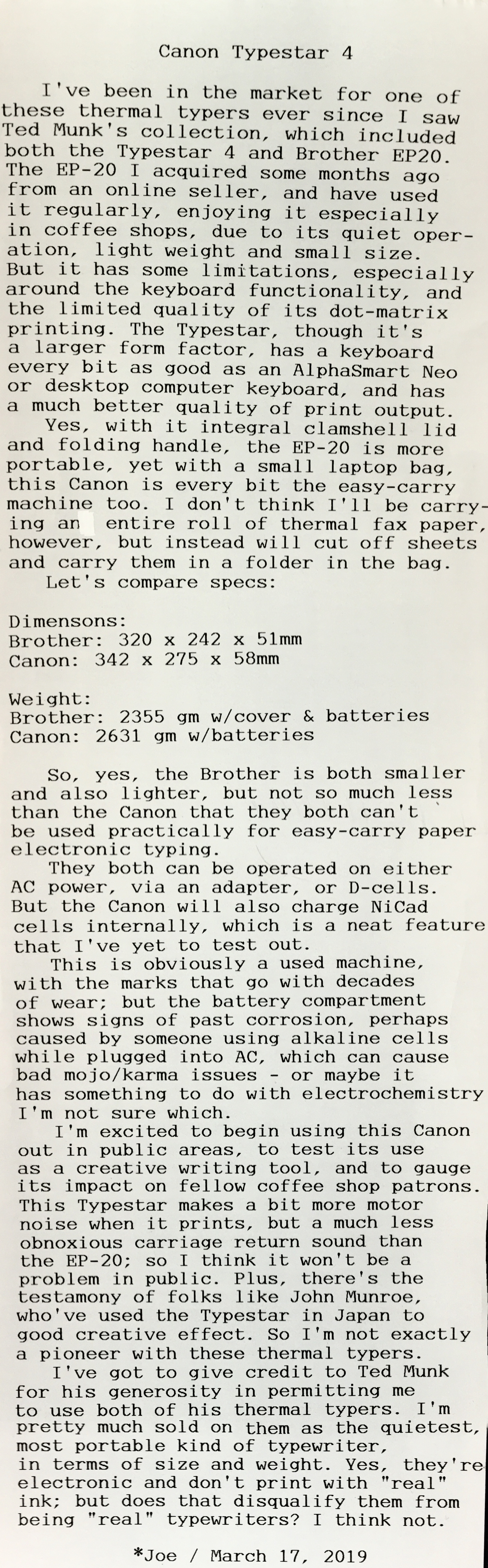
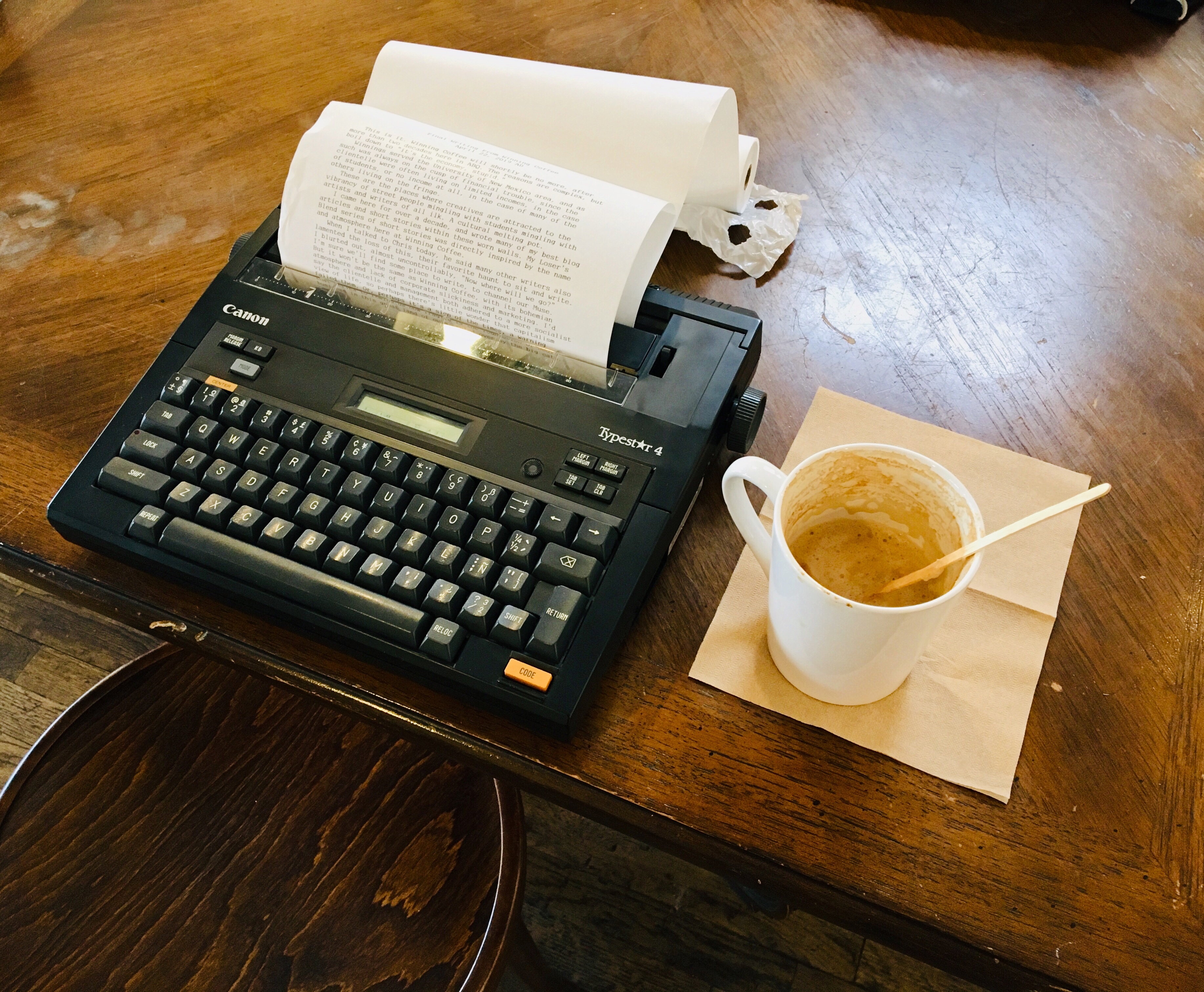
Canon Typestar 4 Thermal Typewriter

Canon Typestar 4
Canon Typestar 4

Post-Script: The Typestar prints nice and straight lines and columns of text. The wonkiness you're seeing in the above typecast is because I'm experimenting with using the panorama mode in my iPhone's camera, where you slowly scan the camera across the scene and it assembles a very large image file. But if you're handholding the camera rather unsteadily, as I was, it looks a bit weird. Still, it's better than the results of using the camera in its normal mode, because then it tends to curve the lines near the top and bottom of the image due to pincushion distortion of the lens - which the native photo edit app can't correct for.

This is all in an effort to configure a more mobile blogging workflow, independent of my flatbed scanner. Still a work in progress, however.

Back to the thermal typewriters. It's been educational using both this Canon and the Brother EP-20, side-by-side. You'd think, because it has a much better keyboard and printing quality, that the Typestar would "mop the floor" with the Brother. But the EP-20 is smaller & lighter, with an integral clamshell lid and carrying handle, aside from its storage bag; whereas with the Canon I have to use a dedicated laptop bag for carrying around.

Yet they're both only going to make "temporary" paper documents, despite the quality appearance of the Canon's output, because thermal paper is essentially not an archival medium. I have thermally printed bookstore receipts jammed into paperback books I've purchased decades ago and, though readable, they're mostly faded away. It reminds me of magnetic tape media - it'll last a long time, but not forever. In the case of writing onto thermal paper, the workflow is essentially one of rough drafting, getting those initial ideas down on paper, to be later sorted and edited, using a more permanent medium, like regular typewriter ink on paper, or some digital media that is, though substantial, not permanent in the sense of forever permanent. It's kind of like the idea in photography of infinity focus. It's a theoretical construct, the idea that you can visually focus a scene from infinity. Infinity is a long way aways.

I suppose you could argue that nothing's really permanent, it's all gonna burn, given enough time until the sun flares up to a red giant. It just has to be "permanent enough".

The value proposition with these small thermal typewriters is that they're much more quiet than a manual typer. Meaning you can go places, use them in public, in ways you can't easily with a manual machine. And they resemble, in form factor, an older-style laptop computer. One with a sheet of paper sticking out. Yes, the printout isn't "archival," but it'll last plenty long enough to go through the inevitable edit phase, to eventually make its way into some digital file.

I'm going to do some cogitating in the near future about the validity of these small machines as "real typewriters." I know there are some folk who'd argue that any kind of electronic typewriter really isn't a "valid" typewriter, it has to be a manual machine. I can understand their point, but would also counter-argue that, if a 1950s Smith-Corona Electric is a "valid" typewriter (it's essentially the same as a manual series 5, but with a motor, belts and some drive spindles), then you can't discount a machine just because it's electric. So then what? Is it invalid because it has a daisy wheel? Or a carbon film ribbon? What does it matter, really; as long as it prints directly to paper - even if the paper's thermal paper - it's a typewriter, right?

Both of these machines use D-cell batteries, and also have AC adapters for when close to an electrical outlet. But the Canon will also charge Ni-Cad batteries internally, using the AC adapter, which I'm going to test out soon. But I've noticed some evidence of corrosion in the battery compartment, which I suspect is because someone in the past (isn't everything in the past?) kept non-rechargeable alkaline batteries in the machine while it was plugged into the AC adapter, a no-no as per the instruction manual. With the Brother EP-20, plugging in the AC adapter disables the batteries, so there's no risk of damaging the machine.

About the thermal paper I use. You can easily get 3-1/8" wide point-of-sale thermal cash register paper, at the big-box office supply stores. And then there's 4-3/8" wide rolls, available from online sellers, more appropriate for poetry. But I really like the 8-1/2" wide thermal fax paper rolls. You can either use the roll intact, or cut it in sheets and carry the sheet around with the typewriter in its case or bag, making for a very portable medium. These typewriters were originally intended to use special thermal-compatible film ribbon cartridges, meaning the machine would transfer the text onto regular paper. Both of my machines have a few such cartridges, but they're no longer being manufactured and are expensive to buy online, as new-old-stock. Hence the reliance on the much more readily available thermal paper, which you can use directly without any kind of cartridge in the machine.

And how long do we expect thermal paper to be in supply? As long as paper receipts are a thing, I suppose. And fax machines. Maybe about as long as fabric typewriter ribbons? Maybe.

Labels: , ,