There was a time, a few decades ago, when I found myself in possession of a handful of slide rules. This ad hoc collection had started when I was in high school, and slowly grew in the subsequent years while I served in the military.
Back in those years, people weren't as keen on collecting ephemera or peculiarly specialized objects as they are today. My folks, of the WWII generation, were more apt to collect curio bottles, pretty trinkets and nicknacks than things like slide rules or typewriters, which were to them mere practical implements; it made as much sense to them as collecting shower curtain rods.
Sadly, in the intervening years I've lost that collection of slide rules, my most prized item being a circular slide rule. This happened due to a number of moves, from one apartment to another, during which I'd unload as many items as I could. I've also lost other items which I now wish I had, such as my mother's Kodak folding camera.
I know the usual advice people give about clutter: it's best to move every few years, to permit oneself to declutter and rid themselves as much as possible of unneeded items. Myself, the more I age the more I wish I yet had a few more of those precious items from long ago, as momentos serving as a physical link to a past that only resides in memory, a temporary dwelling at best. This is a benefit of living in the same house for decades upon decades: the clutter itself becomes like some personal archeology, a mapping or extension of one's cerebelum; the forensic evidence of a life actually lived. Sure, one's clutter can all too easily get out of hand, but there's value in considering the artifacts of one's life, in going through each item periodically to relive those memories.
I'm reminded of the android Leon in the film Blade Runner, who carried with him his precious photographs, reminding him of a childhood he never had. Momentos are like that, they're something tangible we can hold in our hands, talismans we can fondle to make contact with another time. Snapshots I've always held in special regard for that reason, especially polaroids and the like.
The interesting thing about periodically reviewing one's clutter is, as we assess each item for its personal value, it gives opportunity to reassess the things we'd been hanging onto that we no longer find of value, like my penchant for once having saved newspaper and magazine clippings from long ago.
I was pleasantly surprised this week to find a card in the mail from my Aunt, the last surviving sibling on my father's side. She'd unearthed an old trunk from her basement and, searching through it, found an old school picture of your's truly, a red-headed, freckled kid I'd barely recognized after all of these years. Looking at that print, it was like some kind of magic mirror into the past, as I rediscovered someone I'd totally forgotten.
Last week I was in a thrift store mood. I will periodically make a thrift store run, in the hopes of finding some wonderful find, like yet another typewriter. Yes, I did spot a handful, but nothing that interested me. As I've matured as a collector, I'm a bit more selective than when I first started out. But one item I did pick up last week was a slide rule, of all things.
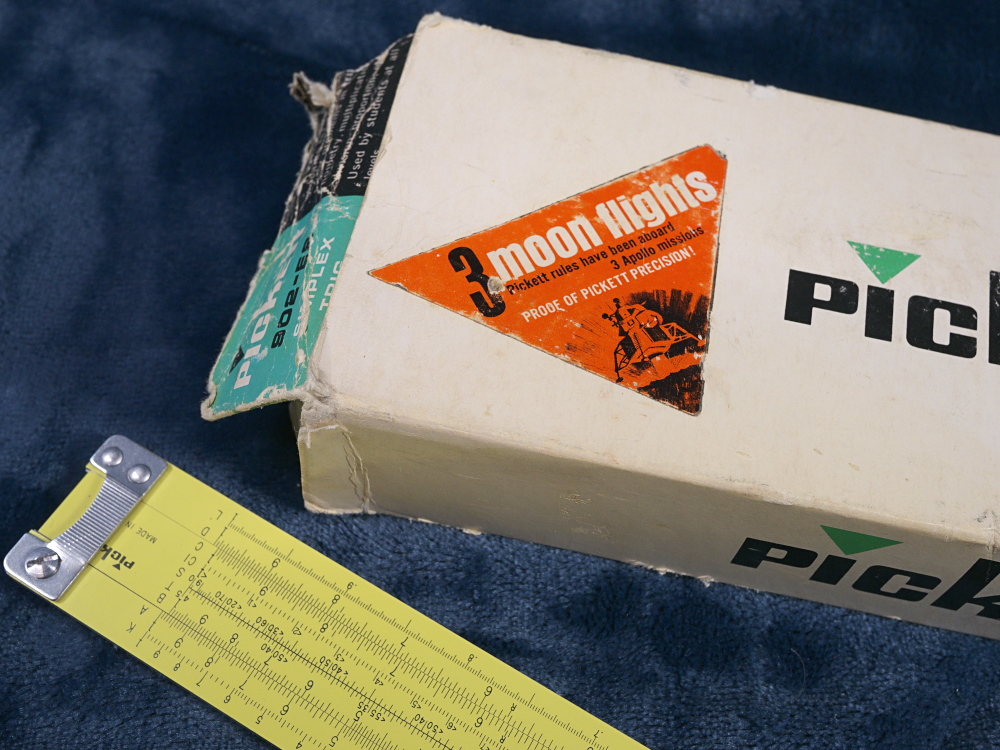
I see these all the time at thrift stores, and rarely do they interest me, except to remind me of that collection I once had. So, what made this one different enough to warrant purchasing? Well, it came with the original box, leather holster, plastic bag, packing material and owners manual. It's a Pickett N902-ES Simplex Trig model, intended for students I'd suppose, since the reverse side of the rule lacks the additional set of scales, but instead has a table of fractional/decimal conversions and instructions for use.
The clincher in the decision to purchase was the orange triangular sticker on the box proclaiming "3 moon flights - Pickett rules have been aboard 3 Apollo missions - PROOF OF PICKETT PRECISION." I don't have an exact year when this particular rule was made, but I'd suppose those three missions might have been Apollos 8, 10 and 11, which dovetails nicely with my interest as a young man into all things space-related.
Items such as this slide rule are not particularly valuable, monetarily, since they were made by the millions. I don't collect such items with the mistaken idea that doing so might make me a rich man. Unless one counts their riches in some other valuation than monetary. A bit of online research shows that this version is a later model, circa 1970, with the more modern Pickett logo and the yellow color indicating it's the "eye saver" version, as indicated by the ES in the model number.
What does interest me is the owners manual, a booklet titled "how to use Trig SLIDE RULES" by Professor Maurice L. Hartung of the University of Chicago. I like this introductory sentence in the booklet's preface:
"A computer who must make many difficult calculations usually has a slide rule close at hand."
This idea of referring to a "computer" as a person rather than a machine directly reminds me of the early days of mechanized writing where "type writer" referred to the user of the machine rather than the machine itself. I'm surprised this terminology was yet in use as late as the date of this preface, of 1960.
Slide rules remind me of photos I've seen from the Apollo era of the 1960s, of large rooms of engineers, each in their white shirts and thin black neckties, hunched over their drafting tables with their sleeves rolled up and slide rules in hand, an overflowing ashtray nearby. It's amazing to think that we got to the moon's surface and back six times using, along with early digital computers, these humble slide rules.
Of course they're an anachronism. The idea of taking up a slide rule to do a bit of multiplication seems like sheer nonesense. A bit like sliding the beads of an abacus to balance one's checkbook. But I've been known to do a bit of that, also. I like the idea that a purely analog tool like a slide rule yields merely approximate results to math problems that should otherwise be entirely exact. For example, a simple problem like 2 times 2 we know to be 4 because of us having learned our maths tables in school; but what about 42 times 37? Using the C and D scales of the slide rule informs me that the answer falls somewhere slightly less than halfway between 1550 and 1560. An approximate kind of answer, entirely analog in nature, requiring a bit of extrapolation to find that last digit. Only after I stop and think that 2 times 7 equals 14 do I then realize that the answer should also end in 4, implying the result should be 1554.
The funny thing is that I had to verify my result with a cheap, plastic digital calculator of questionable heritage. Yet that cheap calculator gives the same result as a hundred dollar Hewlett Packard scientific model. Not necessarily so with analog instruments like slide rules, where the accuracy of the result is directly dependant upon the precision of manufacture of the instrument and skill of the operator.
I like the concept of extrapolation as being absolutely necessary in the operation of a slide rule for deducing the last digit of precision. This is something that many technical people seem to lack these days, the ability to find a ballpark answer to a problem. I like the real-world skills of being able to approximate the scale of a problem by mere deductive reasoning, an insightful hunch based on common sense and a bit of thought. The value of being able to make a
SWAG - a scientific wild-ass guess - should never be underestimated, and will get one far in life.
I remember some of the slide rules in my former collection were bamboo, and required to be dusted with talcum powder periodically to remain smooth in operation. This Pickett is all metal, and thus the booklet recommends a bit of petroleum jelly on the edges to maintain smooth operation, along with the advice of holding it by the ends when in use, so as not to bind the scales together too tightly. I like the idea that this humble calculating device requires a bit of simple yet necessary maintenance in order to function properly; whereas with that cheap plastic calculator I'll mash it buttons until it no longer functions, then throw it in the rubbish bin of history.
The most essential observation I can make in comparing slide rules to typewriters is that few of us have need in our daily lives for solving math problems any more complex than addition or subtraction; which makes slide rules not nearly as useful as typewriters, since slide rules don't "do" addition or subtraction. (Actually, they multiply and divide by adding and subtracting logarithms, but you probably didn't need to know that.) Which means that for most of us, a humble abacus would probably be more useful. Which I'll discuss in another installment.
Labels: memories, mid-20th century naivete, retro tech, slide rules, storytelling, thrift stores