Monday, August 03, 2020

Looking Up

P1020093a
Back to Space
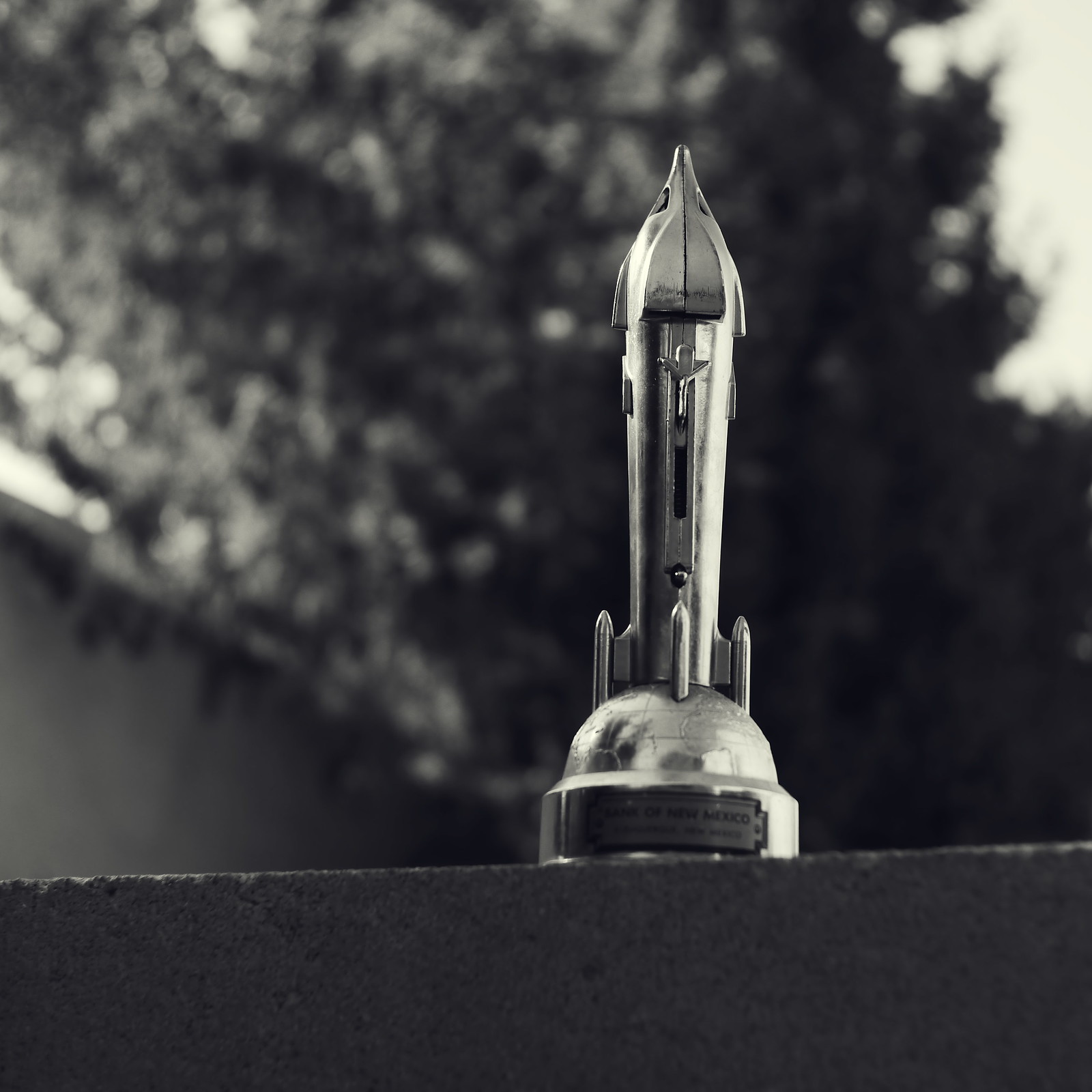
It was sometime in the very early 1960s when Dad brought home these rocket banks. He worked out on Sandia Base, at a place called D.A.S.A. - Defense Atomic Support Agency, Field Command, Cataloging Department; later renamed D.N.A - Defense Nuclear Agency. He set up the system that catalogs the parts for the nation's "special weapons." Years later, sometime in the 1990s or early aughts, I met some of the ladies who still worked in his same department, they said the system he set up was still being used.

In the geography of the Cold War, Sandia was a place where the "physics packages," designed by Los Alamos and Livermore, were turned into practical, field-ready weapons, safe enough to be handled by soldiers and sailors with high school diplomas and rugged enough to withstand the abuse of deployment.

Dad was a meticulous documenter. He balanced his checkbook to the penny, using his clearly legible printing, which featured little details like horizontal serifs on the loops of the capital "J". I can imagine this worked well for the kind of career he had with that secretive government agency.
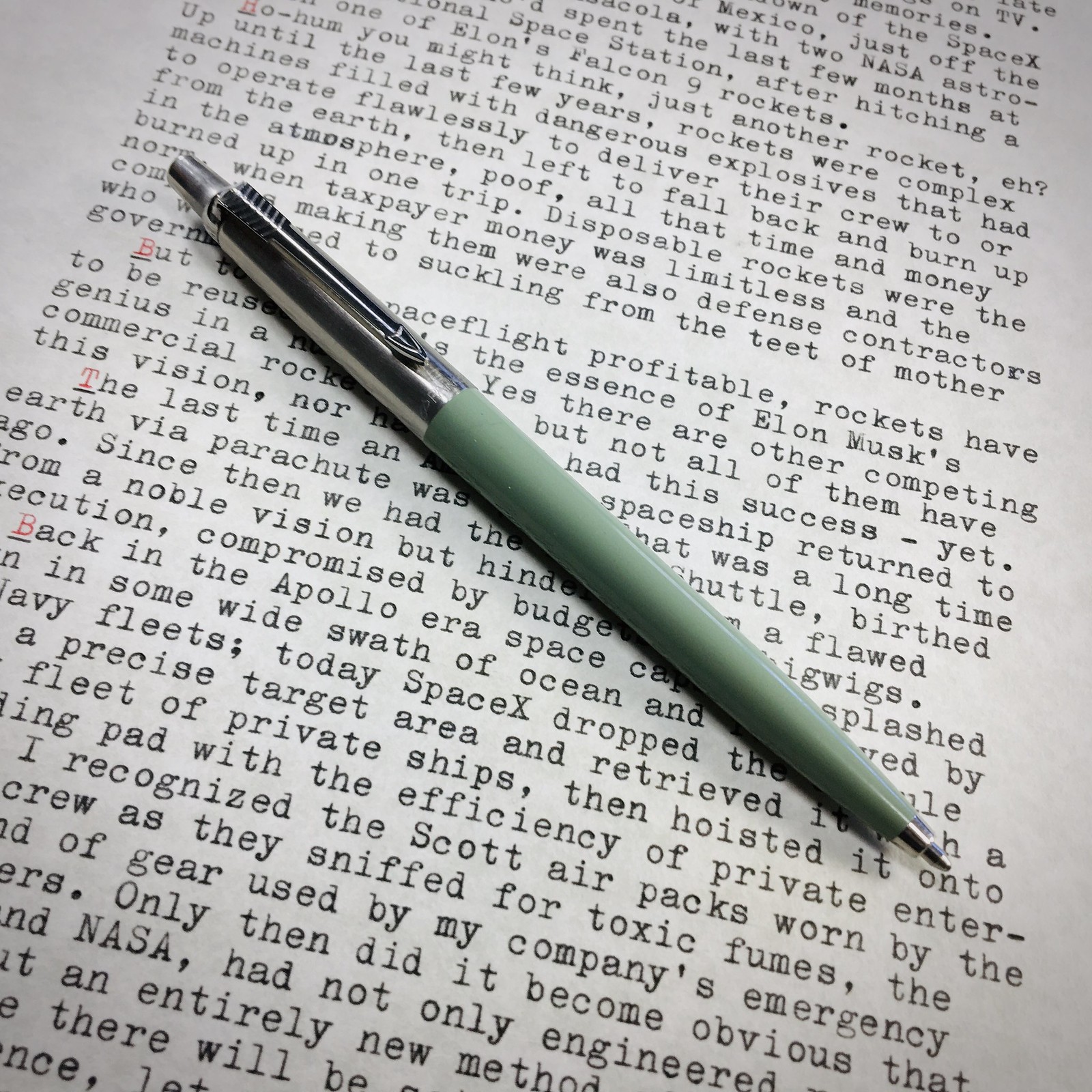
Parker Ballpoint

Dad always used these Parker ballpoint pens, with the brushed metal rear half and pastel colored plastic front. There was often one in his shirt pocket, or clipped to that checkbook that was always balanced to the penny. This one's mine, but I think he had one in this very same color. I don't use it that often - part of the problem of being a pen collector - but keep this one mainly because of Dad.

Bank of New Mexico had a branch office on the Base, which was where Dad got these rockets banks from. There's a vertical slot on the side of the bank, and a part above it that looks somewhat like the middle of a peace sign, inverted; or a crucifix with broken arms. There's a lot to unpack in these symbols; I'll leave that up to you.

A coin could be nestled into those broken crucifix arms, then the bank cocked by pulling the fixture down along the slot. When the button below the slot was pressed, it would shoot the coin up into the nosecone of the rocket - clank! - and the coin would rattle down into the bottom, preserved for that future college education. We loved watching the coins being shot into the bank much more than the idea of saving for our education. Go figure.

The base of the bank can be unlocked using a simple key, which we'd long ago lost, but a bent paper clip works well. I think my two brothers each still have their rocket banks. These weren't just fun toys for us to play with, but they also served as tokens representing the fact that we were very interested in the space program of the 1960s. I was born in '57, coming of age around the time of Apollo, and remember well our space infatuation.

My middle brother and I would play astronaut at Grandma's house. We'd set up the card table against the sofa. The card table was taller than the cushions of the sofa, so we'd lie on our backs under the table with our legs up on the sofa cushions, in that reclining position common to astronauts. We'd enhance the effect by covering the table with a large blanket, enclosed as if in our tin capsule, then play with pretend control dials we'd taped to the underside of the table. We do a countdown, then one of us (usually me, because I was the younger) would stand outside the pretend capsule and rock the table back and forth while spewing rocket-like sounds and droplets of sputum, the latter unintentional but common to overly-energetic young lads.

Later, we realized our pretend capsule wasn't realistic enough, so my middle brother and I commenced to build our own capsule in our grandparent's back yard, using aged lumber from a pile out by the shed near the alley.

DSCF4472a
My grandparents former house at 112 Edith St. NE in Albuquerque, now a law office.

The pile of lumber, I only learned more recently, came from circa 1929, when Grandpa had leased the ranch land to some businessmen who made an Indianapolis-style dirt racetrack, with wooden bleachers and a tall wooden fence that surrounded the 160-acre property, located near where the corner of Central and Wyoming are now. When the Depression hit hard, the racetrack went bankrupt and left Grandpa with an abandoned property. He built a shack of wood to live in, and dismantled the wooden structures and sold them off to make spare cash. With the remnants of that lumber we - my middle brother and I - made a go-cart and space capsule, in the late 1960s. From Google Earth you can still see remnants of the south turn of the oval racetrack, now located on Base property, between the Officer's Club and the north fence line adjacent to the Wyoming Gate entrance. After WWII the government had annexed part of Grandpa's ranch land to expand Sandia Base.

The capsule we built resembled a Gemini-style conical shape, built on a circle of boards as a base, with the sides of the conical capsule made of boards leaned up together, teepee-style. More bits and bobs were used to decorate the inside of the capsule to our liking. We'd have launches during every weekend visit to our grandparents, where my brother would lie on his back in the capsule and I'd shake it while roaring and spewing forth my boyhood energy, imagining him soaring into the sky on a column of flame and smoke. Later on we'd try making our own rocket engines from wooden kitchen match heads, but they only were good for smoke bombs.

One summer evening before dark there were flashlights flickering up the alley behind the backyard, then police officers entered the yard and questioned the adults assembled therein, a family reunion of sorts. Had they seen the escaped convict they were searching for? Nobody saw the escaped convict, but the officers made sure to search inside Grandpa's shed, and the conical Gemini-style space capsule, just to be certain no one was hiding. Years later I'd imagine that escaped convict, hiding in the spaceship, ready to blast off from earth to some better place.

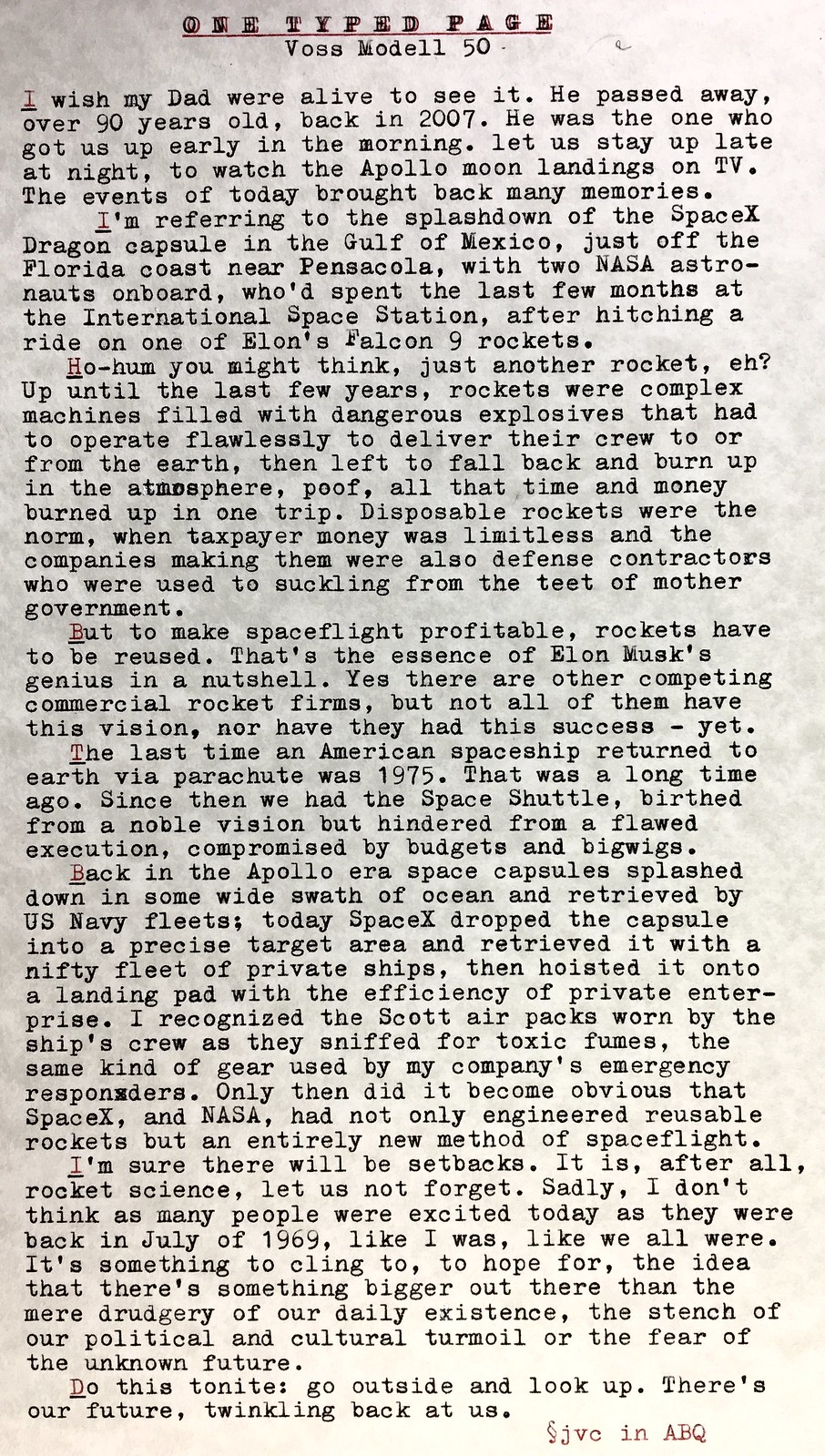
These are the kinds of memories that come flooding back when I watch notable space events, like this week's return of the SpaceX Crew Dragon capsule from orbit. My oldest grandson doesn't seem much interested, not many kids his age seem to be. I suppose it's an artifact of my generation's era, whatever happens during one's formative years seems to make a lasting impression. If there's to be a permanent and expanding space program it's going to require a permanent fanbase of supporters who petition their congressional representative to allocate the funds. As it was, Apollo was cut short by the economic ravages of Vietnam and the Cold War. Maybe our choices are endless wars, or space exploration, but not both? Maybe. In the meantime, keep looking up.

Labels: , ,

Tuesday, July 28, 2020

I Seem to be an Adverb

120 LCD Triangle
"120 LCD Triangle"

Copy-Typing Bucky Fuller

It's 1974 and I'm a skinny, curly-haired nerd, standing in all my teenage awkwardness under the bright New Mexico noontime sun, adjacent to the Industrial Arts building at Eldorado High School, the campus a glaringly bland architectural afterthought comprised of adobe-brown brick rectangles dropped onto a brown dirt landscape on the eastern edge of town. Even today, as I drive by on my way to or from some errand, I'm amazed at its blandness, as if some architect had to go out of their way to achieve this spectacle of aesthetic anonymity.

But it was the early 1970s and Albuquerque's northeast heights was experiencing an explosive population growth, fueled by families whose dads and moms might have worked at the nearby Sandia National Laboratory, a not-so-subtle pun referencing the plowshares being hammered into bombs of unimaginable ferocity. The local school system built campuses like Eldorado, named after that fabled lost city of gold, as an expediency to deal with the enormous population surge. Back then, more school money went to the classroom, in the form of bland buildings designed to house a surge of students; whereas today, in contrast, the administrative overhead of the school system seems bloated and outdated, as the state's educational system ranks near the bottom of the list, in a country that struggles to educate its citizens to any kind of standard that could be considered "first-world."

That skinny, curly-haired nerd is standing outside Rob Mangold's Architectural Drafting class because there are several enormous plastic, air-inflated structures on display, built by said Skinny Nerd. This is the early 1970s, on the waning cusp of the hippie movement, and change is still in the air. One of those articles of change are the works of R. Buckminster Fuller, known affectionately as Bucky, the white-haired messiah-like icon and inventor of the geodesic dome, whose writings Skinny Nerd has devoured in eagerness.

It's over 45 years later and Skinny Nerd is not so skinny any more. But I still have many of those books I collected in my youth, including Fuller's Synergetics, a tome that encompasses his life's work in the form of a structured dissertation that remains, decades later, virtually impenetrable.

Many of my books, once neatly organized by subject matter, are now scattered throughout the house in a manner more fitting the needs of decor rather than library, a compromise I've accepted as the price of living in harmony with my life's companion. I recently pulled down Synergetics from a bookshelf and left it on the patio room table, where my wife, in her curiosity, opened it, glanced at a page, then put it down again, exclaiming "I have no idea what I just read."

Sometimes I feel the same way.

Where this blog article is leading to is a convergence of several ideas. First, there's the concept of what I call "copy-typing," which is sitting down at a typewriter and typing text from some published work, preferably written in the age of the typewriter, where one could easily imagine the work's original author doing much the same thing, in much the same manner. I first started doing this with Jack Kerouac's On the Road, because of my interest in the idea that one of that book's first drafts was written (or typed, depending on whether you agree with Truman Capote's opinion of Kerouac when he quipped "That's not writing, that's typing") on a scroll of paper - which I'd been experimenting with at the time, and wanted to see for myself if indeed the rhythm of the work, its frenetic pacing, could somehow be deduced through the endless roll of paper threaded through a typewriter's platen. I was, and remain, curious to the idea that an author's intention can be deduced by typing what (s)he typed, in the manner of the author's use of the typewriter as compositional aid (while remaining aware than many 20th century writers literally penned their first drafts by hand, relegating the typewriter for the intermediate editing stages). So that's one idea.

The second idea has to do with my choice of author to copy-type from - R. Buckminster Fuller's Synergetics, a dense, obscure, obtuse work that bridges multiple gaps between scientific and philosophical disciplines. While Fuller was perhaps best known for the geodesic dome, his pioneering work on tensegrity structures is more appropriate to my interest in handmade tripods. Tensegrities are structures that isolate structural components into two distinct categories: compressional and tensile. The classic tensegrity structure (the term being a portmanteau of tensional integrity) is comprised of discrete compression-bearing struts suspended within a network of tensile wires or cords in such a manner that the struts don't touch one another. The struts keep the wires tightly pre-stretched, while the wires suspend the struts into a three-dimensional geometric array. They can seem like magic at first appearances, and tend to respond to external stimuli by flexing and redistributing the forces evenly across the tension net and through the load-bearing struts.

I became enamored of Bucky Fuller and his domes while in high school, as Skinny Nerd, and his influence has been periodically felt throughout my life. When, years later, I first happened upon the thought of making my own tripods, I borrowed a bit of the tensegrity principle by using screw-eyes and a loop of cord (serving as a tension member) to stabilize the tripod legs (serving as compression struts) such that as more weight bears down upon the tripod, the system becomes stronger, more rigid - the tension cord loop bears more of the load as compressive forces suddenly transform themselves into tensile stresses.

In the intervening years I've also become interested in tabletop tripods, mainly because of my video-making activities and attendant habit of shooting footage from a seated position at my studio desk. Over the last few years I've cobbled together a handful of primitive tabletop camera supports, the goal being able to assemble them from components readily available at hardware stores, with minimal machining or fabrication needed.

Segue to earlier this week, after I'd finished yet another tabletop tripod build, my fifth, this one an utterly simple design comprised of a central body with legs made from a cheap wooden yardstick cut into thirds (I'd hoped to find painting stir-sticks, but had to make do with the yardstick instead), assembled using simple hardware. It, along with an earlier version, had their legs stabilized with tension cords using the tensegrity principle, as seen in the screenshot below, from my recent video:

Joe and his tabletop tripods

After I'd finished the video edit and upload, that next morning I sat at my garage workbench and cogitated over the assemblage of handcrafted tripods before me, representing an evolutionary design process, wondering what I'd do with them, the Skinny Nerd never very far away in my mind. The tripod seen to the right in the above photo had nicely-fashioned round dowel legs, but the head design was a bit wonky, making the camera mount slanted, necessitating the use of a ballhead. The middle tripod featured a handmade ballhead cobbled together from various bits and bobs, but by now I'd begun using Joby-brand ballheads on all my tripods, making this handmade version redundant. What to do?

What I did was cut a short piece of square poplar stick to serve as a new tripod body; drill several holes, then borrow the round legs from the righthand tripod, drill out its existing mounting holes; then borrow the head-plate of the righthand tripod, along with the threaded knobs from the middle one, and assemble the whole thing into a new tripod that uses a similar design as the lefthand tripod. Whew!

By now you should be getting to understand that my tripod infatuation was merely an ongoing series of design experiments. Ephemeralization is what Bucky would call it - the continuing process of doing more with less.

Tabletop Tensegrity Tripod
The sixth tripod

Rather than a loop of cord that slips between the screw-eyes on each leg, the triangle of tension cords is made of three discrete segments, so the relationship between each leg is fixed to how far each can be pulled taught, helping to ensure the legs remain in a mostly equilateral triangular arrangement. And once again, the harder you press down on the head, the stronger and stiffer the system gets.

You don't have to stare at a tripod very long before you begin to see it resembles a tetrahedron - a three-side pyramid. The three legs represent three of the edges, the tension cords represent the other three edges at the bottom, and the camera mount on top is the top vertex, with the legs' feet being the other three vertexes. This is important, not only because a tetrahedron is the only stable geometric solid, but because Bucky Fuller's system of geometry is all based on tetrahedrons as its starting point.

Tripods are stable because they're three-legged. One or two legs require some constant servo-feedback-driven articulation system to maintain balance (as employed by bipedal homonids), and four legs will intrinsically wobble, unless the legs are absolutely the same length, on an ideally flat surface (which, being Euclidean, doesn't exist in nature). Three is the ideal amount required to be stable; no more, no less.

Here's what Bucky has to say about the tetrahedron, from section 620.00 of Synergetics:

"In the conceptual process of developing the disciplines for carrying on the process of consideration, the process of temporarily putting aside the irrelevancies and working more closely for the relationships between the components that are considered relevant, we find that a geometry of configuration merges from our awareness of the minimum considered components. A minimum constellation merges from our preoccupation with getting rid of the irrelevancies. The geometry appears out of pure conceptuality. We dismiss the irrelevancies in the search for understanding, and we finally come down to the minimum set that may form a system to divide Universe into macrocosm and microcosm, which is a set of four items of consideration. The minimum consideration is a four-star affair that is tetrahedral. Between the four stars that form the vertexes of the tetrahedron, which is the simplest system in Universe, there are six edges that constitute all the possible relationships between those four stars."

I told you it was dense! (As an aside, I might mention that Fuller's prose is as densely layered, and obliquely structured, as that little Austrian paper-hanger's work, that started all the trouble leading up to WWII - though Fuller's is much more important.)

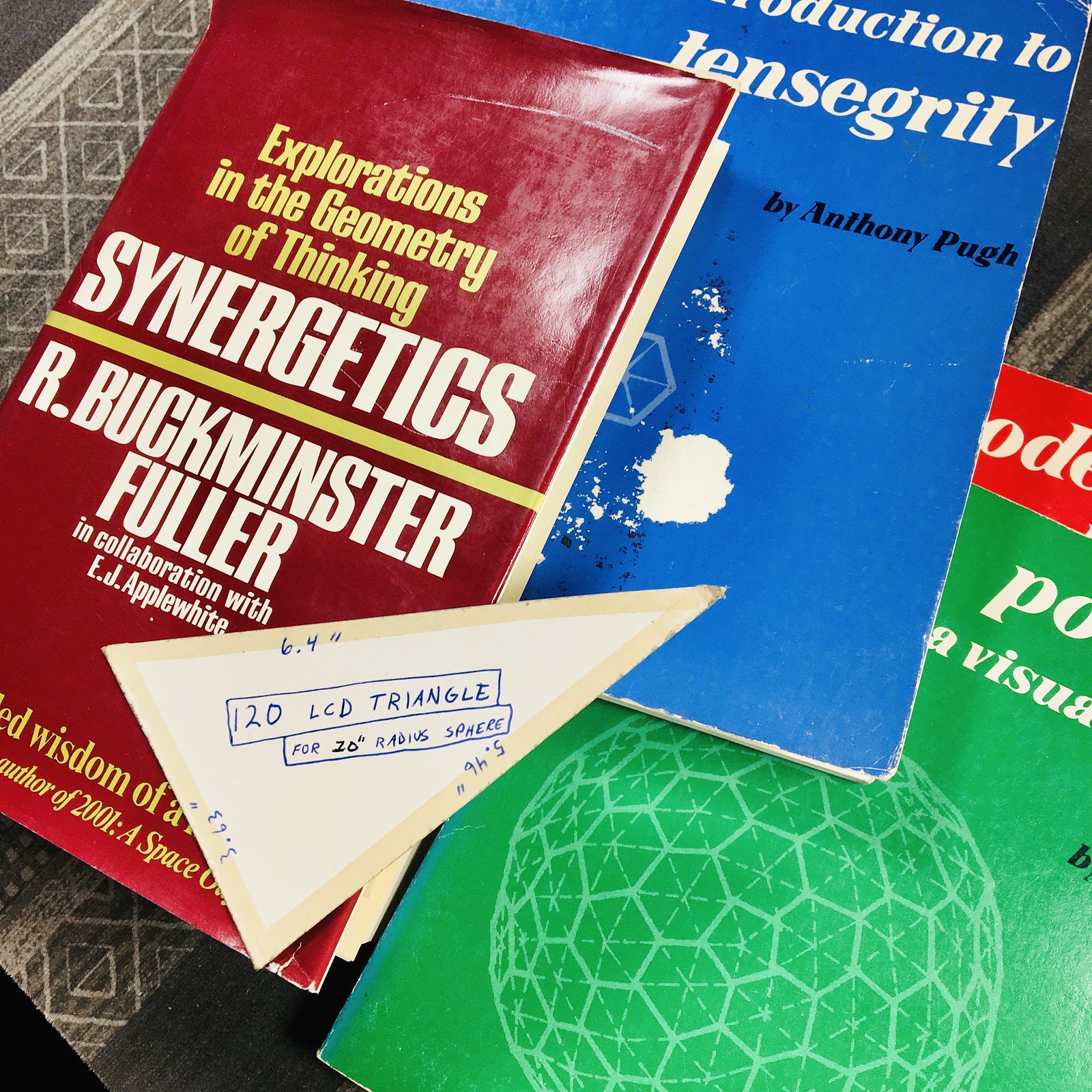
When I opened up my hardbound copy of Synergetics (which appears to be out of print, but is selling used on Amazon for a mere $967 - but rest assured, the softbound version is still available at a mere fraction of the cost!) I found a triangle of cardboard serving as a bookmark, at section 205.00 Vector Equilibrium, seen in the top photo of this piece, a template for making a 20" diameter geodesic sphere. I don't actually remember making such a model, but this triangular template is evidence that I pursued it to some degree, serving as further evidence of my infatuation.

Returning to the typewritten quote at the top of this article, I might be making more of these copy-typings in the near future, excerpted from Fuller's Synergetics, and other books. I've thought about submitting them to the One Typed Page blog of Daniel Marleau, but don't think they fit well alongside the more personal writings other people are sharing therein. So perhaps you may see in the near future more brief copy-typecasts posted here, though with less exposition than today's article, which you can be thankful for.

I've lived long enough that my childhood and young adults years seem to reside in a distant past far removed from the present. Inside this overweight middle-aged guy is Skinny Nerd, still yearning to be set free. Yet every once in a while, in the course of working on some project, I unearth an artifact that once again reminds me of the person I used to be. And those immature infatuations, though seemingly far removed in the past, continue to inform me in ways I've yet to fully understand, reminding me once again that the past, no matter how obscure, serves as preparation for the future.

The tabletop tripod video:


By the way, the title of this article is an allusion to another of Bucky's works, that is selling for a mere $245 used; and somewhere around this place I have that same copy.

Oddly enough, my wife has suddenly taken on a newfound appreciation for my clutter of dusty books.

Labels: , , , , , ,

Sunday, May 12, 2019

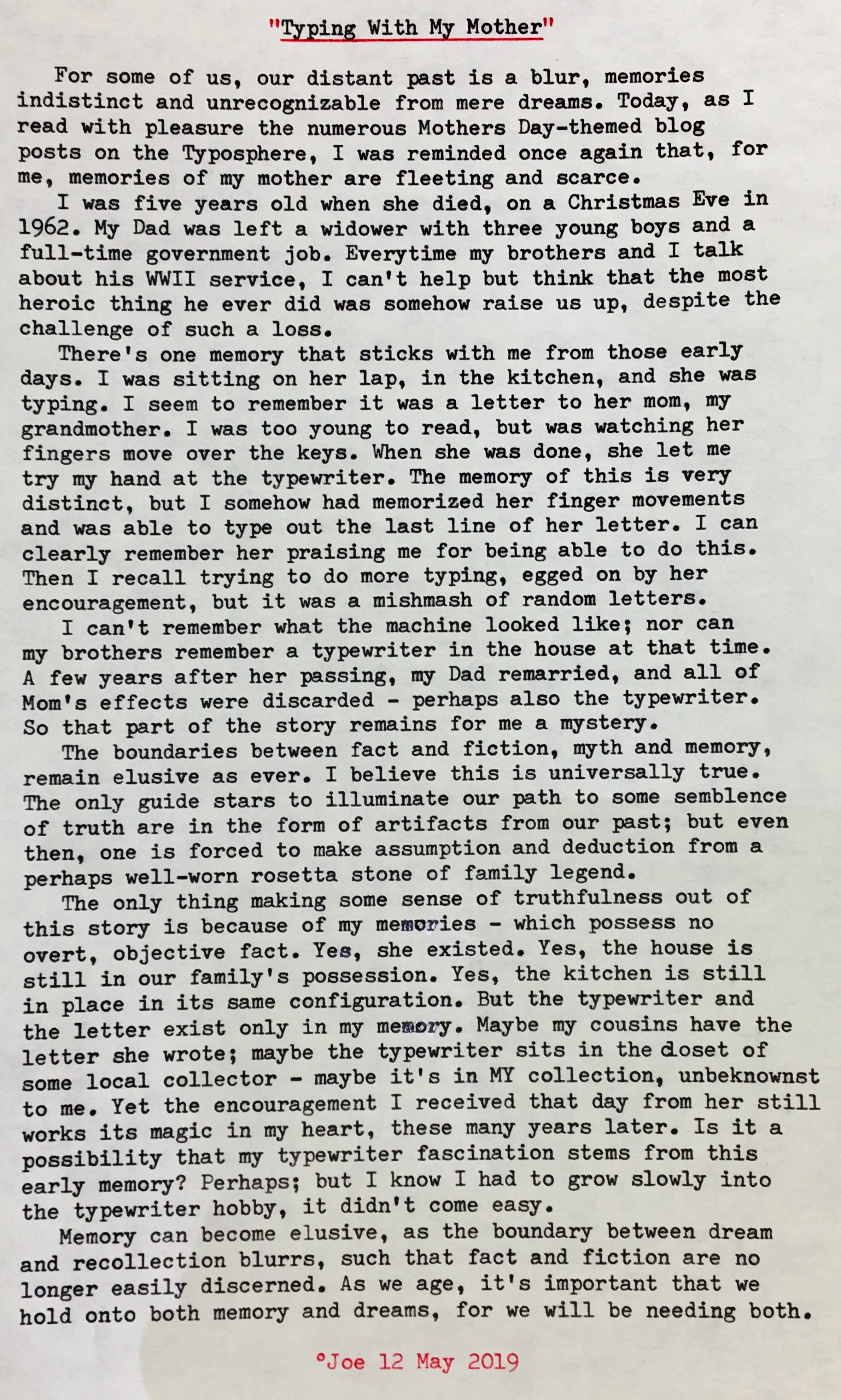
Typing With My Mother

P1140431
“Typing With My Mother”

Post-Script: Here's a photo of my Dad, sitting on a camel, taken during WWII in Egypt. He's on the right. On the left is his hometown buddy Dino Limore.
Dad_Egypt001a

Typecast via Olympia SG-3.

Labels:

Wednesday, August 01, 2018

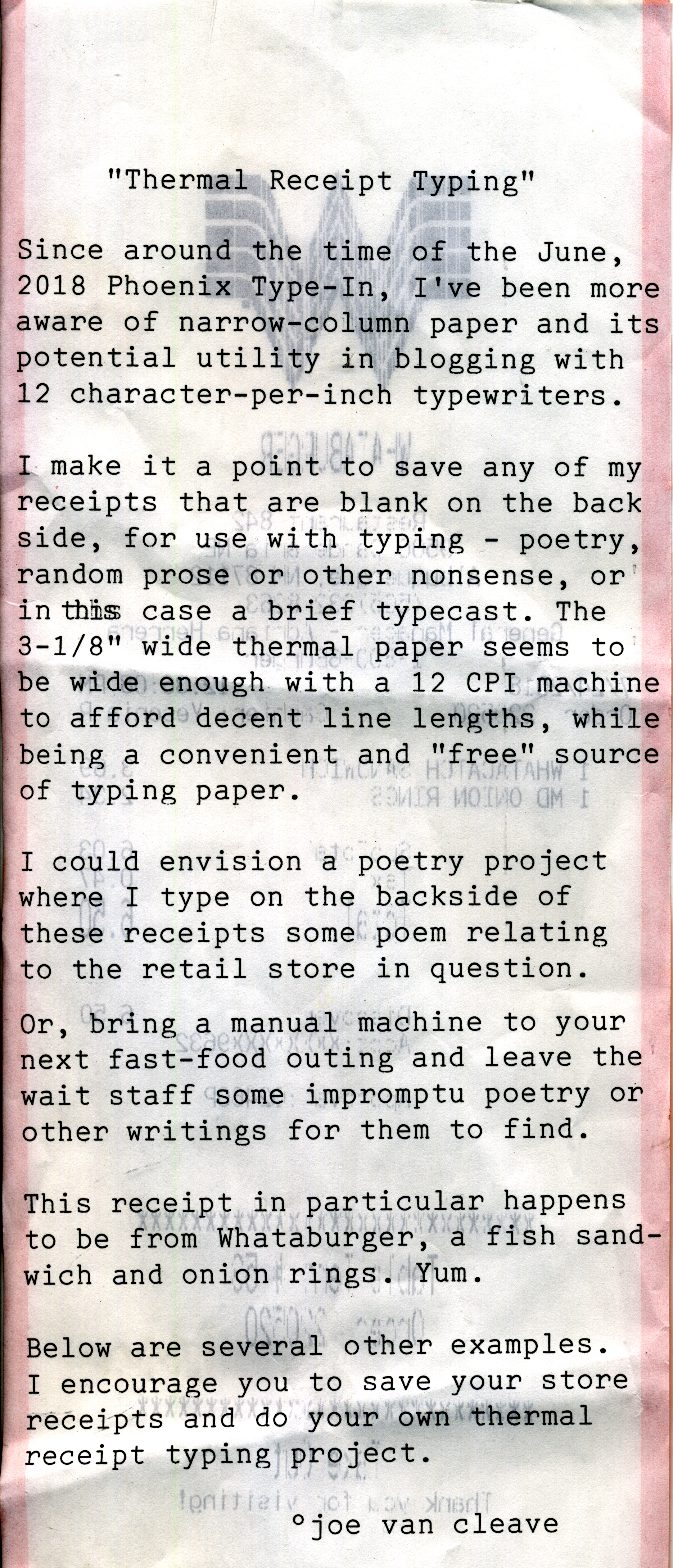
Thermal Receipt Typing

Typecast032

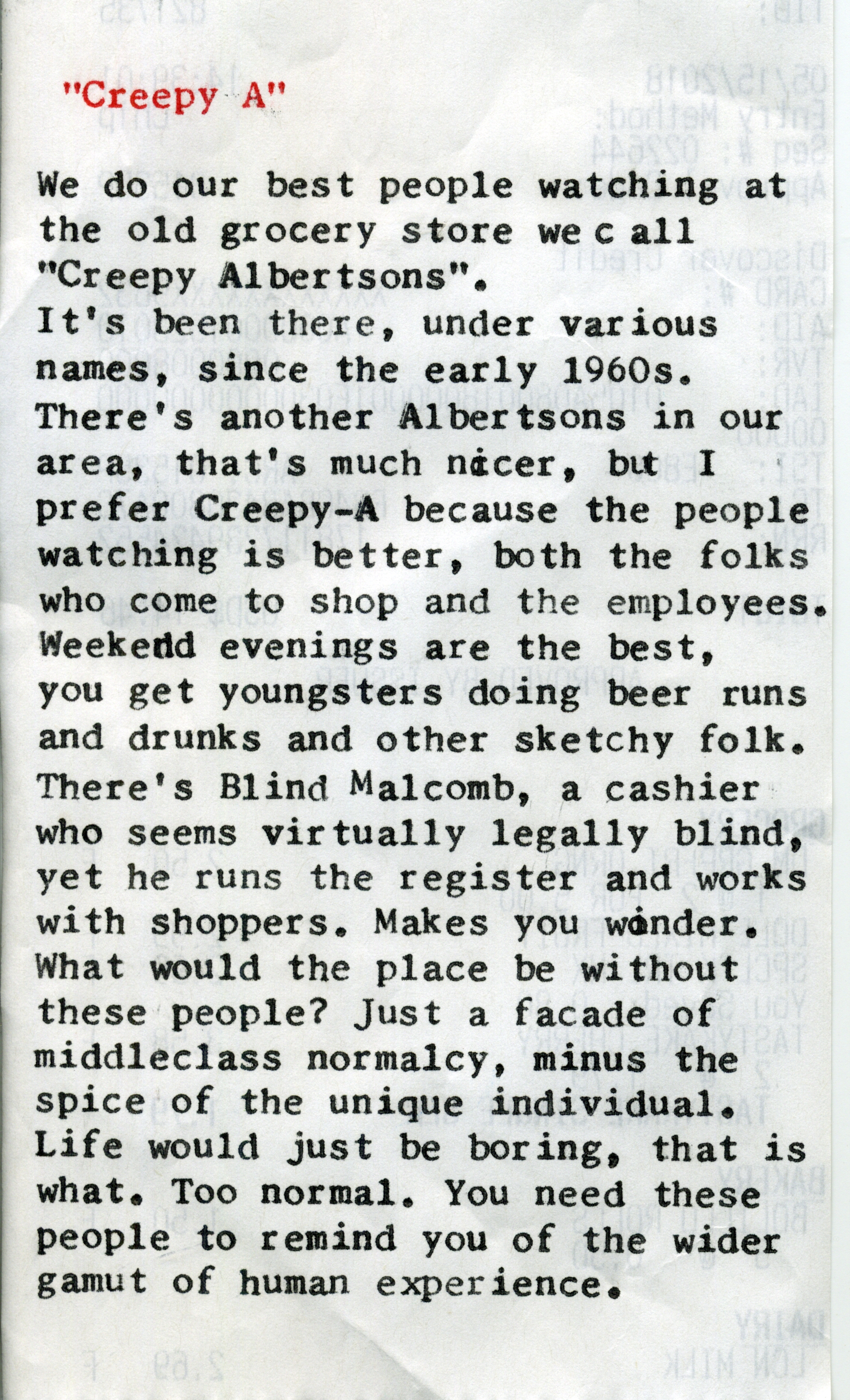
I've written previously in this blog about the old Albertsons grocery store down the hill from our neighborhood. It started out in the early 1960s as a Safeway and Skaggs drug store, then became Skaggs AlphaBeta, then AlphaBeta, then Furrs, then Albertsons, as the grocery store industry went through mergers and upheaval. In all of those changes, the store has remained its usual dingy self. There have been repeated attempts at renovation, but it was always done with the store still open, resulting in a perpetual sense of disorganization and clutter. Even today, it seems every month or so some seasonal change results in some category of grocery loses its shelf space and gets split asunder to the "end caps" of various aisles, making it hard to find things. Since many of the store's customers are older, you'd think it would be smart to keep things in the same location. But I keep shopping here because it's convenient, and I enjoy observing the clients and employees. A people watcher's paradise, for certain.

Typecast033

Besides the grocery store, the local library also gives receipts on 3-1/8" wide thermal paper. This one is from the Tony Hillerman library, formerly the Wyoming Branch, behind Hoffmantown Shopping Center in northeast Albuquerque. I've visited this library since I was a kid. Hang out at the library in the hot summer months (I was on foot or bicycle), with its cool air conditioning and cold drinking fountain, then walk across the street to Hoffmantown and have lunch at the Campbell Pharmacy. Conveniently, the book receipt gives room for a brief book review, this being the auto-biography of Michael Moore, which I enjoyed more than I expected. It also helps the aesthetics to have the receipt coffee-stained and wrinkled.

Typecast034

Since all these receipt were the same 3-1/8" width, it was easy to scan, keeping the left edges even on the flatbed. I like the way the front sides of the receipts slightly show through the thin paper.
Typecast via Olympia report electronic. Other receipts typed via Royal QDL (aka Adobe Rose).

Labels: , , , , , , ,

Monday, May 21, 2018

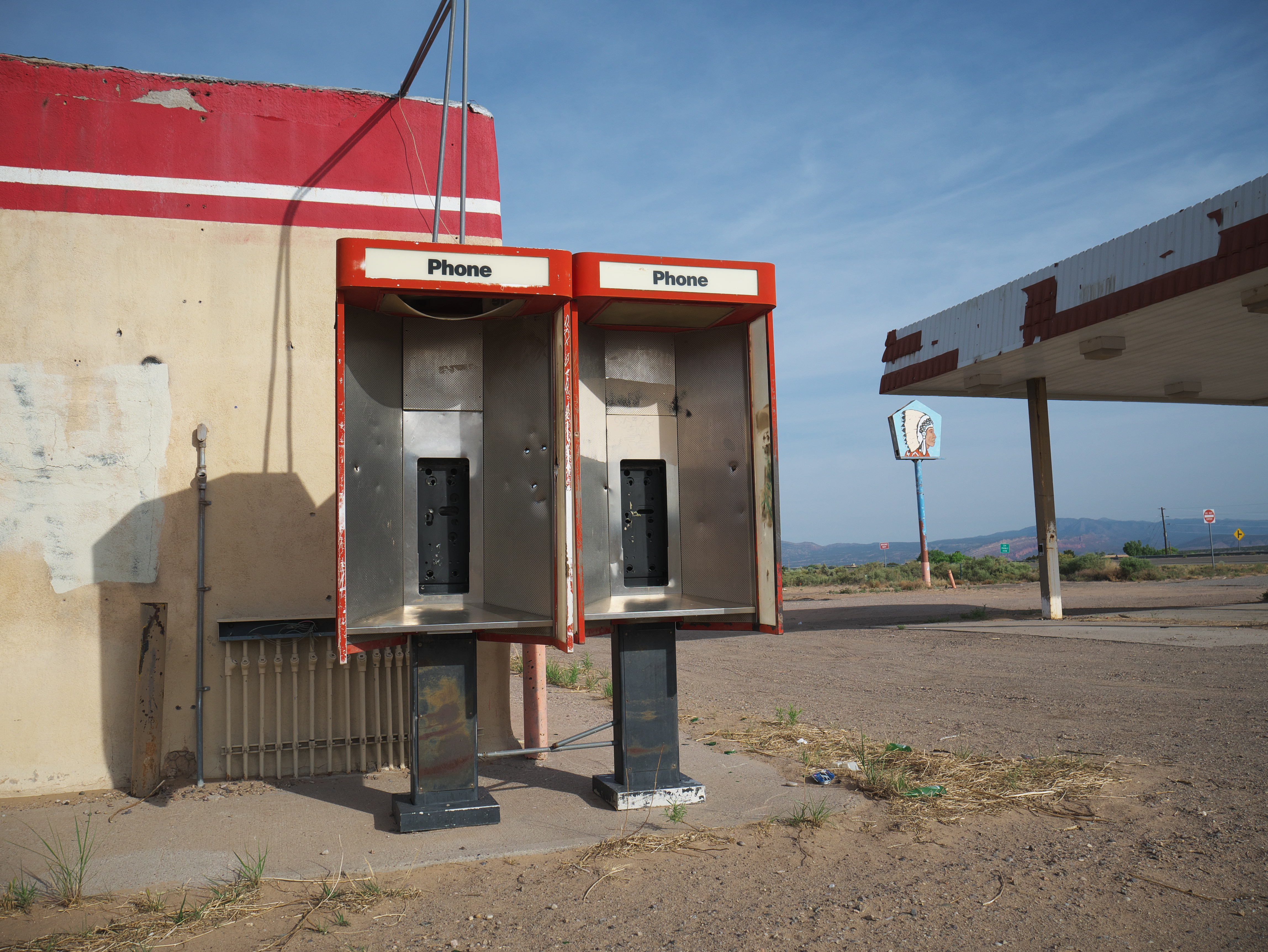
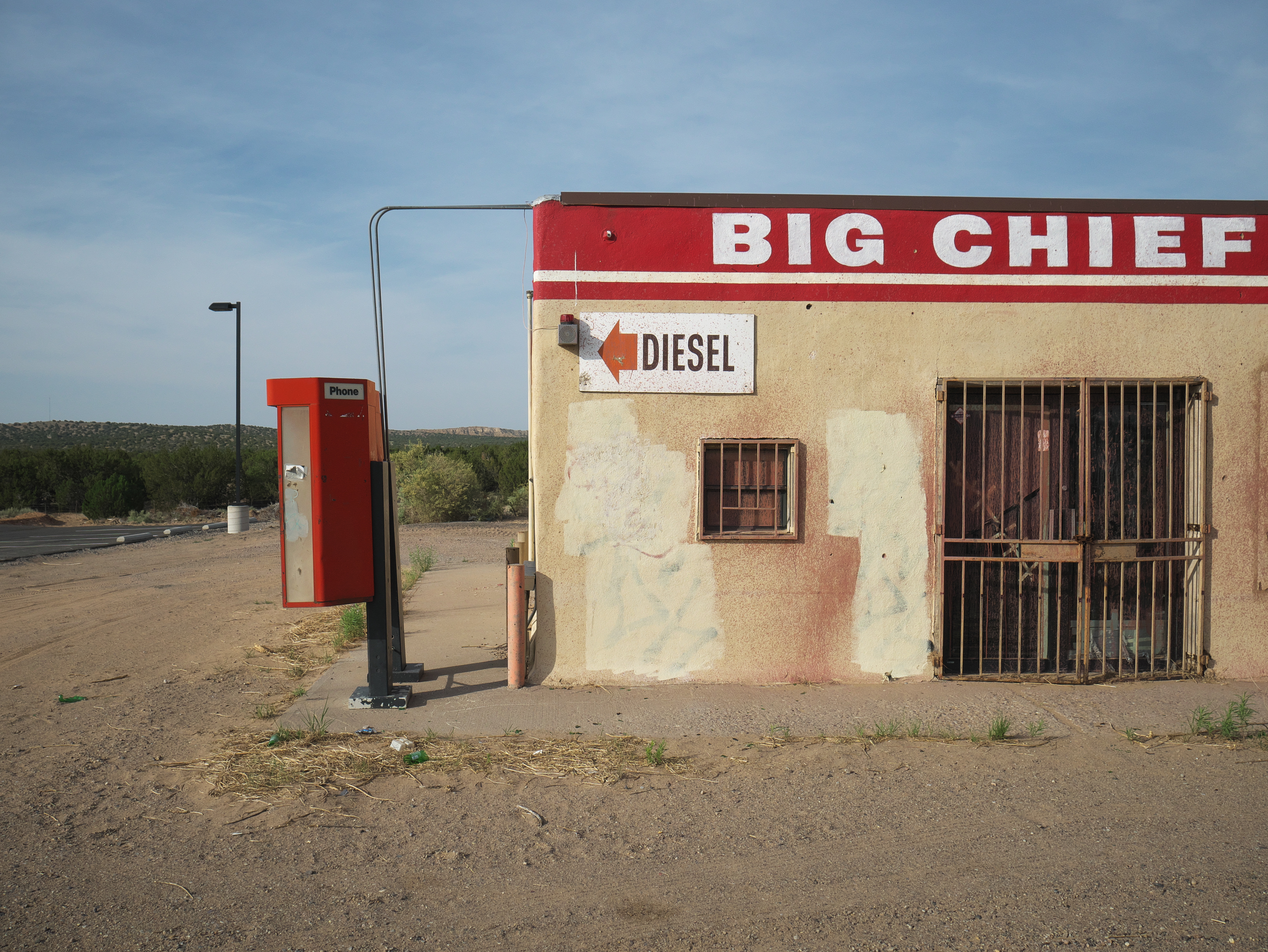
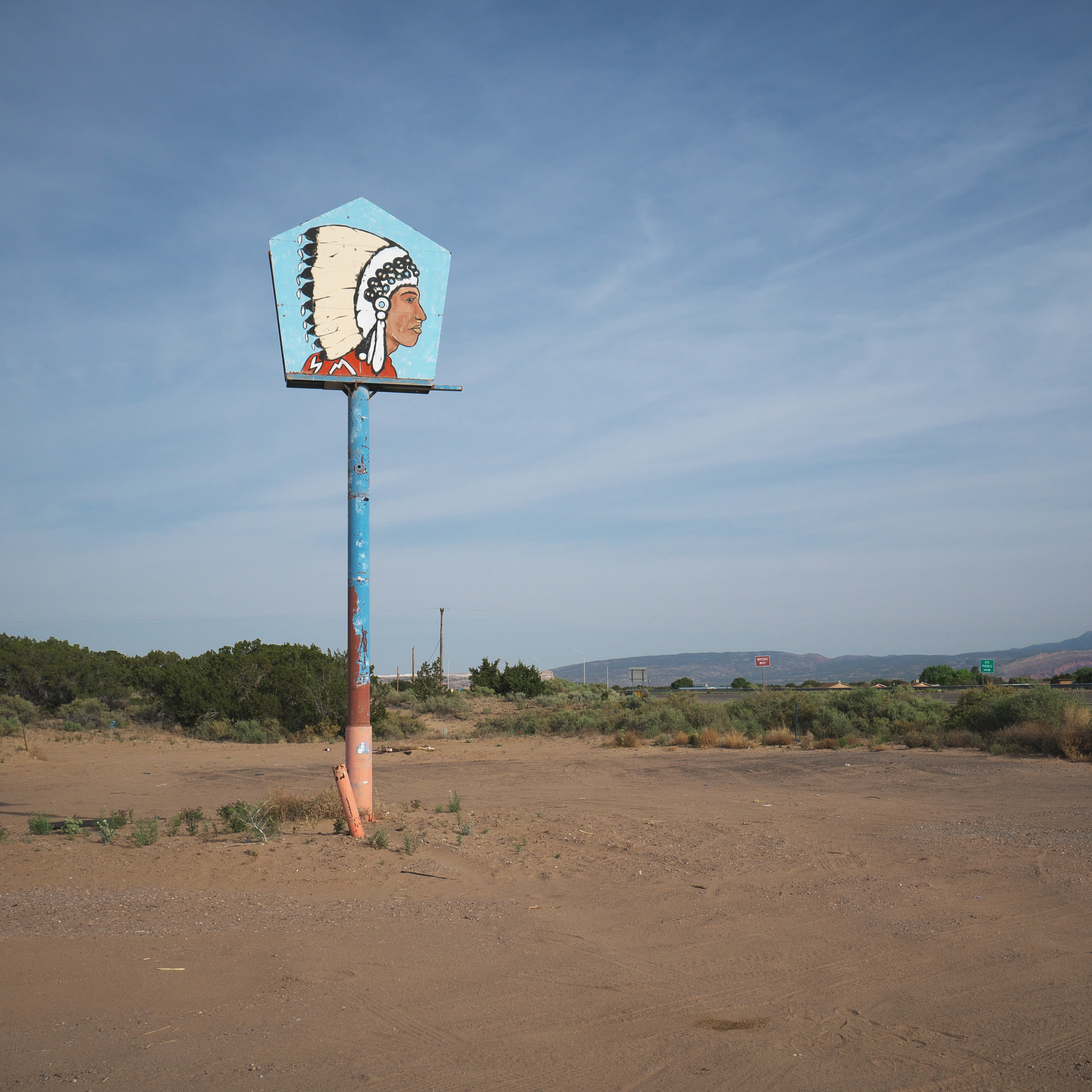
Big Chief Gas Station

P1010718
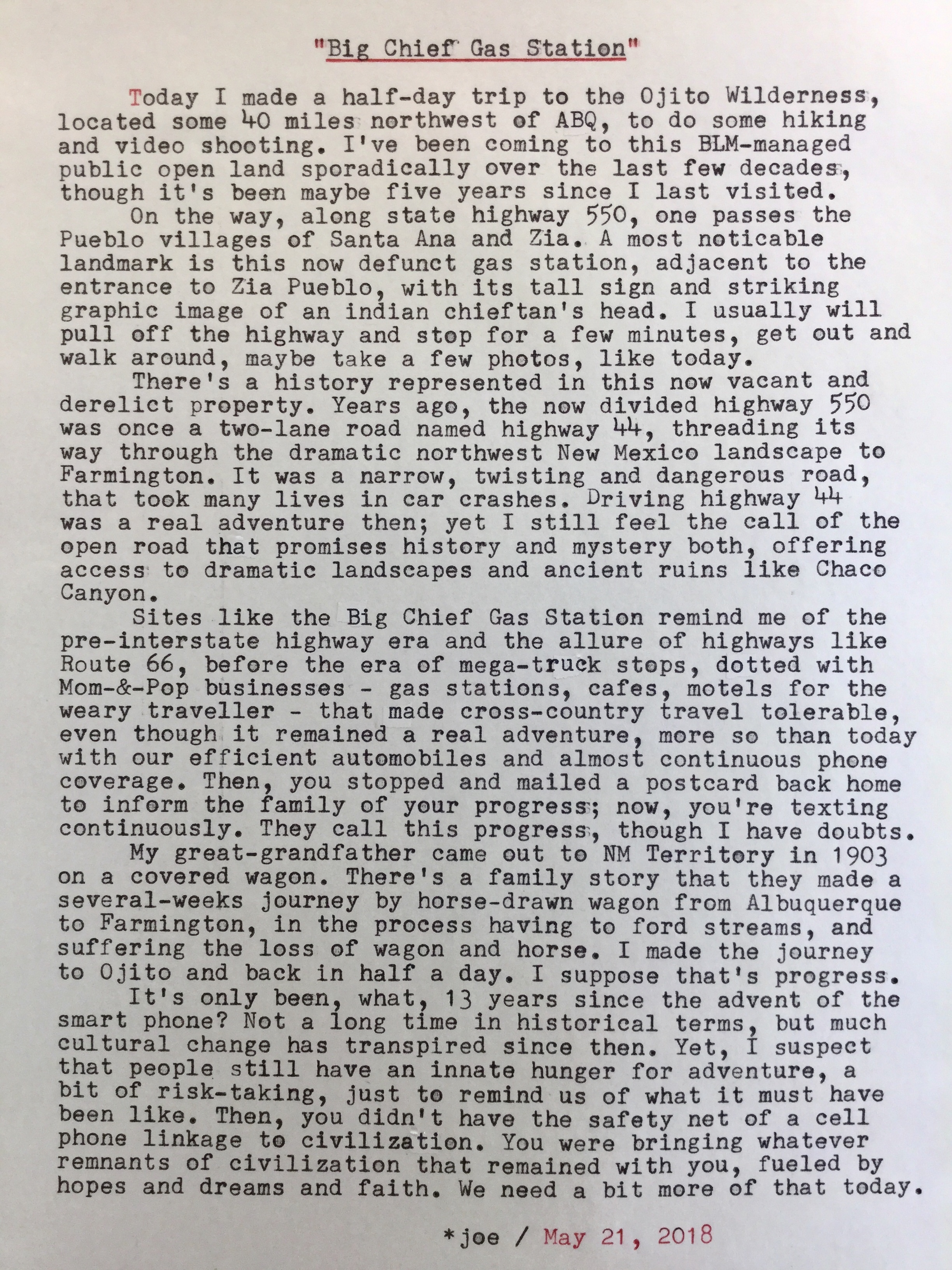
“Big Chief Gas Station”
P1010714
P1010711

Post-Script: Photos via Panasonic Lumix G7. I was also shooting video on my recently acquired Canon R800 camcorder. Yes, an actual camcorder. I'll be making a video about this soon. Here's the This is Not a VLOG video for today:


Typecast via Remington Quiet-Riter and roll of thermal fax paper.

Labels: , , , , , , , , ,

Monday, October 09, 2017

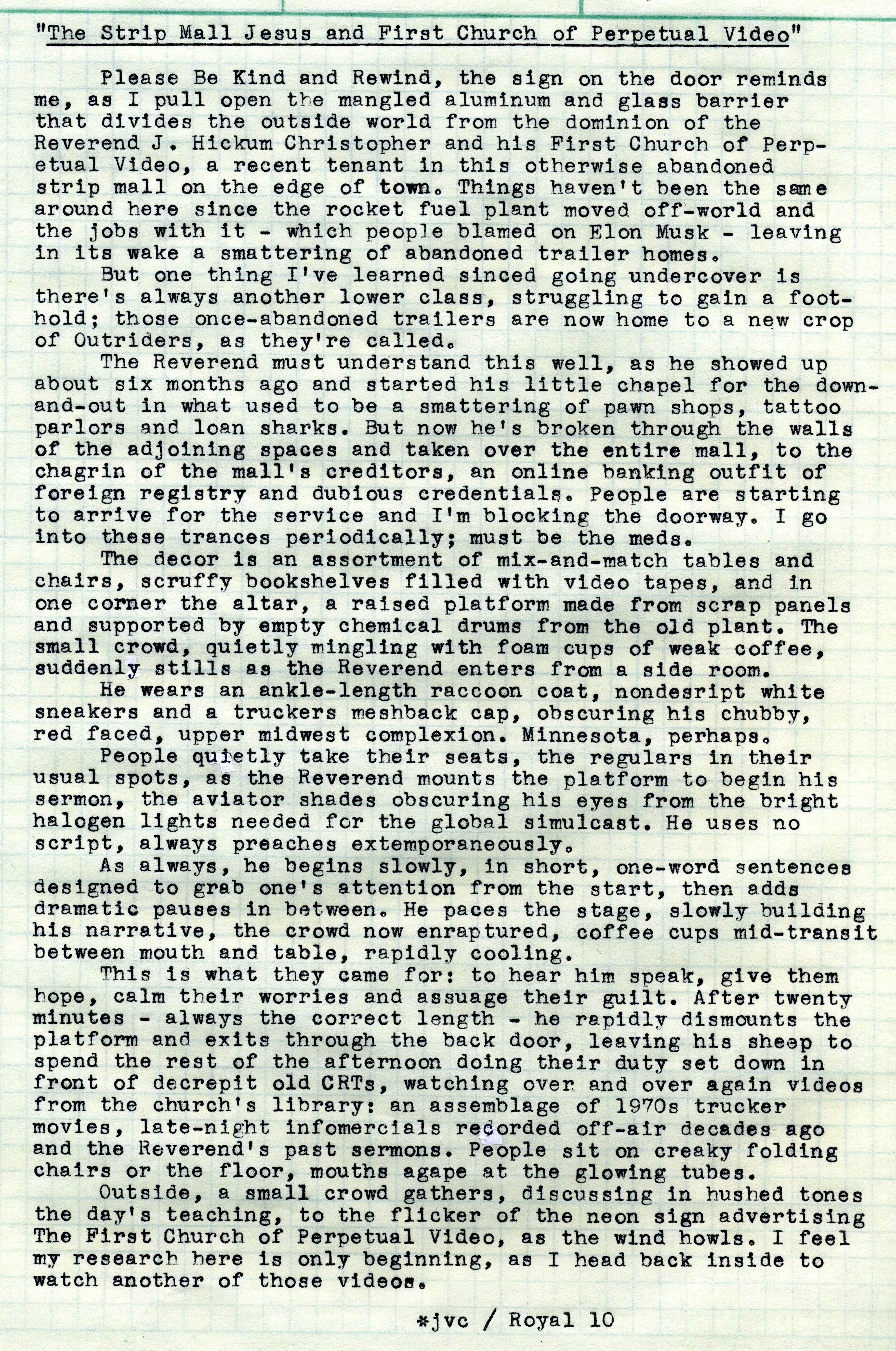
The Strip Mall Jesus and First Church of Perpetual Video

P1110320a
Typecast007

Post-Script: Inspiration for this short-short story, my submission for Typing Assignment No. 10, was from remnants of a dream I'd had, last week. It seems I've have episodic dreams over the years, set in the same or similar environs, that evolves over time as my life experience and employment changes. The dream I'm certain was based on a TV repair shop I'd worked in, decades ago, in a nearby strip mall, at the corner of Eubank and Menaul Blvds here in Albuquerque. While the owner of the shop wasn't exactly a messiah-type, mixed in this dream is also something to do with small storefront churches I've been in over the years.

Typed on my aunt's repaired-as-good-as-it's-gonna-get Royal 10, now situated on my office desk and ready to deliver back to Colorado, when I have the time and the weather cooperates.

How about you? Do you get inspired to write creatively from dreams? Perhaps this is another topic for the Typewriter Video Series. Hmm...

Labels: , , , , , , ,

Sunday, July 23, 2017

It Was a Dark and Stormy Night

Connie002a
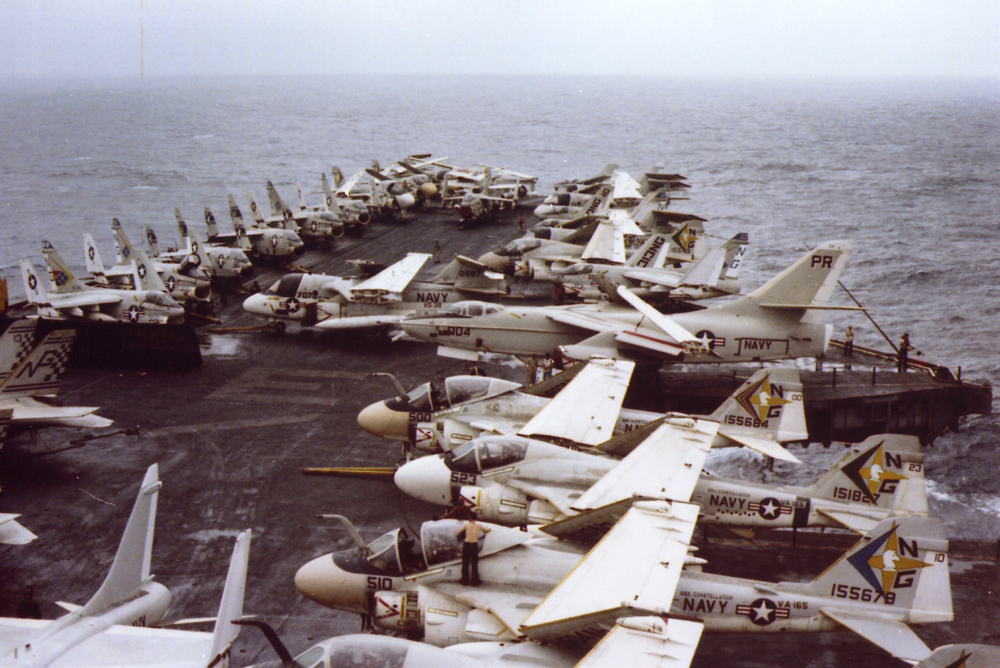
Haze-gray and underway

Typecast001

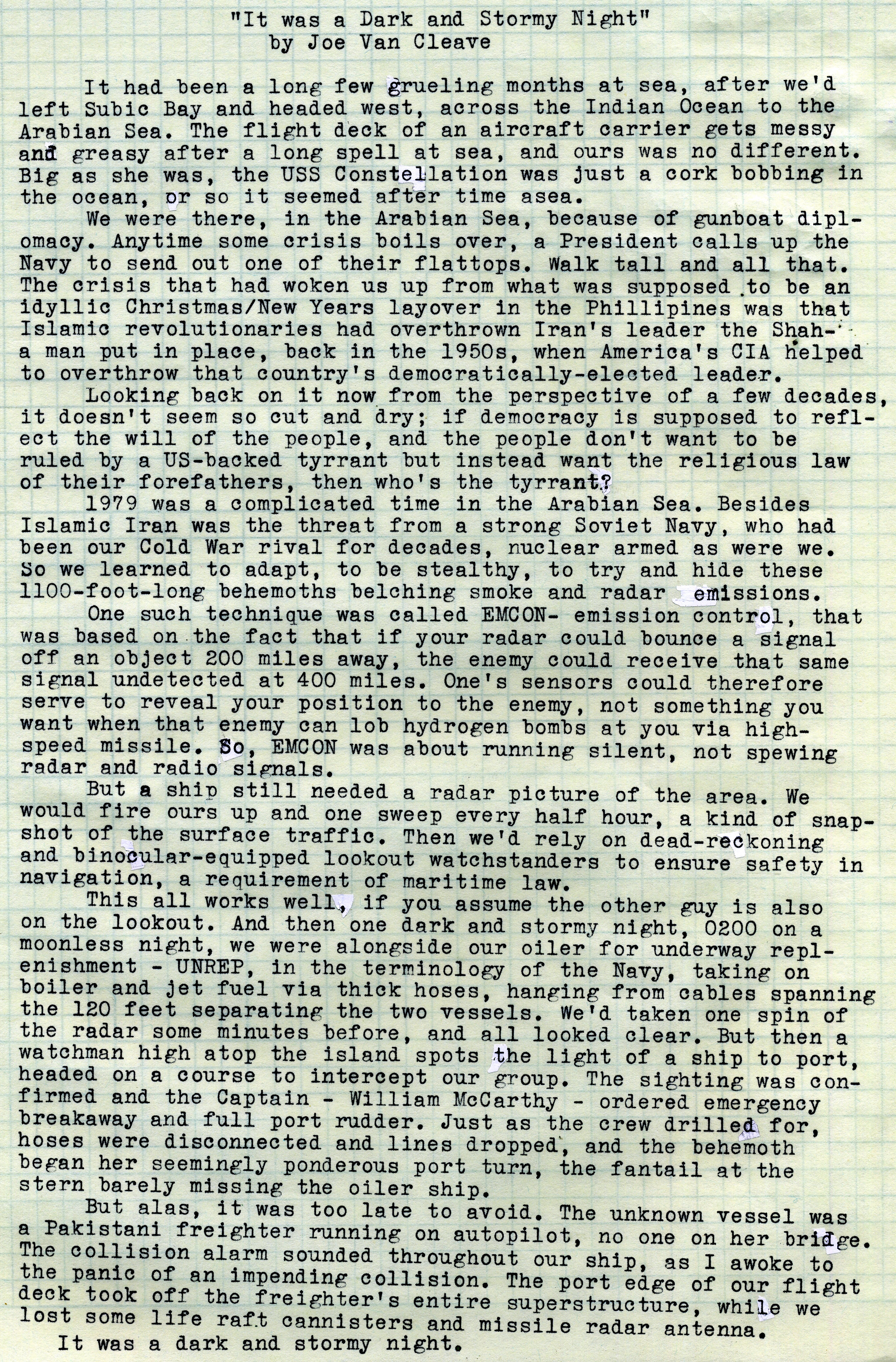
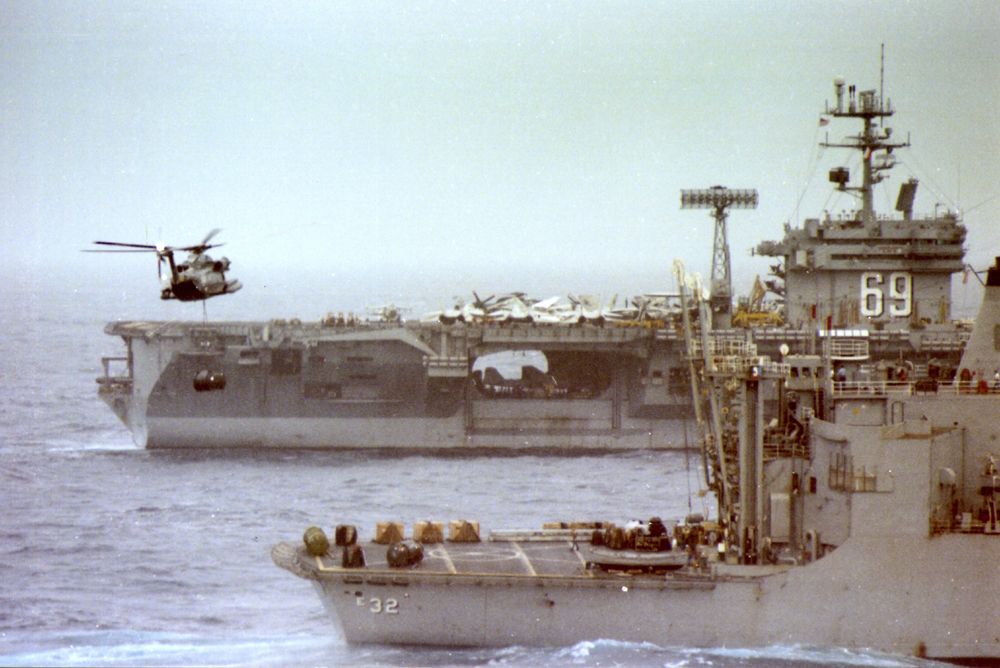
Post-Script: As it turns out, we had attempted to radio the Pakistani ship on an international hailing frequency prior to the collision; they responded but only too late, and attempted to navigate the gap between what they thought were the lights of two smaller ships, but was actually the darkness between our bow lights and superstructure. Despite their size, it seems you can hide an aircraft carrier, in the glum of a dark and stormy Arabian Sea night.

Subsequent to this event, the US Navy installed a navigation lighting mast on all its carriers, a tall pole fixed to the starboard catwalk between bow and superstructure, to serve as a visual indication that this is one huge ship, not two smaller vessels.

The freighter ship ended up being towed back to Karachi via US Navy oceangoing tug, and financial recompense was made. Our port Terrier missile radar antenna was retrieved from the deck of the freighter. The four-foot hole in our ship, high above the waterline and just below the flight deck, was merely a superficial wound; we remained at sea for several more weeks before turning east and returning to Subic Bay for repairs.

Captain McCarthy, one of the best skippers I served under, it is said didn't make the rank of Admiral because of this event, but did become a Commodore and served as head of the Naval Academy. His voice can be heard if you tour the USS Midway museum, in San Diego bay.

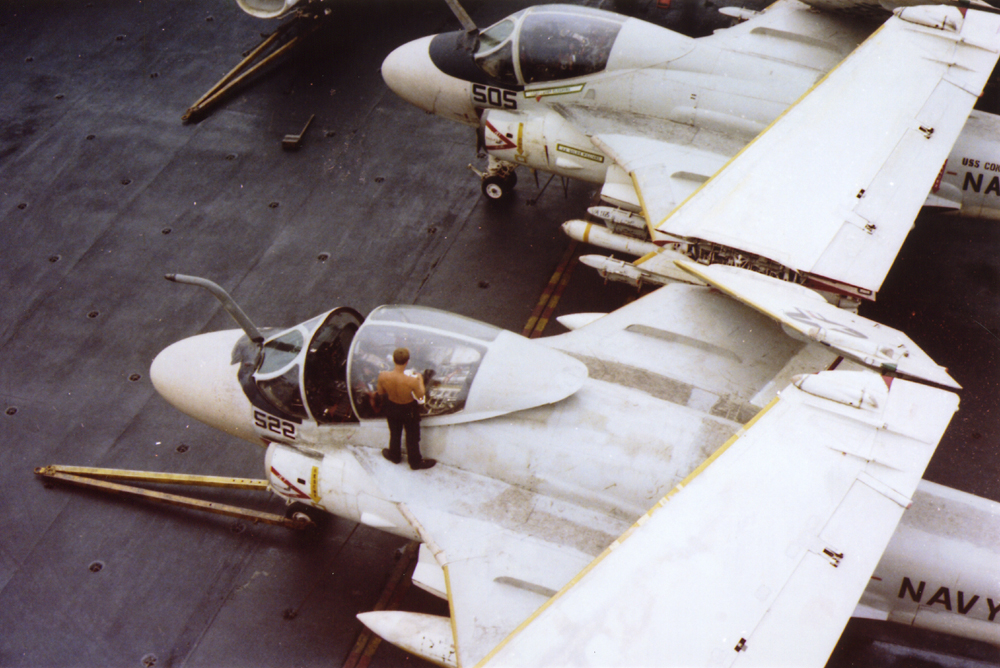
If you visit little old landlocked Albuquerque, you should visit the National Museum of Nuclear Science and History, formerly know as the National Atomic Museum and once located, prior to 9/11, on Kirtland Air Force Base. In the parking lot of the museum you will see a blue and white Terrier Missile launcher. This is because these systems were capable, as was the Connie's, of being nuclear armed. At the time of the collision, it was said that the Connie's was the last nuclear-certified Terrier system left in service. These employed a W30 1kt nuclear warhead and had a range of something like 40 nautical miles; designed in the atmosphere of nuclear idealism in the mid-1950s, before the advent of ICBMs, when it was thought that virtually every conventional tactical weapon could be nuclear armed. That was a different time.

Today, sold to a salvage company for $1, the Connie is being cut apart for scrap metal in the Galveston shipyards, while the governments of the United States and Iran remain at odds over their respective views of national sovereignty. Meanwhile, events like these that transpired during those long, dark nights of the Cold War remain but sea stories old men tell their grandkids.
Typing assignment via Underwood Portable, a newcomer to my collection.

Connie003a
Connie005a

Labels: , , ,

Wednesday, February 01, 2017

3D Line Mazes

1-31-2017001
(Click to embiggen)
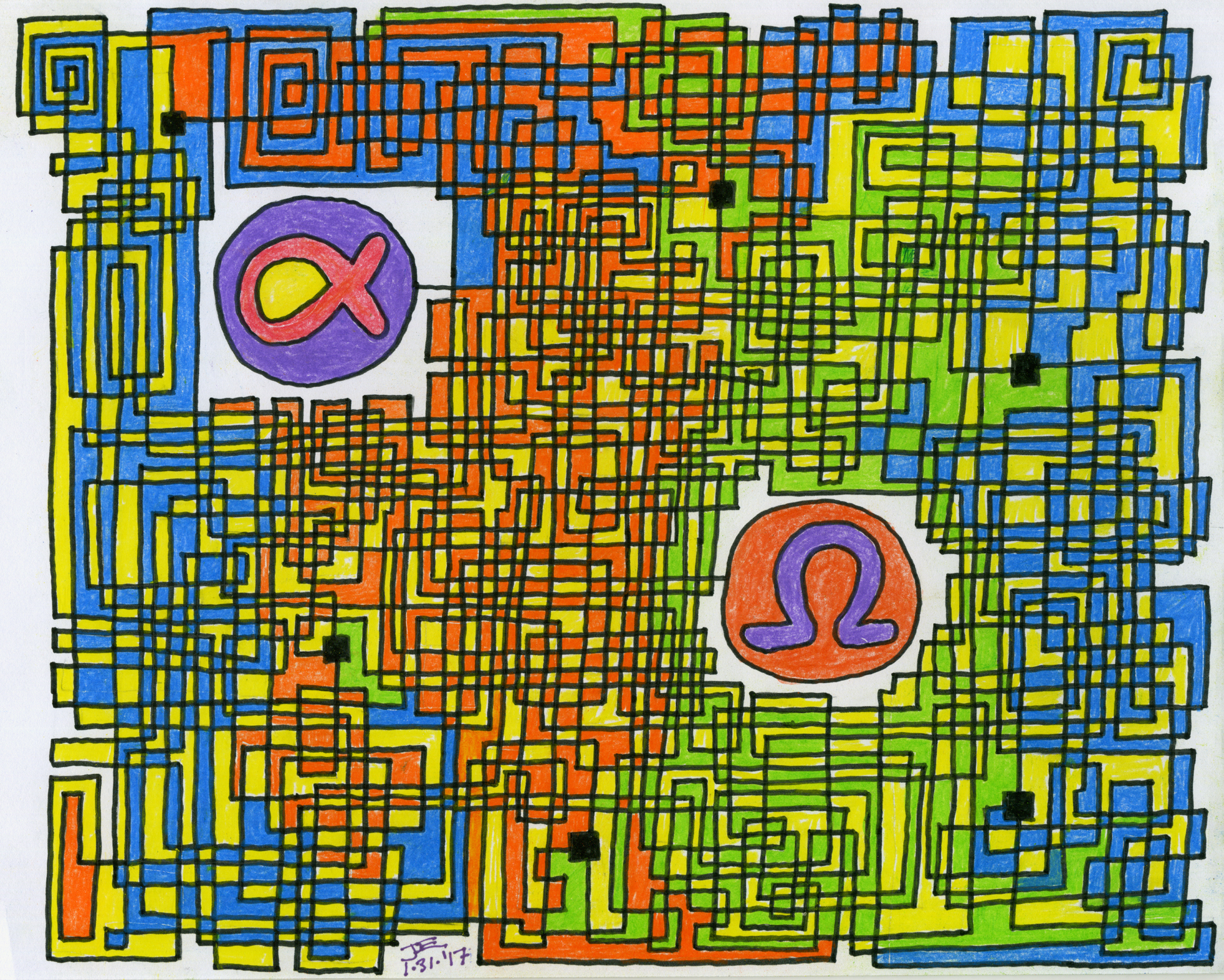
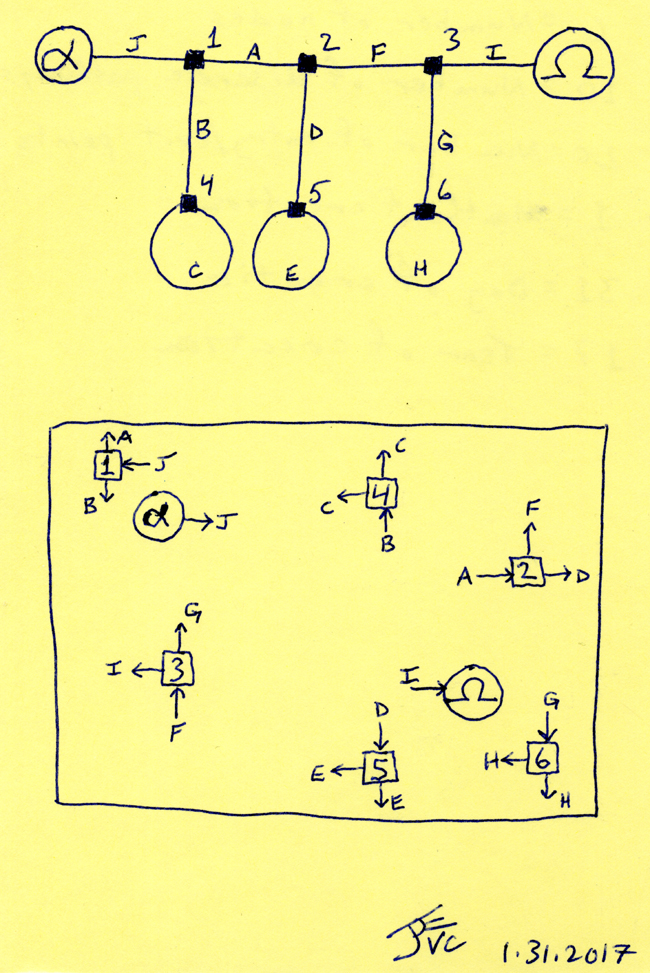
Follow the lines themselves, from Alpha to Omega. They cross over but don't connect to any other line except at the large square nodes. A line goes straight until it makes an elbow bend.

It's strange how events that transpired long ago in one's life can leave a lasting impression. That's the case here, and the reason why there's a colorful, hand-drawn maze adorning this blog posting. Permit me to spin a yarn.
It's the spring of 1971 and I'm several weeks from graduating 8th grade middle school when I come down with a bad intestinal flu. I'm home-bound for several weeks, missing the end of 8th grade, and the illness isn't getting any better. Then one day the pain begins, and gets worse and worse. Finally my dad drives me to the hospital and we find out I have a ruptured appendix that is badly infected with gangrene and peritonitis. I go into surgery an hour or two before dying, or so says my surgeon, Dr. Goddard, a relative of the famous rocket scientist. The hospital was Lovelace Clinic at Bataan Hospital, the same place the Mercury 7 astronauts underwent their pre-flight testing.
I'm in the hospital for several weeks before being sent home, during which I get rather used to the nightly morphine shots administered by the pretty nurse; by now I'm age 13 and already beginning to notice such things. The doctor advises me to take it easy during the summer recess and to not go out for sports that next school year; this decision has a life-long effect upon me being non-athletic.

So what's a kid to do? Hang out at the public library, that's what. Read up on interesting subjects; some that will end up holding my interest throughout my adult life. One of those topics was mazes, and I read every book I could find on the subject.

During that long, lazy summer I began to draw a maze on a sheet of notebook paper. When I filled the page I realized the maze was far from complete, so I taped on another sheet and continued. By summer's end it was done, a scroll of paper about 8 feet long containing blue Bic cristal inky pen lines of swirls and whorls. I'd figured out this graphic design element of double- and triple-spirals, where a pathway leads into a vortex, at the center of which is a decision point node that spins its way back out, only to connect to more such vortices.

Proud as I was by the maze, I had opportunity to show it off in a 9th grade class where our assignment was to "show-and-tell" what we did over the summer vacation. Naturally I didn't want to tell about my illness and resulting operation, so instead I brought The Scroll Maze to class. Much to my chagrin, the teacher demanded that I prove, right then and there, that the maze actually worked, otherwise I wouldn't get credit for the assignment. So I spent the rest of the class ruining my maze with the pencil line tracings of my route from start to end.

I was so incensed by having to ruin my maze that I tossed it out when I got home. Of course, in retrospect I now wish I hadn't. But that maze-drawing experience stuck with me. A few years later, while in military service, I began collecting maze books. One such book was the classic Dover Publications edition of "Mazes & Labyrinths - Their History & Development" by W.H. Matthews, a thorough, historical analysis of mazes ancient and modern.

The book that changed my understanding of maze design was Greg Bright's "The Great Maze Book," which introduced to me the idea of what he called "one-way valving," a topological method of steering the subject away from the correct path, so as to make it as difficult as possible.

I eventually came upon my own method of drawing mazes, what I call "line mazes," meaning the pathway to follow is the line itself, rather than the space between lines, as in a normal maze. Then I realized that the maze could be rendered in 3D if the lines were permitted to cross each other without connecting; actual connection nodes were explicitly drawn so as to reduce ambiguity. The final topping on the cake came years later when I realized that a finished 3D line maze could then be colored, Mondrian-style. The result is what you see at the top of this article.

I'd first advise you to click on the image for a larger rendering, as the 650-pixel wide default image is a bit too small. Follow the maze from Alpha to Omega. Or you could try it backwards, but there's no advantage in doing so. And mazes can be designed to purposefully foil those who try working them backwards. Because us maze designers can be a cruel lot.

Follow the lines themselves. They cross over but don't connect to any other line except at the large square nodes. A line goes straight until it makes an elbow bend. You can appreciate the colorful graphic design on its own merits, but there's no hint or clue to the solution given by the colors themselves.

I've included below the schematic diagram for the maze's solution, along with a template map that labels each node and the corresponding letters associated with each path entering or leaving the nodes, as an aid in the puzzle's solution.

I designed the maze by drawing the schematic diagram first. You'll notice there are no dead-ends in this design; instead, I use loops, where a path exits a node (such as path "C" from node 4) and later reenters that same node. After designing the schematic I then laid out the location of all six nodes, then began drawing the lines themselves.

When designing the maze it's all too easy to crowd the lines together too closely early on such that later on, toward the end, it's more difficult to finish. I've thought of ways to prevent this, such as using an under layer of grid paper and assign each segment of the maze its own portion of the grid. For example, this maze has ten discrete pathways (count the lines connecting the various nodes). So using engineering grid paper that has a major grid in bold lines divided into tenths, each pathway would be drawn such that its lines stay on only its portion of the grid; i.e. pathway 3 would only be drawn on the grid lines three spaces over from the major lines, etc.

The result would be a more homogeneous design, with the lines more evenly covering the canvas and each path segment geographically encompassing more of the entirety of the page; with conventional 2D mazes, you'll often find pathways limited geographically to certain areas of the layout, which can give the solver clues to the maze's solution.

It's also possible to use a graphic design program and make the lines absolutely straight and true; whereas in this maze it's pretty obviously hand-drawn and colored with Prismacolor pencil.

Regarding the "one-way valving" principle of Greg Bright, he never actually explained in his books how this works, but I figured it out by assuming that when the solver reaches a node the decision of which branching point to take is made at random; thus, probability theory can be employed in the maze's design.

In this example maze, one-way valving would be evident if I had made nodes 4,5, and 6 with four branches instead of three; when entering node 1 the solver would have a 50% chance of choosing the correct path to node 2; but if he makes an incorrect choice and heads to node 4, then he only has a 33 1/3% chance of getting out of node 4 back onto the correct path. So probability can be used to steer (or "valve") the solver away from the correct path, by making it easy to wander off the correct path and harder to get back on. Just like as in real life.

I also figured out a difficulty rating system for these mazes, involving the odds of solving the maze first time with no backtracking, by multiplying the odds of choosing the correct path through each node. In this example maze, the chance of threading nodes 1, 2 and 3 first time with no backtracking is 1/2 x 1/2 x 1/2, or 12.5%. The lower the number the harder the maze.

Another design concept involves multiple correct routes from start to end, instead of just one. This maze is a classic example of there being only one correct solution path. But suppose the schematic diagram were more like a grid instead of only one correct route? The start could be in the upper left corner of the grid and the end in the lower right corner, for example; most of the nodes would each have four branches; or the sides could be wrapped around to the opposite, so every node has four branches. There wouldn't be just one correct solution through the grid, but many. And no dead-ends or loops. Would that make the solution easier? Perhaps; or, it could also make it more difficult, since it would be easier to get tied up in the complexity of connectivity and never reach the solution. Given my limited mathematical background, I have no idea how to determine the probability rating for solving such a multi-solution design. But these were the kinds of thoughts that kept me preoccupied all those years.

There are ways to make these mazes fiendishly difficult, besides employing one-way valving. For example, take advantage of the propensity for people's eyes to wander off the correct line. Surround the correct path with other lines that don't connect anywhere else but form an isolated, dead-ended loop; once your eyes mistakenly cross over into this nether region, woe betide you, you'll never get out without starting over. And the more graphically complex the maze, with lines drawn tightly together, the more likely you are to slip up. These kinds of graphic features are difficult to model mathematically. My triple-spiral graphic method from long ago was one such technique that can be used in this manner, since while threading the spirals it's all too easy to skip over a line into a neighboring pathway.

I'm interested in these mazes as much for their graphic design potential as for their connectivity as puzzles. This example maze is not great art, nor is it particularly complex as a maze. But it does introduce you to my idea of 3D line mazes, which I may share with you once again, the next time I find myself sitting at the kitchen table late at night for hours on end when I should be in bed. I also have a number of mazes from long ago, which might find themselves herein.

Post-Script: Here's the solution to the maze, including the schematic diagram and the location mapping of the nodes. Have fun.

1-31-2017002

Labels: , ,

Sunday, January 15, 2017

The Joe Show?

P1120527a
Typecast271

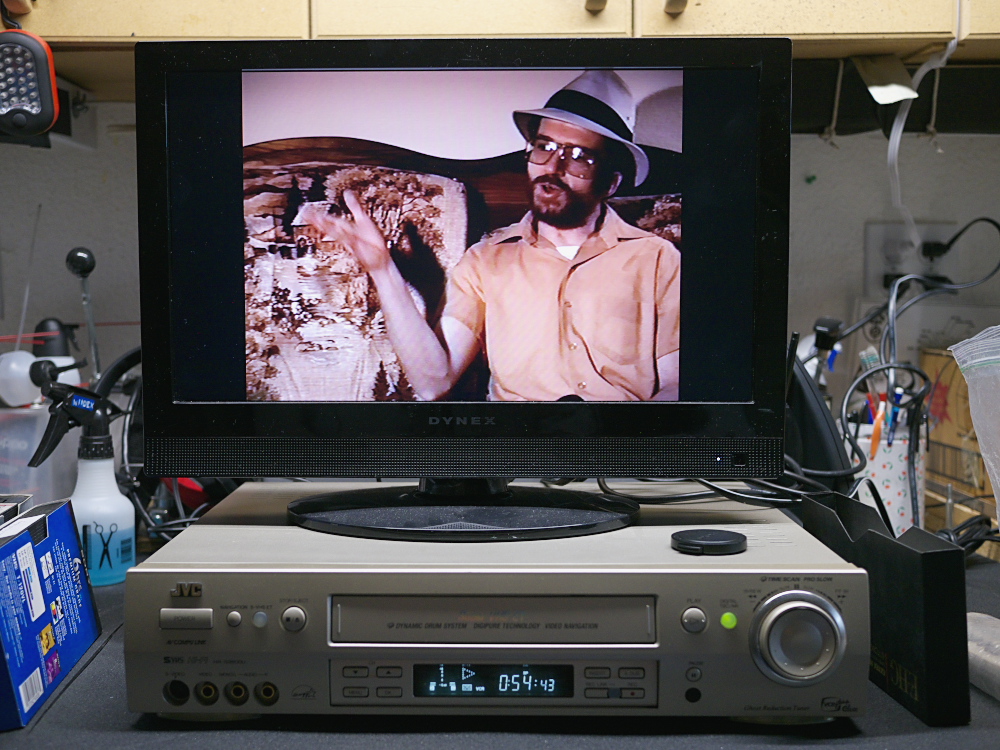
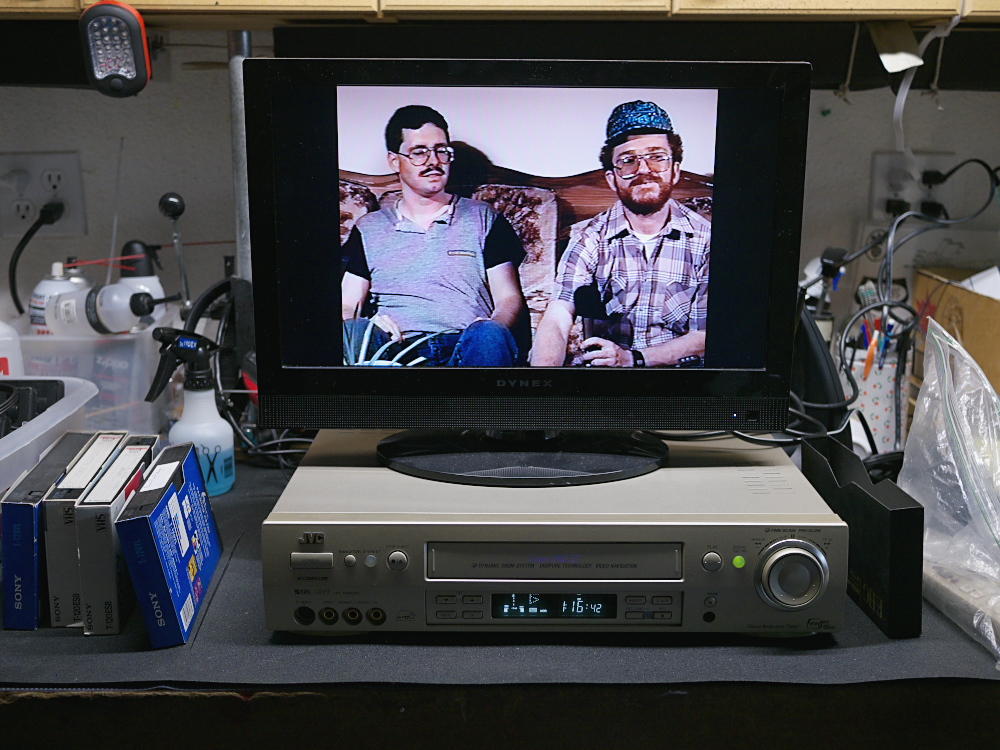
Post-Script: See the screen shot in the top photo? That's from a frame grab of a VHS tape compilation of The Joe Show, circa 1991. Was I actually wearing a salmon-colored shirt? And what's the deal with that funky hat? And those glasses ... I've seen better looking safety goggles. Boy do I remember that old couch. I think it was from Country Dan's. Massive wooden construction. Country-motif pictorial illustrations on the cushions - that never stayed put, always slid down and fell behind the back frame of the couch (notice the cushion behind me has already slipped down) and had to be continually adjusted. I was also a lot skinnier back then; so was everyone.

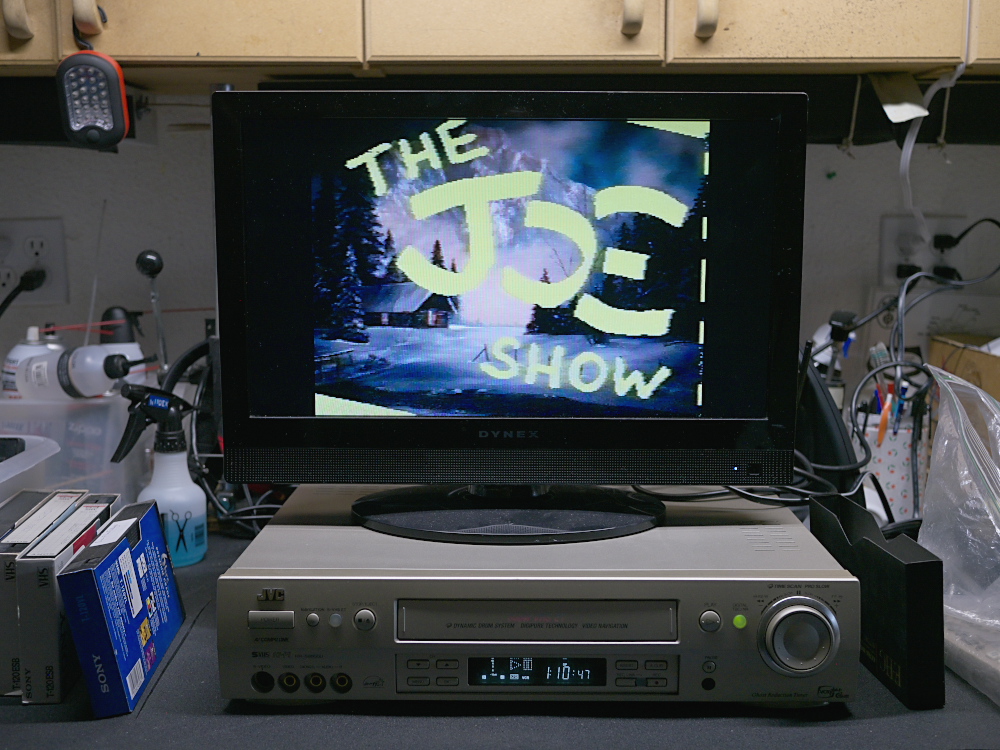
Here's more Joe Show goodness. First one of the intro graphics. My old Canon Hi8 camcorder had a feature called "matte," permitting you to take a matte shot of something, in this case hand-written titles, and overlay them, in a selection of colors, atop live video. Here the background was a Christmas greeting card.

P1120530a

Next is from a different episode, me in a different shirt and hat (what the heck's the deal with the hat? And why does it look too small?) with my friend Bob, a co-conspirator. Notice the handheld microphone, which I still have to this day.

P1120532a

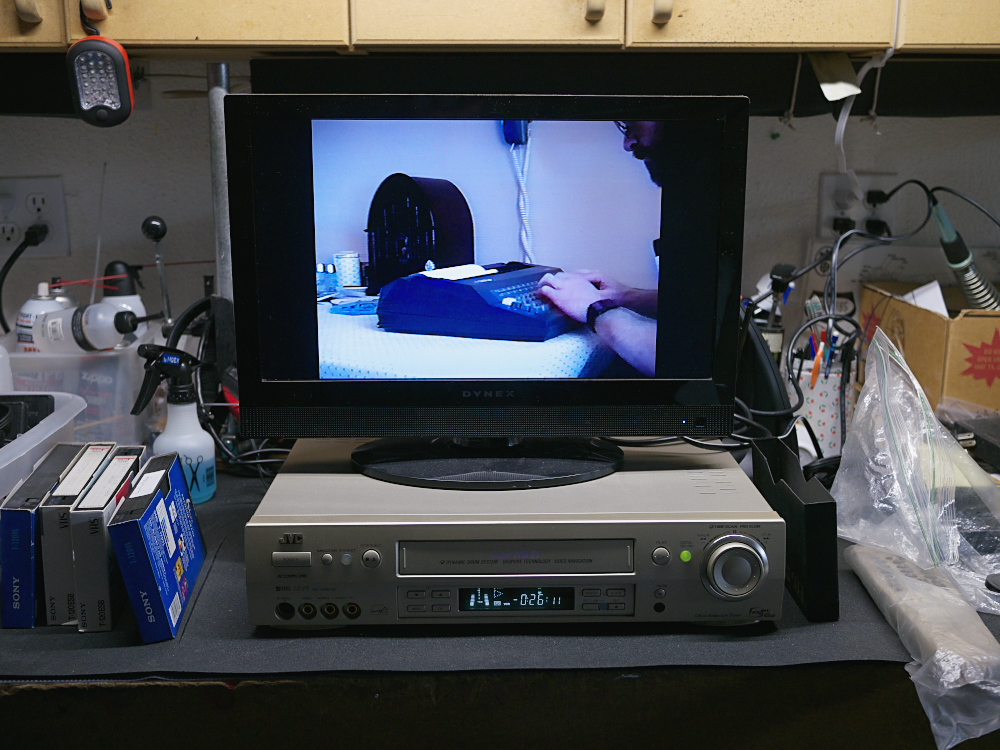
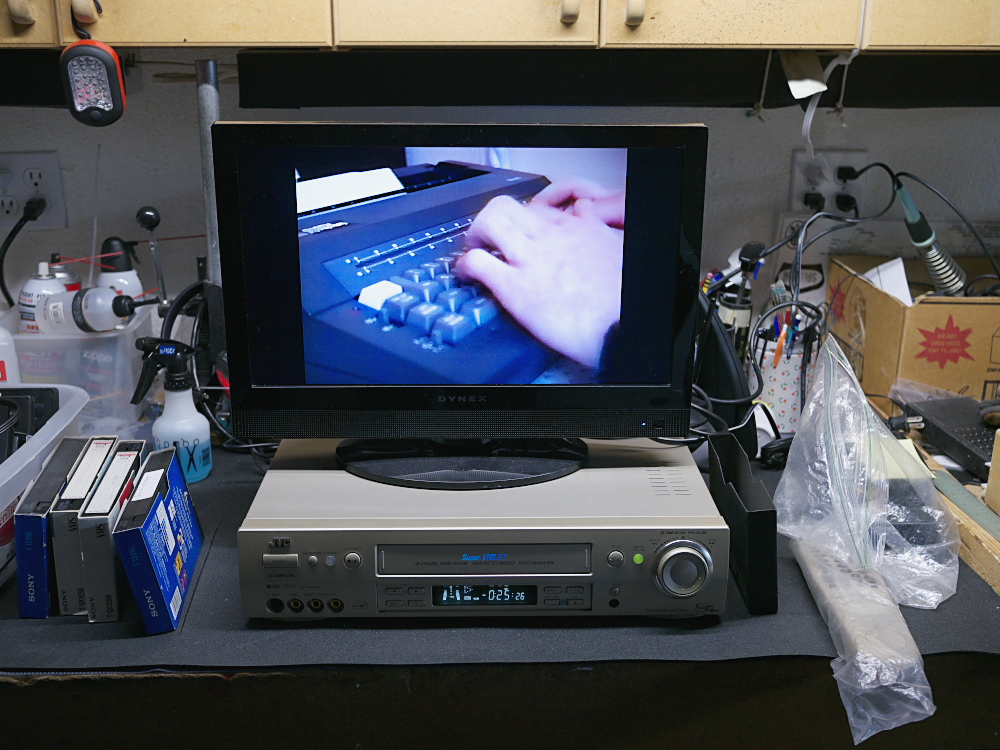
These next two frames are from a little "drama" I made, some Z-grade spy drama that was really an exercise in montage and editing, using my then-newly-acquired JVC editing VCR. Note my newer JVC is what I'm using to play back the tape; it was purchased in 2001 and is still like new. These two shots are of my Smith-Corona 100 daisy wheel electronic typewriter. This clip is historically my very first typewriter video.
P1120534a
P1120535a

Watching a handful of these old productions was a bit painful, not only for how dorky I looked back then, but the production values were pretty low. Kind of like a bad SNL skit, absent the talent. Perhaps I'll get one transferred and uploaded to YouTube, for all to enjoy.

Semi-nongratuitous plug to my YouTube Channel, in case you haven't yet visited.

Labels: , , , , , , , ,

Sunday, December 18, 2016

Thrift Store S.W.A.G.

P1120450a

There was a time, a few decades ago, when I found myself in possession of a handful of slide rules. This ad hoc collection had started when I was in high school, and slowly grew in the subsequent years while I served in the military.

Back in those years, people weren't as keen on collecting ephemera or peculiarly specialized objects as they are today. My folks, of the WWII generation, were more apt to collect curio bottles, pretty trinkets and nicknacks than things like slide rules or typewriters, which were to them mere practical implements; it made as much sense to them as collecting shower curtain rods.

Sadly, in the intervening years I've lost that collection of slide rules, my most prized item being a circular slide rule. This happened due to a number of moves, from one apartment to another, during which I'd unload as many items as I could. I've also lost other items which I now wish I had, such as my mother's Kodak folding camera.

I know the usual advice people give about clutter: it's best to move every few years, to permit oneself to declutter and rid themselves as much as possible of unneeded items. Myself, the more I age the more I wish I yet had a few more of those precious items from long ago, as momentos serving as a physical link to a past that only resides in memory, a temporary dwelling at best. This is a benefit of living in the same house for decades upon decades: the clutter itself becomes like some personal archeology, a mapping or extension of one's cerebelum; the forensic evidence of a life actually lived. Sure, one's clutter can all too easily get out of hand, but there's value in considering the artifacts of one's life, in going through each item periodically to relive those memories.

I'm reminded of the android Leon in the film Blade Runner, who carried with him his precious photographs, reminding him of a childhood he never had. Momentos are like that, they're something tangible we can hold in our hands, talismans we can fondle to make contact with another time. Snapshots I've always held in special regard for that reason, especially polaroids and the like.

The interesting thing about periodically reviewing one's clutter is, as we assess each item for its personal value, it gives opportunity to reassess the things we'd been hanging onto that we no longer find of value, like my penchant for once having saved newspaper and magazine clippings from long ago.

I was pleasantly surprised this week to find a card in the mail from my Aunt, the last surviving sibling on my father's side. She'd unearthed an old trunk from her basement and, searching through it, found an old school picture of your's truly, a red-headed, freckled kid I'd barely recognized after all of these years. Looking at that print, it was like some kind of magic mirror into the past, as I rediscovered someone I'd totally forgotten.

Last week I was in a thrift store mood. I will periodically make a thrift store run, in the hopes of finding some wonderful find, like yet another typewriter. Yes, I did spot a handful, but nothing that interested me. As I've matured as a collector, I'm a bit more selective than when I first started out. But one item I did pick up last week was a slide rule, of all things.

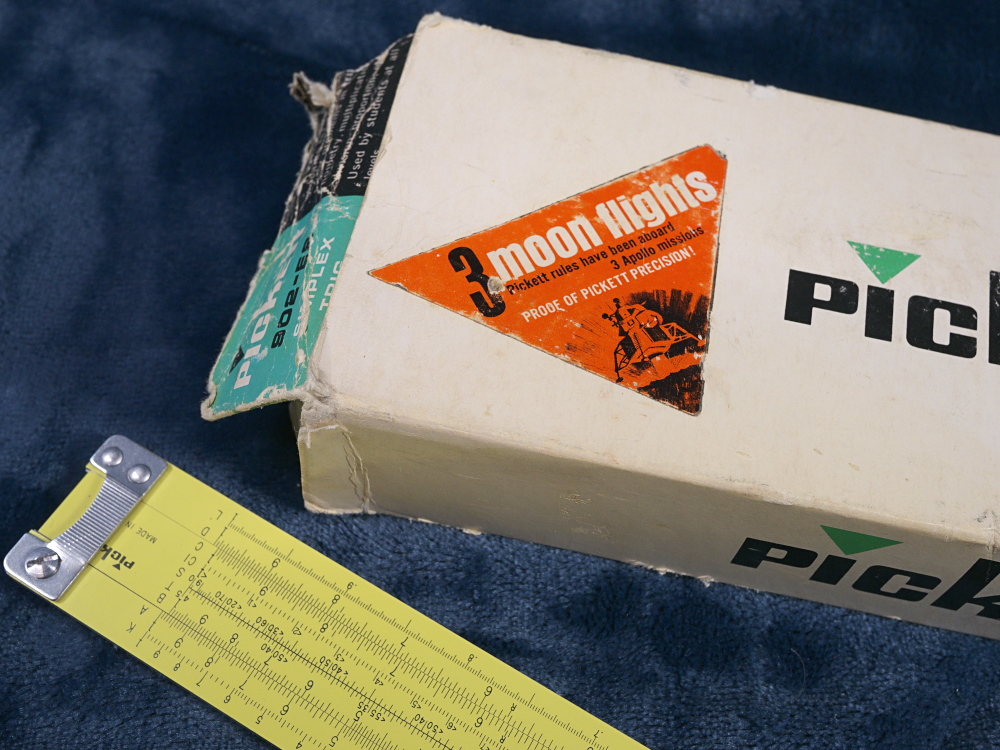
I see these all the time at thrift stores, and rarely do they interest me, except to remind me of that collection I once had. So, what made this one different enough to warrant purchasing? Well, it came with the original box, leather holster, plastic bag, packing material and owners manual. It's a Pickett N902-ES Simplex Trig model, intended for students I'd suppose, since the reverse side of the rule lacks the additional set of scales, but instead has a table of fractional/decimal conversions and instructions for use.

The clincher in the decision to purchase was the orange triangular sticker on the box proclaiming "3 moon flights - Pickett rules have been aboard 3 Apollo missions - PROOF OF PICKETT PRECISION." I don't have an exact year when this particular rule was made, but I'd suppose those three missions might have been Apollos 8, 10 and 11, which dovetails nicely with my interest as a young man into all things space-related.

Items such as this slide rule are not particularly valuable, monetarily, since they were made by the millions. I don't collect such items with the mistaken idea that doing so might make me a rich man. Unless one counts their riches in some other valuation than monetary. A bit of online research shows that this version is a later model, circa 1970, with the more modern Pickett logo and the yellow color indicating it's the "eye saver" version, as indicated by the ES in the model number.

What does interest me is the owners manual, a booklet titled "how to use Trig SLIDE RULES" by Professor Maurice L. Hartung of the University of Chicago. I like this introductory sentence in the booklet's preface: "A computer who must make many difficult calculations usually has a slide rule close at hand."

This idea of referring to a "computer" as a person rather than a machine directly reminds me of the early days of mechanized writing where "type writer" referred to the user of the machine rather than the machine itself. I'm surprised this terminology was yet in use as late as the date of this preface, of 1960.

Slide rules remind me of photos I've seen from the Apollo era of the 1960s, of large rooms of engineers, each in their white shirts and thin black neckties, hunched over their drafting tables with their sleeves rolled up and slide rules in hand, an overflowing ashtray nearby. It's amazing to think that we got to the moon's surface and back six times using, along with early digital computers, these humble slide rules.

Of course they're an anachronism. The idea of taking up a slide rule to do a bit of multiplication seems like sheer nonesense. A bit like sliding the beads of an abacus to balance one's checkbook. But I've been known to do a bit of that, also. I like the idea that a purely analog tool like a slide rule yields merely approximate results to math problems that should otherwise be entirely exact. For example, a simple problem like 2 times 2 we know to be 4 because of us having learned our maths tables in school; but what about 42 times 37? Using the C and D scales of the slide rule informs me that the answer falls somewhere slightly less than halfway between 1550 and 1560. An approximate kind of answer, entirely analog in nature, requiring a bit of extrapolation to find that last digit. Only after I stop and think that 2 times 7 equals 14 do I then realize that the answer should also end in 4, implying the result should be 1554.

The funny thing is that I had to verify my result with a cheap, plastic digital calculator of questionable heritage. Yet that cheap calculator gives the same result as a hundred dollar Hewlett Packard scientific model. Not necessarily so with analog instruments like slide rules, where the accuracy of the result is directly dependant upon the precision of manufacture of the instrument and skill of the operator.

I like the concept of extrapolation as being absolutely necessary in the operation of a slide rule for deducing the last digit of precision. This is something that many technical people seem to lack these days, the ability to find a ballpark answer to a problem. I like the real-world skills of being able to approximate the scale of a problem by mere deductive reasoning, an insightful hunch based on common sense and a bit of thought. The value of being able to make a SWAG - a scientific wild-ass guess - should never be underestimated, and will get one far in life.

I remember some of the slide rules in my former collection were bamboo, and required to be dusted with talcum powder periodically to remain smooth in operation. This Pickett is all metal, and thus the booklet recommends a bit of petroleum jelly on the edges to maintain smooth operation, along with the advice of holding it by the ends when in use, so as not to bind the scales together too tightly. I like the idea that this humble calculating device requires a bit of simple yet necessary maintenance in order to function properly; whereas with that cheap plastic calculator I'll mash it buttons until it no longer functions, then throw it in the rubbish bin of history.

The most essential observation I can make in comparing slide rules to typewriters is that few of us have need in our daily lives for solving math problems any more complex than addition or subtraction; which makes slide rules not nearly as useful as typewriters, since slide rules don't "do" addition or subtraction. (Actually, they multiply and divide by adding and subtracting logarithms, but you probably didn't need to know that.) Which means that for most of us, a humble abacus would probably be more useful. Which I'll discuss in another installment.

Labels: , , , , ,

Wednesday, September 28, 2016

On Storytelling

Downtown Java Joe's

I was thinking about the similarities between writing and photography. Part of the reason for this chain of thought was because I'd been watching an interview with photographer Michael Kenna, who talked about photography being a medium of communication.

For those of us steeped in the technological side of photography, with its incessant equipment upgrade cycles and talk of megapixels and form factors, it's all too easy to lose site of the primary purpose for creating and sharing images, which should be to inspire and impart some experience, idea or emotion to the viewer; to communicate, as a creative person, to a wider audience.

Part of the blame for our lack of appreciation for photography as a communicative medium is that it is so gear-centric, and thus manufacturers, marketers and the photo media are incessantly busy pushing gear and software products; and laypeople are all too willing to talk it all up in discussion forums. All too infrequently is the conversation about how to communicate to others through the medium of images. Being a better photographer really means being a better communicator, rather than merely being better equipped at twiddling camera settings. Oh, sure, technical proficiency is one aspect of being a skilled communicator, but that's not where it ends; wielding a camera skillfully is only the beginning; like learning to write requires first some skills at composition, but doesn't end there.

I was also thinking about this art we call writing, the use of words to communicate ideas. The end result is much the same as in photography, although the means to that end is very different, as are the methods employed. We talk about word pictures, or use visual terminology to describe literary metaphor. A picture is worth a thousand words, perhaps more. These thoughts were floating around in my head today as I returned home from a day trip to northern New Mexico and found a package waiting for me, from the print-on-demand publishing service Blurb, of a collection of short stories I'd been working on for the last few years. It's one thing to see the finished book simulated on my computer screen, ready to upload to Blurb; but an entirely other thing to hold the thing in one's hand. These are called vanity presses for a reason, although in my case it was more a case of relief than egoism, since I was merely hoping to get these stories polished and in book form; to be done with them and get them into other readers' hands, even if those readers are only family and friends.

I placed the small stack of paperbacks on the table in our patio room, while my wife busied herself with whatever it is wives do after a day trip to northern New Mexico and the Three Ravens Coffee House in Tierra Amarilla. But once she settled down, she suddenly took notice of the books and immediately started reading.

She's read a few of these stories before, spread out over a period of years, but not all, nor all in one collection. I was gratified that she appeared to be engrossed; or perhaps it was mere curiosity, in the way that people are attracted to mayhem and disaster. But I think not; Loser's Blend is an okay collection of short stories, centered around a fictional bohemian coffee shop and its regulars. There won't be any Pulitzer Prize awaiting me, but that's not what motivates me to write, any more than hoping to be the next Ansel Adams doesn't motivate me to create images.

Like all good photographs, what I enjoy about writing is conveying a story to someone else. Storytelling is essential to the creative experience, and also might well be genetic, as humans have been telling stories since the beginning of language itself. Humans have also been picturing those stories as drawings since as far back as we can find evidence for humans, and more recently making those drawings by means of photography instead of charcoal or smashed berry juice.

I find myself, now in middle age, conveying family lore and personal experience to the younger folk in the clan by means of storytelling; just as my dad and his dad before him. This isn't unusual, but entirely normal. We're all storytellers; it's genetic. Storytelling is the mind's playback mechanism, imparting to someone else through oral tradition that which would otherwise be lost to posterity. It's history in the making through telling, and retelling. If we boil it all down, scrape off the dross of the world of elite literature and art, we are all storytellers at heart, in some way. It matters not if we are degreed or pedigreed or half-breed; we all have a story to tell, and some means to convey that story to a wider audience. The idea that only "professional" writers can tell stories is an artifact of western culture, its social stratification and elitism. Sure, to have your story more widely heard it might do you good to polish it with the skills of the learned writer (or photographer, or film maker); but the first thing, the essential thing, before all else, is to write, to tell, to create, to express.

What's your story, and who will you tell it to?

Post-Script: Here's the link to my Blurb books, including Loser's Blend.

Labels: , , , ,

Sunday, July 31, 2016

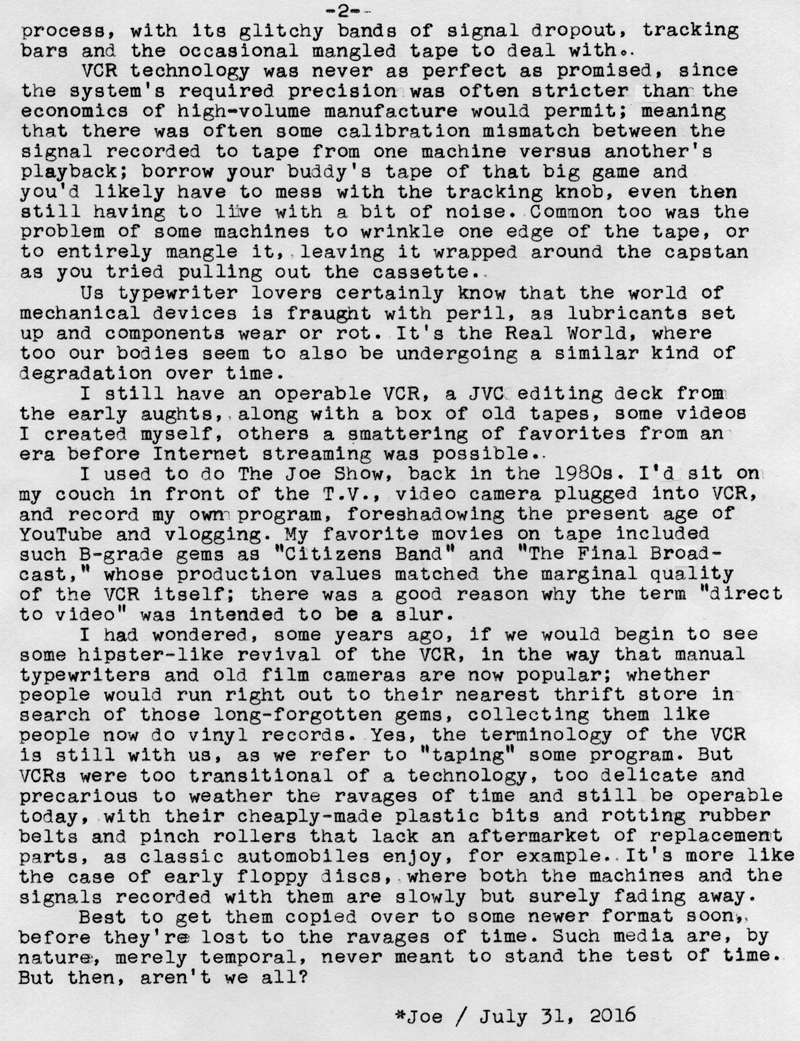
VCRs and the Test of Time

DSCF5090a
Typecast185
DSCF5093a
Typecast186

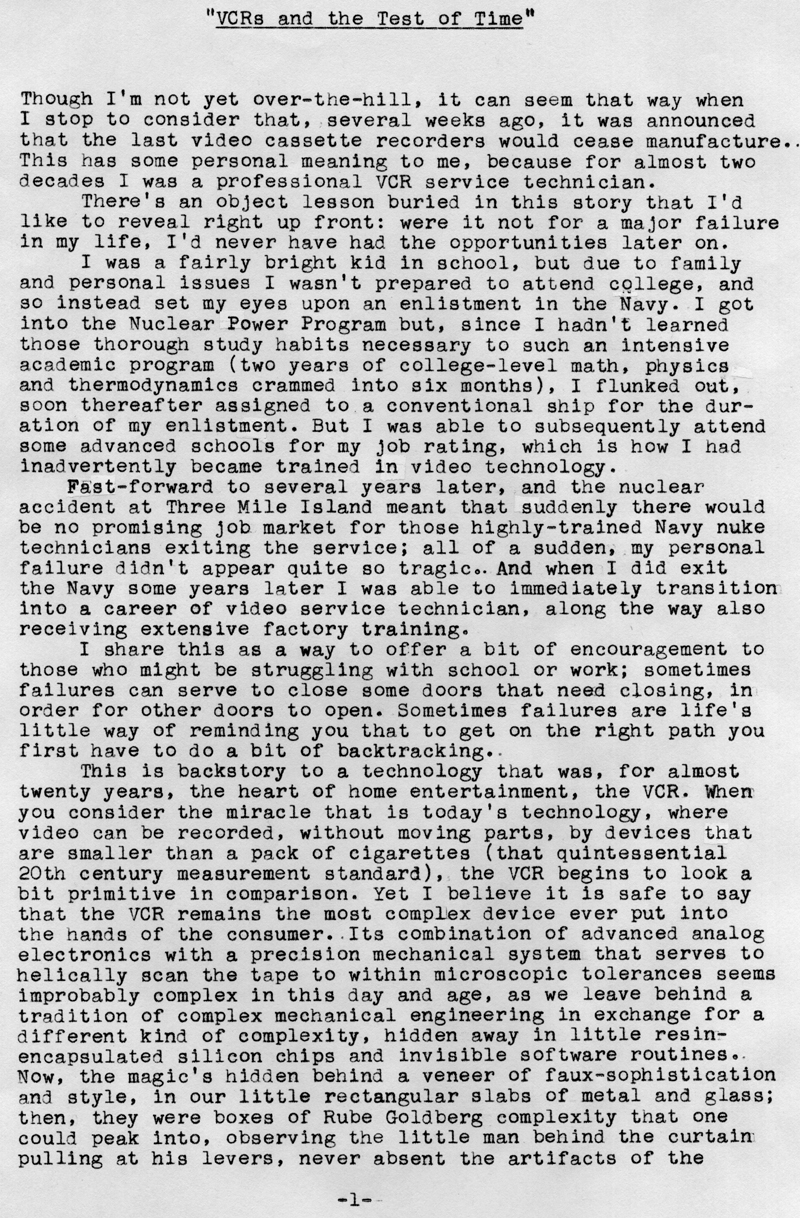
Post-Script: There was a time when I was engaged in video editing strictly using analog video equipment, editing Hi8 video footage onto S-VHS. It was a fun process because one had to learn to time the back-roll of the recording deck, in order to get an accurate edit. The audio production was a bit more challenging, since only the low-quality linear audio tracks could be dubbed. I learned to compensate by using a Tascam 4-track cassette-based mixer for the sound production, edited ahead of time and rolled into the production as the video edit was progressing.

These days, the simple method I employ of iMovie on the iPad is so much easier; but I do look back upon those former days with fondness, as we learned to work around the limitations of our equipment.

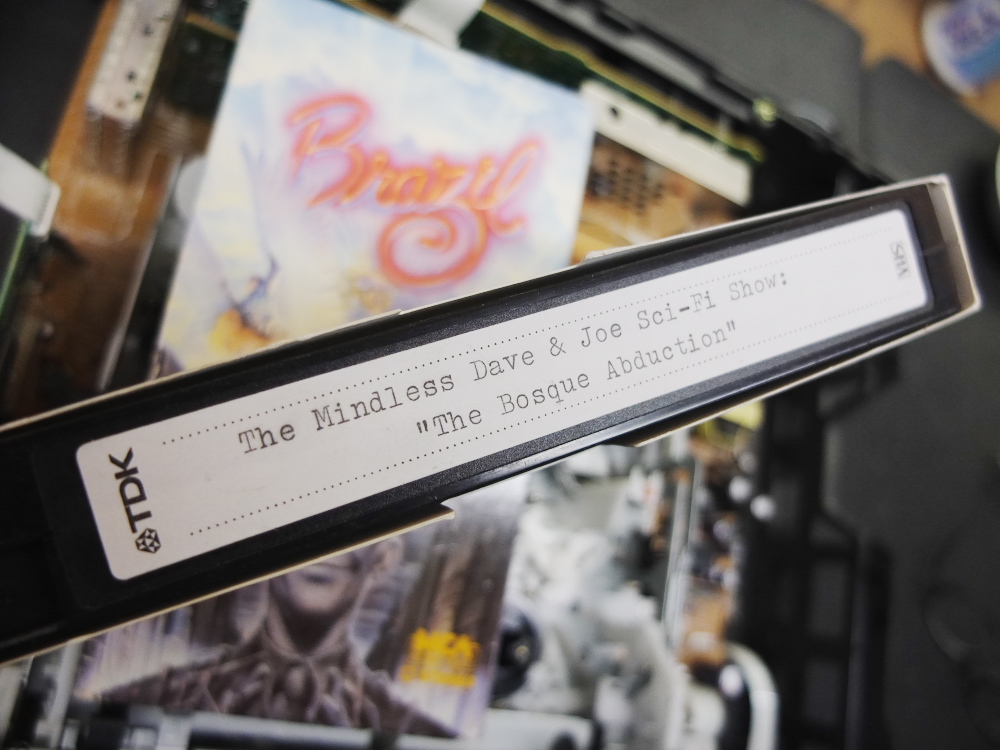
I made a number of experimental videos throughout the '90s and into the aughts. And made a short movie with a buddy, "Bosque Abduction," wherein I star as the bad guy. Lots of fun.

Regarding the two movies mentioned in this piece, here's a link to Citizens Band (also known as Handle with Care), and The Last Broadcast.

In the early days of VHS and Betamax, before copy guard technology, it was possible to get a good copy of a laser disc movie onto video tape. Also, many films released to laser disc were unavailable on tape, and so copying was commonplace. Not that I would ever think about doing such a dastardly deed, but in our contemporary setting of digital audio protected by the DMCA (Digital Millennium Copyright Act), the lawyers would be running around in circles at the thought of someone copying audio via analog means, which is pretty much impossible to protect against.

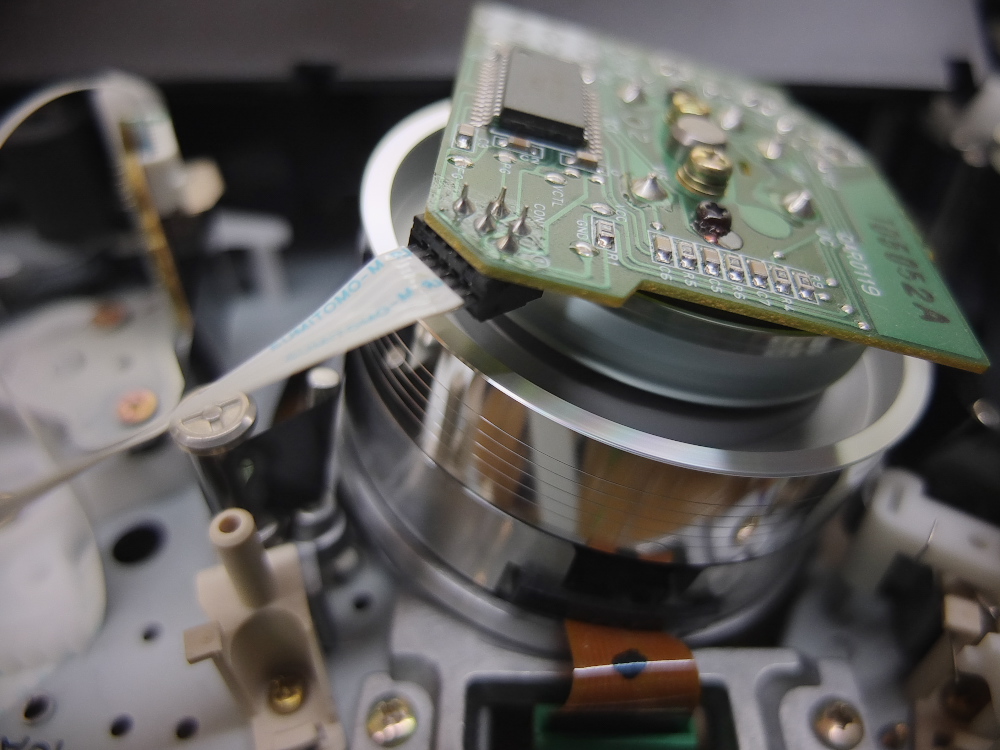
I still see piles of VHS movie tapes in thrift stores, but rarely if ever consider purchasing any. Mostly it's because the titles available are of little interest to me; but also because playing someone's used tape is kind of like unprotected sex; you don't know if the tape was badly mangled at some point, which could clog or even destroy your deck's video heads; or if grease or other debris is on the tape, again presenting a danger to your equipment. This is especially important these days when you consider the gear is irreplaceable and unrepairable.

Oh, and in case you were wondering: yes, Betamax was superior to VHS. So there.

Photos via Fujifilm X10. Typecast via Corona Standard.

Labels: , , , , ,

Monday, July 25, 2016

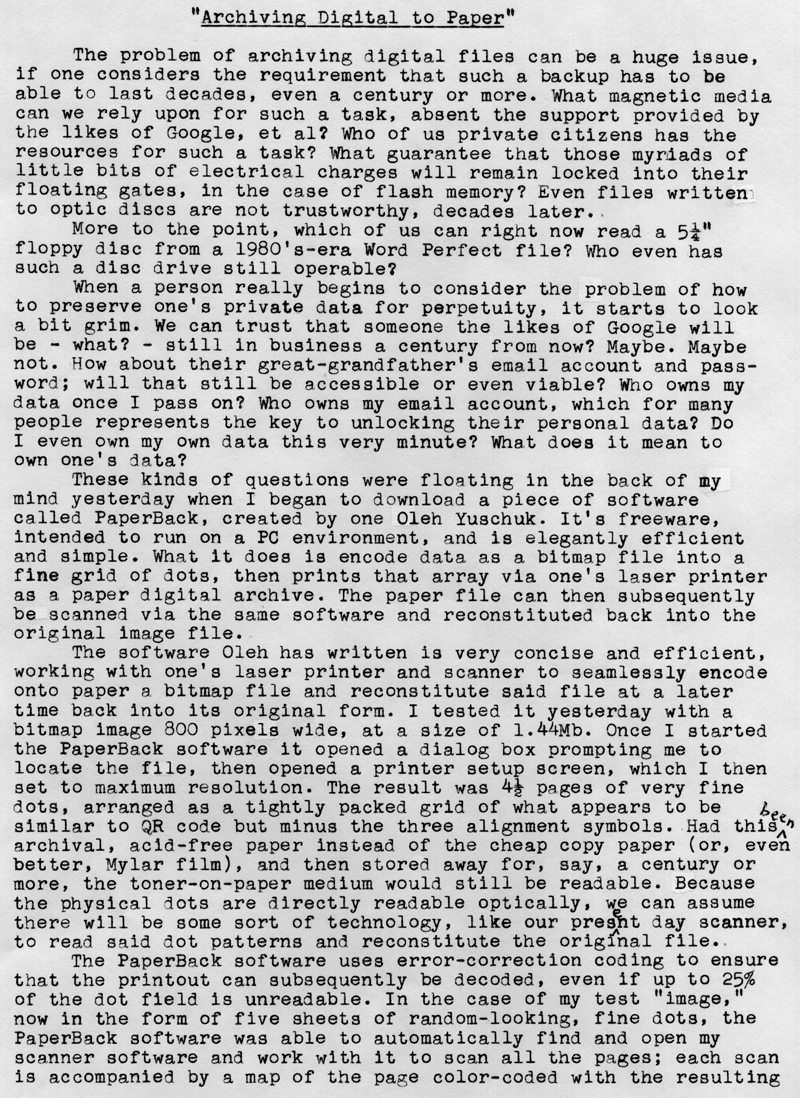
Archiving Digital to Paper

DSCF5073a
Typecast183
DSCF5074a
Typecast184

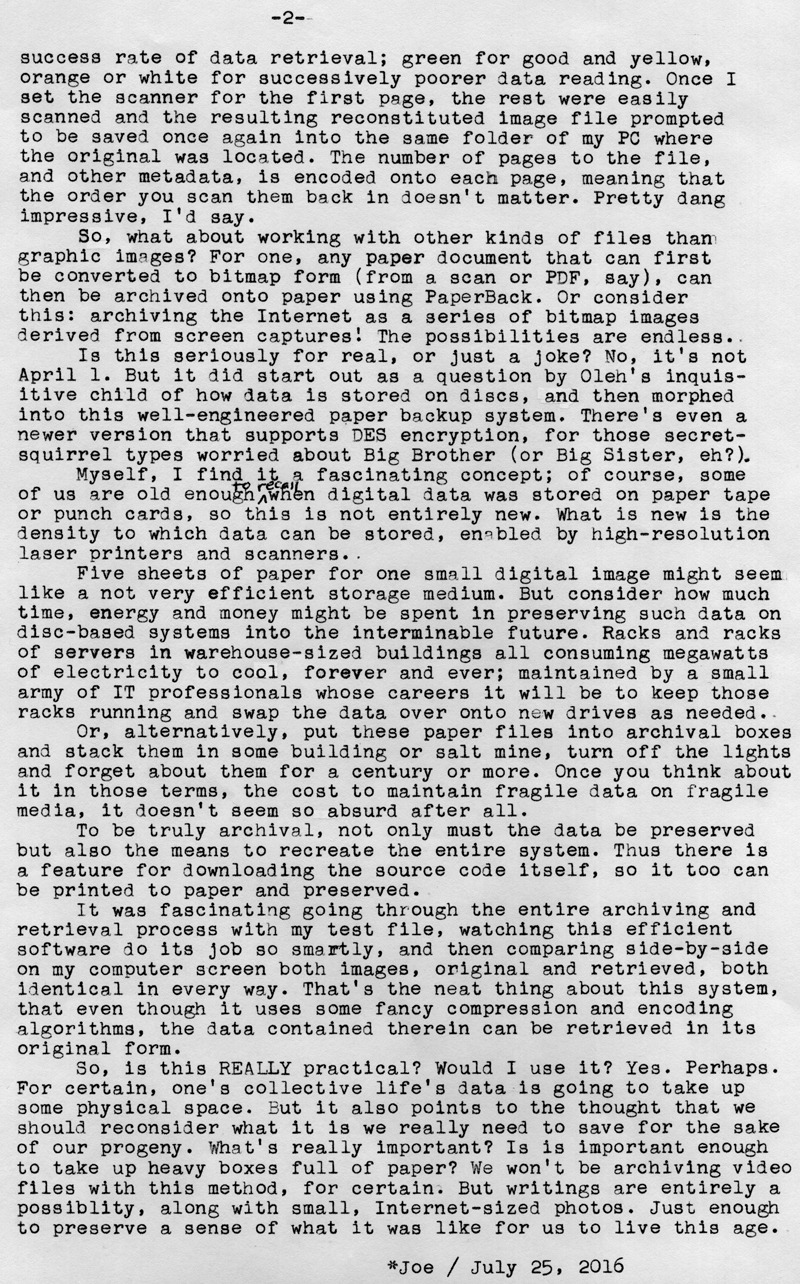
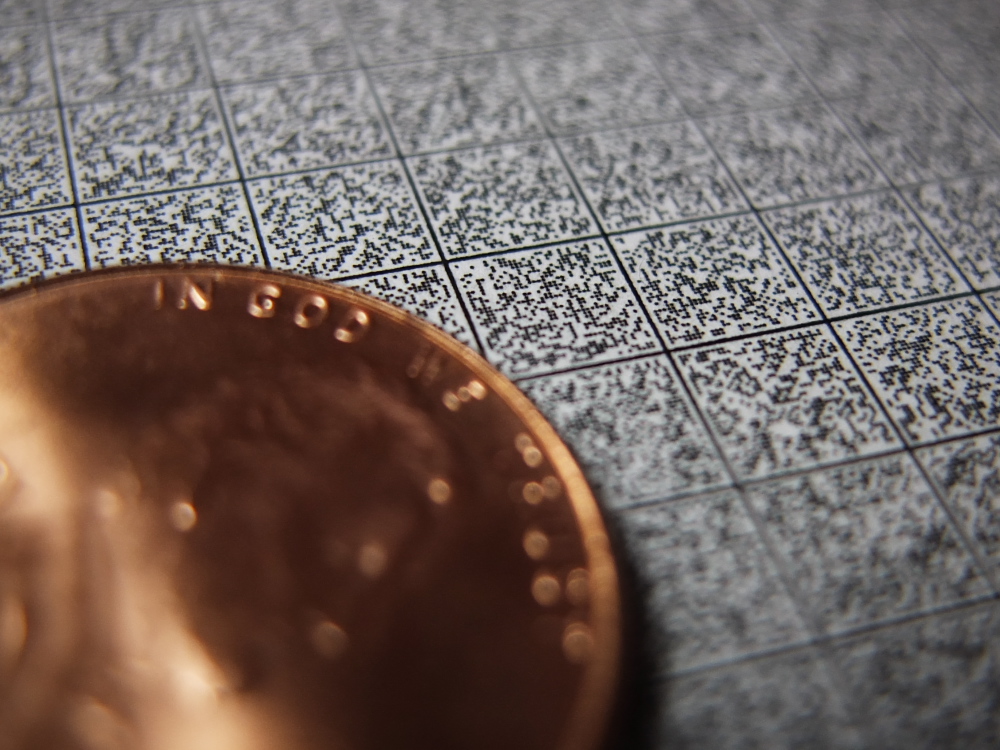
Post-Script: I was surprised the software worked as well as it did, glitch-free and with such ease, finding my scanner and printer with no fuss, converting the file to and from paper with no hassle. Obviously well-engineered by someone who knows how to code. One sheet I used for the printout had one corner previously marked up by pencil (I obviously made no conscious attempt at providing archival-quality paper); during the scan, I could see that corner showed a bit of yellow and orange in the data map provided. Yet the error correction coding worked well enough to reconstitute the file in its entirety.

Yes, it sounds like a crazy idea, but it works! Which brings to mind the thought of what is it in my personal affects that's important enough to warrant this kind of backup? If all it does is serve to raise these kinds of questions, then it's a valuable tool.

Here's a link to the PaperBack website. And here's a link to an article about it.

Typecast via Corona Standard.

Labels: , , , ,

Monday, June 20, 2016

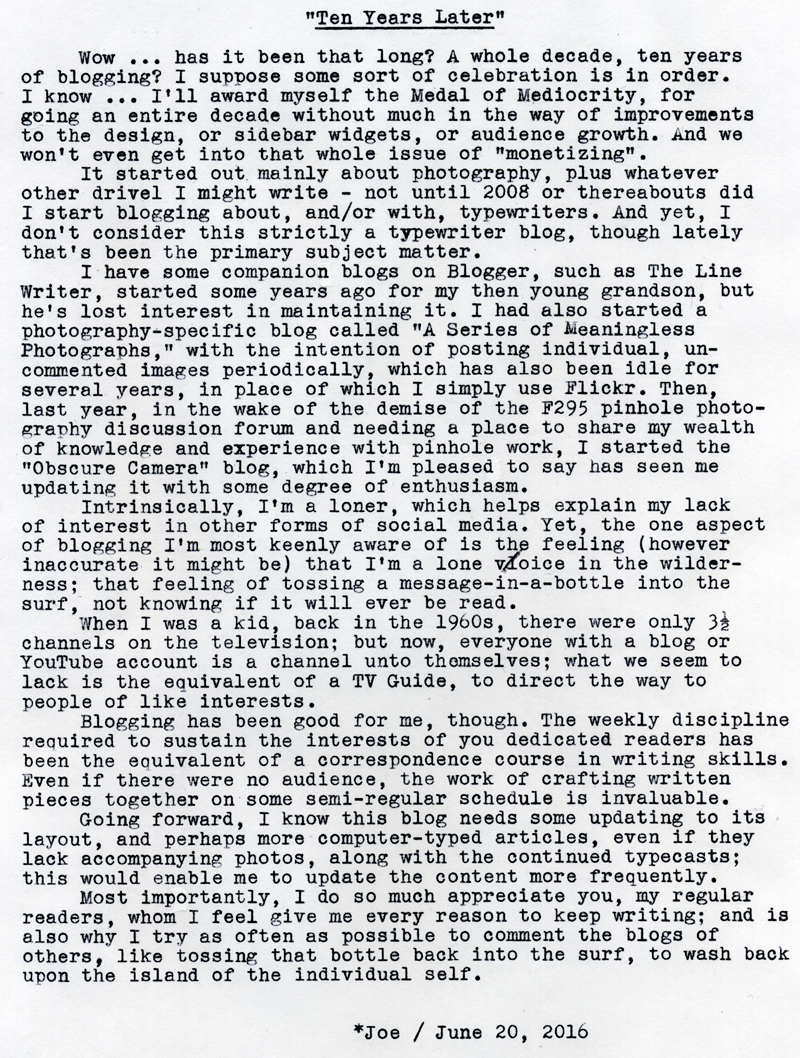
Ten Years Later

Ojito008a

Typecast176

Post-Script: In the interests of self-promotion (which I'm awful at), here are some links to my other blogs, and You Tube channel.

The Line Writer.
A Series of Meaningless Photographs.
Obscure Camera.
Joe's YouTube channel.

At this current moment I see no reason to monetize any of these social media, as I appreciate the idea of a "free" interchange of thoughts; even if the concept of "free" is a matter of self-delusion, since it's all paid for, somehow, indirectly, by some other scheme. I think this is an important component to understanding this age of social media, that we often operate under the false assumption of "free" access to global, internet-based communications, since most social media platforms require no direct pay-to-play membership. In the long term, none of this is really sustainable without someone footing the bills. Understanding the underlying architecture of social media, we have to realize that you and I are the product being bought and sold. As long as we are comfortable with that thought, all is well, in the near term. Yet the idea that my writings, images and videos are being stored on someone else's servers, with no real insurance of their long-term survivability (other than the financial health of the hosting corporation itself), remains a bit unsettling.

Photo via 8"x10" meniscus lens box camera onto photo paper negative. Typecast via Underwood Universal.

Labels: , , ,

Monday, May 16, 2016

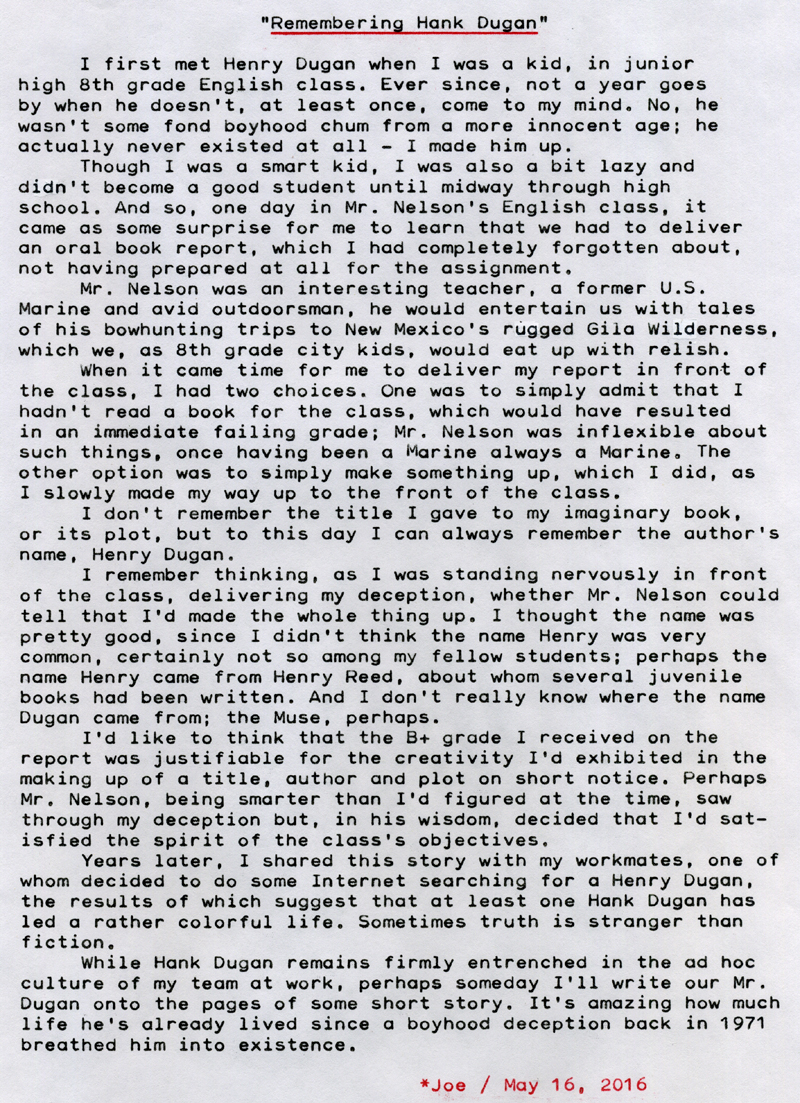
Remembering Hank Dugan

P1080143a
Typecast171

Post-Script: I didn't develop an extracurricular interest in story writing until midway through high school, though I'd like to think that somehow the genesis of Hank Dugan was the start of it all. A person often doesn't see such patterns in life until, years later, you stop to reflect.

I made and uploaded another episode of the Typewriter Video Series, this one about an outing I made to a local coffee shop, Humble Coffee. I realize, as I stated in the video's epilogue, how boring my last few videos must seem to the average viewer, and so I've embarked on an attempt at making them a bit more interesting; though I'm not certain I've succeeded, it's all a work in progress. Here's an embedded link:


Typecast via (fully clothed) Hermes 3000.

Labels: , , , , ,

Monday, February 08, 2016

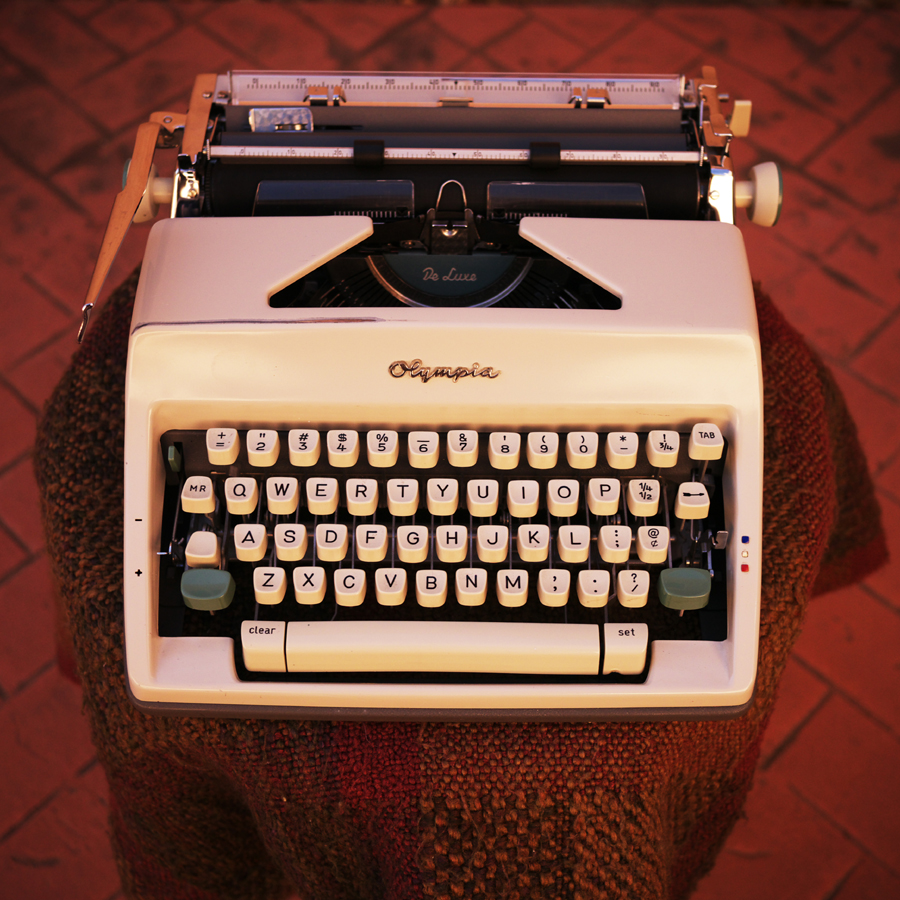
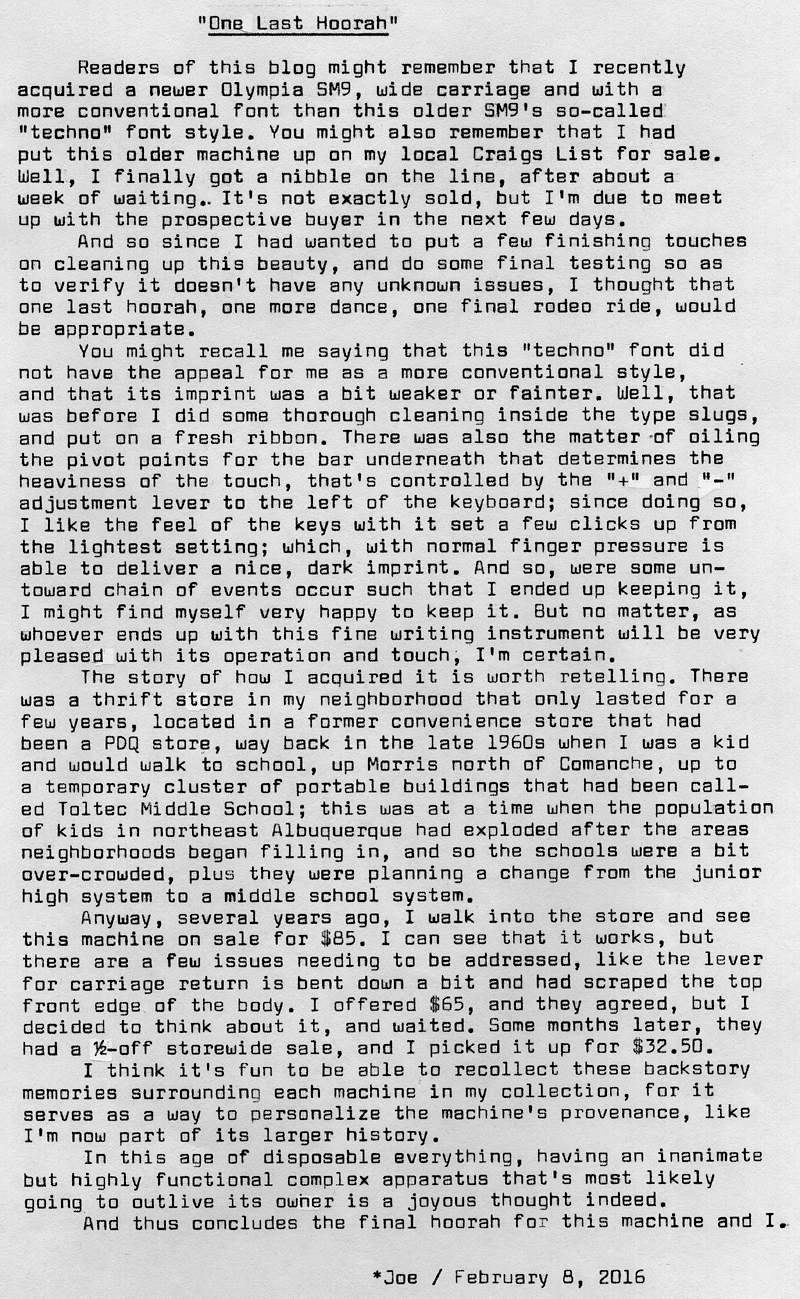
One Last Hoorah

P1030409B
Typecast137

Post-Script: It's funny how something as seemingly mundane as a typewriter can bring back so many memories from long ago. In the case of this particular machine, its so-called "techno" font reminds me of having taken several computer programming classes, in high school in the early 1970s (Basic, Fortran and Algol). We typed each line of our program onto individual IBM punch cards, one line of code per card. Along the top edge of the card could be the plaintext equivalent character for each set of punched holes below. This style of printing, from a dot-matrix printer, is somewhat indicative of this Olympia's, hence the remembrance.

In the course of preparing the typewriter for sale, I decided to type up a "brief" instruction sheet of the machine's various controls, along with its care and feeding. It will also serve as an example of the machine's typing quality. Well, that "brief" instruction sheet is now three pages, and of course I could have gone on and on.

Being as how I have some spare correction tape cartridges (from one of my spontaneous office supply store binges - yes, I need a 12-step program), I'm going to include one along with the machine. And for another $3 I'll include an unopened 100-sheet pack of the Mead "general purpose" typing paper that I purchased online several months ago. Because I'd like to make the new owner's typing experience go as well as possible.

Which reminds me, I got an email today from a person in Albuquerque who found my blog online and has a question about a Smith-Corona Silent typewriter, of the same color and model as one I own. So that's kind of neat, now I'm starting to answer typewriter questions.

The top photo was made some years ago using my old Lumix G1, in the front courtyard late in the day. Because of the time of day, the brown stucco house and brick-colored courtyard paving, its very warm in tone, which the camera somehow rendered rather vividly, but I made no attempt to correct the tones; I have a whole set of these typewriter portraits, from that same day, on my Flickr stream, and rather like them.

Labels: , , , ,