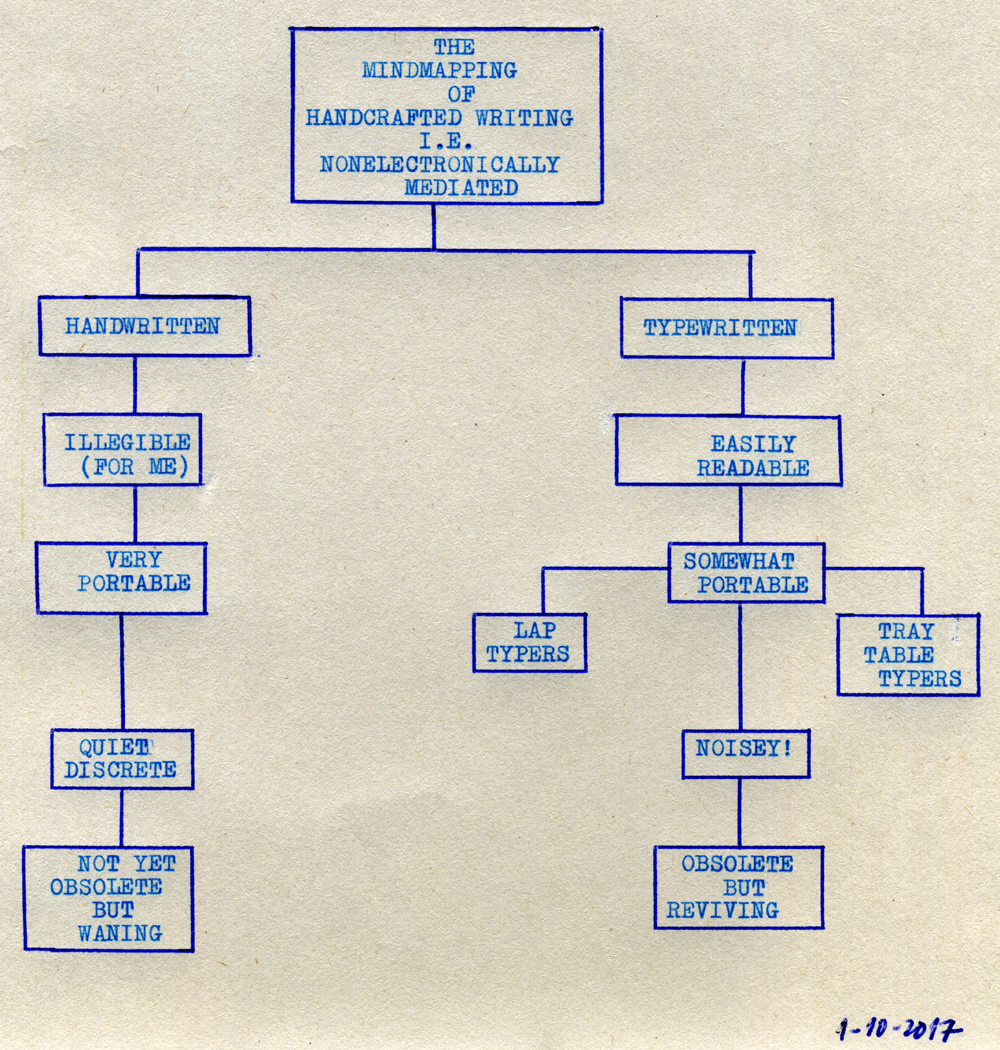
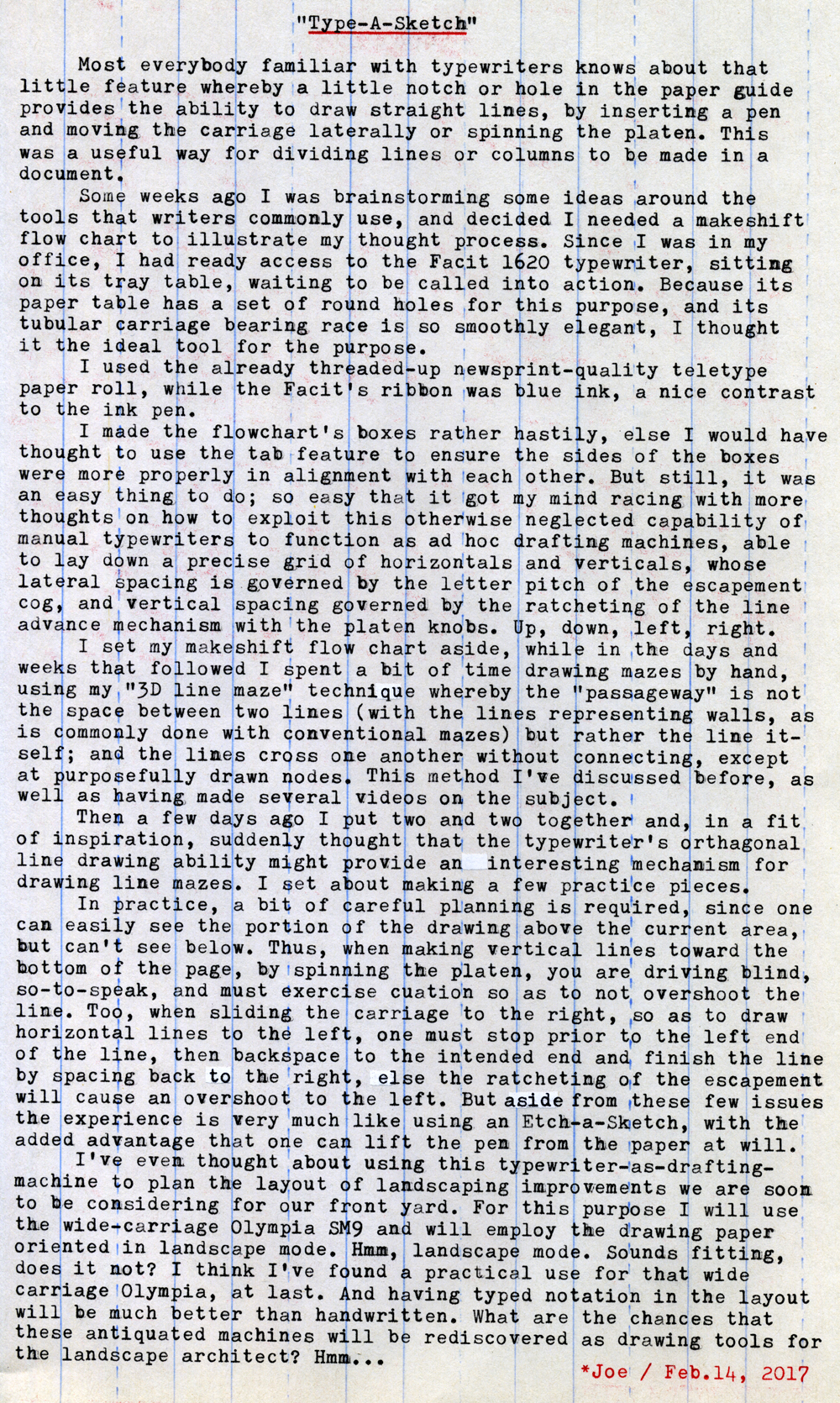
Wednesday, March 29, 2017

More Videos and Type-In Prep
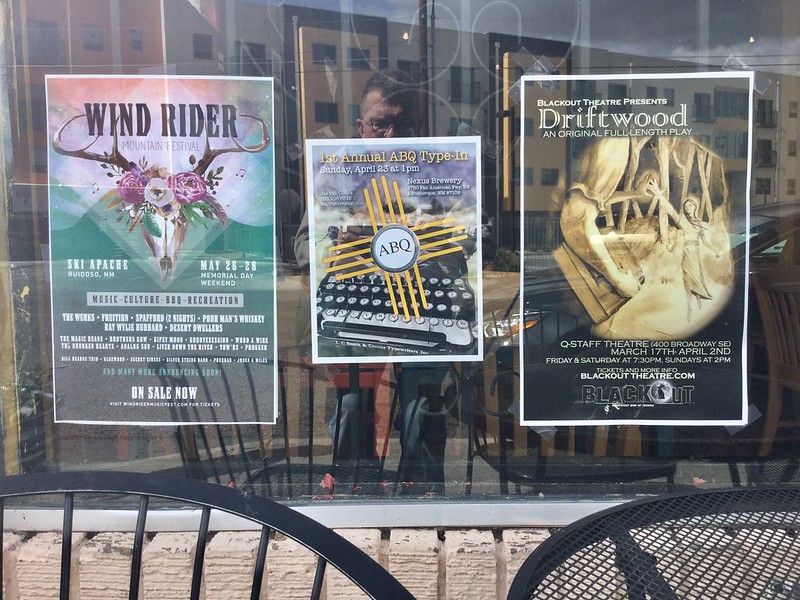
Downtown Java Joe's
It's been a busy several weeks, though that is not in itself adequate justification for ignoring this blog for nearly two weeks. There's a certain amount of irony in the observation that a recent video was about the power of blogging; a power which I've apparently ignored.


This week I've produced four videos for my YouTube channel, three of them about photography. The first two were about the Stearman Press SP-445 sheet film developing tank, a new product which promises sheet film processing in daylight, using a changing bag. In many ways it offers a similar result to a rotary tank, with the added benefit of not requiring constant agitation, as is the case with rotary processing, and thus permits stand development methods to be employed. I found my test results using the SP-445 to be satisfactory in terms of uniformity of development, but did note a bit of emulsion scratching along the very edge of the film, due to the way the thin, ABS plastic holders clamp the film. I didn't think this was a "deal-breaker," however.

I did experience one negative detach from the holder sometime during either the five minute fix (using continuous agitation) or the initial rinse cycle. But the image results were fine. My biggest concern with this system, aside from a few dribbles of liquid leaking from the o-ring sealed lid during inversions, is the seeming flimsiness of the internal plastic baffles and film holders. Longevity will only be proven over time, I suppose.


I produced another video, at the prompting of a viewer who liked the camera I'd been using for the film development tests, presented as a 75 year-old camera review of the Graflex Anniversary Speed Graphic, which has been my primary workhorse for large format and experimentation with adapted lenses; since it has a functional curtain shutter, any lens that projects a usable image can be employed, even if it lacks its own shutter. I've over the years employed several decidedly unphotographic devices as lenses, such as the front objective to a 7x50 binocular, a plastic, credit card-sized fresnel magnifier, a Xerox machine lens and a brass pinhole. Certainly newer field cameras are lighter in weight, but they don't offer the flexibility of a functional curtain shutter, along with a wire frame viewfinder to augment the ground glass view screen. This camera I had purchased from a local camera store years ago, and it's been worth every penny to me in return.

It's been several weeks since I made a typewriter-themed video, and as I was looking through my video production notebook I found a post-it note I'd made to myself about a potential video idea, that being making a log book for one's typewriter collection. The idea is to have a separate section for each machine, with detailed data on date of acquisition, serial number, age, past service, present mechanical issues, date of last ribbon replacement and one's own personal observations about the machine. It might also be of value to include a log of how each machine is getting used, in the form of a list of entries documenting the date of use and for what purpose - letter writing, blog article, short story, etc.

The video itself ended up morphing into more of a Confessions of an Office Supply Junky theme, as I delved into using the Staples Arc system (compatible to Levenger's Circa) of disc-binders for making customizable notebooks. Since making that video I've decided to also update my ad hoc video production journal with the Arc binding system. So now there are a plethora of little colored paper chads dotting the floor in my office, as the cheap little Arc hole punch likes to spew chads intermittently.

My wife and I spent several hours of the last three days spreading posters and fliers around town for the upcoming ABQ Type-In, scheduled for April 23 at 1 PM at Nexus Brewery. One downtown coffee shop we wandered into resulted in us meeting a poet who writes via typewriter, whom we invited to the event. You just don't know which venues will lead you to meeting creative people who employ typewriters in their work; one reason why I wanted to visit as many coffee shops as I could, since creative types and caffeine seem to go together.

At a downtown bookstore we talked to the proprietor about the Type-In, who in turn suggested we contact a local poetry collective, many of whose members might also be interested. All of a sudden I'm getting this feeling that our venue might be too small; a good problem to have, I suppose, but I can remember just a few weeks ago when it seemed like I was worried about nobody showing up.

I've contacted a local alternative newspaper about getting a notice for the event in their paper, and I'll also be contacting more local media in the next few weeks.

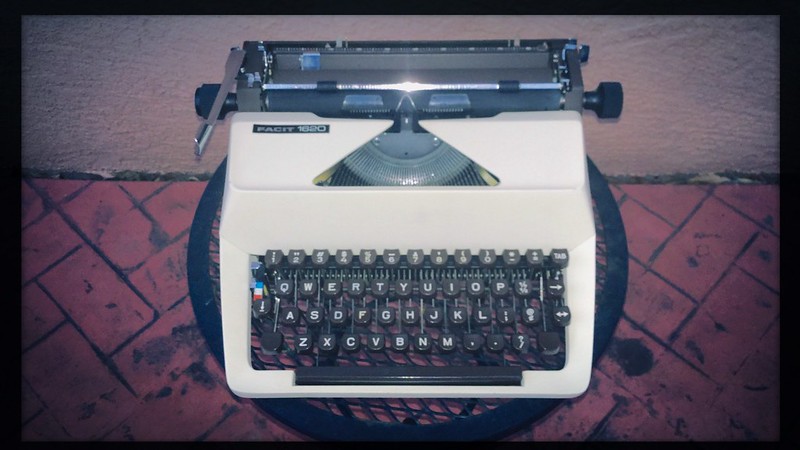
I'm also amassing a small stack of letters and postcards from new pen pals. This is another good problem to have, since I haven't been in regular correspondence with out-of-town folk in many years. Time to get that fountain pen filled and the Facit 1620 typewriter's type slugs cleaned and readied for use.

I've also been working on making my small video studio more efficient. It's funny with television production, you can't tell from the perspective of the viewer what a studio looks like off-camera. My local PBS station, for example, has a dumpy, cluttered studio, having visited on numerous occasions; but you can't tell from watching on TV.

My own production studio is in a corner of my bedroom-based office, where I employ some dark blue curtains in front of the closet doors, and some LED lighting in metal hardware store reflectors, clamped to wherever I can manage. I had been using a folding wooden tray table as my presentation table, but that's proven a bit too small, and also I've been needing to change the height of the table relative to my seating position, in the case of presenting some object on the table where I still want my face to be in the frame.

My solution was to employ an old Bruneau's Pneumatic Tripod, that I've had for decades, with the large metal mounting plate attached to a sheet of wood, atop of which I can set my new carpet-covered plywood tabletop, now wide enough to cover the camera's 16:9 field of view and able to move up or down with the tripod's pneumatic elevation system. I also attached two hardware clamps to the back corners adjacent to the camera, upon which I can now clamp my lights. And best of all, the whole shebang disassembles and stores away, for when I'm at work and don't wish for the office to appear quite so cluttered. Perhaps a future video will be a show-and-tell of my new video digs. Until then, have a great week!

Labels: , , , , , ,

Wednesday, March 15, 2017

Personal Discoveries and Barry's Folly

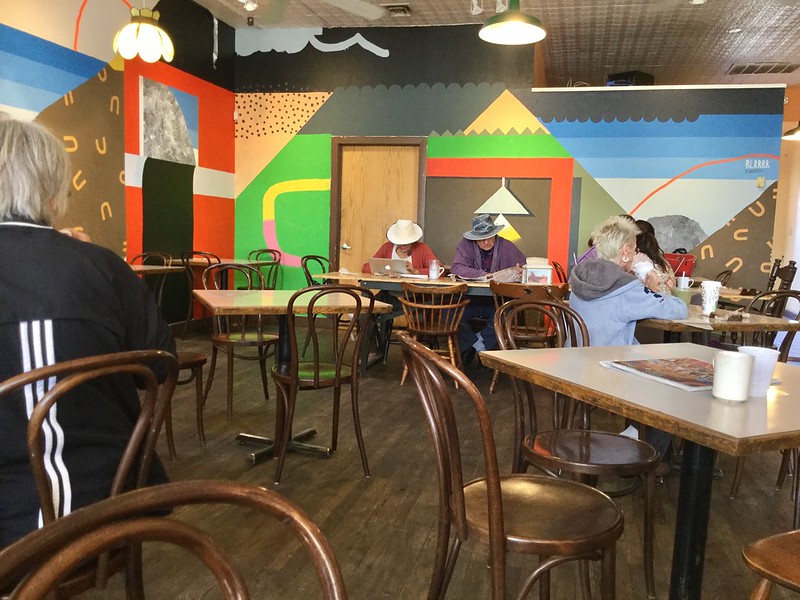
Aging Hippies at Winning Coffee
Ageing Hippies at Winning Coffee

Is there some universal law that dictates when a person first makes a personal discovery? What if that discovery involves a public venue, like Winning Coffee Company, in the University Neighborhood of Albuquerque? These things are like wings you don't even know you've put on, they've become so comfortable. In the case of Winnings, I can't now recall how I first heard of it, or from whom, or the circumstances of my first visit. All I know for certain is that there came a time, in the mid-aughts, when I began spending many a morning at Winnings, eating breakfast, drinking coffee and writing in a journal.

The circumstances of how these places come to be are mysterious, or so I'd like to pretend. In fact, some one or group of people had the vision to start this business, in 1996; but that's not what this story is about. The story I'd like to tell is that Winnings is as unlikely of a hangout for creatives as one can ever imagine in this dry, dusty southwest city, seemingly perpetually insulated from the balance of civilization by many hundreds of miles of badlands and years of history.

If Beatnik culture were a "Thing," let us presume, and someone with the vision and aptitude to make a buck off the declining entrails of mid-20th century American Beatnik culture were to have a free hand in fashioning a simulacra of that culture, they could do no better than start at Winnings, study what it is and what it is they do, and try to franchise the results far and wide.

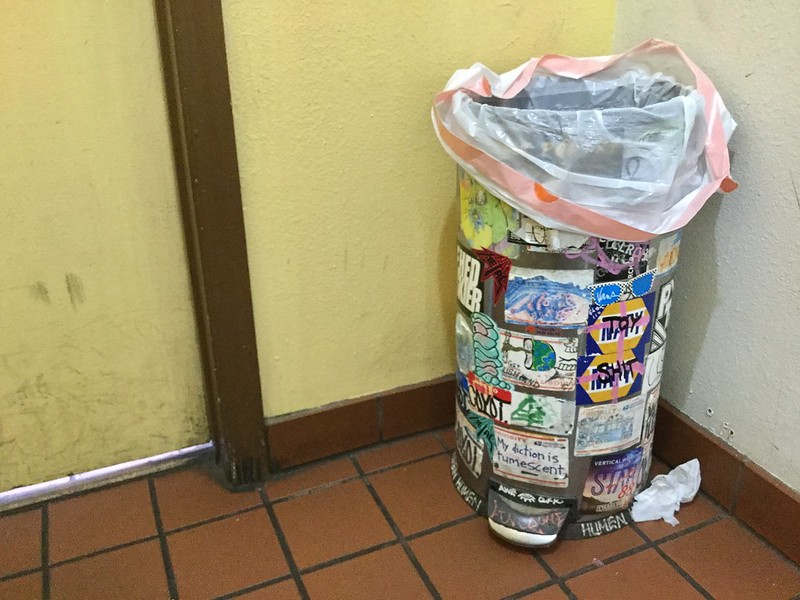
Men's Room Trashcan at Winning Coffee
Simulacra of Decrepitude

You'd need, at the very least, an aroma of cumin and cayenne wafting from an ancient-looking kitchen, just as mood music fills the modern spaces of Starbucks out in Suburbia. You'd need some corporate specification defined for how intense the aroma becomes, along with how to simulate the decrepitude of years of caked-on paint, crazed plaster walls and tin ceilings in some state of disarray. An exacting simulacra of decrepitude, canned and marketed for the suburbanites in newly built communities of cracker mansions out by the Interstate, neatly set down in their precise rows of grids, enticing them to drive their SUVs down to the strip mall and experience a bit of inner-city, beatnik funkiness distilled down to its essential ingredients. Employee personal hygiene would be optional, in order to preserve the aroma of the unkempt philosopher, specified in the corporate policy manual, which also mandates faded bell-bottom denim, braided beards and bandanas securing greasy locks. Most essential would be the front patio, where tables and chairs offer a convenient place for revolutions to be fomented in billowy clouds of hand-rolled cigarette smoke; local ordinances would require special exemptions, palms would need to be greased. We have money to make, boy!

Of course, no true revolutions will arise from our imaginary chain of faux-beatnik coffee shops (Now Nationwide!), only harmless little pretend ones; for the affluence of American Suburbia is predicated on the notion of keeping one's head to the grindstone of Corporate America, doing as one's masters might dictate, and don't rock the boat.

On October 1, 2011, (un)Occupy Albuquerque, a protest group loosely inspired by the then ongoing and worldwide Occupy Movement, began a weeks-long protest and occupation of Yale Park, across Central Avenue from Harvard Drive, the location of Winning Coffee, which became for participants a de facto support triage, with food, drink and moral encouragement. For myself, Winning had by now also become my own personal triage, a place from which to escape middle-class suburbia and it trappings. I'd visit almost every week, notebook and camera in hand, simultaneously inspired and also desiring to capture on film a fleeting essence of the ephemeral. Like capturing fairies on glass plates, how does one capture the essence of a culture defined primarily by the negative space of protest and opposition? It's like that old optical illusion: is it a pair of faces or a candlestick?

I think it always comes back to that most essential approach, storytelling. People are intrinsically interested in the lives of other's, especially if those others come from a different walk of life. I've always felt a bit out-of-place visiting Winning Coffee because of the imagined disparity between my station in life (middle-class suburbanite) and those Winning regulars closer to the streets. And yet, as I've come to know some of them, I've found a richness in their diverse backgrounds that is wholly unexpected and irreplaceable.

Some of these people I've gained only a casual familiarity with, enough to catch a mere glimpse into their psyche, but enough to serve as inspiration for fictional characters in a series of short stories based on Losers Blend, the parallel universe fictionalized version of Winnings.

It's been many months since I've visited Winnings; their coffee roaster guy quit and we'd begun buying beans elsewhere. It's been several years since I was a regular enough visitor to spend hours there writing, or visiting with fellow patrons. So it came as some shock to learn this week that they are having financial difficulties, brought about by the Albuquerque Rapid Transit project, which has resulted in the entirety of Central Avenue being torn up, disrupting traffic, parking and shopping for miles. The project has earned the scorn of most every business along Central, known by its initials ART; but there's nothing art-like or redeeming about it. The Mayor, Richard Barry, heavily promoted it as a way to begin transitioning the city's transportation infrastructure away from being so automobile-centric; a noble cause. But instead of placing it in a part of town most needing mass transit - the suburbs of the densely-packed northeast heights - he instead located it along the one thoroughfare already better served by bus lines than any other. So while the city might call it ART, I call it Barry's Folly.

It will take several more years before the project is concluded, and funding has not even been appropriated for any more than the initial demolition phase currently underway. Neither was the public given an opportunity to directly vote to determine the project's future, but it was instead mandated from the top, down. Theoretically, a democratic society works by the government working for the people, not the other way around.

There is the very real prospect that, even if the project is successfully completed, those areas of downtown, the University District and Nob Hill who were to benefit so directly from the transformation will be burned-out, boarded-up shells of their former vibrancy, a zone of economic blight brought about by the reality that the cure was worse than the illness; that in attempting to revive the city's core through infrastructure improvements they've killed off those essential but delicate economies of small businesses which make up most of this city's commercial liveliness; the very opposite of what Mayor Barry promised. Unique places like Winning Coffee might very likely cease to exist.

Conspiracy theorists might even conjecture this was their intention all along, so that real estate could be bought up cheaply and sold off to new corporate clients waiting in the wings.

This morning we had a late breakfast at Winnings, a hearty burrito filled with eggs, potatoes, green chile sauce and cheese; and their wonderfully rich lattes. Bradley, the bookseller, was there, setting up shop in the corner nook by the coffee roasting machine. He has a younger assistant who does the heavy lifting of setting up and tearing down, whom I asked how the books are organized, and the answer I got revealed once again the rich diversity of this crowd, as he told me that they're organized by genre: beat authors here, soviet realists there, feminist lit over yonder, Latin American fantasists over there. Only at places like Winnings will you find the guy with the strong back also has a strong mind for literature.

As we entered through the front door (there's also a rear entrance from the alley) the regulars were seated outside at the patio tables, while the big oval table inside by the order line had the usual old guys, the knights of the round table I call them, including the one who always sports some puffy-sleeved shirt and black vest, with black top hat. As we stood in line waiting to place our order, I overheard one of them inform the others "One of the Chicago Seven is now a stock broker."

I'm hoping Barry's Folly will fail to have its full sway, and that these unique venues like Winning Coffee will survive and prosper. In the meantime, Bradley informed me that the new coffee roaster guy now has his act together, and so perhaps next week, when our stock of beans begins to run low, I'll make a drive down to the University District, brave the construction barricades, have breakfast and perhaps do a bit of writing. Maybe I'll take a portable typewriter, sit out on the front sidewalk tables, sip my coffee and pound inky words into paper, the aroma of hand-rolled smokes wafting in the breeze.

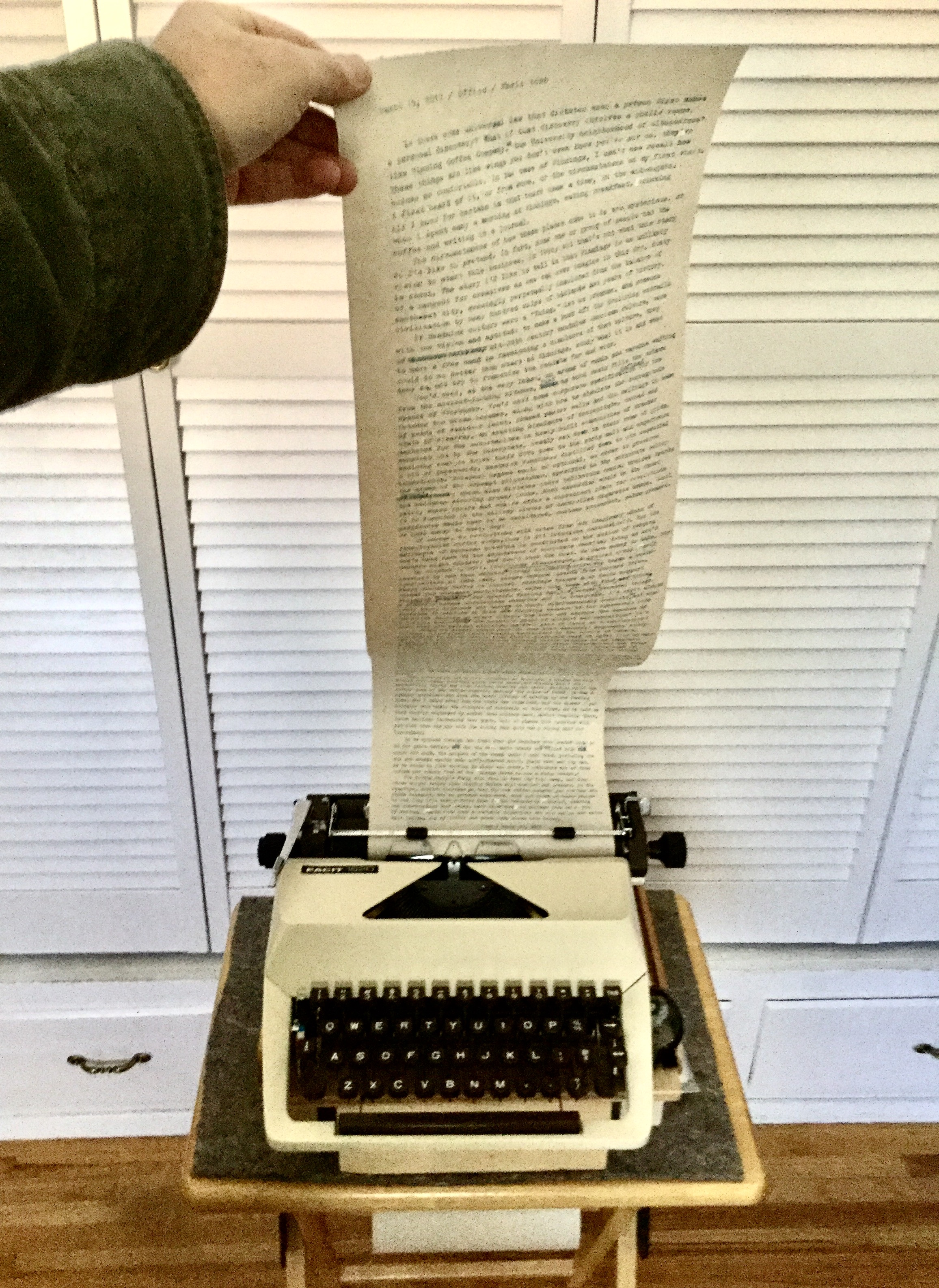
Post-Script: I enjoyed writing the first draft of this piece on the teletype paper roll using the Facit 1620. Spaced at 1.5 lines, the piece came to 31 inches.

'Personal Discoveries' Rough Draft, Facit 1620 and Teletype Roll

Labels: , , , , , , , ,

Monday, February 27, 2017

On the Other Side of the Lens

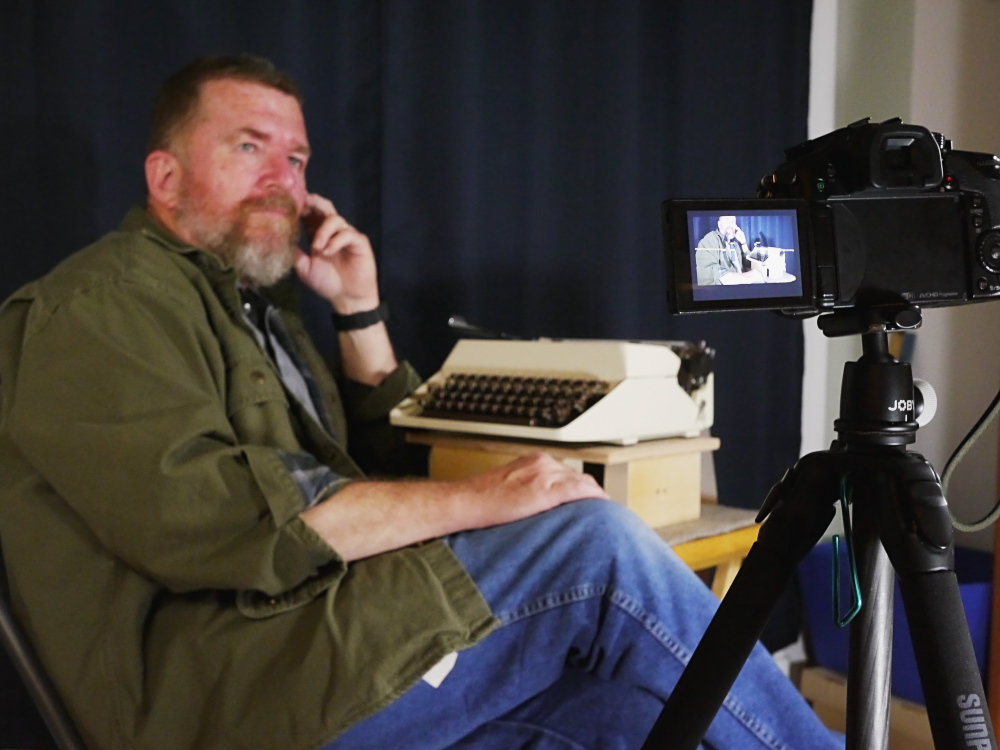
P1120697b

I have a couple of typewriter-related things to share with you today. The first concerns my seemingly perpetual and tenuous planning for what I hope to be the first ever ABQ Type-In. Since I first had an inkling about planning such an event, late last year, it seems I've dragged my feet, not quite knowing how to go about planning such an event. I needed to decide on a date, time and venue, while also needing some idea about how many people might be expected to show up with typewriters, which dictates the size of the venue.

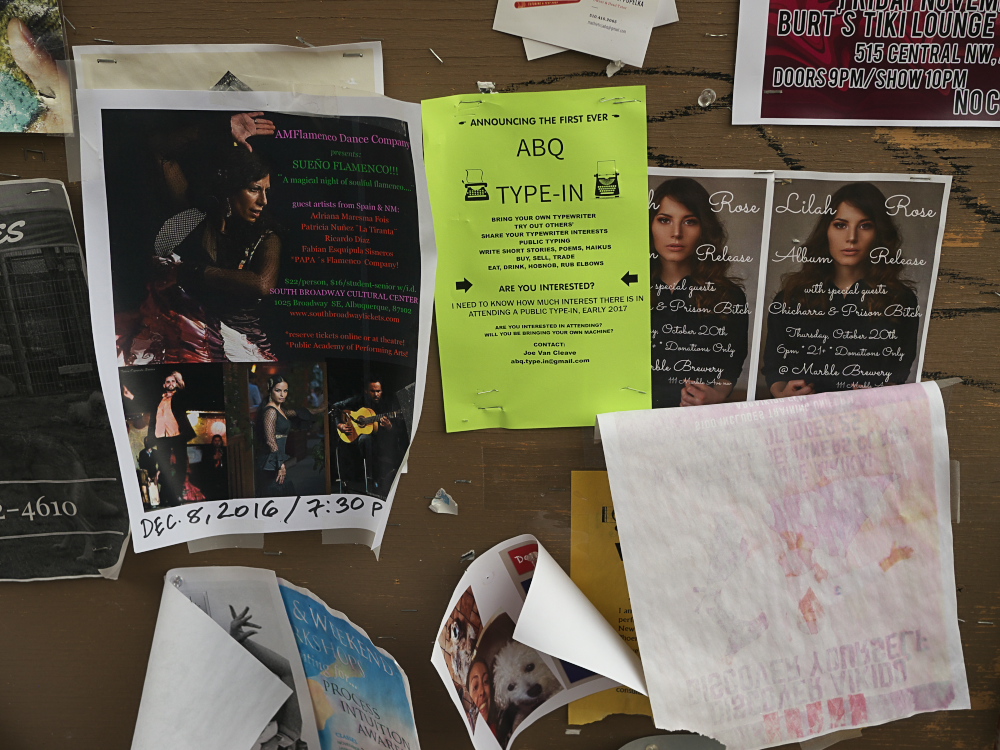
So earlier this year I put together a simple flier, soliciting interest in attendance, and posted it around town, hoping for the best. I've thus far received about a half-dozen replies to the affirmative.

I also created a gmail account for this project (abq.type.in@gmail.com), through which I put together an informational email packet about Type-Ins, to be sent in reply to any respondent to my fliers.

The biggest hurdle has been finding a suitable venue. I've visualized the event as taking place on a Sunday afternoon at a public place with food and drink, the kind conducive to creatives and the general public alike. I needed it to have some separate meeting room big enough for a sizable turnout (not knowing how many people might show up), yet able to attract people who might just wander in for lunch.

Initially I had limited my search to the area of Nob Hill and UNM, the part of town where one might expect to find creative peoples in mass, but I widened my search after realizing that the ongoing reconstruction of Central Avenue, due to the ongoing Albuquerque Rapid Transit project/fiasco, would hamper access and parking. I also wanted to avoid the time when the NCAA basketball tournament is being televised, while also wanting to avoid Good Friday and Easter weekends.

Then this last weekend I had lunch at Nexus Brewery, in north-central Albuquerque near I-25 and Montgomery, and discovered they have a suitable meeting room, a great selection of award-winning brews, and a good food menu, including the ever-popular chicken and waffles. So today I called their business office and was able to confirm a date and time, that being Sunday, April 23 starting at 1 PM.

I'm excited that this major hurdle has been passed. Now I have to wait on my graphic designer to finish the poster and fliers, and to get some media attention. I'm not a publicist by nature, so this is all new territory for me.

The second typewriter-related item to share with you is that last week I spent several hours at my home being interviewed by an Associated Press reporter for a story about the typewriter revival. He had found me through one of my fliers left at John Lewis's Mechanical Antique typewriter repair shop; where he was having one of his two typewriters serviced. I won't know for several weeks how the story ends up, or in what venue it will be published. During the interview we spent considerable time discussing my background and how I came into typewriters, and why I like and use them. He also was shooting video during this time, much more than taking notes (in a Staples-branded reporters notebook, for those of you office supply geeks). I don't know if the video will be used in some footage online, or if he uses the camera as an alternative note-taking device.

This week I got back to making another episode of my "Confessions of an Office Supply Junkie" series, this being about handmade letter envelopes. Since I'm engaged in several pen-pal correspondences, I use envelopes and preprinted address labels every week. I got to thinking that if I could make my own envelopes I could preprint the addresses via laser printer and dispense with the cost of labels. I ended up with a novel design that is folded from a standard letter-size 8.5"-by-11" sheet of paper, uses only two small cuts and is taped shut for closure. It ended up being just a bit larger than the so-called "6-3/4" small letter envelope size. I did a cost comparison, using for prices the Staples brand of copier paper and premanufactured envelopes. The paper is about 1 cent per sheet, while a premade envelope is around 6 cents per. Of course, the cost of a few inches of adhesive tape also has to be factored in; but it is still less expensive for this homemade version, even though it looks a bit novel in design (the term "novel" being a more polite alternative to "weird").

Speaking of YouTube videos, while I'm nowhere near being a heavyweight in the YouTube arena, I was heartened to see the Samsung commercial at the beginning of last Sunday night's Academy Awards telecast, featuring YouTube star Casey Neistat, who played himself giving a mock awards presentation in a dark, rainy, empty parking lot (implying the huge gap between established Hollywood personalities and us small-time YouTubers). His short speech honored all of us unknowns who follow our dreams of creativity through video production; unlikely to be walking down any red carpets in designer clothes anytime soon. Of course, it was a Samsung advertisement about mobile phone tech, we must remind ourselves - ultimately for commercial purposes, but I felt heartened by it anyway.

I'll keep you informed of any further developments pertaining to the upcoming ABQ Type-In. Happy typing and envelope-making.

Post-Script: Here's my video on handmade letter envelopes:


Here's a link to the Samsung commercial about us YouTubers:


Here's the link to Nexus Brewery's website.

Final thought: The lead photo in this post has me posed in front of my video camera setup (Lumix GH3), adjacent to the Facit 1620 typewriter. Even though the focus of the shot was intentionally directed at the screen of the GH3, with the background left soft, you might be able to tell that the Facit is sitting propped up on some kind of wooden platform upon a folding tray table . This was a cobbled-together contraption to get the typewriter at a more ergonomic position while seated in my office chair, whose height I didn't want to keep adjusting between my main desk, which is higher, and the tray table, which is lower. The platform is very stable, and the newer typing position is much more conducive to extended typing. This post's first-draft was composed using the new setup onto the roll of teletype paper. I would have made it a typecast, but I didn't want to interrupt my stream-of-consciousness typing with correcting my numerous typos; and I'm too self-conscious to post that messy of a typed sheet.

Labels: , , , ,

Tuesday, February 14, 2017

Type-A-Sketch

Writing_Flowchart001

Typecast274

Post-Script: See Typewriter Video Series Episode 56 for more on using the manual typewriter as a mechanical drafting machine.

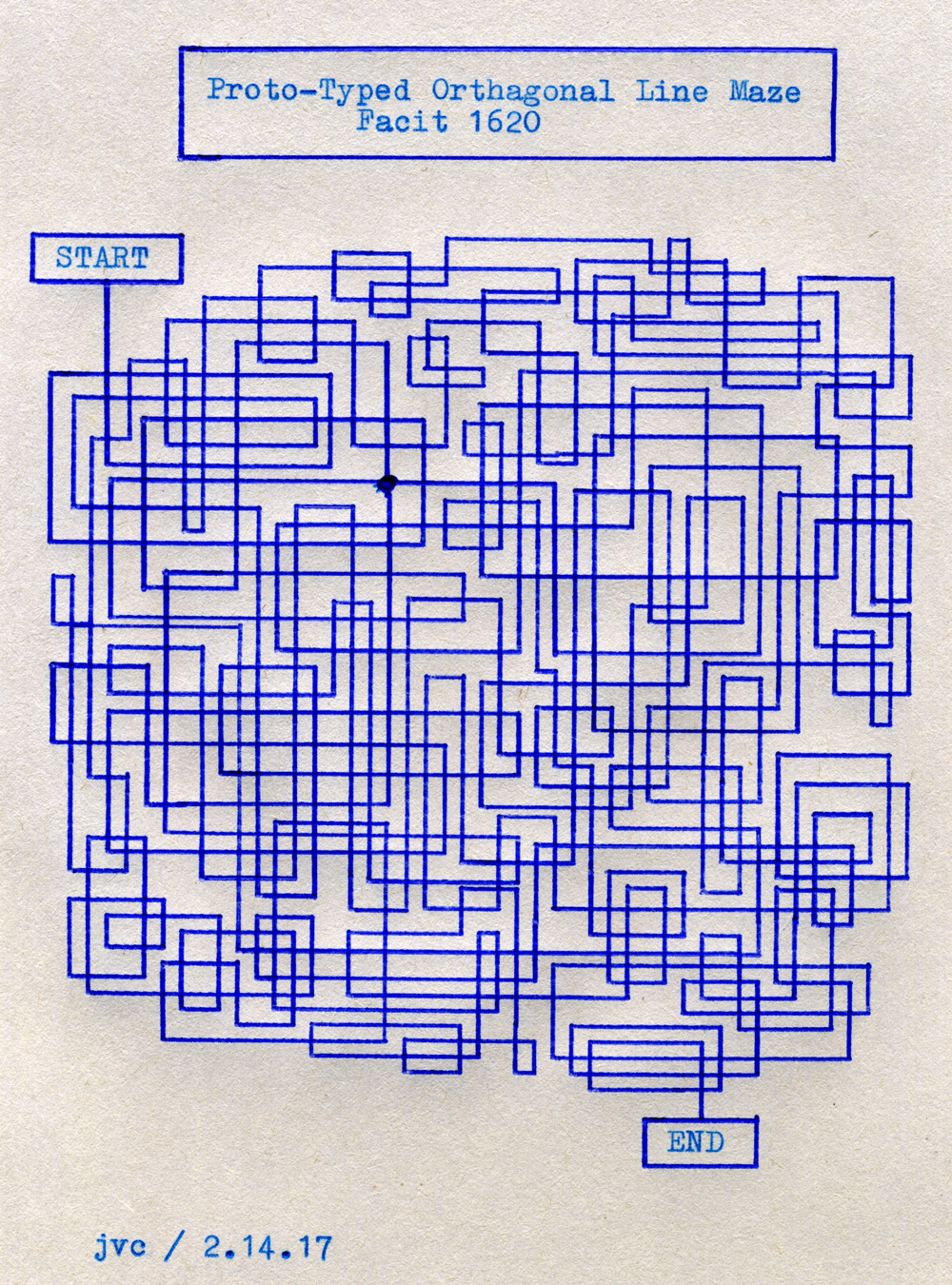
Here's the line maze I drew today, using the Facit 1620 and Bic Cristal blue medium point pen:

Facit_1620_001
As is the case with all of my so-called "line mazes," you follow the line itself, rather than the space between the lines. Conventional mazes use the space between lines as the passageway, with the lines to either side representing the walls of the maze. My line mazes are more like 3D routing diagrams. The lines cross over one another and don't make a turn until you get to an elbow (or corner); lines only connect to one another at a "node." There's only one node in this maze, the bold dot where four lines converge.

You might notice that I had to hand-draw the node dot; I tried typing an asterisk for the node, but the alignment between the typed characters and the pen holes in the paper guide of my Facit 1620 are not exact.

This was more of a test drawing than a really challenging maze. I find using a typewriter as a form of mechanical drafting machine is rather fun. The horizontal spacing of the vertical lines is governed by the character spacing as defined by the escapement mechanism; while the vertical spacing of the horizontal lines is governed by the ratcheting of the line advance mechanism. Thus, the smallest resolution you can draw - the closest the lines can get to each other - is limited by this mechanical, orthographic grid system of the typewriter's mechanism.

You can move the drawing point in any of four directions. Horizontal movements are done by either the space bar, the backspace key or manual movement of the carriage via the carriage release lever. It's best to draw from left to right (move the carriage from right to left), because backspacing causes the carriage to overshoot the end point, due to the nature of the escapement mechanism. Similarly, I find it better to draw vertical lines from bottom to top, since you can see more easily the drawing and where you need to stop.

If your typewriter has more than one notch or hole for a pen in the paper guide, it's best to choose one and stick with it, since the two holes or notches might not be exactly aligned to the grid system of the mechanism, or each other.

I used a ballpoint pen for these drawings, but another type of technical drawing pen would be preferred. As well as better quality paper than the newsprint-quality teletype paper roll I was using.

If you have a wide-carriage machine, this would be ideal for drawing landscape-oriented illustrations on full-sized paper.

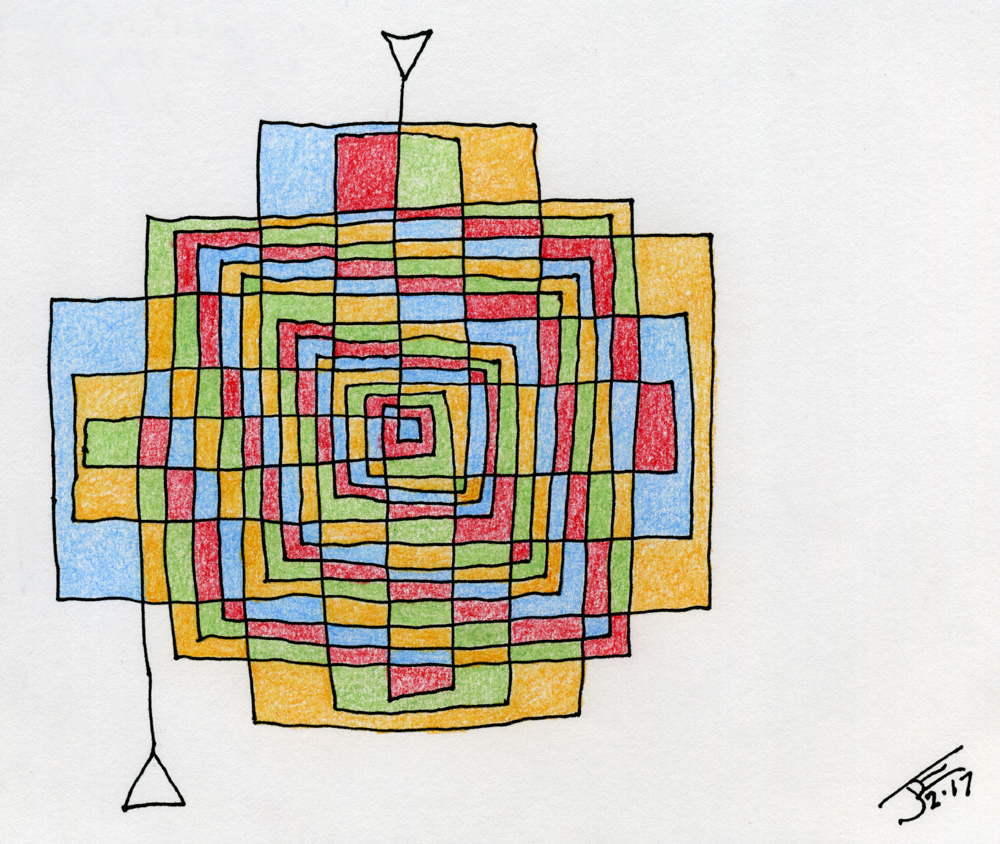
Bonus: Here's a line-maze version of a labyrinth, hand-drawn. It could have benefited from the orthographic alignment of the Type-A-Sketch, so as to make the lines much straighter. Being a labyrinth instead of a maze, it only has one passage, so you can't get lost. Start at either end. As with all line routing networks, the lines cross over one another without connecting. Lines go straight until they bend at an elbow. I rather enjoyed coloring the various cells in. My personal rule is two adjoining cells can't have the same color; similar colors can only touch at their corners. Oh, the title of this piece is "Centripetal Labyrinth with Hysteresis, 1.0." Don't ask me why. I think it has something to do with the way the lines converge on, then fly away from, the center point, like a comet in a highly elliptical orbit. As with all "art-speak," it only really matters to the artist, and the academic community. In this case, there's only me, since no one would seriously consider this to be "art."

Labyrinth001

Typecast via Brother Charger 11, lap-typing in the front courtyard on a cold day.

Labels: , , , , ,

Sunday, January 15, 2017

The Joe Show?

P1120527a
Typecast271

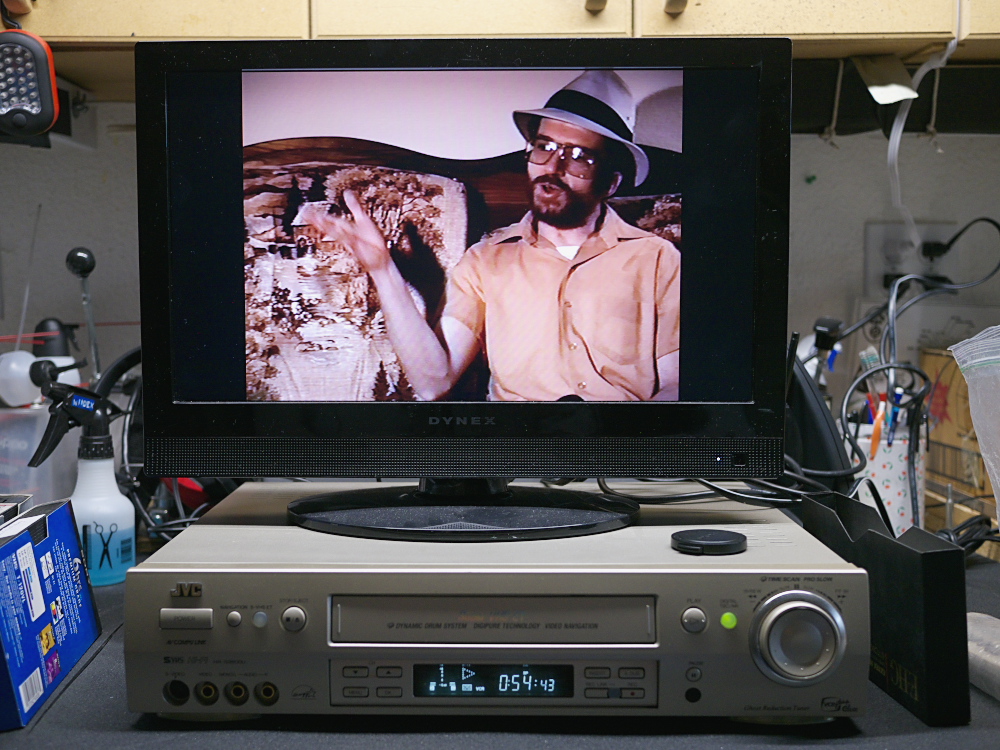
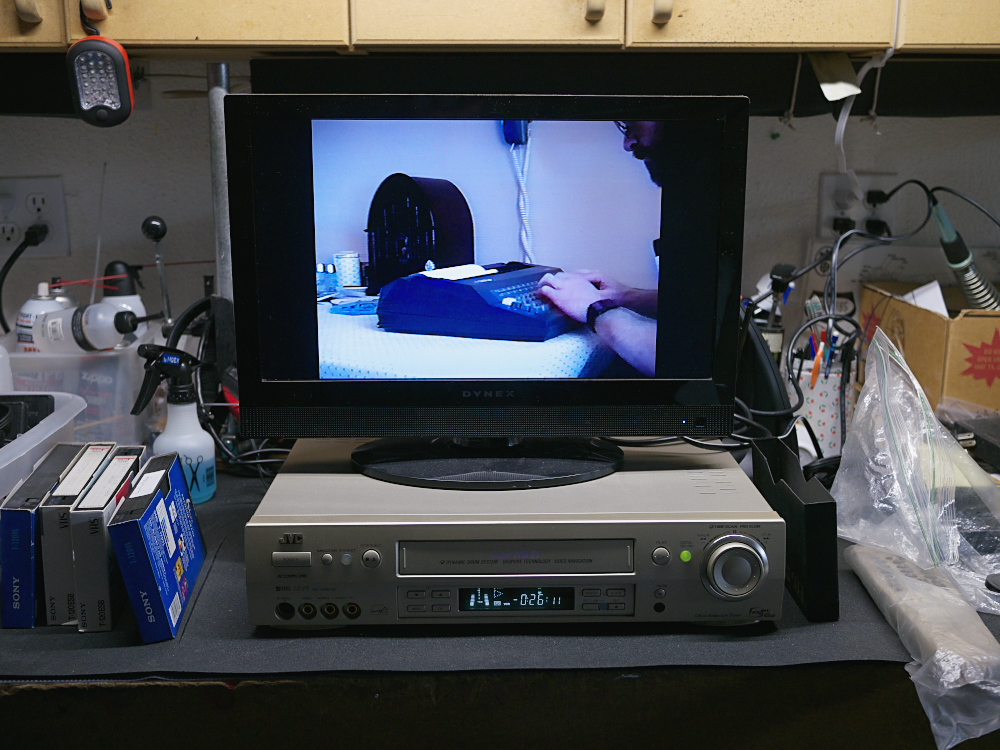
Post-Script: See the screen shot in the top photo? That's from a frame grab of a VHS tape compilation of The Joe Show, circa 1991. Was I actually wearing a salmon-colored shirt? And what's the deal with that funky hat? And those glasses ... I've seen better looking safety goggles. Boy do I remember that old couch. I think it was from Country Dan's. Massive wooden construction. Country-motif pictorial illustrations on the cushions - that never stayed put, always slid down and fell behind the back frame of the couch (notice the cushion behind me has already slipped down) and had to be continually adjusted. I was also a lot skinnier back then; so was everyone.

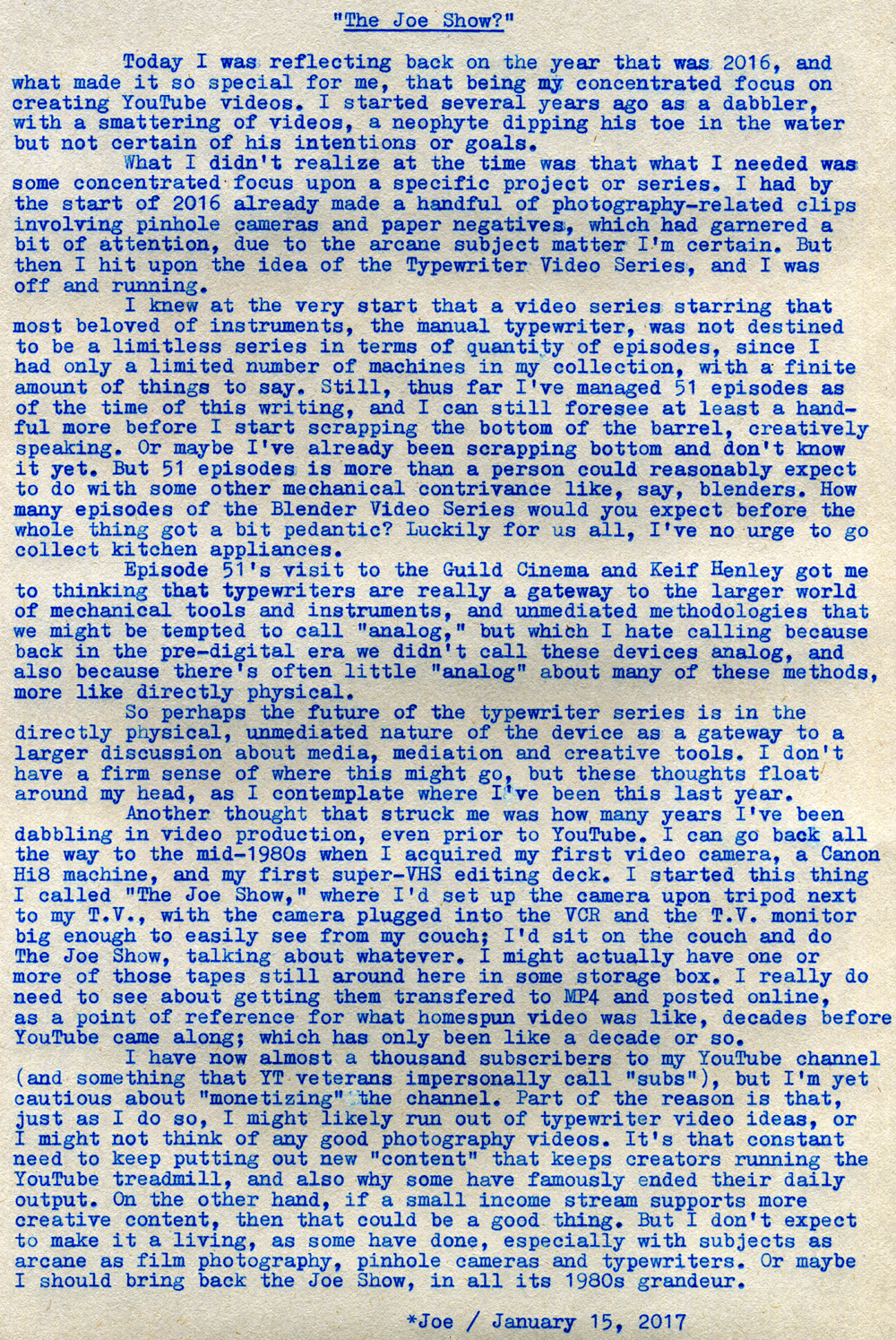
Here's more Joe Show goodness. First one of the intro graphics. My old Canon Hi8 camcorder had a feature called "matte," permitting you to take a matte shot of something, in this case hand-written titles, and overlay them, in a selection of colors, atop live video. Here the background was a Christmas greeting card.

P1120530a

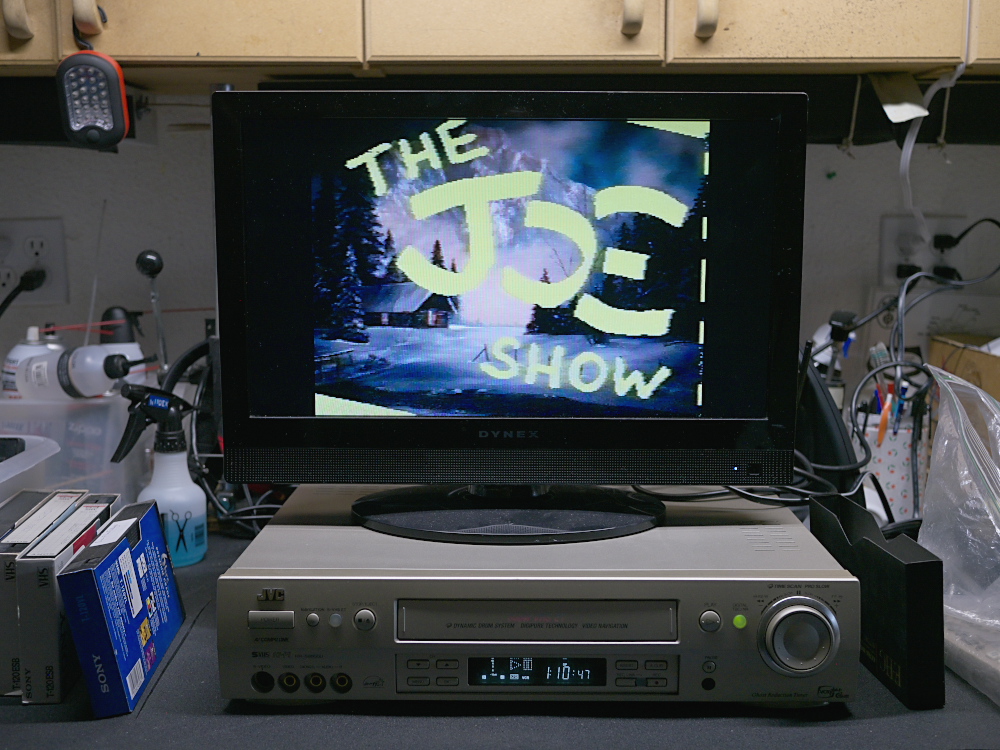
Next is from a different episode, me in a different shirt and hat (what the heck's the deal with the hat? And why does it look too small?) with my friend Bob, a co-conspirator. Notice the handheld microphone, which I still have to this day.

P1120532a

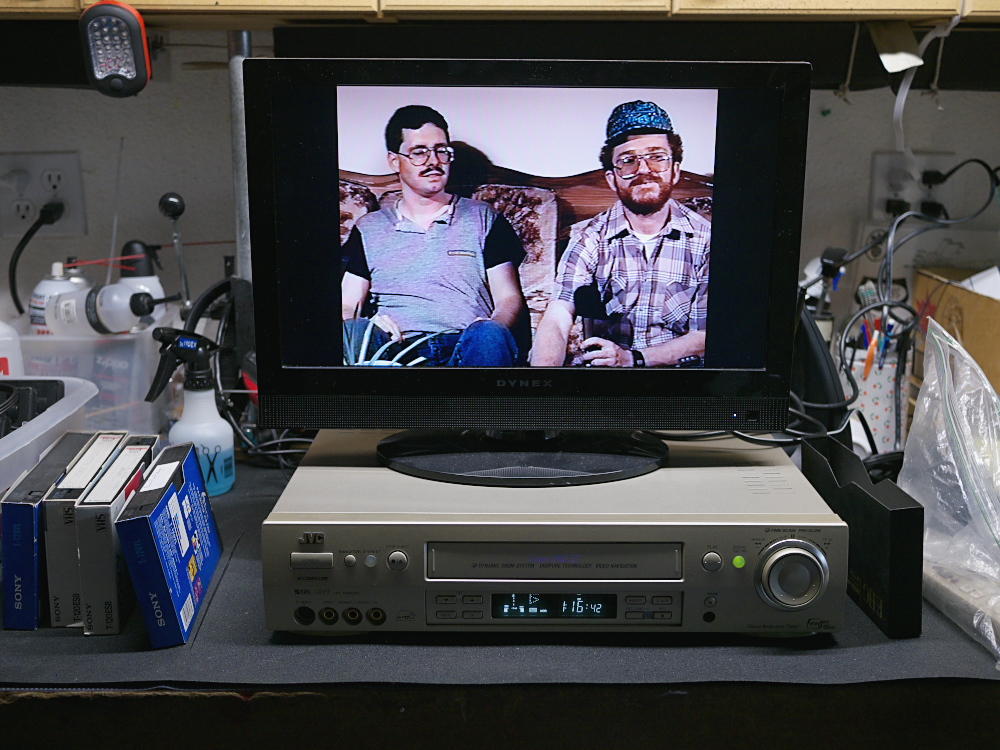
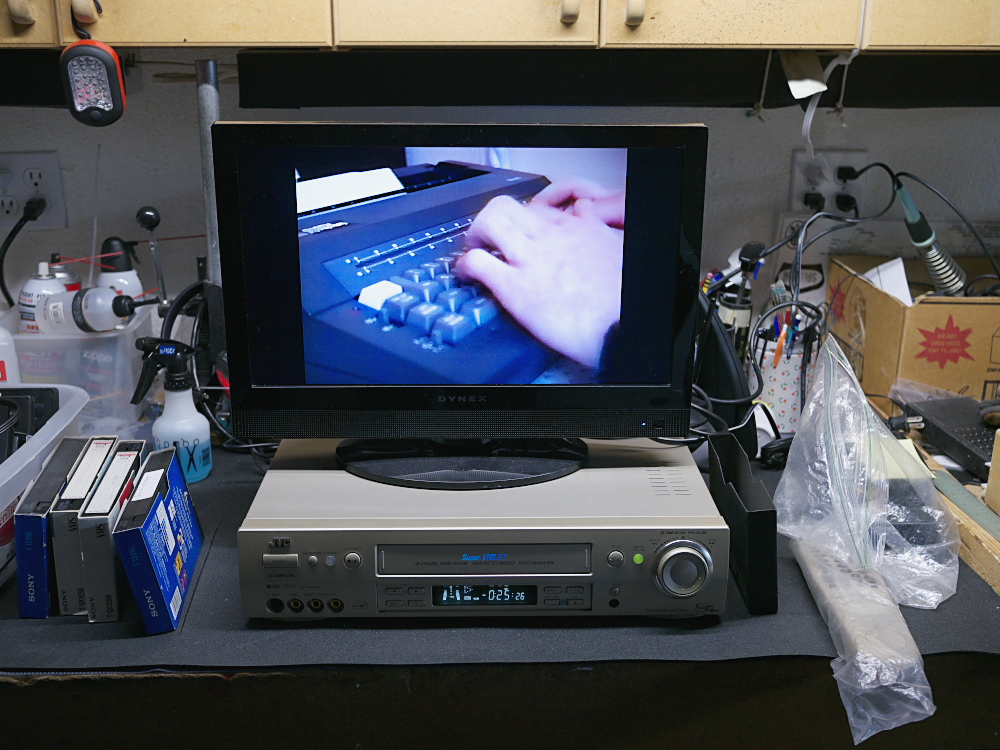
These next two frames are from a little "drama" I made, some Z-grade spy drama that was really an exercise in montage and editing, using my then-newly-acquired JVC editing VCR. Note my newer JVC is what I'm using to play back the tape; it was purchased in 2001 and is still like new. These two shots are of my Smith-Corona 100 daisy wheel electronic typewriter. This clip is historically my very first typewriter video.
P1120534a
P1120535a

Watching a handful of these old productions was a bit painful, not only for how dorky I looked back then, but the production values were pretty low. Kind of like a bad SNL skit, absent the talent. Perhaps I'll get one transferred and uploaded to YouTube, for all to enjoy.

Semi-nongratuitous plug to my YouTube Channel, in case you haven't yet visited.

Labels: , , , , , , , ,

Monday, January 09, 2017

Leaves of Winter

P1120519a
P1120525a

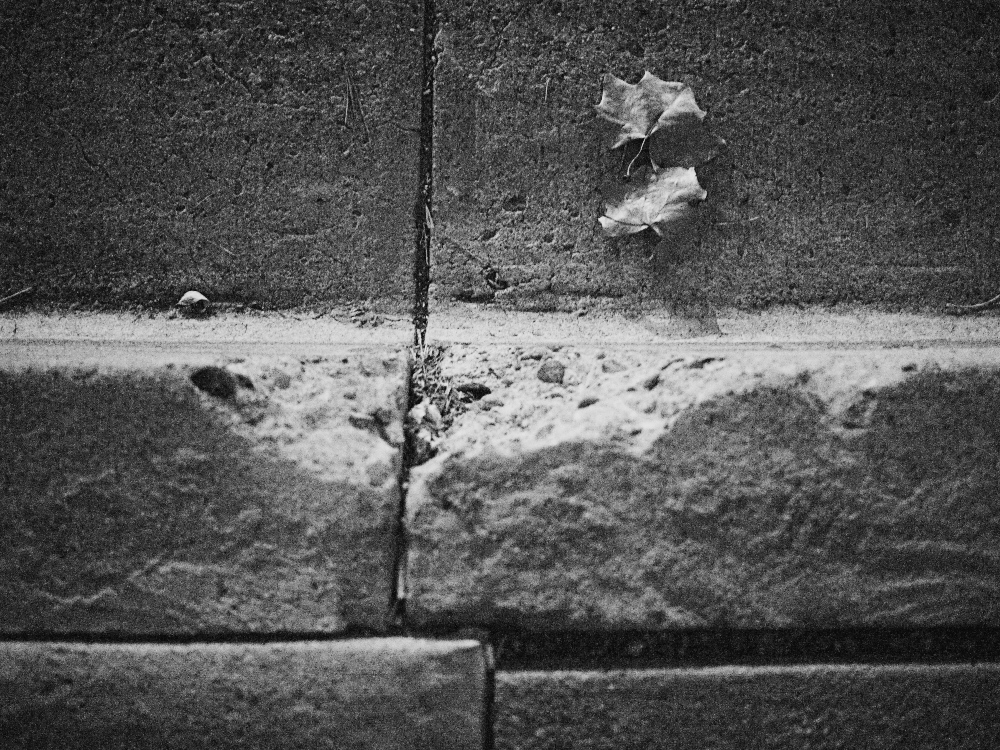
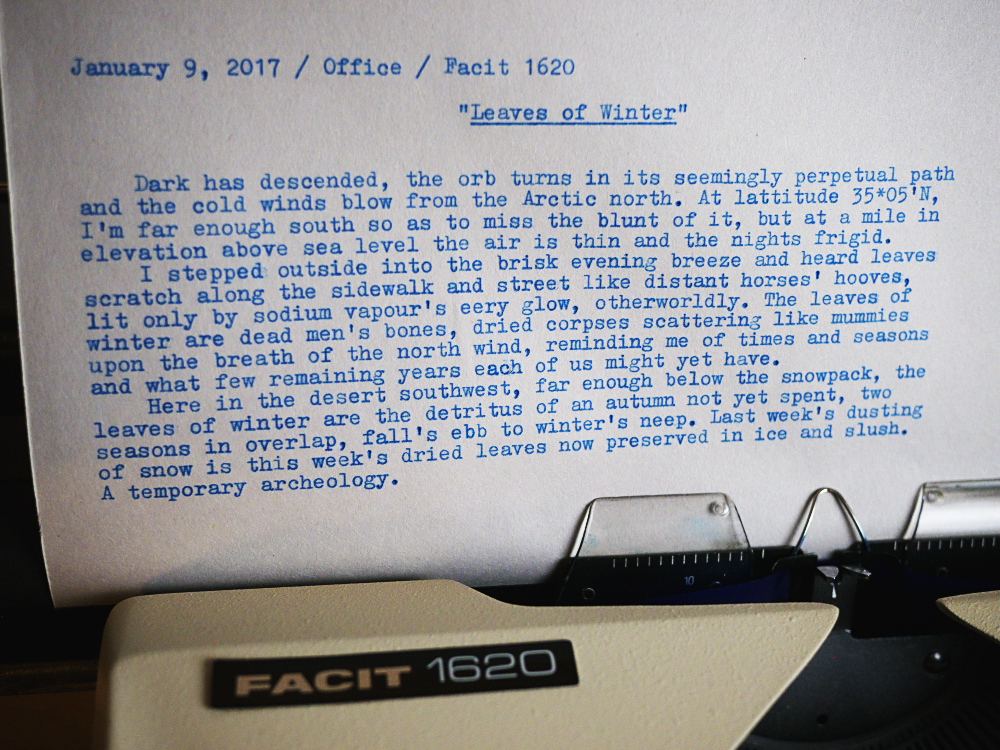
Post-Script: Sometimes, in order to remain spontaneous, a person has to grab their antiquated dig-it-al camera and go out in virtual pitch-darkness at 8 PM on a January night, with the winter's wind howling and lit only by the dim glims of a sodium vapor light across the street, and make an ISO 12,500 exposure, then remove the color noise and give it some feeling of gritty, monochrome, film-like artiness on the compooter by fiddling with the tone curves. And I was too lazy to fire up the old scanner, so a shot of the typed piece still threaded in-carriage will have to suffice. This is called "arte" in some circles. But probably not here.

Labels: , ,

Wednesday, December 07, 2016

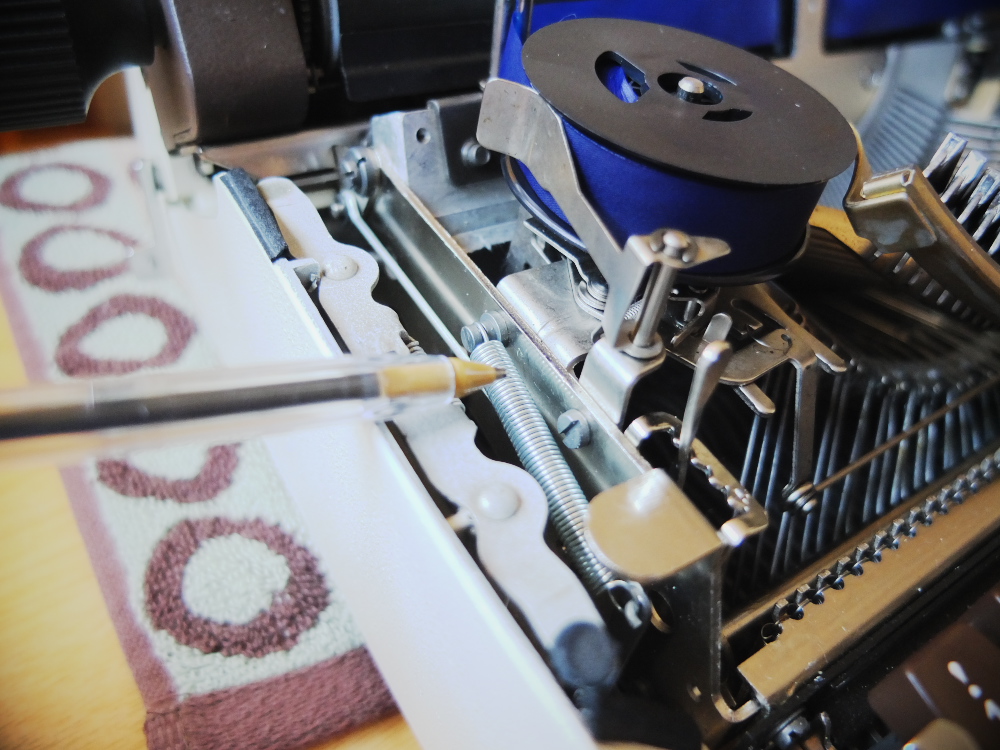
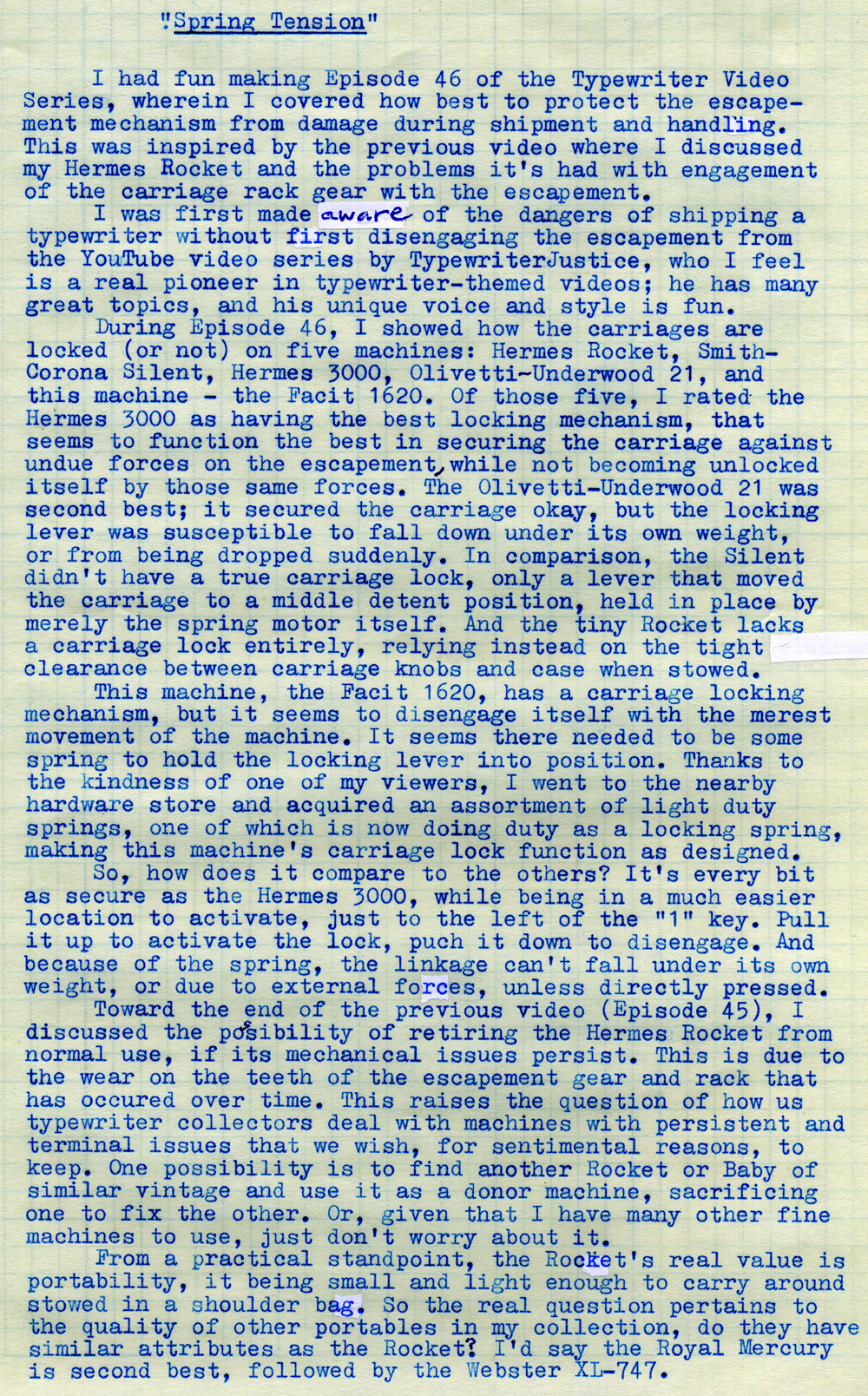
Spring Tension

DSCF5142a
Typecast267

Post-Script: Here are links to the videos mentioned above:

Episode 45, Hermes Rocket:


Episode 46, Escapements:


Here's a link to the TypewriterJustice channel on YouTube, a great typewriter resource.

Photo via Fujifilm X10. Typecast via Facit 1620.

Labels: , , , , , , , , , , ,

Sunday, December 04, 2016

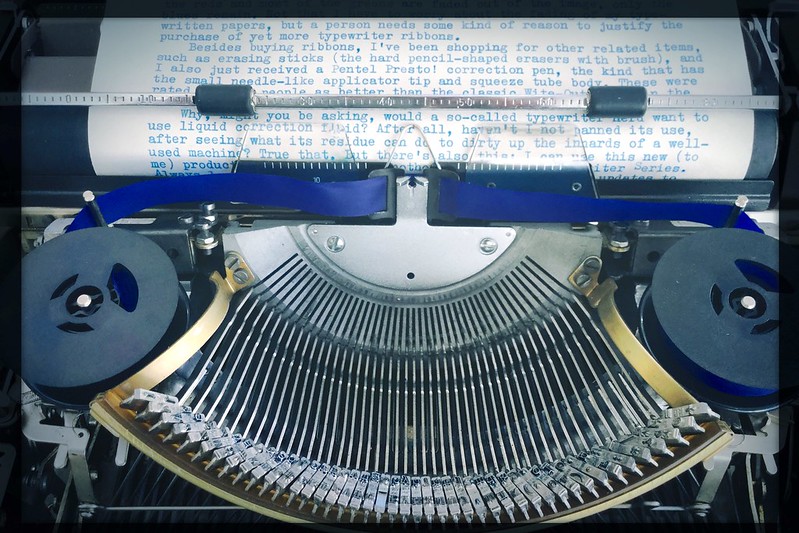
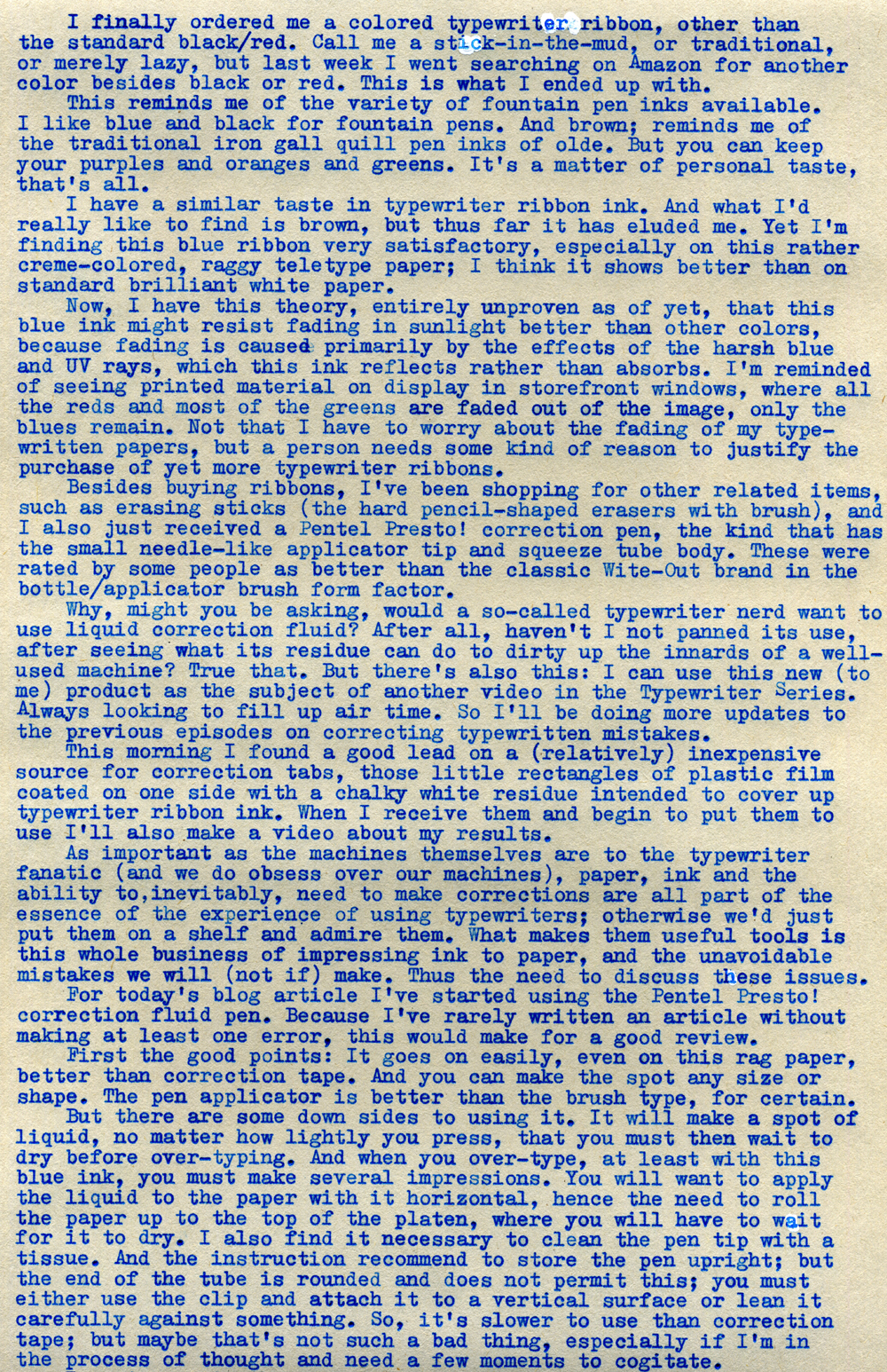
Typewriter Blues

Typewriter Blues
Typecast266

Post-Script: One effect of typing on the roll of teletype paper is getting long-winded, like I'm apt to do, and not having room on my flatbed scanner to get the title and signature in one scan.

I like this blue ribbon, it's darker than I thought it would be at the time of order. As I indicated in the piece, the slightly yellowish tint of the teletype paper works well with blue, since they're complimentary colors, if I recall.

I'm not yet sold on the idea of liquid correction fluid, even if it is dispensed in this neat applicator pen. It's certainly slower to use, and requires care to avoid a mess. Yet this teletype paper does not work at all well with any of the brands of correction tape I've tried. So perhaps for this specific paper I'll continue using it for a while.

It's been fun working with these varieties of correction methods, something essential if we are to continue typing via cloth ribbons to paper; or, become entirely faultless in our typing technique (that ain't happening!). I am looking forward to using the correction tabs.

Typecast via Facit 1620.

Labels: , , ,

Monday, November 28, 2016

Rituals of Re-Enactment

P1120401a
Typecast265

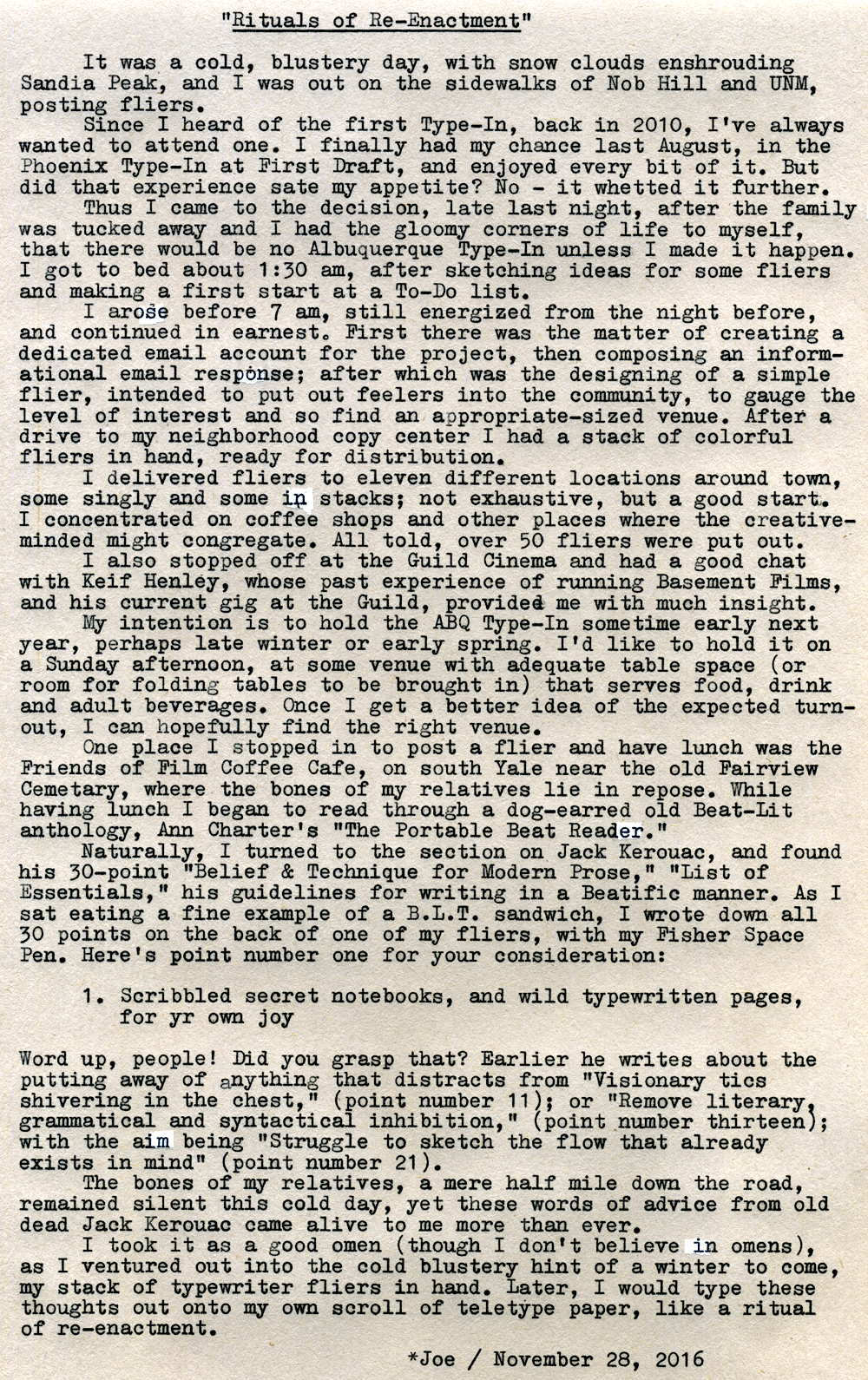
Post-Script: I'm a newbie to this whole organizing an event thing, so I've lots of learning in store. But there are some good resources available, such as Ted Munk's excellent Type-In page.

Albuquerque's a funny town. It's hard to predict the response to a Type-In event. News of popular fads and new customs seems to travel here slower than one might expect, inland from the west coast to the high desert. We're usually a few years behind everyone else when it comes to popular culture; although the Internet-based media has helped to reduce the delay.

In my rounds today I stopped in to Field and Frame for a roll of black gaffers tape and talked to Alan Fulford about my ABQ Type-In fliers. He was interested, and permitted me to leave a few for his customers. He also mentioned he had several manual typewriters in the back room. I took a look at one, an Olivetti Lettera 35, that has dirty type slugs and needs a new ribbon. I'm going to bring one by on my next visit, with perhaps a little kit to service his machine. He also has (are you ready for this?) an Olympia SG-1! OMG! It turns out that Alan tweets typewritten poems to his friends. Who woulda thunk?

Typecast via Facit 1620.

Labels: , , , , , , , ,

Monday, November 21, 2016

Another Tabletop Tripod

P1010460a
Typecast199

Post-Script: Bonus Image:

P1010461a

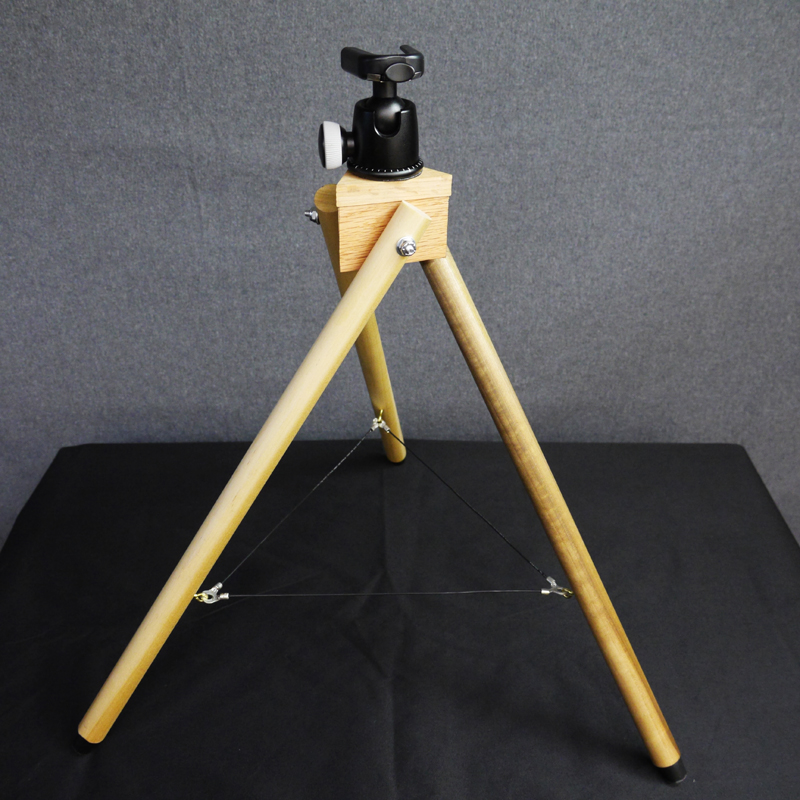
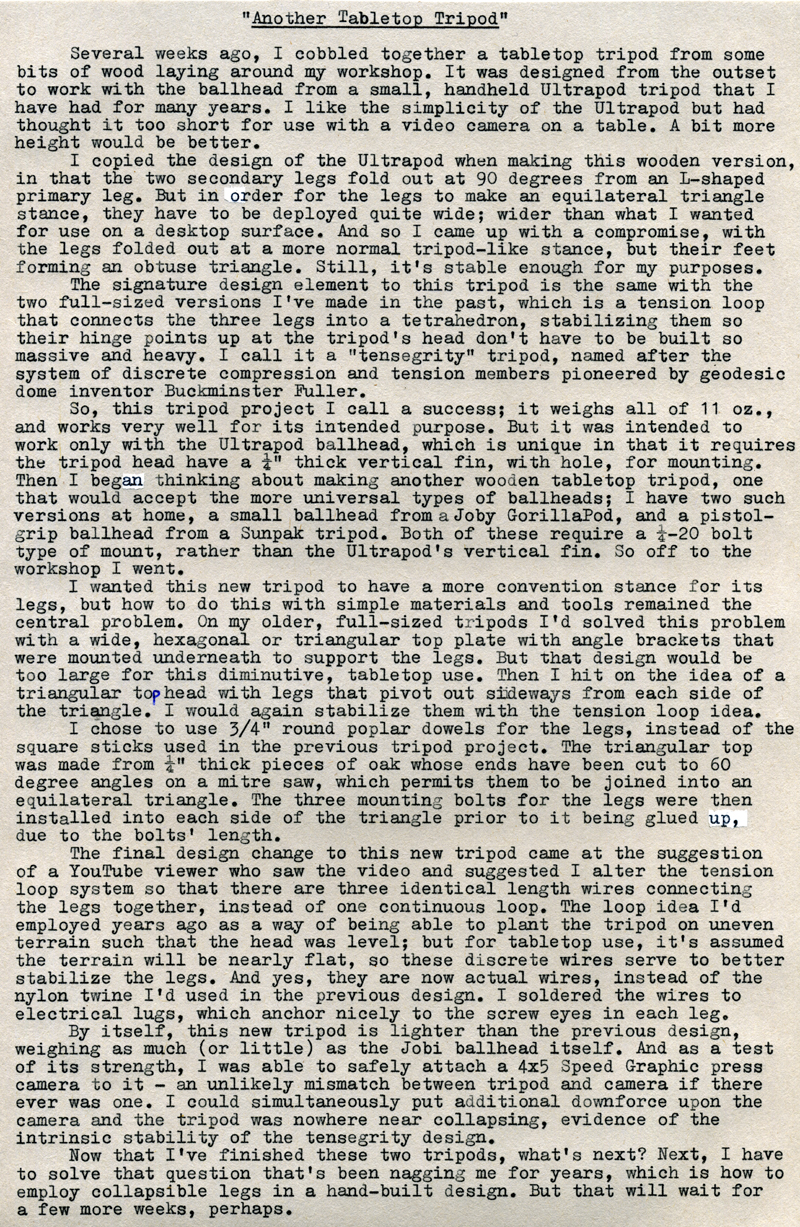
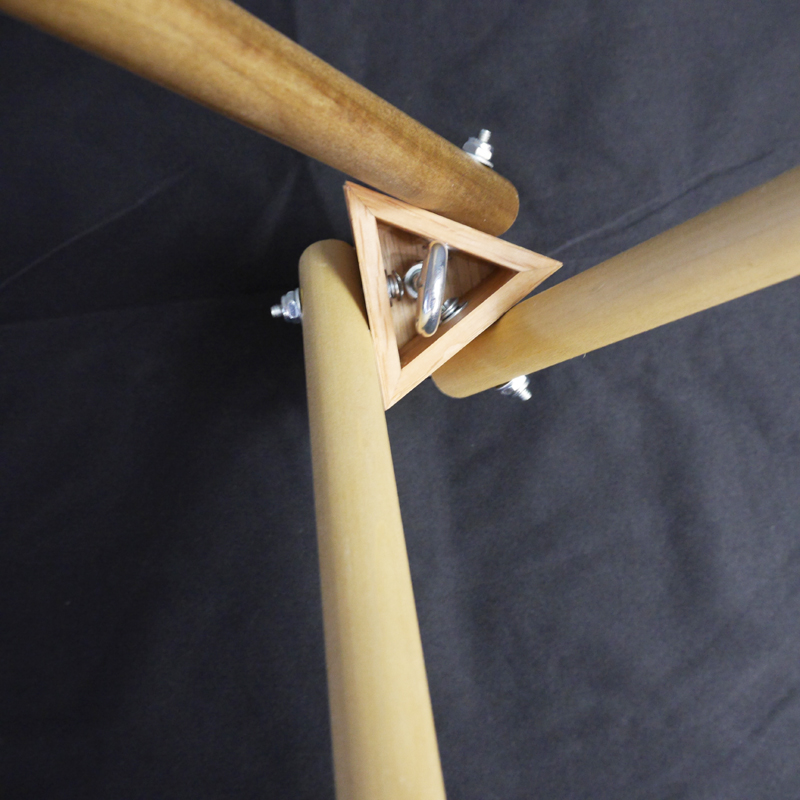
Now that I've altered the design with discrete tension wires between each leg, this new design is more stable atop a table. I think for the full-sized tripods, intended to be used outdoors on potentially uneven terrain, having the continuous loop system works better to help level the tripod head. Here's a video describing how they work.

Here's the video about my first tabletop tripod design:


And here's the video on this latest version:


Typecast via Facit 1620. Pronounced like "faucet" (I think).

Labels: , ,

Monday, November 14, 2016

Facit 1620

Facit 1620
Typecast198

Post-Script: Finding this machine was a pleasant surprise. Finding it for $8 was even better. And finding out that, after being serviced, it types remarkably smooth and clear was an added bonus. This initial round of typing impressed me even more, especially the smoothness of the carriage return, as it uses a peculiar design of tubular bearing housing with radial ball bearings mounted inside a large diameter tube.

Be sure to check out Episode 42 of the Typewriter Video Series for details on how I serviced this machine back to life.

Labels: , ,