Monday, January 28, 2019

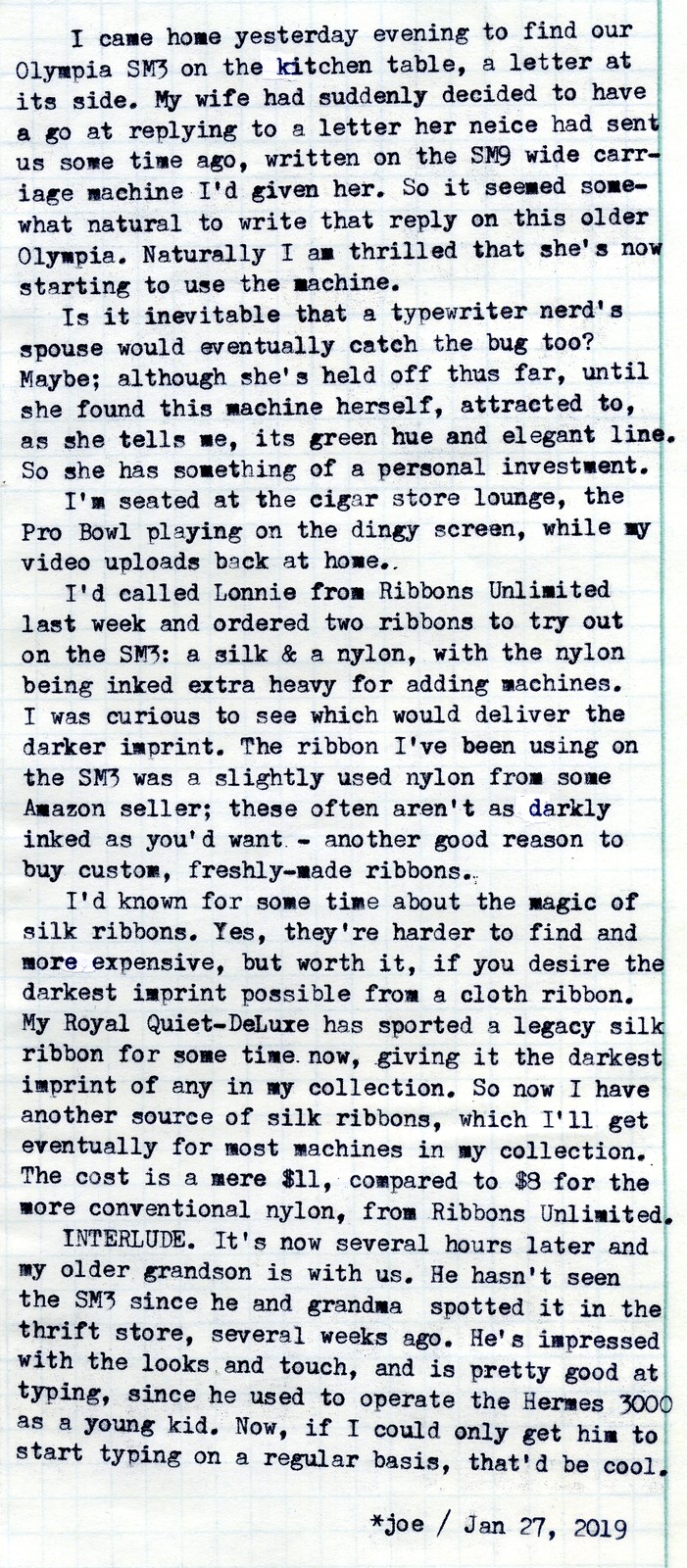
Sporting Silk

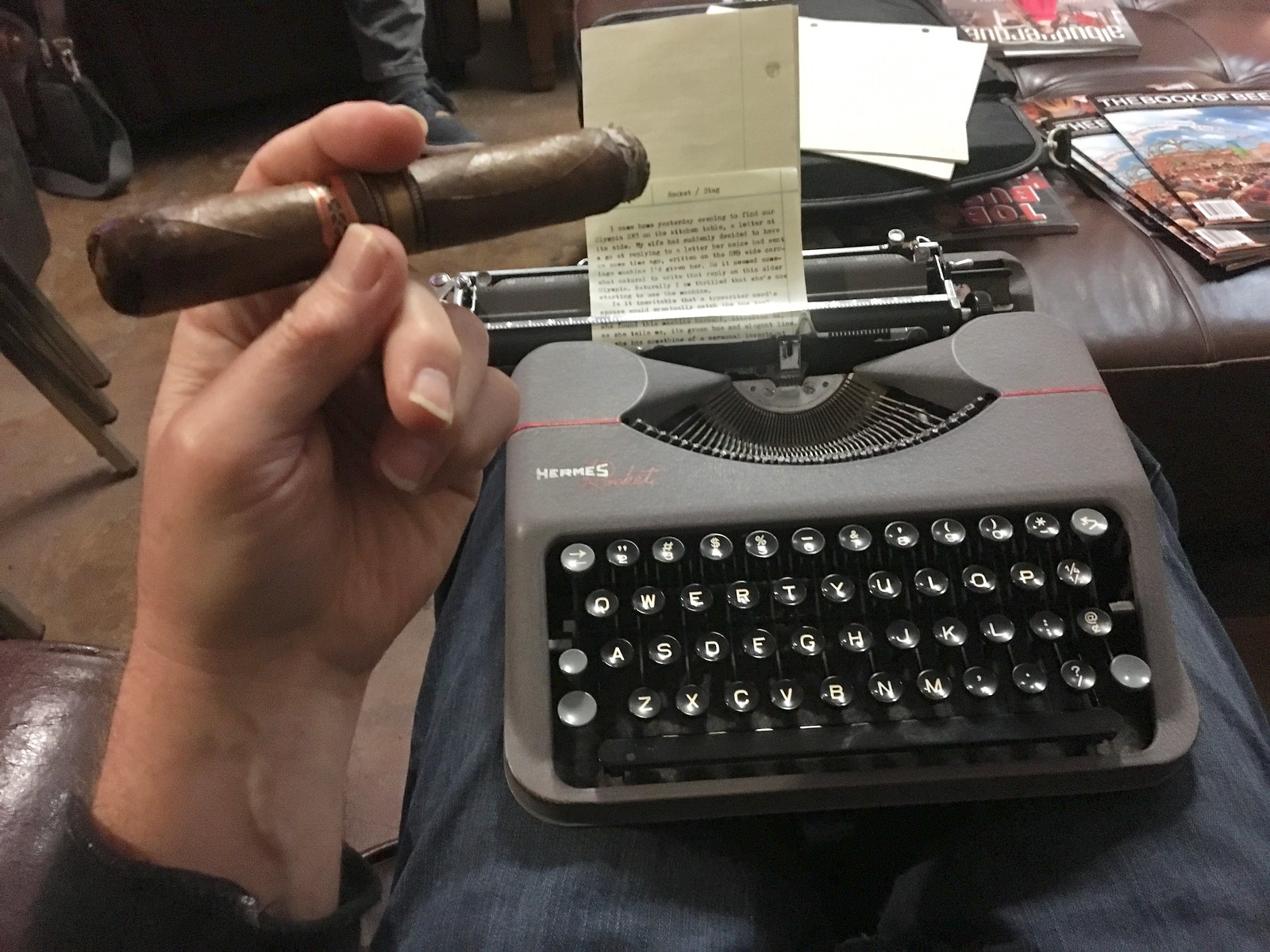
Hermes Rocket at Stag Tobacconist
Typecast080

Post-Script: Of course, I haven't tried every ribbon supplier out there, so there's more exploration to do. One of my YouTube viewers suggested an Etsy supplier of cotton ribbons, which I'll have to try out and review. Another suggested FJA Products, another good supplier.

Blog articles like this one aren't spectacularly informative, but they do represent the ongoing lifestyle of a typewriter aficionado, living with these machines, taking them to the cigar store lounge to write a blog article about taking a typewriter to the cigar store lounge. Self-referential, yes; but I think it's an important aspect of typewriter culture, documenting how we live with, and use, these mechanical wonders, mundane as that might seem.

On a technical note, I like to fold this green engineering paper in half when typing a narrow column for this blog, especially with the Rocket's 13 CPI typeface. So the left edge is creased and the right is open, when threaded through the platen rollers. But the right side must have fed faster than the left, because in the scan you can see the lines of text start out at the top slanted toward the left and end up slanted toward the right at the bottom of the page. Probably some subtle pressure roller issue in the carriage, but nothing that's going to keep me up at night. I should be just left the paper unfolded and used a backing sheet.

In the resulting video, linked below, I have some wonky audio issues, caused partly by a weak battery in my dynamic mic's preamp, which spoiled the video's overall quality, since audio is so important of an aspect to video. I tried to even out the clips' levels, but it's still rather awful. I need to take better care next time.

I have a number of video projects needing to be made, but my time these days has been occupied with edits and rewrites for my Cold Hard Type short story project. I've also been holding off on another typing assignment until the deadline has passed, because I know a number of participants to the series that are also in the midst of writing their Cold Hard Type stories.

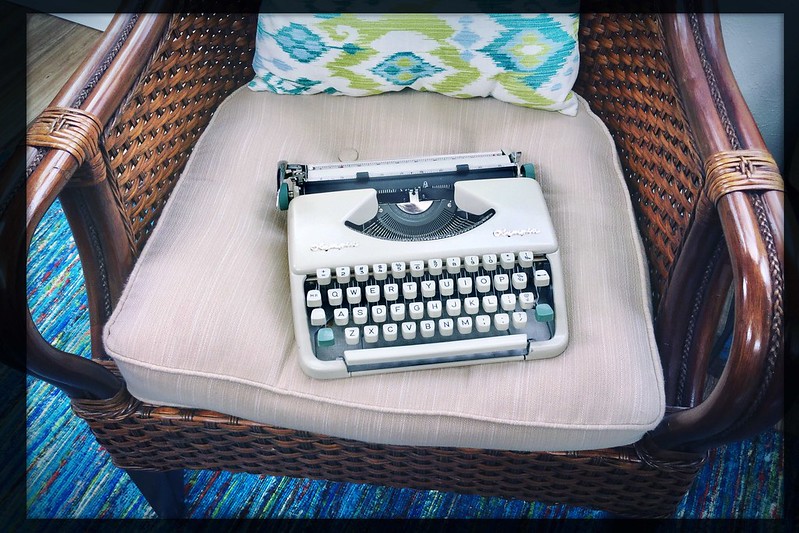
Last night I spent hours typing changes to the story on my Royal QDL, while today I once again broke out the Olympia SM3 to type a neat copy incorporating all the changes thus far. While the Royal is a darned good machine, the SM3 is yet a cut above.

I hope to get one more video done this week. Wish me luck, and that the quality will be up to par.

Labels: , , , , , , , ,

Tuesday, November 06, 2018

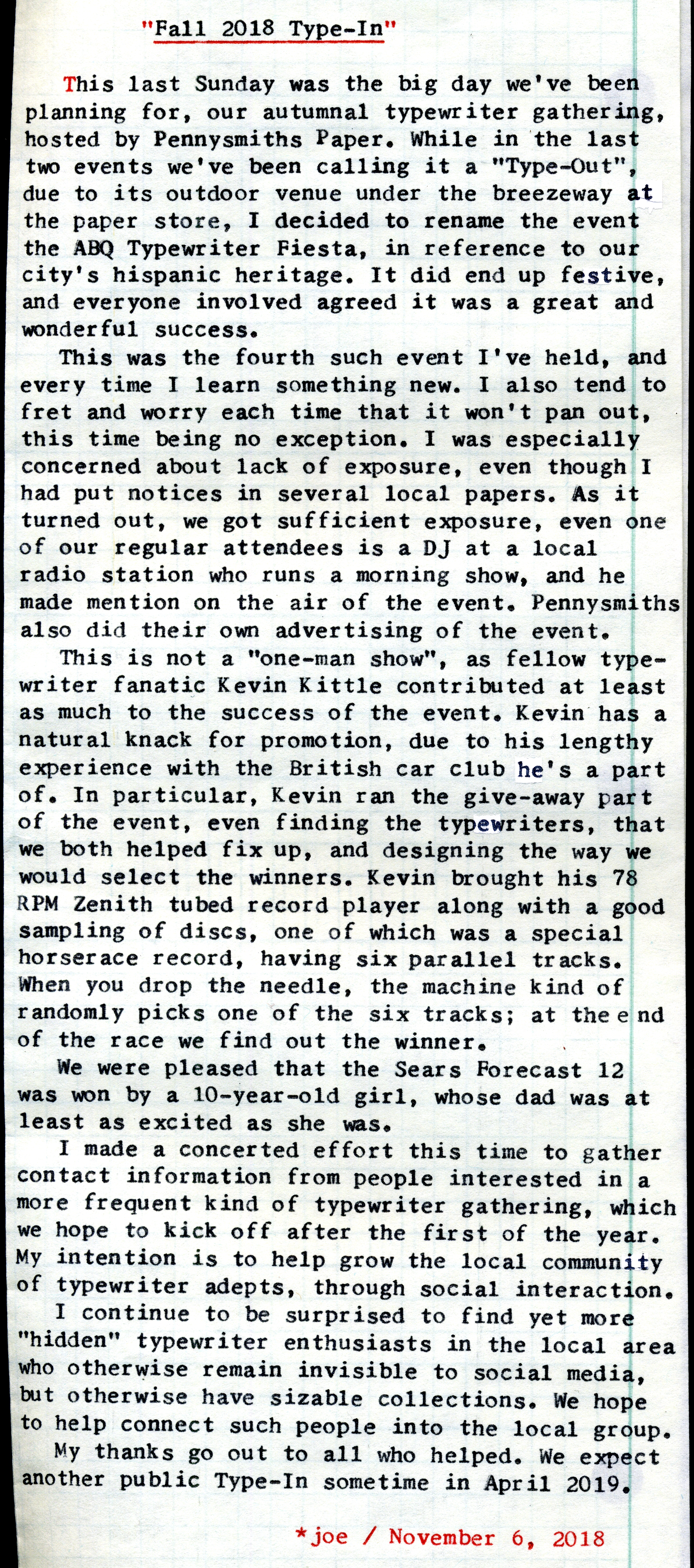
Fall 2018 ABQ Typewriter Fiesta


Typecast058

Post-Script: Months ago, I'd started recording footage intended to be used in a video about the behind-the-scenes planning that goes into organizing a typewriter event. I'm not sure I'll make that video, as the quality of the footage is subpar, but at least I have those scenes available for personal reflection. I do want to eventually make a how-to video, as I'm certain there are others out there who want to organize a typewriter event in their area and perhaps don't know where to start.

We had a sizable assortment of electric machines this time, including an IBM Selectric II; Olympia Report Electronic; 5-series Smith-Corona Electric; 6-series Smith-Corona Coronet Automatic 12; Smith-Corona daisy wheel from the 1980s; and an IBM Wheelwriter. The electric machines seem to attract "ordinary", non-enthusiast people, as many of them make comments that they are reminded of high school typing classes.
As indicated in this video (see embedded link at the top), these Type-In events have seen mainly "regular" folk from the community attend, who might have a casual interest in typewriters but wouldn't necessarily be considered part of the Typosphere, or typewriter fanatics. Therefore I tend to choose machines for the event that are better suited to novices, reliable workhorses, rather than more exotic or fragile specimens, such as my Rooy. But I'm hoping in the next year we can begin to grow a more typewriter-focused social group in the community, with more people participating in organizing these events.

Having said that, I continue to be amazed at finding "hidden" typewriter collectors in the community, people who may not be connected via social media to the larger Typosphere. One such gentleman showed up early for the event, an elderly man and his wife, who's been collecting for many years and retains almost 30 machines. Would the term "crypto-typer" be appropriate? Hmm, perhaps I've just made up a new word. I look forward to making connections with more such crypto-types in the coming months.

Our friend Jerrel showed up again, this time with a handful of standard uprights, including his latest, an L.C. Smith. He's quite a young man for having such a collection of older machines. I look forward to seeing what he does in the coming months.

As I observed ordinary people from the community interacting with these machines, it once again had me thinking about the lifecycle of typewriters, and the intrinsic fragility of the remaining fleet of machines still out there. There seems to be a growing interest in them, fueled by events such as this, yet the total number of machines isn't being supplanted with newly built machines of acceptable quality. So it will be natural to expect them, in the coming years, to become more rare and valued. I hope we can save as many of them as we can for posterity.

A big thank you goes out to Kevin and Andrea Kittle, and the staff at Pennysmiths Paper, for all the help they provided in planning this event. I'm looking forward to the April 2019 event.

Typecast via Adobe Rose.

PPS: I wanted to talk about blogging, and specifically Blogger. I've been having problems leaving comments on other Blogger-based typewriter blogs. Maybe it's my computer, or browser (Safari), but many such blogs only offer a "Google ID" login, which doesn't work for me. Other blogs offer an option of a name/user ID login, which does usually work. From mobile iOS devices, I usually can't leave a comment on a Blogger-based blog, even when properly logged in to my Blogger account. I have no such issues when commenting to WordPress-based blogs, as long as I log into WordPress first.

Perhaps this is a tinfoil hat rant, but is Google trying to kill Blogger, or merely allowing it to decay into irrelevance? Or maybe I just need to try another browser? Despite the preponderance of social media like Basefook, I still find blogging to be far superior, for what we need it to do. Let me know in the comments below what you think. If you can leave a comment, that is!

Labels: , ,

Tuesday, June 12, 2018

Albuqwerty Type Writer Society Meeting

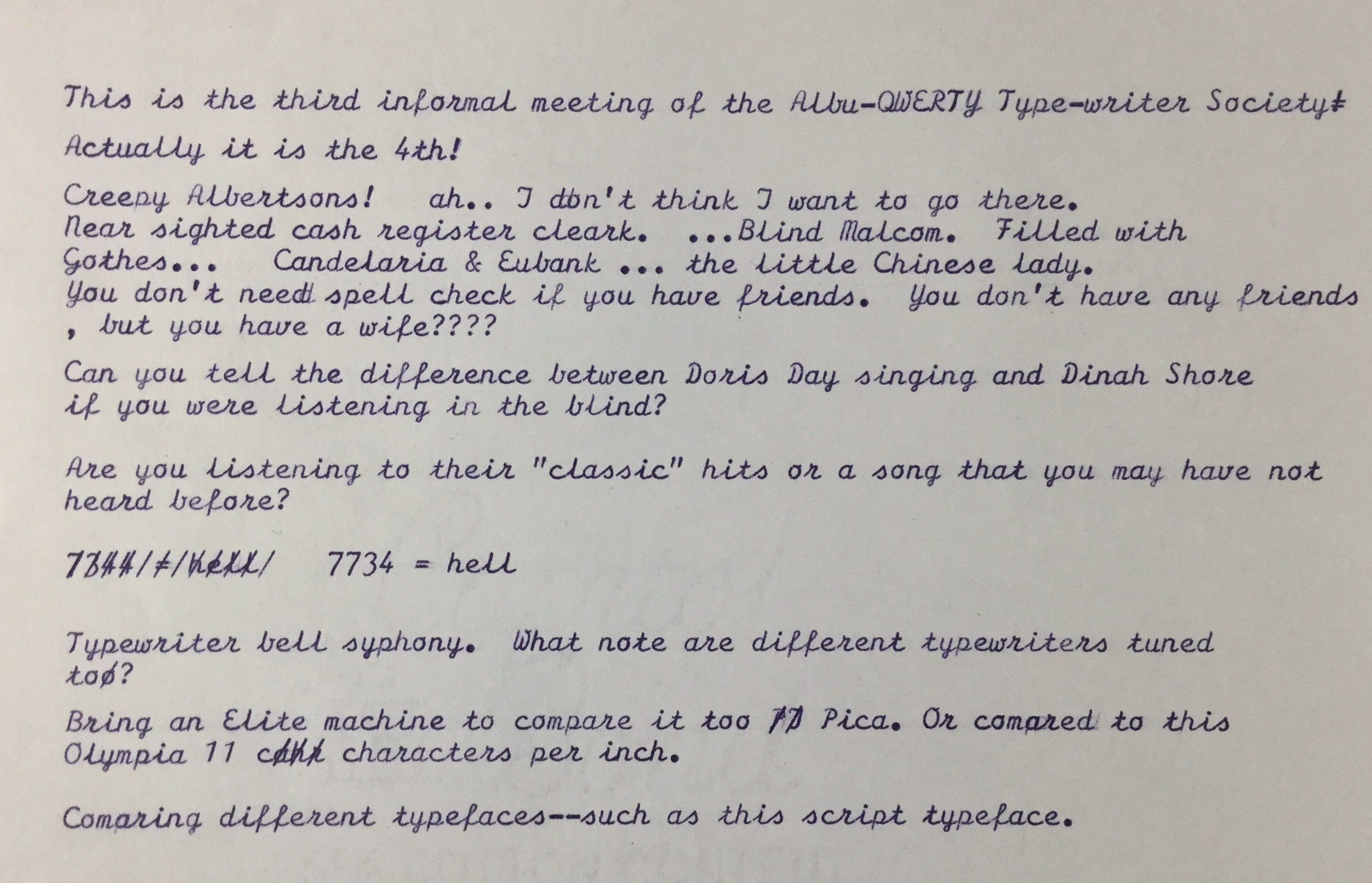
Albuqwerty Type Writer Society Notes

You can't call these meeting minutes. More like rambling, random typings. Scraps salvaged from the aether, as Kevin and I, the two founding (and thus far only) members of the Albuqwerty Type Writer Society have spent a recent evening together on the front porch of his Neo-Victorian mansion, nestled in the north Rio Grande valley of Albuquerque; typewriters, scotch and cigars at hand as we discuss typewriters and whatever else comes to mind.

We have an interesting relationship. Both our wives have the same first name. We both like antique mechanical objects, especially typewriters; although Kevin also has considerable experience with British motor cars. We like geeking-out on these things, while at the same time we seem to avoid controversial topics such as politics, sports and religion. Perhaps typewriters are our religion? Well, I think we both have enough experience with friendships to know there's a certain line you don't want to cross, for the sake of the friendship.

We've met like this on a number of occasions, and it usually follows a similar pattern. We chit-chat, we break out a typewriter or three, we discuss issues we're having, or acquiring new ribbons, or restoring platens - or a plethora of related topics. Then the drink and cigars follow, with more of the same, into the wee hours of the morning. We'll both be in conversation, typewriters at the ready. One of us will be talking intently, the other listening, when suddenly the listener will attack the keyboard and bash out some crucial thought worthy of preservation. It's usually something random, but deemed important enough at the time to document. All the while listening to the other talk. And then the roles will reverse.

We will, over time, swap machines, trying out this one then that one, giving our opinion as to its feel and action. Our typed comments will become a mixture of both our thoughts, an amalgam.

One of these recent evenings we starting talking about forming a local organization dedicated to typewriters. We eventually came up with this name, and Kevin's working on a logo. It's not a formal organization, with Robert's Rule of Order and all that falderal. Just a name to put upon a local community of adepts. Well, I use the term "community" loosely, since thus far there's only us two. But perhaps we will formalize the thing and publicize it, seeking more members. But thus far it's a club of two. Revolutions have been started with less.

The typing shown above is but one example from our most recent meeting. I'd been talking to Kevin about the old grocery store in our neighborhood we call "Creepy Albertsons" (to distinguish it from the newer Albertsons) and the entertainment I derive from late-night visits. He was skilled enough to capture some of the details of the conversation.

Kevin had been playing 78s on his Zenith phonograph when he played Dinah Shore then Doris Day records back-to-back. It was hard to distinguish their voices after all these years.

Then we talked about what key typewriter bells might be tuned to; and if one should use a digital guitar tuner to determine each one's key.

These are the kinds of things that result from our meetings. Nothing earth-shattering. No solutions for world hunger or the ecology. Just good times spent together bonding over common interests.

In the subsequent video I made about our gathering (embedded link below) I discussed the importance of community to our passion with typewriters. Iron sharpens iron, so goes the old saw. Each person brings something new to the discussion, a unique perspective or skill. We all learn from each other. And it's wonderful to fellowship with like-minded individuals.

I'd encourage you, if you're a typewriter aficionado, to seek out others in your local area. Create a club or loose-knit community. Organize Type-Ins. Make you voices (and type bars) heard.

Here's the video mentioned above:

Labels: , , , , ,

Monday, June 04, 2018

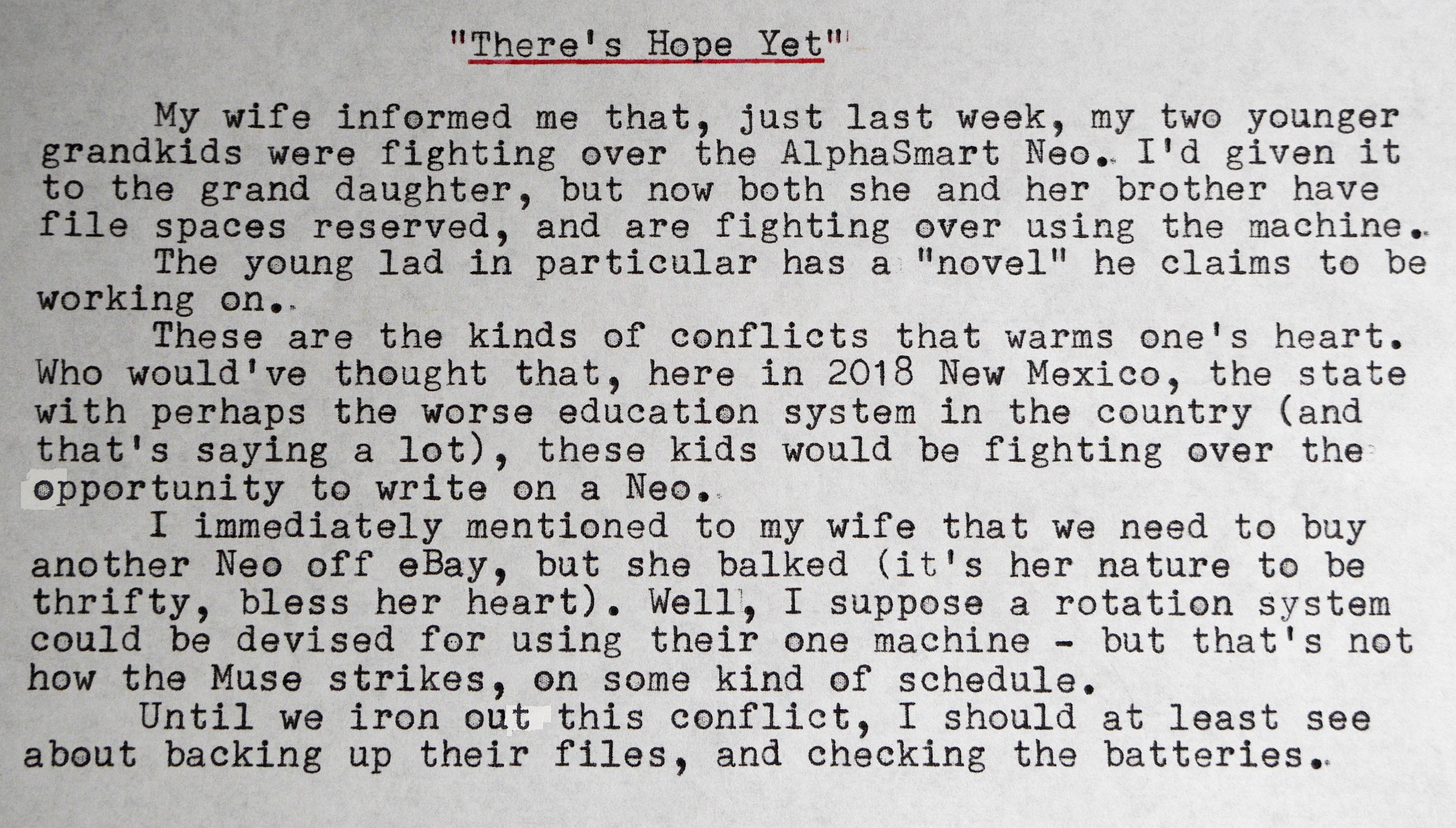
There's Hope Yet

P1090434a
"There's Hope Yet"

Post-Script: On the subject of the AlphaSmart, there's been some discussion recently on the Flickr AlphaSmart forum about alternative devices that offer a similar non-distractive work flow with a great keyboard and battery life. So far, you can't beat a used Neo on eBay (or wherever).

I'm wanting to start making more impromptu blog entries, spur of the moment, off the top (or side, or wherever) of my head. This motivation was prompted by a recent blog entry by Ted Munk, who spoke of the apparent decline of typewriter blogs, from their heyday in the mid- to late-aughts. Part of this is that blogging in general is in decline; but also our attention is being redirected to social media. I wonder also if mobile platforms are just more cumbersome for both consuming and creating blog content.

Whatever the reason, I've decided to get my act together. I know with my focussed concentration on YouTube these last few years, my blog now plays second fiddle. Whereas it once was the primary medium into which my creative thinking was expressed, it's often been used to just advertise a new video over on YouTube; there's rarely new content expressed herein.

There are often little thoughts that break the surface of my consciousness, not big enough to warrant a full-blown (or even half-blown) video production, but something worth tossing into the pond of public discourse in the Typosphere. Little thoughts that might prompt further discussion about things. Or just little observations that might, for no other purpose, serve as entertainment for a few brief moments. These often have been discarded or abandoned. But perhaps they deserve to be preserved here in. The life of the blog doesn't have to be just big articles. There's also little snippets and observations. It is a log, right? A web log.

My older blogging methods were rather meticulous about using a flatbed scanner for type-casts, to eek out the last bit of quality in those images; I've always wanted those images to look like ink on paper, where you see not just black letters floating against a nondescript white background, but you also see the texture, wrinkles and folds of the paper itself. But having to fire up the scanner is often a chore, and chains me to the office computer.

Lately, I've been trying to photograph these pieces, either with the camera in my iOS device, or using a dedicated digital camera. The challenge is always the light, especially evenness of illumination. Even the least bit of shading, from one side to the other, is exaggerated once the levels are tweaked in post-processing. Like today's example; I had flood lamps on either side of the sheet, with a white reflector card helping to even out the exposure. Even so, you can detect that left-to-right shading.

I've decided, on this matter of photographing type-casts, that perfect is the enemy of good enough. It needs to be legible, for certain. Good contrast between the background paper and the ink. It needs to be sharp, both in focus and lack of motion blur. But a bit of geometric distortion (key-stoning, from shooting off-axis; or pincushion) is okay I think. We're not archiving documents for the Library of Congress.

I like more and more the way Ted Munk makes his type-casts, with narrow typed columns and hence large letters on screen. Very legible and readable.

I keep threatening to make a dedicated copy stand for these pieces; perhaps that's the way to go, so I can guarantee even lighting. But would that end up being just as involved as firing up the flatbed scanner? I'd still have to import the images into my computer from the camera and do some post-processing, like levels, rotation and cropping. Well, by using a camera to digitize them, I have the option of not only importing them to my computer but also to my iOS device where I could do the post-process and upload to Flickr, as an alternative method. The only place where the copy stand would be impractical would be blogging while on the road.

Okay, enough about the minutia of the process. What's important is to make the process streamlined, efficient and effortless enough that one (this one) can focus on doing it as often as possible. With results that are "good enough." You might not always like what you read, but hopefully you'll come back more often and visit, to see what I've been up to.

Typecast via Remington Quiet-Riter.

Labels: , , , , , ,

Thursday, August 17, 2017

Typing Scrolls Revisited


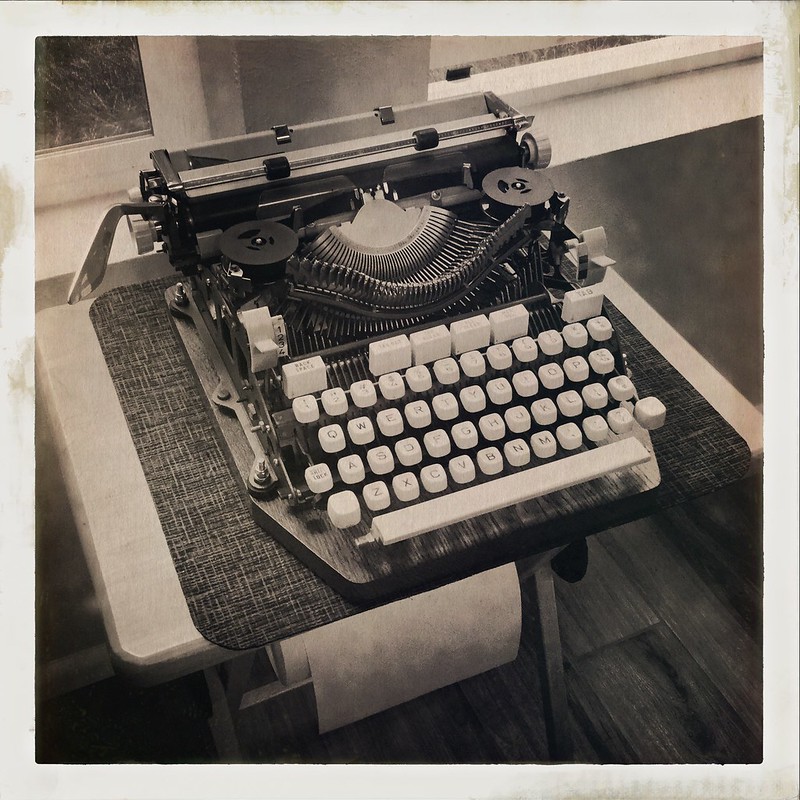
I'm certain I've blogged about this before. Using rolls of paper for typing, like the way that Jack Kerouac did with an early draft of On the Road, where he used a roll of teletype paper. Why a person would want to do so today has nothing to do with wanting to mimic the Beats. The Beat Movement is pretty much dead, last time I checked. And so are typewriters, except actually they're not; there's a revival in progress. Which is all the more reason to resurrect the idea of typing on a seemingly endless roll of paper - no more stopping in mid-thought to change paper. Just keep banging the keys and slinging the carriage back after the bell dings, and watch the paper pile up behind the machine on the floor; a more certain measure of one's writerly output.

Years ago, after this idea struck me (and inspired by a visit to the Palace of the Governors Museum in Santa Fe, which was hosting the On the Road manuscript scroll in its long glass-topped display case), I went in search of rolls of paper. Adding machine paper was too narrow, unless all you were interested in writing was short haiku poems. There were brown masking paper rolls, 6 inches wide, available at hardware stores; but I didn't want to type on brown paper. And there was white paper rolls in craft and art stores, but in widths much wider than the standard 8-1/2 inches.

After a bit of Internet searching I found a 6 inch wide roll of white paper, in 700 foot lengths, used for masking in the automotive painting industry. A local search found some at the Napa Auto Parts painting supply store. I ended up buying a damaged roll (the inner cardboard core was deformed) for less than half the price of new.

This paper I used for a time for typecast blogging. With the margins set to ~1/4 inch in from either edge, I could get long enough lines of text sufficient for this blog's template. But the paper was thin and crinkly, and didn't take ink all that well. I think, being engineered for painting, its surface was hydrophobic and hence repelled the ink, which would also easily smear. So after some time, I set that roll aside and looked for another solution.

A search on Amazon revealed rolls 8-1/2 inches wide of what was described as "teletype paper," but after receiving an order I found the quality of the paper was about the worse I'd ever seen. I should have known; I think Western Union quit the teletype business some years ago. Essentially like the very cheapest newsprint art paper, off-white and very fibrous, it doesn't take correction tape, and is mostly useful only for rough-draft writing where no one else will see the finished results. You wouldn't want to type that letter to dear old Aunt Mary with this stuff, or she'd take you out of her will.

This last week I once again found myself in the local big-box office supply retailer, when I happened across a roll of white "banner" paper 17 inches wide by 50 feet in length, for $5. It doesn't take a math whiz to figure out that 17 inches is twice 8-1/2, and I at once began thinking that perhaps my miter saw could cut it in half sufficiently neat to make the effort and cost worthwhile.

And yes, it was worth the cost, even the effort required afterward of cleaning up the garage because of the surprisingly messy cloud of shredded paper dust kicked up by the saw. But the cut was very smooth, and the resulting roll of 8-1/2 inch by 50 foot-long, white bond paper is nicely threaded up in the old Underwood Portable on the tray table, with the roll snuggled nicely between the scissor legs of the folding table using a piece of wooden broom handle. And a backup roll, from the other half, waits in the wings. $2.50 per roll is not a bad price. Maybe next time I'll do the cutting out of doors. Live and learn.

The paper takes typewriter ink very nicely, and has a very nice feel to it. I threaded up the paper in the machine so as to oppose the natural curl of the roll, hoping it helps in flattening it out. We'll see. Some of this paper, made from recycled pulp, can achieve a semi-permanent curl if left threaded around the platen too long.

So now I can say that my long search is over for an inexpensive source of good quality, white, typewriter-compatible paper rolls. I just need to set my butt down in front of that typewriter and start banging out some words. Which only I can do.

Labels: , , , , , ,

Tuesday, June 27, 2017

What? Another Typewriter? Yes!

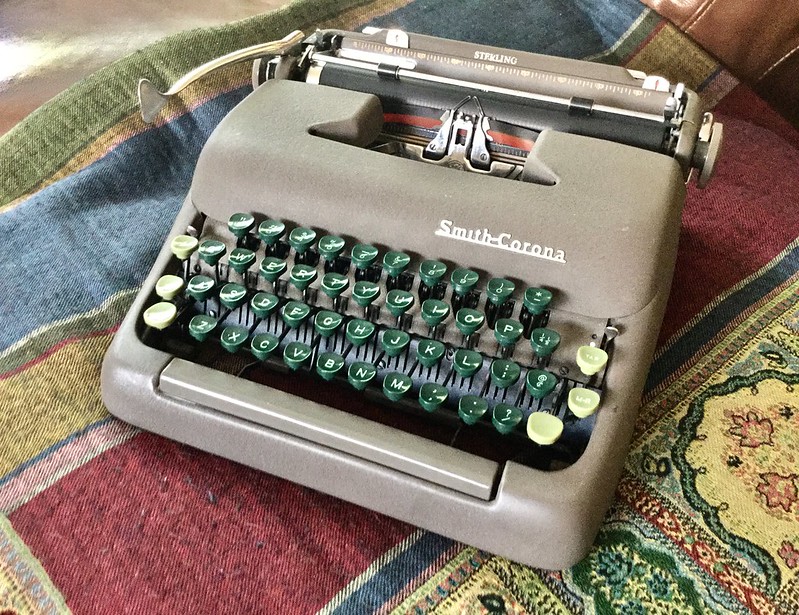
Smith-Corona Sterling in script font

After the Associated Press article on the typewriter revival came out several weeks ago, some people took notice that I live in the local area, including a lady named Sandy, who had in her possession her mother's Smith-Corona Sterling. No, I don't need another typewriter, but this one has an italic typeface. Sandy called me last week, inquiring if I'd care to take it off her hands, and I agreed for her to come over Sunday and I'd take a look at the machine.

I've always been amused by the styling of machines from this era, with their muted colors (or lack thereof) in drab grays and browns, with just a hint of excitement from the two-tone green keys. Automobiles from the same era were similarly adorned in muted color schemes; was it because of some intrinsic modesty, or simple economics? Even the shape of these 5-Series machines reminds me of late-1940s cars, with their rounded curves.

The machine turned out to be entirely functional, excepting the end-of-line bell wasn't working, caused by a bent bracket. And it was very dirty inside, evidence of having never been serviced. Her mother purchased it in 1949 from a small town in Kansas, though it lacks a dealer sticker.

It took me hours and hours to get it adequately cleaned and adjusted. Years of eraser debris had accumulated inside, enough to pit and stain some of the metal surfaces. Extensive cleaning with naphtha and alcohol took care of most of the grunge, however.

The type slugs were caked with old ink and grease, the worse I've seen, and took an extensive session with toothpicks, toothbrush and alcohol to render clean.

Luckily, I have Ted Munk's Typewriter Repair Bible for these 5-Series Smith-Coronas, for I went through the machine, checking in turn each adjustment. It actually wasn't too bad. The right side of the space bar sat lower than the left, which required reforming (i.e. bending) the support arms to get it flush with the body panels, while ensuring adequate travel to trip the escapement, with room to spare. The four screws that hold the space bar to their brackets needed to be loosened and the space bar adjusted to be square to the opening in the body panels.

The other adjustment needed was the tripping point of the type bars. They should trip the escapement to advance the carriage one space when the type slugs just approach the front of the type guide. With this machine, the escapement wouldn't trip until the type slugs were almost in contact with the ribbon. The adjustment involved bending an arm in the escapement mechanism.

As is common with these machines that've never been serviced, some additional degreasing in the slots of the segment were required for some of the type bars, which would subsequently hang up while test typing. I've found that, even if you think the machine is fully functional, you need to do some extensive test-typing to iron out those intermittent problems that remain. I find using disposable mascara brushes, with alcohol, to be a good way to clean the slots of the segment.

I like this italic type face; it's the first in my collection, and the main reason why I purchased this machine. I think it'll be a good letter-writing machine, which is what the lady's mother did, as evidenced by what she told me, and the observation that the right margin was set inward so as to correspond to the width of letter-writing paper.

The Sterling is at the lower end of the 5-Series line. It lacks the end-of-line indicator found on the left end of the platen roller in the higher-end Silents; has fixed tabs with metal slugs that can, if so desired, be set to one's liking; and the platen roller is not easily removable without unscrewing the right carriage cover and loosening a nut.

This machine has a bit more of a mechanical clanking sound to it than the Silents in my collection. Perhaps it's due to being a lower-end model; or because the thin rubber washers originally located on the body panel screw holes have all dissolved into tar. I'll have to find some replacements at the hardware store.

I don't really need another machine in my collection, unless it were highly desirable. This is my third 5-Series machine, which I'll probably keep just for the italic type face. But if I had the opportunity, I'd certainly pick up the little Sky Writer, one of the best ultra-portables.

What I'm thinking of doing with some of these "surplus" or redundant machines in my collection is to donate them to a local school classroom, should I be able to locate a teacher so inclined. I don't want to incur the expense and risk of shipping them out of town, otherwise I'd sell them online.

I think this is a reasonable approach to maintaining a working collection of typewriters, while not permitting them to get out of hand and control my life. As you learn over time your personal preferences, you can adjust your inventory accordingly. Fixing these surplus machines up, then passing them on to others who'd like to experience the manual typewriter lifestyle is our responsibility as aficionados. It certainly beats having them be discarded to the landfill, or be victims of the key-choppers.

One bonus item of Ephemera included with the typewriter was a generic plastic typewriter cover. It's beige in color and in great condition, though lacks any Smith-Corona branding, so I'm thinking it was sold along with the machine by the shop in Kansas. It turns out this cover is large enough that it will serve as a usable cover with even larger machines in my collection, such as the Hermes 3000. Were I of the mind to, and adequately equipped with sewing machine, it'd be nice to use this cover as a template for making colorful cloth covers for sale. I'm just not certain I want to get in the typewriter cover business. But maybe a small sewing machine is in my future. Perhaps.

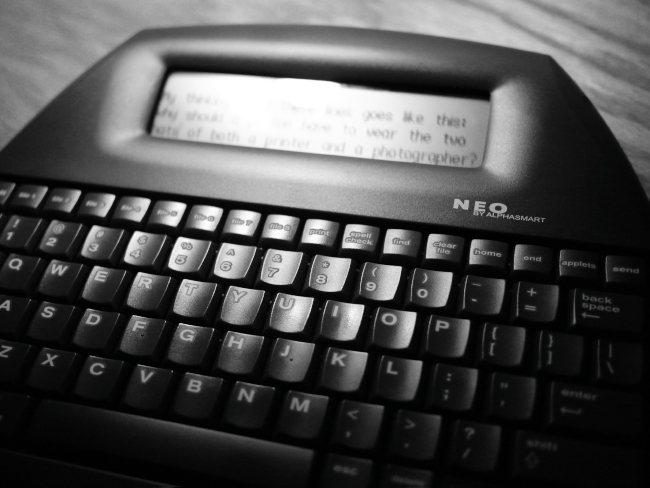
Post-Script: Written via Alphasmart Neo at my local cigar store lounge. I didn't feel like walking back home in the afternoon heat lugging a typewriter, even a small portable.

Here's my video about this new typewriter to my collection:

Labels: , , , , , , , ,

Wednesday, June 14, 2017

AP Typewriter Article and Typing Assignments

Olympia SF

I was pleased to see in my inbox a link to this Associated Press article about the typewriter revival. I knew it was in the works when I was interviewed, back in early April, by the article's author, Russell Contreras, who I met again at the Type-In later that month.

These kinds of stories come out once every few years, it seems. Just do a quick search and you'll see that the typewriter revival has been ongoing for at least a decade. They're fueled as much by the novelty and romantic ideas of these classic old machines as they are by the reality of more and more people rediscovering and putting them to practical use.

Which gets us to the subject of a new project I'm starting on my YouTube channel, Typing Assignments. This is inspired a great deal by Ted Forbes's photo assignments series on his The Art of Photography channel, where he gives an assignment, permits time for participants to create the required images, then culls them from social media and presents a slide show of the results.

I'm going to be using a similar method, but will be asking participants to post a link to the online image of their one-page typewritten piece as a comment to an accompanying blog article, to be posted here every Monday, along with the YouTube video of the new assignment.

As the series progresses, I will be showing highlights of people's work as a slide show in the next week's video. This will be the most challenging part of the project, getting images of sufficient quality from the participants' postings and including them in the video.

What interests me in this project is the idea of promoting creative uses for typewriters. Sure, we love to look at them as a form of decor; and many of us also enjoy tinkering with them; along with the thrill of the hunt for new specimens, for our museums of mechanical wonders. But it's the practical use of typewriters as catalysts for creative writing that I'm interested in pursuing - a subject that has been visited repeatedly on my Typewriter Video Series.

Here's the kickoff video to this new series:


And here's a how-to video on scanning and photographing typewritten sheets for online posting:

Labels: , , , , , ,

Monday, February 27, 2017

On the Other Side of the Lens

P1120697b

I have a couple of typewriter-related things to share with you today. The first concerns my seemingly perpetual and tenuous planning for what I hope to be the first ever ABQ Type-In. Since I first had an inkling about planning such an event, late last year, it seems I've dragged my feet, not quite knowing how to go about planning such an event. I needed to decide on a date, time and venue, while also needing some idea about how many people might be expected to show up with typewriters, which dictates the size of the venue.

So earlier this year I put together a simple flier, soliciting interest in attendance, and posted it around town, hoping for the best. I've thus far received about a half-dozen replies to the affirmative.

I also created a gmail account for this project (abq.type.in@gmail.com), through which I put together an informational email packet about Type-Ins, to be sent in reply to any respondent to my fliers.

The biggest hurdle has been finding a suitable venue. I've visualized the event as taking place on a Sunday afternoon at a public place with food and drink, the kind conducive to creatives and the general public alike. I needed it to have some separate meeting room big enough for a sizable turnout (not knowing how many people might show up), yet able to attract people who might just wander in for lunch.

Initially I had limited my search to the area of Nob Hill and UNM, the part of town where one might expect to find creative peoples in mass, but I widened my search after realizing that the ongoing reconstruction of Central Avenue, due to the ongoing Albuquerque Rapid Transit project/fiasco, would hamper access and parking. I also wanted to avoid the time when the NCAA basketball tournament is being televised, while also wanting to avoid Good Friday and Easter weekends.

Then this last weekend I had lunch at Nexus Brewery, in north-central Albuquerque near I-25 and Montgomery, and discovered they have a suitable meeting room, a great selection of award-winning brews, and a good food menu, including the ever-popular chicken and waffles. So today I called their business office and was able to confirm a date and time, that being Sunday, April 23 starting at 1 PM.

I'm excited that this major hurdle has been passed. Now I have to wait on my graphic designer to finish the poster and fliers, and to get some media attention. I'm not a publicist by nature, so this is all new territory for me.

The second typewriter-related item to share with you is that last week I spent several hours at my home being interviewed by an Associated Press reporter for a story about the typewriter revival. He had found me through one of my fliers left at John Lewis's Mechanical Antique typewriter repair shop; where he was having one of his two typewriters serviced. I won't know for several weeks how the story ends up, or in what venue it will be published. During the interview we spent considerable time discussing my background and how I came into typewriters, and why I like and use them. He also was shooting video during this time, much more than taking notes (in a Staples-branded reporters notebook, for those of you office supply geeks). I don't know if the video will be used in some footage online, or if he uses the camera as an alternative note-taking device.

This week I got back to making another episode of my "Confessions of an Office Supply Junkie" series, this being about handmade letter envelopes. Since I'm engaged in several pen-pal correspondences, I use envelopes and preprinted address labels every week. I got to thinking that if I could make my own envelopes I could preprint the addresses via laser printer and dispense with the cost of labels. I ended up with a novel design that is folded from a standard letter-size 8.5"-by-11" sheet of paper, uses only two small cuts and is taped shut for closure. It ended up being just a bit larger than the so-called "6-3/4" small letter envelope size. I did a cost comparison, using for prices the Staples brand of copier paper and premanufactured envelopes. The paper is about 1 cent per sheet, while a premade envelope is around 6 cents per. Of course, the cost of a few inches of adhesive tape also has to be factored in; but it is still less expensive for this homemade version, even though it looks a bit novel in design (the term "novel" being a more polite alternative to "weird").

Speaking of YouTube videos, while I'm nowhere near being a heavyweight in the YouTube arena, I was heartened to see the Samsung commercial at the beginning of last Sunday night's Academy Awards telecast, featuring YouTube star Casey Neistat, who played himself giving a mock awards presentation in a dark, rainy, empty parking lot (implying the huge gap between established Hollywood personalities and us small-time YouTubers). His short speech honored all of us unknowns who follow our dreams of creativity through video production; unlikely to be walking down any red carpets in designer clothes anytime soon. Of course, it was a Samsung advertisement about mobile phone tech, we must remind ourselves - ultimately for commercial purposes, but I felt heartened by it anyway.

I'll keep you informed of any further developments pertaining to the upcoming ABQ Type-In. Happy typing and envelope-making.

Post-Script: Here's my video on handmade letter envelopes:


Here's a link to the Samsung commercial about us YouTubers:


Here's the link to Nexus Brewery's website.

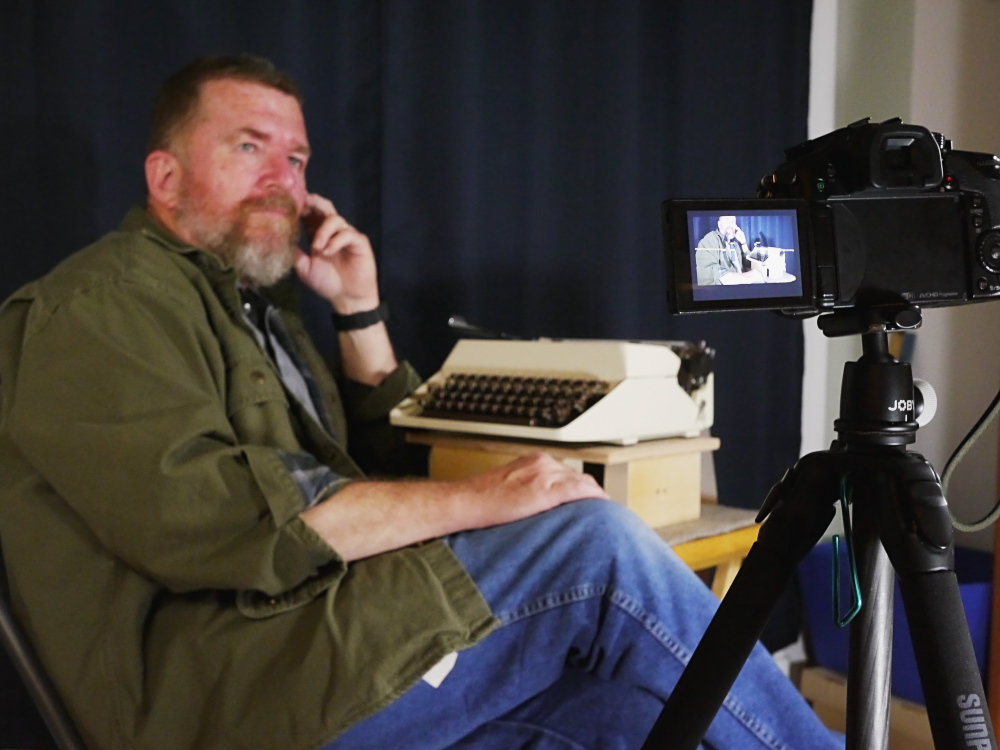
Final thought: The lead photo in this post has me posed in front of my video camera setup (Lumix GH3), adjacent to the Facit 1620 typewriter. Even though the focus of the shot was intentionally directed at the screen of the GH3, with the background left soft, you might be able to tell that the Facit is sitting propped up on some kind of wooden platform upon a folding tray table . This was a cobbled-together contraption to get the typewriter at a more ergonomic position while seated in my office chair, whose height I didn't want to keep adjusting between my main desk, which is higher, and the tray table, which is lower. The platform is very stable, and the newer typing position is much more conducive to extended typing. This post's first-draft was composed using the new setup onto the roll of teletype paper. I would have made it a typecast, but I didn't want to interrupt my stream-of-consciousness typing with correcting my numerous typos; and I'm too self-conscious to post that messy of a typed sheet.

Labels: , , , ,

Monday, November 07, 2016

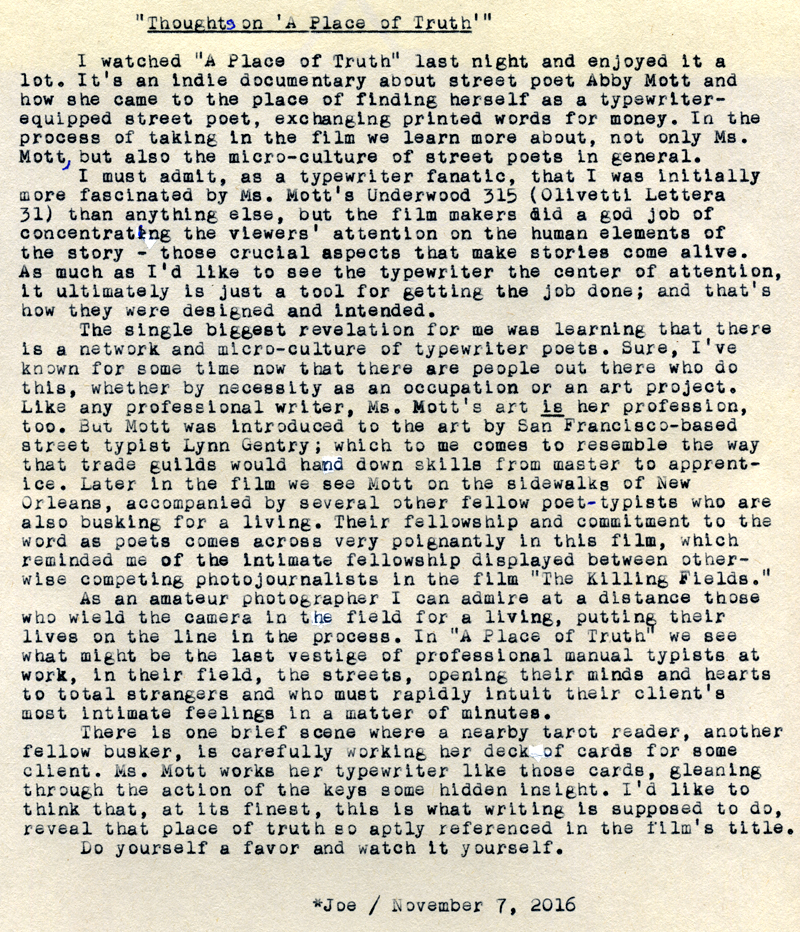
Thoughts on 'A Place of Truth'

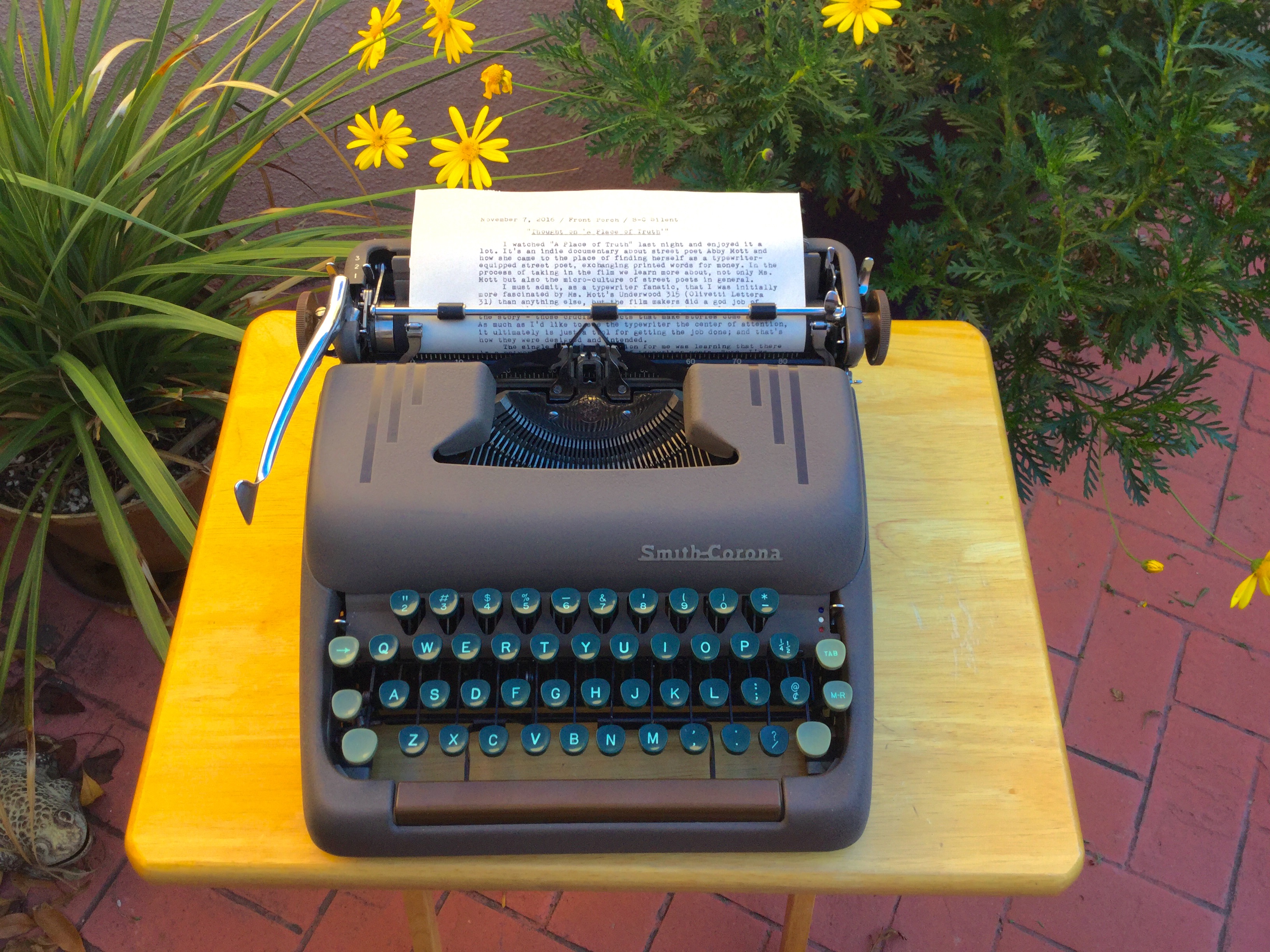
Smith-Corona Silent

Typecast196

Post-Script: I enjoyed this documentary more than I expected; not only because typewriters play a central role, but also Ms. Mott's story is compelling, as is the life of the for-hire street poet. As I hinted at in my typecast, to blog via typewriters is one thing (tantamount to an amateur snapshot shooter wielding a camera); but to type for a living on the streets, that's the real deal.

But there's more involved than the machines themselves; poets like Mott are true writers, despite the venue within which they work. They love the written word and see themselves as carrying on in the tradition of mainstream literature, despite their working setting seeming far removed from academia.

I'm not certain professional street typists have gained the recognition they deserve as an important part of the typewriter renaissance; Abby Mott's blog deserves more recognition, be sure to visit.

Be sure to visit the film's website, and make an effort if you can to watch it.

Labels: , , , ,

Tuesday, October 04, 2016

Pre-Typosphere Typewriter Collecting

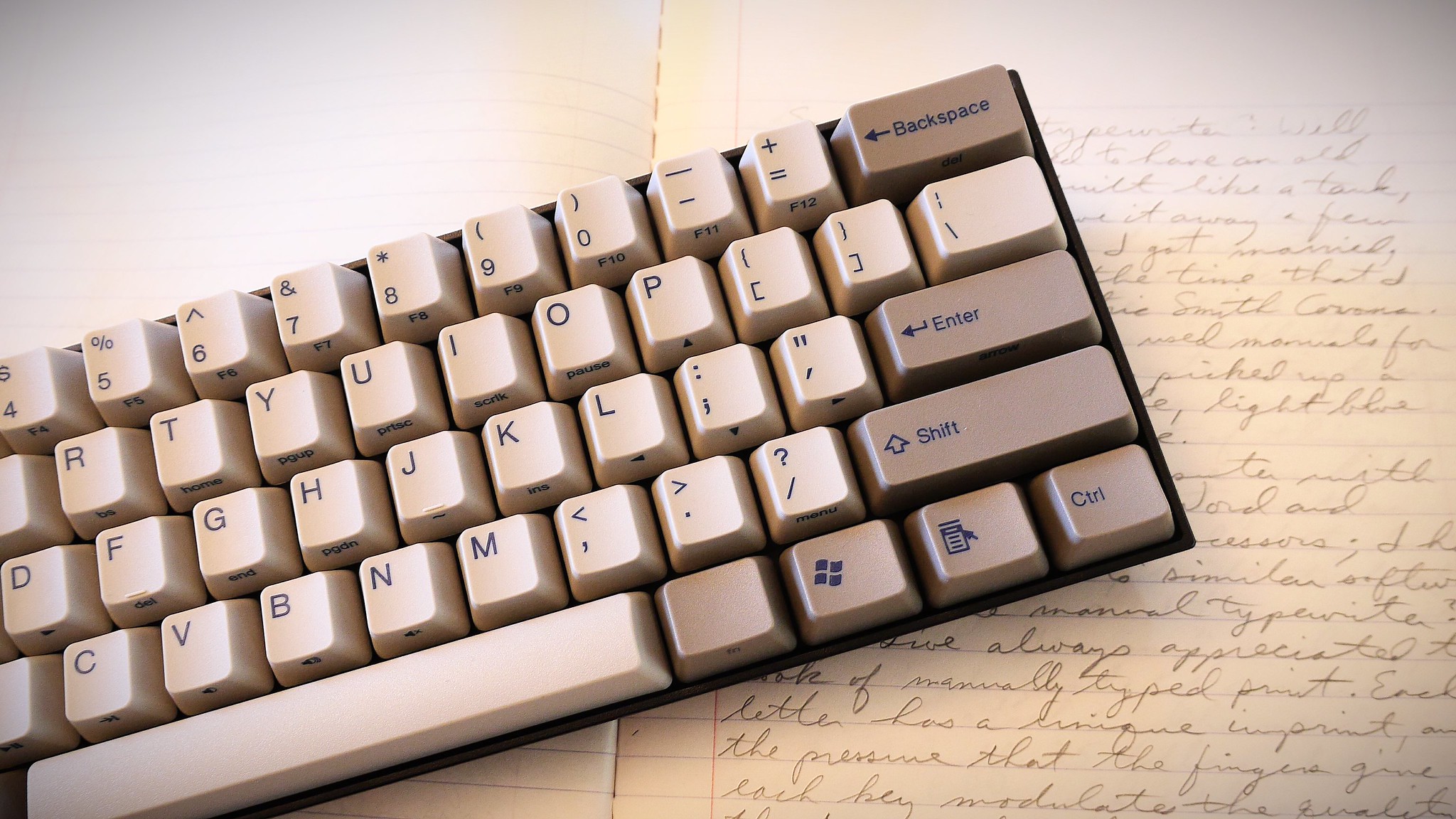
KB Paradise V60 Mechanical Keyboard and Journal Book

While researching material for my latest "Agent 51" video, I came across a journal entry I'd written on October 28, 1998, the first entry in a new composition journal book. This had been written in mechanical pencil, and what I found worth sharing with you was that it included the subject of typewriters, and alluded to a revival of interest in manual typewriters as far back as 1998, well before the current era of blogging and what we have come to know as the Typosphere.

So, without further ado, here is the transcription of that article.

10-28-98

This opening entry in this, the second volume of my journal series, begins with me having purchased a manual typewriter.

I don't believe that I've ever seriously entertained any ambition of becoming a writer. The closest thing I've come to is when I was on a poety writing kick while in the Navy and afterward. Upon thinking about it, I recall that, because of the volume of work I produced, I gained a self-identity as "poet," which I reinforced by surrounding myself with creative people - artist types, if you will.

But to be a "real" writer - a composer of "prose" - I have never identified with. And not to take anything away from these pages, but this journal is definitely not aimed toward public consumption, although some of my thoughts in the previous journal concerning video, film and photographic images constitutes a good framework around which writings for public consumption could be built upon, or perhaps worked into the upcoming seminar.


(Note: the seminar mentioned was an upcoming Basement Films presentation I made on low-budget analog video production techniques. - Joe)

So, why the typewriter? Well, for starters, I used to have an old Royal manual, built like a tank, but I think I gave it away a few years ago, before I got married, maybe around the time that I bought the electric Smith-Corona. My friend Worden has used manuals for years, and recently picked up a mint little portable, light blue with a carrying case.

(Note: Worden passed away a few years ago, but he self-published many small books of stories and poems on portable manual typers. That blue machine of his I only later realized was perhaps nearly identical to my Brother-made Webster XL-747, also blue and with a carrying case; further reason why I value it so much. - Joe)

So I have a computer with the latest Microsoft Word and Word Perfect word processors; I have access at work to similar software. So why the manual typewriter? Well, I've always appreciated the look of manually typed print. Each letter has a unique imprint, and the pressure that the fingers give to each key modulates the quality of the typed character in a direct, analogous fashion. You can tell when a computer typist is trying to touch-type on a manual, for the letters which are on the far left and right ends of the keyboard, struck by the weakest ring and little fingers, show up on paper as noticeably lighter in tone.

Last week I roamed around town, and visited several typewriter places. The one on Menaul
(John Lewis's shop - Joe) had an interesting museum, including old calculating, tabulating and other office equipment, as well as an abacus collection.

I engaged into an interesting discussion with the proprietor, and we covered an interesting gamut of things. He finally showed me an Adler manual typewriter, not quite as compact as the Hermes Rocket but, according to him, built to last a long, long time. It was built in "Western Germany," and supposedly has a high grade of corrosion-resistant steel in the mechanism. He knocked off 35 dollars, but I threw in for trade an old adding machine which he dated at before 1925. The end result is a nice, durable, well-built typewriter, which should last for a long, long time (I hope).

He asked me if I had planned to write a book, as many UNM-types come in and look for old Smith-Coronas that resemble the one that Hemingway used. Kind of like photographers who buy Leicas because they hope that they will immediately become more like Cartier-Bresson or Winogrand.

I never thought that a typewriter could actually influence one's writing style until I noticed that in order to type successfully on a manual you have to jab at the keys. The requirement of the fingers is not an increased strength, just a quick jab or punch at each key. It's the speed of the jab, not the pressure of the finger against the key. My thought is that perhaps the quick-jab style of typing could change the tone of the writer's voice from mellow word processor-smooth-clicky-clack into an aggressive, angry street-smart voice, matter-of-fact and no-nonsense, a kind of sparring session with the machine, the result imprinted upon paper, artifacts left behind from the interaction of human mechanics with antiquated technology. As the finished image is affected by the uniqueness of the lens in use, so is the typewriter able to focus the writer's thought in a peculiar way.


Did you catch those hints? Keep in mind that this was in 1998, before Facebook, Twitter or YouTube; when AOL was the dominant Internet provider and laptop computers were bulky devices. And it was certainly before the time that we commonly recognize as the revival of interest in the manual typewriter, before the Typosphere was formally identified. Yet there it is, John Lewis the typewriter repairman telling me that, even back then, university students were interested in those machines as writing tools.

Notice too that I've already gained some understanding of how a person should interact with a typewriter, that it's more about the speed of one's fingers than the pressure applied to the keys. I was certainly a neophyte at that time, but yet I had some understanding.

There is this mysterious reference in the piece to a comparison between the Adler and a Hermes Rocket. I didn't think, until I read this today, that I even knew of the existence of Hermes Rockets. Had I been suddenly educated that day by my visit to John Lewis, already had some subtle yearning for those little portable machines? Perhaps; only a few years later I'd return to his shop and trade in the Adler for a Royal Mercury portable, which I have to this day.

I am also amused by the idea that in 1998 someone like me was roaming around town on the lookout for typewriters; the more things change, the more they stay the same, even then the typewriter bug had already bitten hard, apparently.

For me, this journal entry is a bit of personal history unearthed; but for you out there in the Typosphere this might serve as some source material for the prehistory of the typewriter revival that was yet to come. I'd like to hear from others of you, if you have any personal anecdote or story pertaining to your pre-Typospherian interaction with typewriters.

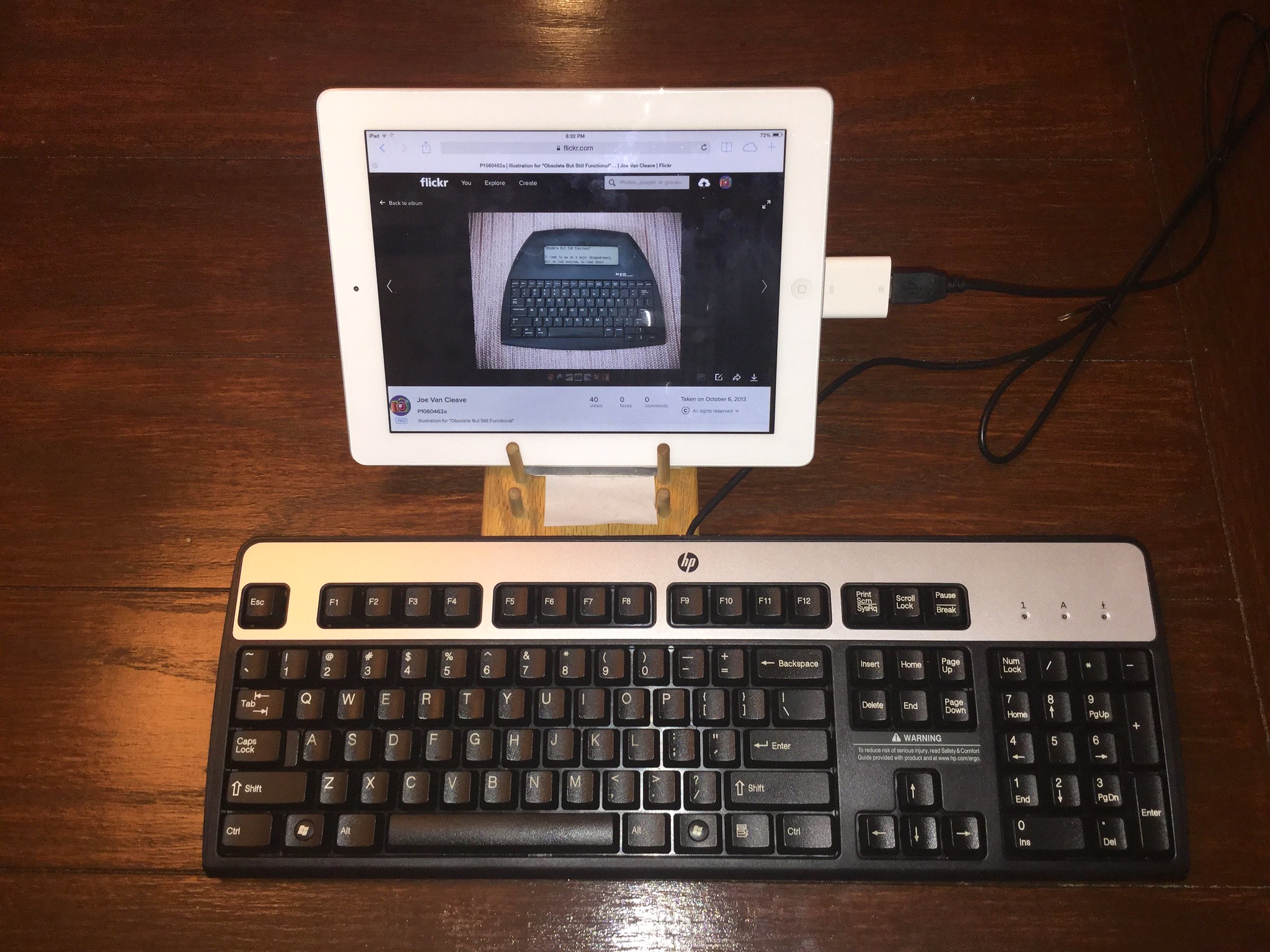
Post-Script: Transcribed via KB Paradise V60 mechanical keyboard into iPad 2 with iAWriter. Wow, was this fun to type. Very AlphaSmart-like. But with a much bigger screen - a touch screen. No, it's not a "real" typewriter (and I apologize to those of you who might have been put off by the last two blog articles that have been overly enthusiastic about mechanical computer keyboards and tablet devices), but a very pleasant, focused writing experience.

Labels: , , , , ,

Sunday, October 02, 2016

Some Thoughts on Electronic Typewriter Alternatives

AlphaSmart Alternative

I uploaded a video today describing the usefulness of the AlphaSmart Neo, text-editor based keyboard device, as an alternative to the direct typewriter experience. This idea will come as no surprise to people who are already familiar with these paperless, electronic writing tools, but for others who aren't, this might come as a shock, even blasphemy. I offer no apologies, only my personal viewpoint to the contrary.


In the video, I explain my feelings as to the essence of what the writing-with-a-typewriter experience is all about, for me. To some, it might have to do with the pre-computer legacy of the typewriter, or to others it might be the mechanical, direct ink-to-paper aspect of typewriters. Those are all valid reasons to prefer typewriters to other forms of writing methods, ones to which I can heartily attest as an incurable typewriter fanatic.

But for the actual experience of writing using a typewriter, I find these three aspects most unique and attractive: 1) Non-distractive writing; 2) Mechanical interface; 3) Single-purpose use. There are other aspects of typewriters worth appreciating, but these three I feel capture in essence what many others, throughout the past decades, have expressed as their primary reason for preferring typewriters over other forms of writing.

It is helpful to remind ourselves that, for a long period of time, typewriters were the only form of mechanized writing accessible to the common person. Certainly by the 1960s there were a handful of writers who gained access, through special circumstances, to word processor programs hosted on mainframes or mini-computers; but it wasn't until the mid- to late-1970s that the personal computer platform became sufficiently capable and affordable for access by the mainstream public as a writing device. Once that happened, writing technology was quickly transformed.

Interestingly, we really didn't hear much about computer-based word processors being a distraction to the writing experience until personal computer platforms became sufficiently capable to host other, more distractive, features such as games and the Internet. This has become most notable since the advent of widely available wireless Internet accessibility.

I'd like to argue in favor of mechanical keyboards connected to distraction-free text entry systems as being essentially typewriter-like. Broadly speaking, if a computing platform, dedicated to a word processor or text-entry program, is not typewriter-like, then electric typewriters shouldn't be considered as typewriters either. An early personal computer, lacking distractive software other than a few 8-bit graphic games, and connected to a mechanical-feeling keyboard and line printer, is essentially an electric typewriter in function, that lacks the compactness of a predecessor technology such as the IBM Selectric, whose components fit all in one package instead of scattered over the work surface of a desk. Was an early word processor computer overly complex? Yes, certainly. Ungainly? Yes, without doubt. Non-portable? Other than the Osborne luggable computers and their ilk (which lacked a built-in printer), yes. But were they functionally like electric typewriters? Certainly; and would also permit text editing.

By the time we get to the 1980s and the daisy-wheel electric typewriter, some of which offered limited text editing via a single-line LCD screen and memory buffer, we have what is essentially the mess of an early word processor personal computer, keyboard and printer, that would have otherwise covered the entire working surface of an office desk, all jammed into one small enclosure; light and small enough to lug around, but still requiring to be plugged into an electric outlet to function.

So, I think it's fair to say that electric typewriters, though different in some respects to manuals, deliver a genuine typewriter writing experience; and I will also argue that any technology that delivers a sufficient similarity of writing experience should be considered electric typewriter-like.

I know what you skeptics are thinking, this guy's trying to use convoluted logic to convince himself that computers are typewriters and therefore should be considered the same. Actually, no. I've written with both typewriters and computers, as have many of you. Computers are fine for final polish of a document; and considering that there are few publishers left who will accept manuscripts in typescript form on paper, a writer has little option but to, at some point in the writing process, employ that demon computer.

But few of us are writers; fewer still are published. Yet what's most important in those crucial early stages of the writing process is to employ tools that reduce distraction and focus the writer to the task at hand. Non-distractive systems, in whatever form they be, are often preferred. Does that mean all professional writers use non-distractive systems like typewriters in some part of their writing process? Probably not; I'd wager that many writers whose output is measured in several books per year have disciplined themselves to using computers as their preferred writing tool, without falling into the pitfalls that computers can offer, simply for the efficiency of the word processor. It's a matter of discipline and focus. For the professional, it's their livelihood at stake; of course they'd be able to figure out how not to be tempted by Instagram, Twitter and YouTube cat videos.

For a person like me, a typewriter fanatic and also fledgling, amateur writer, I find advantage to both typewriter and word processor. It's the foibles of the computer platform that host most word processor applications that gets me. For many of us, we've found devices like the AlphaSmart text editing keyboards to be almost ideally suited to that early writing phase, due to its non-distractive nature, portability, excellent feeling keyboard and world-class battery life. We should remind ourselves that even 1980s-era, line-editing, electric daisywheel typewriters had within their innards some form of micro-processor. Certainly the AlphaSmarts do, too. So I think it's fair to say that computers, in the most broad application of that term, are not intrinsically writer-unfriendly. Rather, it's the crudeness of general-purpose computer operating systems that draws the ire of typewriter aficionados like myself and others.

It would be nice if devices like the AlphaSmart Neo were still being manufactured, but they aren't. I purchased mine in 2010, for under $100. At that time, laptop computers with all their distraction were selling for around ten times that amount. Today, a person looking for a dedicated electronic writing experience that offers a text file output has few alternatives. One such alternative is to purchase a used Neo online, and risk receiving someone's broken device with no factory support, other than software uploads from Renaissance Learning. Another alternative is the Hemingwriter device, but it, though costly, is less capable than an AlphaSmart, as it lacks text edit capability. A third option is someone on Etsy selling what he calls a Write-O-Tron, an Arduino-based dedicated word processing system built into a wooden cigar box, that costs about the same as the Hemingwriter.

I would like to propose another alternative, one that lacks some of the advantages of the AlphaSmarts but does offer a distraction-free writing experience (with one cavaet) and an excellent-feeling, truely mechanical keyboard. That is to pair a true mechanical keyboard with a small iOS tablet device like an iPad Mini or, better yet, iPod Touch.

I'm working on building such a system. This piece was written with the first iteration, that being a full-sized desktop computer keyboard (one I had laying around in storage) paired with an old iPad 2 sporting the IAWriter app. I'm going to be replacing this large keyboard with a so-called "60%" mechanical keyboard (that should be arriving this week), and the iPod Touch I've already been using for editing photos and videos.

If you had to purchase this system new (I already had the iPad 2 and old desktop keyboard, so their cost was essentially free), you'd spend about $250 for a 32GB iPod Touch and about $100 for a true mechanical keyboard (or a lot less for a larger, standard desktop keyboard); still somewhat less than either the Hemingwriter or Write-O-Tron, but with much more capability. Or maybe you already have an iPhone; all you need is the mechanical keyboard, and the discipline to put it into "airplane" mode for a few hours (the secret to non-distractive writing on iOS devices).

Yes, you can get Bluetooth wireless keyboards for iOS devices; but these lack the feel of a true mechanical keyboard (remember that typewriter-like writing experience we're after?) and being wireless means they'll end up sucking the battery life out of your iOS device. Keep your iOS device in "airplane" mode and the Bluetooth turned off and its battery will last for many hours, sufficient to get your writing done for the day. And using a smaller, "60%" keyboard means full-sized mechanical keys in a much smaller, more portable package.

An AlphaSmart Neo isn't a replacement for a true typewriter, because direct mechanical type to paper is an experience unique unto itself. I'll never get rid of my typewriter collection (though its numbers might fluxuate up or down over the years); likewise, I hope to have my Neo for many years into the future, because it's such an excellent portable first-draft writing tool. But being electronic, and no longer manufactured or supported, means I need to find some kind of functional alternative. I think a mechanical keyboard mated to an iOS tablet device might be that alternative. I'll keep you posted on my findings.

Labels: , , , , ,

Tuesday, September 20, 2016

Compact, Colorful Computer Keyboard Craziness

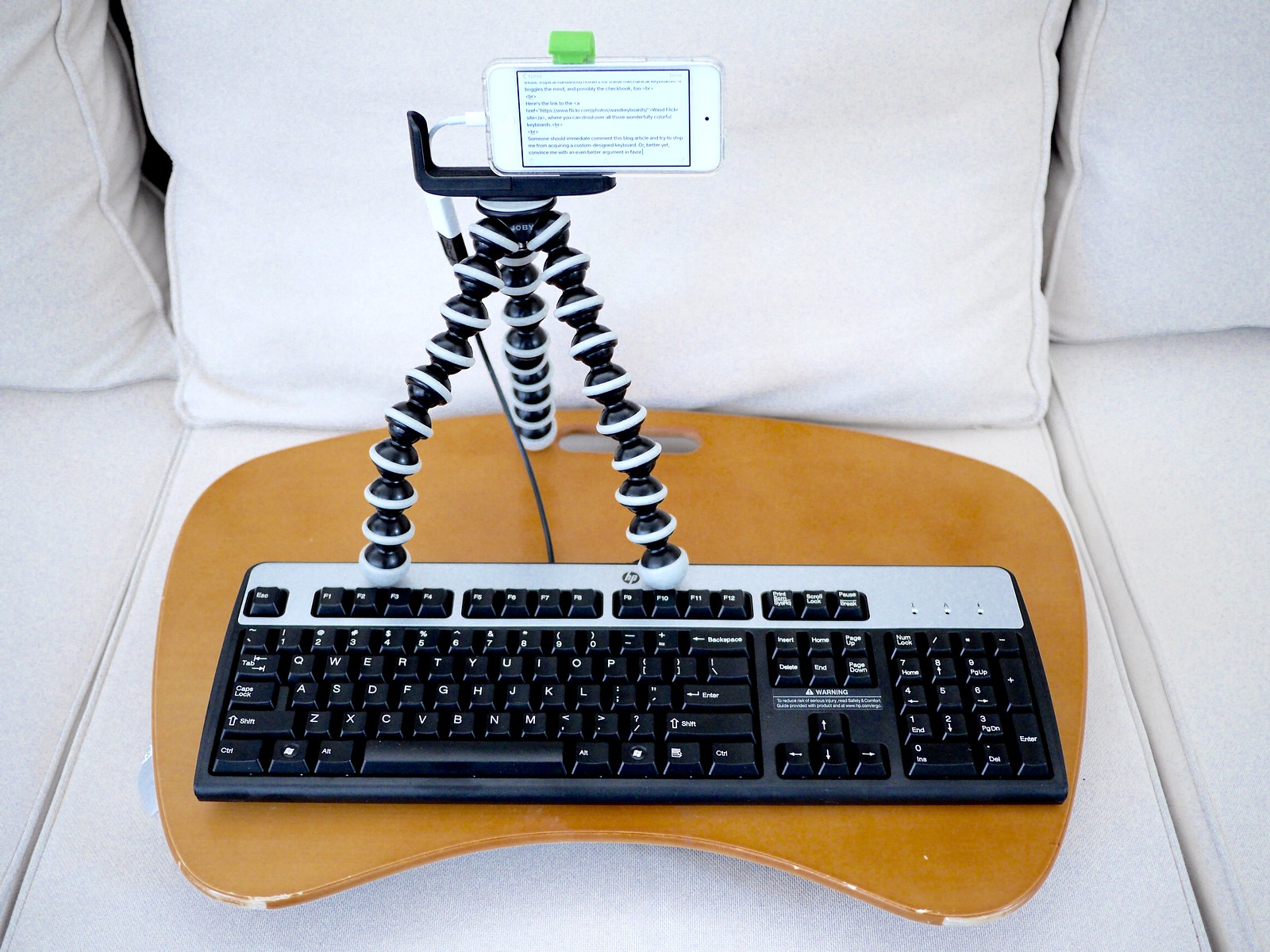
PC Keyboard and iPod Touch: The Replacement Alphasmart?

I'm doing this crazy techno-mashup that's not supposed to work, and that's likely to infuriate both the digerati and the Typosphere, which is to plug a standard USB-wired PC keyboard - one of those wide decks that's about the size of a miniature skateboard, minus the wheels and trucks, that has the function keys and ten-key-pad off to the right, so far off to the right that if you were using a mouse with your right hand your right elbow would be in the next county, and you'd certainly be showing signs of carpel tunnel - into my little iPod Touch, via its standard USB adapter.

No, it's not one of those sleek, Apple-looking wireless keyboards with those rubbery chicklet keys, that advertises you're somewhere in the 21st century; no sir, this is one of those clacky desktop keyboards that shouts "1980." Actually, it's not that cool; just a standard HP keyboard from the last decade. But where to mount the tiny iPod Touch so as to make this a practical writing rig?

My wife, smart as she is, immediately knew the solution, which was to employ the lap desk. So now I'm seated in the backyard, under our big tree, on a cloudy, late Summer's day, with this big keyboard and the tiny Joby Gorilla Pod holding the dinky iPod Touch. At least the black-and-white theme of the HP keyboard matches the tripod's. Not that fashion statements matter at this late date.

This little iPod has a very small battery, smaller than an iPhone's, so battery life is an issue. When I'm not actually needing to be connected to WiFi I set it to airplane mode; and now with this wired keyboard I also don't need to be wasting more battery juice with blue tooth turned on.

How I found out about using a standard USB keyboard on an iOS device is because I was on one of those Internet fixations the other day, researching so-called "60%" mechanical keyboards, and came across a keyboard discussion forum (you knew there'd be such a thing, right?) where this was mentioned.

I have this hate/hate relationship with full-sized keyboards, the ones with 110 or so keys and all those extra keys off to the right; that, if you're a touch-typist like me, with your fingers on the home row, your hands are centered about 1/3 of the way over from the left side of the keyboard. Which is an issue with certain workstation setups, like just about every one in the factory where I work, that equip each station with just enough room for one of these wide behemoths, and position the monitor over the middle of the thing, so that us touch-typists can't have the alphanumeric keys and monitor centered in front of them; and also us right-handed mouse users are relegated to a very non-ergonomic position. I've taken to mousing left-handed while at work, just to take the strain off my right shoulder and wrist.

I don't use those ten-key-pads off to the right; I never worked in a grocery store as a clerk, back in the days before barcode scanners, when the clerks would pick up the can of beans out of your cart with one hand, read the price on the little sticky paper label and, without looking, key in the price on the cash register with the other hand. I remember in high school the math department had classes that taught students how to be fluent in touch entry on adding machines and cash registers and such. It would be only a decade or two after that and such skills would be entirely obsolete.

The desk in my office is one of those big cherrywood colored, Scandinavian-styled corner units. You'd think I'd have plenty of room, but with all the clutter I like to accumulate, such as scanner, printer and a plethora of books and papers, a full-sized keyboard is kind of a nuisance. There's also a typewriter on the desk, but that doesn't count as clutter, of course. What I really want is a smaller keyboard.

A practical person would go down to the nearest big-box retailer and pick up for cheap a medium-sized keyboard, one without the ten-key-pad off to the right, but one that still has the top row of function keys and the navigation keys on the right. But I'm not a practical person; especially after I discovered so-called "60%" keyboards, ones that only have the alphanumeric keys and the few additional ones immediately adjacent, no function or navigation keys; instead, they use a program key that accesses three other key mapping layers.

These tiny keyboards seem to be popular with geeks who like to attend gaming conferences and don't want to travel with their full-sized keyboards, that are as big as their skateboards. Also, there's this popular fascination with mechanical keyboards, that I suspect any typewriter fanatic could appreciate, much like the way a film photographer can appreciate Fuji digital cameras that appear somewhat film-camera-like.

While IBM model-M keyboards enjoy a legacy of being the standard in mechanical keyboards, the big name in mechanical keyboard switches these days has been Cherry, and they have a full line of such switches, each with a different kind of feel (detent or linear, with a variety of force settings), that are identified by color. Cherry Blue switches are the most clicky feeling, and the loudest, with the Cherry Browns being more subtle, followed by the Cherry Clear switches. Since keyboard touch, as any typewriter fanatic can tell you, is such a personal thing, buying into such an exotic keyboard should not be done without first a bit of research. Luckily, there are sample switches you can buy. I just ordered, from Wasd Keyboards, a 6-key Cherry sampler, that I hope will give me more information before I embark down the road of acquiring a custom mechanical keyboard to my liking.

There is also, as with any technological field of interest, more exotic keyboards and switches. Some of these Japanese magnetic reed switch keyboards have attracted interest, like the way that denizens of local coffee shops like to denigrate Starbucks as being "so corporate." The more exotic the better, like small lines of exotic Japanese denim jeans, ones that are so pricey that you can't afford to wash them. There's also an interest in legacy keyboards by many young folks, with pre-PC mainframe keyboards and early Apple models in high demand.

Stylistically, I'm somewhat attracted to the control consoles of nuclear command centers and other military computer systems, like what you'd see in the film "War Games," or what we saw, earlier this year, when we visited the Titan II Missile Museum, south of Tucson, Arizona. "Don't press the red key, that launches the missile." It would be so cool to have a keyboard with a red key that said "Launch," or maybe "Apocalypse Now."

I'll probably buy my keyboard from Wasd, because they offer this spectacularly personalizable 61-key keyboard where you can choose the color of each key - yes, think about that for a second: each key can be customized with whatever color you choose, even artwork - along with your choice of labels. They have a Flickr account where you can view, in jaw-dropping color schemes, all the hundreds of custom keyboards they've fashioned for customers.

Some of these color schemes directly remind me of the pre-Personal Computer era, when mainframes were controlled by these colorful banks of switches. Certainly, some of the designs are a bit too much, like alternating the color of every other key, just to be different; but other color schemes seem simultaneously practical and beautiful.
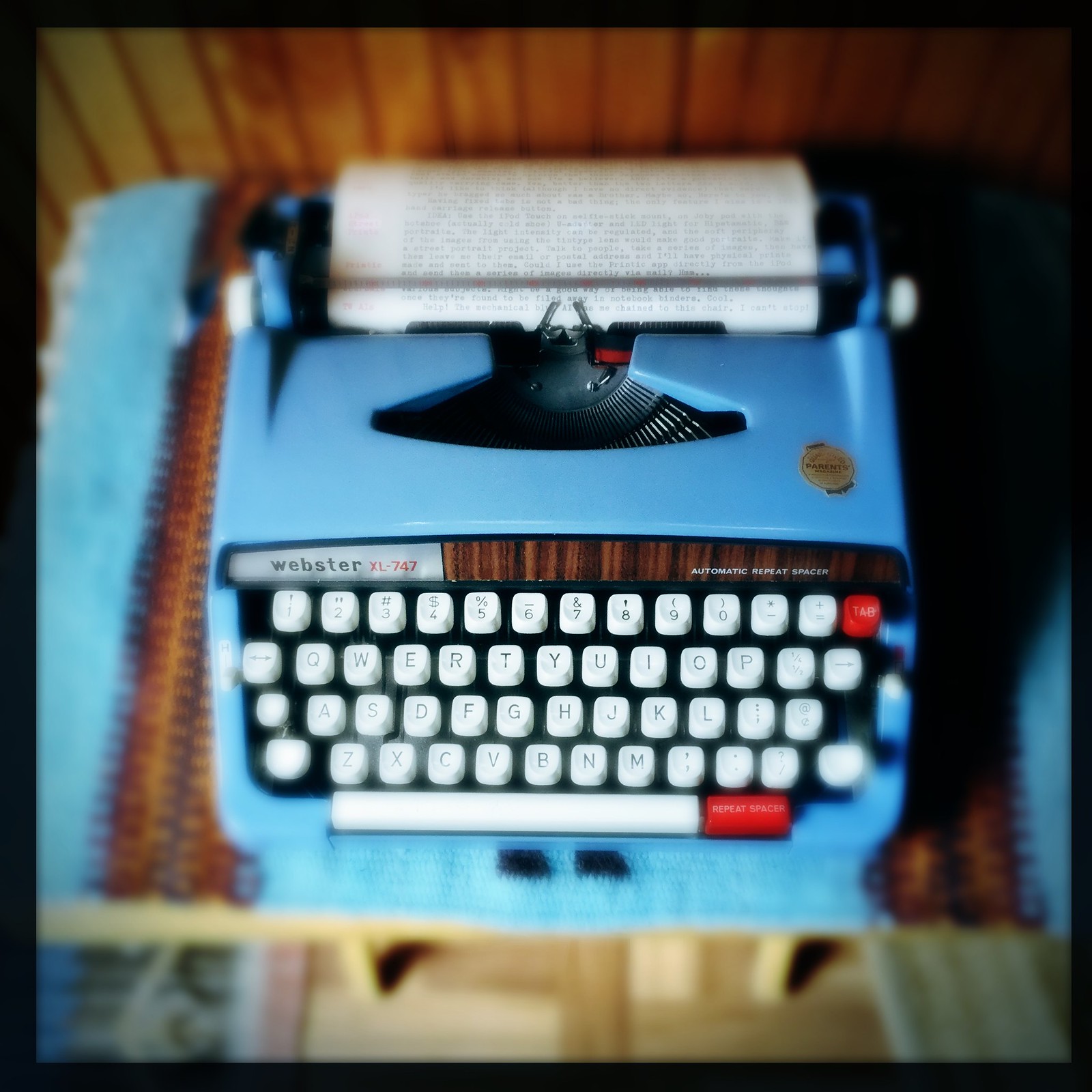
The Blue Mechanical AI

I was seated at this same spot in the backyard yesterday, typing on my robins egg-blue Webster XL-747 typewriter, with white keys, bold black labels and the red tab and repeat spacer keys, when it struck me that this would make a dandy color scheme for a custom keyboard. I'm thinking the letter keys would be white with large, black labels centered on the keys; the number row would be robins egg blue and the surrounding keys (control, shift, caps, tab, escape, enter, backspace) would be bright red. Not red, white and blue for patriotic reasons, but in honor of this wonderfully pretty typewriter from the 1970s.

I must not be alone in my appreciation of the color schemes of manual typewriter keys, because I also saw a photo of an all-green 60% keyboard, inspired by the Hermes 2000/3000 line of typewriters.

This fascinates me, that manual typewriters could serve as design inspiration for modern-day, tech-savvy computer geeks and gamers; people who are decidedly not part of the Typosphere and typewriter blogging community. Sometimes you have to step outside of your own cultural community to see the wider picture of how much typewriters have inspired and informed the culture at large.

Which reminds me, on a side note, that I walked into a Goodwill store about ten minutes after someone found an Olympus SM-3, in burgundy trim, for $5. She was kind enough to let me take a peek inside that wonderfully round carrying case, but I couldn't talk her out of her intended purchase. Which is fine, since I have 11 typewriters, and this will be her first. Spread the wealth. But still, such a nice machine for five bucks. It boggles the mind, thinking about all those potential great bargains I've missed by not being on constant patrol of the thrift stores. Best not to think of it, since I've been reminded repeatedly, by She-Who-Must-Be-Obeyed, that I have enough typewriters for now. Uh huh.

This combination of clacky keyboard and iPod Touch reminds me so much of the Alphasmart line of word processing keyboards. I've visited their Flickr site many times, and read many of the discussion threads, but can't recall mention of this easy way to simulate an Alphasmart system with an iOS device and standard USB keyboard.

I'm thinking that another way to incorporate a miniature 61-key keyboard, in a personalized color scheme, with an iOS device would be to build some little bracket device that attaches the iPod Touch right behind the keyboard, elevated at a convenient viewing angle.

Oh, did I mention that there are also wooden (yes, wooden - think exotic tropical hardwood) holders for these mechanical keyboards? It boggles the mind, and possibly the checkbook, too.

Here's the link to the Wasd Flickr site, where you can drool over all those wonderfully colorful keyboards.

Someone should immediate comment this blog article and try to stop me from acquiring a custom-designed keyboard. Or, better yet, convince me with an even better argument in favor.

Labels: , , , , , ,

Monday, August 22, 2016

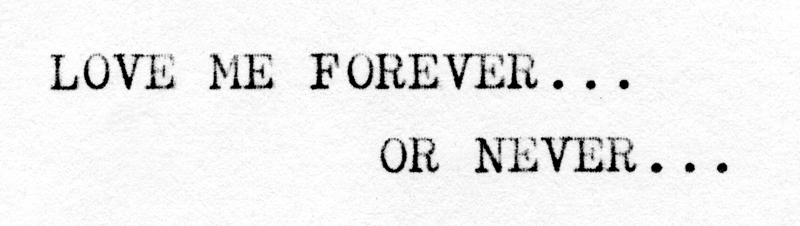
Love Me Forever: Phoenix Type-In Ephemera Surrealist Poem

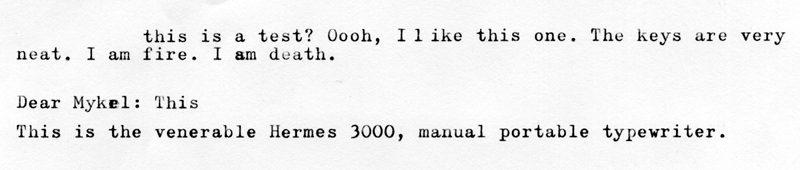
Hermes 3000 Nekkid-Riter
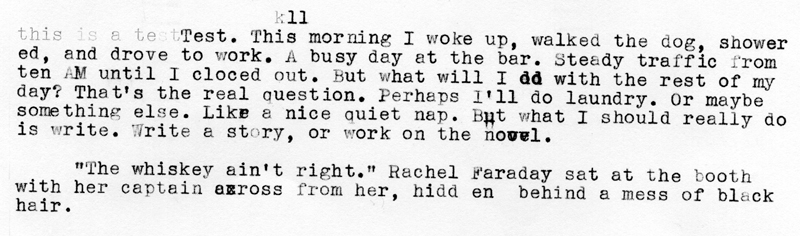
Today I was delighted to see Ted Munk's posting of typewritten ephemera from the 2016 gathering of the Typeratti in Phoenix, Arizona. This stuff is great because there's an element of randomness to it, as some people just type whatever comes to mind, along with typographical errors; and some more purpose-felt compositions. But there's also an element of surrealist poetry to the idea of collecting an assortment of semi-random writing, from a disparate swath of humanity, and finding some subconscious connection as it is assembled together.

Today I went through my man-bag, after having returned from the Type-In, and found that I had also collected a small sampling of such ephemera, which I am presenting herein. Since my Blogger template limits images to 650 pixels wide, I normally limit my images to that width; but I've decided to break the template in this case. Enjoy.

2016phx003a
2016phx008a
2016phx007a
2016phx002a
2016phx001a
2016phx006a
2016phx005a
2016phx009a

Labels: , , ,

Saturday, August 20, 2016

Smuggling Typewriters to Phoenix

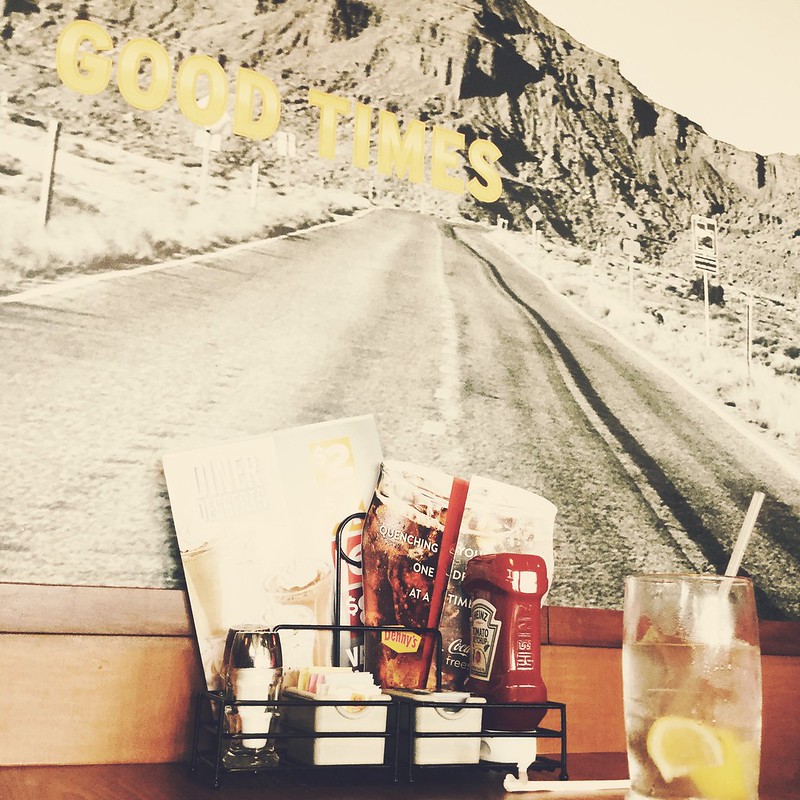
Good Times
Smuggling Typewriters to Phoenix

Post-Script: This posting serves as a kind of experiment for mobile blogging, in that both the lead photo and typecast were taken with this iPod Touch camera, the photo using Hipstamatic and the typecast cropped and tweaked in the camera's edit feature.

Once the images were emailed to my Flickr stream, grabbing the links was challenging, as you need to use the desktop version of Safari (a hidden feature accessed by pressing the retry button), then highlight the entire URL, a kludge of an operation that seems to eventually work if you hold your mouth just a certain way, and the phase of the moon is correct. Or maybe my fingers are too stubby and I need to learn the iOS touch gestures better.

Labels: , , , ,

Sunday, June 26, 2016

Scribes of Our Present Age

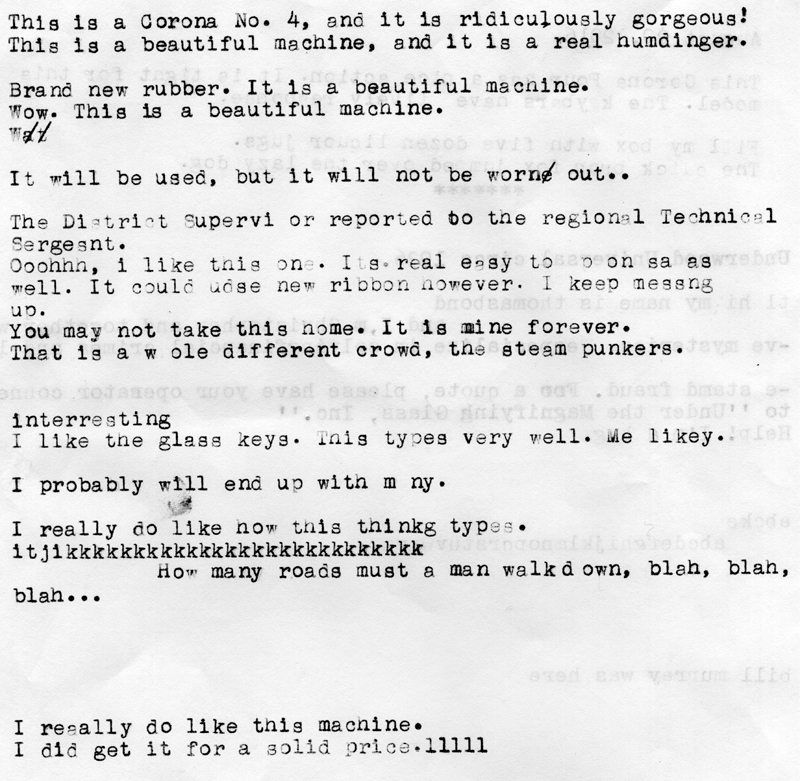
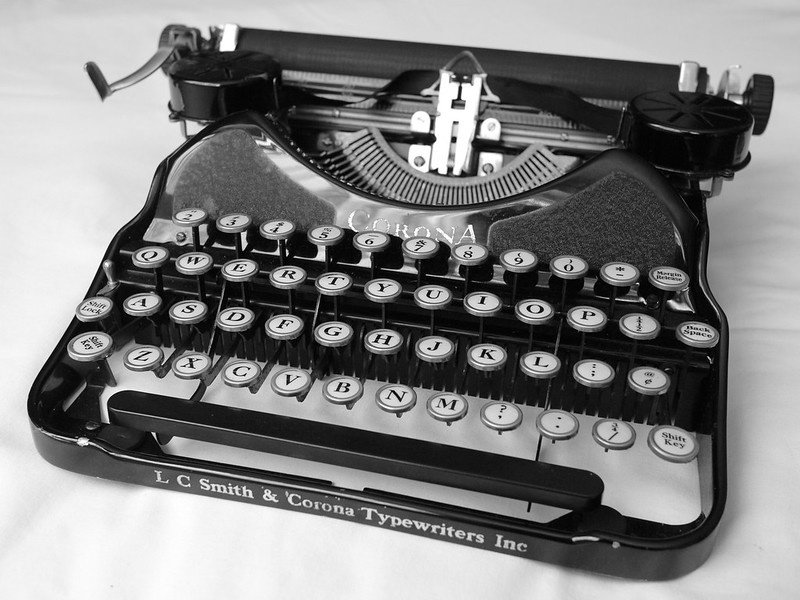
Corona 4
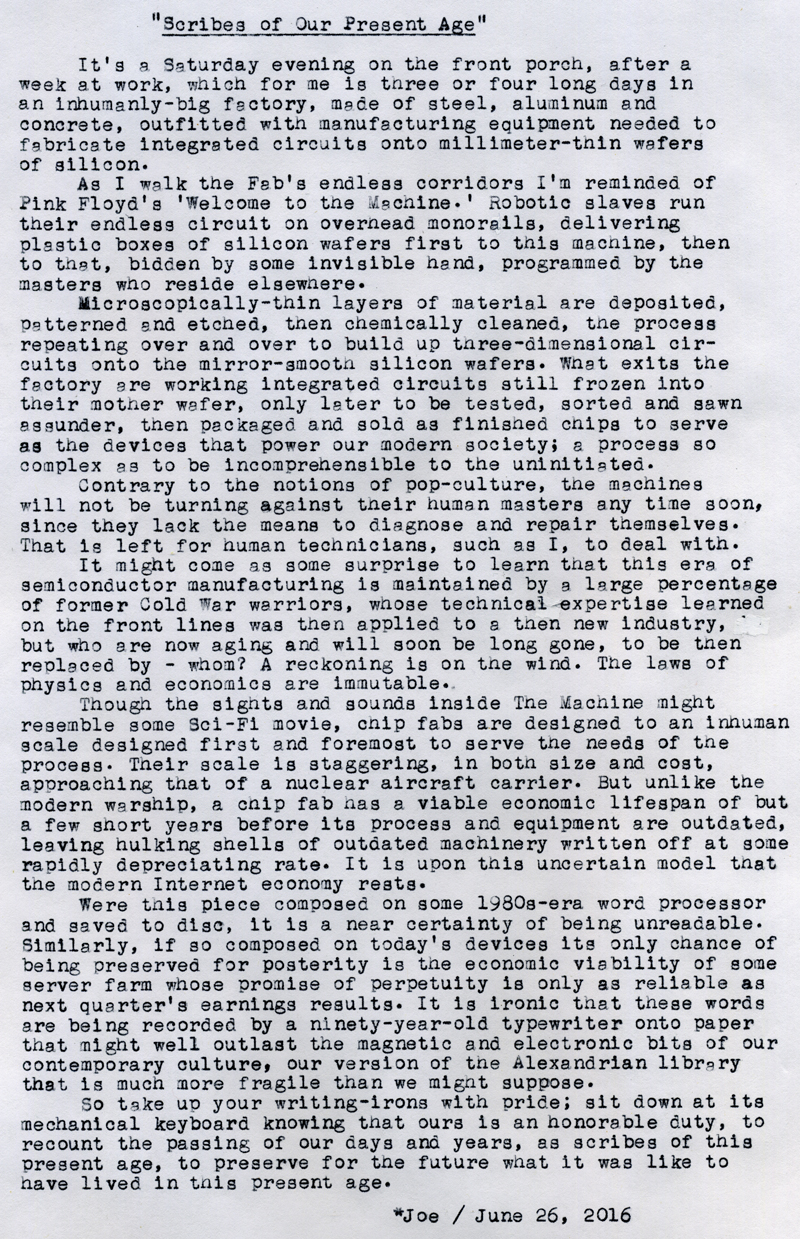
Typecast177

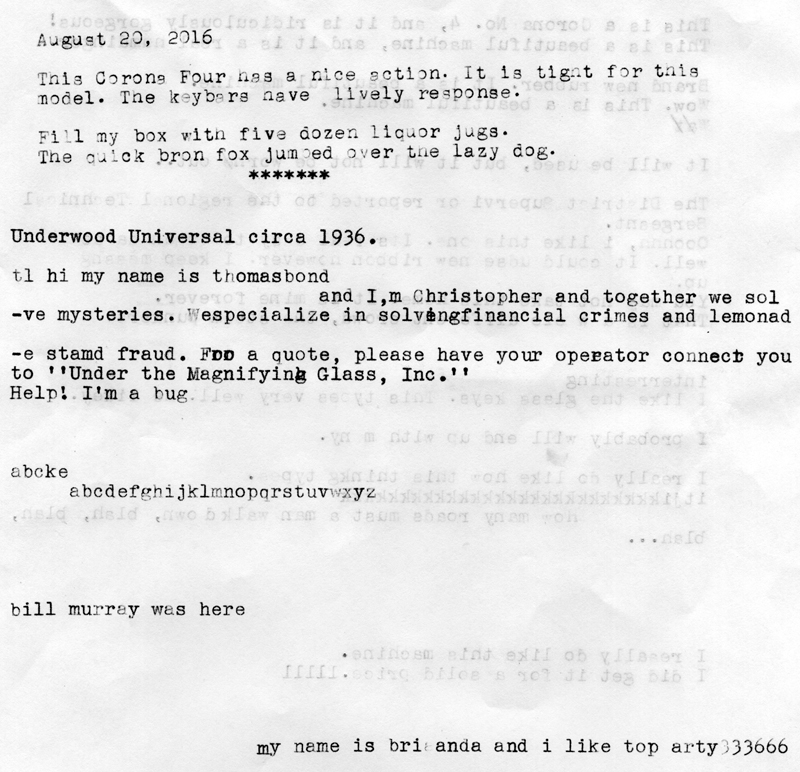
Post-Script: Perhaps us typewriter aficionados do have a duty to future generations, to preserve some small glimpse of this present age, through this seemingly outdated medium of mechanically imprinted ink upon paper, like those few diehard film photographers who choose to preserve images onto a more physically permanent medium than magnetic fields or bits of electric charges might provide. Perhaps that is the greater significance of the typewriter renaissance, offering one last opportunity, before these machines corrode irreparably through the effects of time, to preserve the knowledge of the past and present.

Maybe this is all much too romantic of an approach, the idea that typewriters serve some culturally historic function. But consider that the typed document is able to be scanned and then converted to some electronic format, much more easily than a handwritten manuscript might (certainly my handwriting is scanner-proof); functioning as a film negative, as a document existing into the future within the physical realm.

We could argue endlessly as to whether paper is more archival than electronic media. I can imagine scenarios where either media would fail first. For my purposes, however, paper documents require no expenditure of energy to sustain, only space to store; unlike information in server farms or hard drives, which have to be repeatedly copied onto new media periodically to remain viable. The laws of thermodynamics and quantum physics dictate that magnetic fields inevitably degrade over time, as do electrical charges, that will inevitably leak out of the best flash memory's floating gate.

I wonder if future historians will even have access to the archives of our present social media platforms, or if these will function as virtual voices in the wind, fleeting and ephemeral, only accessible in the present. Might it be possible that there will remain an enormous gap in our culture's legacy, brought about by the temporal nature of the systems and platforms that support our contemporary culture?

I am reminded that the typewriter's origins lie in an attempt at circumventing the effects of a labor strike at Christopher Latham Sholes's newspaper's printing office. Such is the problem of centralized control of the means to access information technology; which reminds me of our present-day era of silicon-based platforms dependent on specialist, centralized complexity, and of the typewriter's intrinsic self-sufficiency. Unlike the ancient Alexandrian library (another centralized repository of cultural data), whose contents were lost to history, the typewriter is entirely decentralized into the hands of individual collectors and users. Contrast this with these mega-sized semiconductor factories, described above (and in which I work), which are becoming more and more expensive to build and maintain, in the hands of fewer and fewer corporations willing to invest the necessary capital.

Typecast via ~90 year old Corona 4.

Labels: , , , ,