Thursday, August 17, 2017

Typing Scrolls Revisited


I'm certain I've blogged about this before. Using rolls of paper for typing, like the way that Jack Kerouac did with an early draft of On the Road, where he used a roll of teletype paper. Why a person would want to do so today has nothing to do with wanting to mimic the Beats. The Beat Movement is pretty much dead, last time I checked. And so are typewriters, except actually they're not; there's a revival in progress. Which is all the more reason to resurrect the idea of typing on a seemingly endless roll of paper - no more stopping in mid-thought to change paper. Just keep banging the keys and slinging the carriage back after the bell dings, and watch the paper pile up behind the machine on the floor; a more certain measure of one's writerly output.

Years ago, after this idea struck me (and inspired by a visit to the Palace of the Governors Museum in Santa Fe, which was hosting the On the Road manuscript scroll in its long glass-topped display case), I went in search of rolls of paper. Adding machine paper was too narrow, unless all you were interested in writing was short haiku poems. There were brown masking paper rolls, 6 inches wide, available at hardware stores; but I didn't want to type on brown paper. And there was white paper rolls in craft and art stores, but in widths much wider than the standard 8-1/2 inches.

After a bit of Internet searching I found a 6 inch wide roll of white paper, in 700 foot lengths, used for masking in the automotive painting industry. A local search found some at the Napa Auto Parts painting supply store. I ended up buying a damaged roll (the inner cardboard core was deformed) for less than half the price of new.

This paper I used for a time for typecast blogging. With the margins set to ~1/4 inch in from either edge, I could get long enough lines of text sufficient for this blog's template. But the paper was thin and crinkly, and didn't take ink all that well. I think, being engineered for painting, its surface was hydrophobic and hence repelled the ink, which would also easily smear. So after some time, I set that roll aside and looked for another solution.

A search on Amazon revealed rolls 8-1/2 inches wide of what was described as "teletype paper," but after receiving an order I found the quality of the paper was about the worse I'd ever seen. I should have known; I think Western Union quit the teletype business some years ago. Essentially like the very cheapest newsprint art paper, off-white and very fibrous, it doesn't take correction tape, and is mostly useful only for rough-draft writing where no one else will see the finished results. You wouldn't want to type that letter to dear old Aunt Mary with this stuff, or she'd take you out of her will.

This last week I once again found myself in the local big-box office supply retailer, when I happened across a roll of white "banner" paper 17 inches wide by 50 feet in length, for $5. It doesn't take a math whiz to figure out that 17 inches is twice 8-1/2, and I at once began thinking that perhaps my miter saw could cut it in half sufficiently neat to make the effort and cost worthwhile.

And yes, it was worth the cost, even the effort required afterward of cleaning up the garage because of the surprisingly messy cloud of shredded paper dust kicked up by the saw. But the cut was very smooth, and the resulting roll of 8-1/2 inch by 50 foot-long, white bond paper is nicely threaded up in the old Underwood Portable on the tray table, with the roll snuggled nicely between the scissor legs of the folding table using a piece of wooden broom handle. And a backup roll, from the other half, waits in the wings. $2.50 per roll is not a bad price. Maybe next time I'll do the cutting out of doors. Live and learn.

The paper takes typewriter ink very nicely, and has a very nice feel to it. I threaded up the paper in the machine so as to oppose the natural curl of the roll, hoping it helps in flattening it out. We'll see. Some of this paper, made from recycled pulp, can achieve a semi-permanent curl if left threaded around the platen too long.

So now I can say that my long search is over for an inexpensive source of good quality, white, typewriter-compatible paper rolls. I just need to set my butt down in front of that typewriter and start banging out some words. Which only I can do.

Labels: , , , , , ,

Monday, November 28, 2016

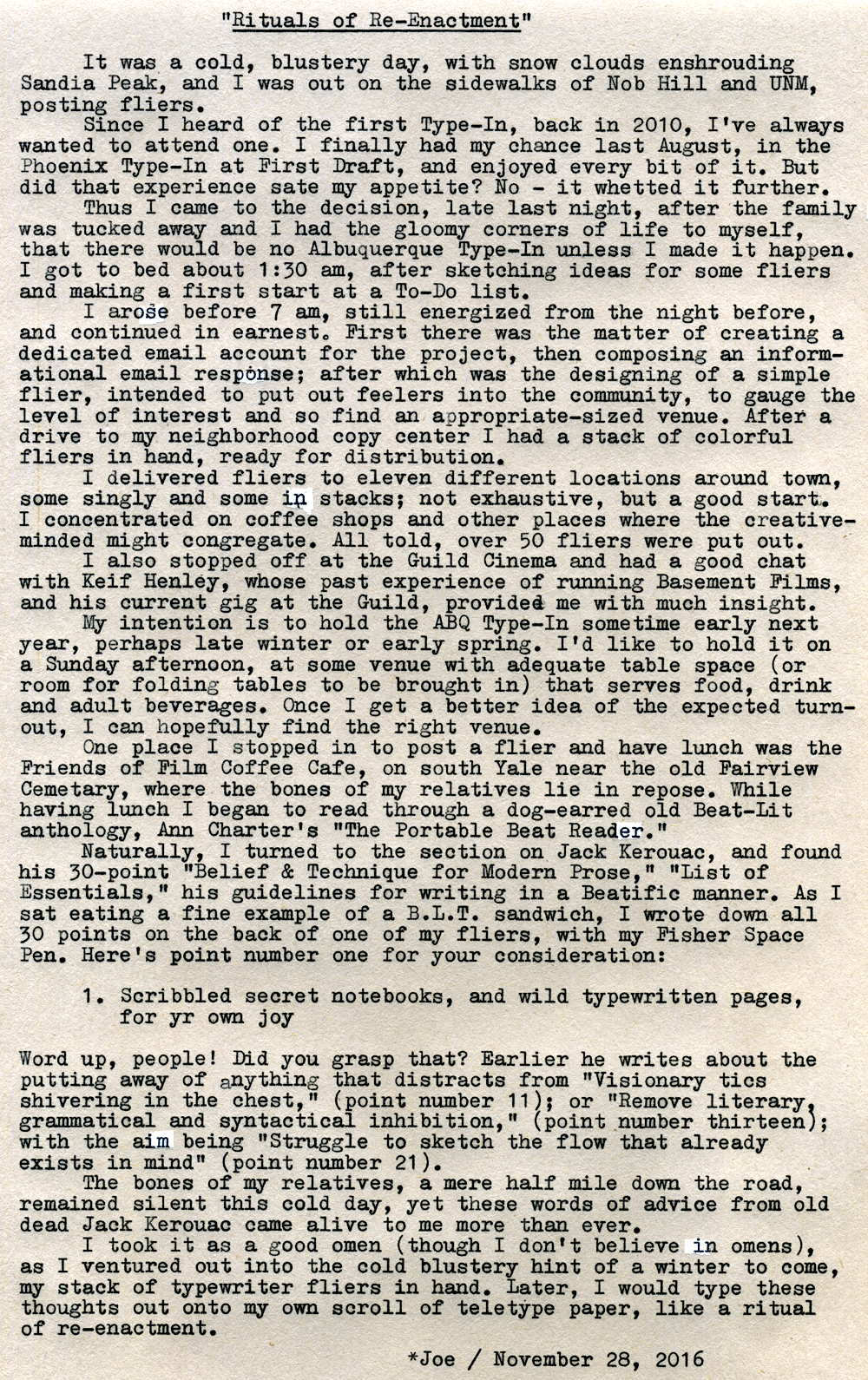
Rituals of Re-Enactment

P1120401a
Typecast265

Post-Script: I'm a newbie to this whole organizing an event thing, so I've lots of learning in store. But there are some good resources available, such as Ted Munk's excellent Type-In page.

Albuquerque's a funny town. It's hard to predict the response to a Type-In event. News of popular fads and new customs seems to travel here slower than one might expect, inland from the west coast to the high desert. We're usually a few years behind everyone else when it comes to popular culture; although the Internet-based media has helped to reduce the delay.

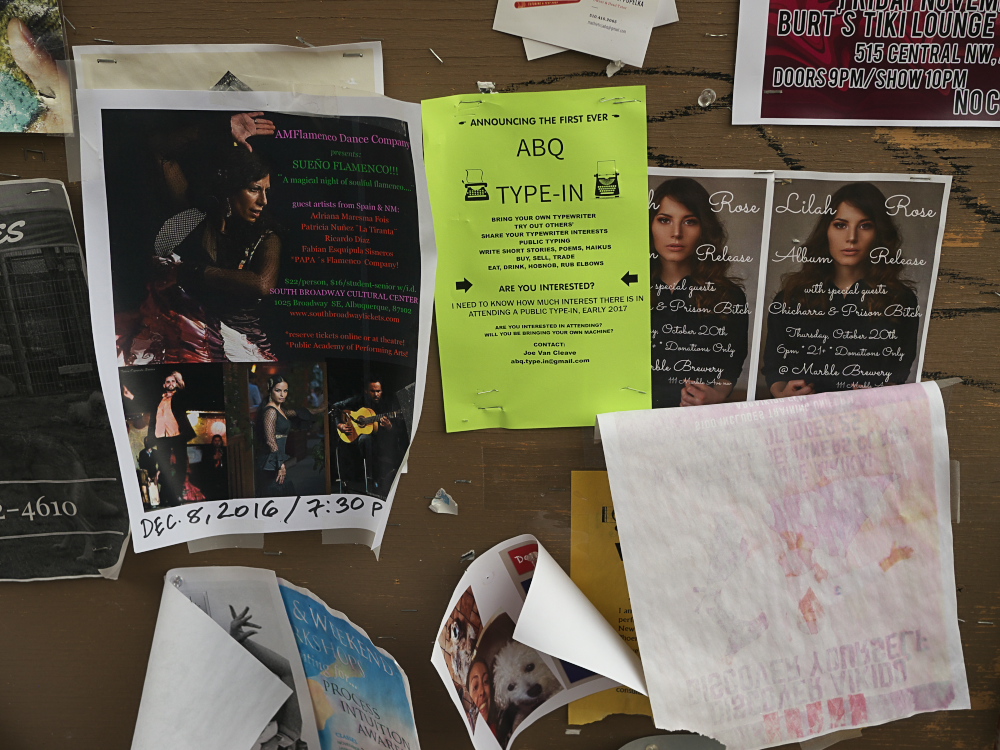
In my rounds today I stopped in to Field and Frame for a roll of black gaffers tape and talked to Alan Fulford about my ABQ Type-In fliers. He was interested, and permitted me to leave a few for his customers. He also mentioned he had several manual typewriters in the back room. I took a look at one, an Olivetti Lettera 35, that has dirty type slugs and needs a new ribbon. I'm going to bring one by on my next visit, with perhaps a little kit to service his machine. He also has (are you ready for this?) an Olympia SG-1! OMG! It turns out that Alan tweets typewritten poems to his friends. Who woulda thunk?

Typecast via Facit 1620.

Labels: , , , , , , , ,

Tuesday, September 13, 2016

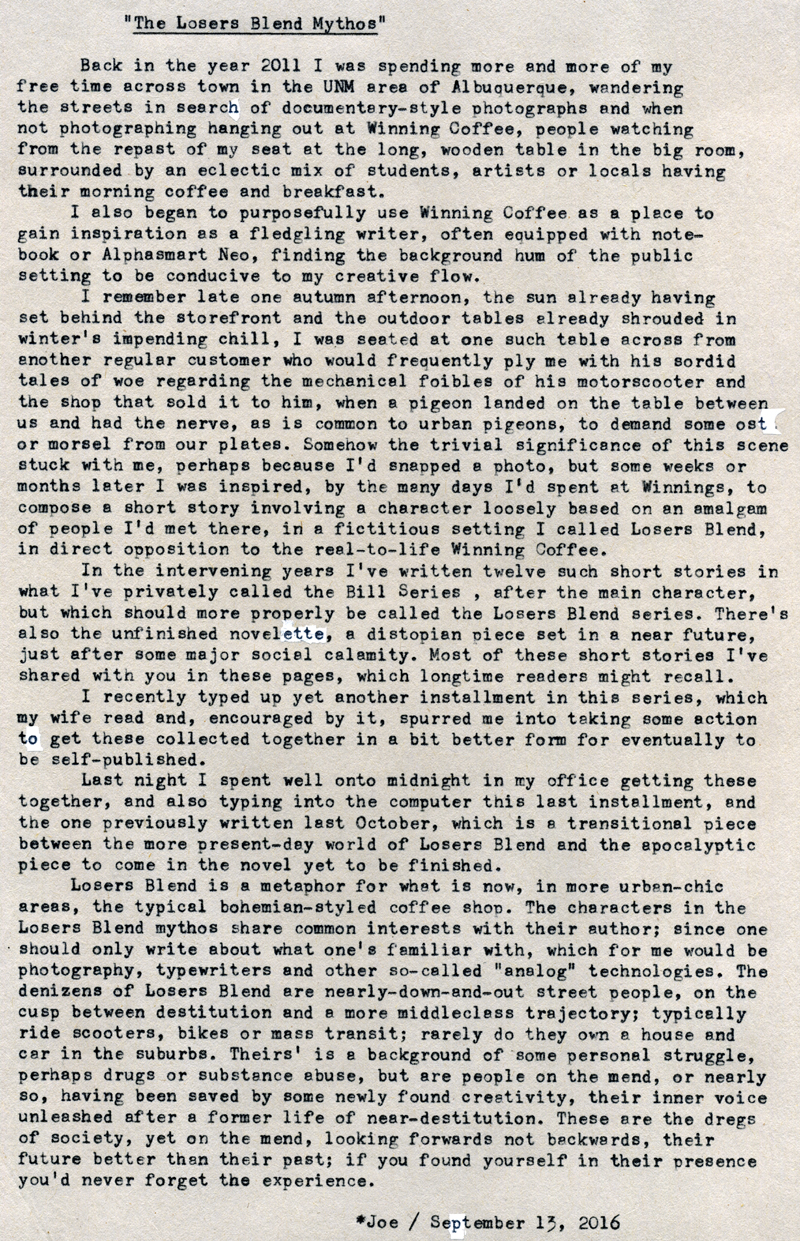
The Losers Blend Mythos


Typecast192

Post-Script: Here's the entirety of the short story series thus far, in the internal chronology of the story's world. The last part yet to be posted online is below, which comes second-to-last in the chronology.

1) "Pigeons" / Oct. 19, 2011

2) "Interface" / Nov. 1, 2011

3) "Barney The Cigarette Guy" / Nov. 14, 2011

4) "Healthy Respect" / Nov. 30, 2011

5) "Winter Crows" / Dec. 12, 2011

6) "The Guy Who Came in from the Cold" / Dec. 28, 2011

7) "Decrepit Underpinnings" / Jan. 22, 2012

8) "Two Lovers" / June 17, 2012

9) "Coming Home" / May 20, 2013

10) "The Real Deal" / May 29, 2013

11) "Some Future" / Aug. 23, 2016
(See below)

12) "Typing Like Your Life Depends on It" / Oct. 1, 2015


You might notice that a number of these stories were written in a short period of time, spanning October 2011 to January 2012, in what I consider to have been a most creative period of my life. It's difficult to manufacture creativity, but I must have been doing something consistently good; perhaps merely hanging out at Winning Coffee had some effect.

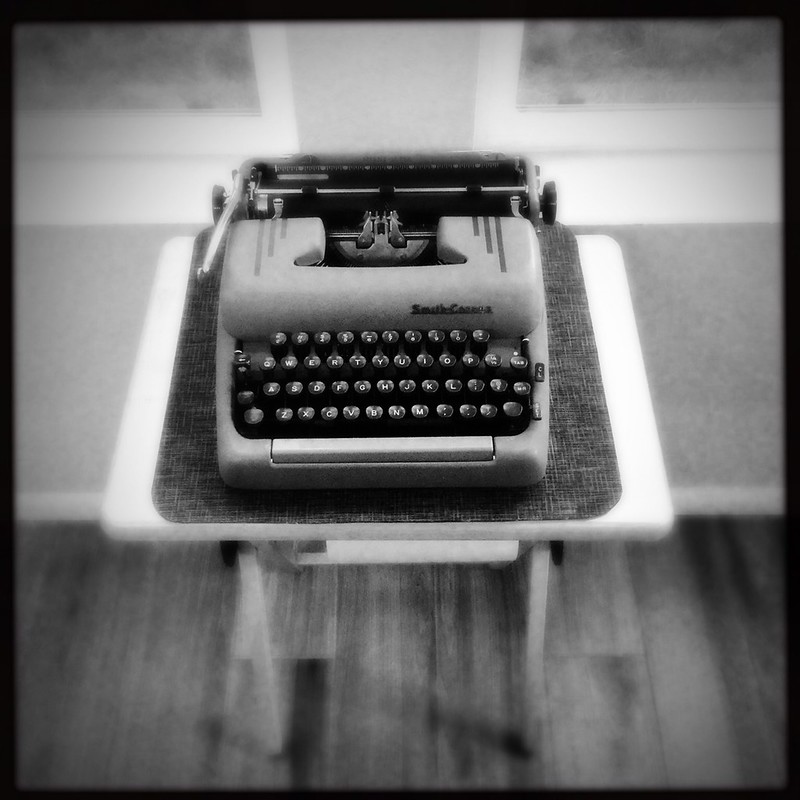
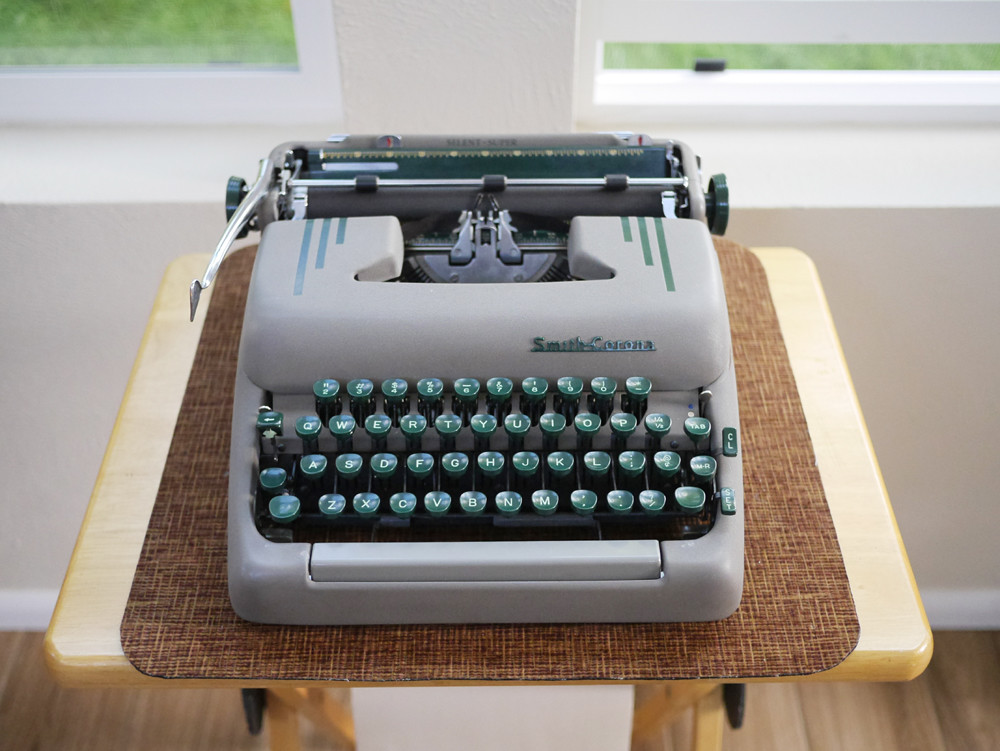
Smith-Corona Silent Super

The eleventh story in the chronology, "Some Future", is posted for the first time below. I composed it on the Smith-Corona Silent Super, a typewriter that is of the same ilk as the denizens of Losers Blend, for it too was rescued from a former existence of bohemia and the dregs of society, requiring plenty of work, and even now remains noticeably less-than-perfect, but therefore possesses a quaintness because of that troubled background. This is a reformed beatnik typer, yet still possesses the spirit of that Kerouac technology, despite all the work I've put into reforming it into some model of middle-class Americana. It possesses a free spirit, always reminding me of its scars and troubles, as is fitting for a beat typer. One should always respect one's beat typer, for they are the artist-typers of our culture, the ones we should grab first when we wish to channel our inner Muse and capture onto ink and paper a bit of the whimsy of the aether.


"Some Future"
by Joe Van Cleave

Bill threaded the scooter between traffic and rows of parked cars, finding the ramped curb where Harold the store clerk rolled his dollies of produce from the double-parked delivery trucks, early in the morning. Finding his favorite spot on the sidewalk between the newspaper box and light pole, Bill lifted the seat and extracted cable lock and shoulder bag, securing the rig as he'd always done, then headed halfway down the block to Losers Blend, indicated by the mess of tables and chairs on the wide, brick sidewalk, filled with mostly an assortment of college students, street people and hipsters posing as the former. The smell of hand rolled cigarettes and vaporizers filled the autumn air, unseasonably warm.

The aroma of fresh ground coffee, garlic and cayenne pepper from the kitchen greeted him as always, a comforting familiarity in his otherwise hectic existence. "Morning, Todd."

"Morning, Bill. The usual?"

"Yea. And the Times. I'm feeling rich today." Bill didn't always read the news, but sometimes he made exceptions.

Coffee and paper in hand, he made his way to the corner table, ordinarily cluttered with a mess of magazines and sections of yesterday's paper, a catch-all that the old crew knew was actually Bill's reserved table in disguise. He quickly gathered up the detritus of old news and stacked them, in one graceful heave, into the spare chair, then sat down, neatly arranging his coffee, shoulder bag and paper.

Just in time, Maggie, the new gal, brought him his breakfast. "Here you are. Can I get you anything else?"

"Just keep the coffee coming, thanks."

"Well, we normally don't do refills, it's serve yourself."

"I know. But then again, nobody's come here as long as I have, and it's become a kind of tradition, one that Marty started, years ago."

"Oh, you're the special customer. I see. Sure, no problem."

"Special customer? No, not really. I just like tradition, that's all. Otherwise nothing special at all about me."

As Maggie turned to leave, Bill realized his special status as the closest friend to the late founder of Losers Blend was a soon passing phase, one that would be lost to the changes that time brings. Just as cultures evolve, the old Losers Blend would soon be forgotten.

He didn't exercise his special status out of some ego-driven motivation, but as a way of remembrance, or so he liked to tell himself. Remembrance for the way things used to be, for the special person Marty had been, and for their special relationship, forged by a bond that only comes from drastic circumstances. Though he didn't want to think about those dark times, he also didn't ever want to forget. That was the whole point of the messy table in the corner, the one Marty used to sit at during his breaks from the kitchen, back when Losers Blend was just starting and the idea of a bohemian coffee shop was an oddity to middle class sensibilities.

Digging into his breakfast, the chile was as hot as ever, the one thing, aside from the good coffee, that hadn't changed with Marty's passing. Pausing with elbow on table and forkful at mouth, Bill could still recall, as if it were just yesterday, when they'd first met.

Bill's had been a hard childhood, with his mother dying when he could barely walk and then his dad's years of struggle with drink. He'd been passed around from one family member to another, first his grandparents, then an aunt, then another aunt, until he was sixteen and decided enough was enough and he ran away, to start his adult life a few years earlier than his peers, whom he didn't know, having moved from city to city and school to school, always the loner, the outsider, the new guy.

At eighteen he tried to join the Army but failed the entrance exam. People told him you had to be pretty dumb to fail the Army exam, as dumb as a box of rocks. For a while he started to believe it himself, until one day when he found himself on a bus stop bench voraciously reading a discarded paperback novel and suddenly looked up and the world around him looked different from what it had been a half hour earlier, as if those words printed in that grimy, dog-eared novel had been a key that unlocked something deep inside him, like shedding a thin veneer that'd covered his eyes and obscured the truth. Ever since then, he'd been on a journey of discovery, bouncing around from one situation to the next but always with his mind set forward, to some future that only he could see, a future anyone else who knew him at that time would be hard pressed to imagine could ever circumvent the situation he'd been in then.

And then he met Marty, a fellow vagabond like himself, and at once they both knew they'd found brothers in each other, the family they didn't have. Marty and Bill hung out together, ran the streets together and did whatever they could to get by, sometimes doing things they knew were trouble, but justifying it with the reason that they were desperate, and desperate people had to do what they had to do. Survival was the motto on the streets.

But Marty and Bill weren't dumb. They knew enough of the streets and the people on them to know that once you fell to the allure of the bottle or the needle or the pipe, you were a goner; that the way forward and up would be much harder. And they both shared a common vision for the future, one in which they both could keep a bit of their present freedom while somehow making it in life, threading that narrow needle's thin gap between slavery to The Man and succumbing to the flesh.

Bill suddenly realized he'd been staring out the window, the food that had once been on his fork now staining the front of his shirt, and Maggie had refilled his coffee while he'd been away in his private reverie. And this was how he came to understand that he'd crossed over some crucial milestone in life, when instead of all his energy being consumed in striving for a seemingly unattainable future, he spent more and more time recalling a past that was even more unattainable. The future was certain to happen, though maybe not the future one hoped for; but the past was gone forever, its only evidence distant memories and some artifacts, like bones unearthed and preserved in our private museums, memories of the kind one finds prodded into surfacing from the dark pond of life by snapshot photos in crusty old albums.

The morning rush now over, Todd was busying himself with cleaning up and preparing for the noon rush when he noticed Bill standing at the counter. "Need a refill?"

"No, Todd, thanks anyway. I'll be going now. And the table in the corner, you should clean off those old newspapers, I'm sure somebody'd like to use it."

"Later, Bill."

But Bill didn't answer, or didn't hear him. He exited out the grimy glass door into the morning light, bag on shoulder, without looking back, his face set on some future only he could see.

Labels: , , , ,

Tuesday, September 06, 2016

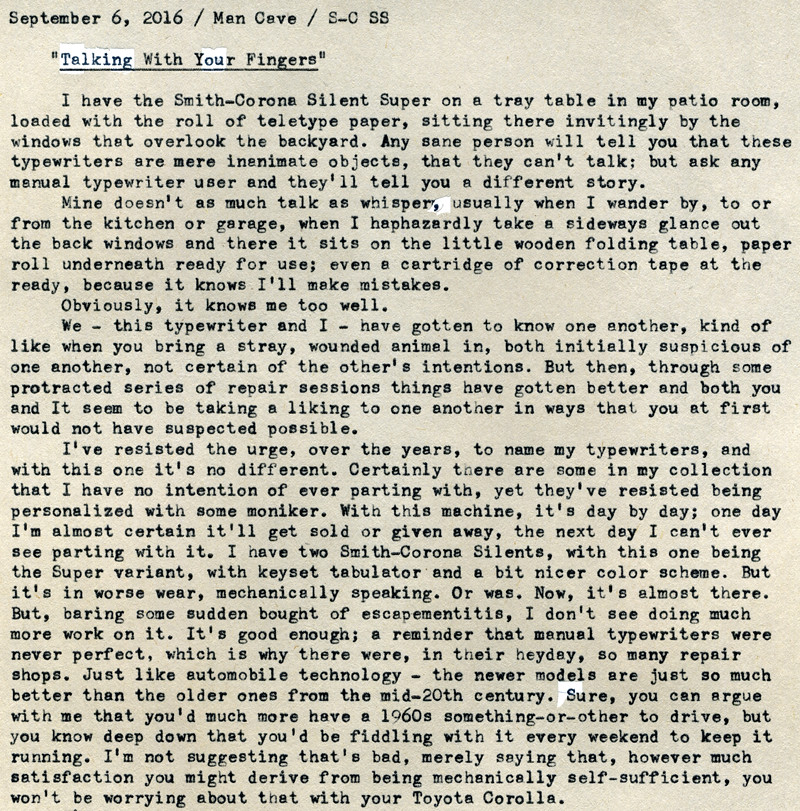
Talking With Your Fingers

P1010007a
Typecast190
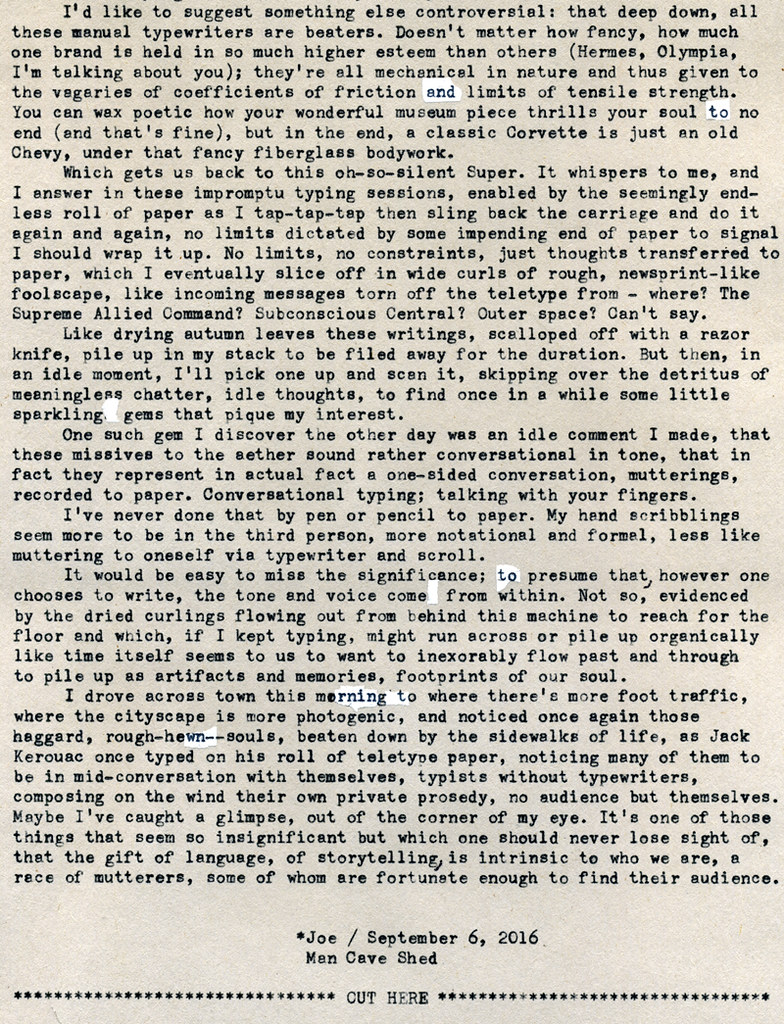
Beater Typer
Typecast191

Post-Script: The reference in that last paragraph to Kerouac's On The Road was unplanned, but perhaps inevitable, given the nearly identical method of composition. I've read On The Road numerous times, but never in the context of it being a work specifically wrought onto teletype paper via manual typewriter, in some manic act of marathon muttering. Perhaps a reread is warranted.

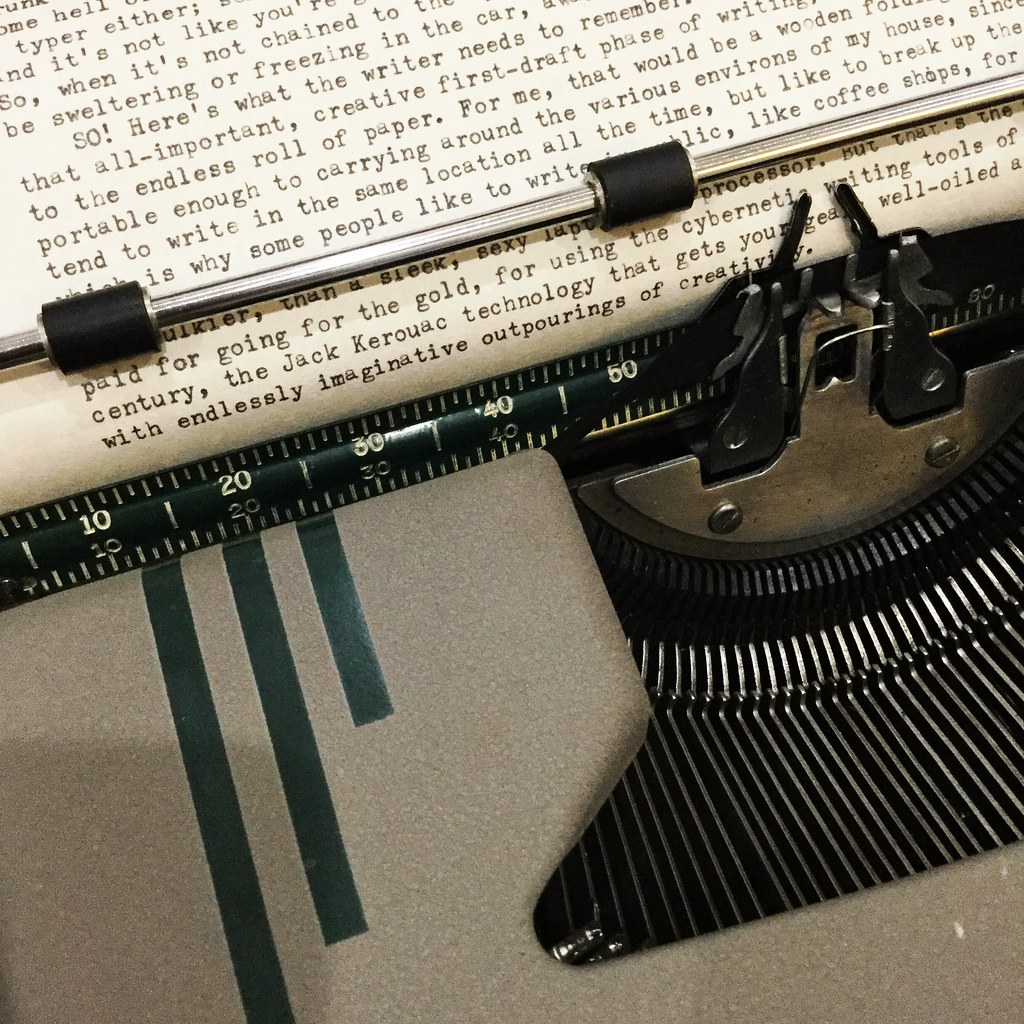
I find the smaller font size of the Silent Super to be ideal for this kind of writing, as it seems more like letter-writing, more personable, requiring an up-close read, an intimate squint into one's own soul.

Misspellings and typographic errors courtesy of the author.

Labels: , , , , , ,

Sunday, August 07, 2016

First Draft Writing

P1080148a
Typecast187
P1010508a
Typecast188

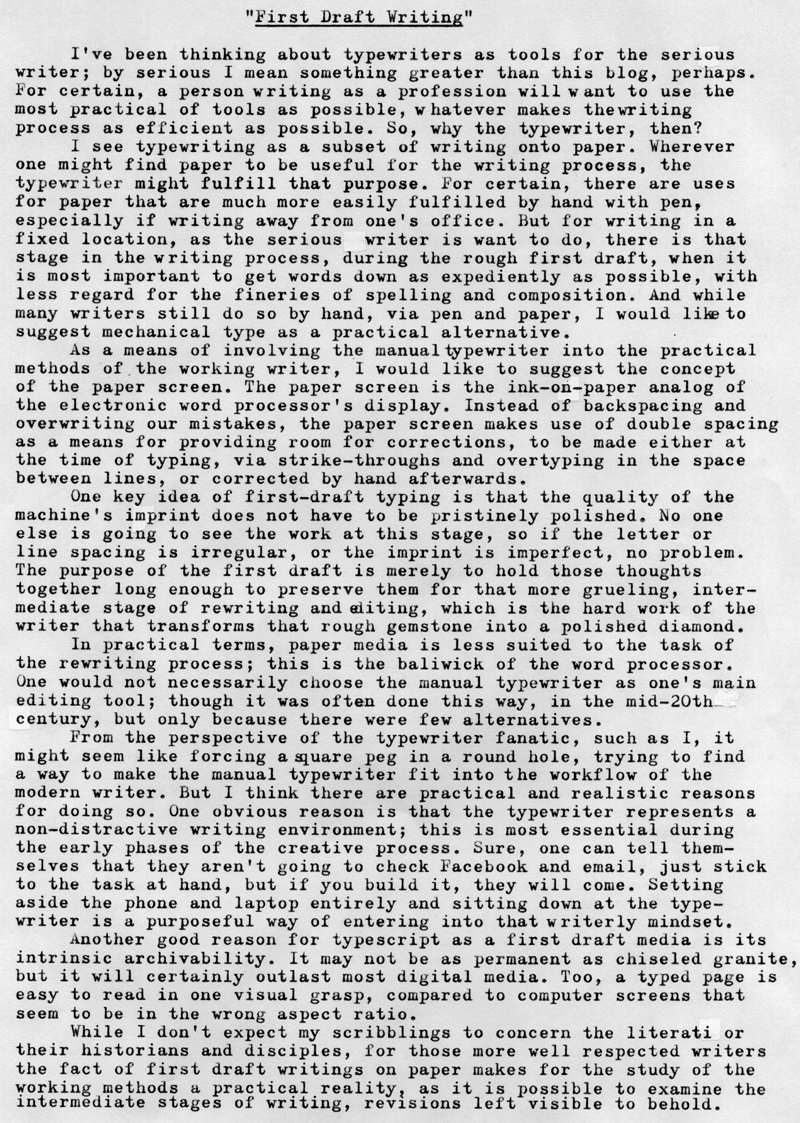
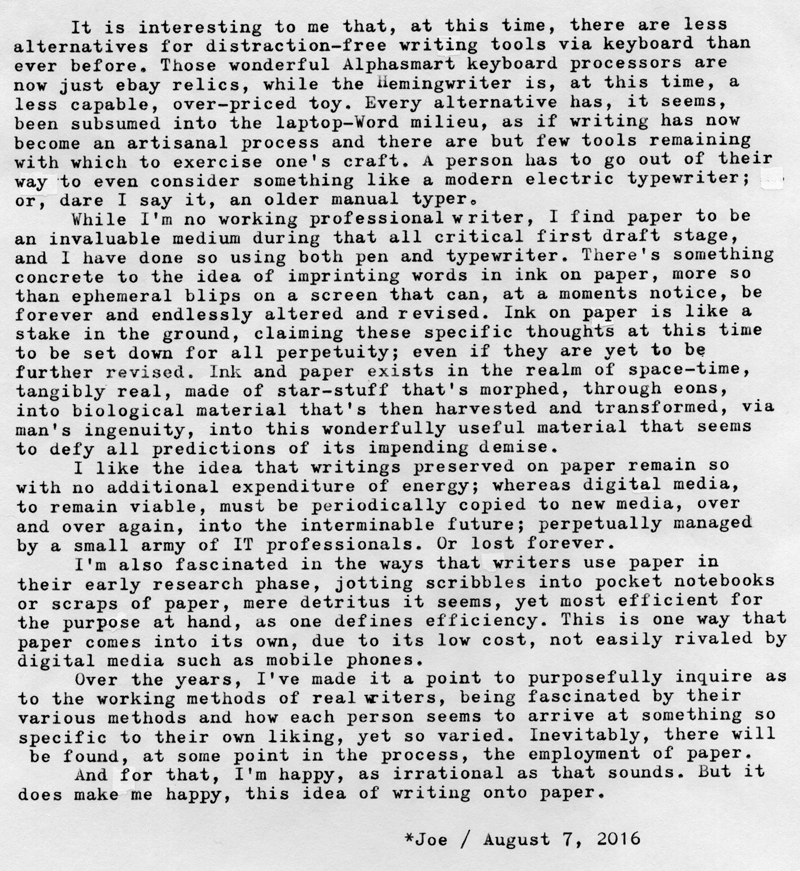
Post-Script: I'm reminded that there are a number of writing applications that purport to make the writing process via laptop computer less distractive. Yet at the same time I can't help but think that it's not a problem with Microsoft Word, but rather with the computing platform itself, wirelessly and incessantly connected to the World Wide Web.

Alternatively, since I'm not a working writer, perhaps I don't know what I'm talking about. But the times I've been the most creative have been those times when I've purposed myself to sit down and write. It's a specific decision a person makes, despite the risk of so-called writer's block. To sit down and put words on paper. Yes, on paper. I do think the paper helps to make the thoughts tangible, though that might be a mere psychological trick. But whatever works.

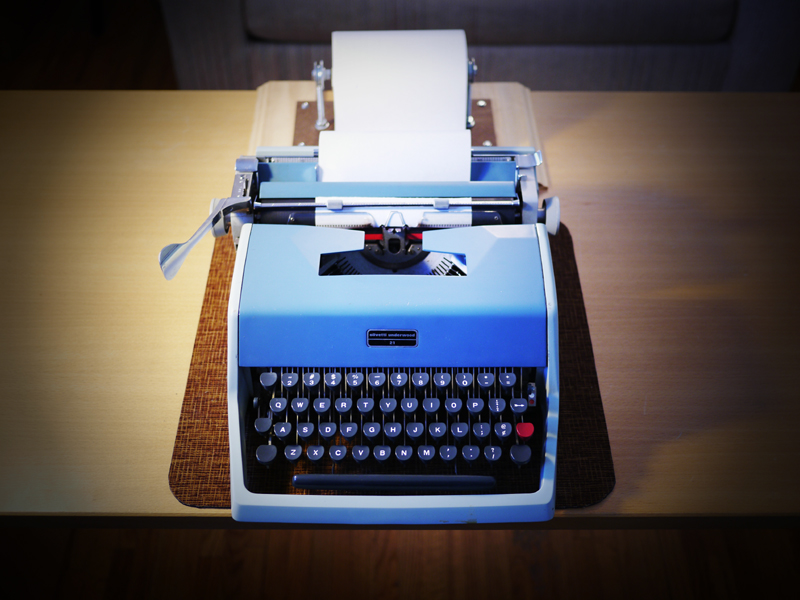
I've included as the second photo my old Underwood Olivetti 21 and the L.A.R.O.P. - Little Ass Roll Of Paper, the junior-sized version of the Jack Kerouac-inspired endless scroll. I had to find this narrower (6" wide) white paper at Napa Auto Parts, used for masking cars prior to being painted. It's white, but isn't letter-writing perfect for taking typewriter ink; but for first-draft writing it's sufficient, if you need the narrower size; and the first-draft writing process with the endless roll of paper is remarkable. Set your machine to double line spacing, set the margins about one character in from either edge, and start typing. And don't stop. Just keep putting words on paper and slinging the carriage back and forth, and before you know it, there's a long tail of paper hanging off the back of the machine, piling up on the floor, and you find yourself with a sizable amount of words written to paper. When you're done, either accordion-fold the scroll into page-sized pieces or cut it up and bind it together; whatever works for you. The double spacing means you can immediately begin proof-reading and revising what you've typed, via pen or pencil. I've found this to be the most efficient way to get words down on paper using a manual typewriter; and the narrower size makes it easier for the scroll to slide back and forth sideways with the carriage motion, compared to a full-width scroll of paper.

Labels: , , , , ,

Tuesday, June 07, 2016

On Re-Typing

P1000463a
Typecast174

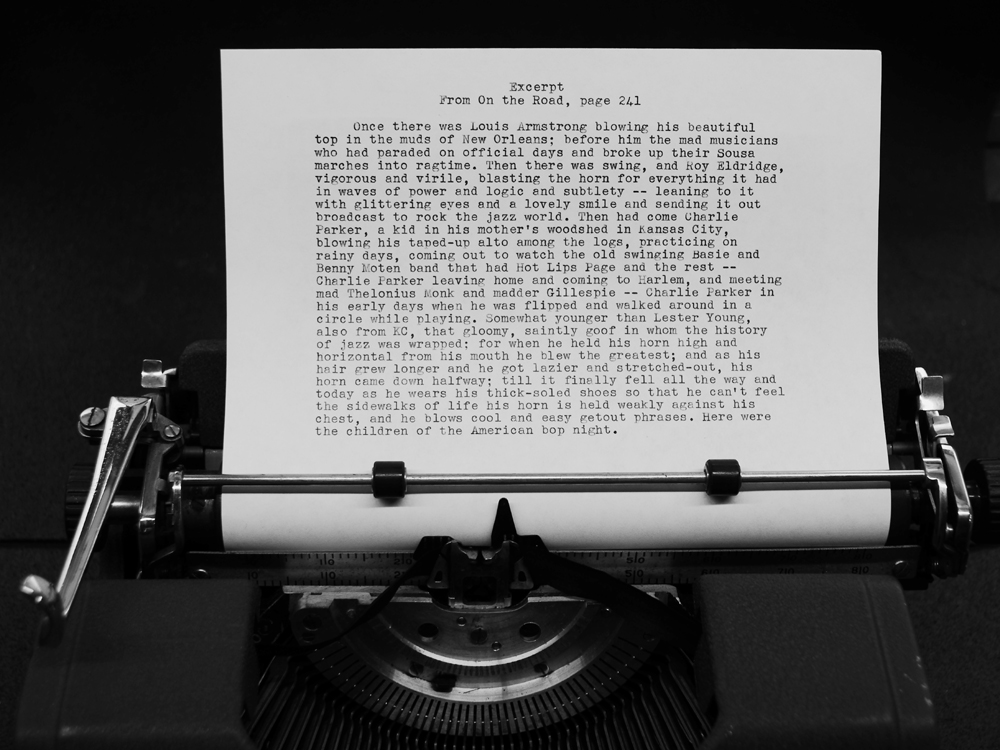
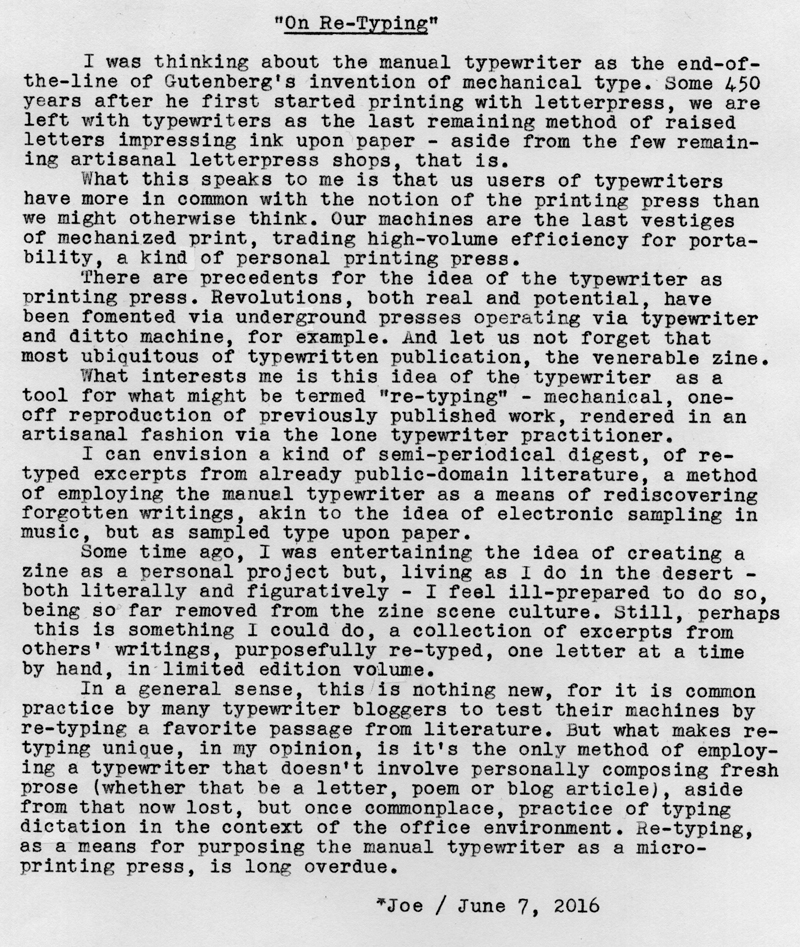
Post-Script: I'm not certain the analogy is perfectly apt, but I see re-typing as similar to noodling on a guitar using sheet music of some popular song; a cover-tune, attempting to walk in someone's footsteps, not for the purpose of simulation; more like emulation, honoring their art and craft in the knowing that, in the case of authors from the mid-20th century, they too most likely were perched in front of some similar typing iron, fingers banging away on keys. You get a sense of the work that went into the final piece. I certainly felt that as I typed this favorite excerpt of mine from Kerouac's On the Road, wherein you can almost hear the music and smell the aroma of the smoke-filled nightclubs.

"Here were the children of the American bop night." What a wonderful turn of phrase.

Photo via Lumix GH3, typecast via Underwood Universal.

Labels: , ,