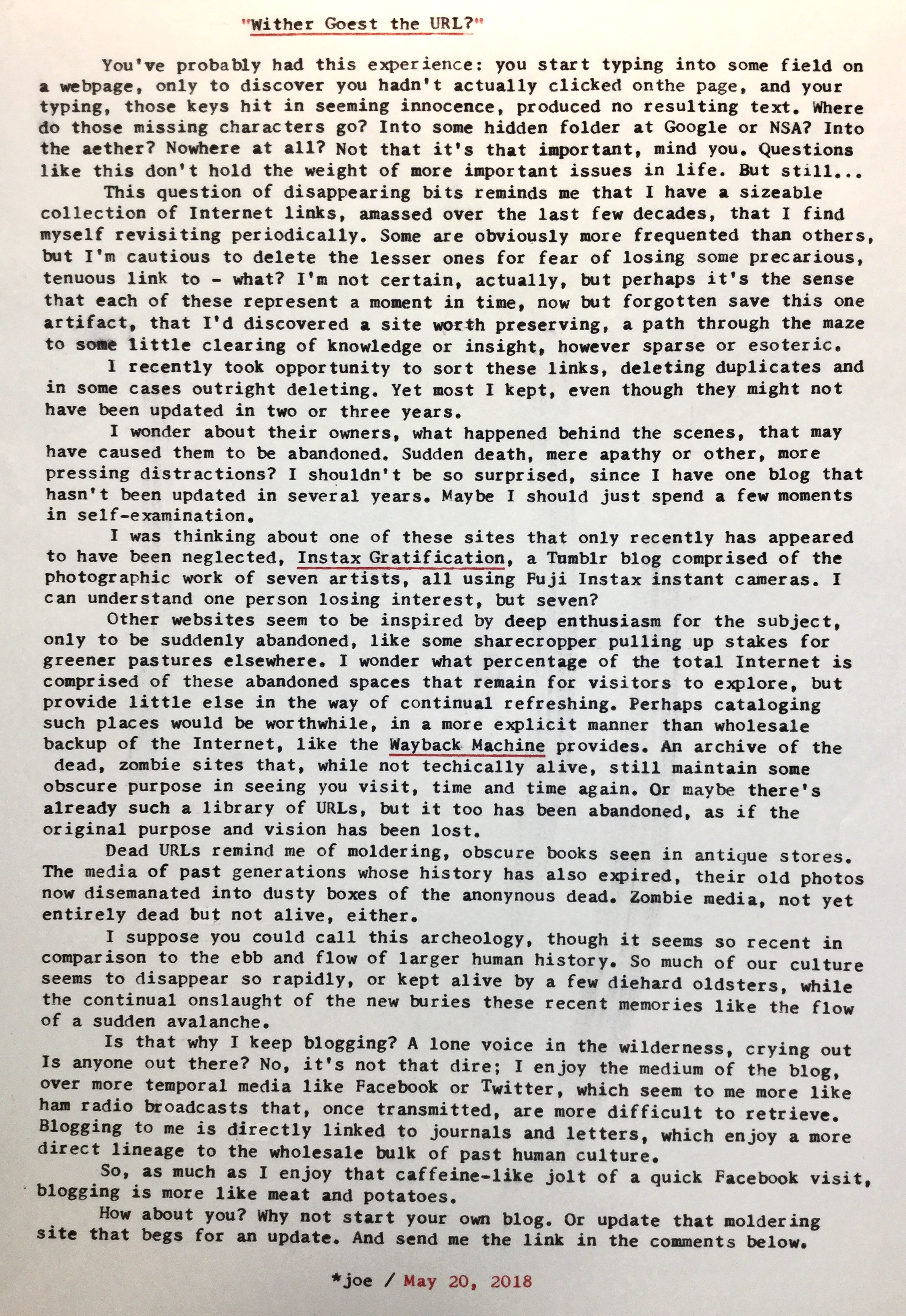
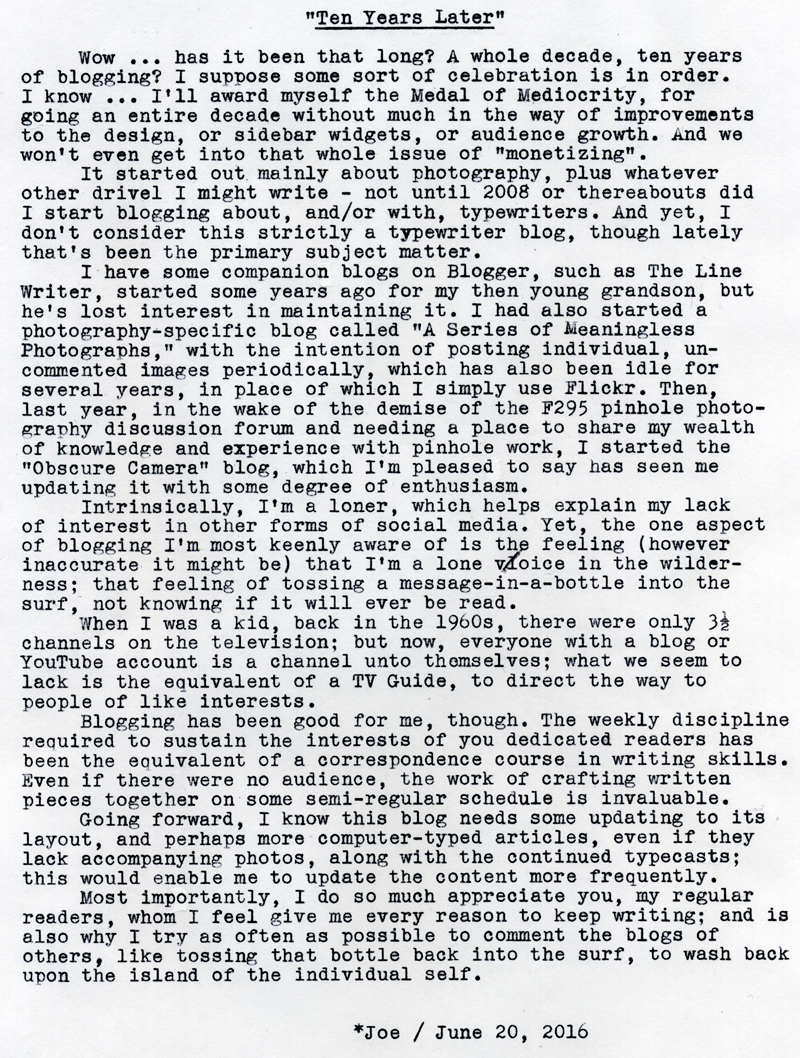
This was a fun project, resulting in bona fide messages sealed in glass. We discussed the merits of actually tossing our bottles into - where, exactly? We're in the high desert, after all, almost a thousand miles from the ocean. Perhaps we can wait for spring runoff on the Rio Grande (last year's runoff was spectacularly high) and hope the bottles make it downstream of Elephant Butte reservoir into the southern reaches of the Rio Grande, hoping for the Gulf of Mexico. Most likely they'd get trapped in some brush along the riverbank and get buried in sand, or discarded as litter. Is tossing a glass bottle into the river littering, when there's a real message inside? Probably.
Another idea was to take a trip to California and toss it into the Pacific ourselves. Hmm, maybe.
Last weekend I sat down at the Skyriter and composed a one-pager about the merits of keeping it or not. As it turns out, it ended up in the hands of a young man eager to put it to good creative use. Here were my thoughts:
Going back further in time (in case you haven't figured it out, I'm dealing here with a backlog of writings) in mid-January I sat on Kevin's front porch (it must have been a warm January afternoon) and enjoyed a bit of writing on his Groma Kolibri, equipped with a green ribbon. This is the one I worked on earlier in 2019, and it's a sweet machine. For some reason I decided to underline the first letter of each paragraph, which is an interesting typographical idea, perhaps I'll do more of this. In the piece I mentioned "birdie time," this being our weekly visit where we try to get their bird used to our presence, as we'll be bird-sitting for them. Kevin also makes this wonderful statement, that I'm "a collector of typewriter experiences." Well spoken, and a great way to differentiate myself from the classic typewriter collector.
The Typewriter Bus idea mentioned above was my idea for a mobile typewriter bus for conducting public type-in events in various places. It could have school desks bolts to the floor with typewriters securely mounted, and an external fold-up sideboard table along the outside for standing-while-typing outside. I can envision a fold-up awning on either side for shade, and a 50-states typewriter bus tour. I only need lots of money and time. Maybe. Maybe not. But never let your dreams die.
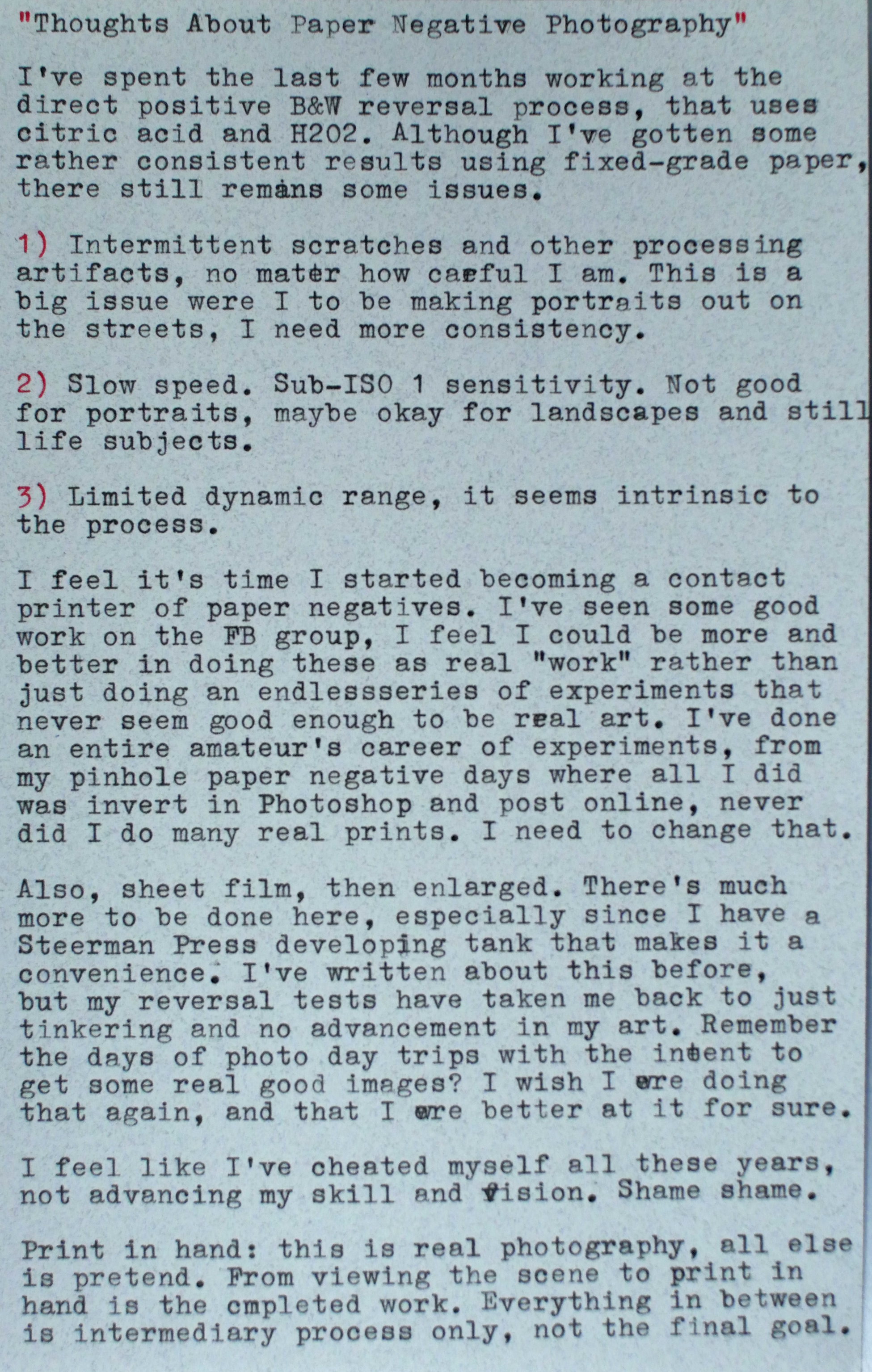
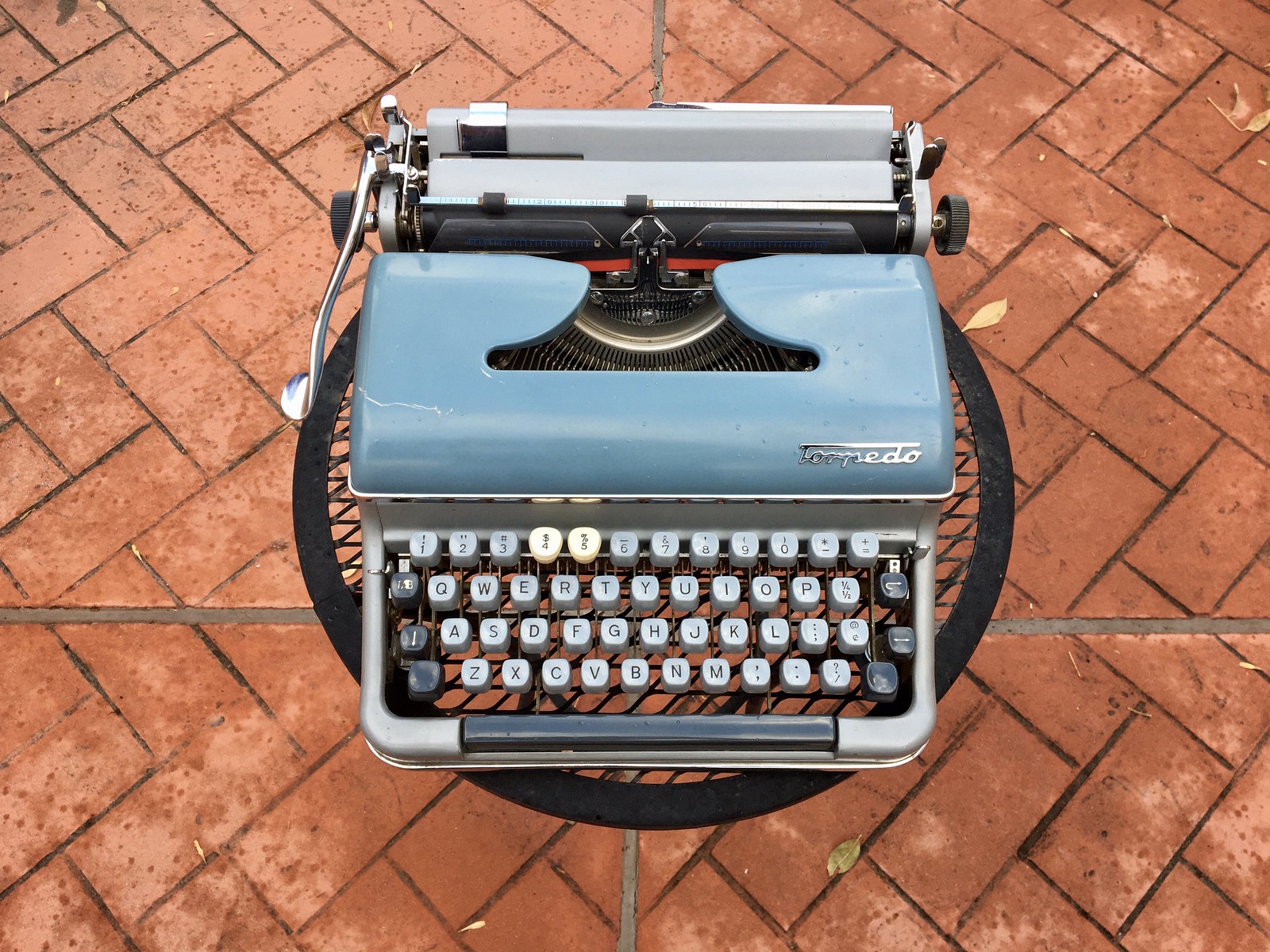
The next three pieces were composed on 30 December 2019, again at Kevin's, using the Torpedo 18. It must've been a heck of a session, as it progresses from the first page involving a review of the last year as it pertains to the founding and growth of the ABQwerty Type Writer Society, to a short essay on pictures versus language and my desire to explore personal story-telling, to another short essay about my paper negative photography. A hodge podge of subjects, for certain.
2019 Year in Review:
On visual versus written media, and personal story-telling:
Thoughts on paper negative photography:
I should've been posting these pieces here as separate articles, but I do tend to procrastinate, more so lately. I hope you find this variety of writings to be of interest. Please leave a comment down below if you wish, I'd love to have a dialog with you about these ideas.
Here are the parts to each original foot, with the new foot mounted to the machine:
The rectangular brackets are mounted on the top and bottom of each foot, then mounted to the chassis with both shoulder screws. I was originally hoping to find a square furniture caster with a deep enough recess in the middle that I could use these brackets and screws; but none I could find were deep enough. I'm happy with these round rubber feet, however, and they prove very grippy on smooth surfaces, just like a rubber typing pad. I did have to add some spacer washers between the tops of the rubber feet and the frame of the machine, so the shoulder screws would remain recessed sufficiently so they won't scratch the tabletop.
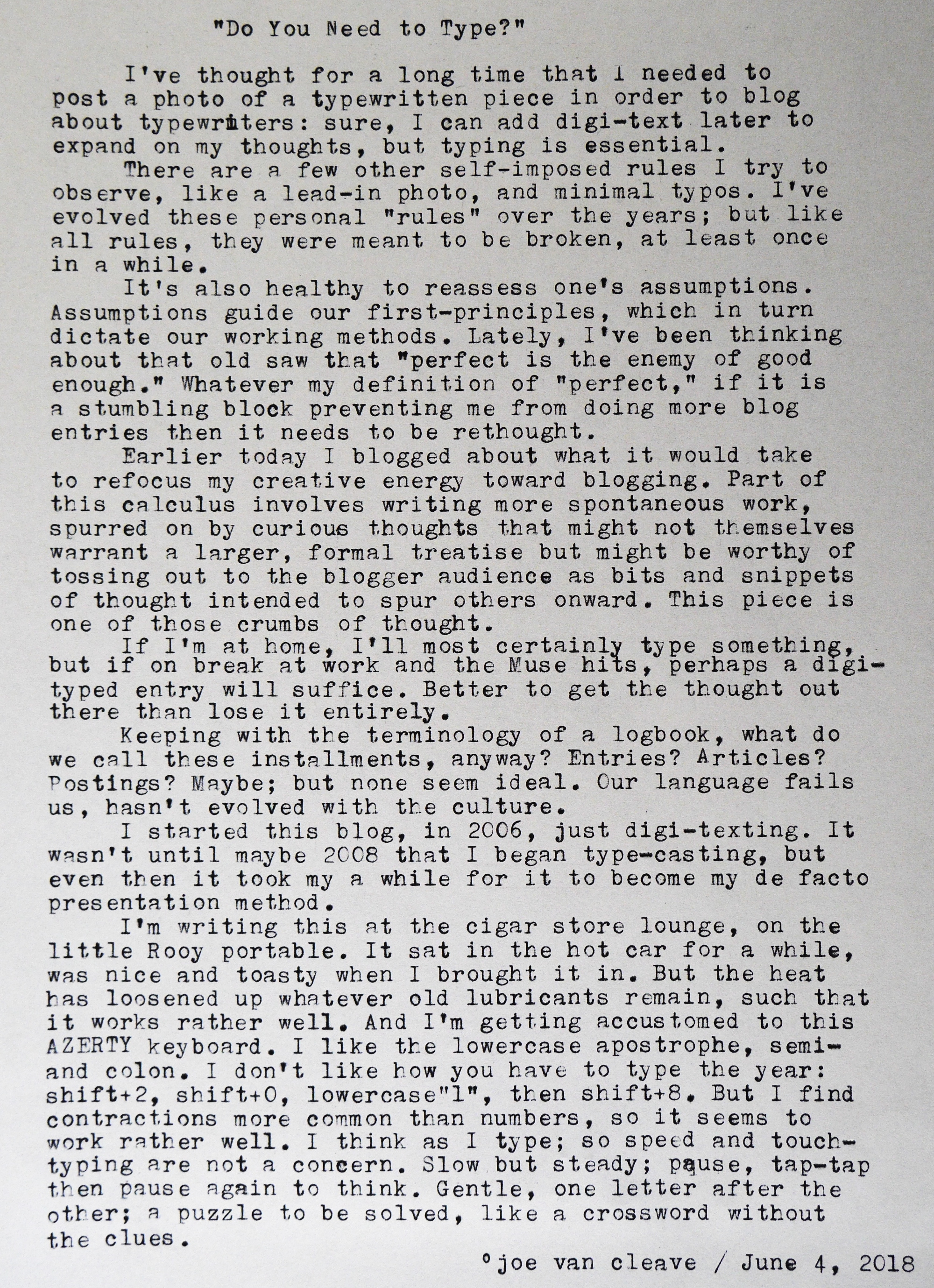
I'm at the place where I'm more comfortable with typographical errors in my typecasts. I don't know why it's taken me this long. I was probably holding onto some affectation of the typewritten piece as a work of published perfection; whereas in actual fact I'm an imperfect typist (as well as an imperfect writer, thinker and speller) who's learning to embrace the "organic" look of human imperfection. Er, at least that's my excuse.
Actually, I think there's something valid here. In the heyday of the typewriter as a tool for the professional business world, perfect copy was an expectation, administered by professional typists who were compensated to do just that. But in this post-typewriter world, we can hold onto our imperfections as work-in-progress, somewhat akin to how a quick pencil sketch, in its brief roughness, doesn't compare to a finished painting. Typewritten pieces like this one are akin to jottings or doodles - they communicate an idea, but imperfectly so. Their value is in their immediacy. And I like that they reveal something of the process involved.
In fact, one of my favorite blogs is Vinnie McFeats' The Untimely Typewriter. I revel in each posting, as they exhibit the look of an experienced typist who knows his way around a manually typewritten page, replete with corrections in all their glory; no affectations present here. I don't think there's an ASCII character for a double-struck or X'd-out correction; these are markings unique to the manual typewriter. They're like the sound of gears mashing on a non-synchronized manual transmission - it's the way they're supposed to work.
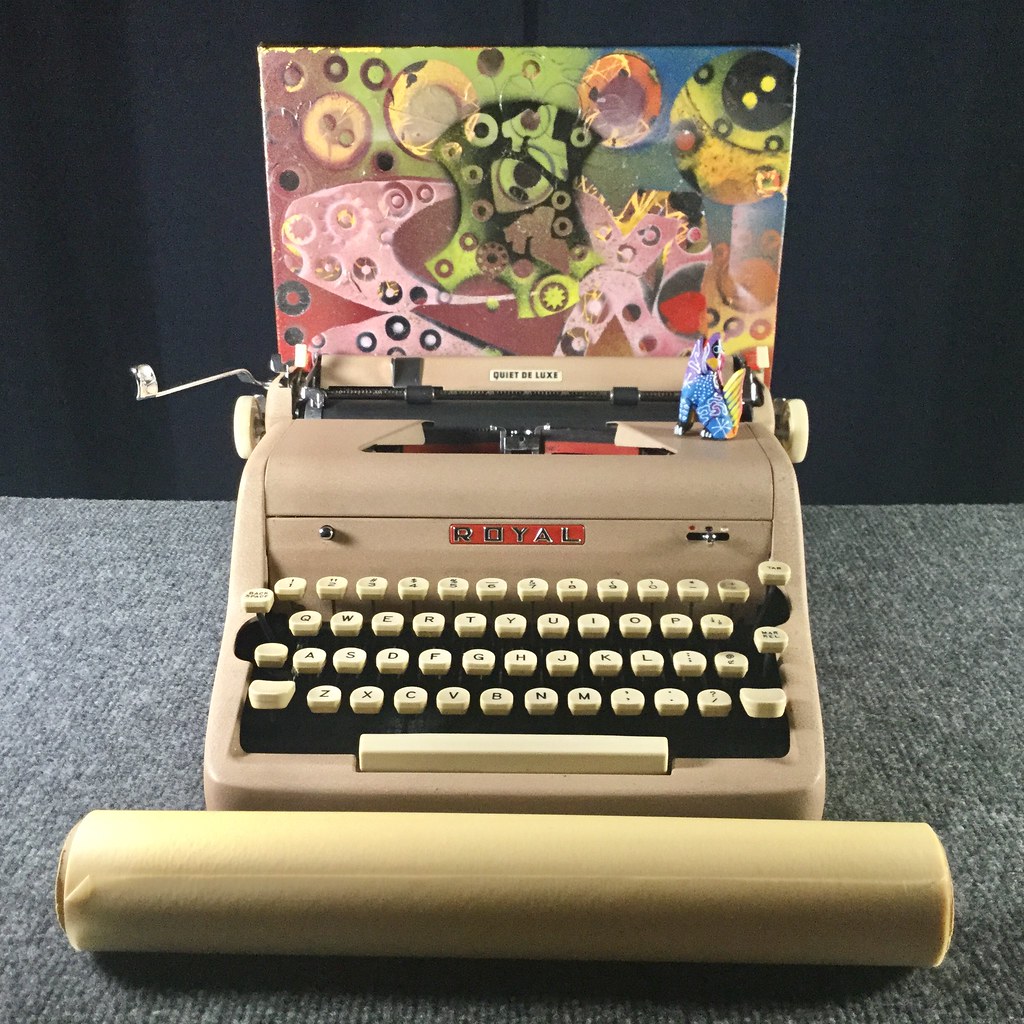
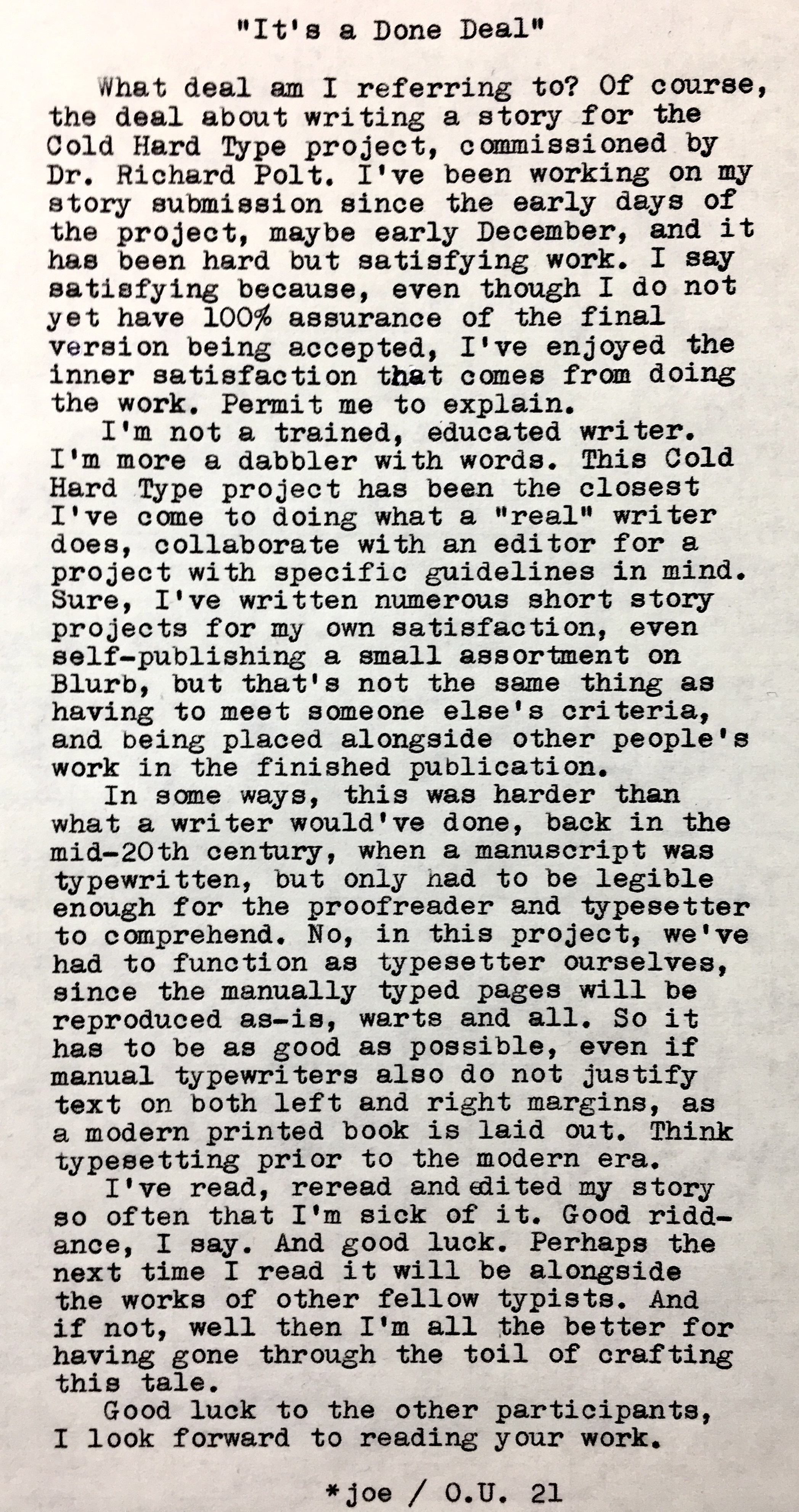
Post-Script: I did the final typing of the story on Adobe Rose, the Royal QDL, seen above. Though it had a partly used silk ribbon, I ended up swapping out the ribbon mid-story for the fresh ribbon Bill Wahl had installed in my Hermes Rocket. Also, the type alignment of the Royal isn't perfect, though it hasn't bothered me in the past; but for some reason I felt self-conscious about it, thinking the imprint needs to be as "professional" as possible. And then I was reminded by John Lewis, my local typewriter repairman, whom I visited this morning, that it's a manual typewriter after all - it's not supposed to look perfect! I like John's fresh perspective on things.
I suppose if I knew for certain that the story was top-notch, I'd be less worried about the aesthetics of its typewritten appearance. Oh well.
Today I placed a visit to Rust is Gold Coffee, to touch base and remind them that our ABQwerty Type Writer Society will be meeting there this coming Sunday, at 12:00 noon. I brought my Triumph Norm 6, upon which to type a few notes, and they loved the machine, especially considering they are a motorcycle-themed coffee shop, and there's a connection between the German Triumph typewriter firm and the British Triumph auto/motorcycle company. I permitted Sara to take some photos of the machine, for use in marketing their coffee shop. She's the gal I'd sold one of my Royal Mercury machines to, and I'm happy to announce that she's been doing lots of typing on it, even taking up virtually permanent space on her kitchen table. She loves typing on it, says there's something about a manual typewriter that brings out the creativity in her. I'm pleased that she's finding good use for the machine.
This typecast was done via iPhone 6s, instead of my flatbed scanner. I've used an iPod Touch previously, usually while on vacation, away from my scanner, and the results have been marginal. But I like what the iPhone produces, at least under my bright video table lights. Gives me less reason to rely on the scanner.
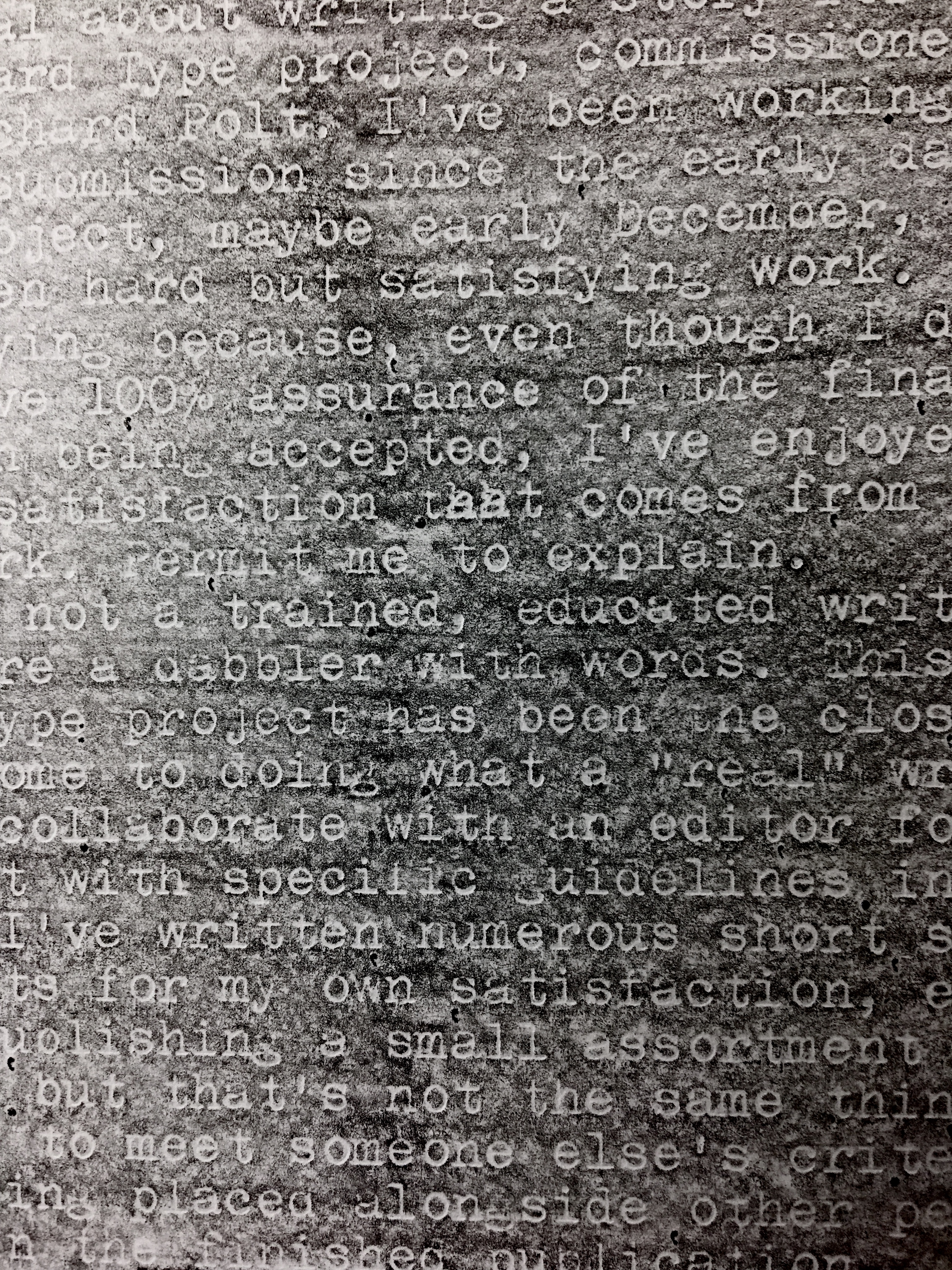
I'd used a backing sheet of paper while typing this piece in the Olivetti Underwood 21, and I noticed afterward that I could see the imprint rather distinctly in the backing sheet. So I took a no.2 pencil and did a rubbing, to reveal the imprint thusly:
I've boosted the contrast of the image a bit, but in person the rubbing is very readable, which gives me pause to consider that, in the event typewriter ribbons become scarce in the future, a charcoal rubbing might suffice. Not exactly steganography, since you can easily see the imprint with adequate side-lighting, but an interesting effect. I need to try this again with just one sheet of paper in the stencil mode, and rub with a real charcoal pencil.
I was reminded yesterday that I'm now in two cassette tape letter exchanges. I need to remember to bring a recorder with me when running errands, so as to take advantage of location sounds that make such taped letters so much more interesting.
With the help of one of my YouTube viewers I've found a solution to the problem of why I couldn't post comments to blogs hosted on Blogger, on my Mac computer. The reason had to do with a setting in Safari browser dealing with cross-site tracking. Yesterday I did a typewriter blog comment blitz, catching up on many blogs I've wanted to comment but couldn't.
Earlier in this post I mentioned placing a visit to John Lewis's shop. He has a pristine, fully restored Underwood No.5 for sale. The black paint shines, all the decals are virtually new, the nickel/chrome trim is immaculate, the key top legends are fully redone - and the platen is freshly recovered. I took it for a test typing, and boy was I impressed, I can truly touch-type on it with ease, and the spacing of the keys is ideal for my hands. If it sounds like I'd like to buy it, you're correct. But he's asking a pretty penny for it, considering all the work he's put into it, and that it's been professionally restored. Still, what a temptation. One obstacle for me is where to put it, since, unlike portables, these don't have cases. I'd have to find a permanent writing location. Or, like I've done with my Burroughs Comptometer, that's too large to store permanently on my desk, I found a high-quality plastic box with a gasket-sealed lid. I lined the box with foam rubber, secured the calculating machine in a plastic bag and secured it inside the dust-proof box via the gasket-sealed lid, so it can be stored in less than ideal conditions when not in use. I'd have to find a similar solution for the Underwood, were I to acquire it. There's also the little matter of explaining all this to my better half. But, at least she's been bitten by the typewriter bug, with her claiming ownership of the Olympia SM3, so perhaps there's less convincing needed than I think. Do I really need another typewriter? No. Do I need this Underwood 5? Yes!
PPS: Be sure to check out this typewriter-themed blog, Madam Mayo. There's a link to her older blog that goes all the way back to 2006. Nice to find more typewriter bloggers.
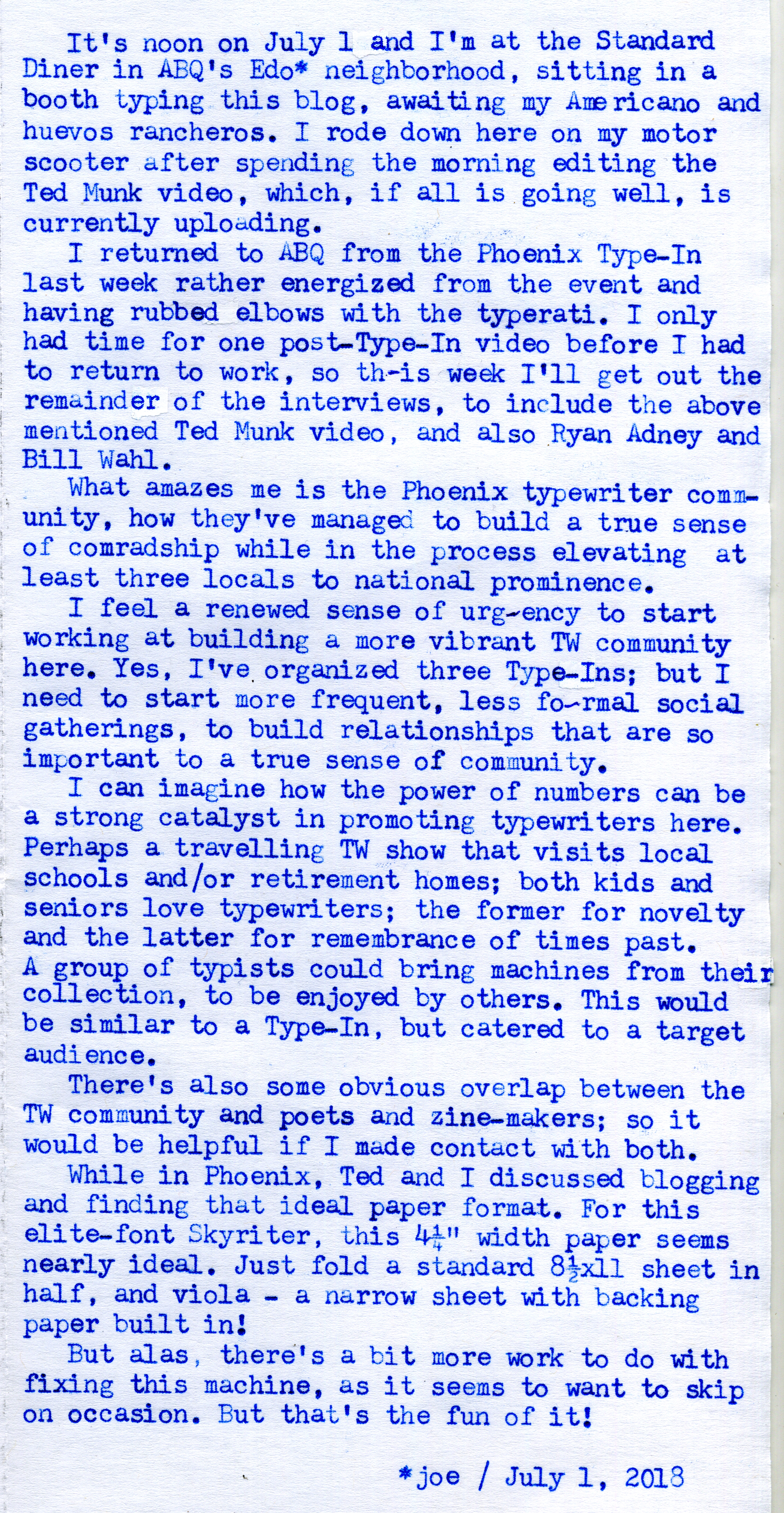
Post-Script: I carried the Skyriter in my green shoulder bag that normally holds the blue Webster XL-747; I can easily tell the Skyriter is lighter than either the Webster or my other shoulder bag typer, the Olympia SF. While the wide cloth strap is okay when motor-scootering, I'd prefer the padded computer bag strap I use for the Nekkid Hermes 3000carrying box. It was a warm day, so wearing a summer shirt and shorts felt pretty good on the scooter.
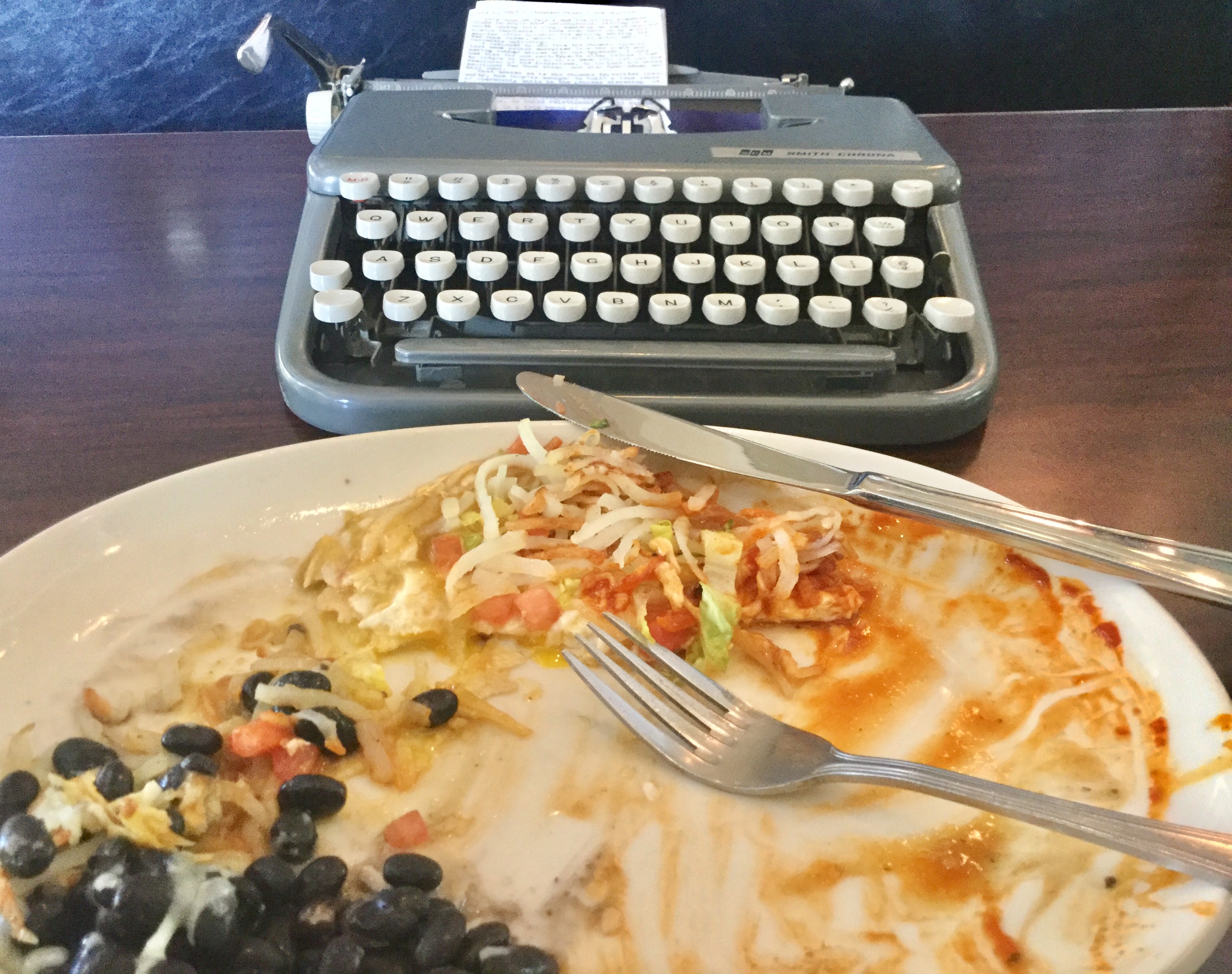
I've liked eating at the Range Cafe for years, so it's nice to know that The Standard Diner is owned and operated by the same family. While my favorite breakfast at the Range has been their huevos rancheros, made with blue corn tortilla and featuring pinto beans, white cheese and fried/baked potatoes (and ordered with red & green Chile - what we call "Christmas"), The Standard Diner's version has a white corn tortilla, black beans and hash browns. I really loved it, especially mixing both chile sauces into the hash browns and breaking the eggs over it. Yes; you can blame me for your sudden appetite.
Sitting in the high-backed, padded booth, I didn't find the Skyriter's noise especially bad; although I think I grasped a bit of conversation across the room involving the word "typewriter," so perhaps they were talking about me? Hmm...
Regarding this issue of narrow-width typecasting, so as to make the words more prominent on-screen, Ted has mentioned the use of 3-1/8" wide thermal paper as a good medium. I'd like to try it, but will wait until I can find some cheap rolls at the thrift stores; otherwise I'd have to spend lots more money on a 6-pack of rolls, enough paper to probably last me a lifetime. For elite-sized font machines, this range of 3-4 inches seems almost ideal for the purpose.
I also remember reading on their menu that The Standard Diner has an old typewriter back by the restrooms, though I didn't take an opportunity to check it out. Which gives me reason to return once again, perhaps with better video equipment than the little iPod Touch. Even so, perhaps that makes this venue a bit more typewriter-friendly.
Now, regarding motor-scootering. Yes, riding two-wheeled vehicles is intrinsically riskier than being enclosed in a metal cage, especially in today's world of phone-distracted drivers. What would be a fender-bender crash in a car can easily become a trip to the hospital, or morgue, on a motorcycle. Even so, there's a particular enjoyment to riding. Always wearing a helmet is an essential habit, even in hot weather; though I find the helmet keeps the sun off the fair skin of my ears and face; while in the winter it keeps my head and neck warm.
There are also some good defensive driving habits to invoke when riding, that you normally wouldn't consider if in a car. Visibility is a primary issue, especially when passing cars or going through intersections. Staying out of blind spots is something I'm always conscious of, which involves momentary speed changes to put myself in a more visible position relative to neighboring vehicles. Watching a neighboring vehicle's lane position and speed can give you clues as to their intent to suddenly change lanes. Even on such a diminutive vehicle like my Honda PCX-150 scooter, my head height relative to the road is easily as high as a medium-sized SUV. Regardless, when being followed by a vehicle I try to stay in the left side of the lane, so I'm directly in front of them, in their central zone of vision. When passing through intersections where there's a left-turning vehicle in the opposite turn lane, I will adjust my lane position to the right side so they can see me as early as possible. And watching for cars jumping out from side streets is easier if you watch the spoked rims of their front wheels, where you can more easily detect slight rotational motion indicating they're beginning to roll forward. All these are tactics I've learned that help me stay safe.
If I ever feel especially nervous about riding in traffic (which I usually don't, since I learned to ride on scooters in city traffic), I have the advantage, in northeast ABQ, of taking side streets to almost anywhere else in this part of town, like I would if on a bicycle. That is the essential advantage of living in a grid-like city, the network of side streets between major roadways.
Here's the Ted Munk interview video. Stay tuned on my YouTube channel for the upcoming interviews with Ryan Adney and Bill Wahl.
*About downtown Albuquerque. My grandparents' old house in on Edith near Central, just two blocks up from The Standard Diner.
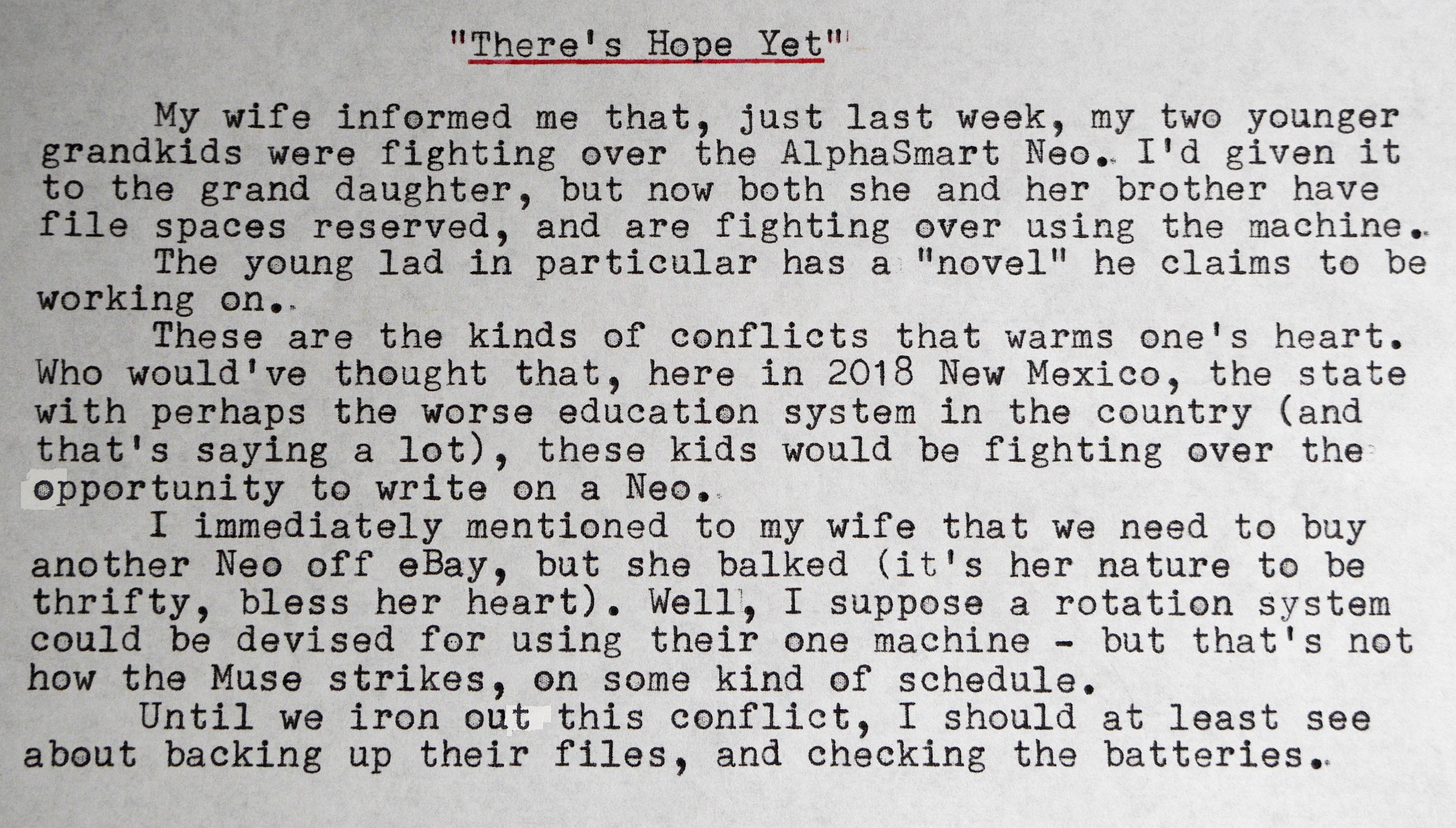
Post-Script: On the subject of the AlphaSmart, there's been some discussion recently on the Flickr AlphaSmart forum about alternative devices that offer a similar non-distractive work flow with a great keyboard and battery life. So far, you can't beat a used Neo on eBay (or wherever).
I'm wanting to start making more impromptu blog entries, spur of the moment, off the top (or side, or wherever) of my head. This motivation was prompted by a recent blog entry by Ted Munk, who spoke of the apparent decline of typewriter blogs, from their heyday in the mid- to late-aughts. Part of this is that blogging in general is in decline; but also our attention is being redirected to social media. I wonder also if mobile platforms are just more cumbersome for both consuming and creating blog content.
Whatever the reason, I've decided to get my act together. I know with my focussed concentration on YouTube these last few years, my blog now plays second fiddle. Whereas it once was the primary medium into which my creative thinking was expressed, it's often been used to just advertise a new video over on YouTube; there's rarely new content expressed herein.
There are often little thoughts that break the surface of my consciousness, not big enough to warrant a full-blown (or even half-blown) video production, but something worth tossing into the pond of public discourse in the Typosphere. Little thoughts that might prompt further discussion about things. Or just little observations that might, for no other purpose, serve as entertainment for a few brief moments. These often have been discarded or abandoned. But perhaps they deserve to be preserved here in. The life of the blog doesn't have to be just big articles. There's also little snippets and observations. It is a log, right? A web log.
My older blogging methods were rather meticulous about using a flatbed scanner for type-casts, to eek out the last bit of quality in those images; I've always wanted those images to look like ink on paper, where you see not just black letters floating against a nondescript white background, but you also see the texture, wrinkles and folds of the paper itself. But having to fire up the scanner is often a chore, and chains me to the office computer.
Lately, I've been trying to photograph these pieces, either with the camera in my iOS device, or using a dedicated digital camera. The challenge is always the light, especially evenness of illumination. Even the least bit of shading, from one side to the other, is exaggerated once the levels are tweaked in post-processing. Like today's example; I had flood lamps on either side of the sheet, with a white reflector card helping to even out the exposure. Even so, you can detect that left-to-right shading.
I've decided, on this matter of photographing type-casts, that perfect is the enemy of good enough. It needs to be legible, for certain. Good contrast between the background paper and the ink. It needs to be sharp, both in focus and lack of motion blur. But a bit of geometric distortion (key-stoning, from shooting off-axis; or pincushion) is okay I think. We're not archiving documents for the Library of Congress.
I like more and more the way Ted Munk makes his type-casts, with narrow typed columns and hence large letters on screen. Very legible and readable.
I keep threatening to make a dedicated copy stand for these pieces; perhaps that's the way to go, so I can guarantee even lighting. But would that end up being just as involved as firing up the flatbed scanner? I'd still have to import the images into my computer from the camera and do some post-processing, like levels, rotation and cropping. Well, by using a camera to digitize them, I have the option of not only importing them to my computer but also to my iOS device where I could do the post-process and upload to Flickr, as an alternative method. The only place where the copy stand would be impractical would be blogging while on the road.
Okay, enough about the minutia of the process. What's important is to make the process streamlined, efficient and effortless enough that one (this one) can focus on doing it as often as possible. With results that are "good enough." You might not always like what you read, but hopefully you'll come back more often and visit, to see what I've been up to.
Post-Script: I, on occasion, have these little thoughts or observations, too minuscule to make into some big project like a video but important enough to share, in the hope that someone will find value; or, that they might amass, each a mere stone, into some sizable structure, sometime in the future. I need to do more of this. Perfect is the enemy of good enough, someone once said. In this case, grandiose is the enemy of the humble. Something like that. Just little thoughts, observations, one piled atop another, to become, what? I don't yet know. But I've got to keep amassing these pebbles.
Typecast via Adobe Rose onto the reverse side of thermal fax paper, using a new old-stock silk ribbon.
I'm certain I've blogged about this before. Using rolls of paper for typing, like the way that Jack Kerouac did with an early draft of On the Road, where he used a roll of teletype paper. Why a person would want to do so today has nothing to do with wanting to mimic the Beats. The Beat Movement is pretty much dead, last time I checked. And so are typewriters, except actually they're not; there's a revival in progress. Which is all the more reason to resurrect the idea of typing on a seemingly endless roll of paper - no more stopping in mid-thought to change paper. Just keep banging the keys and slinging the carriage back after the bell dings, and watch the paper pile up behind the machine on the floor; a more certain measure of one's writerly output.
Years ago, after this idea struck me (and inspired by a visit to the Palace of the Governors Museum in Santa Fe, which was hosting the On the Road manuscript scroll in its long glass-topped display case), I went in search of rolls of paper. Adding machine paper was too narrow, unless all you were interested in writing was short haiku poems. There were brown masking paper rolls, 6 inches wide, available at hardware stores; but I didn't want to type on brown paper. And there was white paper rolls in craft and art stores, but in widths much wider than the standard 8-1/2 inches.
After a bit of Internet searching I found a 6 inch wide roll of white paper, in 700 foot lengths, used for masking in the automotive painting industry. A local search found some at the Napa Auto Parts painting supply store. I ended up buying a damaged roll (the inner cardboard core was deformed) for less than half the price of new.
This paper I used for a time for typecast blogging. With the margins set to ~1/4 inch in from either edge, I could get long enough lines of text sufficient for this blog's template. But the paper was thin and crinkly, and didn't take ink all that well. I think, being engineered for painting, its surface was hydrophobic and hence repelled the ink, which would also easily smear. So after some time, I set that roll aside and looked for another solution.
A search on Amazon revealed rolls 8-1/2 inches wide of what was described as "teletype paper," but after receiving an order I found the quality of the paper was about the worse I'd ever seen. I should have known; I think Western Union quit the teletype business some years ago. Essentially like the very cheapest newsprint art paper, off-white and very fibrous, it doesn't take correction tape, and is mostly useful only for rough-draft writing where no one else will see the finished results. You wouldn't want to type that letter to dear old Aunt Mary with this stuff, or she'd take you out of her will.
This last week I once again found myself in the local big-box office supply retailer, when I happened across a roll of white "banner" paper 17 inches wide by 50 feet in length, for $5. It doesn't take a math whiz to figure out that 17 inches is twice 8-1/2, and I at once began thinking that perhaps my miter saw could cut it in half sufficiently neat to make the effort and cost worthwhile.
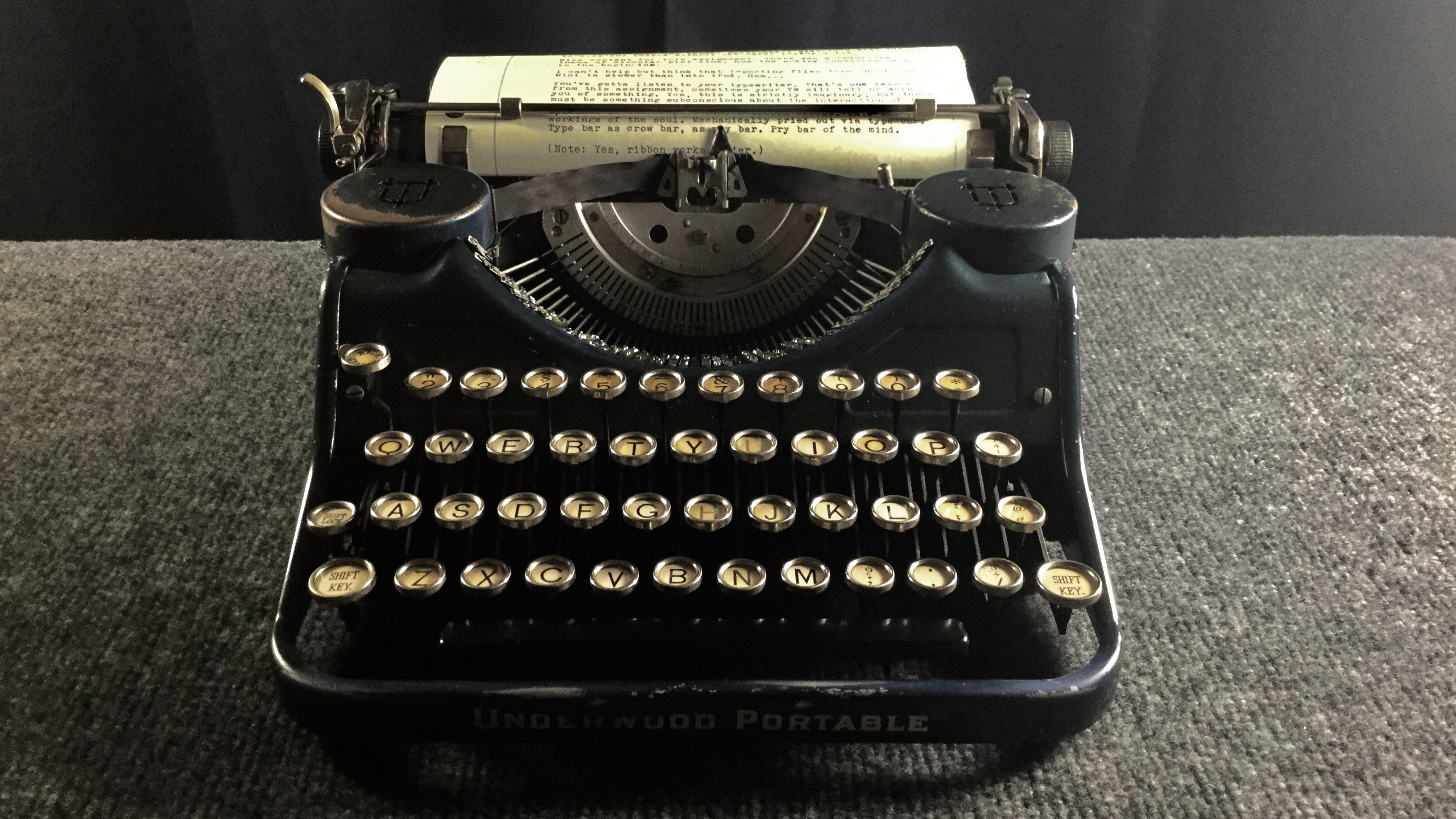
And yes, it was worth the cost, even the effort required afterward of cleaning up the garage because of the surprisingly messy cloud of shredded paper dust kicked up by the saw. But the cut was very smooth, and the resulting roll of 8-1/2 inch by 50 foot-long, white bond paper is nicely threaded up in the old Underwood Portable on the tray table, with the roll snuggled nicely between the scissor legs of the folding table using a piece of wooden broom handle. And a backup roll, from the other half, waits in the wings. $2.50 per roll is not a bad price. Maybe next time I'll do the cutting out of doors. Live and learn.
The paper takes typewriter ink very nicely, and has a very nice feel to it. I threaded up the paper in the machine so as to oppose the natural curl of the roll, hoping it helps in flattening it out. We'll see. Some of this paper, made from recycled pulp, can achieve a semi-permanent curl if left threaded around the platen too long.
So now I can say that my long search is over for an inexpensive source of good quality, white, typewriter-compatible paper rolls. I just need to set my butt down in front of that typewriter and start banging out some words. Which only I can do.
Post-Script: I had to do a bit of tinkering with the Underwood Portable, as it seems the ribbon advance was a bit wonky. It liked to prematurely reverse direction midway through the lefthand spool. I found the margin release linkage was interfering with the left spool auto-reverse mechanism, which required "reforming;" and I also adjusted the heights of the spool drive shafts, so they would turn freer. To test out my work, I began typing nonsense on a scrap of paper, but then decided to take advantage of this opportunity and not be as wasteful of ink, so moved the operation out to the Man Cave Shed and began some more premeditated writing, ribbon covers removed. Thus far, my work seems to have been useful, but I haven't gotten entirely to the end of the ribbon to test the reverse from the left spool.
I also added one more turn of tension to the spring motor, and the carriage return feels entirely normal. Not that I was experiencing any issues with lighter tension, but I didn't want to induce any problem in the future.
I also typed a piece of remembrance concerning my dad, whose birthday would have been on August 8. I'll use this for Typing Assignment No.6; which reminds me, I forgot to post the blog article accompanying the video, so I'll get that out today also.
Post-Script: Noah is now in his own room at the hospital, and is mostly sleeping. Skin grafts will begin in a few days. Thank you all, near and far, for your thoughts and prayers.
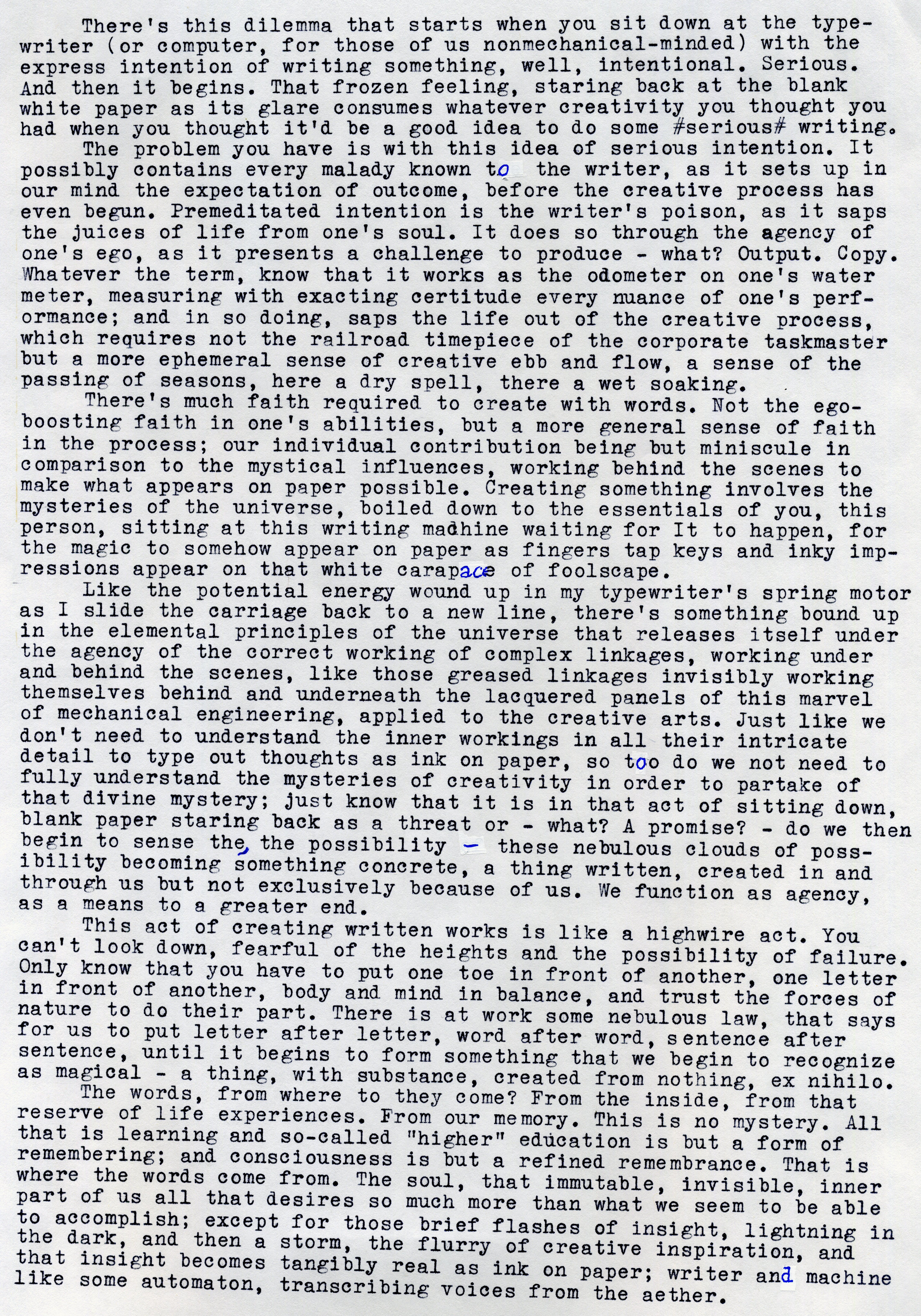
I sat out on the back porch this afternoon, Olympia SF in my lap, typing while smoking a cigar. I hope this typecast isn't permeated with the aroma, for you sensitive nonsmoking readers. I observed that, while the last round of adjustments seem to have mostly fixed this machine's line spacing issues, there's a bit of wonkiness on the first letters after a carriage return. So not 100% yet. Repairing these entirely mechanical devices is, appropriately enough, an analog function. It's not like it's either entirely broken or entirely perfect, a Boolean logic function, but always somewhere in between, in that fuzzy gray area of real life. Such it will be with Noah's recovery, too. We'll give him all the support he needs. Best of all, the body has built-in healing systems of regeneration, unlike this inanimate assemblage of metal.
I feel the need to get at least one video produced this week, but haven't settled on a topic. And I need a haircut, and the barbershop doesn't open till tomorrow. Maybe something to do with reading through the archive of Noah's old typings, and the value of getting kids started with typewriters - even though, in his case, he really hasn't been using a typewriter for a few years. Still, there's something about these strictly mechanical devices as enablers of creativity, for this generation of millenials who didn't grow up with them as a regular part of their lives.
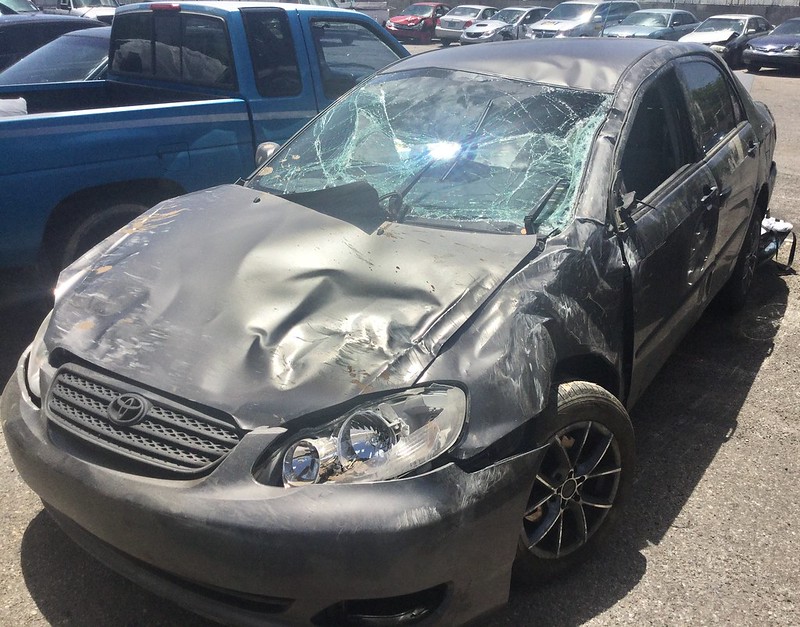
Regarding the top photo of Noah's car, I wasn't certain about posting it online, but there it is, in all its ugliness. I don't intend on keeping this blog entirely focused on this family issue, but I'll keep you updated as events warrant. Thank you again for all your thoughts and prayers.
It's been a busy several weeks, though that is not in itself adequate justification for ignoring this blog for nearly two weeks. There's a certain amount of irony in the observation that a recent video was about the power of blogging; a power which I've apparently ignored.
This week I've produced four videos for my YouTube channel, three of them about photography. The first two were about the Stearman Press SP-445 sheet film developing tank, a new product which promises sheet film processing in daylight, using a changing bag. In many ways it offers a similar result to a rotary tank, with the added benefit of not requiring constant agitation, as is the case with rotary processing, and thus permits stand development methods to be employed. I found my test results using the SP-445 to be satisfactory in terms of uniformity of development, but did note a bit of emulsion scratching along the very edge of the film, due to the way the thin, ABS plastic holders clamp the film. I didn't think this was a "deal-breaker," however.
I did experience one negative detach from the holder sometime during either the five minute fix (using continuous agitation) or the initial rinse cycle. But the image results were fine. My biggest concern with this system, aside from a few dribbles of liquid leaking from the o-ring sealed lid during inversions, is the seeming flimsiness of the internal plastic baffles and film holders. Longevity will only be proven over time, I suppose.
I produced another video, at the prompting of a viewer who liked the camera I'd been using for the film development tests, presented as a 75 year-old camera review of the Graflex Anniversary Speed Graphic, which has been my primary workhorse for large format and experimentation with adapted lenses; since it has a functional curtain shutter, any lens that projects a usable image can be employed, even if it lacks its own shutter. I've over the years employed several decidedly unphotographic devices as lenses, such as the front objective to a 7x50 binocular, a plastic, credit card-sized fresnel magnifier, a Xerox machine lens and a brass pinhole. Certainly newer field cameras are lighter in weight, but they don't offer the flexibility of a functional curtain shutter, along with a wire frame viewfinder to augment the ground glass view screen. This camera I had purchased from a local camera store years ago, and it's been worth every penny to me in return.
It's been several weeks since I made a typewriter-themed video, and as I was looking through my video production notebook I found a post-it note I'd made to myself about a potential video idea, that being making a log book for one's typewriter collection. The idea is to have a separate section for each machine, with detailed data on date of acquisition, serial number, age, past service, present mechanical issues, date of last ribbon replacement and one's own personal observations about the machine. It might also be of value to include a log of how each machine is getting used, in the form of a list of entries documenting the date of use and for what purpose - letter writing, blog article, short story, etc.
The video itself ended up morphing into more of a Confessions of an Office Supply Junky theme, as I delved into using the Staples Arc system (compatible to Levenger's Circa) of disc-binders for making customizable notebooks. Since making that video I've decided to also update my ad hoc video production journal with the Arc binding system. So now there are a plethora of little colored paper chads dotting the floor in my office, as the cheap little Arc hole punch likes to spew chads intermittently.
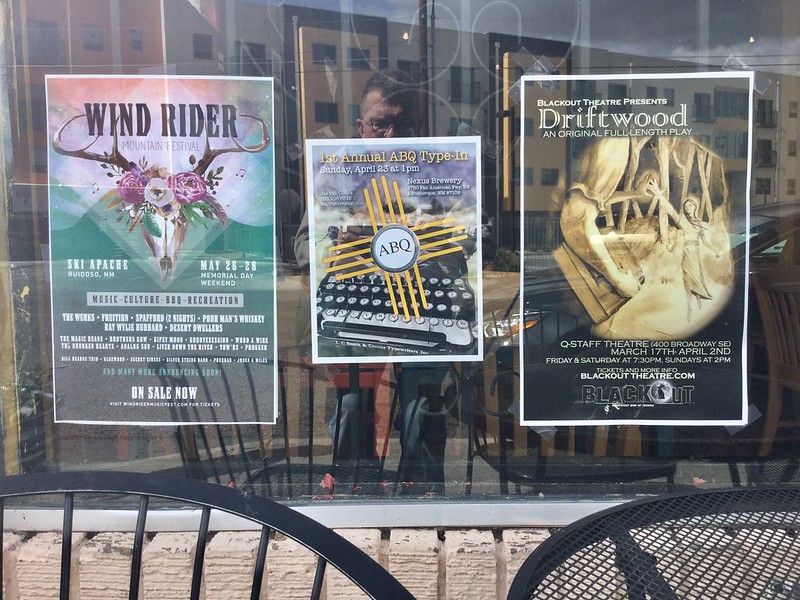
My wife and I spent several hours of the last three days spreading posters and fliers around town for the upcoming ABQ Type-In, scheduled for April 23 at 1 PM at Nexus Brewery. One downtown coffee shop we wandered into resulted in us meeting a poet who writes via typewriter, whom we invited to the event. You just don't know which venues will lead you to meeting creative people who employ typewriters in their work; one reason why I wanted to visit as many coffee shops as I could, since creative types and caffeine seem to go together.
At a downtown bookstore we talked to the proprietor about the Type-In, who in turn suggested we contact a local poetry collective, many of whose members might also be interested. All of a sudden I'm getting this feeling that our venue might be too small; a good problem to have, I suppose, but I can remember just a few weeks ago when it seemed like I was worried about nobody showing up.
I've contacted a local alternative newspaper about getting a notice for the event in their paper, and I'll also be contacting more local media in the next few weeks.
I'm also amassing a small stack of letters and postcards from new pen pals. This is another good problem to have, since I haven't been in regular correspondence with out-of-town folk in many years. Time to get that fountain pen filled and the Facit 1620 typewriter's type slugs cleaned and readied for use.
I've also been working on making my small video studio more efficient. It's funny with television production, you can't tell from the perspective of the viewer what a studio looks like off-camera. My local PBS station, for example, has a dumpy, cluttered studio, having visited on numerous occasions; but you can't tell from watching on TV.
My own production studio is in a corner of my bedroom-based office, where I employ some dark blue curtains in front of the closet doors, and some LED lighting in metal hardware store reflectors, clamped to wherever I can manage. I had been using a folding wooden tray table as my presentation table, but that's proven a bit too small, and also I've been needing to change the height of the table relative to my seating position, in the case of presenting some object on the table where I still want my face to be in the frame.
My solution was to employ an old Bruneau's Pneumatic Tripod, that I've had for decades, with the large metal mounting plate attached to a sheet of wood, atop of which I can set my new carpet-covered plywood tabletop, now wide enough to cover the camera's 16:9 field of view and able to move up or down with the tripod's pneumatic elevation system. I also attached two hardware clamps to the back corners adjacent to the camera, upon which I can now clamp my lights. And best of all, the whole shebang disassembles and stores away, for when I'm at work and don't wish for the office to appear quite so cluttered. Perhaps a future video will be a show-and-tell of my new video digs. Until then, have a great week!
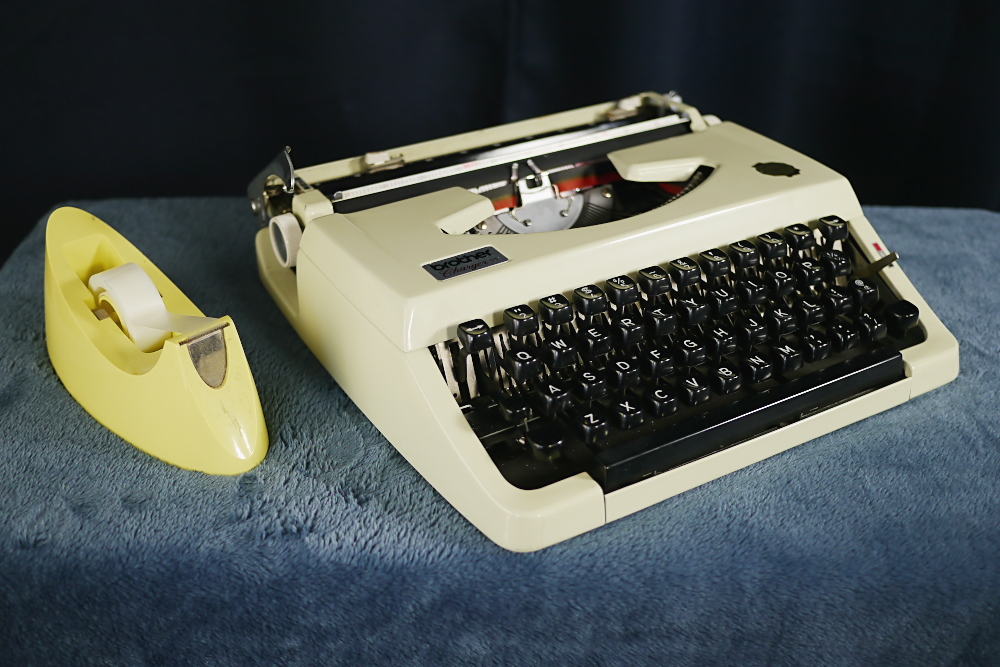
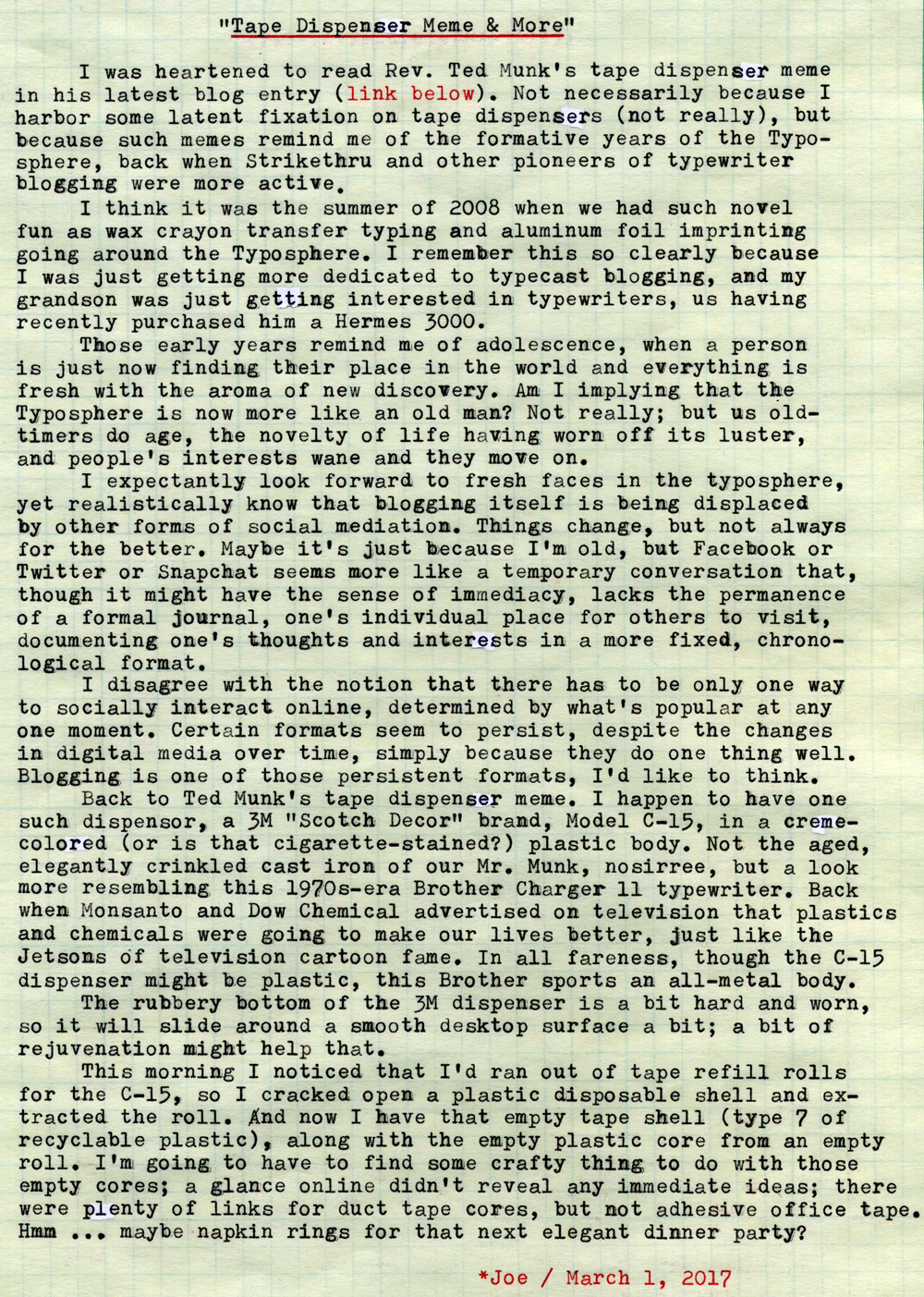
Post-Script: Here's the link to Rev. Ted's tape dispenser blog article. Alas, my Brother Charger 11 doesn't exactly match the color of the 3M Model C-15 dispenser. Does this mean I should immediately run out to the nearest thrift store and look for another typewriter? No, but I like the way you're thinking.
I was surprised by my dear wife's reaction to my suggestion that those plastic tape cores might serve as napkin rings. She's normally very sensitive to clutter and junk (an intrinsic problem when married to a packrat such as myself), but she suggested I decorate these cores with colorful adhesive tape, and collect eight of them for our formal dinner service. I should check if she's running a fever...
Post-Script: I love these kinds of blog articles, however crude or unpolished they might seem. The idea of being able to spontaneously sit down with a typewriter on your lap and bash out a thought or two with no ulterior motive or agenda is a compelling reason for blogging, like sitting down with a friend for no reason whatsoever except to spend time in idle chitchat. Separated by the miles via the interwebz, this is our version of spending time together. I enjoy reading others' blogs, and try to comment as much as I can.
I know many people find it difficult to continue blogging, with the busyness of life getting in the way. Part of this is a misconception, that we have to compose carefully polished prose, edited and revised multiple times before it can be seen by the public. Ideally that would be true, but sometimes time is a luxury, and yet to put blogging in some kind of priority in our lives means that people get to see us in all our private messiness; warts, typos, misspellings and all. As is fitting with friends.
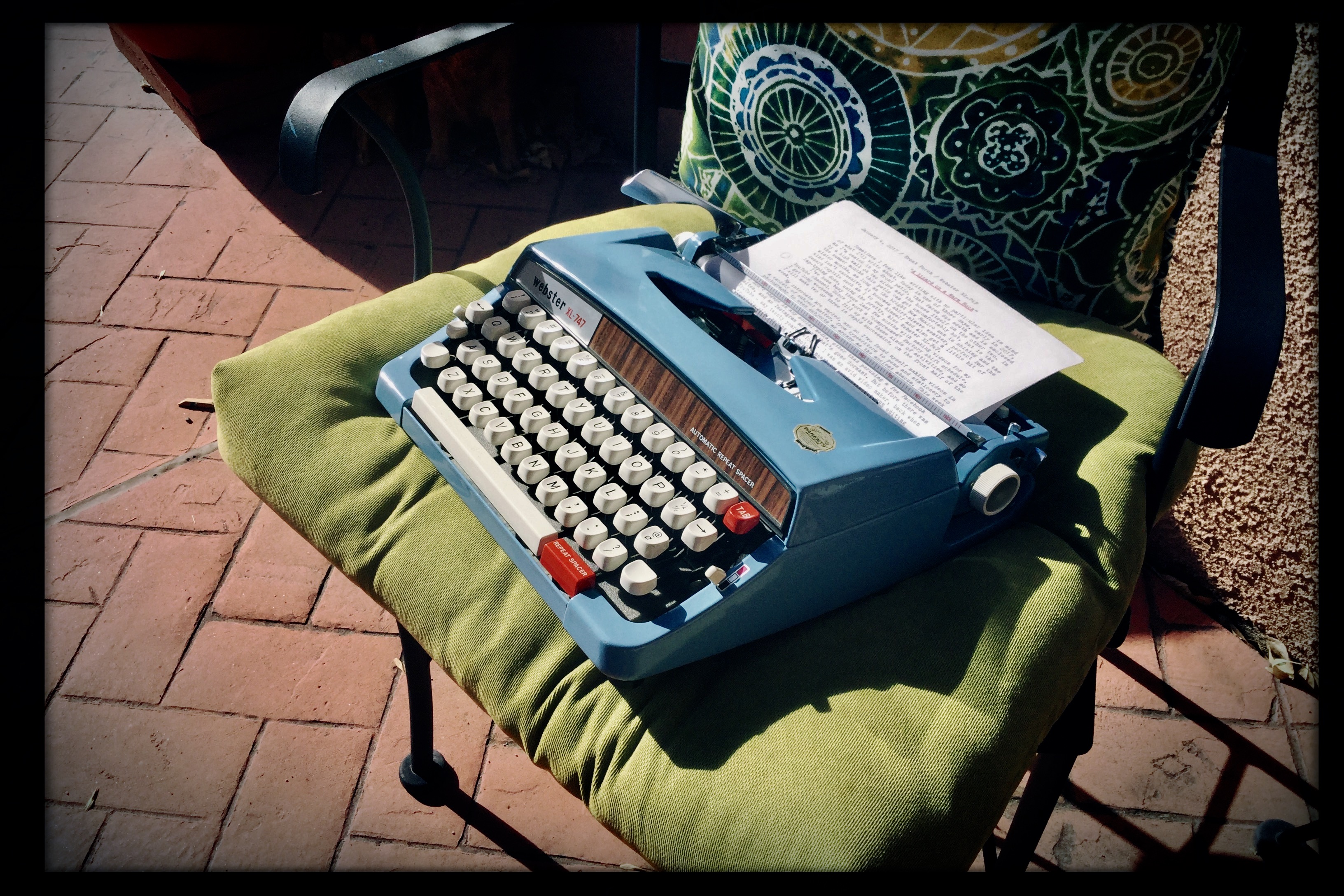
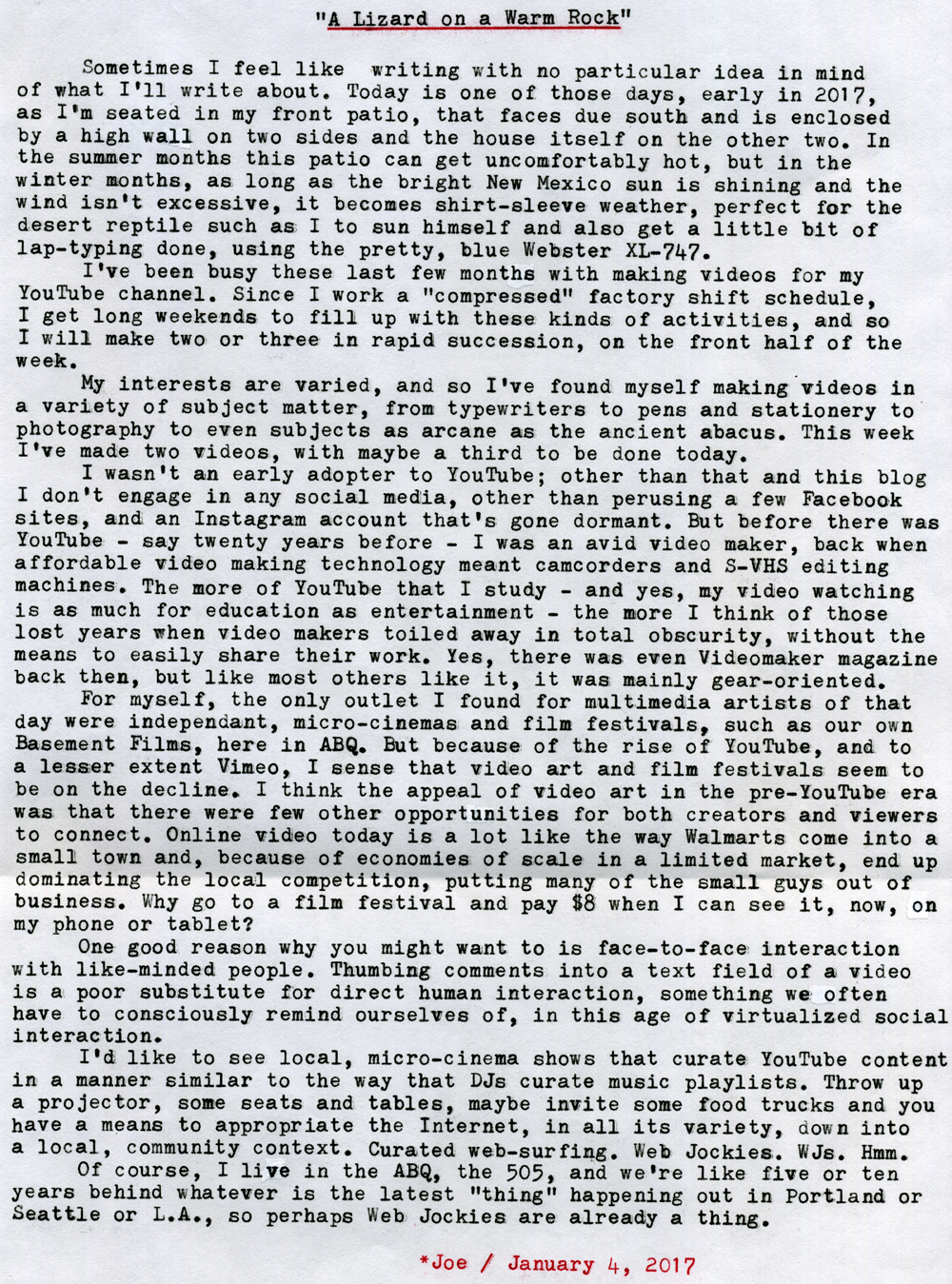
Photo via Apple iPod Touch. Typecast via Brother-made Webster XL-747.
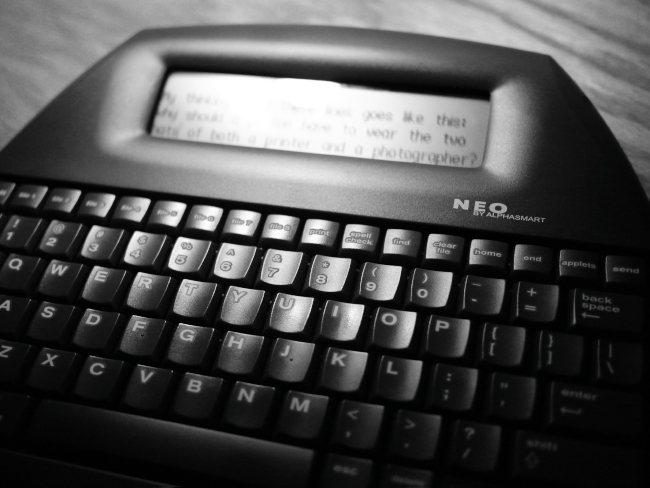
There is this thing I'd like to call the alternative writing community. It's the group of people who write with alternatives to the computer and word processor, like typewriters, fountain pens, and Alphasmarts for instance.
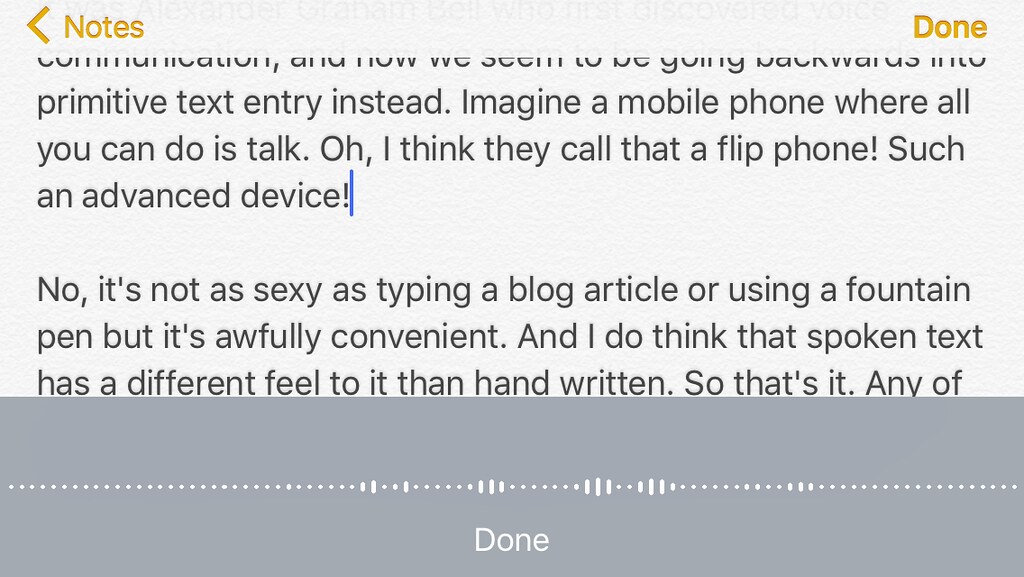
There is also an alternative writing technology using OCR software and scanning typewritten text, to create a text file. But I'd like to suggest another, alternative method of writing, which is dictation. I'm writing this using the Notes app on the iOS platform, using the microphone input keyboard method.
For anyone who's tried typing lengthy text using a phone sized screen keyboard, you know it's a chore. Even with predictive text entry, you have to make constant corrections.
Several weeks ago, I discovered that it was easier to use the microphone text entry method than trying to thumb in text by hand. I still have to make a few corrections, but they're much less than before and my speed of text entry is much faster.
What works the best for me is to speak slowly and distinctly each word, in a quiet environment. I have very few problems using it this way, although some people might think it sounds strange the way I'm talking, almost like a robot voice. Also, the microphone text entry only excepts so many lines of text before it buffers and stops, at which point you have to hit the microphone button to continue. But still, I don't think I can hardly type this fast and this reliably.
Because I have a digital field recorder, I thought at one point I would start doing podcasts. But now, with this microphone text entry method, I can use it to create the text for a blog article.
To use the microphone text entry on an iOS device, just to the left of the keyboard is a microphone symbol. Press it, then begin talking. For punctuation you can use the words for period and comma. Note that I had to spell out those words in the previous sentence because otherwise it wanted to use the punctuation instead.
Note that you can also use this same microphone text entry method with many android smart phones.
On my iOS device, I noticed that the microphone button was only active when the device was connected to Wi-Fi or the Internet. This might be because my Notes documents are backed up to the cloud.
When you finish each portion of verbal text, you hit the done button below the audio field and the software will auto correct your spelling and punctuation. So, it's not a continuous writing experience, but more like a sporadic start and stop method. But still, being able to write by talking is a much different experience.
"Who is he talking to?"
"Oh he's just dictating into his iPod."
You might not want to use this writing method late at night, when the family is asleep in bed. Although it's not really any louder than having the TV sound on.
To get the text into a Blogger article, you highlight and copy the entire Notes document, then paste it into your Blogger browser window.
Alternatively, you could try microphone entry directly into the Blogger window, but you wouldn't be able to edit it as easily.
I've made this observation before, but smart phone text entry via tiny keyboard seems like a step backwards in technology. It was Alexander Graham Bell who first discovered voice communication, and now we seem to be going backwards into primitive text entry instead. Imagine a mobile phone where all you can do is talk. Oh, I think they call that a flip phone! Such an advanced device!
No, it's not as sexy as typing a blog article or using a fountain pen but it's awfully convenient. And I do think that spoken text has a different feel to it than hand written. So that's it. Any of you bloggers who have smart phones should try this out and let me know in the comments below how you come out.
Post-Script: I should point out that working with Blogger using an iOS device is a bit more complex than what I suggested. For line and paragraph breaks, you need to insert the code "< b r >" after every paragraph and break. I do this by hand, in the Notes app, prior to copy/pasting the finished piece into Blogger. Also, to get my photo at the top of the article, I first mail it to my Flickr account (the image is a screen shot taken during the voice entry), then go to the desktop version of Safari and grab the HTML code for the image and paste it into the top of the Notes article. Then I resize the image by changing the height and width values to fit my Blogger template (using the calculator app to scale the correct values). Once that's done, I copy/paste the entire Notes document and paste it into the Blogger text entry field. Easy-peesy. Sort of.
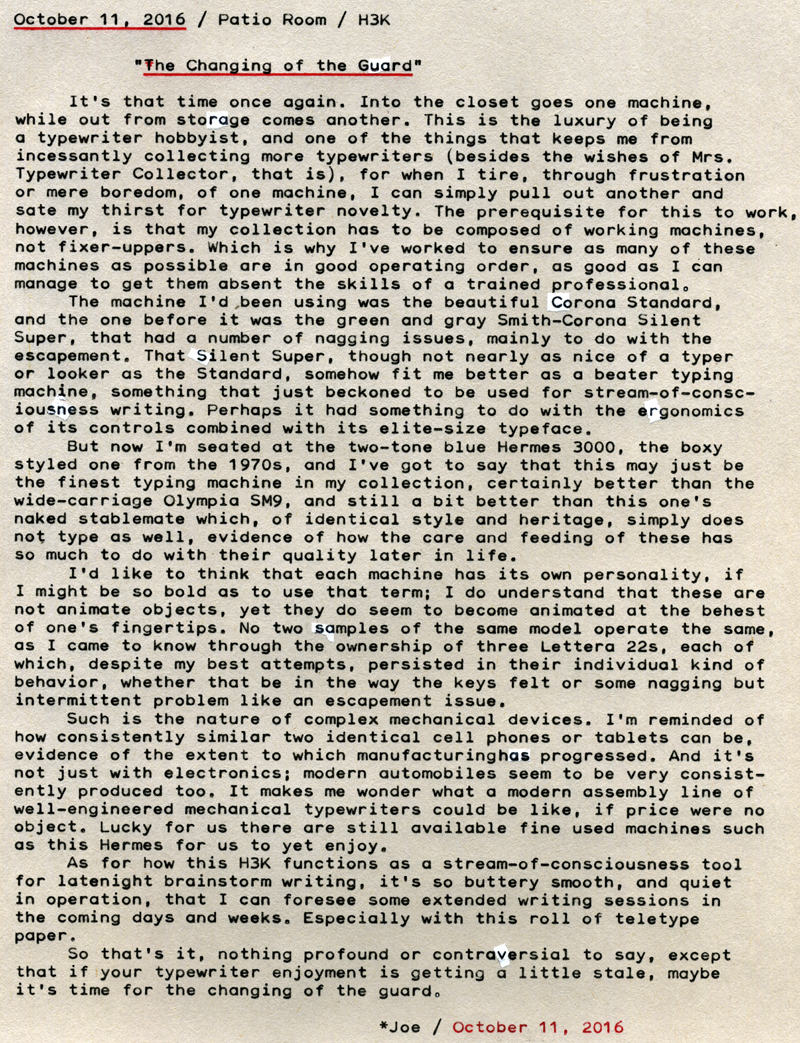
Post-Script: I like these kinds of simple pieces. They're conversational, like sharing to a larger audience just a little bit of how typewriters fit into one's day. Nothing fancy or presumed, merely about rotating one's typewriter usage. I wonder if Jay Leno does this, tweeting about taking some car from his collection out for an afternoon spin.
As a typewriter fanatic, I think it's important to type frequently, even if it's nothing profound or earth-shattering. Just get one's fingers on those keys, hear the snap of the type slugs hitting paper, hear the ding of that little bell at the end of the line, smell the machine oil exude from that shiny instrument of literary creativity. Keep in touch, even if it is just about swapping machines, or some other mundane part of one's life.
Others might think differently. They might ask of us why would we go to the trouble, especially with something so ordinary and relatively unimportant as this little one-pager sent off into the aether. I think it's most important to answer the question of "Why type?" by the simple response of "Because." Because I can, certainly. Because I have a selection of functional, beautiful machines to choose from. Because it's "Me-Powered." Because it's fun: we are far enough removed from the days of typists toiling away at their typewriters in the drudgery of the mid-20th century office environment that bringing one of these to life by the animation of our fingers somehow brings us to life, too.
I think typecasting makes blogging more satisfying. It's one thing to bang out a little nothing note to the world directly on one's computer, but quite another to do so with a scan of a paper artifact that reveals so much more than the mere words themselves. And it takes some effort, more so than hitting the "enter" key. So, to paraphrase that old Hallmark greeting card slogan, "When you care enough to send the very best, send them a typecast."
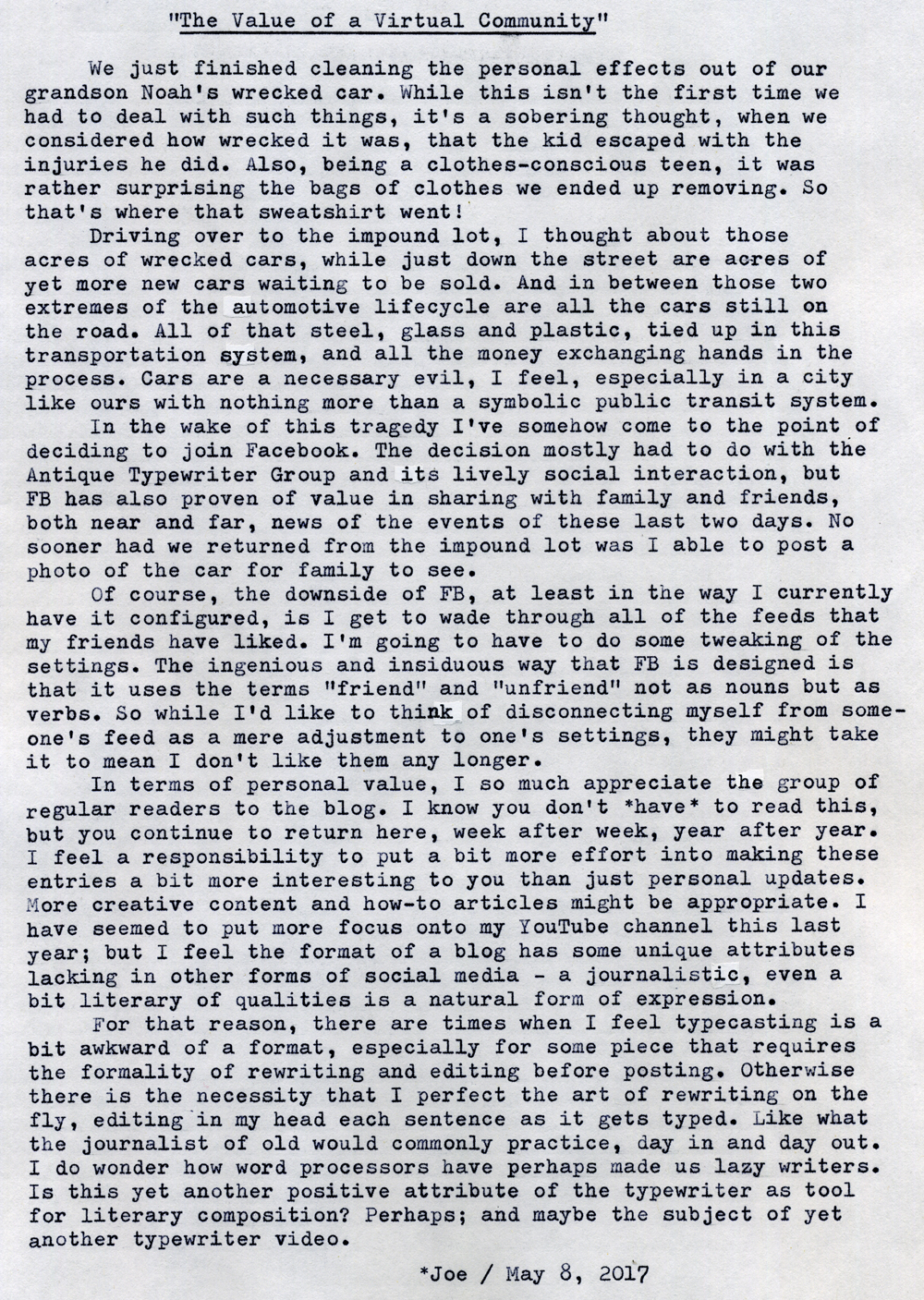
At this current moment I see no reason to monetize any of these social media, as I appreciate the idea of a "free" interchange of thoughts; even if the concept of "free" is a matter of self-delusion, since it's all paid for, somehow, indirectly, by some other scheme. I think this is an important component to understanding this age of social media, that we often operate under the false assumption of "free" access to global, internet-based communications, since most social media platforms require no direct pay-to-play membership. In the long term, none of this is really sustainable without someone footing the bills. Understanding the underlying architecture of social media, we have to realize that you and I are the product being bought and sold. As long as we are comfortable with that thought, all is well, in the near term. Yet the idea that my writings, images and videos are being stored on someone else's servers, with no real insurance of their long-term survivability (other than the financial health of the hosting corporation itself), remains a bit unsettling.