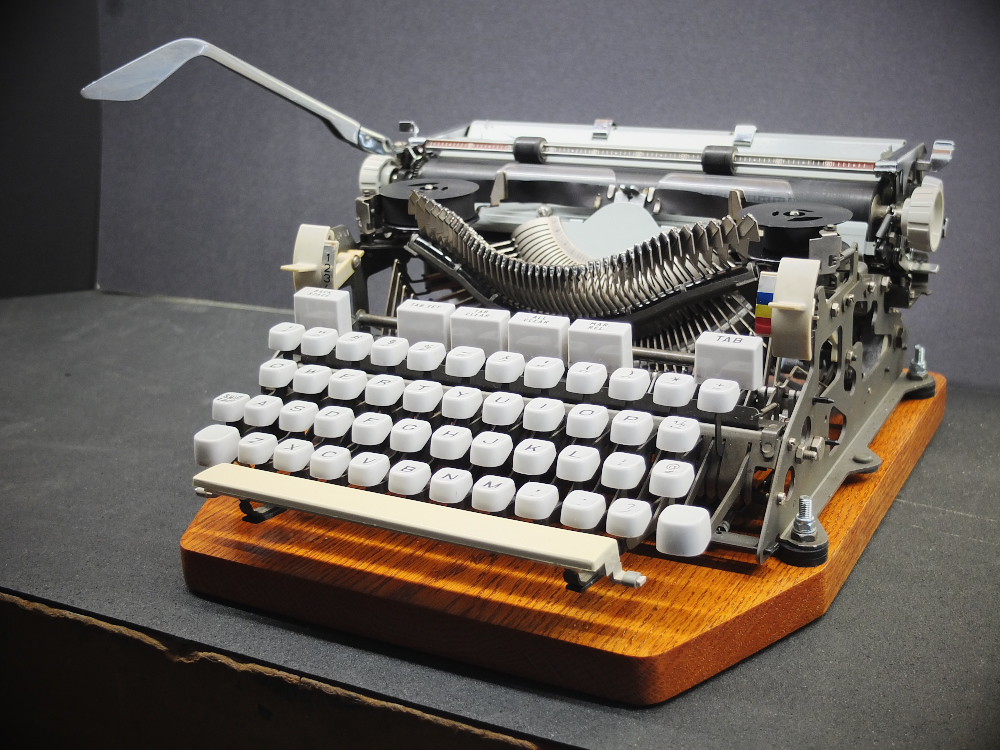
We, my wife and I, had a discussion this afternoon about this newcomer to my collection. She reminded me, some months ago, that when I got the Royal KMM I said I didn't any more typewriters. Since then, I've reacquired the Groma Kolibri from Kevin, and now this Optima. So what gives?
I do feel satisfied with my current collection, as most every machine I own are functional writing tools that I feel good about using. But there's also the fact that John Lewis is a national treasure, of sorts, in the sense that he represents almost 60 years of experience, and every machine for sale in his shop has some of that experience applied, during his reconditioning efforts.
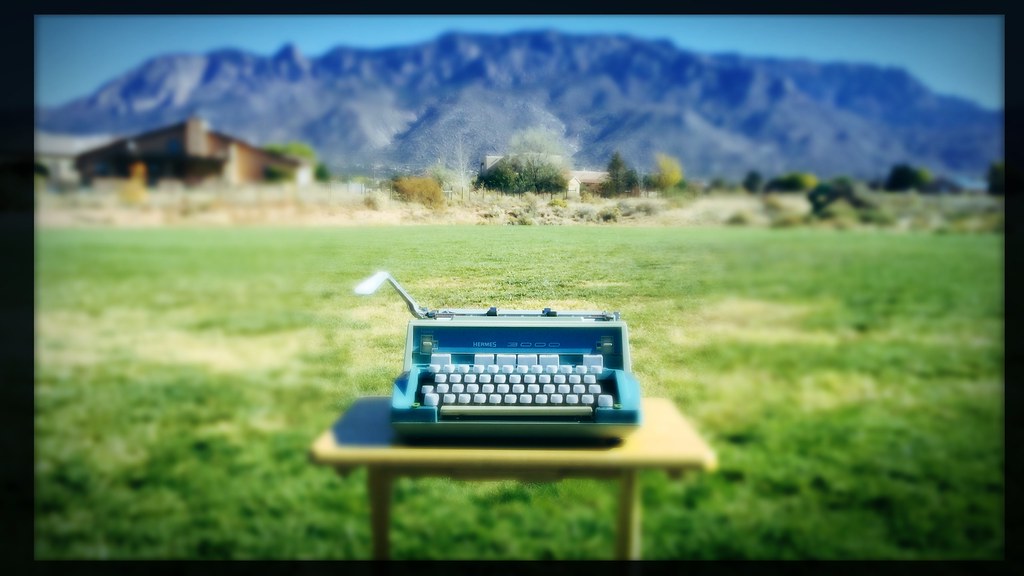
Last week, I tried almost every machine he had for sale. Olympias, Hermes 3000s, Smith-Coronas, Royals, you name it and he probably has it. Yet, none of them spoke to me. They're all nice machines, I'm certain every one has a potential new owner out there who would treasure it. But I already have several Hermes 3000s, a very nice Olympia SM3, a Royal QDL, a Silent-Super, etc.
And also, I can't single-handedly buy out John's entire inventory; I'm no Jay Leno.
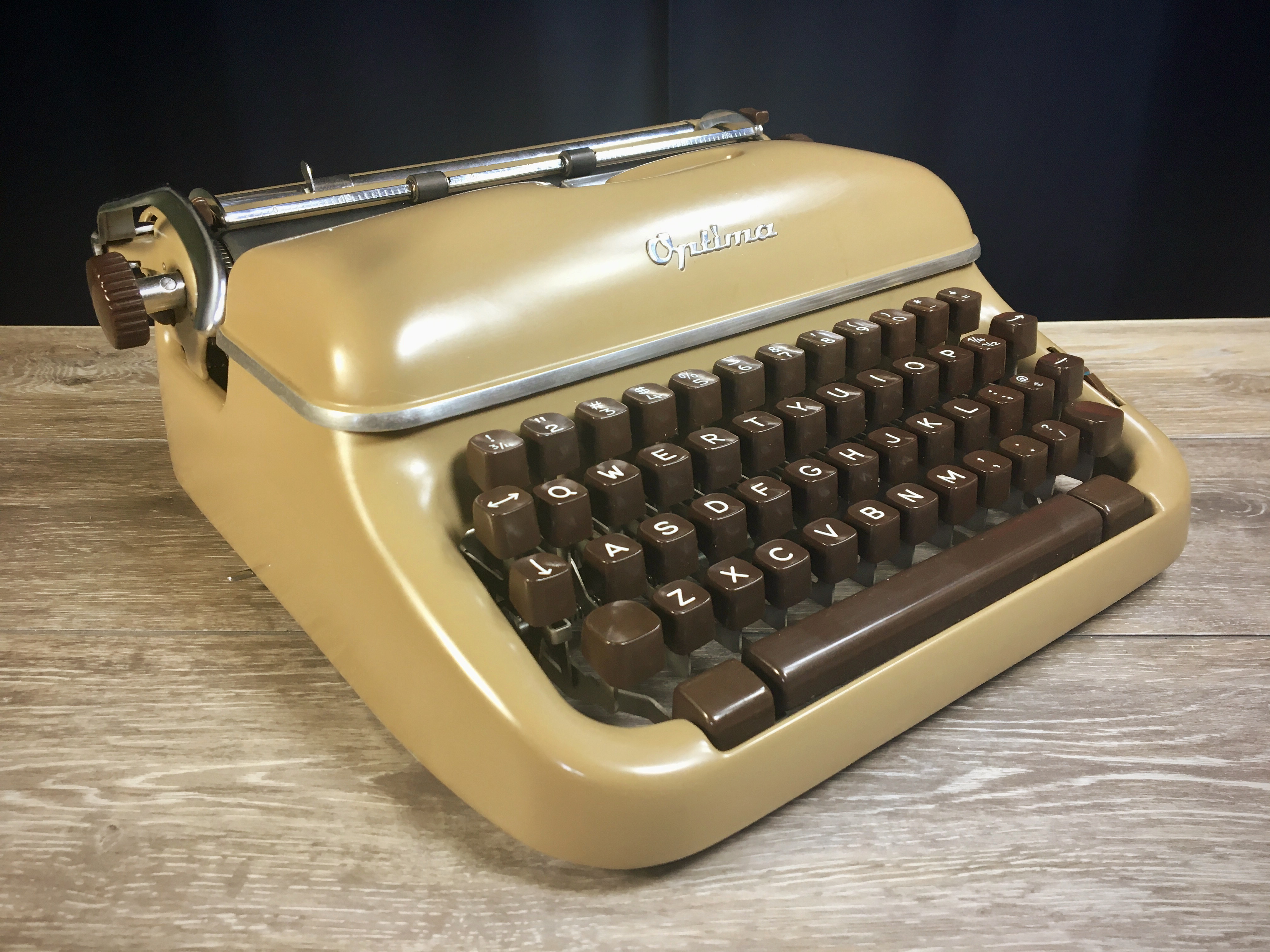
But this Optima was unusual, if not a bit rare, at least around my neck of the woods. And it has everything I'm looking for in a functional workhorse writing tool that's also portable.
So, never say never. I can't say with certainty that this will be the last machine in my collection; I don't feel in need of more typewriters, that's for certain. I'm good, thank you; I'll pass. Unless I step foot in John's shop again, that is. Maybe, like an alcoholic, I just need to be more careful about that in the future. Be more self-aware of my weaknesses. And also, continue using the machines more, put them to good use creatively speaking.
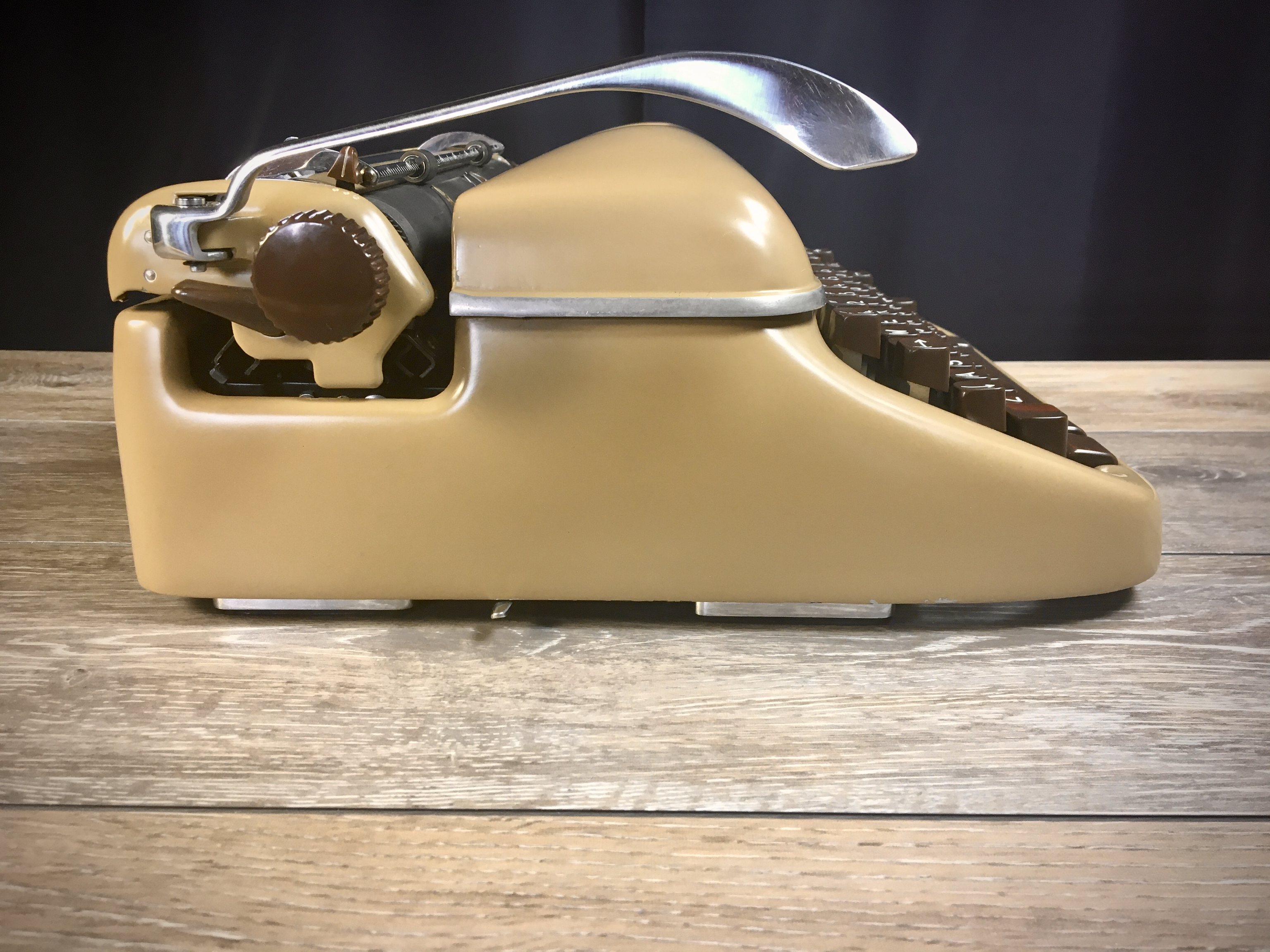
Okay, just one more photo of the Optima, then I'm done:
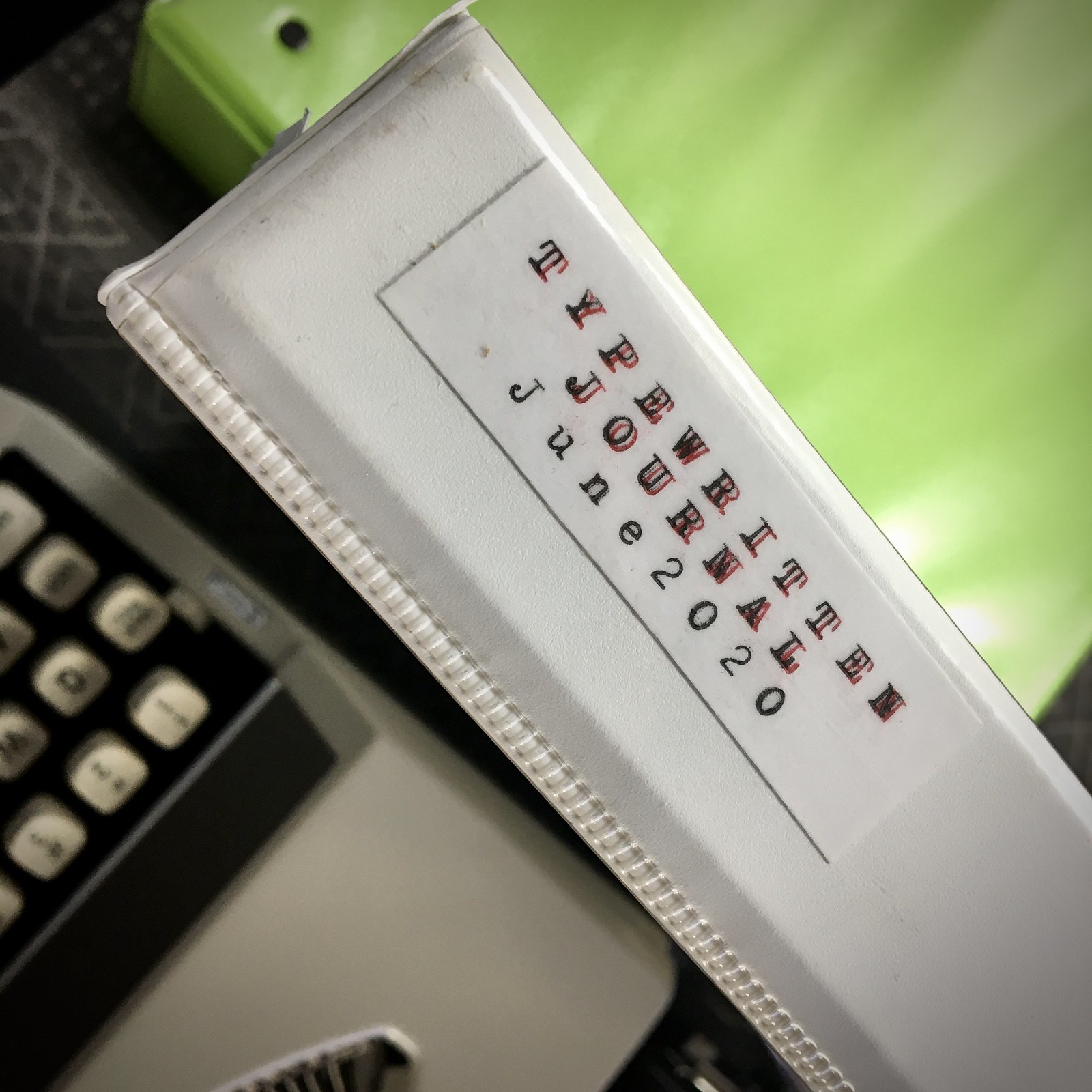
It was about time to start a new 3-ring binder, after the old one, started in June of 2020, was full up. This piece goes into the start of that new binder. I organize my writings into one binder for personal journal entries and One Type Page (OTP) entries; and another binder for my own blog's articles (like this one). And that other binder of blog articles is fat, with articles dating back to 2016, itself soon needing to be replaced.
Once they're full, I store them either in my office closet, or in plastic storage boxes, stacking up from the weight of decades' worth of writings and photography.
The old binder, now full, was a freebie, acquired last year when I was in the waiting room of my optometrist and noticed they had a stack of binders they were tossing out. So naturally I came home with, not only new glasses, but some extras. But this time, I went to my neighborhood big-box office supply retailer and specifically chose this bright green binder, to stand out amongst the drabness of my office bookcase. A typewritten adhesive label or two later, and it was all ready to go.
I don't look through the old writings often enough. It's fun to not only read what I was thinking back then, but look at what paper I was using (I tend to frequently mix up my choice of typing paper), and also what machines were in use. It was interesting, looking through that fat binder of archived blog articles, to see machines being used that I don't even have any longer. This kind of "metadata" I find just as interesting as the writing itself.
Naturally, this begs the larger question of how best to archive one's personal writings. It's a sticky issue, because most of us aren't blessed by tenure at some institution of higher learning, where our work might be archived in some institutional archive; nor have most of us achieved some significant professional stature as a published author and thereby acquired some archivability of our work through reputation alone. If you're like me, you're a struggling writer, in that in-between space squeezed by one's job and family responsibilities on the one hand and some innate creative urge, just bursting to get out, on the other.
When you mention archives, many people immediately think you're talking about computer data backups. There is that, but what I'm talking about is bigger than data backup. Many of us creatives have amassed significant volumes of work on paper. Work that, sure, could be archived digitally, but what would be the point? Would that hard drive or thumb drive survive long enough to mean something down the road, or be tossed in a drawer or box to be forgotten, then discarded?
The point is the future reader. Is it good enough for someone to read, down the road, when you've shed your mortal coil? If not for some stranger with passing interest, is it interesting enough for family offspring to keep? Maybe. Depends, on your relationships, and on the work itself. Many of us have accumulated mounds of what others might call "clutter," but you might call the priceless offspring of a life's worth of creativity. You'd like for someone to keep it all, but down deep know that's unlikely. Personally, I'd expect much of my stuff to be tossed into the recycle bin.
One could, if one were proactive (gosh how I tire of that business-speak term), cull out the best of one's personal work and cudgel it into some self-published tome, to leave to one's offspring as the distilled essence of your creative thoughtlife in book form. A single volume, a condensation of one's work, small enough to likely survive that great paper-tossing-to-the-curb event, come your demise. Leave behind one, maybe two, good books for them to read. It'll probably outlast that archived hard drive or USB stick.
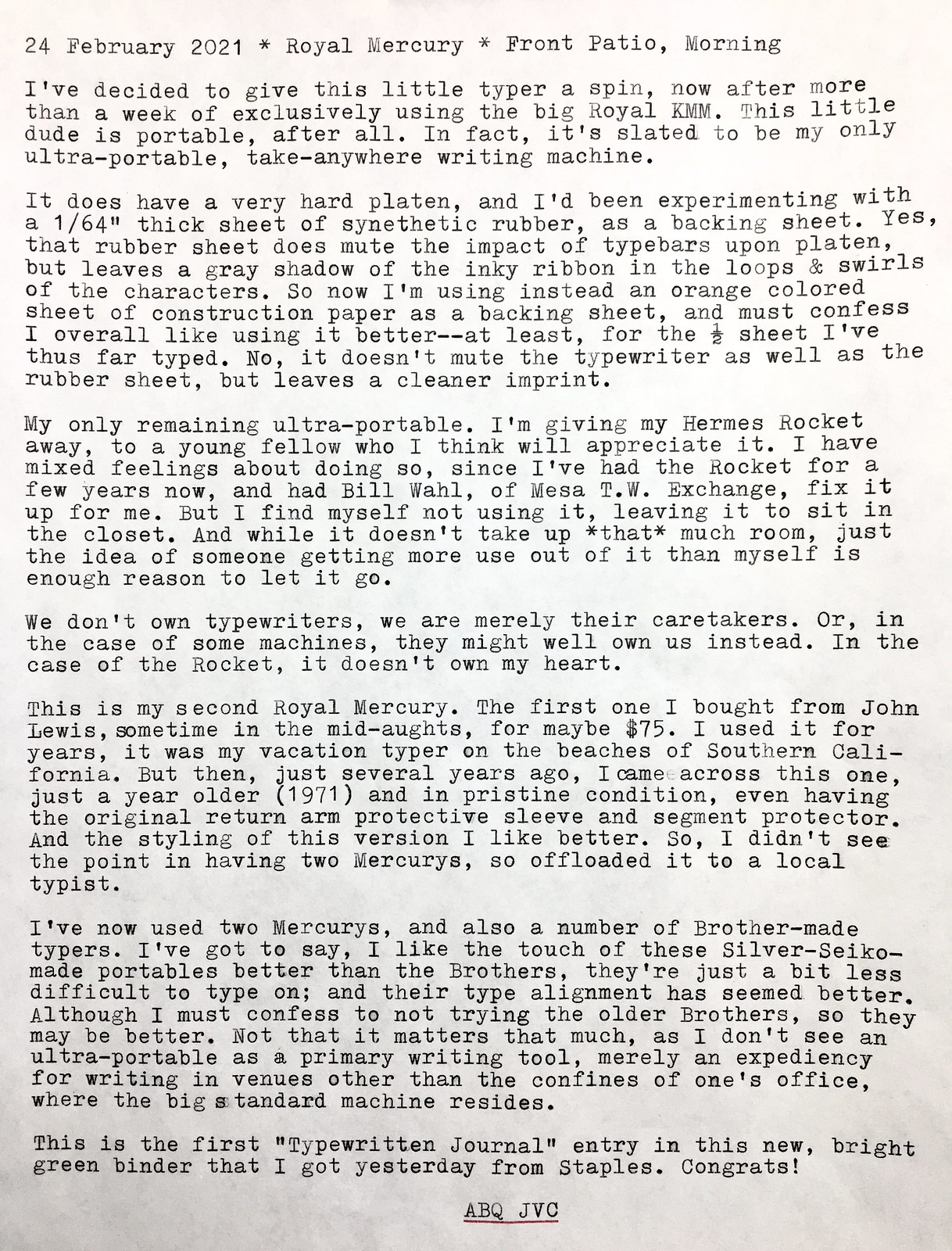
While we're on the subject of culling, I just today shipped off the Hermes Rocket, to a kid in California who will probably get more use out of it than I. And just a few days ago I gave the Groma Kolibri back to Kevin, from whence it came, as again I wasn't using it much, and he'd enjoy it, I'm certain. But don't mistake this for some kind of personal valor, because, you may recall, I've also acquired the massive yet wonderful Royal KMM, which sits prominantly in the office on its typing stand, ready to do battle at a moment's notice.
That leaves this Royal Mercury as my only remaining manual ultra-portable (not counting the handful of thermal ultra-portables). And I still have a good number of medium-sized portables, better suited for longer writing sessions than any ultra-portable, yet still luggable if the need arises.
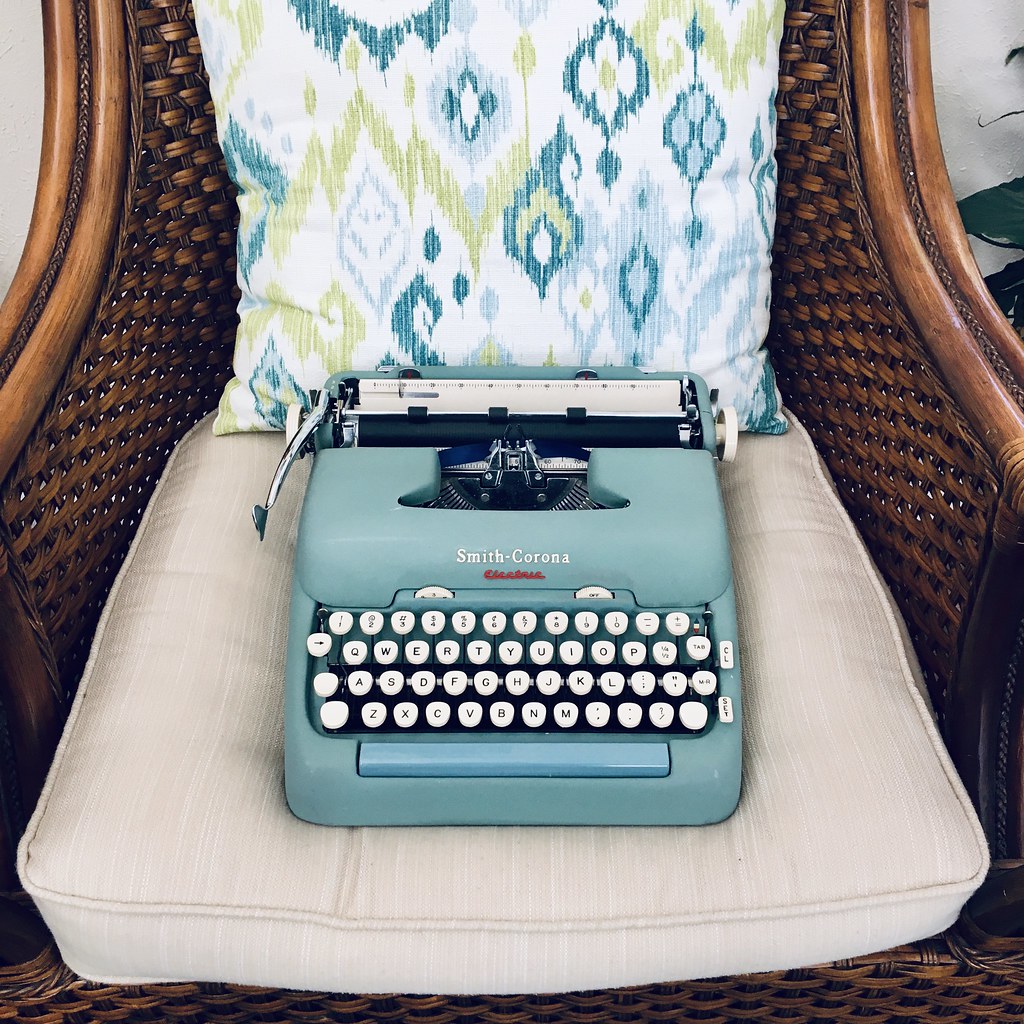
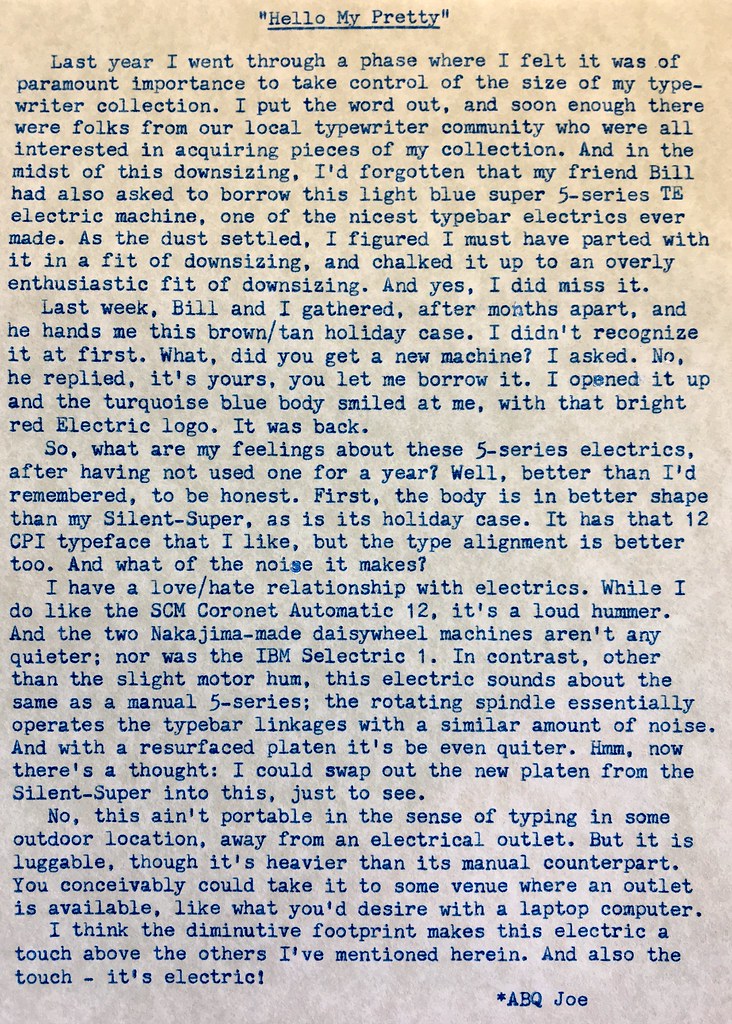
Though it's not as loud as other electric/electronic typers I've used, the typebars do hit the platen with force, as if you were typing on a manual 5-series with a heavy hand. And the shifting is spindle-activated: as you press the shift key a small amount, the spindle engages to lower the segment with authority. This machine doesn't mimic the action of some nimble-fingered dillentante. But the payback you get is a dark, even imprint, and a wonderful touch, as you'd expect from an electric typebar machine.
The keyboard layout on this machine is nice. It has the number 1, unlike the earlier 5-series machines, but the thing I like most is that the apostrophe is lower case, and to the right of the semicolon, just like it is on a modern computer keyboard. I've said this before, but that's the one thing I miss on manual machines, the apostrophe position. I've wondered why manufacturers kept manual keyboard layouts like that, even into the 1970s and later, when their electric/electronic counterparts had the more modern layout. Perhaps it had as much to do with tradition as anything else? Older typing instruction manuals, written for the manual era, did teach the apostrophe as a shifted 8. But, that can't be the only reason.
If I were a writer in the mid-20th century, I would have been tempted to get one of these electrics as soon as I could, if cost were no object, and lack of portability a non-issue. Perhaps for secretarial use the apostrophe was little-used in formal business correspondence, hence its position on a manual machine as a shifted-8 might be less of an issue; but for the fiction writer or playwrite, who might work with lengthy dialog scenes, contractions and their requisite apostrophes are the normal way realistic characters talk. Having the apostrophe in its modern location would be a boon to such a writer.
All of the electric/electronic machines I mentioned earlier I've been cautious about using late at night, while the rest of the family is asleep. This one I expect to be less of a problem with noise. Perhaps I would move it to the patio room at the back of the house, away from the bedrooms, just like I would with a manual typer. I say this in the hopes that I will give it more use, now that it's back in my hands.
Before I loaned it to Bill, I'd not given it much attention. I certainly under-appreciated its finer merits; but just the other day my oldest brother came over to get a new ribbon put into his Remington Quiet-Riter, and I offered to let him try one of the Nakajima daisywheel machines. He declined my offer, but just in the process of testing it I simultaneously envied its clean imprint while lamenting the loud clank of the daisywheel print solenoid, along with the machine's large footprint. I'd kept that machine on one corner of my office desk for months, and all it served as was a place to stack papers. Never once did I use it. But that taste of electrified keys, with its featherweight touch, is what I like about this blue beauty. And, it's quieter and smaller than the daisywheel machine.
Last year I replaced one of the drive belts due to breakage. I used a new-old-stock orange silicone VCR belt I found in my parts bins. Probably won't last as long as the original, but I do think someone is selling replacements online, somewhere. Perhaps I should do some looking and get a spare for both belts.
Now that I've had time to cogitate on electric/electronic typers, their size and noise is what I most object to. Having to drag an extension cord out to the patio is less of a problem. Perhaps this blue beauty will get more winter use, as I expect to do less outdoor typing. Regardless, I'm glad to have it back in the stable.
The mysterious thing about typewriters is the more you experience, the less certain you are about what might constitute the very best machine. Oh, for sure you know better than most the difference between the low-end and the high-end of the quality spectrum. And for certain, there’s lots of middle-of-the-road machines for whom excellence has not quite been achieved in either design or manufacture, but perhaps close enough, at least for some people.
The very best is a high bar to achieve - this is especially meaningful the more time you spend thinking about all the attributes of typewriters that you appreciate. For example, I had in my collection an Olympia SG3. For many, this would be considered near the apex of mechanical build quality. True enough, it’s hard to argue with that era of Olympia in terms of construction. To find a better-built machine you’re now in the rarified air of rank opinion more than absolute fact. And you still have to consider the condition of any one particular specimen.
But what if one attribute that signifies the best, like build quality, is diametrically opposed to other attributes, like portability? Or storability? The problem with the SG3 - for me - was that I didn’t have a permanent place to use it, since I live in a smaller house and store machines in closets when not in use. Full-sized office machines like the SG series don’t come with cases, meaning they’re not “portables” in any sense of the word. I also like to write in various venues and settings. These behemoths just aren’t compatible with that requirement, regardless of how well built they might be. My SG3 also had an extra-wide carriage which, because of its excess mass, meant the carriage return action was irritatingly heavy. Just enough to not be perfect.
Down on the ultra-portable end of the spectrum we find many machines very light and diminutive, easy to tote around in either their case or a messenger-style bag. But they often lack build quality, an expressive feedback touch and a full set of features. Design compromises must be made for the sake of portability.
Somewhere in the middle of the spectrum we might come closer to perfection, or its second-cousin, near-perfection, when we consider medium-sized portables, machines that technically can be lugged around in a case via a handle, but you wouldn’t be comfortable doing so for very long. They can be stored in the closet when not in use and usually come with a full set of features.
When we begin to consider the best of the medium portables there are a few brands and models that stand out, like the Smith-Corona 5 series, the Olympia SM series, the Royal QDL and the Hermes 3000. There are also many other brands and models, less easy to find, that might rank up close to this grouping. And when we begin to consider this elite group of machines, we find ourselves at odds with our own expectations. Like not being able to see the forest through the trees, or getting so close to the base of the mountain that the foothills obstruct the grand vista, so too do we find it difficult to choose just one model that’s the very best. At least for me. The royal “we.”
What if we say the Smith-Corona was the best? Then we’d have to discount the superior build quality of the Olympia, or the smoothness of the Hermes. They each have unique attributes that make them desirable, which is why they’re on the short list. It’s hard to be a monogamist here, with so many enticing machines.
And so we come to The Cult of Hermes. Even if you don’t hold the Hermes 3000 in that high of esteem, it’s hard to argue with The Cult of Hermes as a title. Sounds like The Cult of Diana, something out of ancient history, with mysterious rituals. Of course, this is all tongue-in-cheek. We imagine a Cult of Hermes because of the adoration and fanfare given to these machines by collectors, which have helped to drive up prices on the used market. What kind of Kool Aid does a person have to drink before they too are a True Believer?
Well, it took me giving the former Nekkid-Riter Hermes 3000 to my friend Kevin, before he had enough time to give the machine a fair shake. He’d been a skeptic too. Now, he’s closer to a true believer, if there is such a thing. As he told me, the 3000 just gets out of the way during the process of writing. You don’t notice it, the machine fades into the background, nothing about it stands out as an irritant or distraction. And it’s surprisingly quiet, even with a hard platen. It offers enough features to not be lacking for anything, other than perhaps a half-space feature.
Of course, we do keep our eyes on the other prized machines in the Pantheon of the Greats. We may be a Hermes cult member, but we’re also ecumenical enough to be curious about other cults, too. Lately, in fact, I’ve dipped my toe into the Cult of Olivetti. But that’s a tale for another day.
I worked on this machine sometime last year, when Kevin owned it, and struggled then with the skipping issues. It also was making a clanking sound, which we thought was something interfering with the bottom plate. There was also some evidence of this because of a spot on the plate with scratches. I tried padding it with foam, then tried shimming the bottom plate with washers, but it didn't really help much. Actually going without the plate ends up being quieter, but then you have the problems involved with interference with the mechanics underneath, unless it's sitting on an absolutely flat surface; forget lap-typing without the bottom cover.
There's an extension arm on the escapement rocker that's operated by the type linkages via an adjustable cam, one of the few adjustments on this machine. But gaining access is difficult, you need a special angled driver and adjustment tool. I've been tinkering with this and can get the skipping to become less frequent, but not go away entirely. Then I tried crimping a thin brass tube, a kind of shim, on the extension arm of the rocker, and that actually helped a whole lot, also making the touch a bit nicer -- but alas the brass piece slipped and I was back where I started. Finally I just put a piece of heat shrink on the arm and it seems to be working good enough for now; I only had one skip during this piece.
There's another arm of the escapement that rides on the bottom edge of the carriage as a dampener, the arm has a rubber sleeve but it's badly worn. I need to get a replacement, probably some thin Tygon tubing, about 1/8" diameter, much smaller than automotive vacuum hose.
I was also seeing some issues with the ribbon not auto-reversing, but I think it's because these new DIN-sized ribbons are shorter than a full sized spool and the sensing arms need to be reformed slightly to compensate for the smaller diameter of the ribbon pack.
That's one thing about the Kolibri, it's a beautiful machine but lacks a lot of built-in adjustments. Things have to be reformed or shimmed to compensate.
As for the clanking sound, it's dampened a bit by just typing on a thick pad, so that's the way I'll go; there's very little clearance between the mechanism underneath and the plate for any internal foam padding.
I was thinking the other day about naming this little bird. No, I don't name all my machines. Of course, there's Adobe Rose, the Royal QDL, but she's an exception. We used to have a VW Jetta turbo-diesel that we named Dieter, after the Mike Myers SNL character, but I don't see this little Kolibri as a black-clad Dieter in a German dance club. Maybe it doesn't need a name, it just needs to inspire me to write, and that's good enough for me.
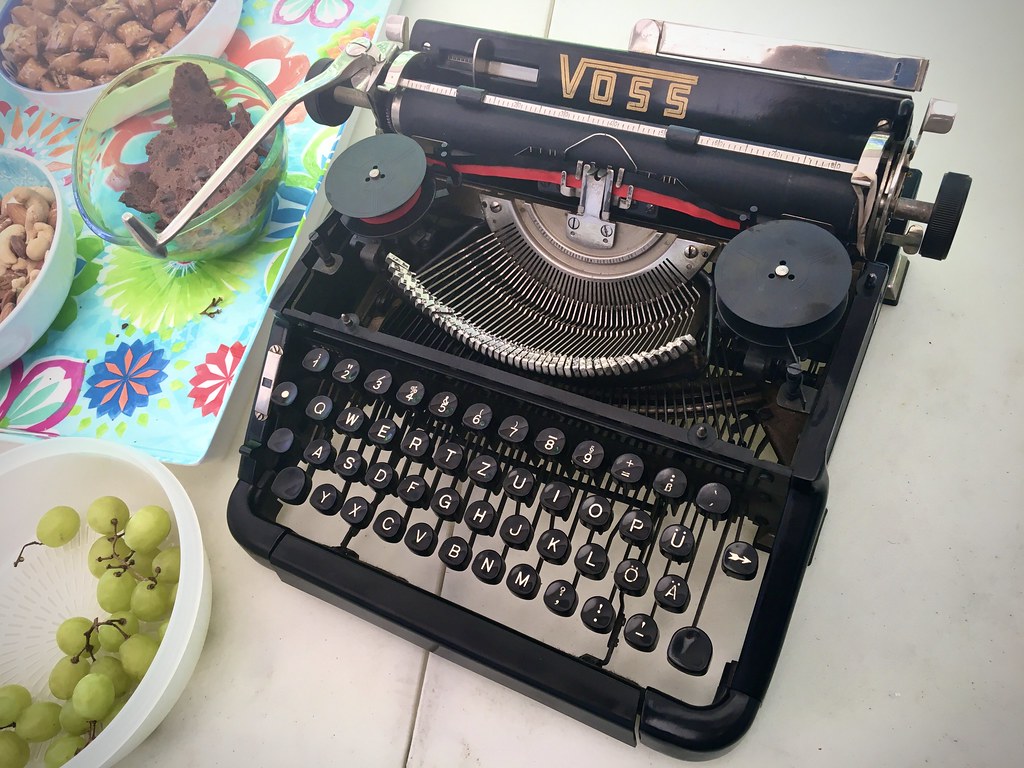
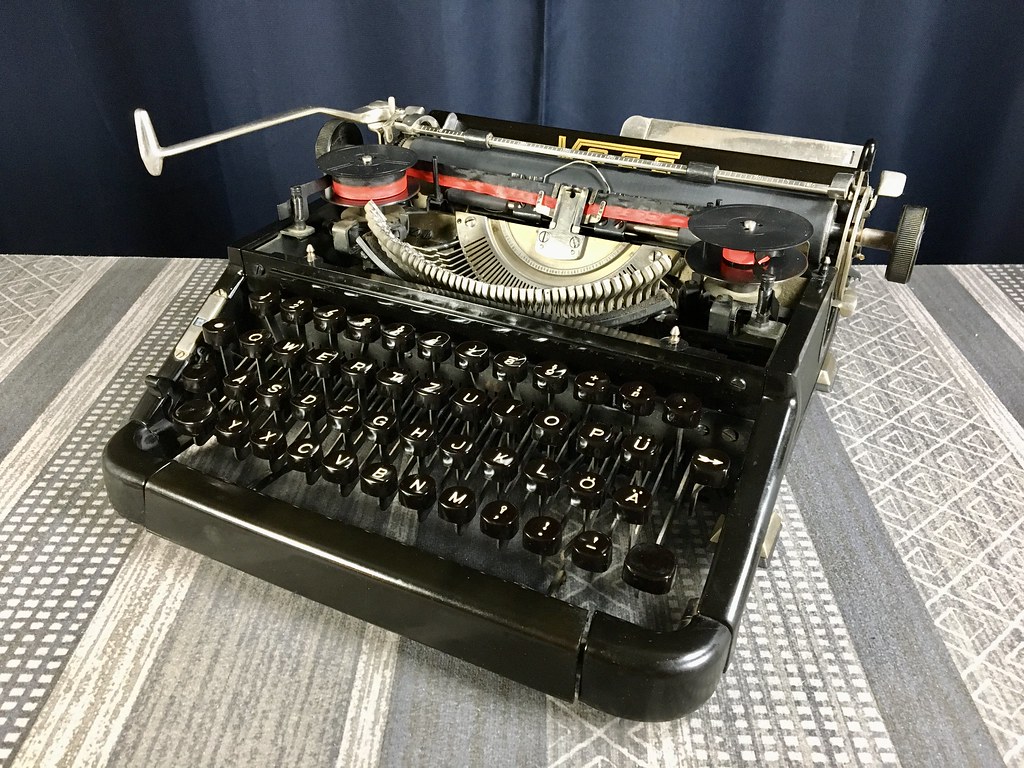
This machine was from John Lewis, our local typewriter shop. It was going to be used as a parts machine for repairing a newer Voss De Luxe owned by Kevin, but John managed to fix the De Luxe without robbing any parts off this older machine. John offered it to Kevin for a song, and now it's mine.
Mechanically this older Modell 50 and the newer De Luxe are very similar, they feature the same escapement mechanism for example (which, by the way, is replete with numerous adjustments), but the carriage on the De Luxe is different, especially around the paper bale. And of course the styling between the two models is different. This Modell 50 is rather masculine in appearance while the De Luxe is rounded and curvy. They also reversed the location of the back space and carriage release controls between the two models; Kevin's De Luxe was made in 1958, while my Modell 50 was made in 1952. And a sticker on the back of the De Luxe indicates it was marketed in the United States by a subsidiary of Voss, whereas on my older machine there's a paper sticker indicating Schultheis & Lenzen, Buromachinen, Koln-Aachener Str.15-17 (my apologies for not using the correct German punctuation marks.)
Aside from several cracked Bakelite panels and the hardened rubber parts, the only other issue is the springs for the paper bale are broken and missing, they are flat spring steel and only the ends remain where they were secured under mounting screws on either end of the bale. This type of spring steel can be brittle. My simple solution was to route a rubber band around from behind the right side of the carriage to the right front finger of the paper bale; it now gives plenty of pressure onto the paper.
Aside from needing more superficial polishing, I'm seriously thinking about making a ribbon cover. It won't have the same curvy shape as the original, but should be functional. It will be made from wood, and I hope to successfully seal and finish the wood into a glossy black appearance to match the rest of the machine.
There's an even earlier version of this machine, with round keys and a more conventional space bar. This is more of a hybrid machine, sporting a pre-WWII conservative appearance yet featuring modern plastic key caps.
This is one of those machines I didn't know I needed. In practical terms I don't need another typewriter; but now that it's mine, and I've put some work into it, I can say it's starting to feel like one of the family. It also has a stablemate cousin, the Triumph Norm 6 with a similar German/Hungarian keyboard. As I indicated in this piece, I have little problems typing with a QWERTZ keyboard, since I'm not a pure touch-typist on manual machines and therefore will periodically look at my fingers as I type, and make a mental note to be on the lookout for the letter "Y" so as to ensure I hit the correct key and not the "Z".
This was a fun project, resulting in bona fide messages sealed in glass. We discussed the merits of actually tossing our bottles into - where, exactly? We're in the high desert, after all, almost a thousand miles from the ocean. Perhaps we can wait for spring runoff on the Rio Grande (last year's runoff was spectacularly high) and hope the bottles make it downstream of Elephant Butte reservoir into the southern reaches of the Rio Grande, hoping for the Gulf of Mexico. Most likely they'd get trapped in some brush along the riverbank and get buried in sand, or discarded as litter. Is tossing a glass bottle into the river littering, when there's a real message inside? Probably.
Another idea was to take a trip to California and toss it into the Pacific ourselves. Hmm, maybe.
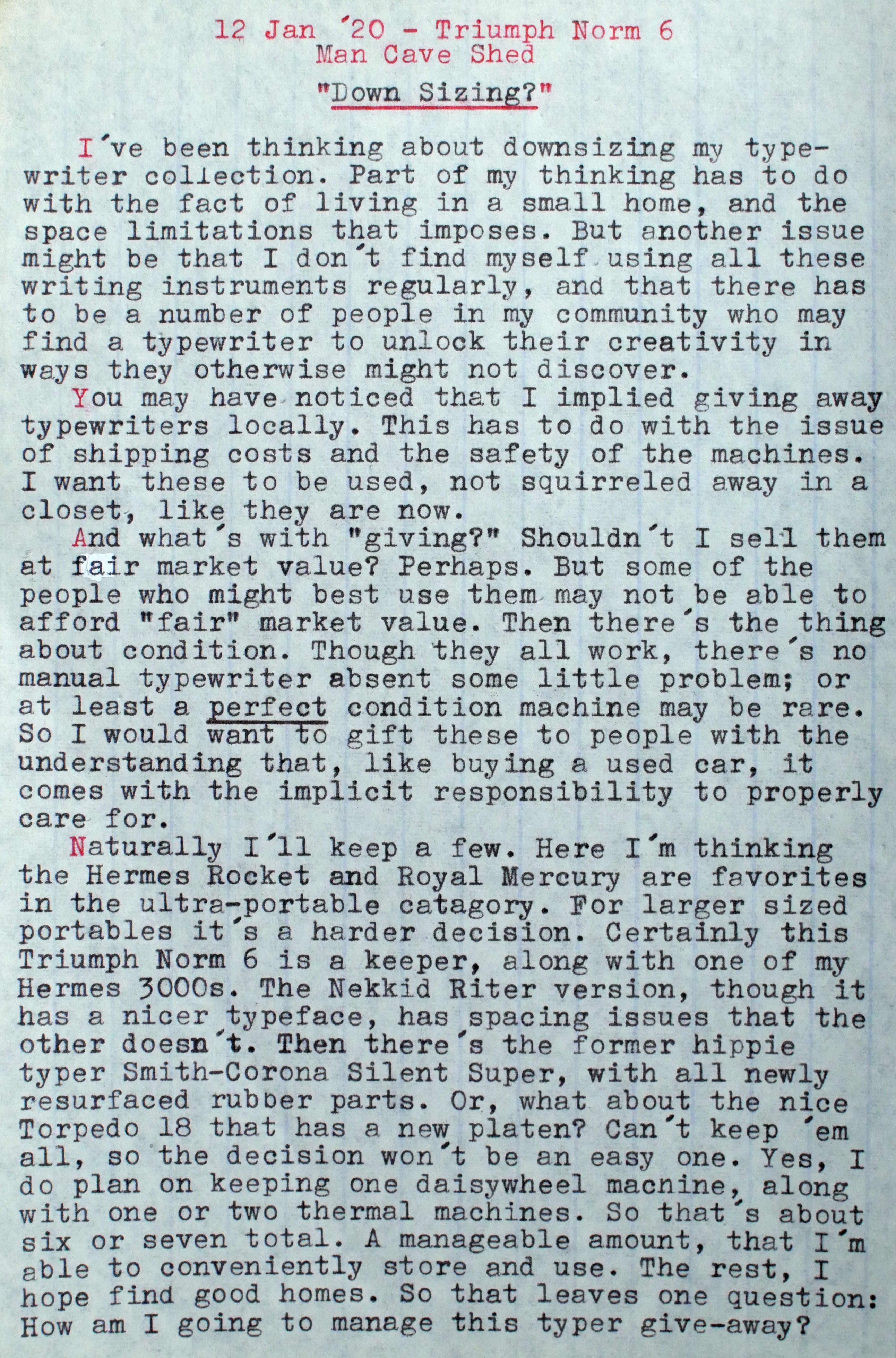
Last weekend I sat down at the Skyriter and composed a one-pager about the merits of keeping it or not. As it turns out, it ended up in the hands of a young man eager to put it to good creative use. Here were my thoughts:
Going back further in time (in case you haven't figured it out, I'm dealing here with a backlog of writings) in mid-January I sat on Kevin's front porch (it must have been a warm January afternoon) and enjoyed a bit of writing on his Groma Kolibri, equipped with a green ribbon. This is the one I worked on earlier in 2019, and it's a sweet machine. For some reason I decided to underline the first letter of each paragraph, which is an interesting typographical idea, perhaps I'll do more of this. In the piece I mentioned "birdie time," this being our weekly visit where we try to get their bird used to our presence, as we'll be bird-sitting for them. Kevin also makes this wonderful statement, that I'm "a collector of typewriter experiences." Well spoken, and a great way to differentiate myself from the classic typewriter collector.
The Typewriter Bus idea mentioned above was my idea for a mobile typewriter bus for conducting public type-in events in various places. It could have school desks bolts to the floor with typewriters securely mounted, and an external fold-up sideboard table along the outside for standing-while-typing outside. I can envision a fold-up awning on either side for shade, and a 50-states typewriter bus tour. I only need lots of money and time. Maybe. Maybe not. But never let your dreams die.
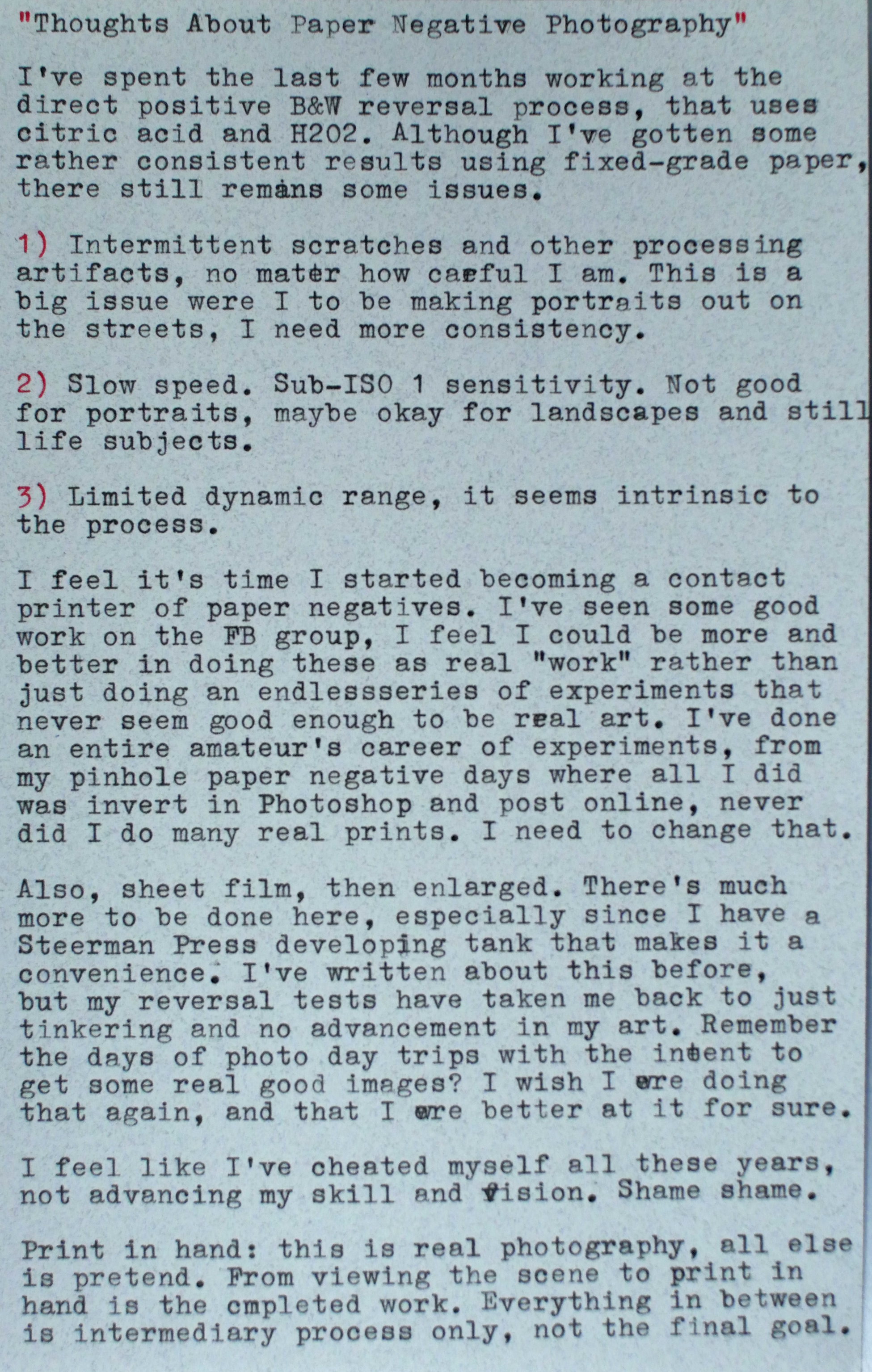
The next three pieces were composed on 30 December 2019, again at Kevin's, using the Torpedo 18. It must've been a heck of a session, as it progresses from the first page involving a review of the last year as it pertains to the founding and growth of the ABQwerty Type Writer Society, to a short essay on pictures versus language and my desire to explore personal story-telling, to another short essay about my paper negative photography. A hodge podge of subjects, for certain.
2019 Year in Review:
On visual versus written media, and personal story-telling:
Thoughts on paper negative photography:
I should've been posting these pieces here as separate articles, but I do tend to procrastinate, more so lately. I hope you find this variety of writings to be of interest. Please leave a comment down below if you wish, I'd love to have a dialog with you about these ideas.
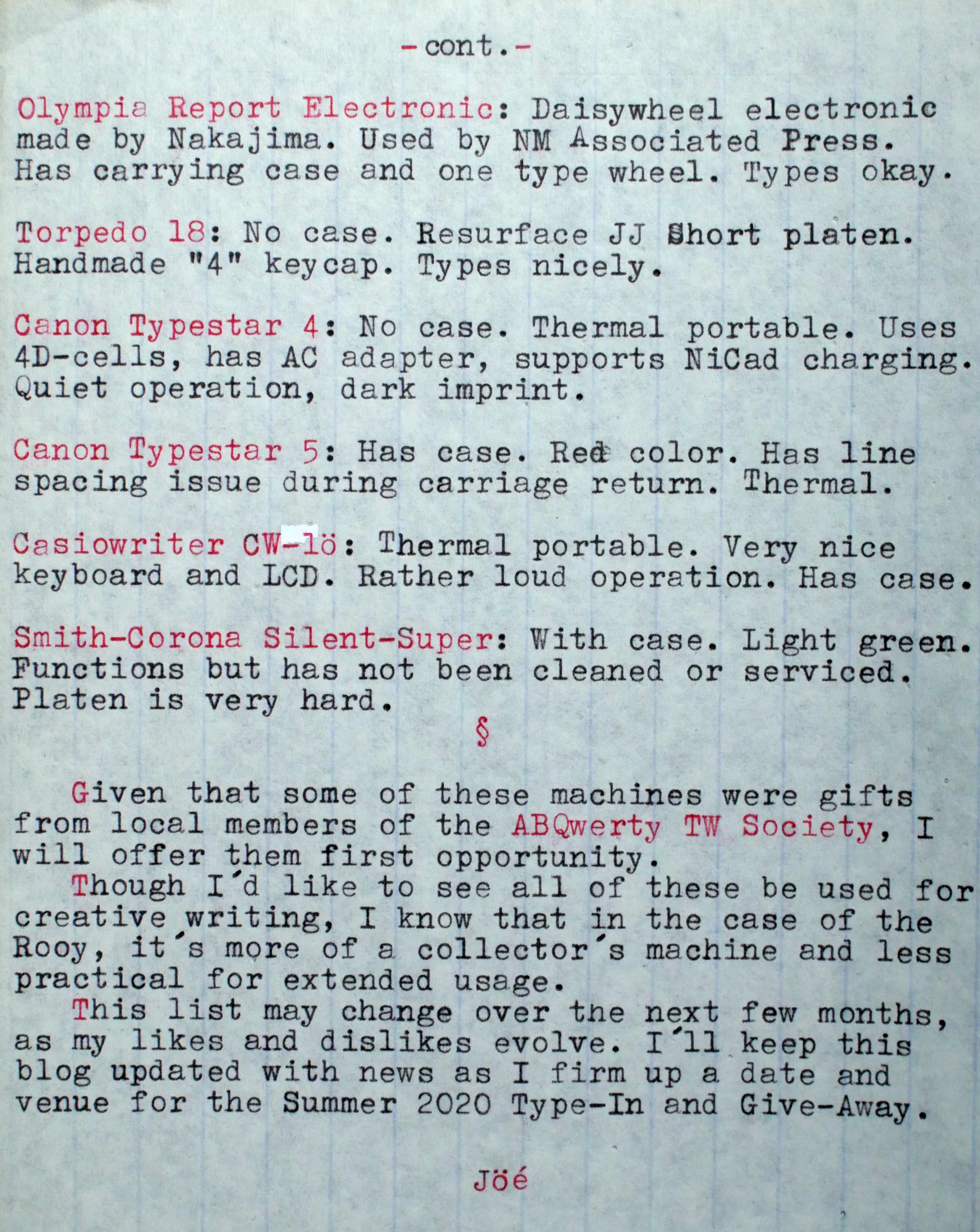
I've come up with a tentative list of typewriters to give away:
I think it's a fair question to ask: once I clear out these twenty or so typers, does this mean I'll be making room for another round of collecting? Well, at this point my intentions are to maintain a much smaller collection, more conducive to a "semi-minimalist" approach to being a typewriter-oriented creative. But, as always, I reserve the right to change my mind, sometime down the road. Perhaps, if that "dream machine" presented itself, I'd consider adding to the collection. But I'd like for my collection to be practically functional, focused on using for the purposes of creativity, rather than hoarding.
Post-Script: Of course, I haven't tried every ribbon supplier out there, so there's more exploration to do. One of my YouTube viewers suggested an Etsy supplier of cotton ribbons, which I'll have to try out and review. Another suggested FJA Products, another good supplier.
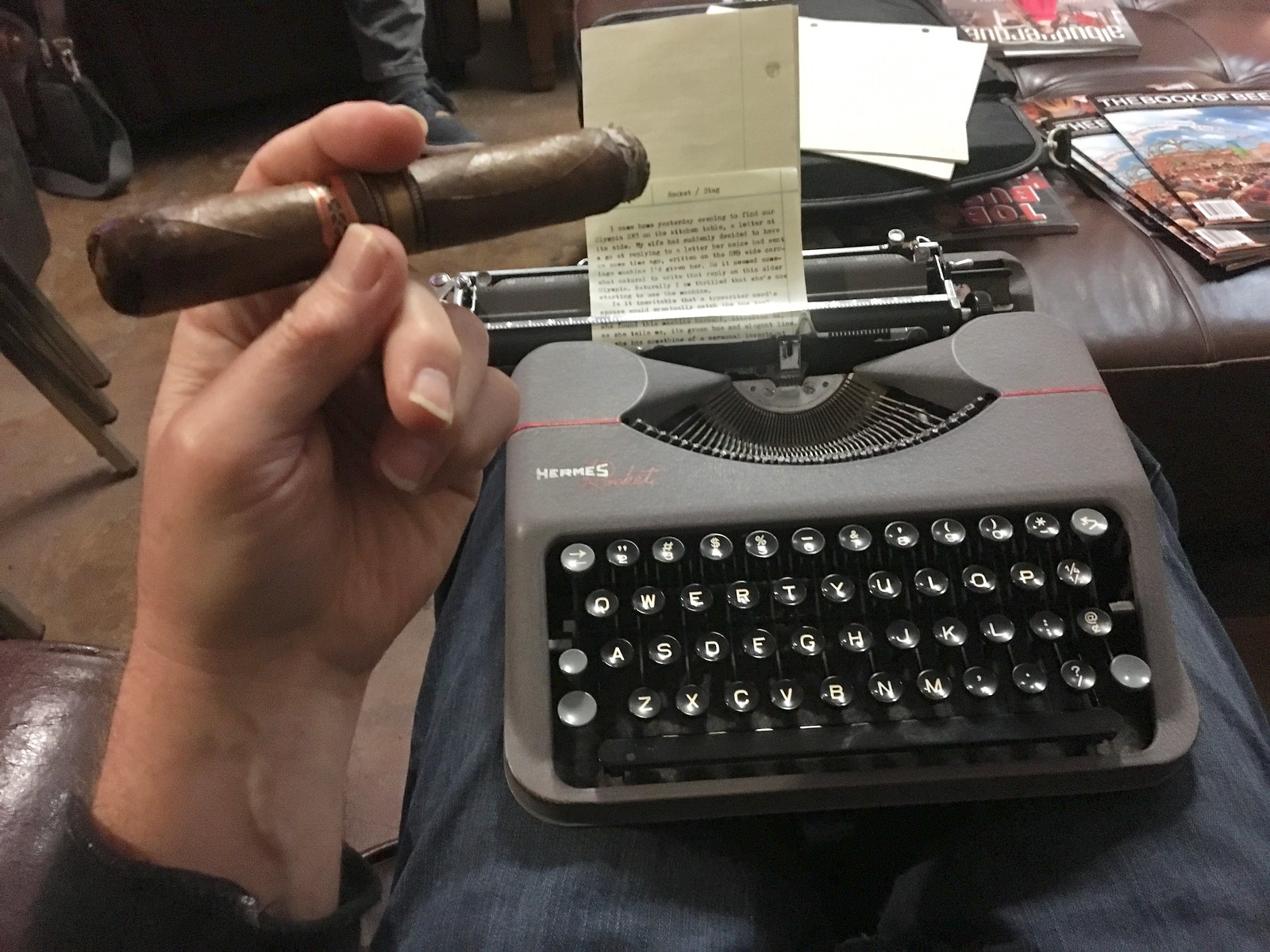
Blog articles like this one aren't spectacularly informative, but they do represent the ongoing lifestyle of a typewriter aficionado, living with these machines, taking them to the cigar store lounge to write a blog article about taking a typewriter to the cigar store lounge. Self-referential, yes; but I think it's an important aspect of typewriter culture, documenting how we live with, and use, these mechanical wonders, mundane as that might seem.
On a technical note, I like to fold this green engineering paper in half when typing a narrow column for this blog, especially with the Rocket's 13 CPI typeface. So the left edge is creased and the right is open, when threaded through the platen rollers. But the right side must have fed faster than the left, because in the scan you can see the lines of text start out at the top slanted toward the left and end up slanted toward the right at the bottom of the page. Probably some subtle pressure roller issue in the carriage, but nothing that's going to keep me up at night. I should be just left the paper unfolded and used a backing sheet.
In the resulting video, linked below, I have some wonky audio issues, caused partly by a weak battery in my dynamic mic's preamp, which spoiled the video's overall quality, since audio is so important of an aspect to video. I tried to even out the clips' levels, but it's still rather awful. I need to take better care next time.
I have a number of video projects needing to be made, but my time these days has been occupied with edits and rewrites for my Cold Hard Type short story project. I've also been holding off on another typing assignment until the deadline has passed, because I know a number of participants to the series that are also in the midst of writing their Cold Hard Type stories.
Last night I spent hours typing changes to the story on my Royal QDL, while today I once again broke out the Olympia SM3 to type a neat copy incorporating all the changes thus far. While the Royal is a darned good machine, the SM3 is yet a cut above.
I hope to get one more video done this week. Wish me luck, and that the quality will be up to par.
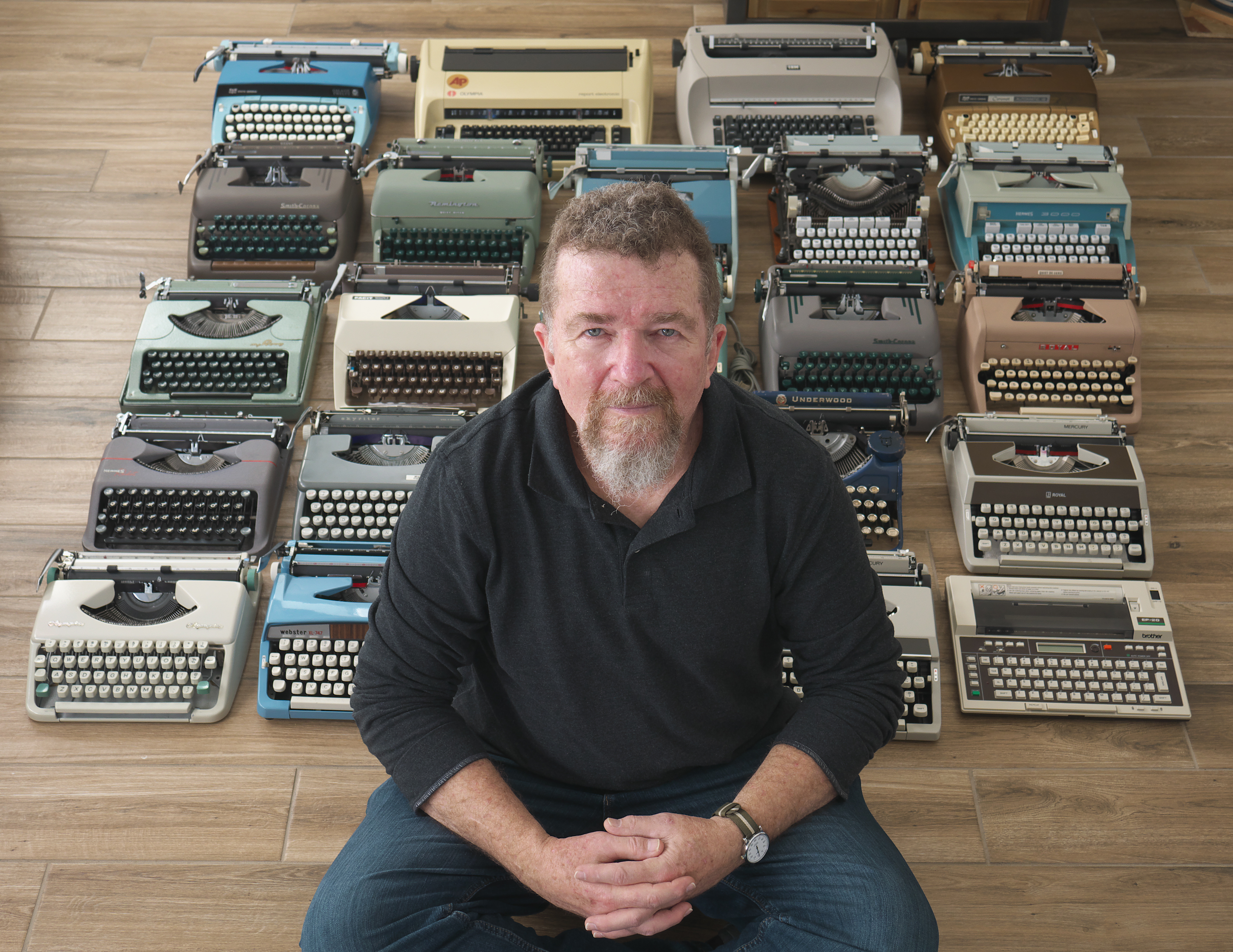
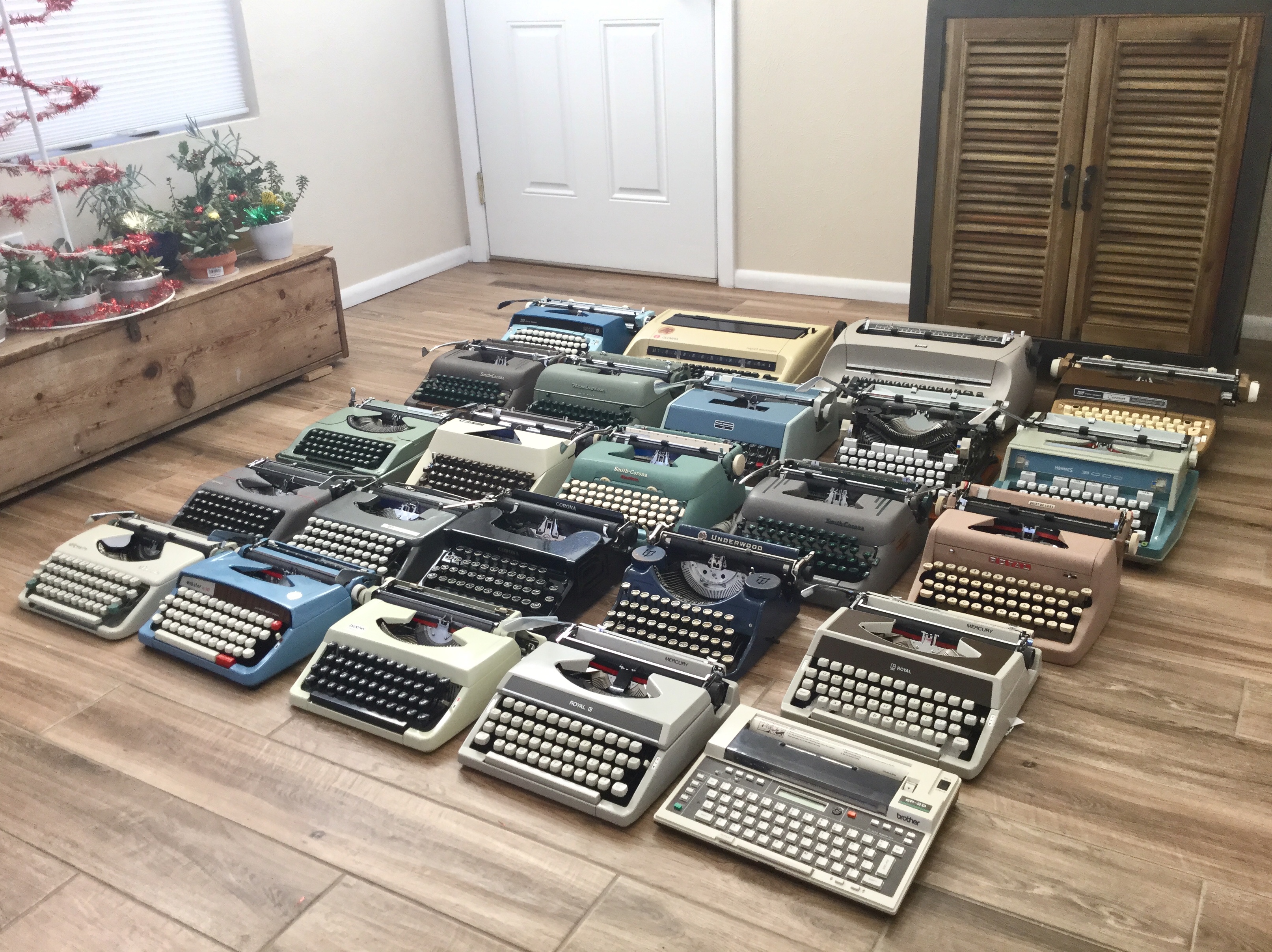
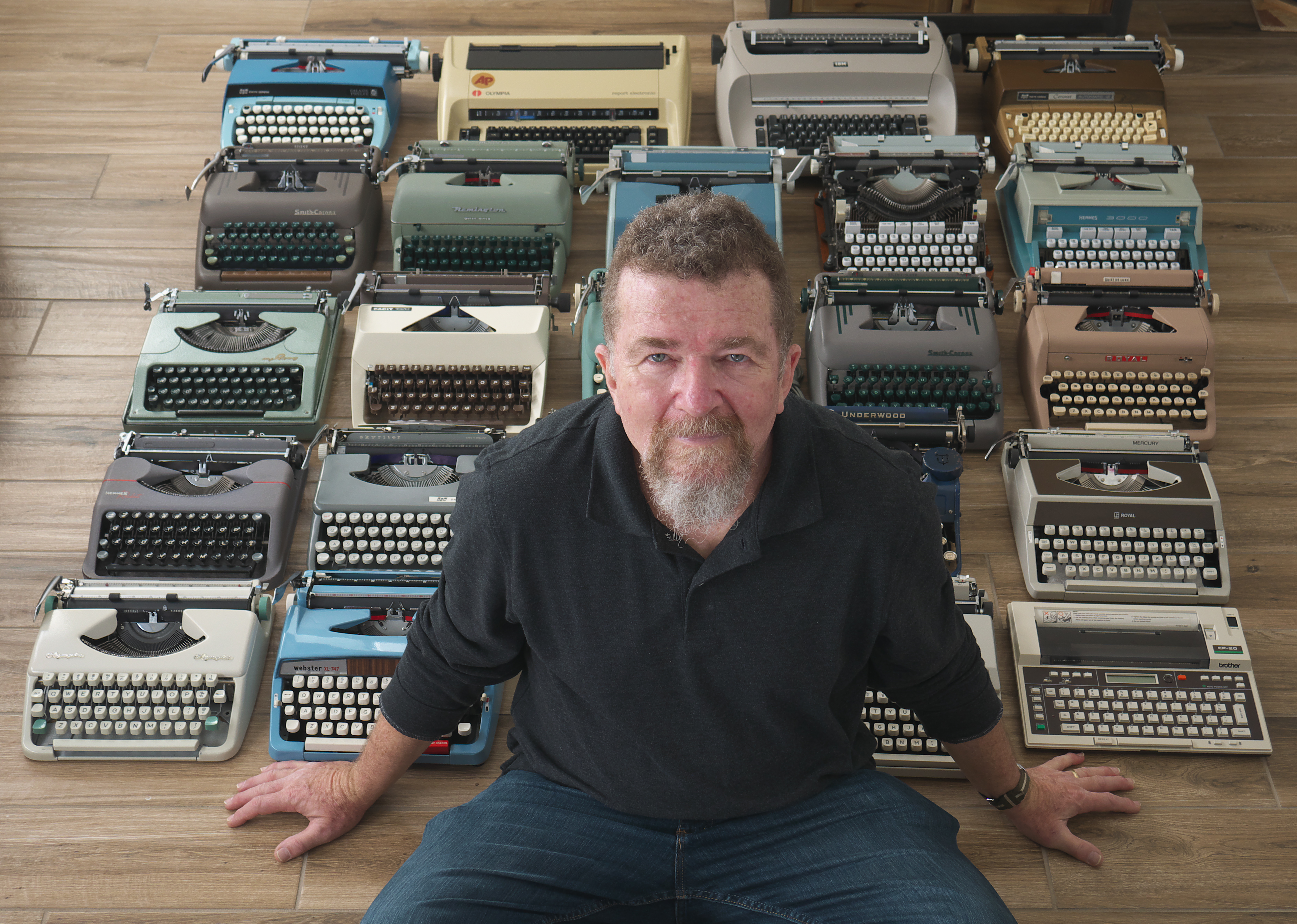
Post-Script: This was fun. Not just trying to make a self-portrait, but more so the gathering of the typing clan. Do typewriters travel in clans, flocks or gaggles? Hmm. Bunches? Troves? That's more alliterative. Yes, a trove of typers. So be it then. As for the portraits, I ended up with these two:
Also captured some nice "B-roll" footage of the trove.
Typecast on Adobe Rose, the Royal QDL, onto the backside of the recently acquired 4-3/8" wide thermal paper. About perfect width for blogging with elite-sized font.
Here's the video about this shoot:
Today I spent hours making test exposures with my various video cameras, trying out various settings, then uploading the footage repeatedly to my computer and viewing full-screen on my monitor. I'm trying to optimize my video quality. I keep wanting to use the little Canon Vixia 800 camcorder, as I like the form factor and it has good image stabilization. But the video quality just doesn't keep up. Some of the footage in yesterday's video was shot with the Canon and I wished I'd used one of the Lumix cameras instead.
The el cheapo "Ape Man" Go Pro knockoff camera is really small, but has a fish-eye field of view and rather cruddy image quality. I wish someone like Go Pro made one with a flip-up screen and external mic input for vlogging. And better image quality, like the Sony RX0.
The older Panasonic GH-3 has the best 1080P files of the four cameras, but it doesn't have as good of autofocus or dynamic range. The even older G5 has the best colors on its LCD screen but the results don't hold up once imported to the computer. The newer G7 has the best dynamic range and auto focus but the colors tend to be a bit orange, and its 1080P isn't as good as the GH3. But it also has cropped 4K, so that's what it's primary use is for.
As for lenses, the 14-42 kit lens has optical image stabilization but its F/3.5 maximum aperture is a bit slow for dim lighting; whereas the 14/2.5 is faster in low light but lacks OIS. I probably need to bite the bullet and fork over some big bucks for a constant aperture stabilized f/2.5 pro lens. The OIS isn't important for stationary shooting in my office studio, but for moving-around scenes, like this typewriter shoot, I really need better stabilization while maintaining a fast aperture. I don't think Santa will be dropping one down the chimney any time soon, however. Plus, our gas stoves' chimneys are rather narrow. Santa's a big boy, last time I checked.
Oh, well. As George Carlin once said, "you can't have everything - where would you put it?" Probably next to all the typewriters.
Now I have to work on Christmas cards. Yes, I'm running late again. I want to type up some letters to go along with them. Wish me luck.
Test-typing someone else’s typewriter collection is often a messy business. You aren’t thinking about finely crafted prose or pristine impressions of ink upon paper. Often - or at least in my case - it’s more like a hurried flurry of poorly typed letters, hardly representing real words at all.
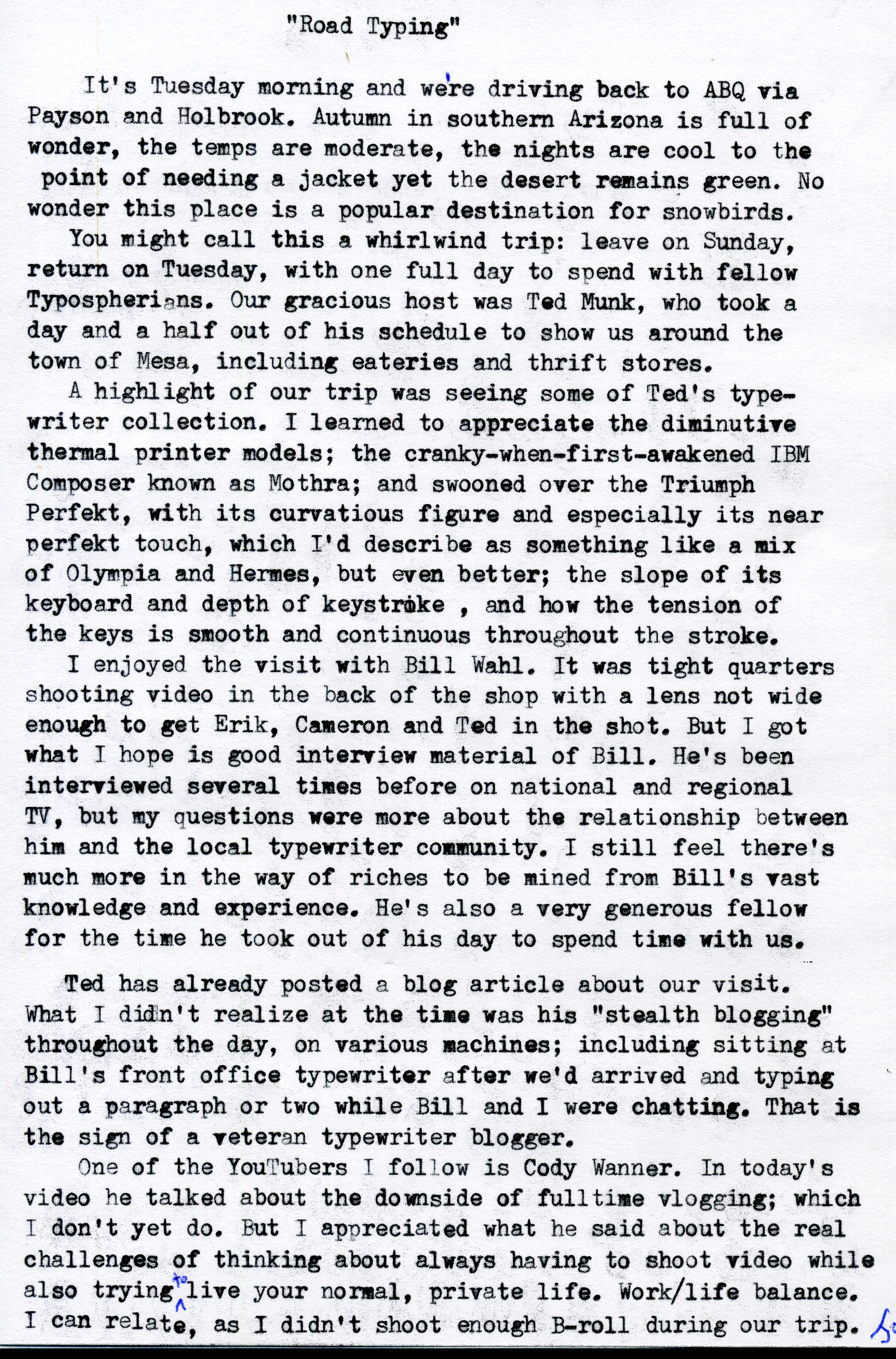
Such were my attempts at test typing on some of Ted Munk’s collection of typewriters, during my recent visit to Mesa, Arizona.
In case you haven’t seen it, here’s a video summary of my trip to Arizona:
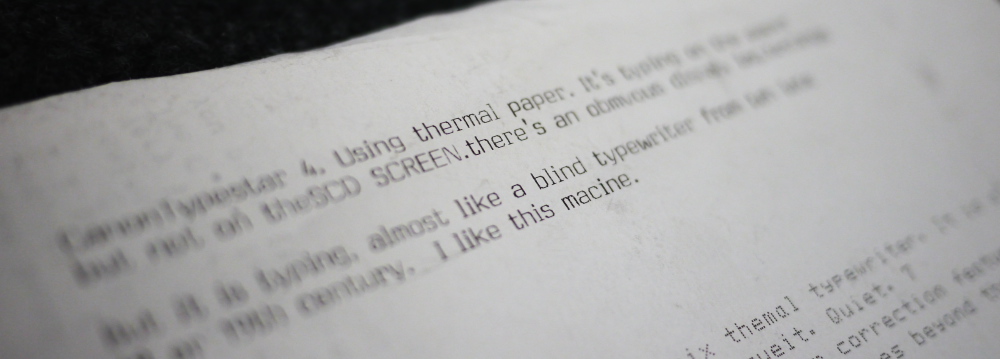
First up was the Canon Typestar 4. This is a machine resembling in form an early 1990s laptop computer. The Typestar line features a small LCD display for editing-as-you-type; a carbon film ribbon cartridge (that’s no longer in manufacture, but examples can be purchased online at exorbitant prices) and a thermal printing feature. It’s this latter ability to print onto a roll of thermal paper that makes these machines still viable.
In actual use, we had an issue getting the text to show on the small LCD screen as we typed; it may have been due to some cryptic setting on the machine. As a result, and because of the location of the thermal print head, it’s somewhat like using a blind typewriter, where you can’t see what you’ve written until after a line advance.
Still, the laptop-like feel of the keyboard, and diminutive form-factor, made for a writing experience somewhat like an AlphaSmart device, with the added benefit of a print-out on thermal paper. No, this isn’t considered an archival medium, but for rough-draft writing it’s more than adequate. You’d want to transcribe your draft onto archival typewritten text once back home; or into a word processor for more formal editing.
In use the machine is nearly dead-silent; you wouldn’t have an issue typing in a quiet coffee shop or on an airline tray table next to a finicky flier. Powered by four D-cell batteries, it’s a nifty little unit. There were a number of machines made in the Typestar line. I couldn’t find a convenient online synopsis of the various models’ features, however. Perhaps Rev. Munk has some resources.
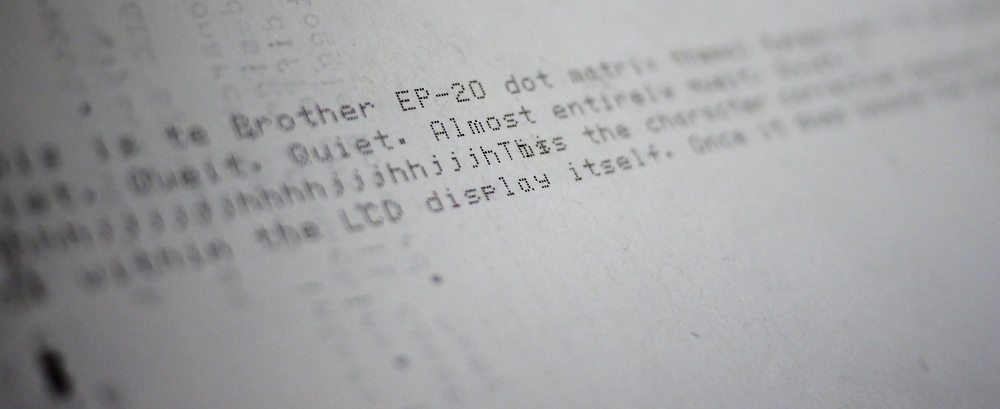
The Brother EP-20 is like a small brother (pun alert) to the Canon Typestar. It too used a now-obsolete carbon film ribbon, and also features thermal printing. Its keys are more like calculator chicklet keys, but the machine is even thinner than the Typestar. It’s thermal printing isn’t as nice as the Canons, obviously more dot-matrix in appearance, but essentially dead quiet.
The tradeoff with the Brother is an even smaller form factor for less sophisticated text - which may not be a bad thing, considering thermal-printed text is essentially a temporary medium anyway.
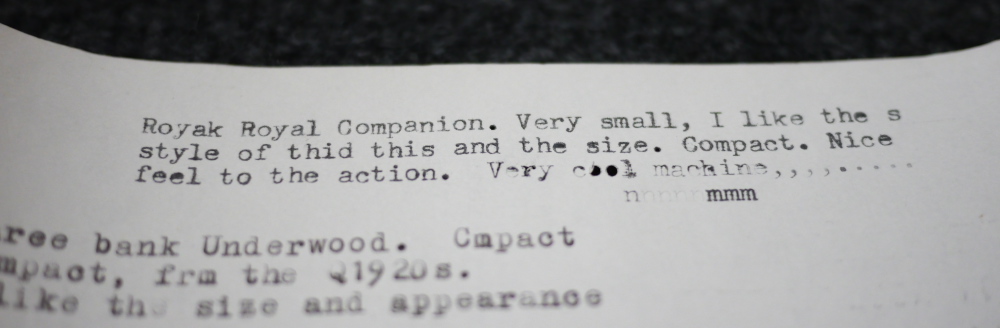
The Royal Companion is a cute little depression-era machine that takes up a small footprint. Ted’s sample has a wonderful finely textured black finish. I was enamored by the small size. It’s kind of like a miniature QDL. The typing action was pretty darned good, too. I can see why it’s one of Ted’s keepers.
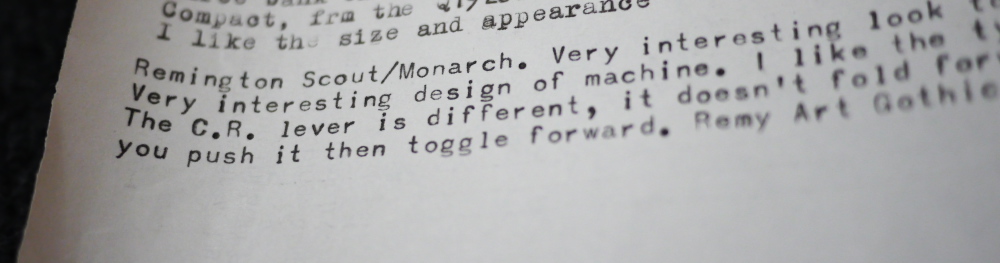
The Remington Scout was an interesting machine. The type bars lie flat for storage, then are raised up by a lever for use, resembling in my overly-active imagination like a ready-to-strike velociraptor in Jurassic Park. This example has a wonderful Art Gothic typeface.
Of special note is the function of the carriage return/line advance mechanism, where the main lever rests toward the rear, with a separate lever for advancing the line spacing.
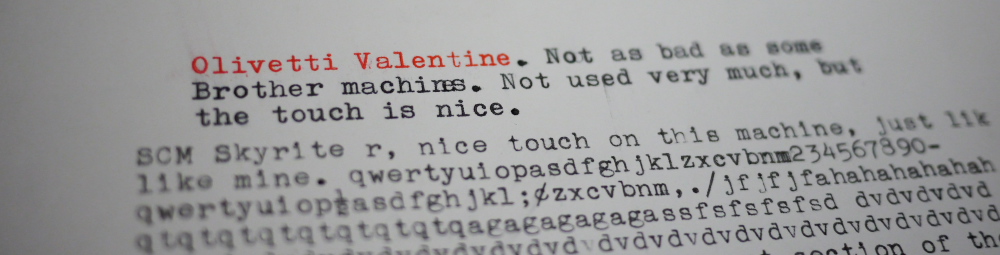
The bright red Olivetti Valentine stuck out on Ted’s shelves like an Italian starlet in the spotlight. This was my first time seeing one in person (typewriter or Italian starlet) and I was duly impressed. From online reports, I’d expected the feel of the keyboard to be less than impressive, but I was surprised at the touch. If they’re all like this one, I can see why they’re so popular. Of course, you’re not going to go out typing in public with one of these unless you’re purposely trying to attract attention to yourself. Best to spend time with your hot little Italian in the privacy of home.
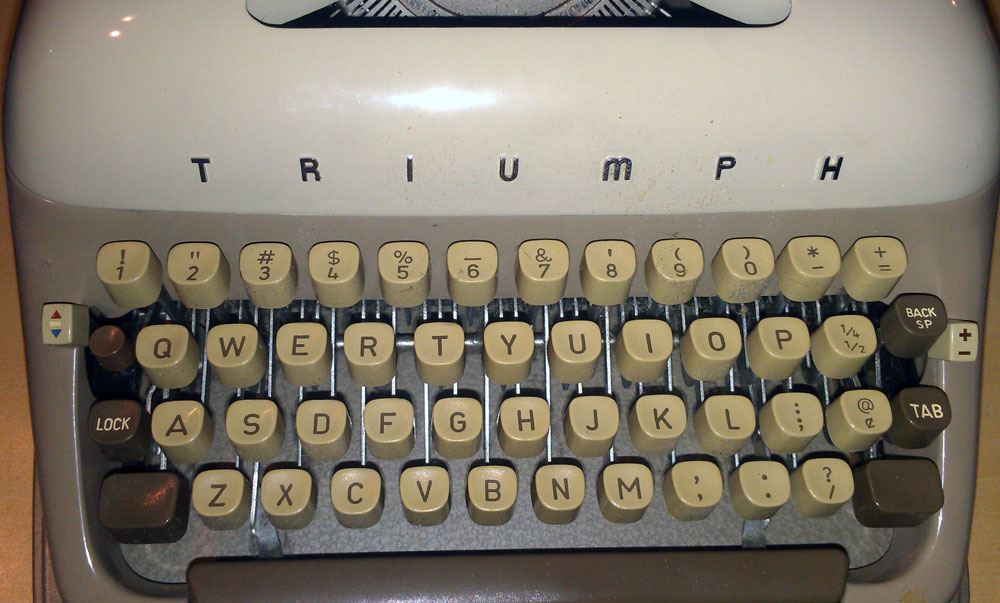
The Triumph Perfekt was the biggest surprise of the day. I loved the no-nonsense curves of the machine and its solid build quality. But the feel of the keyboard was most impressive. First, the slope and spacing of the keys was perfekt. But the action of the keys was great - kind of like a cross between a Hermes 3000 and Olympia SM-something. The resistance of the keys was steady and consistent throughout the entire keystroke. Smooth. Wonderful. I was smitten. Reading back on Ted’s blog, he picked up this beauty for all of $10. The typewriter gods certainly smiled on him that day.
It’s nice to see and use in person machines you’d otherwise only read about online. And I’ve gained a bit more insight into Ted’s typewriter collecting preferences. Another good reason to associate yourself with fellow typewriter enthusiasts - we all can learn from each other.
Post-Script: We arrived home this evening after enduring a loooong line of traffic in Gallup, NM, due to a traffic accident; it added about an hour to our trip.
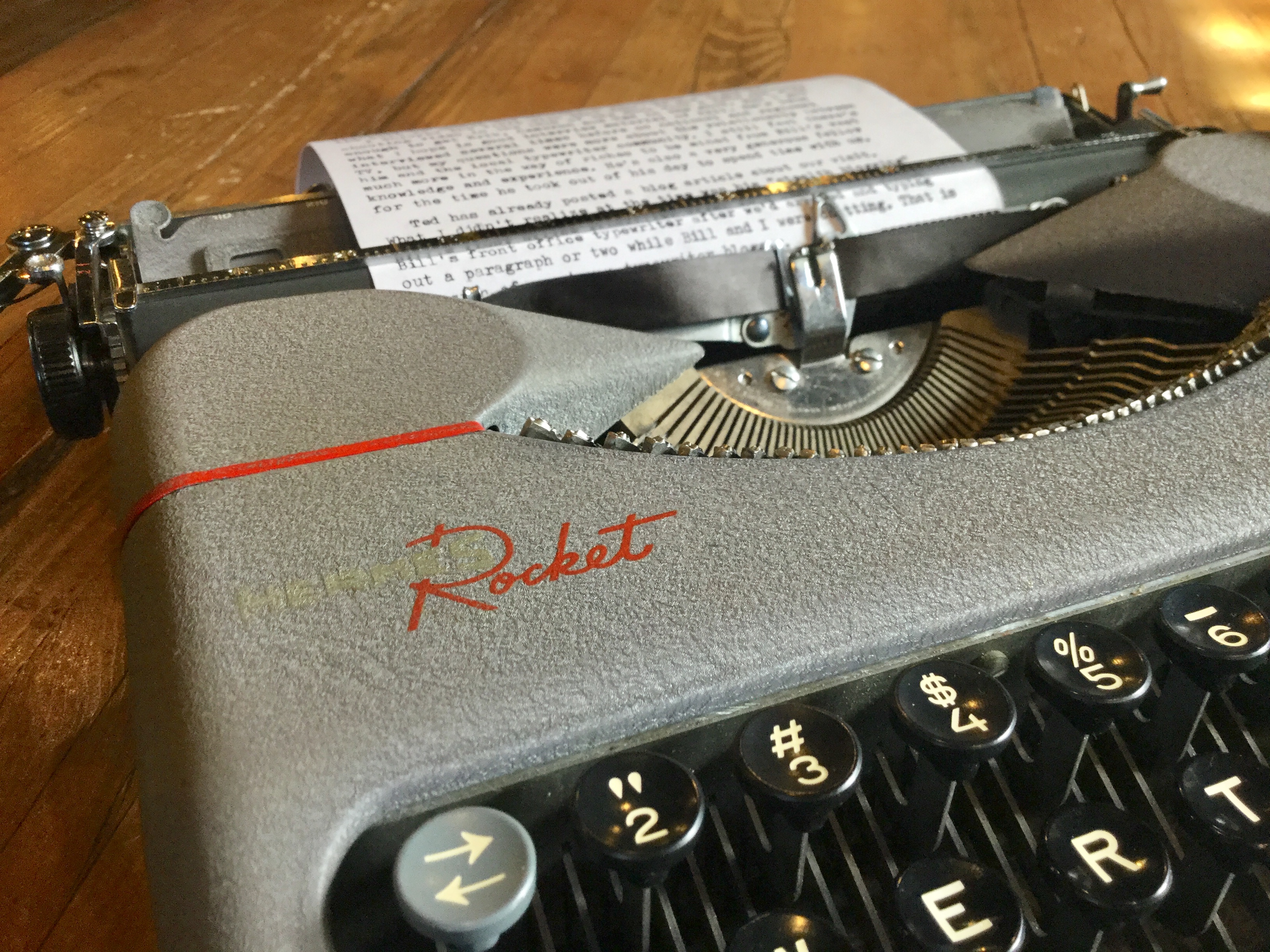
It was nice having the Rocket back, after Bill did his magic to it. I did a bit of journal typing at the hotel breakfast room before we left. One of the wait staff stopped and told me she loved the sound of the machine, and was surprised at how small it is. Along the way we stopped in at Common Grounds Coffee in Payson, AZ for a cuppa, where I worked a bit on this article, during which a fellow patron also commented on the typewriter. She mentioned that she had an old pink Corona back home, I encouraged her to break it out and start using it.
While my wife drove the first leg of the journey back home, I tried writing in my journal (with the new Rotring 600 mechanical pencil), but the vehicle's movement made my handwriting even more sloppy than normal. Another good reason to do road typing instead. I like the feel of the machine on my lap, as I pause, look out the window and think about my next line of text. There's no hurry, as the miles fly by; and the machine is plenty patient - it's not like batteries are being spent.
It was great seeing Ted, Bill, Cameron and Erik again. This business of smuggling typewriters back-and-forth across the Continental Divide could get risky, but no black helicopters were noted. I prefer the drive rather than flying, despite the time it takes, as I don't want to risk flying with typewriters; plus, there's more junk you can stuff in your car than what the airlines would allow you to take onboard.
Okay, time to start uploading video footage and see what kind of story I can piece together.
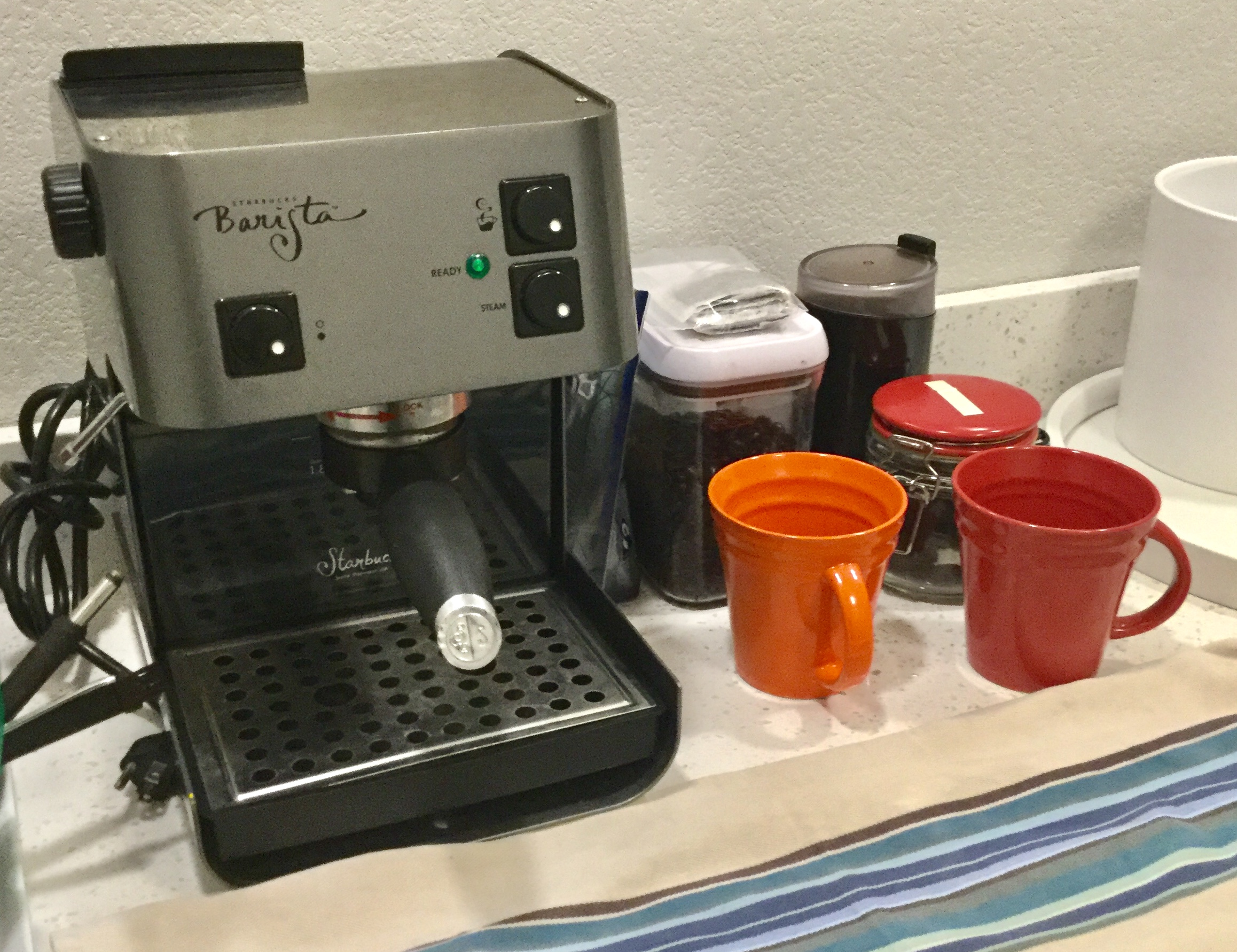
We brought our entire espresso kit with us. Because that's what you can do when you drive instead of fly. When you're coffee snobs like us!
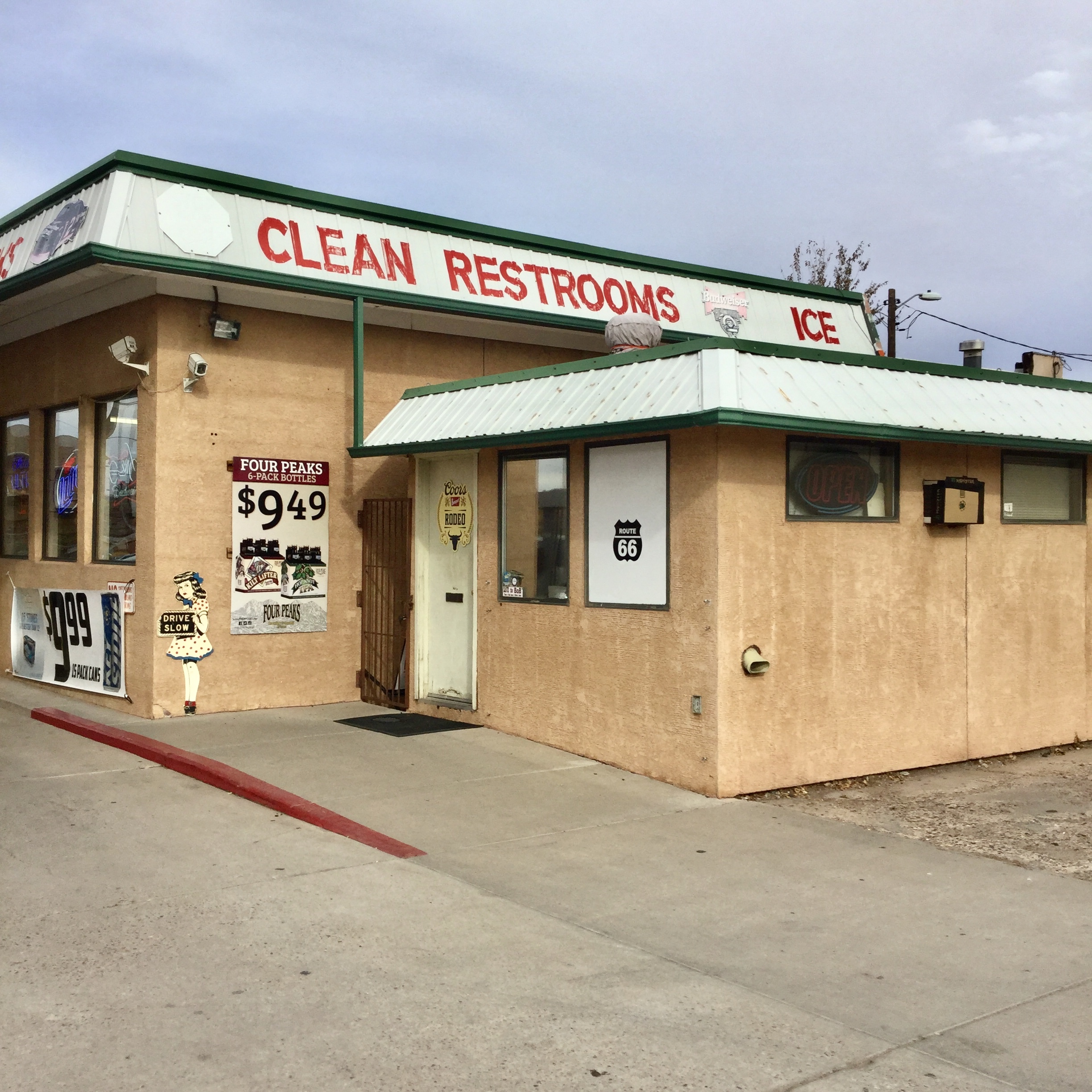
Sometimes it's the little things that count. (Holbrook, AZ)