Monday, April 10, 2017

The Proof is in the Pudding
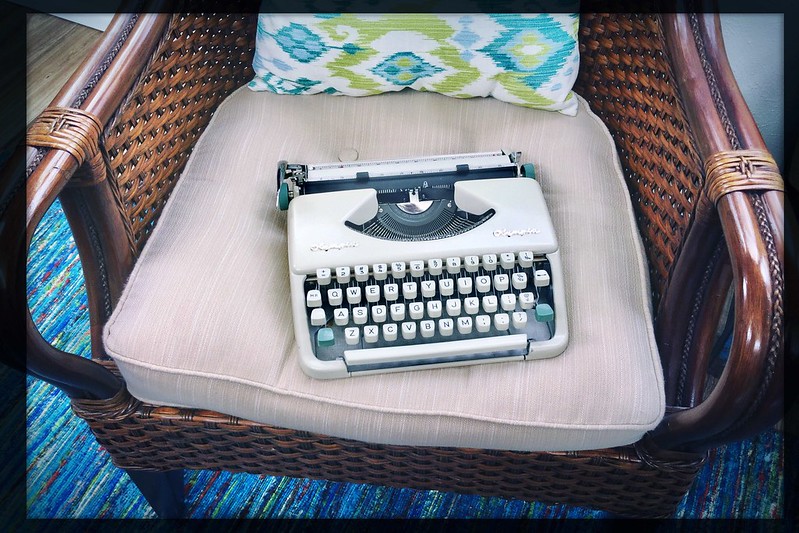
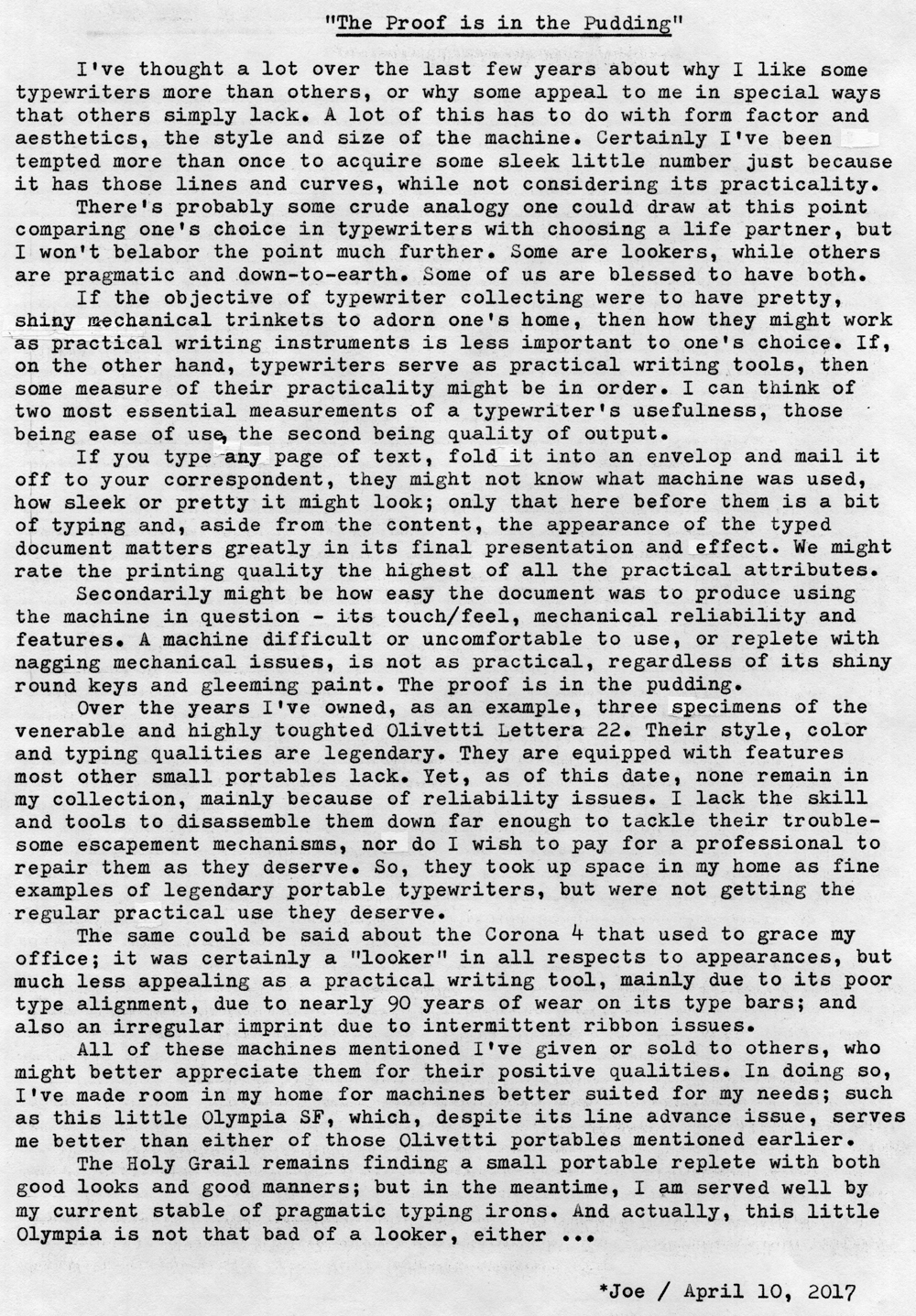
Olympia SF
Typecast279

Post-Script: After we arrived back home from last week's vacation to Jerome, Arizona, the first typewriter I used was the lovely Corona Standard. Not only is it a true "looker," but its typing feel is wonderful. It's probably the one machine in my collection that has it all; aside from not being a true ultra-portable. But then I set this Olympia SF on my lap and began some random typing, and really enjoyed its touch, too. Yes, it does have that one little issue with the line advance, but my temporary solution of back-rolling the platen one click after a conventional carriage return seems to make it a practical writing tool.

Comparing the Olympia with the Brother Charger 11 taken on the Jerome trip, I'd say the Olympia has a more solid feel, though weighs more, but also makes a nicer imprint. And its clam shell lid latch components are made from metal, so they should be more reliable than what I've experienced with the Brother. I know some people criticize these Brother portables, but aside from the broken lid latch, I've found them to be rather reliable. But the Olympia is a more solid machine; and you could argue perhaps has better aesthetics going for it, too.

It's interesting that in all my travels with typewriters I've only ever taken with me an ultra-portable typer. Yet room in one's vehicle shouldn't limit oneself to just those diminutive models, since there's plenty of space in the back seat for at least a medium-sized portable. The real issue is how easy the machine is to lug from car to hotel room, or in the case of last week's trip, from our room to the garden for some private typing. The Brother was a good choice in that respect, as it is light in weight; but I can very much see myself on a future trip taking a medium-sized portable like one of my Smith-Corona Silents. The fancy Corona Standard I think will stay safely at home for the time being.

Since I mentioned the Smith-Corona Silents, I should also make mention that I did a bit more investigation into the intermittent escapement issue plaguing the Super-Silent. I've had promising results by comparing its inner workings with the more reliable Silent stablemate, and documented my findings in a video:


Labels: , , , , , , , ,

Tuesday, October 11, 2016

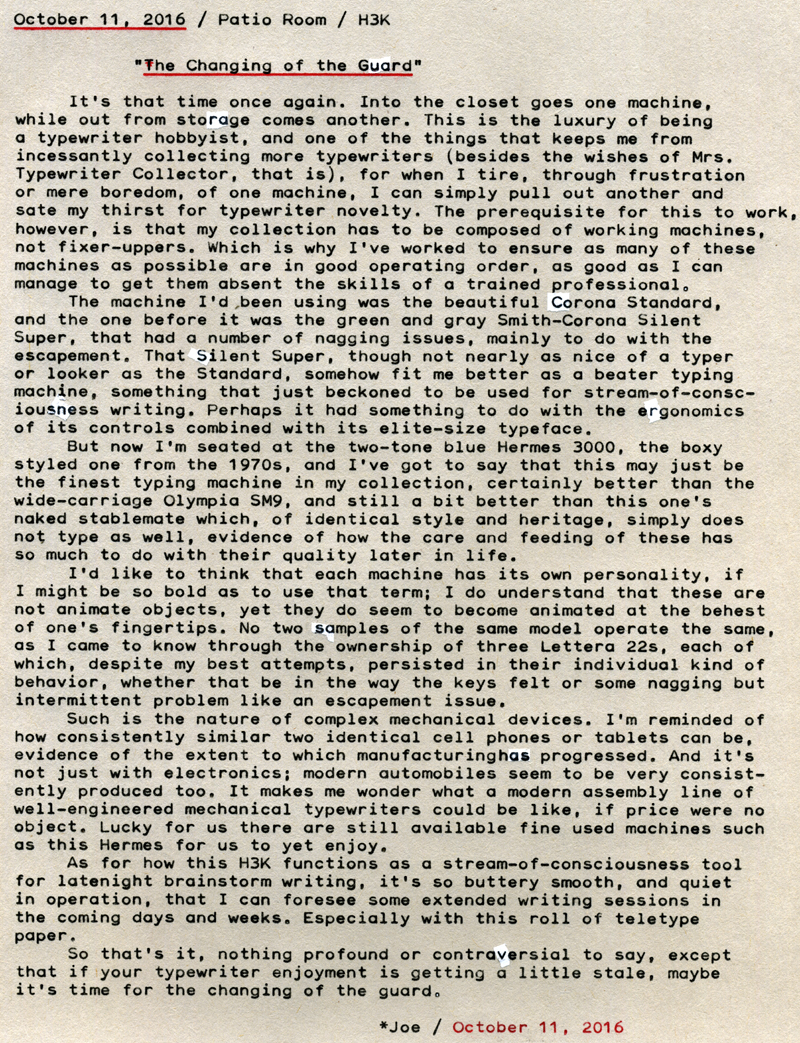
The Changing of the Guard

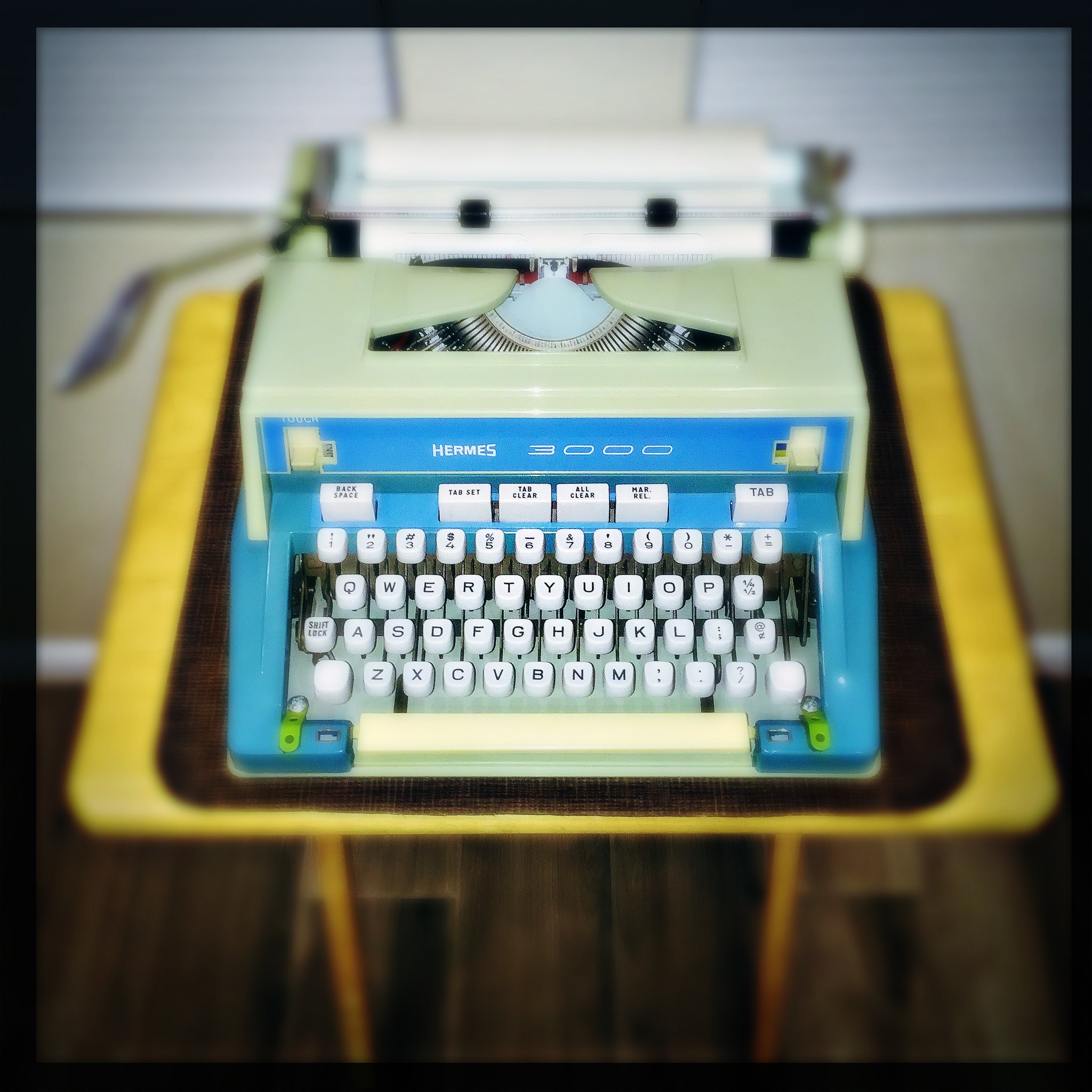
Hermes 3000

Typecast193

Post-Script: I like these kinds of simple pieces. They're conversational, like sharing to a larger audience just a little bit of how typewriters fit into one's day. Nothing fancy or presumed, merely about rotating one's typewriter usage. I wonder if Jay Leno does this, tweeting about taking some car from his collection out for an afternoon spin.

As a typewriter fanatic, I think it's important to type frequently, even if it's nothing profound or earth-shattering. Just get one's fingers on those keys, hear the snap of the type slugs hitting paper, hear the ding of that little bell at the end of the line, smell the machine oil exude from that shiny instrument of literary creativity. Keep in touch, even if it is just about swapping machines, or some other mundane part of one's life.

Others might think differently. They might ask of us why would we go to the trouble, especially with something so ordinary and relatively unimportant as this little one-pager sent off into the aether. I think it's most important to answer the question of "Why type?" by the simple response of "Because." Because I can, certainly. Because I have a selection of functional, beautiful machines to choose from. Because it's "Me-Powered." Because it's fun: we are far enough removed from the days of typists toiling away at their typewriters in the drudgery of the mid-20th century office environment that bringing one of these to life by the animation of our fingers somehow brings us to life, too.

I think typecasting makes blogging more satisfying. It's one thing to bang out a little nothing note to the world directly on one's computer, but quite another to do so with a scan of a paper artifact that reveals so much more than the mere words themselves. And it takes some effort, more so than hitting the "enter" key. So, to paraphrase that old Hallmark greeting card slogan, "When you care enough to send the very best, send them a typecast."

Labels: , , , , ,

Sunday, July 31, 2016

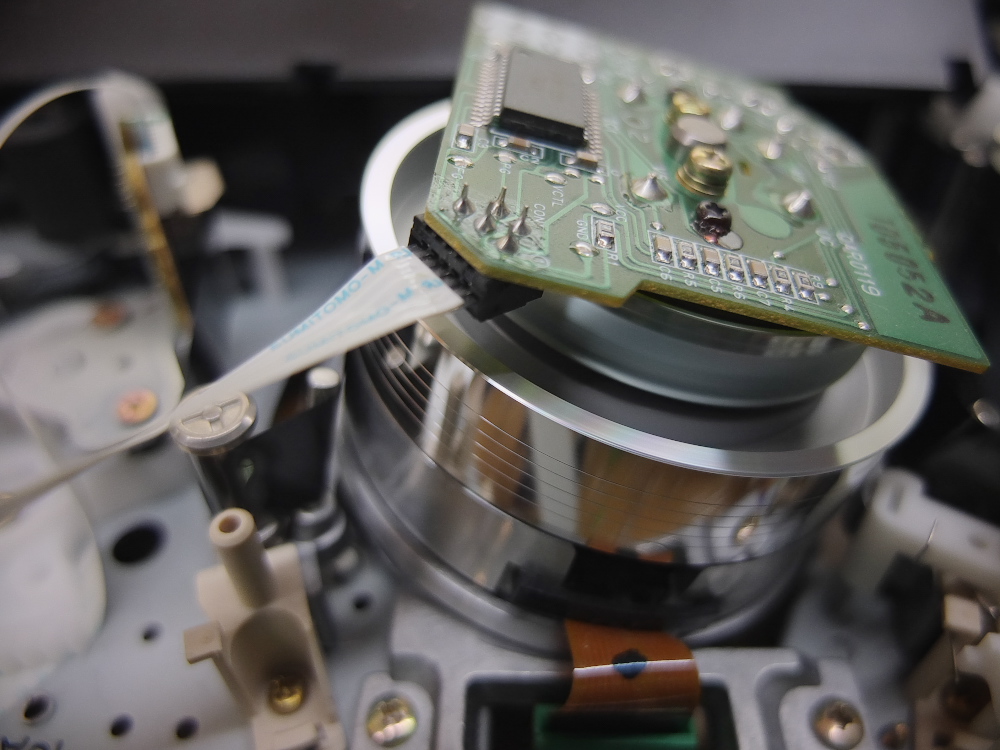
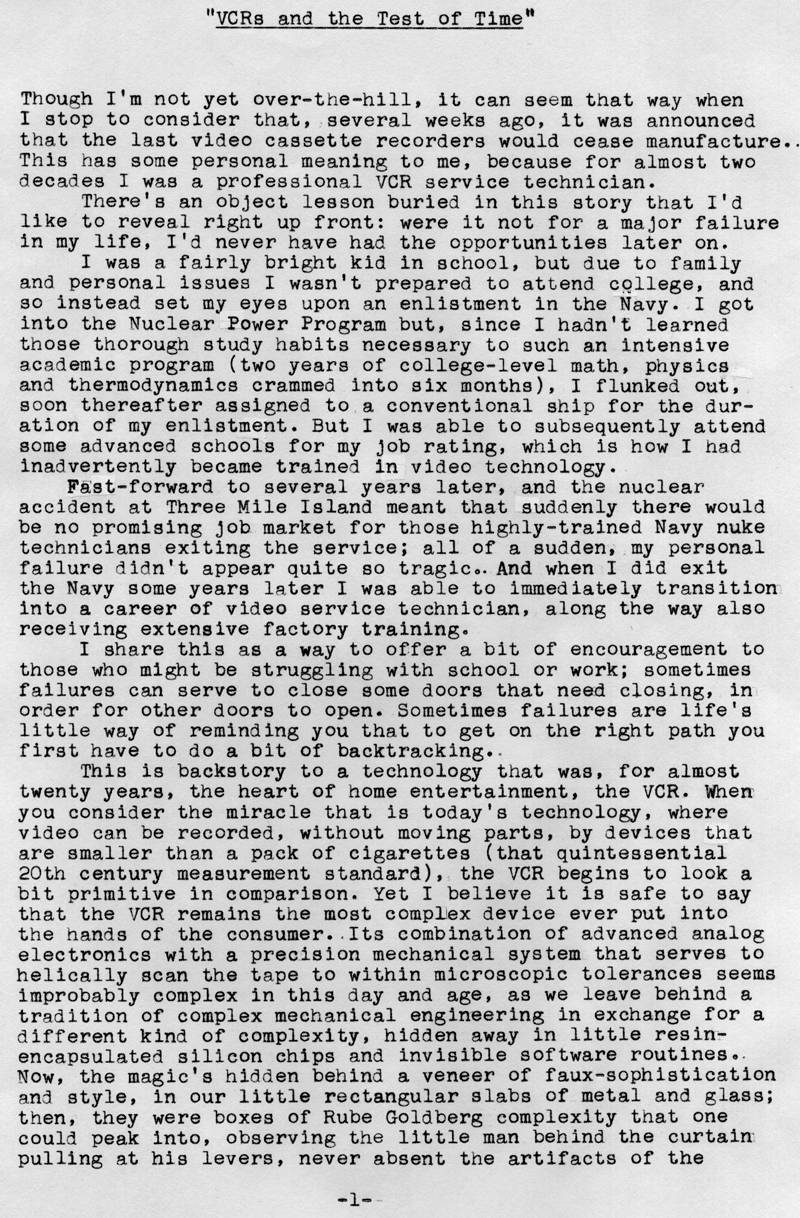
VCRs and the Test of Time

DSCF5090a
Typecast185
DSCF5093a
Typecast186

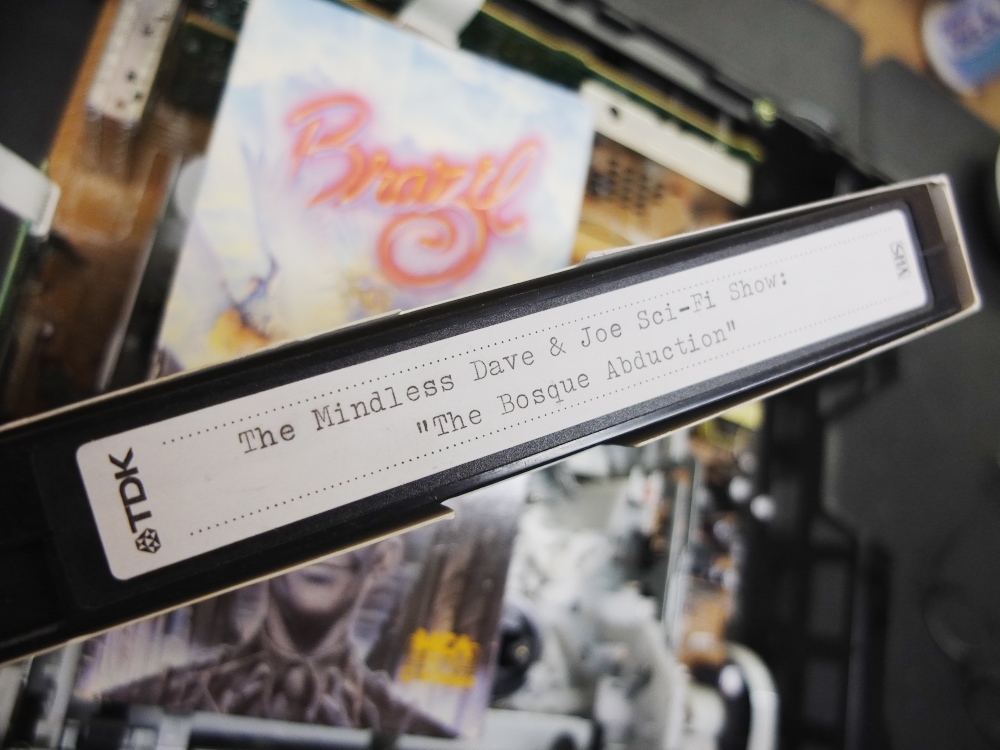
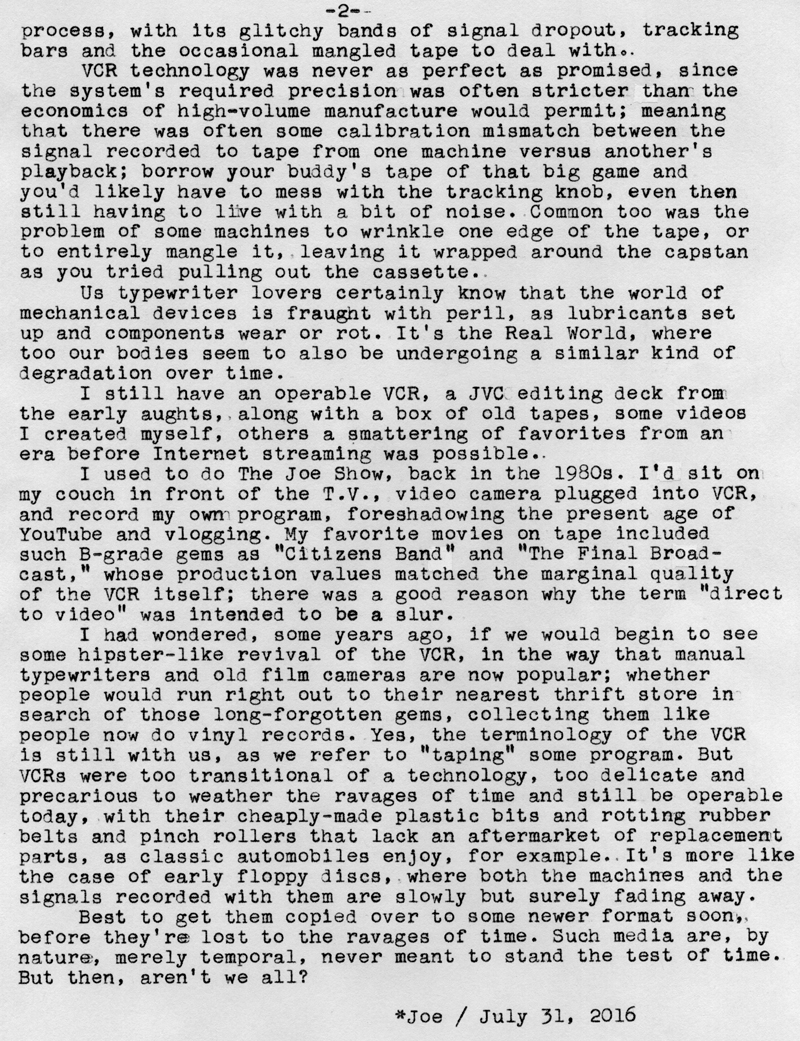
Post-Script: There was a time when I was engaged in video editing strictly using analog video equipment, editing Hi8 video footage onto S-VHS. It was a fun process because one had to learn to time the back-roll of the recording deck, in order to get an accurate edit. The audio production was a bit more challenging, since only the low-quality linear audio tracks could be dubbed. I learned to compensate by using a Tascam 4-track cassette-based mixer for the sound production, edited ahead of time and rolled into the production as the video edit was progressing.

These days, the simple method I employ of iMovie on the iPad is so much easier; but I do look back upon those former days with fondness, as we learned to work around the limitations of our equipment.

I made a number of experimental videos throughout the '90s and into the aughts. And made a short movie with a buddy, "Bosque Abduction," wherein I star as the bad guy. Lots of fun.

Regarding the two movies mentioned in this piece, here's a link to Citizens Band (also known as Handle with Care), and The Last Broadcast.

In the early days of VHS and Betamax, before copy guard technology, it was possible to get a good copy of a laser disc movie onto video tape. Also, many films released to laser disc were unavailable on tape, and so copying was commonplace. Not that I would ever think about doing such a dastardly deed, but in our contemporary setting of digital audio protected by the DMCA (Digital Millennium Copyright Act), the lawyers would be running around in circles at the thought of someone copying audio via analog means, which is pretty much impossible to protect against.

I still see piles of VHS movie tapes in thrift stores, but rarely if ever consider purchasing any. Mostly it's because the titles available are of little interest to me; but also because playing someone's used tape is kind of like unprotected sex; you don't know if the tape was badly mangled at some point, which could clog or even destroy your deck's video heads; or if grease or other debris is on the tape, again presenting a danger to your equipment. This is especially important these days when you consider the gear is irreplaceable and unrepairable.

Oh, and in case you were wondering: yes, Betamax was superior to VHS. So there.

Photos via Fujifilm X10. Typecast via Corona Standard.

Labels: , , , , ,

Monday, July 25, 2016

Archiving Digital to Paper

DSCF5073a
Typecast183
DSCF5074a
Typecast184

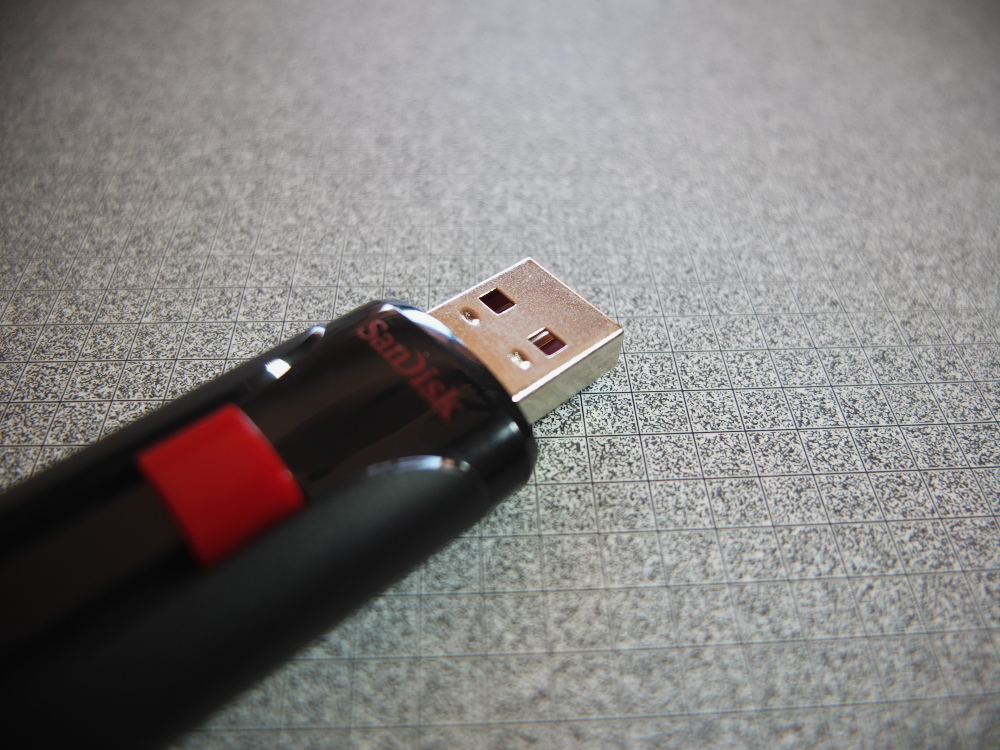
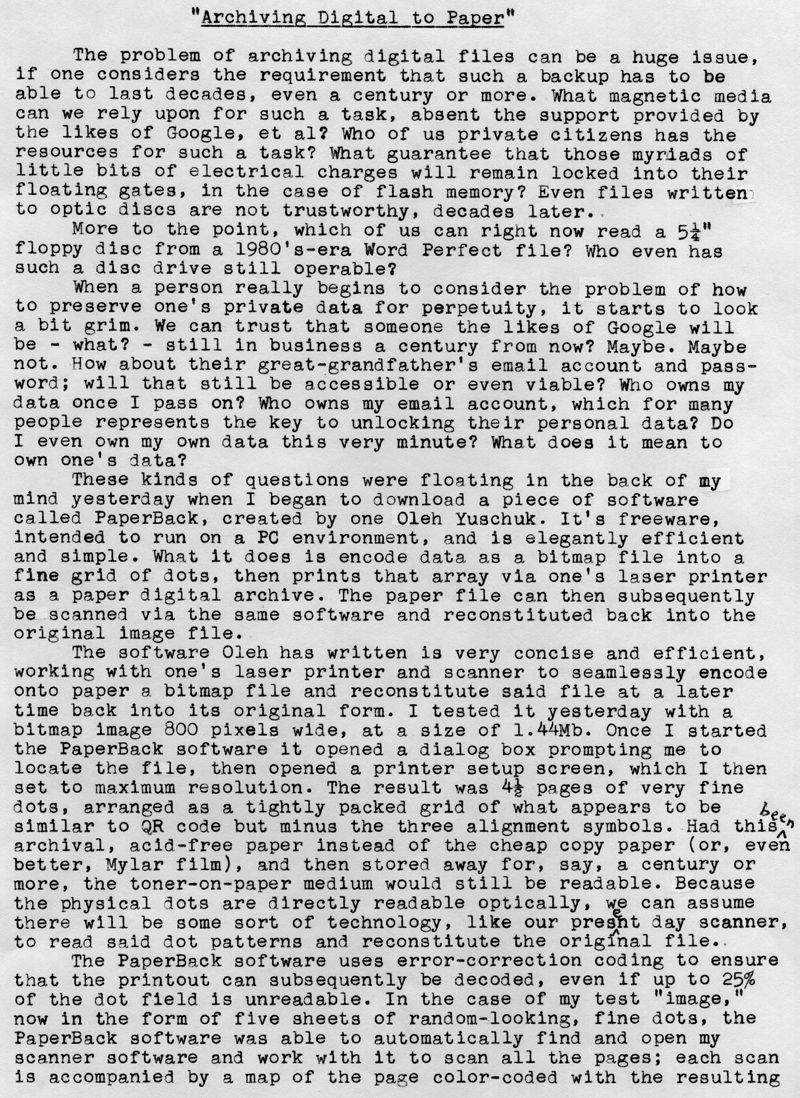
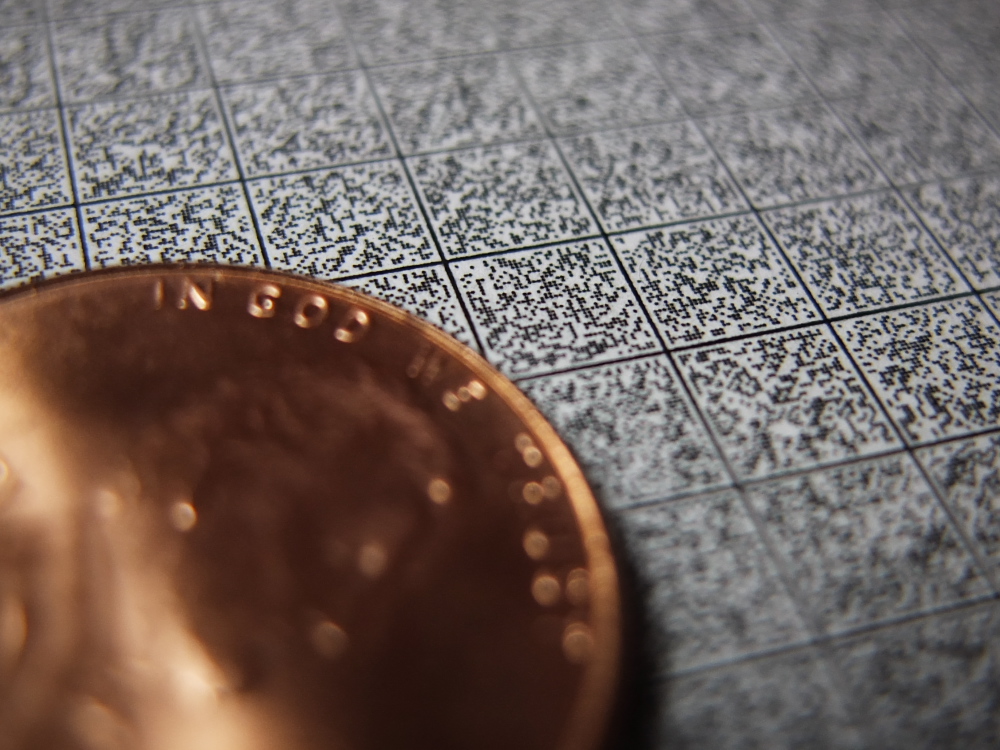
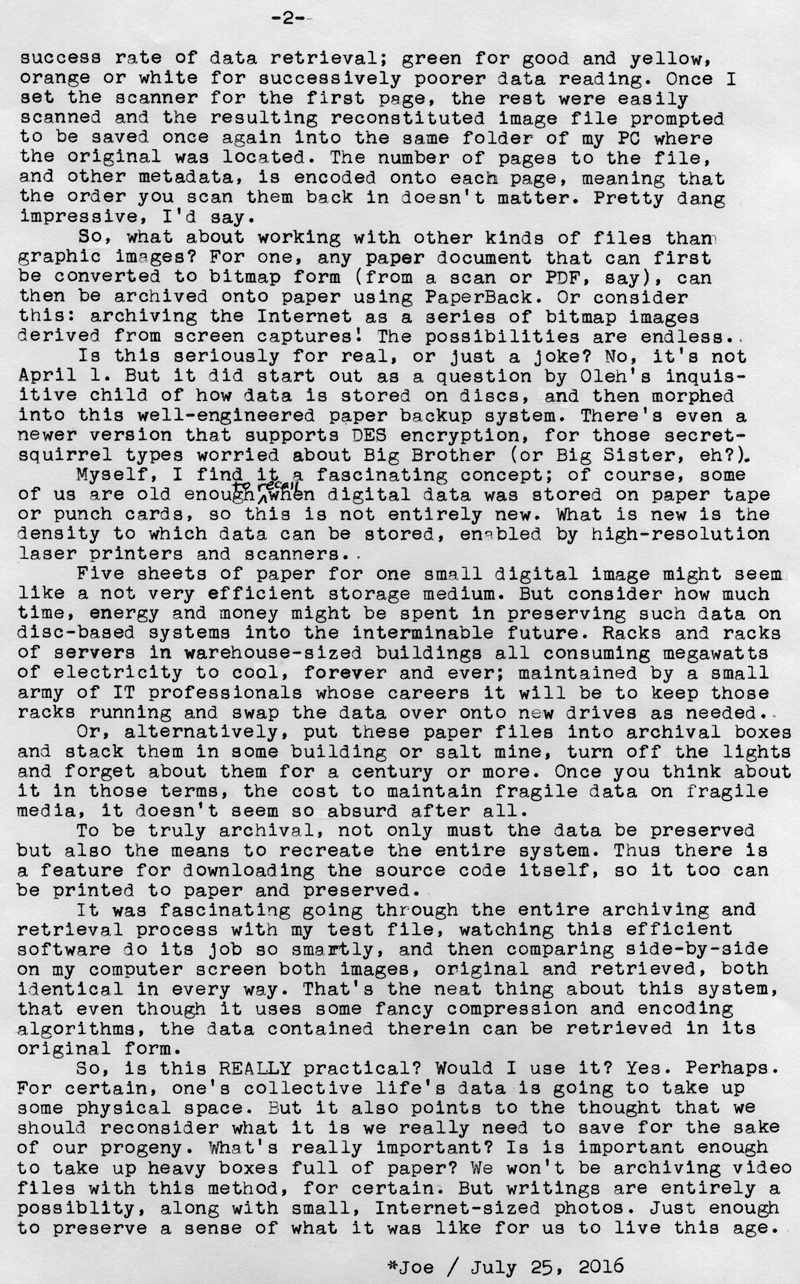
Post-Script: I was surprised the software worked as well as it did, glitch-free and with such ease, finding my scanner and printer with no fuss, converting the file to and from paper with no hassle. Obviously well-engineered by someone who knows how to code. One sheet I used for the printout had one corner previously marked up by pencil (I obviously made no conscious attempt at providing archival-quality paper); during the scan, I could see that corner showed a bit of yellow and orange in the data map provided. Yet the error correction coding worked well enough to reconstitute the file in its entirety.

Yes, it sounds like a crazy idea, but it works! Which brings to mind the thought of what is it in my personal affects that's important enough to warrant this kind of backup? If all it does is serve to raise these kinds of questions, then it's a valuable tool.

Here's a link to the PaperBack website. And here's a link to an article about it.

Typecast via Corona Standard.

Labels: , , , ,

Tuesday, July 19, 2016

Weird Typing

DSCF5055a
Typecast182

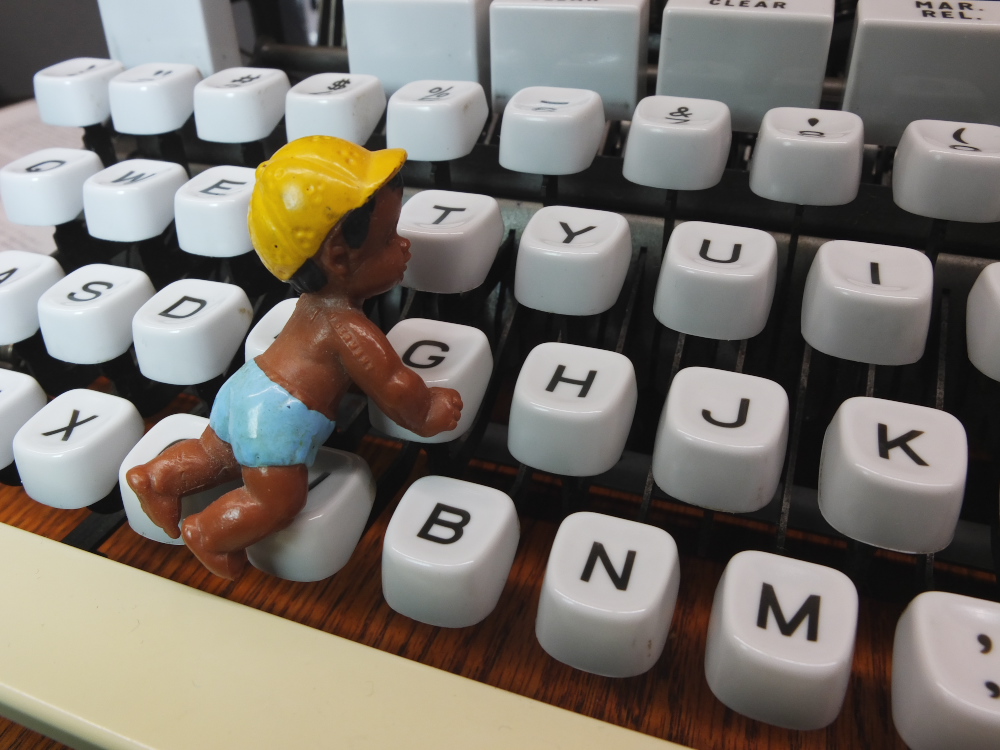
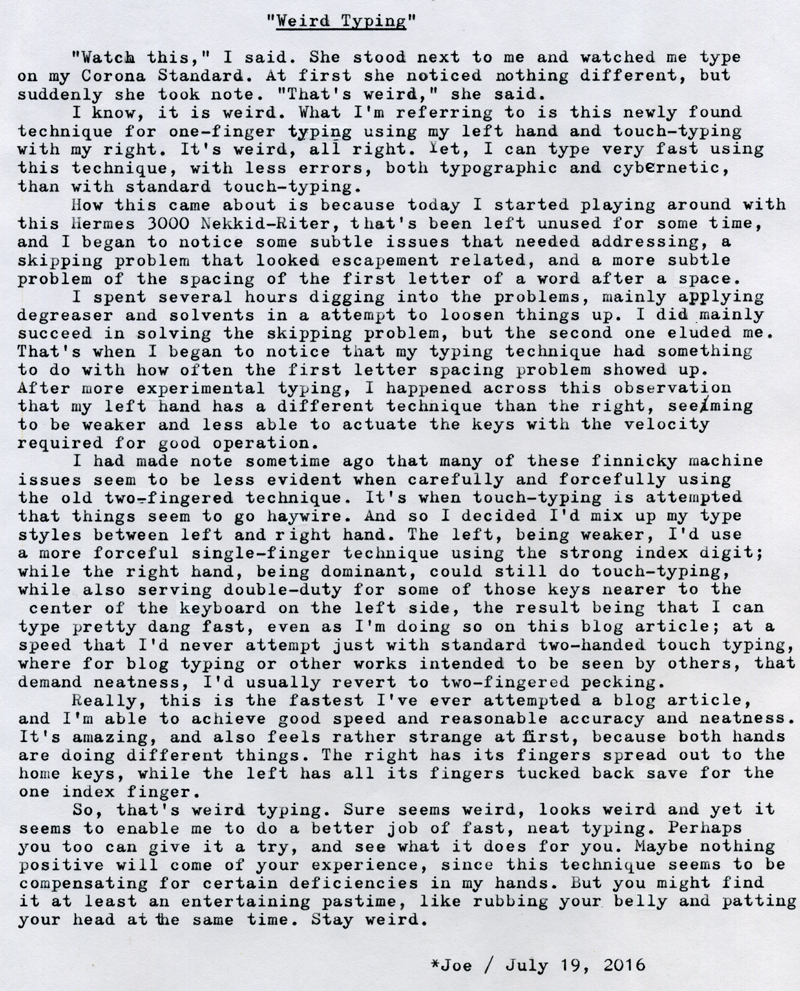
Post-Script: I think this weird typing discovery came out of some intensive typing sessions this last week, during which I was purposefully touch-typing a lot on my newly acquired Corona Standard, whose ergonomics are wonderful and exhibit none of the issues the Hermes 3K showed. Wanting also to rapidly type on the Nekkid-Riter led to my discovering these subtle problems needing fixing, which in turn led to the fact that, at least for mechanical typewriters, I'm now weird typing. Interestingly enough, when I try this same weird typing technique on my PC keyboard I get none of the good effects. It's certainly a mechanical issue between my hands and the machine; something I've come to term "cybernetic," since manual typewriters are one of those few devices that truly operate as an intimately connected system of body and machine.

Regarding the last blog article, about Type-Texting, I haven't yet taken the time to practice, as I've been consumed in my spare time with YouTube videos and some film photography. But I've finished the book "Track Changes," an authoritative history of the word processor, and I garnered lots of thoughts along the way about typewriters and their place in the modern writer's work-flow; which I might write about in the coming weeks. Some of those touch-typing session, alluded to earlier, involved brainstorming some of my thoughts on this subject.

Inspired by the book on word processors, I dug out an old MSI Wind netbook computer that's been sitting in a cabinet for the last five or six years. Its WiFi is essentially nonfunctional, but it does have installed a version of Open Office, so it's essentially a non-Internet connected word processor. I did a bit of writing with it too, fleshing out some of those manually-typed pieces done on the Corona, and so I've used this as an opportunity to experiment with combining typescript into an otherwise all-digital writing process.

Labels: , , , , ,

Tuesday, July 12, 2016

Type Texting & Corona Standard

DSCF5033a

Typecast181

Post-Script: Here's the link to this episode of my Typewriter Video Series:


There are some obvious genetic similarities shared with my older Corona 4, especially around the carriage area. Yet this machine feels so much more solid, and has a much smoother, more elegant feel to its typing action. It's not as tall as my Underwood Universal from the same era, and the key travel is shorter, making, for my hands, a better typing action. So while I'm amazed at the condition of the machine, especially that of the shiny finish and gold decals (and the glass key tops are essentially in brand-new condition, like they've traveled via time machine from 1937), the fact that I can easily touch-type on this machine is what's most astounding. Even that perennial problem "a" letter, that I'm often miss-striking with my left hand pinkie finger on many other machines, seems easier to work on this wonderful machine.

The funny thing about finding this Corona is that I haven't had the itch for a new typewriter, being content with my current stable, and so have avoided thrift and antique stores, and rarely peruse Craigslist. But on Sunday I did happen to search Craigslist for typewriters, just out of curiosity, since in the past I typically only see broken plastic daisy wheel wedges from the 1980s, or rust bucket typewriters that have been in the weather for half a century.

Here are several more glamour shots of the newcomer. Don't know if I'll name her, but I've already determined its gender.

DSCF5032a
DSCF5031a
DSCF5034a

Labels: , , ,