Sunday, June 25, 2017

Typing Assignment #2


We had a great response to Typing Assignment #1 on my YouTube channel, with 18 participants entering their one-page typewritten pieces. For many of you, this was your first foray into creative writing, which I can only respond by feeling grateful that this project has already born some creative fruit. I hope you continue to be inspired and wear out many more ribbons with your future writings!

These short pieces, though each unique, had many aspects in common, especially the devotion and love reflected between machine and user. There was also a strong sense of melancholy, for these machines having sat so many years and decades in disuse, before being rediscovered. Humor was also in plenteous supply, with one writer having the typewriter revolution being started by the machines themselves, and another writer stating that the machines collect their owners - not the other way around. For anybody like us collectors who've sensed that magnetic attraction to some otherwise anonymous thrift store, only to find some wonderful machine inside, waiting to be taken home, we can certainly relate.

Of course, a single page is entirely inadequate for many of these stories to be fully realized; but that is another reason why these one-page assignments are so worthwhile, in that they require just enough creative effort to whet the juices into further expanding the treatment into a full-blown short story, which I hope many participants will take advantage of.

Typing Assignment #2 is less fictional creativity and more along the lines of analytical thinking: write a one-page essay on what you find unique and/or valuable about using typewriters as writing tools. Unless I hear otherwise, we'll assume the due date will be next Sunday, July 2. Please have your entries written, scanned/photographed, posted to social media and the link posted into the comments section below before then. If you require more than one week for this assignment, please post a comment into the YouTube video itself; I'll consider extending the due-date based on responses. I suspect enough of us are typewriter aficionados that we already have a good idea of why we like to use these machines for creative writing.

Good luck and happy writing.

Labels: , , ,

Sunday, June 26, 2016

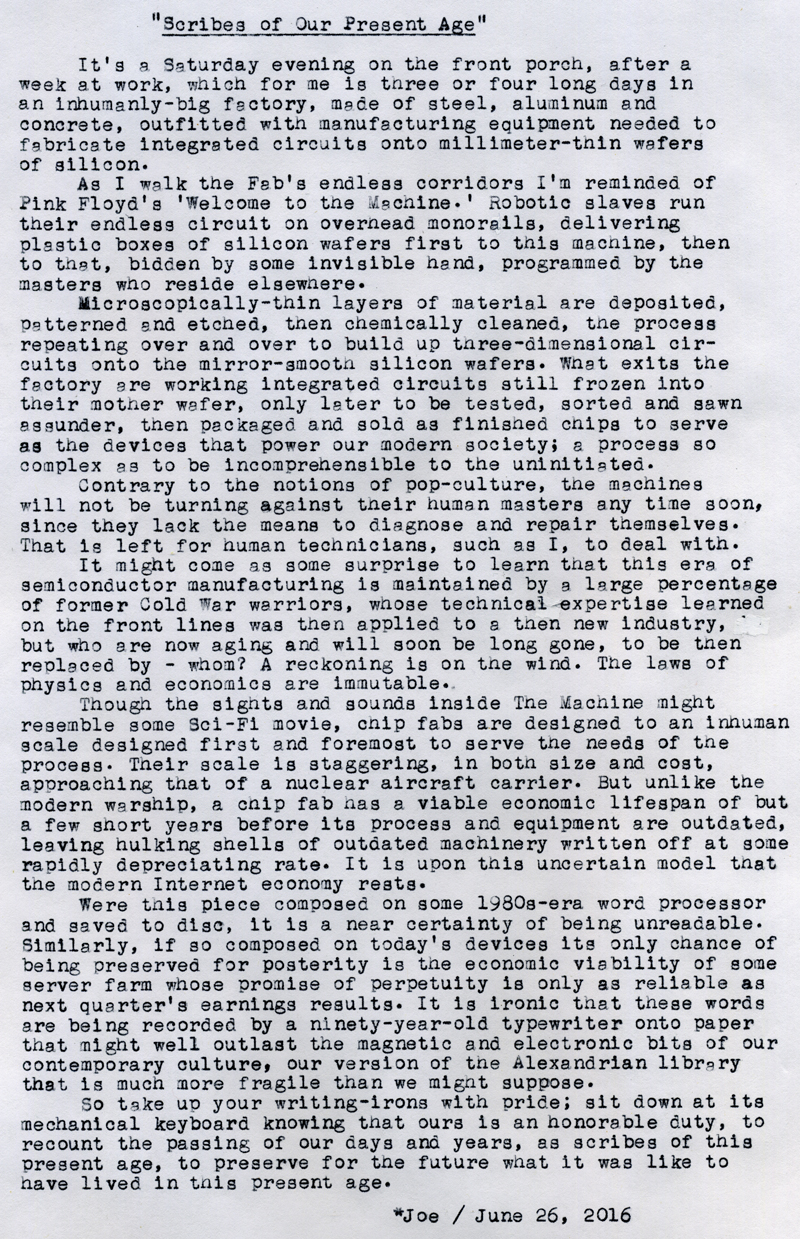
Scribes of Our Present Age

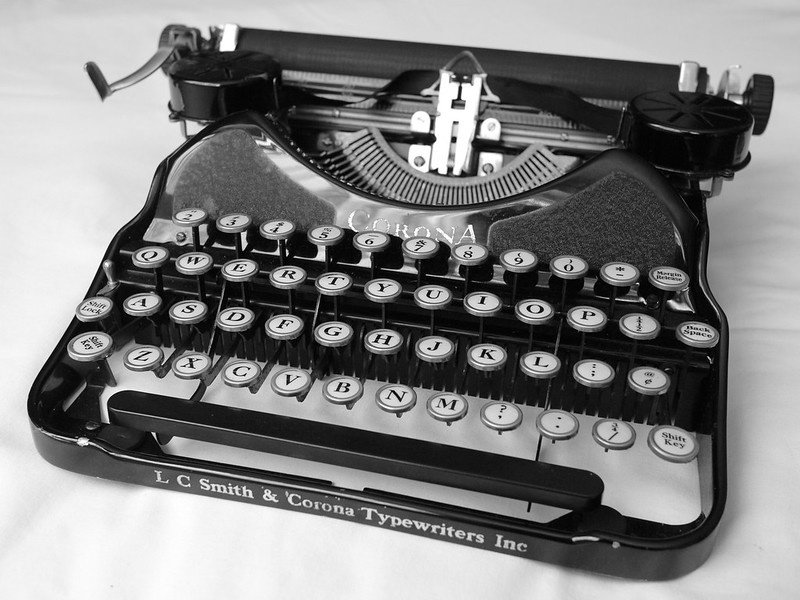
Corona 4
Typecast177

Post-Script: Perhaps us typewriter aficionados do have a duty to future generations, to preserve some small glimpse of this present age, through this seemingly outdated medium of mechanically imprinted ink upon paper, like those few diehard film photographers who choose to preserve images onto a more physically permanent medium than magnetic fields or bits of electric charges might provide. Perhaps that is the greater significance of the typewriter renaissance, offering one last opportunity, before these machines corrode irreparably through the effects of time, to preserve the knowledge of the past and present.

Maybe this is all much too romantic of an approach, the idea that typewriters serve some culturally historic function. But consider that the typed document is able to be scanned and then converted to some electronic format, much more easily than a handwritten manuscript might (certainly my handwriting is scanner-proof); functioning as a film negative, as a document existing into the future within the physical realm.

We could argue endlessly as to whether paper is more archival than electronic media. I can imagine scenarios where either media would fail first. For my purposes, however, paper documents require no expenditure of energy to sustain, only space to store; unlike information in server farms or hard drives, which have to be repeatedly copied onto new media periodically to remain viable. The laws of thermodynamics and quantum physics dictate that magnetic fields inevitably degrade over time, as do electrical charges, that will inevitably leak out of the best flash memory's floating gate.

I wonder if future historians will even have access to the archives of our present social media platforms, or if these will function as virtual voices in the wind, fleeting and ephemeral, only accessible in the present. Might it be possible that there will remain an enormous gap in our culture's legacy, brought about by the temporal nature of the systems and platforms that support our contemporary culture?

I am reminded that the typewriter's origins lie in an attempt at circumventing the effects of a labor strike at Christopher Latham Sholes's newspaper's printing office. Such is the problem of centralized control of the means to access information technology; which reminds me of our present-day era of silicon-based platforms dependent on specialist, centralized complexity, and of the typewriter's intrinsic self-sufficiency. Unlike the ancient Alexandrian library (another centralized repository of cultural data), whose contents were lost to history, the typewriter is entirely decentralized into the hands of individual collectors and users. Contrast this with these mega-sized semiconductor factories, described above (and in which I work), which are becoming more and more expensive to build and maintain, in the hands of fewer and fewer corporations willing to invest the necessary capital.

Typecast via ~90 year old Corona 4.

Labels: , , , ,

Monday, June 20, 2016

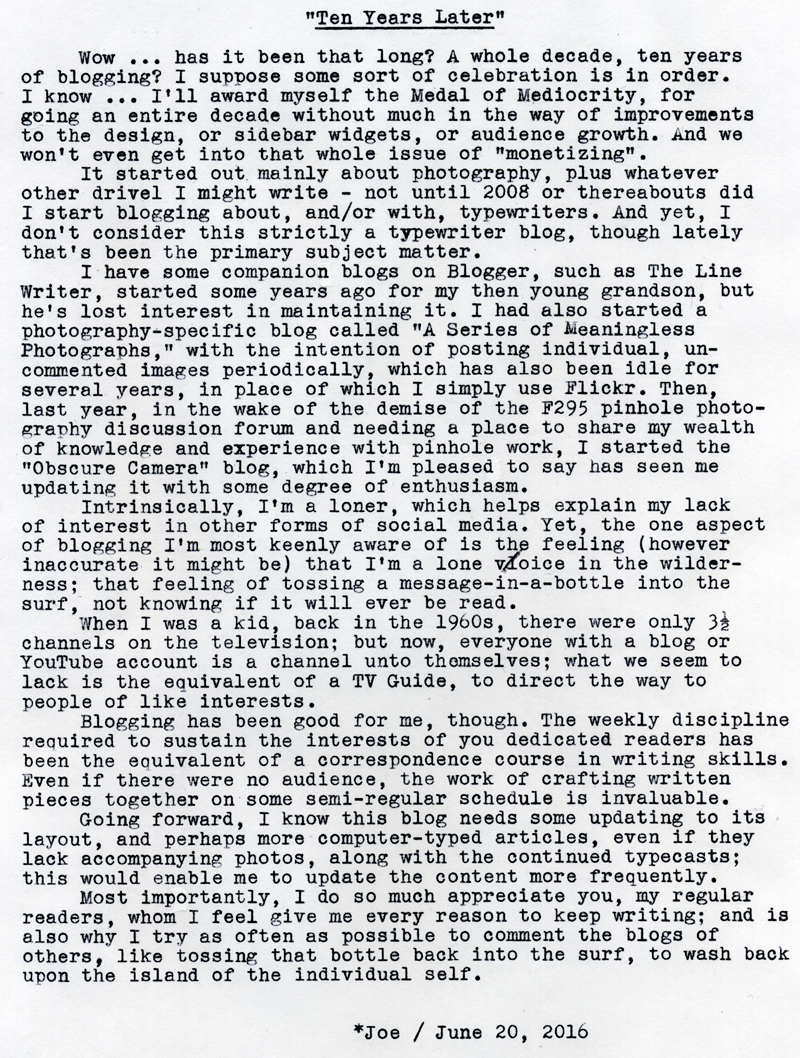
Ten Years Later

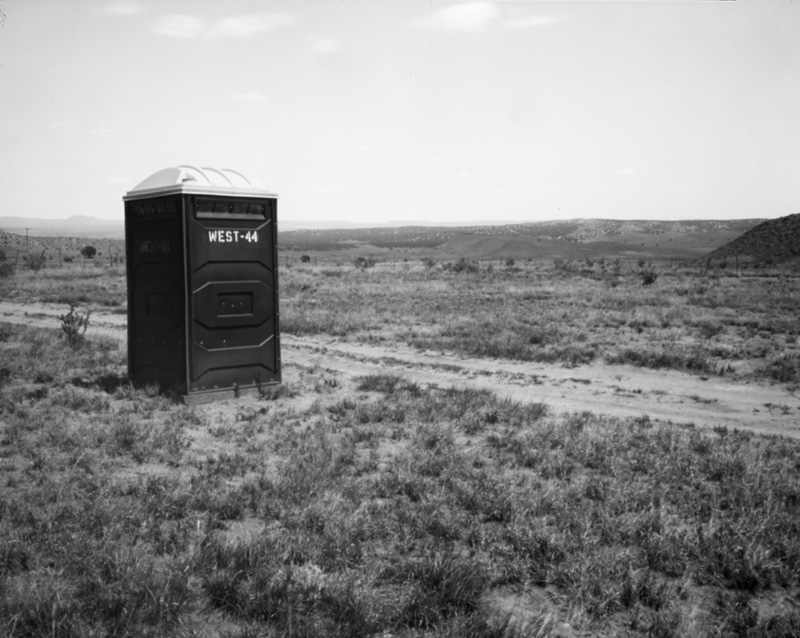
Ojito008a

Typecast176

Post-Script: In the interests of self-promotion (which I'm awful at), here are some links to my other blogs, and You Tube channel.

The Line Writer.
A Series of Meaningless Photographs.
Obscure Camera.
Joe's YouTube channel.

At this current moment I see no reason to monetize any of these social media, as I appreciate the idea of a "free" interchange of thoughts; even if the concept of "free" is a matter of self-delusion, since it's all paid for, somehow, indirectly, by some other scheme. I think this is an important component to understanding this age of social media, that we often operate under the false assumption of "free" access to global, internet-based communications, since most social media platforms require no direct pay-to-play membership. In the long term, none of this is really sustainable without someone footing the bills. Understanding the underlying architecture of social media, we have to realize that you and I are the product being bought and sold. As long as we are comfortable with that thought, all is well, in the near term. Yet the idea that my writings, images and videos are being stored on someone else's servers, with no real insurance of their long-term survivability (other than the financial health of the hosting corporation itself), remains a bit unsettling.

Photo via 8"x10" meniscus lens box camera onto photo paper negative. Typecast via Underwood Universal.

Labels: , , ,