Sunday, May 20, 2018

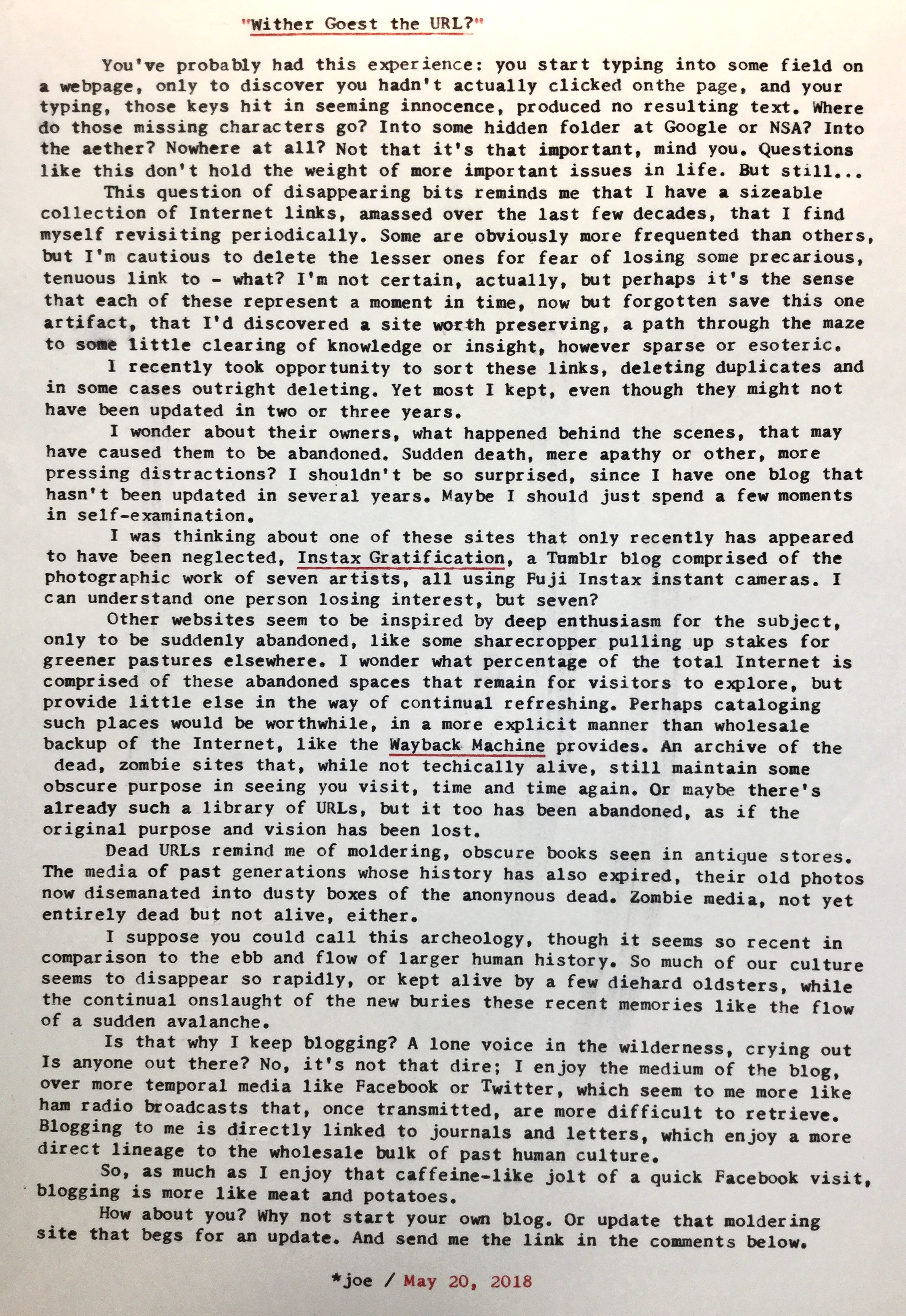
Wither Goest the URL?

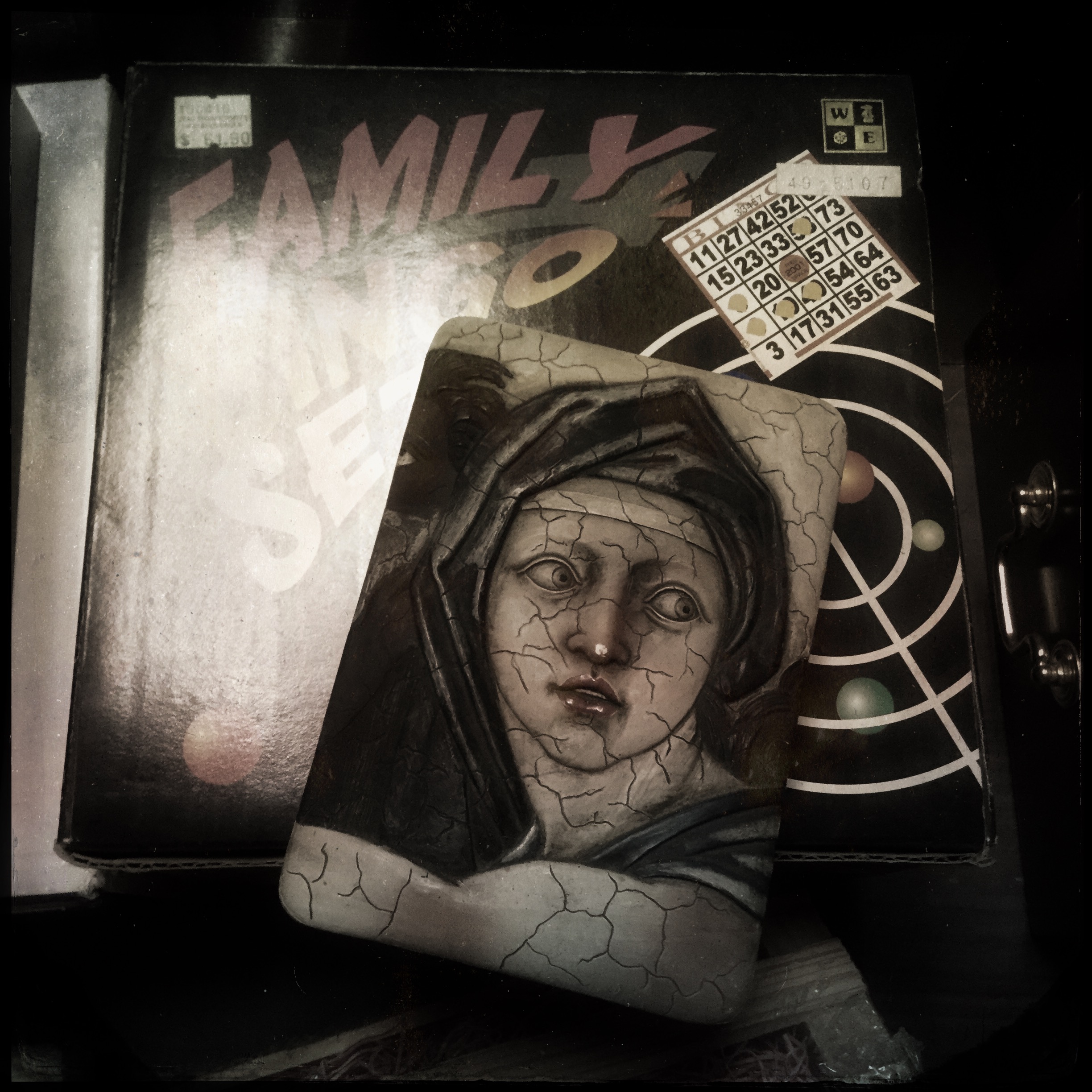
Family Bingo"Family Bingo"

“Wither Goest the URL?”

Post-Script: I, on occasion, have these little thoughts or observations, too minuscule to make into some big project like a video but important enough to share, in the hope that someone will find value; or, that they might amass, each a mere stone, into some sizable structure, sometime in the future. I need to do more of this. Perfect is the enemy of good enough, someone once said. In this case, grandiose is the enemy of the humble. Something like that. Just little thoughts, observations, one piled atop another, to become, what? I don't yet know. But I've got to keep amassing these pebbles.

Typecast via Adobe Rose onto the reverse side of thermal fax paper, using a new old-stock silk ribbon.

Labels: , , , , , , , , ,

Monday, May 22, 2017

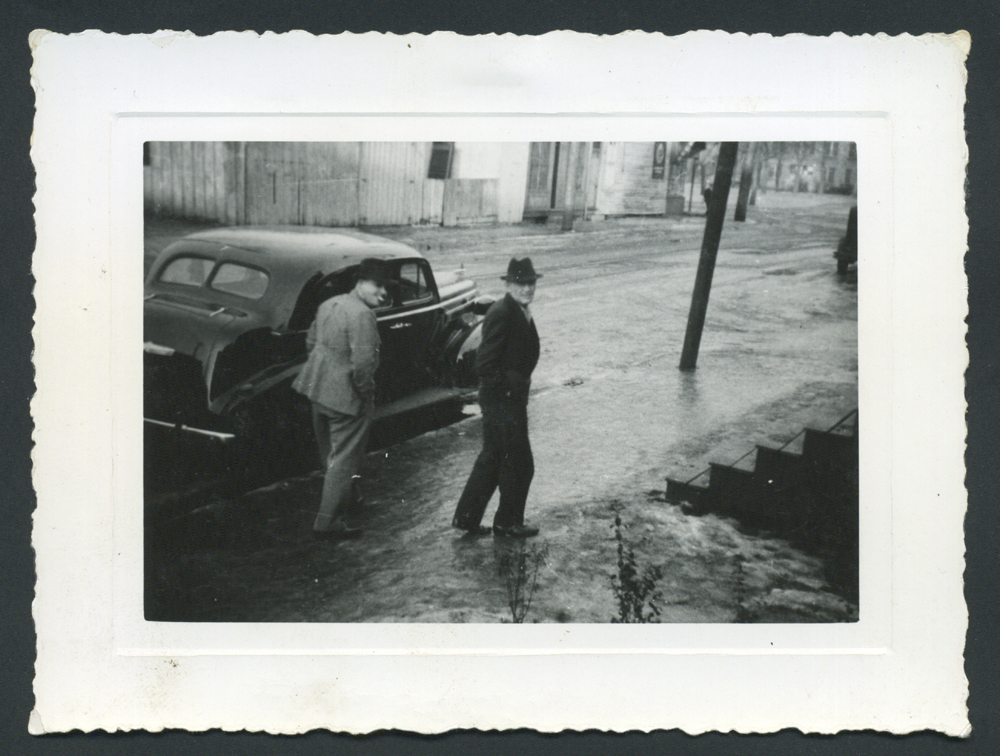
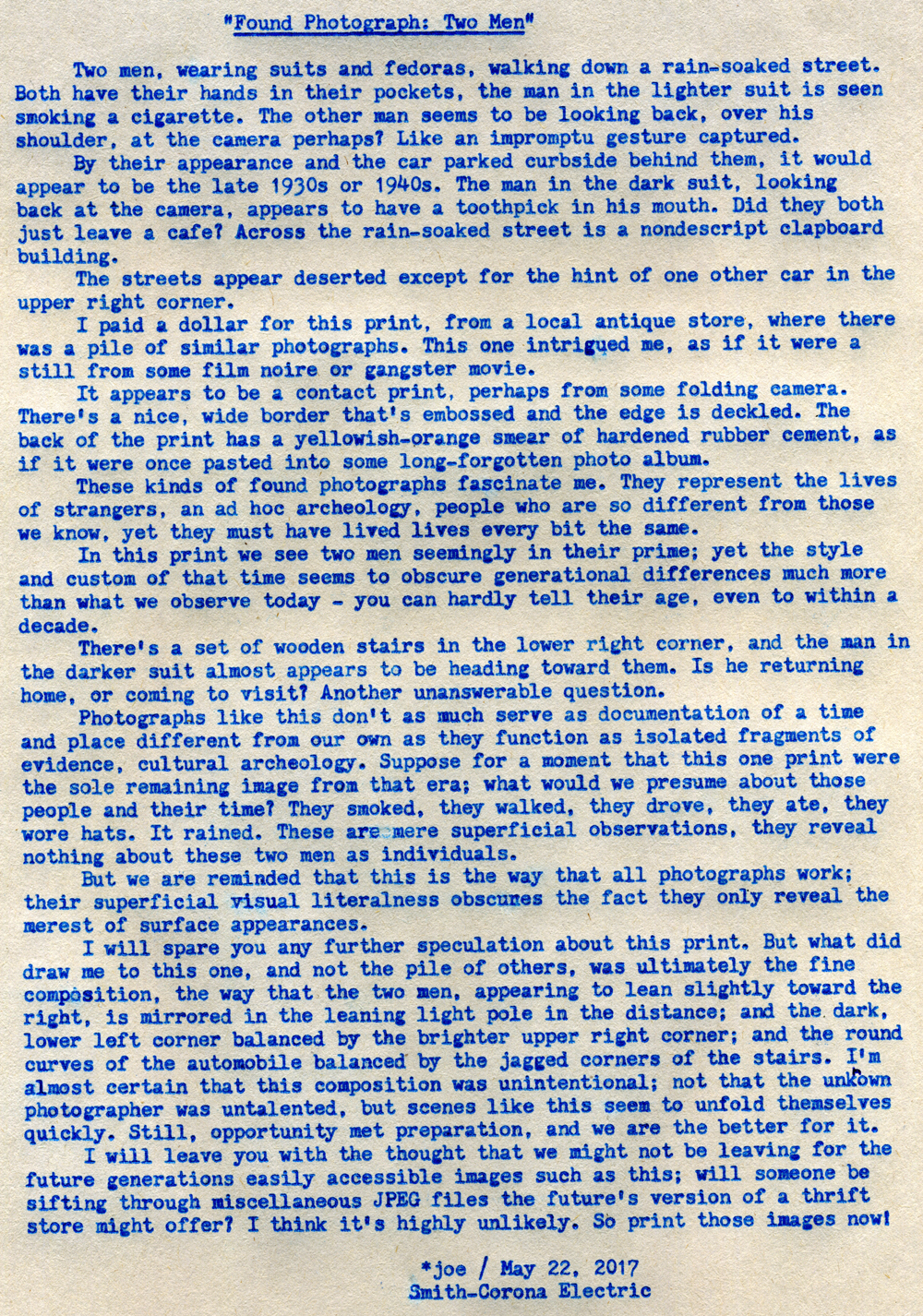
Found Photograph: Two Men

Two-Men-001a
Typecast282

Post-Script: I can't help but think about the film Blade Runner when I handle prints like this. I think of Harrison Ford's character Rick Deckard meticulously examining the snapshot photos from the android Leon - photos that were intentionally made deceptive by the Tyrell Corporation who manufactured Leon, photos from Tyrell's neice, but serving to give the android some semblance of a real human past. Though we aren't mere androids, I can't help from feeling that, somehow, these old snapshots serve much the same capacity, helping to fill in the missing bits of our understanding of a past that remains in many ways just as mysterious to us as Leon's did to him.

I found this print at the same thrift store, on the same day, that I found this blue Smith-Corona Electric.

Labels: , , , , ,

Wednesday, March 15, 2017

Personal Discoveries and Barry's Folly

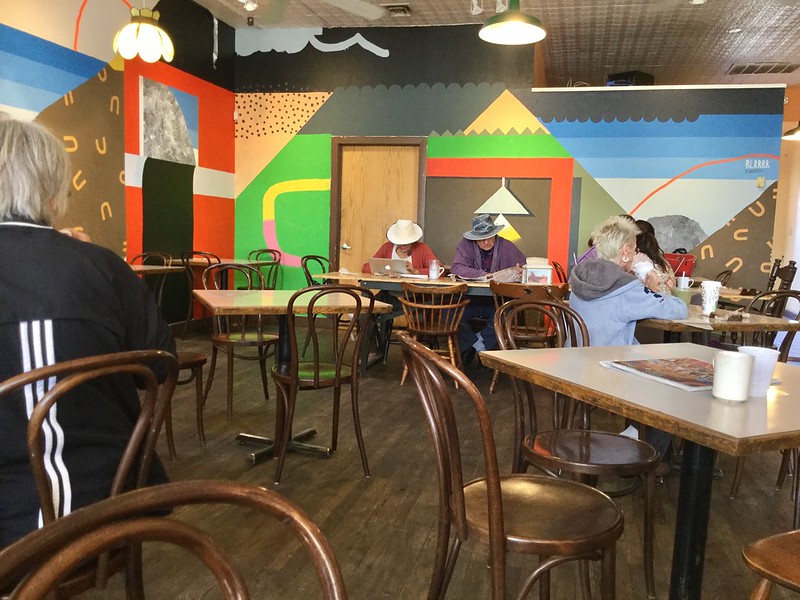
Aging Hippies at Winning Coffee
Ageing Hippies at Winning Coffee

Is there some universal law that dictates when a person first makes a personal discovery? What if that discovery involves a public venue, like Winning Coffee Company, in the University Neighborhood of Albuquerque? These things are like wings you don't even know you've put on, they've become so comfortable. In the case of Winnings, I can't now recall how I first heard of it, or from whom, or the circumstances of my first visit. All I know for certain is that there came a time, in the mid-aughts, when I began spending many a morning at Winnings, eating breakfast, drinking coffee and writing in a journal.

The circumstances of how these places come to be are mysterious, or so I'd like to pretend. In fact, some one or group of people had the vision to start this business, in 1996; but that's not what this story is about. The story I'd like to tell is that Winnings is as unlikely of a hangout for creatives as one can ever imagine in this dry, dusty southwest city, seemingly perpetually insulated from the balance of civilization by many hundreds of miles of badlands and years of history.

If Beatnik culture were a "Thing," let us presume, and someone with the vision and aptitude to make a buck off the declining entrails of mid-20th century American Beatnik culture were to have a free hand in fashioning a simulacra of that culture, they could do no better than start at Winnings, study what it is and what it is they do, and try to franchise the results far and wide.

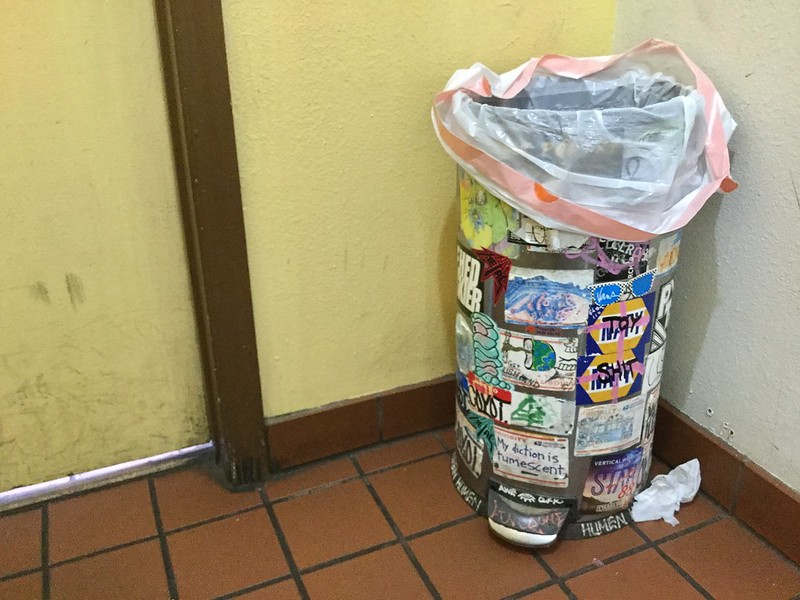
Men's Room Trashcan at Winning Coffee
Simulacra of Decrepitude

You'd need, at the very least, an aroma of cumin and cayenne wafting from an ancient-looking kitchen, just as mood music fills the modern spaces of Starbucks out in Suburbia. You'd need some corporate specification defined for how intense the aroma becomes, along with how to simulate the decrepitude of years of caked-on paint, crazed plaster walls and tin ceilings in some state of disarray. An exacting simulacra of decrepitude, canned and marketed for the suburbanites in newly built communities of cracker mansions out by the Interstate, neatly set down in their precise rows of grids, enticing them to drive their SUVs down to the strip mall and experience a bit of inner-city, beatnik funkiness distilled down to its essential ingredients. Employee personal hygiene would be optional, in order to preserve the aroma of the unkempt philosopher, specified in the corporate policy manual, which also mandates faded bell-bottom denim, braided beards and bandanas securing greasy locks. Most essential would be the front patio, where tables and chairs offer a convenient place for revolutions to be fomented in billowy clouds of hand-rolled cigarette smoke; local ordinances would require special exemptions, palms would need to be greased. We have money to make, boy!

Of course, no true revolutions will arise from our imaginary chain of faux-beatnik coffee shops (Now Nationwide!), only harmless little pretend ones; for the affluence of American Suburbia is predicated on the notion of keeping one's head to the grindstone of Corporate America, doing as one's masters might dictate, and don't rock the boat.

On October 1, 2011, (un)Occupy Albuquerque, a protest group loosely inspired by the then ongoing and worldwide Occupy Movement, began a weeks-long protest and occupation of Yale Park, across Central Avenue from Harvard Drive, the location of Winning Coffee, which became for participants a de facto support triage, with food, drink and moral encouragement. For myself, Winning had by now also become my own personal triage, a place from which to escape middle-class suburbia and it trappings. I'd visit almost every week, notebook and camera in hand, simultaneously inspired and also desiring to capture on film a fleeting essence of the ephemeral. Like capturing fairies on glass plates, how does one capture the essence of a culture defined primarily by the negative space of protest and opposition? It's like that old optical illusion: is it a pair of faces or a candlestick?

I think it always comes back to that most essential approach, storytelling. People are intrinsically interested in the lives of other's, especially if those others come from a different walk of life. I've always felt a bit out-of-place visiting Winning Coffee because of the imagined disparity between my station in life (middle-class suburbanite) and those Winning regulars closer to the streets. And yet, as I've come to know some of them, I've found a richness in their diverse backgrounds that is wholly unexpected and irreplaceable.

Some of these people I've gained only a casual familiarity with, enough to catch a mere glimpse into their psyche, but enough to serve as inspiration for fictional characters in a series of short stories based on Losers Blend, the parallel universe fictionalized version of Winnings.

It's been many months since I've visited Winnings; their coffee roaster guy quit and we'd begun buying beans elsewhere. It's been several years since I was a regular enough visitor to spend hours there writing, or visiting with fellow patrons. So it came as some shock to learn this week that they are having financial difficulties, brought about by the Albuquerque Rapid Transit project, which has resulted in the entirety of Central Avenue being torn up, disrupting traffic, parking and shopping for miles. The project has earned the scorn of most every business along Central, known by its initials ART; but there's nothing art-like or redeeming about it. The Mayor, Richard Barry, heavily promoted it as a way to begin transitioning the city's transportation infrastructure away from being so automobile-centric; a noble cause. But instead of placing it in a part of town most needing mass transit - the suburbs of the densely-packed northeast heights - he instead located it along the one thoroughfare already better served by bus lines than any other. So while the city might call it ART, I call it Barry's Folly.

It will take several more years before the project is concluded, and funding has not even been appropriated for any more than the initial demolition phase currently underway. Neither was the public given an opportunity to directly vote to determine the project's future, but it was instead mandated from the top, down. Theoretically, a democratic society works by the government working for the people, not the other way around.

There is the very real prospect that, even if the project is successfully completed, those areas of downtown, the University District and Nob Hill who were to benefit so directly from the transformation will be burned-out, boarded-up shells of their former vibrancy, a zone of economic blight brought about by the reality that the cure was worse than the illness; that in attempting to revive the city's core through infrastructure improvements they've killed off those essential but delicate economies of small businesses which make up most of this city's commercial liveliness; the very opposite of what Mayor Barry promised. Unique places like Winning Coffee might very likely cease to exist.

Conspiracy theorists might even conjecture this was their intention all along, so that real estate could be bought up cheaply and sold off to new corporate clients waiting in the wings.

This morning we had a late breakfast at Winnings, a hearty burrito filled with eggs, potatoes, green chile sauce and cheese; and their wonderfully rich lattes. Bradley, the bookseller, was there, setting up shop in the corner nook by the coffee roasting machine. He has a younger assistant who does the heavy lifting of setting up and tearing down, whom I asked how the books are organized, and the answer I got revealed once again the rich diversity of this crowd, as he told me that they're organized by genre: beat authors here, soviet realists there, feminist lit over yonder, Latin American fantasists over there. Only at places like Winnings will you find the guy with the strong back also has a strong mind for literature.

As we entered through the front door (there's also a rear entrance from the alley) the regulars were seated outside at the patio tables, while the big oval table inside by the order line had the usual old guys, the knights of the round table I call them, including the one who always sports some puffy-sleeved shirt and black vest, with black top hat. As we stood in line waiting to place our order, I overheard one of them inform the others "One of the Chicago Seven is now a stock broker."

I'm hoping Barry's Folly will fail to have its full sway, and that these unique venues like Winning Coffee will survive and prosper. In the meantime, Bradley informed me that the new coffee roaster guy now has his act together, and so perhaps next week, when our stock of beans begins to run low, I'll make a drive down to the University District, brave the construction barricades, have breakfast and perhaps do a bit of writing. Maybe I'll take a portable typewriter, sit out on the front sidewalk tables, sip my coffee and pound inky words into paper, the aroma of hand-rolled smokes wafting in the breeze.

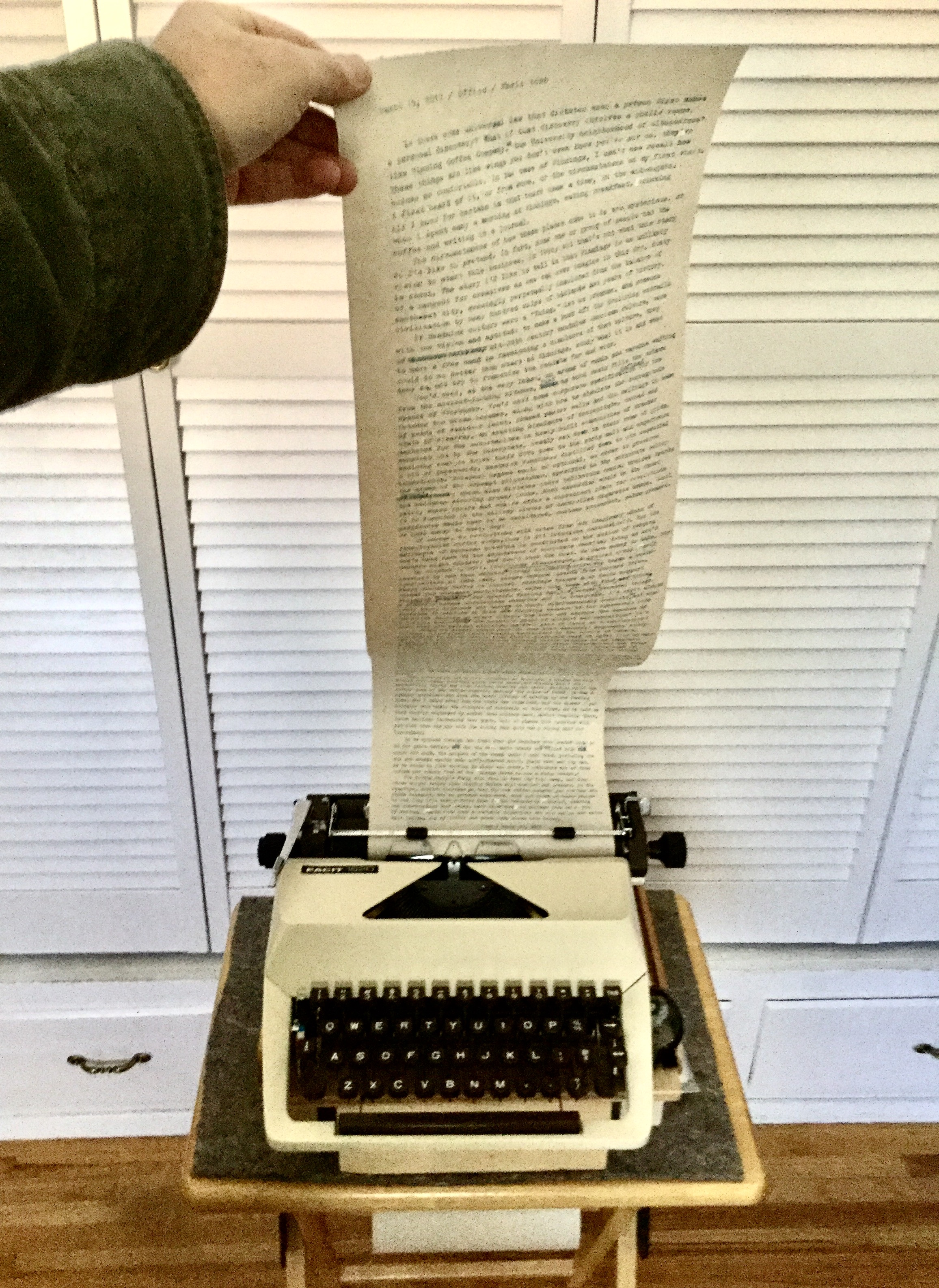
Post-Script: I enjoyed writing the first draft of this piece on the teletype paper roll using the Facit 1620. Spaced at 1.5 lines, the piece came to 31 inches.

'Personal Discoveries' Rough Draft, Facit 1620 and Teletype Roll

Labels: , , , , , , , ,

Wednesday, February 01, 2017

3D Line Mazes

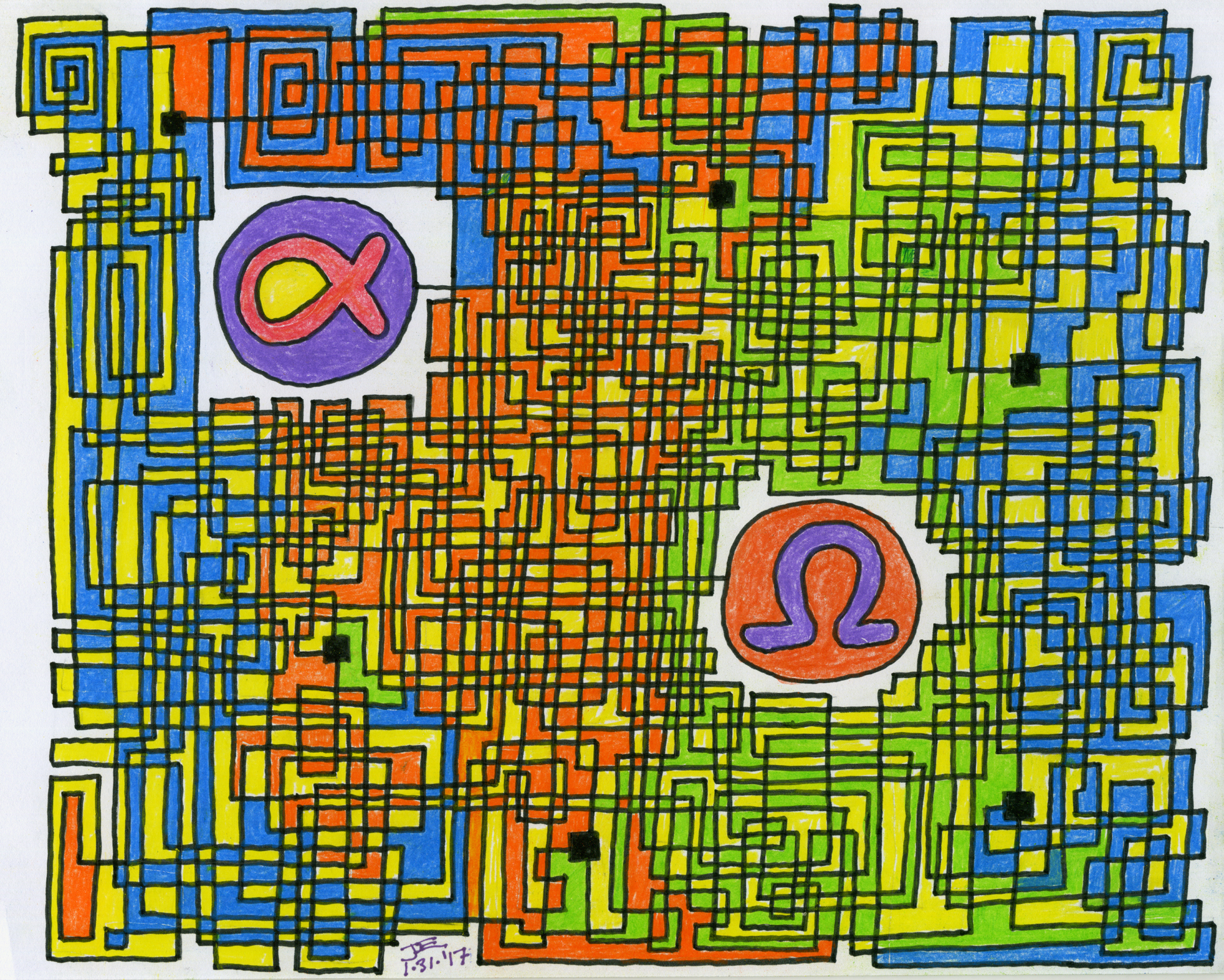
1-31-2017001
(Click to embiggen)
Follow the lines themselves, from Alpha to Omega. They cross over but don't connect to any other line except at the large square nodes. A line goes straight until it makes an elbow bend.

It's strange how events that transpired long ago in one's life can leave a lasting impression. That's the case here, and the reason why there's a colorful, hand-drawn maze adorning this blog posting. Permit me to spin a yarn.

It's the spring of 1971 and I'm several weeks from graduating 8th grade middle school when I come down with a bad intestinal flu. I'm home-bound for several weeks, missing the end of 8th grade, and the illness isn't getting any better. Then one day the pain begins, and gets worse and worse. Finally my dad drives me to the hospital and we find out I have a ruptured appendix that is badly infected with gangrene and peritonitis. I go into surgery an hour or two before dying, or so says my surgeon, Dr. Goddard, a relative of the famous rocket scientist. The hospital was Lovelace Clinic at Bataan Hospital, the same place the Mercury 7 astronauts underwent their pre-flight testing.

I'm in the hospital for several weeks before being sent home, during which I get rather used to the nightly morphine shots administered by the pretty nurse; by now I'm age 13 and already beginning to notice such things. The doctor advises me to take it easy during the summer recess and to not go out for sports that next school year; this decision has a life-long effect upon me being non-athletic.

So what's a kid to do? Hang out at the public library, that's what. Read up on interesting subjects; some that will end up holding my interest throughout my adult life. One of those topics was mazes, and I read every book I could find on the subject.

During that long, lazy summer I began to draw a maze on a sheet of notebook paper. When I filled the page I realized the maze was far from complete, so I taped on another sheet and continued. By summer's end it was done, a scroll of paper about 8 feet long containing blue Bic cristal inky pen lines of swirls and whorls. I'd figured out this graphic design element of double- and triple-spirals, where a pathway leads into a vortex, at the center of which is a decision point node that spins its way back out, only to connect to more such vortices.

Proud as I was by the maze, I had opportunity to show it off in a 9th grade class where our assignment was to "show-and-tell" what we did over the summer vacation. Naturally I didn't want to tell about my illness and resulting operation, so instead I brought The Scroll Maze to class. Much to my chagrin, the teacher demanded that I prove, right then and there, that the maze actually worked, otherwise I wouldn't get credit for the assignment. So I spent the rest of the class ruining my maze with the pencil line tracings of my route from start to end.

I was so incensed by having to ruin my maze that I tossed it out when I got home. Of course, in retrospect I now wish I hadn't. But that maze-drawing experience stuck with me. A few years later, while in military service, I began collecting maze books. One such book was the classic Dover Publications edition of "Mazes & Labyrinths - Their History & Development" by W.H. Matthews, a thorough, historical analysis of mazes ancient and modern.

The book that changed my understanding of maze design was Greg Bright's "The Great Maze Book," which introduced to me the idea of what he called "one-way valving," a topological method of steering the subject away from the correct path, so as to make it as difficult as possible.

I eventually came upon my own method of drawing mazes, what I call "line mazes," meaning the pathway to follow is the line itself, rather than the space between lines, as in a normal maze. Then I realized that the maze could be rendered in 3D if the lines were permitted to cross each other without connecting; actual connection nodes were explicitly drawn so as to reduce ambiguity. The final topping on the cake came years later when I realized that a finished 3D line maze could then be colored, Mondrian-style. The result is what you see at the top of this article.

I'd first advise you to click on the image for a larger rendering, as the 650-pixel wide default image is a bit too small. Follow the maze from Alpha to Omega. Or you could try it backwards, but there's no advantage in doing so. And mazes can be designed to purposefully foil those who try working them backwards. Because us maze designers can be a cruel lot.

Follow the lines themselves. They cross over but don't connect to any other line except at the large square nodes. A line goes straight until it makes an elbow bend. You can appreciate the colorful graphic design on its own merits, but there's no hint or clue to the solution given by the colors themselves.

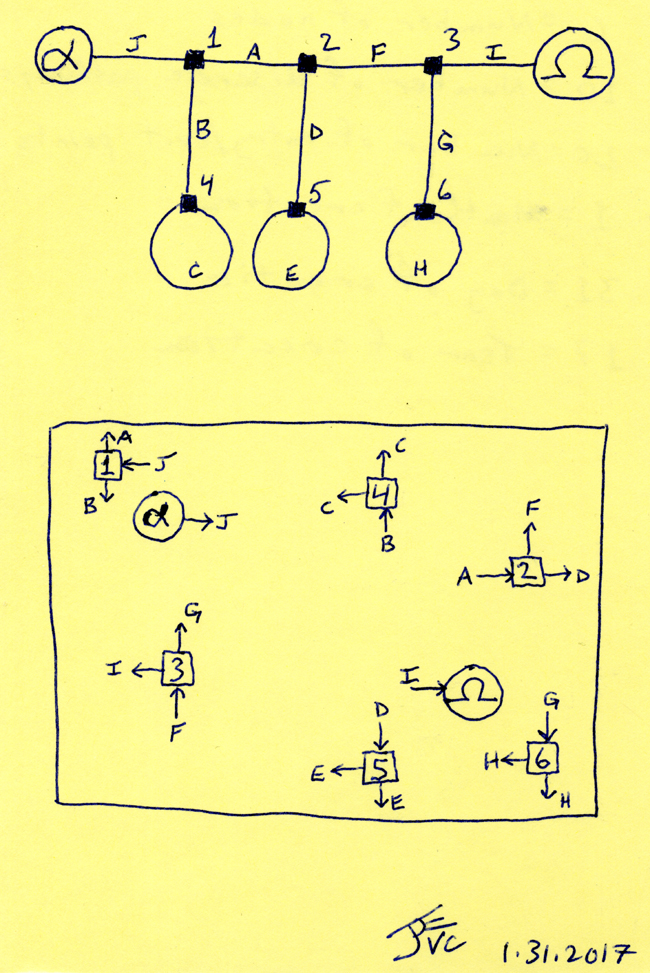
I've included below the schematic diagram for the maze's solution, along with a template map that labels each node and the corresponding letters associated with each path entering or leaving the nodes, as an aid in the puzzle's solution.

I designed the maze by drawing the schematic diagram first. You'll notice there are no dead-ends in this design; instead, I use loops, where a path exits a node (such as path "C" from node 4) and later reenters that same node. After designing the schematic I then laid out the location of all six nodes, then began drawing the lines themselves.

When designing the maze it's all too easy to crowd the lines together too closely early on such that later on, toward the end, it's more difficult to finish. I've thought of ways to prevent this, such as using an under layer of grid paper and assign each segment of the maze its own portion of the grid. For example, this maze has ten discrete pathways (count the lines connecting the various nodes). So using engineering grid paper that has a major grid in bold lines divided into tenths, each pathway would be drawn such that its lines stay on only its portion of the grid; i.e. pathway 3 would only be drawn on the grid lines three spaces over from the major lines, etc.

The result would be a more homogeneous design, with the lines more evenly covering the canvas and each path segment geographically encompassing more of the entirety of the page; with conventional 2D mazes, you'll often find pathways limited geographically to certain areas of the layout, which can give the solver clues to the maze's solution.

It's also possible to use a graphic design program and make the lines absolutely straight and true; whereas in this maze it's pretty obviously hand-drawn and colored with Prismacolor pencil.

Regarding the "one-way valving" principle of Greg Bright, he never actually explained in his books how this works, but I figured it out by assuming that when the solver reaches a node the decision of which branching point to take is made at random; thus, probability theory can be employed in the maze's design.

In this example maze, one-way valving would be evident if I had made nodes 4,5, and 6 with four branches instead of three; when entering node 1 the solver would have a 50% chance of choosing the correct path to node 2; but if he makes an incorrect choice and heads to node 4, then he only has a 33 1/3% chance of getting out of node 4 back onto the correct path. So probability can be used to steer (or "valve") the solver away from the correct path, by making it easy to wander off the correct path and harder to get back on. Just like as in real life.

I also figured out a difficulty rating system for these mazes, involving the odds of solving the maze first time with no backtracking, by multiplying the odds of choosing the correct path through each node. In this example maze, the chance of threading nodes 1, 2 and 3 first time with no backtracking is 1/2 x 1/2 x 1/2, or 12.5%. The lower the number the harder the maze.

Another design concept involves multiple correct routes from start to end, instead of just one. This maze is a classic example of there being only one correct solution path. But suppose the schematic diagram were more like a grid instead of only one correct route? The start could be in the upper left corner of the grid and the end in the lower right corner, for example; most of the nodes would each have four branches; or the sides could be wrapped around to the opposite, so every node has four branches. There wouldn't be just one correct solution through the grid, but many. And no dead-ends or loops. Would that make the solution easier? Perhaps; or, it could also make it more difficult, since it would be easier to get tied up in the complexity of connectivity and never reach the solution. Given my limited mathematical background, I have no idea how to determine the probability rating for solving such a multi-solution design. But these were the kinds of thoughts that kept me preoccupied all those years.

There are ways to make these mazes fiendishly difficult, besides employing one-way valving. For example, take advantage of the propensity for people's eyes to wander off the correct line. Surround the correct path with other lines that don't connect anywhere else but form an isolated, dead-ended loop; once your eyes mistakenly cross over into this nether region, woe betide you, you'll never get out without starting over. And the more graphically complex the maze, with lines drawn tightly together, the more likely you are to slip up. These kinds of graphic features are difficult to model mathematically. My triple-spiral graphic method from long ago was one such technique that can be used in this manner, since while threading the spirals it's all too easy to skip over a line into a neighboring pathway.

I'm interested in these mazes as much for their graphic design potential as for their connectivity as puzzles. This example maze is not great art, nor is it particularly complex as a maze. But it does introduce you to my idea of 3D line mazes, which I may share with you once again, the next time I find myself sitting at the kitchen table late at night for hours on end when I should be in bed. I also have a number of mazes from long ago, which might find themselves herein.

Post-Script: Here's the solution to the maze, including the schematic diagram and the location mapping of the nodes. Have fun.
1-31-2017002

Labels: , ,

Sunday, November 13, 2016

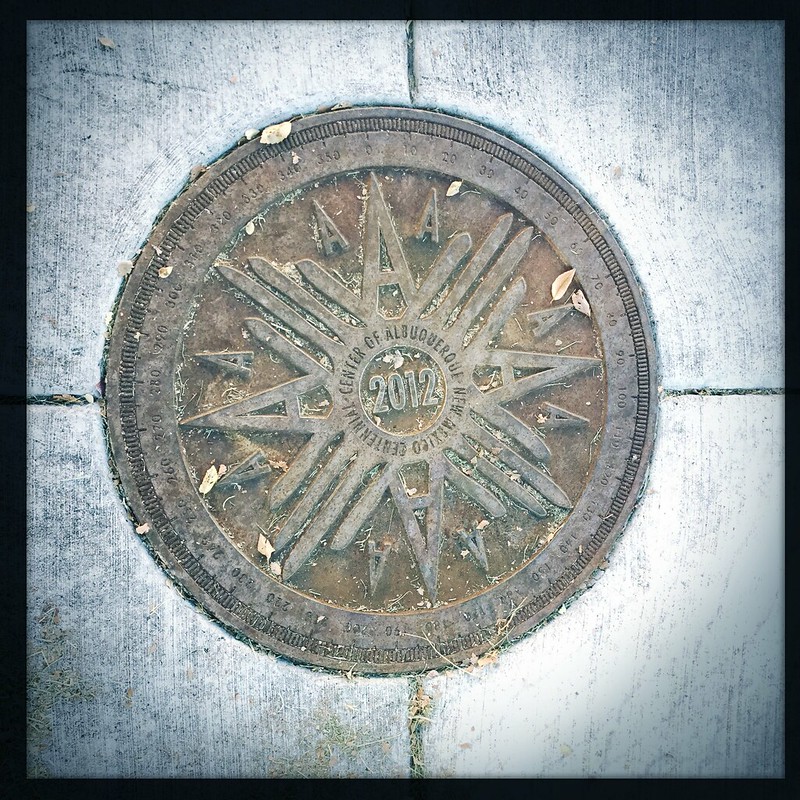
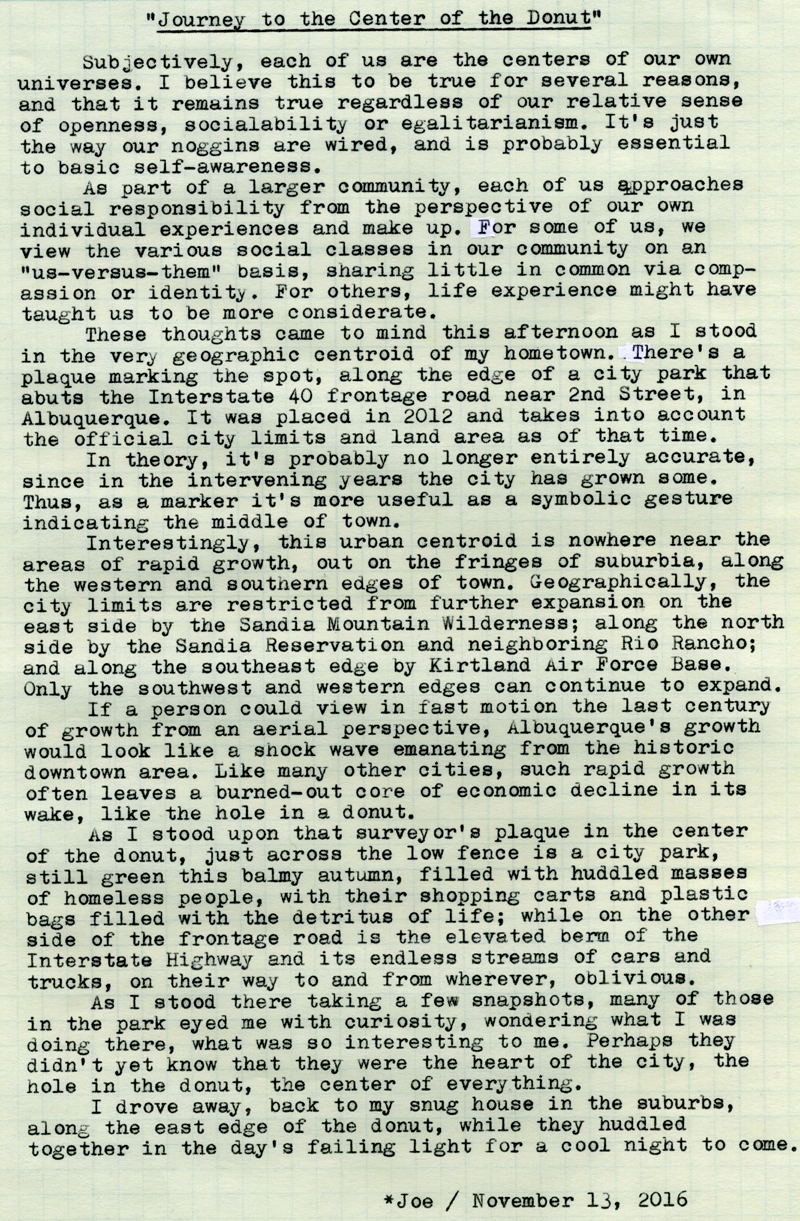
Journey to the Center of the Donut

Center of Abq
Typecast197

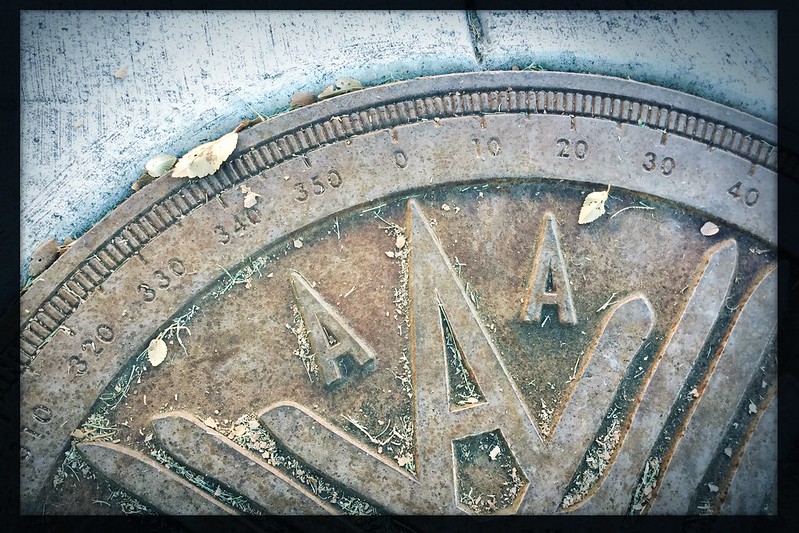
Post-Script: Bonus Image:
Center of Abq

This city park was once the location of an historic steam locomotive from the days of the Santa Fe Railroad, when Albuquerque was the site of a major locomotive repair facility. That engine, once viewable by the public for free in the park, is in the process of being restored and resides elsewhere.

Typecast via Olivetti Underwood 21.

Labels: , , ,

Wednesday, September 28, 2016

On Storytelling

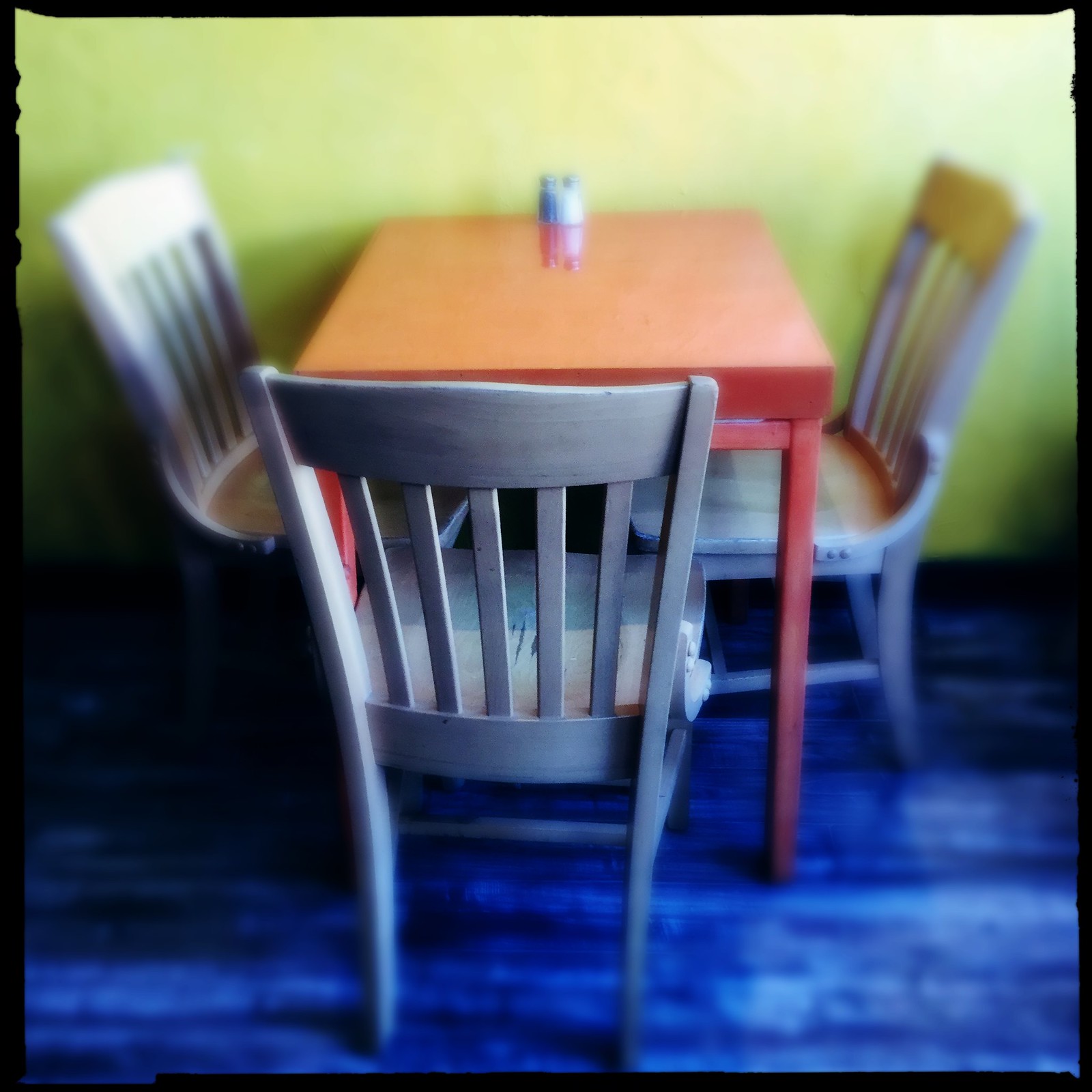
Downtown Java Joe's

I was thinking about the similarities between writing and photography. Part of the reason for this chain of thought was because I'd been watching an interview with photographer Michael Kenna, who talked about photography being a medium of communication.

For those of us steeped in the technological side of photography, with its incessant equipment upgrade cycles and talk of megapixels and form factors, it's all too easy to lose site of the primary purpose for creating and sharing images, which should be to inspire and impart some experience, idea or emotion to the viewer; to communicate, as a creative person, to a wider audience.

Part of the blame for our lack of appreciation for photography as a communicative medium is that it is so gear-centric, and thus manufacturers, marketers and the photo media are incessantly busy pushing gear and software products; and laypeople are all too willing to talk it all up in discussion forums. All too infrequently is the conversation about how to communicate to others through the medium of images. Being a better photographer really means being a better communicator, rather than merely being better equipped at twiddling camera settings. Oh, sure, technical proficiency is one aspect of being a skilled communicator, but that's not where it ends; wielding a camera skillfully is only the beginning; like learning to write requires first some skills at composition, but doesn't end there.

I was also thinking about this art we call writing, the use of words to communicate ideas. The end result is much the same as in photography, although the means to that end is very different, as are the methods employed. We talk about word pictures, or use visual terminology to describe literary metaphor. A picture is worth a thousand words, perhaps more. These thoughts were floating around in my head today as I returned home from a day trip to northern New Mexico and found a package waiting for me, from the print-on-demand publishing service Blurb, of a collection of short stories I'd been working on for the last few years. It's one thing to see the finished book simulated on my computer screen, ready to upload to Blurb; but an entirely other thing to hold the thing in one's hand. These are called vanity presses for a reason, although in my case it was more a case of relief than egoism, since I was merely hoping to get these stories polished and in book form; to be done with them and get them into other readers' hands, even if those readers are only family and friends.

I placed the small stack of paperbacks on the table in our patio room, while my wife busied herself with whatever it is wives do after a day trip to northern New Mexico and the Three Ravens Coffee House in Tierra Amarilla. But once she settled down, she suddenly took notice of the books and immediately started reading.

She's read a few of these stories before, spread out over a period of years, but not all, nor all in one collection. I was gratified that she appeared to be engrossed; or perhaps it was mere curiosity, in the way that people are attracted to mayhem and disaster. But I think not; Loser's Blend is an okay collection of short stories, centered around a fictional bohemian coffee shop and its regulars. There won't be any Pulitzer Prize awaiting me, but that's not what motivates me to write, any more than hoping to be the next Ansel Adams doesn't motivate me to create images.

Like all good photographs, what I enjoy about writing is conveying a story to someone else. Storytelling is essential to the creative experience, and also might well be genetic, as humans have been telling stories since the beginning of language itself. Humans have also been picturing those stories as drawings since as far back as we can find evidence for humans, and more recently making those drawings by means of photography instead of charcoal or smashed berry juice.

I find myself, now in middle age, conveying family lore and personal experience to the younger folk in the clan by means of storytelling; just as my dad and his dad before him. This isn't unusual, but entirely normal. We're all storytellers; it's genetic. Storytelling is the mind's playback mechanism, imparting to someone else through oral tradition that which would otherwise be lost to posterity. It's history in the making through telling, and retelling. If we boil it all down, scrape off the dross of the world of elite literature and art, we are all storytellers at heart, in some way. It matters not if we are degreed or pedigreed or half-breed; we all have a story to tell, and some means to convey that story to a wider audience. The idea that only "professional" writers can tell stories is an artifact of western culture, its social stratification and elitism. Sure, to have your story more widely heard it might do you good to polish it with the skills of the learned writer (or photographer, or film maker); but the first thing, the essential thing, before all else, is to write, to tell, to create, to express.

What's your story, and who will you tell it to?

Post-Script: Here's the link to my Blurb books, including Loser's Blend.

Labels: , , , ,

Sunday, June 26, 2016

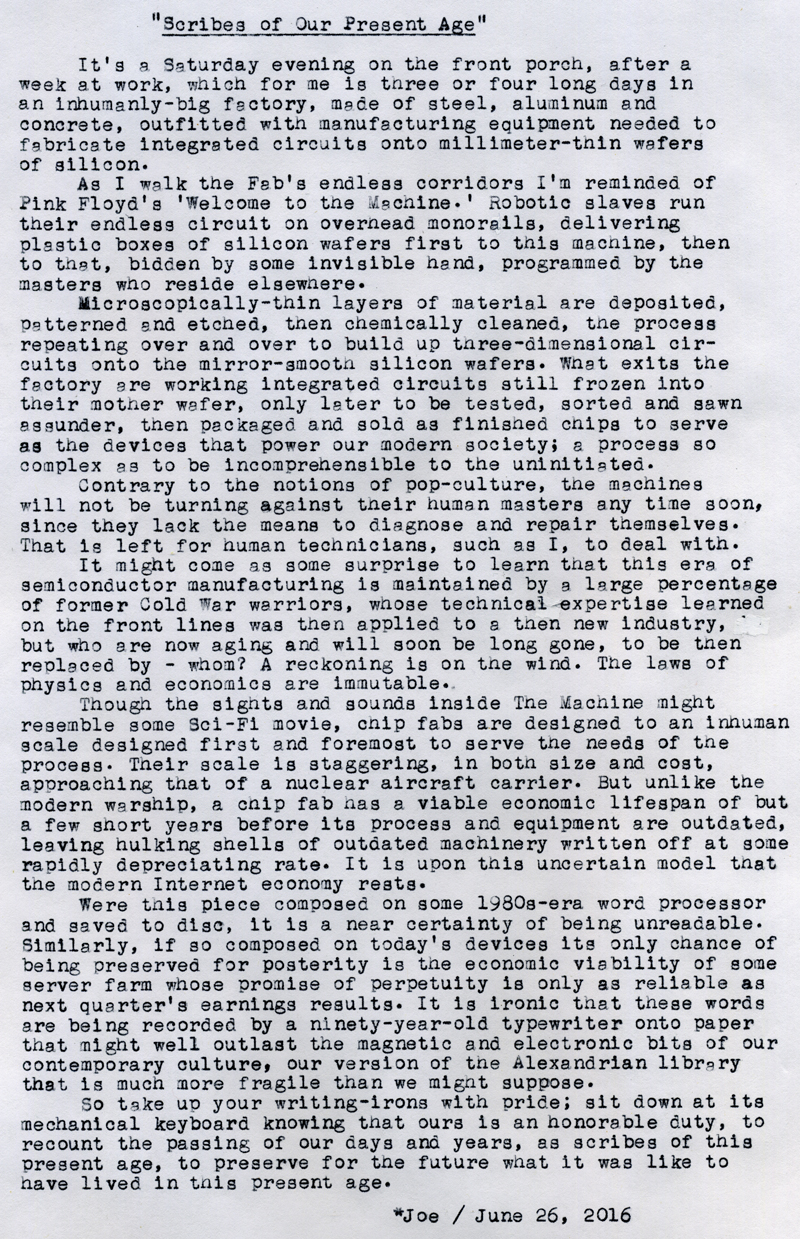
Scribes of Our Present Age

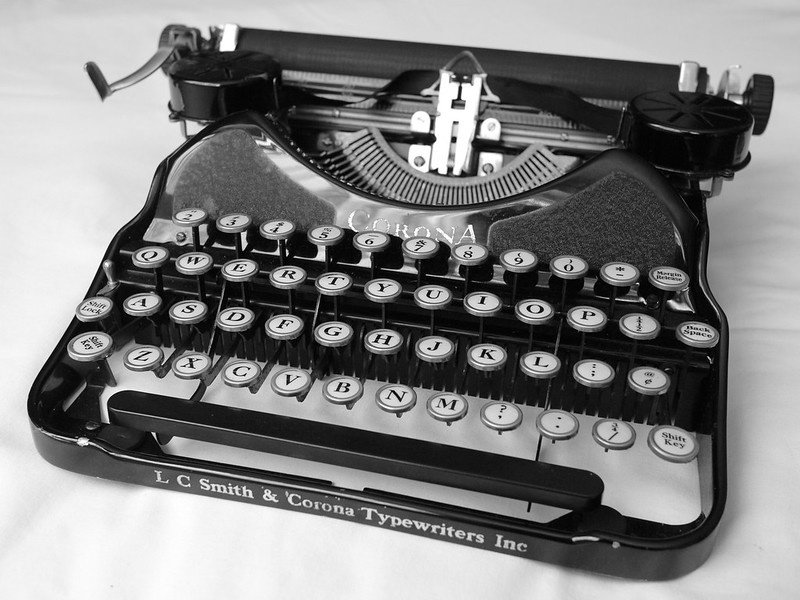
Corona 4
Typecast177

Post-Script: Perhaps us typewriter aficionados do have a duty to future generations, to preserve some small glimpse of this present age, through this seemingly outdated medium of mechanically imprinted ink upon paper, like those few diehard film photographers who choose to preserve images onto a more physically permanent medium than magnetic fields or bits of electric charges might provide. Perhaps that is the greater significance of the typewriter renaissance, offering one last opportunity, before these machines corrode irreparably through the effects of time, to preserve the knowledge of the past and present.

Maybe this is all much too romantic of an approach, the idea that typewriters serve some culturally historic function. But consider that the typed document is able to be scanned and then converted to some electronic format, much more easily than a handwritten manuscript might (certainly my handwriting is scanner-proof); functioning as a film negative, as a document existing into the future within the physical realm.

We could argue endlessly as to whether paper is more archival than electronic media. I can imagine scenarios where either media would fail first. For my purposes, however, paper documents require no expenditure of energy to sustain, only space to store; unlike information in server farms or hard drives, which have to be repeatedly copied onto new media periodically to remain viable. The laws of thermodynamics and quantum physics dictate that magnetic fields inevitably degrade over time, as do electrical charges, that will inevitably leak out of the best flash memory's floating gate.

I wonder if future historians will even have access to the archives of our present social media platforms, or if these will function as virtual voices in the wind, fleeting and ephemeral, only accessible in the present. Might it be possible that there will remain an enormous gap in our culture's legacy, brought about by the temporal nature of the systems and platforms that support our contemporary culture?

I am reminded that the typewriter's origins lie in an attempt at circumventing the effects of a labor strike at Christopher Latham Sholes's newspaper's printing office. Such is the problem of centralized control of the means to access information technology; which reminds me of our present-day era of silicon-based platforms dependent on specialist, centralized complexity, and of the typewriter's intrinsic self-sufficiency. Unlike the ancient Alexandrian library (another centralized repository of cultural data), whose contents were lost to history, the typewriter is entirely decentralized into the hands of individual collectors and users. Contrast this with these mega-sized semiconductor factories, described above (and in which I work), which are becoming more and more expensive to build and maintain, in the hands of fewer and fewer corporations willing to invest the necessary capital.

Typecast via ~90 year old Corona 4.

Labels: , , , ,