Wednesday, March 11, 2020

On Notebooks

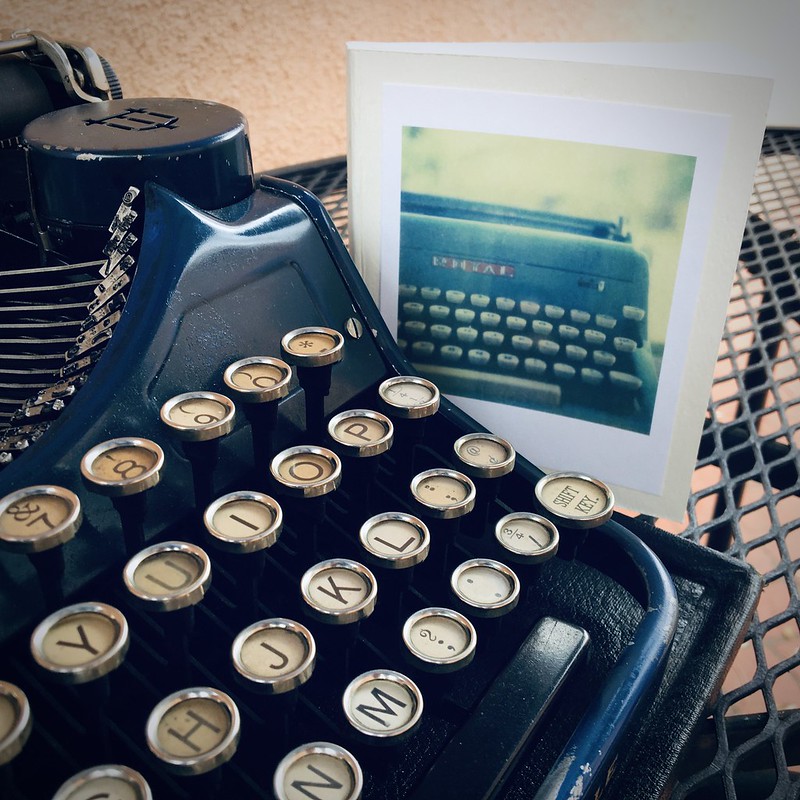
1930 Underwood Portable & Stitch-Bound Notebook
P1040844a
P1040848a
P1040845a
P1040849a
P1040847a
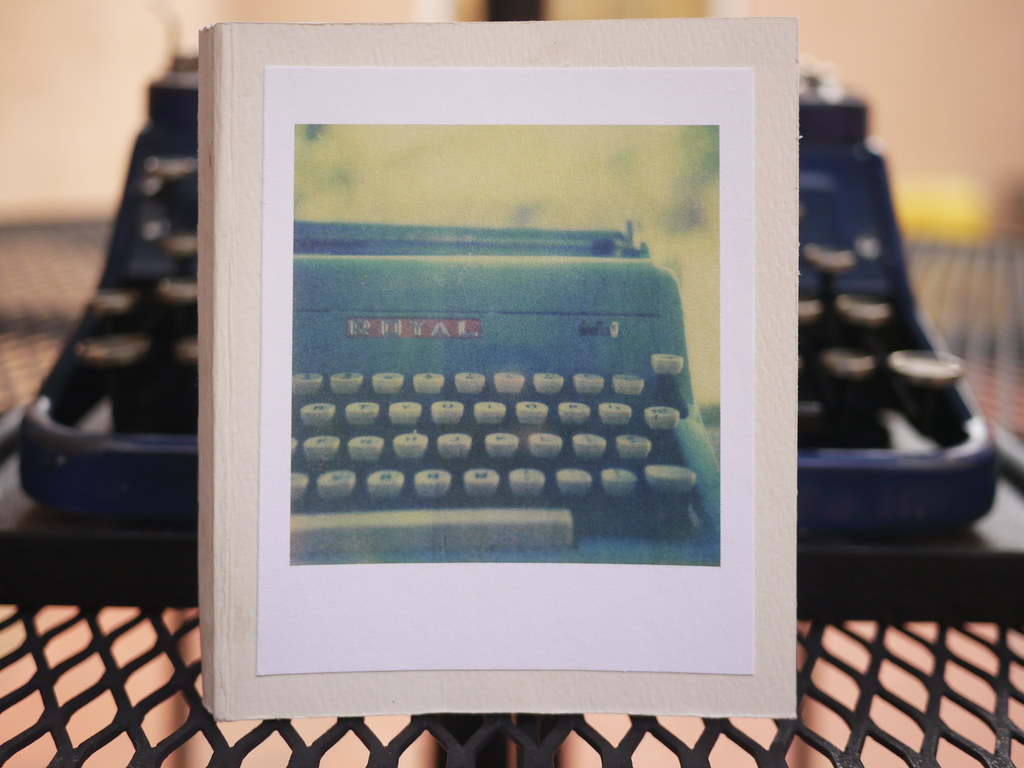
I have a box full of these typewriter-themed note cards, which would make good covers for more handmade notebooks. This also gives me incentive for collecting notecards and other printed ephemera for use as cover art for notebooks.

P1010782a
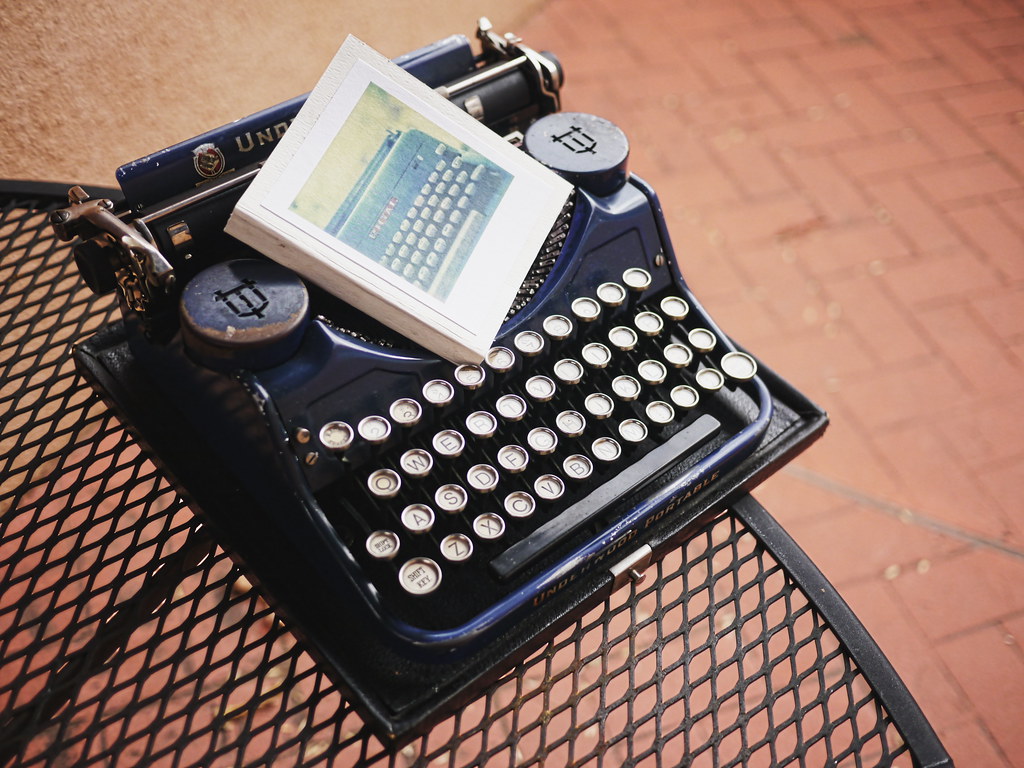
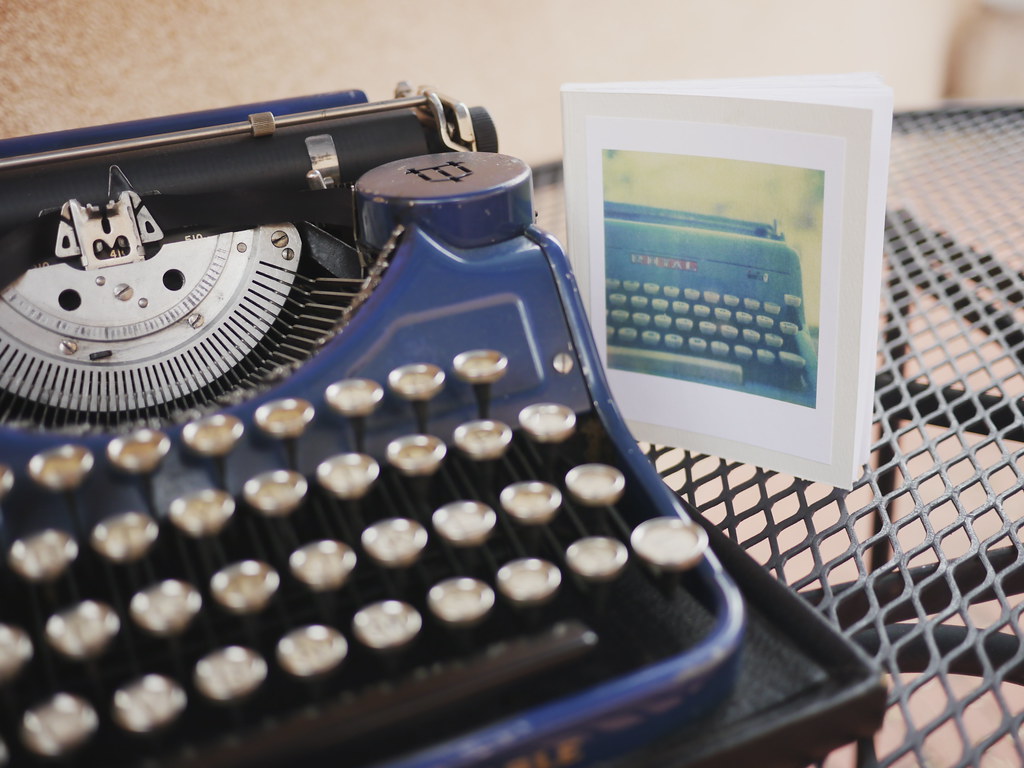
It's not difficult to see the photographic possibilities intrinsic to typewriter-themed notebooks when combined with old typewriters.

P1010790a

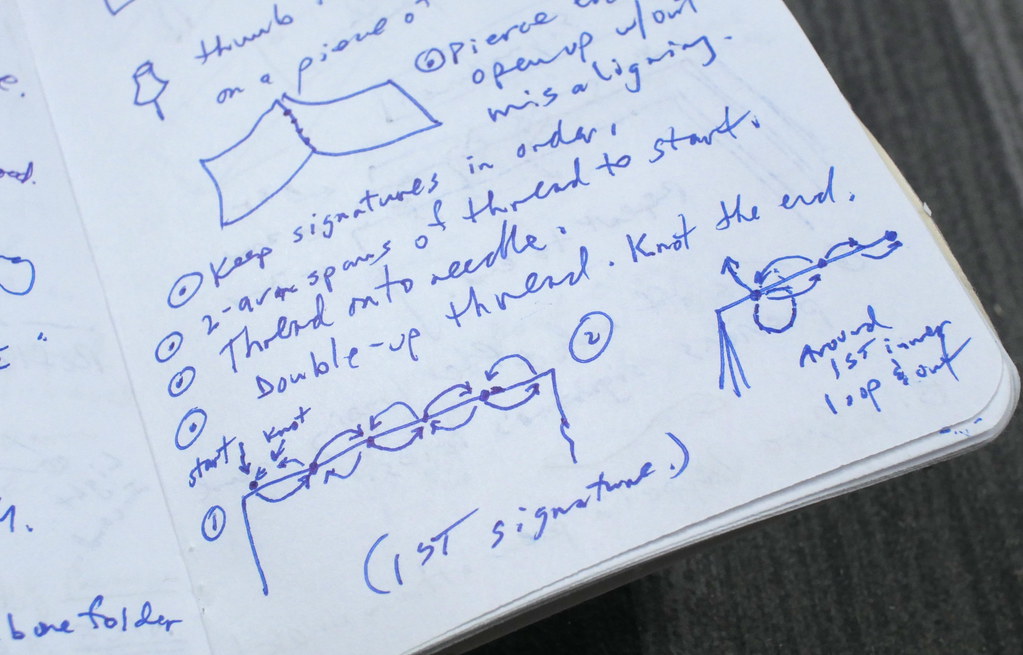
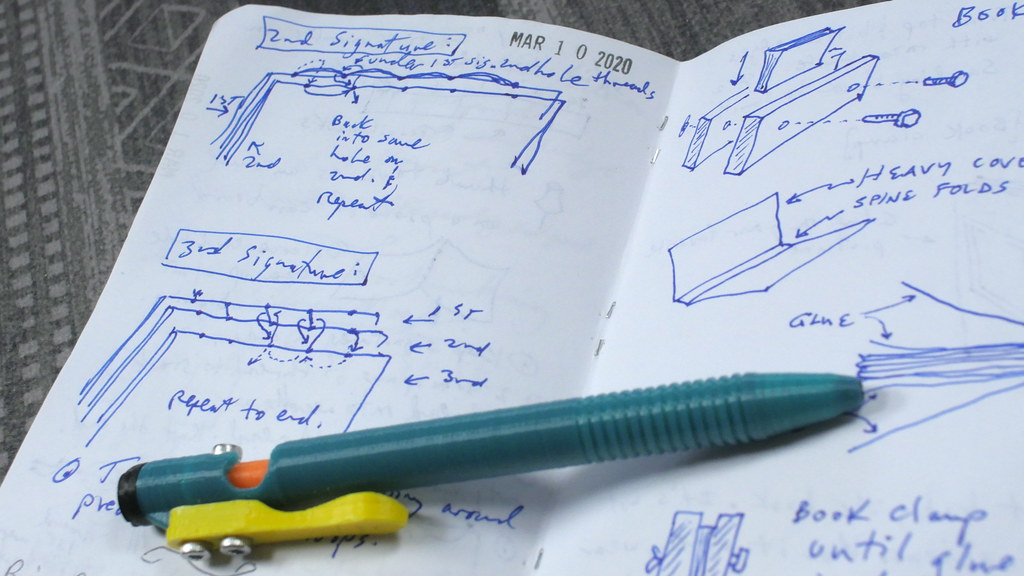
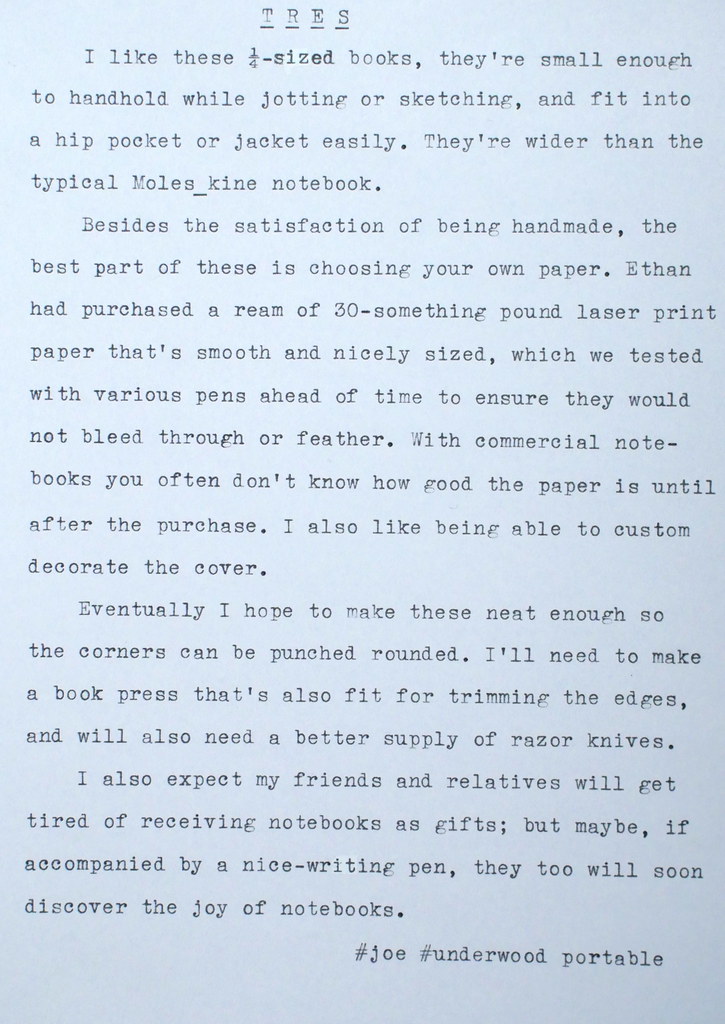
Regarding the handmade notebook, it has 100 pages, a nice size for extended usage. The paper has a nice weight and finish, good for gel and fountain pens. After my frustration with yesterday's assembly process, mainly due to fumbling with the hand stitching process, I was rather pleased with the results. Still, there's room for improvement.

I keep the 1930 Underwood Portable on a small table in our patio room, handy for some quick grab-and-go writing on the front porch. This old machine has a great feeling action to the keys, and seems to be very reliable, aside from the occasional wonky ribbon advance when it gets near one end of the ribbon, which is why, when I'm actually writing with it, I remove the two ribbon spool covers (that have the nifty "UT" logo etched into them) so I can monitor the ribbon motion as I type. I've noticed in many old photos of writers with their typewriters, they often operated the machines with the ribbon covers removed. I recall seeing a more recent photo of Woody Allen at his Olympia, which he apparently still uses for writing, sans ribbon cover.

P1010796a

My intention this afternoon was to just sit in the front patio, type a blog article and smoke a cigar. Then I began to admire the typewriter together with the notebook, and soon the shutter bug in me got busy. I wonder if these beautiful old machines were designed to be this attractive, or is it merely an artifact of distance in time, the effect of nostalgia? I suppose there are some people who are attracted to the beige and grey boxes of 1980's computers with their minimalist modern styling, but they don't, in my opinion, hold a candle to an old typewriter.

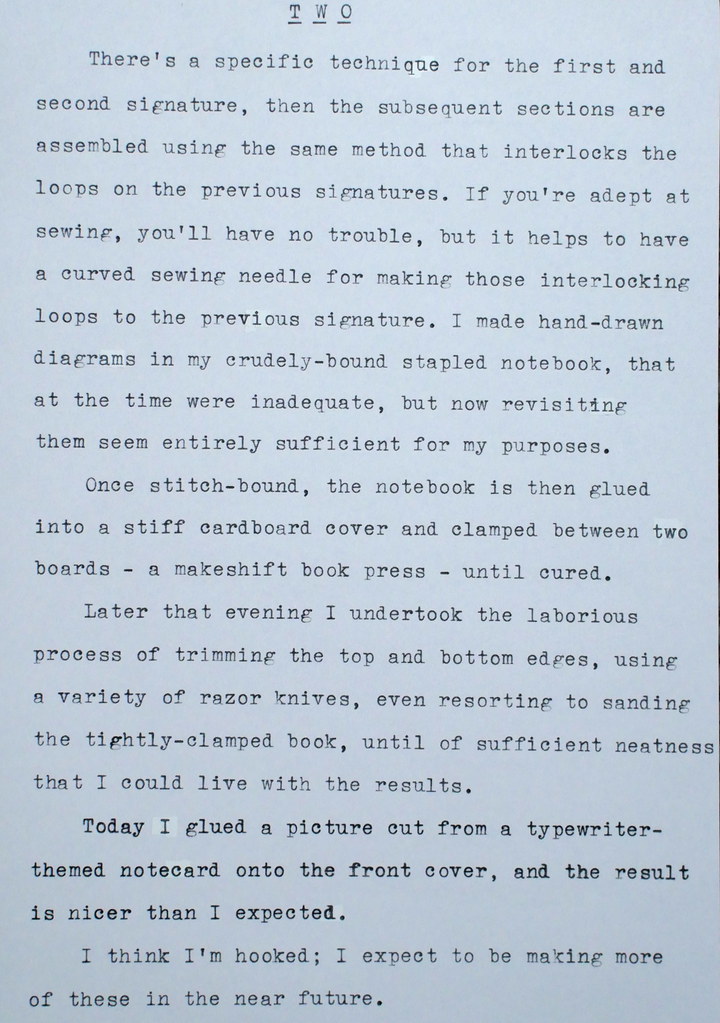
Typecast via Underwood Portable onto Clairefontaine Triomphe paper.

Labels: ,

Wednesday, March 15, 2017

Personal Discoveries and Barry's Folly

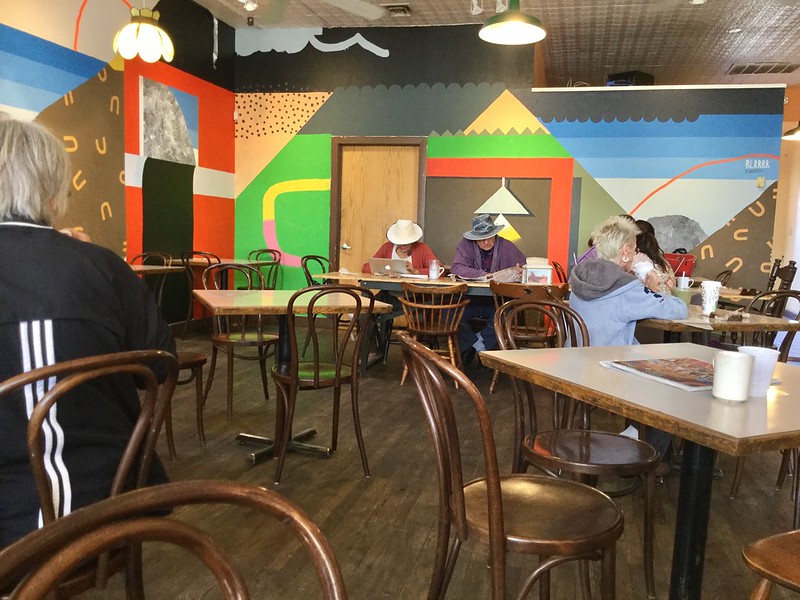
Aging Hippies at Winning Coffee
Ageing Hippies at Winning Coffee

Is there some universal law that dictates when a person first makes a personal discovery? What if that discovery involves a public venue, like Winning Coffee Company, in the University Neighborhood of Albuquerque? These things are like wings you don't even know you've put on, they've become so comfortable. In the case of Winnings, I can't now recall how I first heard of it, or from whom, or the circumstances of my first visit. All I know for certain is that there came a time, in the mid-aughts, when I began spending many a morning at Winnings, eating breakfast, drinking coffee and writing in a journal.

The circumstances of how these places come to be are mysterious, or so I'd like to pretend. In fact, some one or group of people had the vision to start this business, in 1996; but that's not what this story is about. The story I'd like to tell is that Winnings is as unlikely of a hangout for creatives as one can ever imagine in this dry, dusty southwest city, seemingly perpetually insulated from the balance of civilization by many hundreds of miles of badlands and years of history.

If Beatnik culture were a "Thing," let us presume, and someone with the vision and aptitude to make a buck off the declining entrails of mid-20th century American Beatnik culture were to have a free hand in fashioning a simulacra of that culture, they could do no better than start at Winnings, study what it is and what it is they do, and try to franchise the results far and wide.

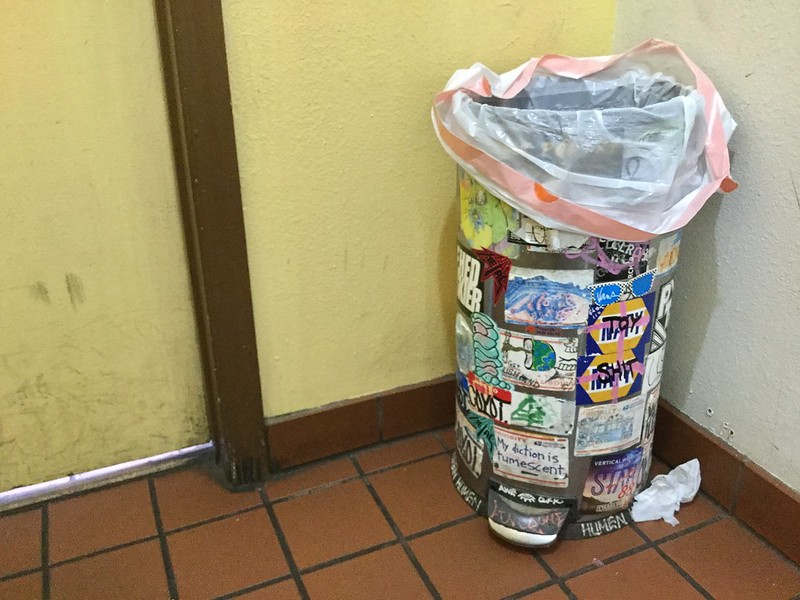
Men's Room Trashcan at Winning Coffee
Simulacra of Decrepitude

You'd need, at the very least, an aroma of cumin and cayenne wafting from an ancient-looking kitchen, just as mood music fills the modern spaces of Starbucks out in Suburbia. You'd need some corporate specification defined for how intense the aroma becomes, along with how to simulate the decrepitude of years of caked-on paint, crazed plaster walls and tin ceilings in some state of disarray. An exacting simulacra of decrepitude, canned and marketed for the suburbanites in newly built communities of cracker mansions out by the Interstate, neatly set down in their precise rows of grids, enticing them to drive their SUVs down to the strip mall and experience a bit of inner-city, beatnik funkiness distilled down to its essential ingredients. Employee personal hygiene would be optional, in order to preserve the aroma of the unkempt philosopher, specified in the corporate policy manual, which also mandates faded bell-bottom denim, braided beards and bandanas securing greasy locks. Most essential would be the front patio, where tables and chairs offer a convenient place for revolutions to be fomented in billowy clouds of hand-rolled cigarette smoke; local ordinances would require special exemptions, palms would need to be greased. We have money to make, boy!

Of course, no true revolutions will arise from our imaginary chain of faux-beatnik coffee shops (Now Nationwide!), only harmless little pretend ones; for the affluence of American Suburbia is predicated on the notion of keeping one's head to the grindstone of Corporate America, doing as one's masters might dictate, and don't rock the boat.

On October 1, 2011, (un)Occupy Albuquerque, a protest group loosely inspired by the then ongoing and worldwide Occupy Movement, began a weeks-long protest and occupation of Yale Park, across Central Avenue from Harvard Drive, the location of Winning Coffee, which became for participants a de facto support triage, with food, drink and moral encouragement. For myself, Winning had by now also become my own personal triage, a place from which to escape middle-class suburbia and it trappings. I'd visit almost every week, notebook and camera in hand, simultaneously inspired and also desiring to capture on film a fleeting essence of the ephemeral. Like capturing fairies on glass plates, how does one capture the essence of a culture defined primarily by the negative space of protest and opposition? It's like that old optical illusion: is it a pair of faces or a candlestick?

I think it always comes back to that most essential approach, storytelling. People are intrinsically interested in the lives of other's, especially if those others come from a different walk of life. I've always felt a bit out-of-place visiting Winning Coffee because of the imagined disparity between my station in life (middle-class suburbanite) and those Winning regulars closer to the streets. And yet, as I've come to know some of them, I've found a richness in their diverse backgrounds that is wholly unexpected and irreplaceable.

Some of these people I've gained only a casual familiarity with, enough to catch a mere glimpse into their psyche, but enough to serve as inspiration for fictional characters in a series of short stories based on Losers Blend, the parallel universe fictionalized version of Winnings.

It's been many months since I've visited Winnings; their coffee roaster guy quit and we'd begun buying beans elsewhere. It's been several years since I was a regular enough visitor to spend hours there writing, or visiting with fellow patrons. So it came as some shock to learn this week that they are having financial difficulties, brought about by the Albuquerque Rapid Transit project, which has resulted in the entirety of Central Avenue being torn up, disrupting traffic, parking and shopping for miles. The project has earned the scorn of most every business along Central, known by its initials ART; but there's nothing art-like or redeeming about it. The Mayor, Richard Barry, heavily promoted it as a way to begin transitioning the city's transportation infrastructure away from being so automobile-centric; a noble cause. But instead of placing it in a part of town most needing mass transit - the suburbs of the densely-packed northeast heights - he instead located it along the one thoroughfare already better served by bus lines than any other. So while the city might call it ART, I call it Barry's Folly.

It will take several more years before the project is concluded, and funding has not even been appropriated for any more than the initial demolition phase currently underway. Neither was the public given an opportunity to directly vote to determine the project's future, but it was instead mandated from the top, down. Theoretically, a democratic society works by the government working for the people, not the other way around.

There is the very real prospect that, even if the project is successfully completed, those areas of downtown, the University District and Nob Hill who were to benefit so directly from the transformation will be burned-out, boarded-up shells of their former vibrancy, a zone of economic blight brought about by the reality that the cure was worse than the illness; that in attempting to revive the city's core through infrastructure improvements they've killed off those essential but delicate economies of small businesses which make up most of this city's commercial liveliness; the very opposite of what Mayor Barry promised. Unique places like Winning Coffee might very likely cease to exist.

Conspiracy theorists might even conjecture this was their intention all along, so that real estate could be bought up cheaply and sold off to new corporate clients waiting in the wings.

This morning we had a late breakfast at Winnings, a hearty burrito filled with eggs, potatoes, green chile sauce and cheese; and their wonderfully rich lattes. Bradley, the bookseller, was there, setting up shop in the corner nook by the coffee roasting machine. He has a younger assistant who does the heavy lifting of setting up and tearing down, whom I asked how the books are organized, and the answer I got revealed once again the rich diversity of this crowd, as he told me that they're organized by genre: beat authors here, soviet realists there, feminist lit over yonder, Latin American fantasists over there. Only at places like Winnings will you find the guy with the strong back also has a strong mind for literature.

As we entered through the front door (there's also a rear entrance from the alley) the regulars were seated outside at the patio tables, while the big oval table inside by the order line had the usual old guys, the knights of the round table I call them, including the one who always sports some puffy-sleeved shirt and black vest, with black top hat. As we stood in line waiting to place our order, I overheard one of them inform the others "One of the Chicago Seven is now a stock broker."

I'm hoping Barry's Folly will fail to have its full sway, and that these unique venues like Winning Coffee will survive and prosper. In the meantime, Bradley informed me that the new coffee roaster guy now has his act together, and so perhaps next week, when our stock of beans begins to run low, I'll make a drive down to the University District, brave the construction barricades, have breakfast and perhaps do a bit of writing. Maybe I'll take a portable typewriter, sit out on the front sidewalk tables, sip my coffee and pound inky words into paper, the aroma of hand-rolled smokes wafting in the breeze.

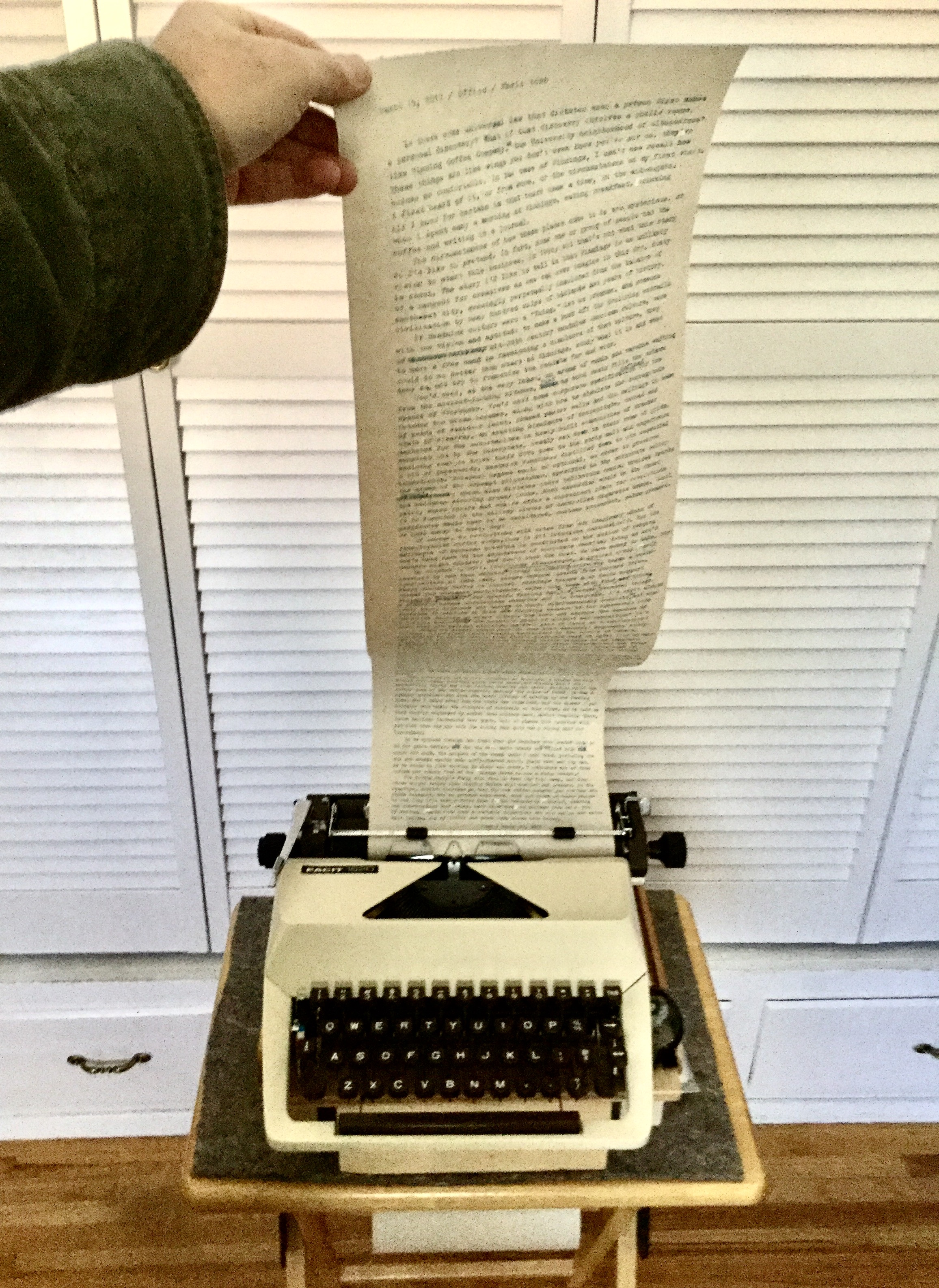
Post-Script: I enjoyed writing the first draft of this piece on the teletype paper roll using the Facit 1620. Spaced at 1.5 lines, the piece came to 31 inches.

'Personal Discoveries' Rough Draft, Facit 1620 and Teletype Roll

Labels: , , , , , , , ,

Sunday, October 30, 2016

To Stay on the Straight and Narrow

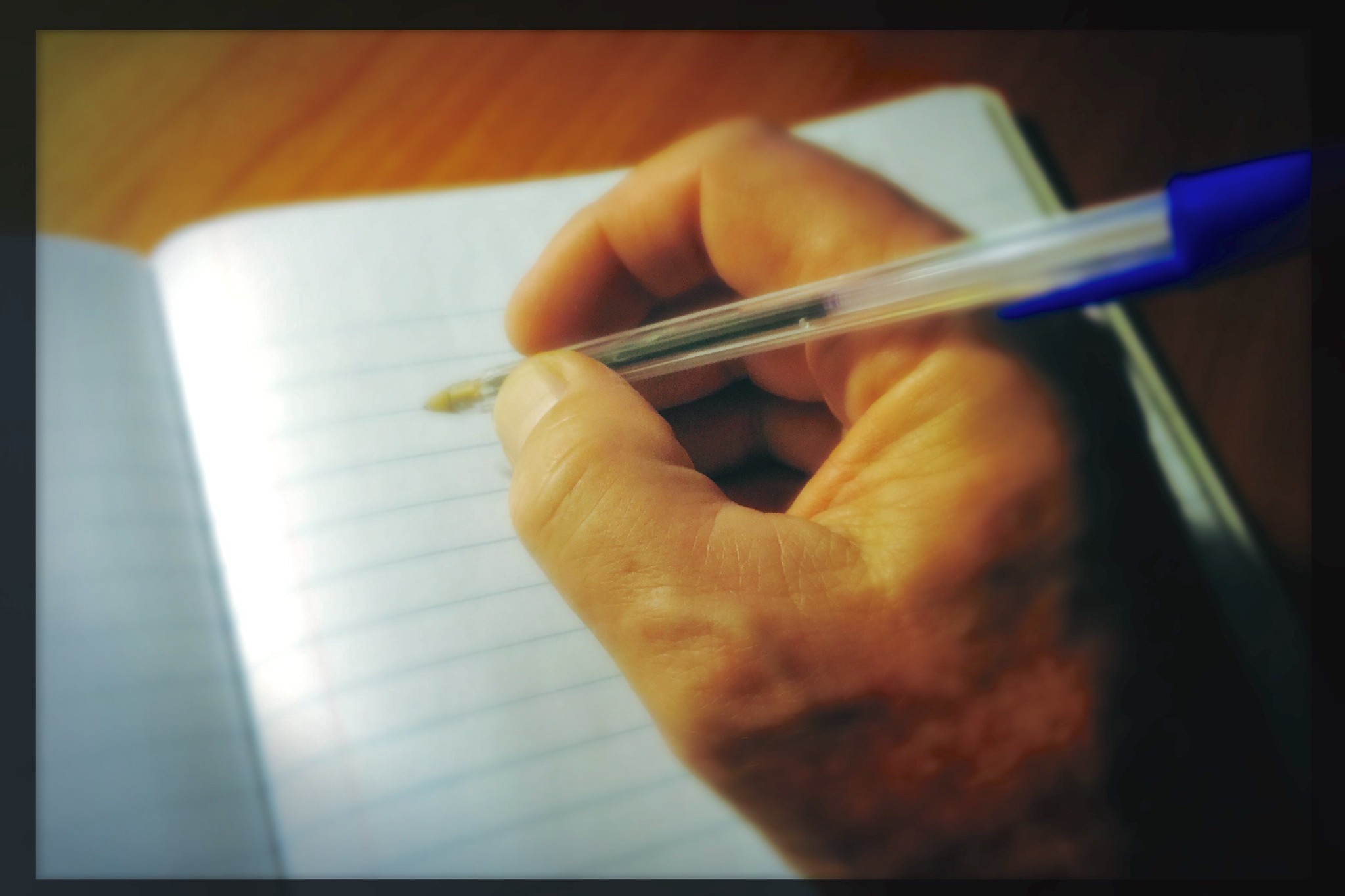
Poised to Write

Typecast195

Post-Script: Do you remember, just a month or two ago, all the time I spent cleaning, adjusting, typing and typecasting with my more recently acquired Smith-Corona Silent Super? Well, this is its older stablemate, the venerable non-Super Silent, the one with the fixed tabs, and a bit more drab color scheme but in better mechanical condition. In terms of "haptics," this one feels every bit as good as the best mechanical typewriter, but is more compact in size than the larger Galaxy 12s or Hermes 3000s. And, being of elite-sized (smaller, 12 characters per inch), it just works better for me as a first-draft typer, especially with the seemingly endless roll of teletype paper threaded up. It is because of machines like this, situated in my patio room upon the tray table, ready to type up a storm, that I can, at a moment's notice, be creating words upon paper. An imminently practical, pleasurable writing instrument.

I've been taking a liking to this teletype paper. No, it's not a fine quality foolscap of rich vellum, it's instead more like rough, leathery, thicker newsprint. But I like the look it gives to printed words. They're meaty and physical. You can more easily see the ink impressed upon the paper's fibers. The paper's off-white tone looks like it's already aged half a century, like these freshly typed words could have been from a previous era; some sort of typewriter time machine at work, words from the present appearing as if they've come from the past.

The best part of using the roll of teletype paper is not having to thread up a fresh sheet of paper after an all-too-brief session of typing. No interruptions, just pure, nonstop writing pleasure.

The top photo shows a Bic Cristal medium-point in blue ink, one of my all-time favorite writing instruments. If it weren't for fountain pens, this is what I'd be writing with. I've taken to liking these pens so much that I go out of my way to stay stocked up on them; the larger 1.6mm tip versions are also very nice writers. Oddly, they're rather hard to find at my local big-box retail stores. Luckily there's Amazon to the rescue.

Labels: , , , , , , , ,

Monday, October 10, 2016

Tools for the Toolbox

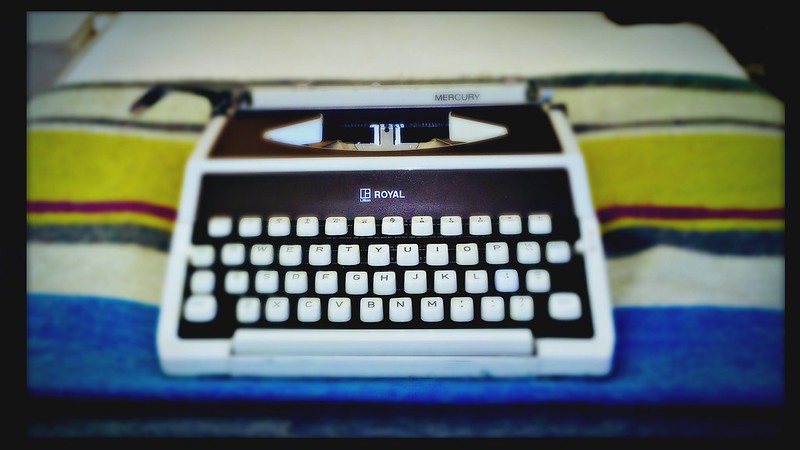
Royal Mercury

Today I want to discuss writing methods. By the term 'writing' I don't mean the art of putting words together, but instead the mechanics of how that's done.

Real writers, those who financially sustain themselves through writing or the teaching of writing, might dismiss this overt emphasis on the mechanics of the process (at the exclusion of creative content) as the dabbling of the amateur; more like street-level scribbling.

But to us street-scribblers, the mechanics of writing are all important, at least as a way of getting over the distractions that come from an ill-thought-out writing system, which is a prerequisite for good writing: get rid of all the encumbrances and roadblocks in the way of one's writing process and the rest will follow suit.

Real writers should have learned early on, as a matter of course in the development of their professional writing skills, the importance of finding and honing their personal kit of tools and methods that enable that creative flow. But for us street-level scribblers, we're always in school, and the streets are our daily lecture series, so we're constantly learning and refining.

The problem for us amateur scribblers is that it's all too easy to confuse the needs of our future writing skills with the necessary but much less important refinement needed to our physical toolkit; similar types of conundrums are evident in the world of photography, where the fledgling confuses the desire for a better camera or lens with what's really needed, that being refinement and development in one's technical and creative skills. So let this serve as reminder that however useful new toys might serve to help refine one's writing toolkit, they ain't gonna make you the next Great American (or insert your nationality of choice) Novelist. But you probably knew that already.

I must confess that I'm a gadget freak, like many males of my age; yet I also admit that I have yet to find an effective way to get over that fundamental blind spot in my personal development. It's probably an artifact of our culture, which sounds like a convenient excuse. Tools, toys, kit, gadgets - they're all fine, and relatively easy to acquire if one is of a sufficient middle-class lifestyle; but harder to acquire are the real skills required of a creative person. This means a protracted period of intense personal development; a lot harder than clicking on some button on Amazon and charging the expense to one's credit card. If only transforming one's mind were that easy.

I suspect this is a problem experienced by many people in our consumer-oriented culture, the expectation that real personal development can be acquired like some mass-marketed product. But ask anyone who's attempted such a personal journey and you'll soon find out that this is a matter common to our humanity throughout recorded history. Education, a true education, is most difficult to acquire, and takes a lifetime.

As to the matter at hand, the making of an effective writing system, this will differ for each individual. At one extreme, many people like the convenience of incorporating the entirety of their writing process, from first-draft brainstorming to the finished electronic document, contained within one system, the computer; and often that computer is a laptop, for reasons of convenience and portability. At the other extreme are people who prefer the hand-wrought crafting of words by pen, pencil or typewriter onto paper, only later to be developed into a finished electronic document. There are also many others whose personal writing system falls somewhere in between these two extremes, the choice often resulting more from personal circumstance and habit than any particularly specific philosophy or bent.

Such habits can be formed through a process akin to superstition, like the way that some sports athletes make preparation using a specific set of pre-game routines or articles of clothing; not because they actually believe there to be some supernatural connection between that particular method or object and the outcome of the game, but more like whatever seems to be working for them, they're not going to change it; keep as much as possible the same and perhaps success can be made more likely. Superstition, or a more effective psychological strategy? Hard to say; perhaps a little of both. Writers have been known to be a superstitious lot, frequently sticking to whatever works (like an obsolete word processor from the 1970s, or that old typewriter) because writing is hard and mysterious and why mess with what's working?

For myself, what has worked for me in the past - and by "worked for me" I mean been able to eliminate distractions and produce effective and creative writing, is both handwriting, either by means of mechanical pencil or fountain pen, and other methods like keyboarding into distraction-free text editors and also manual typing. Is this some magic formula? No; merely working out the application of past experience to future projects. I suspect the "magic" that comes from using these various successful writing methods is because of the confidence they inspire; the knowing that what worked for me in the past will again work for me in the future. It's more a trick of psychology, which is the realm within which all writers blocks originate. The mind is mysterious and unfathomable, its depths yet to be plumbed; especially the creative mind; which is why I consider the act of creativity to be the one essential test of true artificial intelligence.

But knowing that my past successes don't entirely hinge upon one specific set of tools or methods, perhaps I can find other methods that work equally well, or better. That is the approach I'm using with this recent endeavor of employing mechanical computer keyboards with iOS devices. There are many kinds of mobile electronic devices that can host writing applications, everything from Mac or PC to Android or iPad tablets. And bluetooth keyboards also seem to abound, though they lack that preferred mechanical feel. But knowing that some of my best writing experiences involve keyboards that exhibit a particularly satisfying mechanical feel (including both AlphaSmarts and manual typewriters), this new approach tries to synthesize the very best of that mechanical keyboard feel with the advantages of a modern and relatively error-free operating environment, like iOS.

Portability is also of essence to my preferred writing system, for I've found, over the years, that I'm not a static writer, but prefer a variety of places within which to write; hence whatever device I'm employing must be small and lightweight enough to be conveniently carried with me from place to place, even if those places are merely located in and around my neighborhood coffee shop or backyard shed. Over the years I've worked with a number of portable typewriters and, while they are effective tools for creative work, are not as convenient as a more portable device like keyboard and tablet; and are often less than welcome in an enclosed public space, due to their operating noise. For this reason, I've chosen a so-called "60%" sized mechanical keyboard, one that's about the same size as the keyboard of a mechanical typewriter, encompassing a mere 61 keys in total. The feel of this keyboard is every bit as good as, perhaps even better than, that of the AlphaSmart Neo - which is saying a lot; one reason being that, at the time of order, one can choose from a selection of six different Cherry MX keyswitches, thus the feel of the keyboard can be customized for one's personal liking. Mechanical keyboards, of the type I'm using, are now gaining popularity with a wider user base of writers, outside of their original gamer and programmer sub-cultures.

This is perhaps the fourth article I've written in recent weeks on this subject of mechanical keyboards employed along with electronic tablet devices. I've been typecasting - writing, scanning and posting mechanically typed prose to my blog - for almost a decade, which I don't foresee terminating any time in the future; but there is a convenience factor at work here with this new toolkit, the ability to, at a moment's notice, pick up iPad and mechanical keyboard, go somewhere, anywhere, and type out some thoughts, complete with spell checking and embedded HTML markup language, ready to be pasted to a blog template or elsewhere.

I recently went back into my archives of journal books in order to gain a deeper sense of my personal writing history, and what I found was that there's this huge gap, somewhere in the mid-aughts, after I'd supplanted hand-written journal books for various experimental and electronic writing systems, such as Palm-based portable devices and others, and before I'd begun typewriter journalling and blogging more consistently in the later aughts. I attribute this gap in my writing history not to a falling off of my writing activity but because these experimental systems simply hadn't worked out all that well as archiving systems. This mainly had to do with the way I'd managed (or mismanaged) backups to my computer system; but many of those writings are gone forever. It's clear that whatever writing methods one chooses, the stability and security of those documents is essential.

Contrast this with the fact that I have a sizable archive of paper-based writings which, although residing in the physical realm and therefore susceptible to the vagaries of both time and moth, seem to have weathered the digital storms just fine. I think what many of us tend to forget in this regard is that digital media are essentially physical in nature: there's some physical media within which the code resides, and that physical media- magnetic, optical or electronic - is often more fragile than the paper it was intended to replace.

I'm not suggesting that we go out with pitchforks in hand and burn down all the server farms; far from it. I think cloud-based backups, especially for relatively tidy files like text documents, are practical alternatives for us becoming our own IT specialists with home-based systems. But another practical backup alternative is to maintain paper documents. Having that irreplaceable story printed to paper has saved my bacon more than once. Yes, paper does take up room, and large boxes or notebooks of paper documents can be rather heavy. But so too is an article of furniture; I'd like to think of that physical archive of my essential work, printed to paper, to be like the furniture of the mind.

And so I'm suggesting that my mechanical keyboard + mobile iOS writing system will also be outputting a printed copy to paper; especially for writings such as personal journal entries, essays and stories, that are not immediately posted to the Internet, as would be the case with blog articles (which will be supported for perpetuity as long as the likes of Google remain viable businesses). Big Brother's IT department is well-suited for archiving my public writings, while my private work I think will be best backed up on paper. Had I done this back in the mid-aughts, I'd still have all of those personal journal entries.

I'll also continue to create works direct to paper via typewriter, pen or pencil. They're all essential, they all work for me, they each have unique attributes and purposes. But I find a good mechanical keyboard and writing app to be faster than hand writing and just as effective. Neither am I suggesting that I'm going to be abandoning typewriters any time soon. There are peculiarities to the experience of writing via a typewriter that are unique, and can spur uniquely creative results. Typewriters these days I don't see as effective tools for the final stages of editing a work into a finished piece, because word processors simply move text around so much easier. But for those early, creative phases of writing few things can match the typewriter for its ability to somehow pull out of the writer's guts the essence of what that piece will soon become. Hence the old saw about choosing the right tool for the right job. Luckily for me, I now have one more good tool in my writing toolbox.

Labels: , , , ,

Tuesday, October 04, 2016

Pre-Typosphere Typewriter Collecting

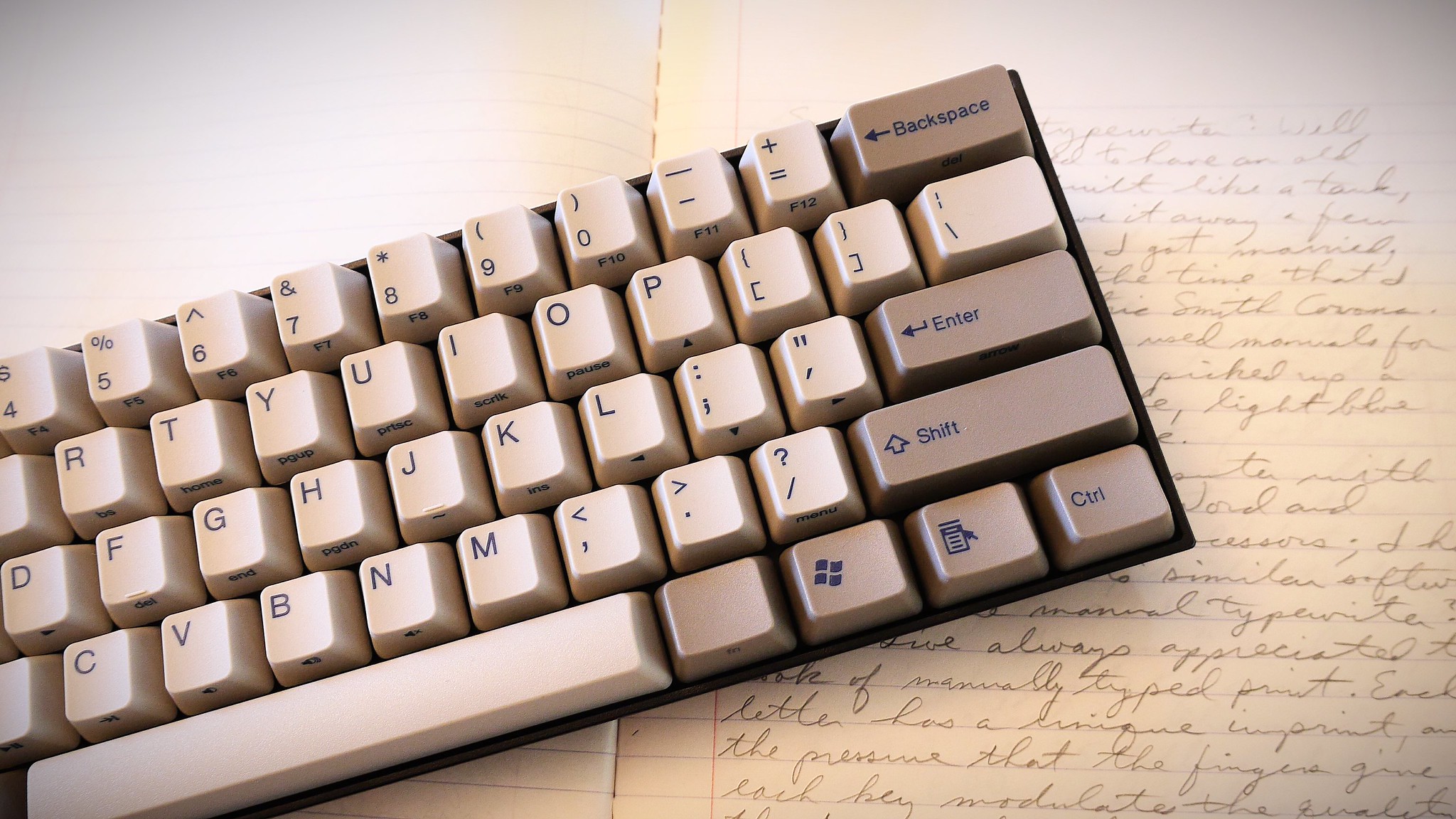
KB Paradise V60 Mechanical Keyboard and Journal Book

While researching material for my latest "Agent 51" video, I came across a journal entry I'd written on October 28, 1998, the first entry in a new composition journal book. This had been written in mechanical pencil, and what I found worth sharing with you was that it included the subject of typewriters, and alluded to a revival of interest in manual typewriters as far back as 1998, well before the current era of blogging and what we have come to know as the Typosphere.

So, without further ado, here is the transcription of that article.

10-28-98

This opening entry in this, the second volume of my journal series, begins with me having purchased a manual typewriter.

I don't believe that I've ever seriously entertained any ambition of becoming a writer. The closest thing I've come to is when I was on a poety writing kick while in the Navy and afterward. Upon thinking about it, I recall that, because of the volume of work I produced, I gained a self-identity as "poet," which I reinforced by surrounding myself with creative people - artist types, if you will.

But to be a "real" writer - a composer of "prose" - I have never identified with. And not to take anything away from these pages, but this journal is definitely not aimed toward public consumption, although some of my thoughts in the previous journal concerning video, film and photographic images constitutes a good framework around which writings for public consumption could be built upon, or perhaps worked into the upcoming seminar.


(Note: the seminar mentioned was an upcoming Basement Films presentation I made on low-budget analog video production techniques. - Joe)

So, why the typewriter? Well, for starters, I used to have an old Royal manual, built like a tank, but I think I gave it away a few years ago, before I got married, maybe around the time that I bought the electric Smith-Corona. My friend Worden has used manuals for years, and recently picked up a mint little portable, light blue with a carrying case.

(Note: Worden passed away a few years ago, but he self-published many small books of stories and poems on portable manual typers. That blue machine of his I only later realized was perhaps nearly identical to my Brother-made Webster XL-747, also blue and with a carrying case; further reason why I value it so much. - Joe)

So I have a computer with the latest Microsoft Word and Word Perfect word processors; I have access at work to similar software. So why the manual typewriter? Well, I've always appreciated the look of manually typed print. Each letter has a unique imprint, and the pressure that the fingers give to each key modulates the quality of the typed character in a direct, analogous fashion. You can tell when a computer typist is trying to touch-type on a manual, for the letters which are on the far left and right ends of the keyboard, struck by the weakest ring and little fingers, show up on paper as noticeably lighter in tone.

Last week I roamed around town, and visited several typewriter places. The one on Menaul
(John Lewis's shop - Joe) had an interesting museum, including old calculating, tabulating and other office equipment, as well as an abacus collection.

I engaged into an interesting discussion with the proprietor, and we covered an interesting gamut of things. He finally showed me an Adler manual typewriter, not quite as compact as the Hermes Rocket but, according to him, built to last a long, long time. It was built in "Western Germany," and supposedly has a high grade of corrosion-resistant steel in the mechanism. He knocked off 35 dollars, but I threw in for trade an old adding machine which he dated at before 1925. The end result is a nice, durable, well-built typewriter, which should last for a long, long time (I hope).

He asked me if I had planned to write a book, as many UNM-types come in and look for old Smith-Coronas that resemble the one that Hemingway used. Kind of like photographers who buy Leicas because they hope that they will immediately become more like Cartier-Bresson or Winogrand.

I never thought that a typewriter could actually influence one's writing style until I noticed that in order to type successfully on a manual you have to jab at the keys. The requirement of the fingers is not an increased strength, just a quick jab or punch at each key. It's the speed of the jab, not the pressure of the finger against the key. My thought is that perhaps the quick-jab style of typing could change the tone of the writer's voice from mellow word processor-smooth-clicky-clack into an aggressive, angry street-smart voice, matter-of-fact and no-nonsense, a kind of sparring session with the machine, the result imprinted upon paper, artifacts left behind from the interaction of human mechanics with antiquated technology. As the finished image is affected by the uniqueness of the lens in use, so is the typewriter able to focus the writer's thought in a peculiar way.


Did you catch those hints? Keep in mind that this was in 1998, before Facebook, Twitter or YouTube; when AOL was the dominant Internet provider and laptop computers were bulky devices. And it was certainly before the time that we commonly recognize as the revival of interest in the manual typewriter, before the Typosphere was formally identified. Yet there it is, John Lewis the typewriter repairman telling me that, even back then, university students were interested in those machines as writing tools.

Notice too that I've already gained some understanding of how a person should interact with a typewriter, that it's more about the speed of one's fingers than the pressure applied to the keys. I was certainly a neophyte at that time, but yet I had some understanding.

There is this mysterious reference in the piece to a comparison between the Adler and a Hermes Rocket. I didn't think, until I read this today, that I even knew of the existence of Hermes Rockets. Had I been suddenly educated that day by my visit to John Lewis, already had some subtle yearning for those little portable machines? Perhaps; only a few years later I'd return to his shop and trade in the Adler for a Royal Mercury portable, which I have to this day.

I am also amused by the idea that in 1998 someone like me was roaming around town on the lookout for typewriters; the more things change, the more they stay the same, even then the typewriter bug had already bitten hard, apparently.

For me, this journal entry is a bit of personal history unearthed; but for you out there in the Typosphere this might serve as some source material for the prehistory of the typewriter revival that was yet to come. I'd like to hear from others of you, if you have any personal anecdote or story pertaining to your pre-Typospherian interaction with typewriters.

Post-Script: Transcribed via KB Paradise V60 mechanical keyboard into iPad 2 with iAWriter. Wow, was this fun to type. Very AlphaSmart-like. But with a much bigger screen - a touch screen. No, it's not a "real" typewriter (and I apologize to those of you who might have been put off by the last two blog articles that have been overly enthusiastic about mechanical computer keyboards and tablet devices), but a very pleasant, focused writing experience.

Labels: , , , , ,

Thursday, February 18, 2016

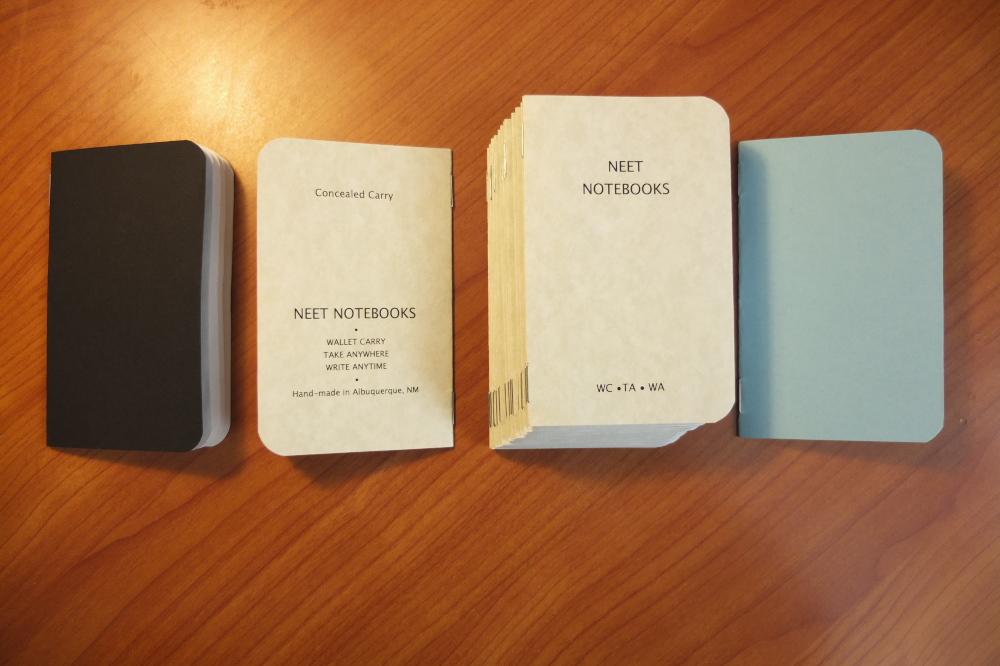
Neet Notebooks?

DSCF4522a
Typecast142
Post-Script: These are simple enough that anyone with a paper trimmer, stapler and corner punch can make these. I did a batch of sixteen just yesterday, and it was kind of meditative as I zoned in on folding the paper by hand as precisely as possible. The hardest part was getting the template made for printing out four covers on one sheet of paper; but the laser printing looks very nice.

Send me your postal address and I'll get one or two in the mail to you. Just give me feedback on how you like them. I always carry one in my wallet, they come in very handy for generic note-taking.

Here's a link to the video on the inspiration for Field Notes brand.

Typecast via Corona 4. I've been tinkering with the Corona this week, as I got the new feet installed. I degreased with isopropyl alcohol the ribbon mechanisms, including the vibrator and reel mechanism, then followed up with some naphtha as a light lubricant, and the ribbon spools now runs the entire length before auto-reversing. She also looks nice and shiny with a bit of car wax.

Labels: , , ,