Monday, May 22, 2017

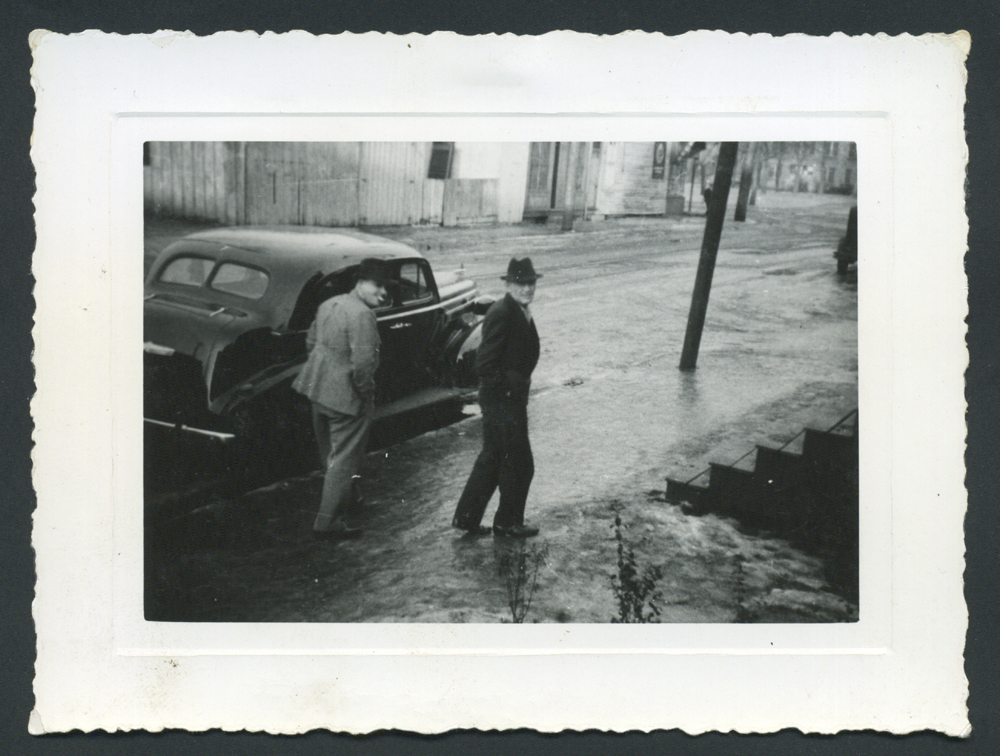
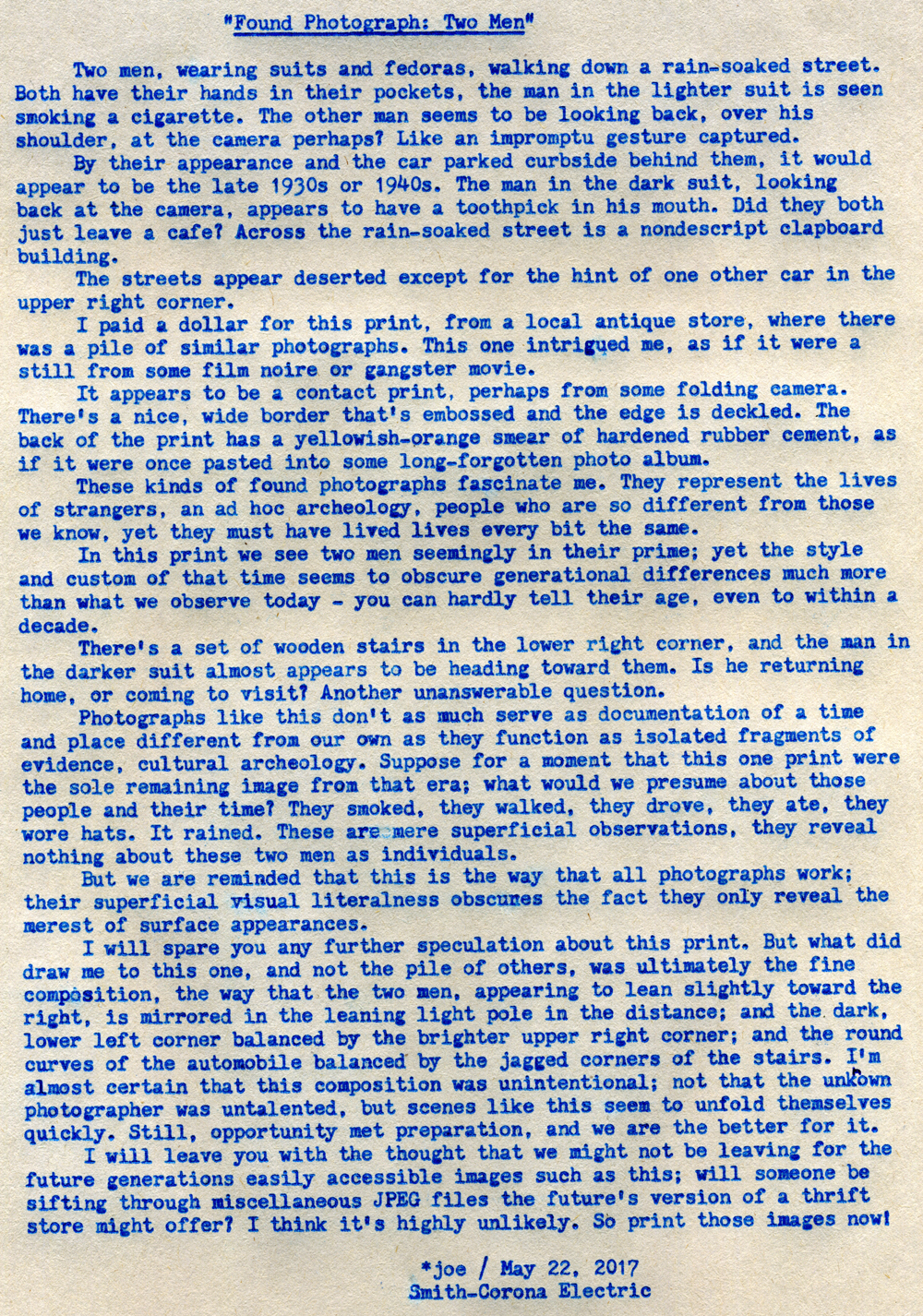
Found Photograph: Two Men

Two-Men-001a
Typecast282

Post-Script: I can't help but think about the film Blade Runner when I handle prints like this. I think of Harrison Ford's character Rick Deckard meticulously examining the snapshot photos from the android Leon - photos that were intentionally made deceptive by the Tyrell Corporation who manufactured Leon, photos from Tyrell's neice, but serving to give the android some semblance of a real human past. Though we aren't mere androids, I can't help from feeling that, somehow, these old snapshots serve much the same capacity, helping to fill in the missing bits of our understanding of a past that remains in many ways just as mysterious to us as Leon's did to him.

I found this print at the same thrift store, on the same day, that I found this blue Smith-Corona Electric.

Labels: , , , , ,

Wednesday, March 15, 2017

Personal Discoveries and Barry's Folly

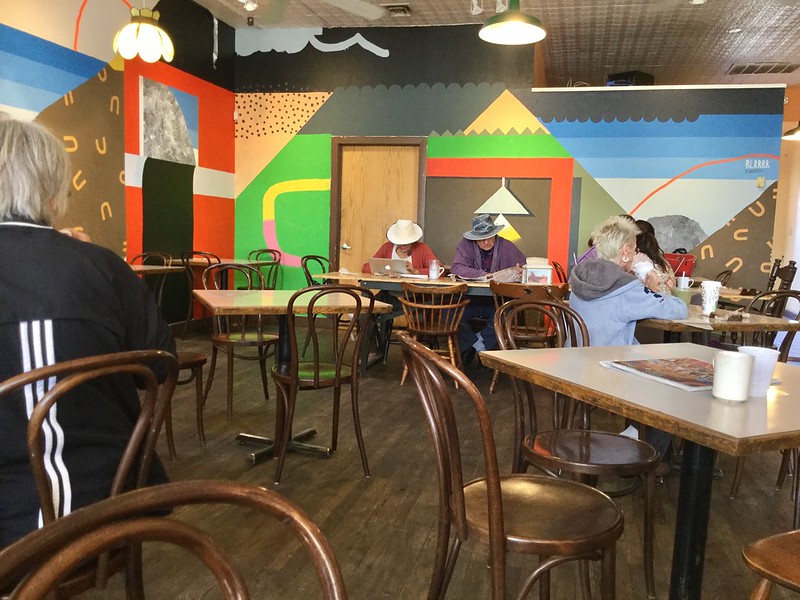
Aging Hippies at Winning Coffee
Ageing Hippies at Winning Coffee

Is there some universal law that dictates when a person first makes a personal discovery? What if that discovery involves a public venue, like Winning Coffee Company, in the University Neighborhood of Albuquerque? These things are like wings you don't even know you've put on, they've become so comfortable. In the case of Winnings, I can't now recall how I first heard of it, or from whom, or the circumstances of my first visit. All I know for certain is that there came a time, in the mid-aughts, when I began spending many a morning at Winnings, eating breakfast, drinking coffee and writing in a journal.

The circumstances of how these places come to be are mysterious, or so I'd like to pretend. In fact, some one or group of people had the vision to start this business, in 1996; but that's not what this story is about. The story I'd like to tell is that Winnings is as unlikely of a hangout for creatives as one can ever imagine in this dry, dusty southwest city, seemingly perpetually insulated from the balance of civilization by many hundreds of miles of badlands and years of history.

If Beatnik culture were a "Thing," let us presume, and someone with the vision and aptitude to make a buck off the declining entrails of mid-20th century American Beatnik culture were to have a free hand in fashioning a simulacra of that culture, they could do no better than start at Winnings, study what it is and what it is they do, and try to franchise the results far and wide.

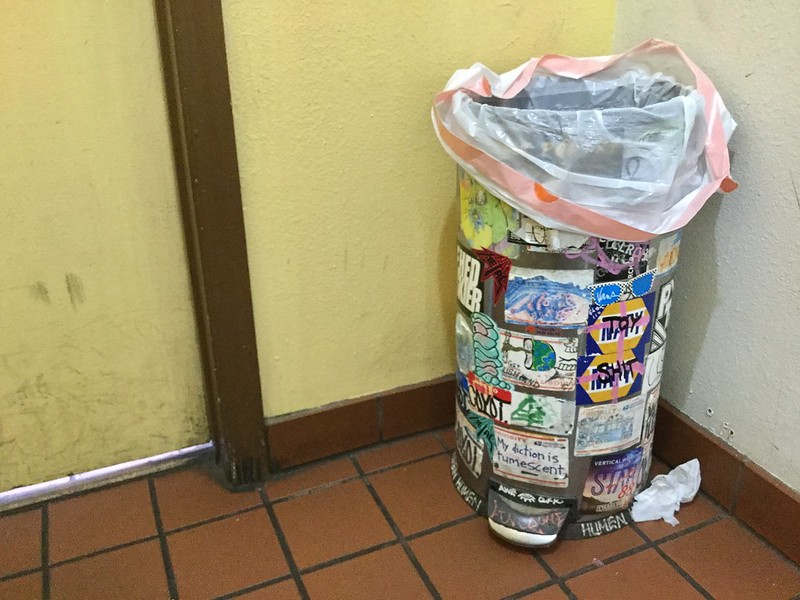
Men's Room Trashcan at Winning Coffee
Simulacra of Decrepitude

You'd need, at the very least, an aroma of cumin and cayenne wafting from an ancient-looking kitchen, just as mood music fills the modern spaces of Starbucks out in Suburbia. You'd need some corporate specification defined for how intense the aroma becomes, along with how to simulate the decrepitude of years of caked-on paint, crazed plaster walls and tin ceilings in some state of disarray. An exacting simulacra of decrepitude, canned and marketed for the suburbanites in newly built communities of cracker mansions out by the Interstate, neatly set down in their precise rows of grids, enticing them to drive their SUVs down to the strip mall and experience a bit of inner-city, beatnik funkiness distilled down to its essential ingredients. Employee personal hygiene would be optional, in order to preserve the aroma of the unkempt philosopher, specified in the corporate policy manual, which also mandates faded bell-bottom denim, braided beards and bandanas securing greasy locks. Most essential would be the front patio, where tables and chairs offer a convenient place for revolutions to be fomented in billowy clouds of hand-rolled cigarette smoke; local ordinances would require special exemptions, palms would need to be greased. We have money to make, boy!

Of course, no true revolutions will arise from our imaginary chain of faux-beatnik coffee shops (Now Nationwide!), only harmless little pretend ones; for the affluence of American Suburbia is predicated on the notion of keeping one's head to the grindstone of Corporate America, doing as one's masters might dictate, and don't rock the boat.

On October 1, 2011, (un)Occupy Albuquerque, a protest group loosely inspired by the then ongoing and worldwide Occupy Movement, began a weeks-long protest and occupation of Yale Park, across Central Avenue from Harvard Drive, the location of Winning Coffee, which became for participants a de facto support triage, with food, drink and moral encouragement. For myself, Winning had by now also become my own personal triage, a place from which to escape middle-class suburbia and it trappings. I'd visit almost every week, notebook and camera in hand, simultaneously inspired and also desiring to capture on film a fleeting essence of the ephemeral. Like capturing fairies on glass plates, how does one capture the essence of a culture defined primarily by the negative space of protest and opposition? It's like that old optical illusion: is it a pair of faces or a candlestick?

I think it always comes back to that most essential approach, storytelling. People are intrinsically interested in the lives of other's, especially if those others come from a different walk of life. I've always felt a bit out-of-place visiting Winning Coffee because of the imagined disparity between my station in life (middle-class suburbanite) and those Winning regulars closer to the streets. And yet, as I've come to know some of them, I've found a richness in their diverse backgrounds that is wholly unexpected and irreplaceable.

Some of these people I've gained only a casual familiarity with, enough to catch a mere glimpse into their psyche, but enough to serve as inspiration for fictional characters in a series of short stories based on Losers Blend, the parallel universe fictionalized version of Winnings.

It's been many months since I've visited Winnings; their coffee roaster guy quit and we'd begun buying beans elsewhere. It's been several years since I was a regular enough visitor to spend hours there writing, or visiting with fellow patrons. So it came as some shock to learn this week that they are having financial difficulties, brought about by the Albuquerque Rapid Transit project, which has resulted in the entirety of Central Avenue being torn up, disrupting traffic, parking and shopping for miles. The project has earned the scorn of most every business along Central, known by its initials ART; but there's nothing art-like or redeeming about it. The Mayor, Richard Barry, heavily promoted it as a way to begin transitioning the city's transportation infrastructure away from being so automobile-centric; a noble cause. But instead of placing it in a part of town most needing mass transit - the suburbs of the densely-packed northeast heights - he instead located it along the one thoroughfare already better served by bus lines than any other. So while the city might call it ART, I call it Barry's Folly.

It will take several more years before the project is concluded, and funding has not even been appropriated for any more than the initial demolition phase currently underway. Neither was the public given an opportunity to directly vote to determine the project's future, but it was instead mandated from the top, down. Theoretically, a democratic society works by the government working for the people, not the other way around.

There is the very real prospect that, even if the project is successfully completed, those areas of downtown, the University District and Nob Hill who were to benefit so directly from the transformation will be burned-out, boarded-up shells of their former vibrancy, a zone of economic blight brought about by the reality that the cure was worse than the illness; that in attempting to revive the city's core through infrastructure improvements they've killed off those essential but delicate economies of small businesses which make up most of this city's commercial liveliness; the very opposite of what Mayor Barry promised. Unique places like Winning Coffee might very likely cease to exist.

Conspiracy theorists might even conjecture this was their intention all along, so that real estate could be bought up cheaply and sold off to new corporate clients waiting in the wings.

This morning we had a late breakfast at Winnings, a hearty burrito filled with eggs, potatoes, green chile sauce and cheese; and their wonderfully rich lattes. Bradley, the bookseller, was there, setting up shop in the corner nook by the coffee roasting machine. He has a younger assistant who does the heavy lifting of setting up and tearing down, whom I asked how the books are organized, and the answer I got revealed once again the rich diversity of this crowd, as he told me that they're organized by genre: beat authors here, soviet realists there, feminist lit over yonder, Latin American fantasists over there. Only at places like Winnings will you find the guy with the strong back also has a strong mind for literature.

As we entered through the front door (there's also a rear entrance from the alley) the regulars were seated outside at the patio tables, while the big oval table inside by the order line had the usual old guys, the knights of the round table I call them, including the one who always sports some puffy-sleeved shirt and black vest, with black top hat. As we stood in line waiting to place our order, I overheard one of them inform the others "One of the Chicago Seven is now a stock broker."

I'm hoping Barry's Folly will fail to have its full sway, and that these unique venues like Winning Coffee will survive and prosper. In the meantime, Bradley informed me that the new coffee roaster guy now has his act together, and so perhaps next week, when our stock of beans begins to run low, I'll make a drive down to the University District, brave the construction barricades, have breakfast and perhaps do a bit of writing. Maybe I'll take a portable typewriter, sit out on the front sidewalk tables, sip my coffee and pound inky words into paper, the aroma of hand-rolled smokes wafting in the breeze.

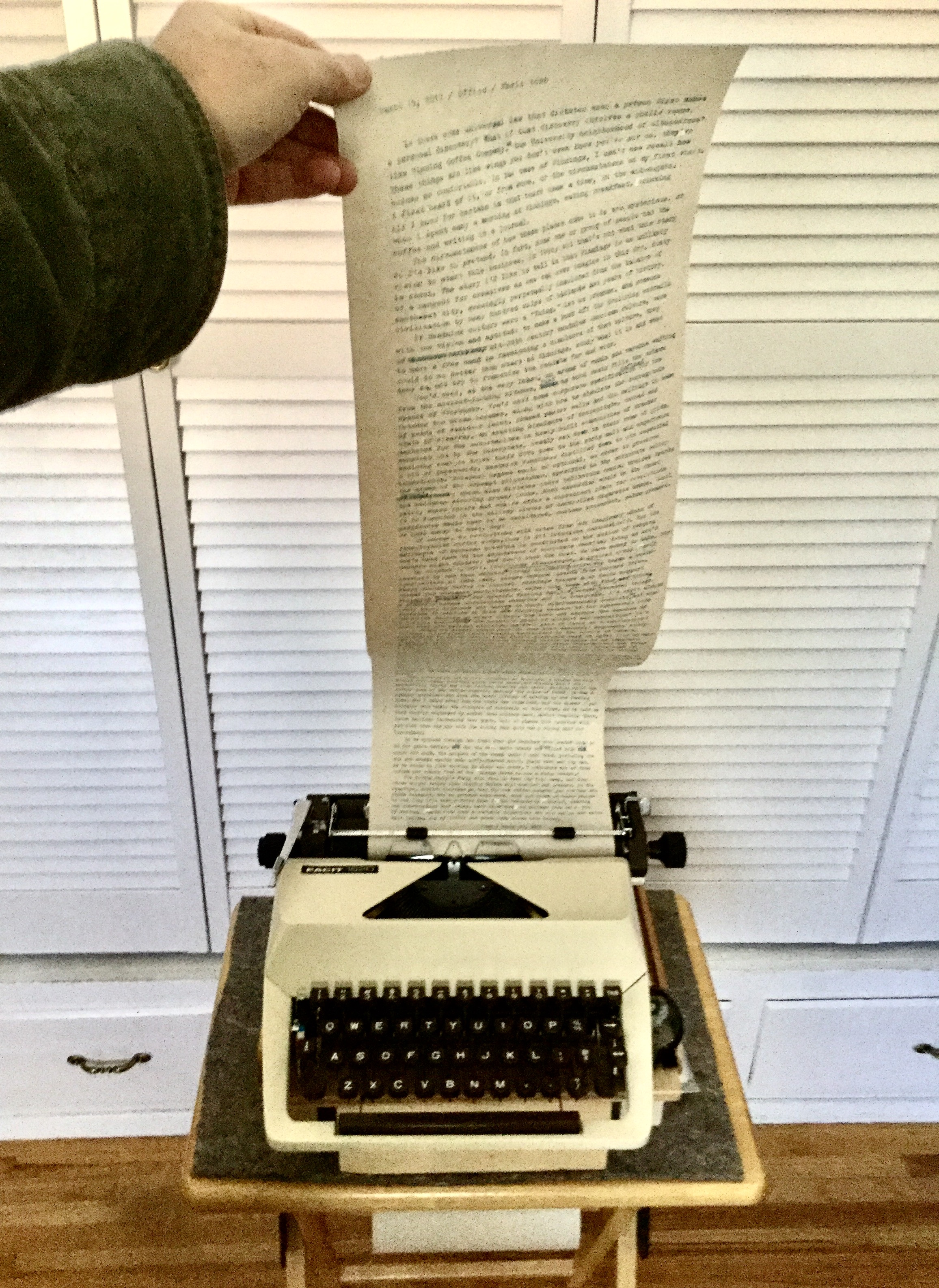
Post-Script: I enjoyed writing the first draft of this piece on the teletype paper roll using the Facit 1620. Spaced at 1.5 lines, the piece came to 31 inches.

'Personal Discoveries' Rough Draft, Facit 1620 and Teletype Roll

Labels: , , , , , , , ,

Wednesday, October 12, 2016

Afghan Box Camera Update

Paper Negative Selfie

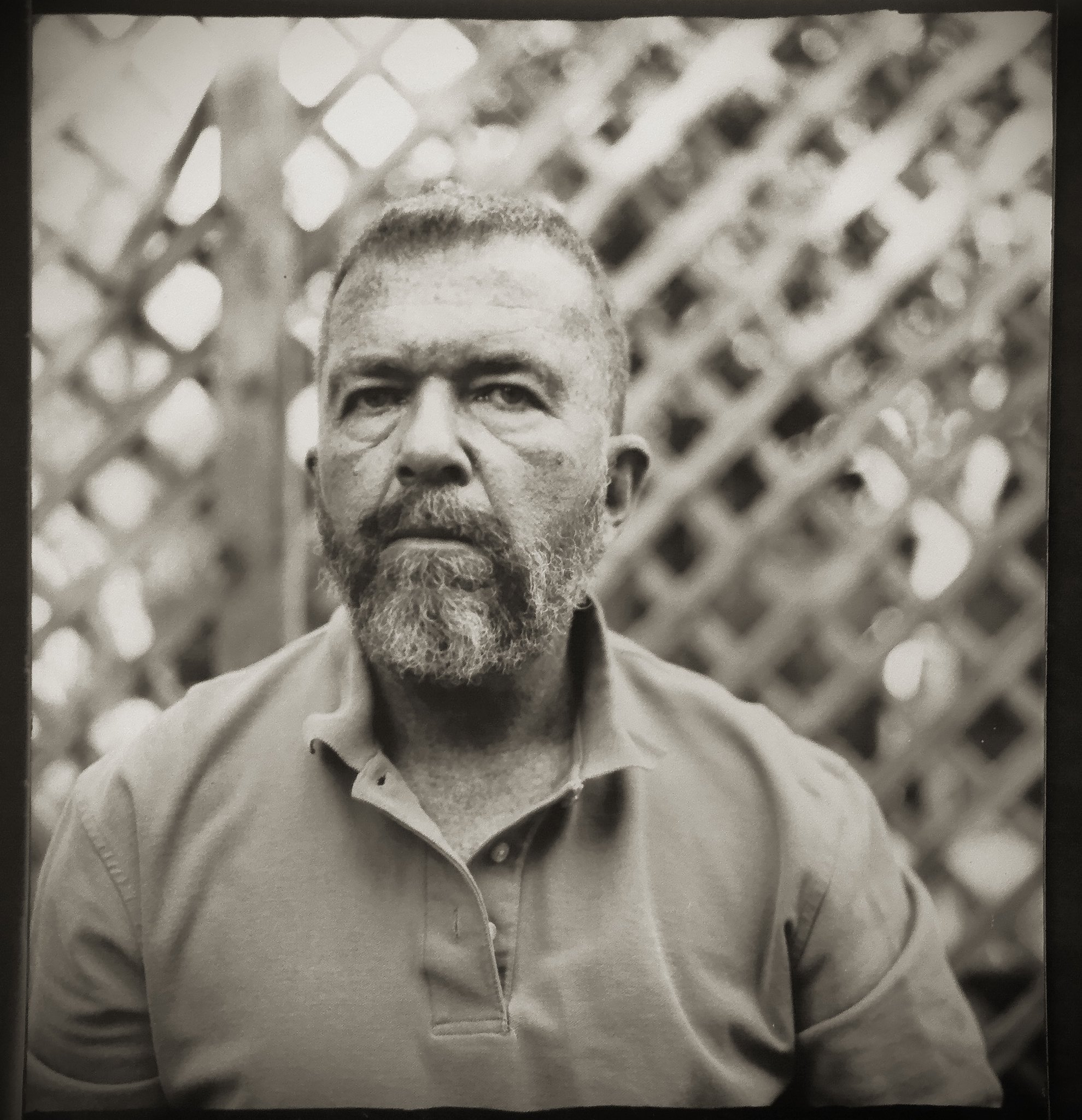
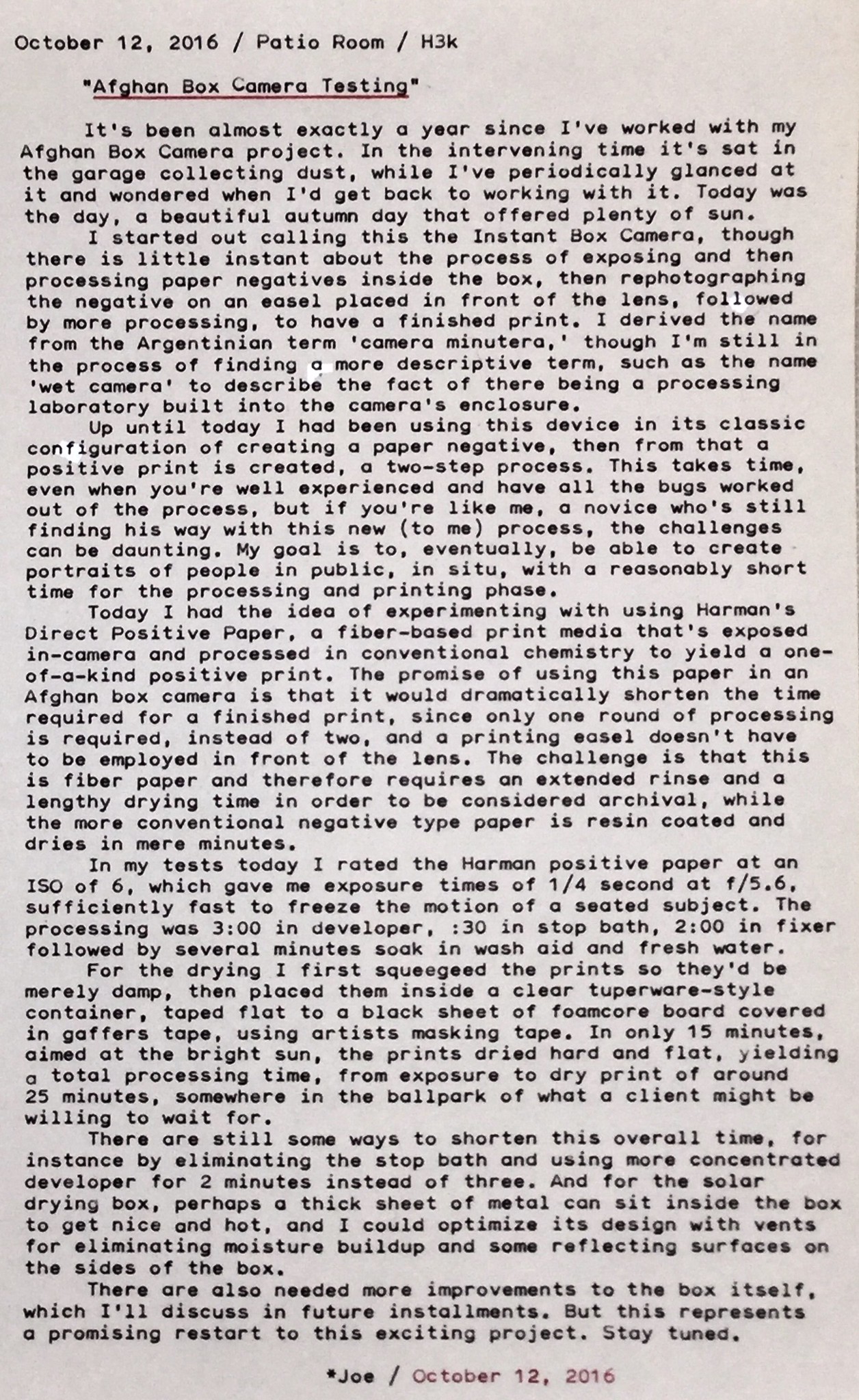
Afghan Box Camera Testing

Post-Script: I was surprised how fast the fiber prints dried inside a little hot box aimed at the bright midday sun. Optimizing the efficiency of the drying box will certainly speed up the overall process.

For the exposures I was reflective metering my face, situated in bright shade, with the Harman paper rated at around ISO 6. Eventually I'm going to want to also use some reflectors to get better portrait lighting, but I don't want to be encumbered with excessive amounts of gear, since I foresee doing this alone, with no assistant to help. I think if I hold a collapsible reflector it should work fine; I couldn't do that today because I had the shutter release cable in one hand and a focusing target in the other,and I was the seated subject.

The way I managed these selfie tests was to use a second tripod where I would be seated, with a focusing target, attached to the front of the camera with a string stretched tight and taped to the tripod. Once I focused the camera on the target I removed the tripod and put my chair in its place. When seated in front of the camera, I would stretch the string tight and place the target adjacent to my eyes, then adjust my head position up, down and sideways relative to the front of the camera; then slowly lower the target and, without moving my head or blinking, click the shutter.

Were I making someone else's portrait I'd have a free hand to manage a reflector.

I mentioned some changes I want to make to the camera. If I dispense with the stop bath tray, I can move the developer tray back to the middle of the box, giving me more room up front, under the lens, for a bigger and easier to operate paper safe for direct positive paper. Another thing is that the film format size, being 4-5/8" by 3-3/4", was designed to fit the film plane mechanism, rather than the other way around. It would be nice to enlarge the format size a bit, ideally to 4"-by-6" so that framing and display of the prints would be easier on the clients. I'm not certain if I can enlarge the film plane mechanism and it's focusing rod system without totally rebuilding the box; which if I had to do, would be easier just to build a new box from scratch.

I've had a newer design sketched out for a while, with vertical processing slot tanks, a vertical slot paper safe and a layout with the camera part on top and the processing area below, with the arm sleeve in between; think of a box that looks something like the shape and size of a desktop PC chassis sitting on the short end and you get the idea.

Labels: , ,

Tuesday, September 13, 2016

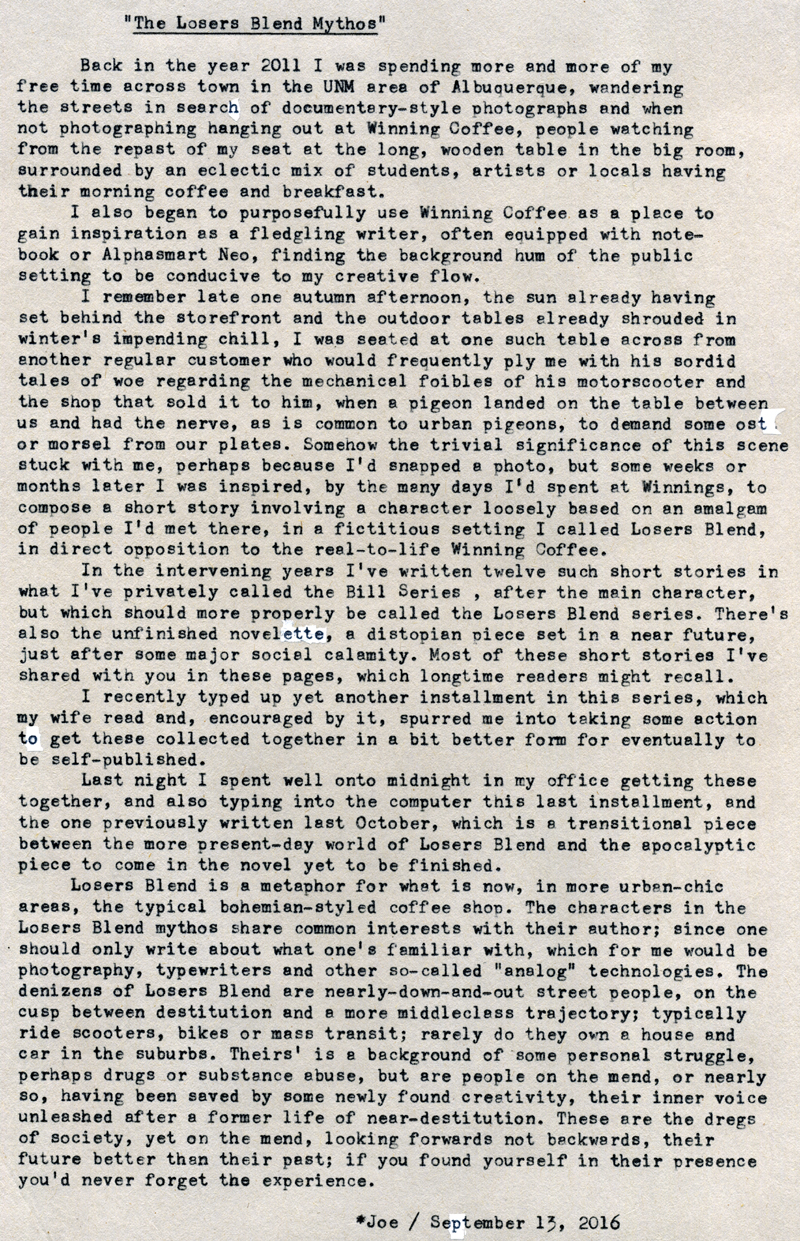
The Losers Blend Mythos


Typecast192

Post-Script: Here's the entirety of the short story series thus far, in the internal chronology of the story's world. The last part yet to be posted online is below, which comes second-to-last in the chronology.

1) "Pigeons" / Oct. 19, 2011

2) "Interface" / Nov. 1, 2011

3) "Barney The Cigarette Guy" / Nov. 14, 2011

4) "Healthy Respect" / Nov. 30, 2011

5) "Winter Crows" / Dec. 12, 2011

6) "The Guy Who Came in from the Cold" / Dec. 28, 2011

7) "Decrepit Underpinnings" / Jan. 22, 2012

8) "Two Lovers" / June 17, 2012

9) "Coming Home" / May 20, 2013

10) "The Real Deal" / May 29, 2013

11) "Some Future" / Aug. 23, 2016
(See below)

12) "Typing Like Your Life Depends on It" / Oct. 1, 2015


You might notice that a number of these stories were written in a short period of time, spanning October 2011 to January 2012, in what I consider to have been a most creative period of my life. It's difficult to manufacture creativity, but I must have been doing something consistently good; perhaps merely hanging out at Winning Coffee had some effect.
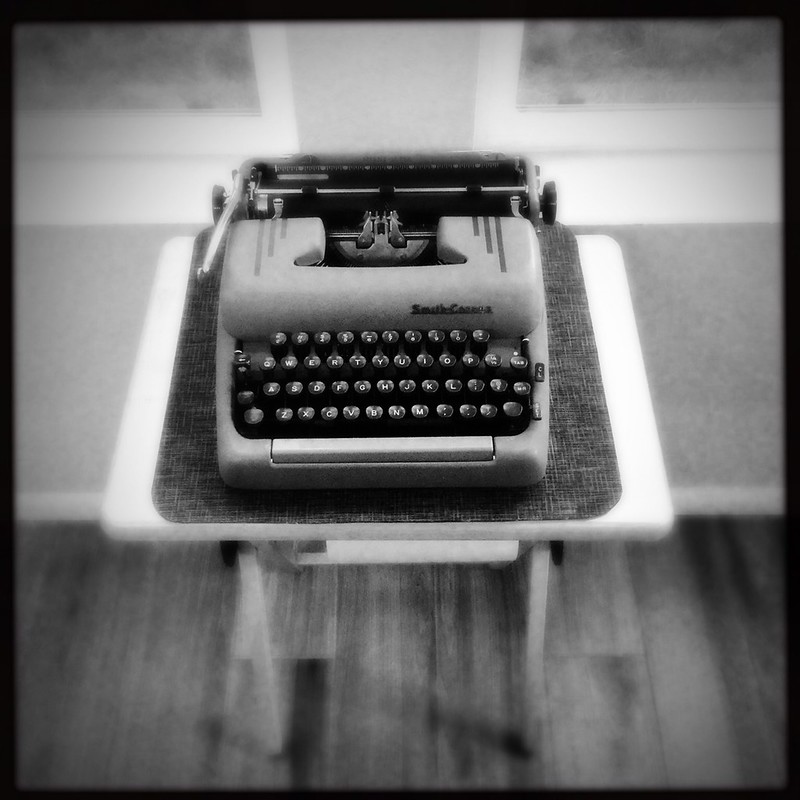
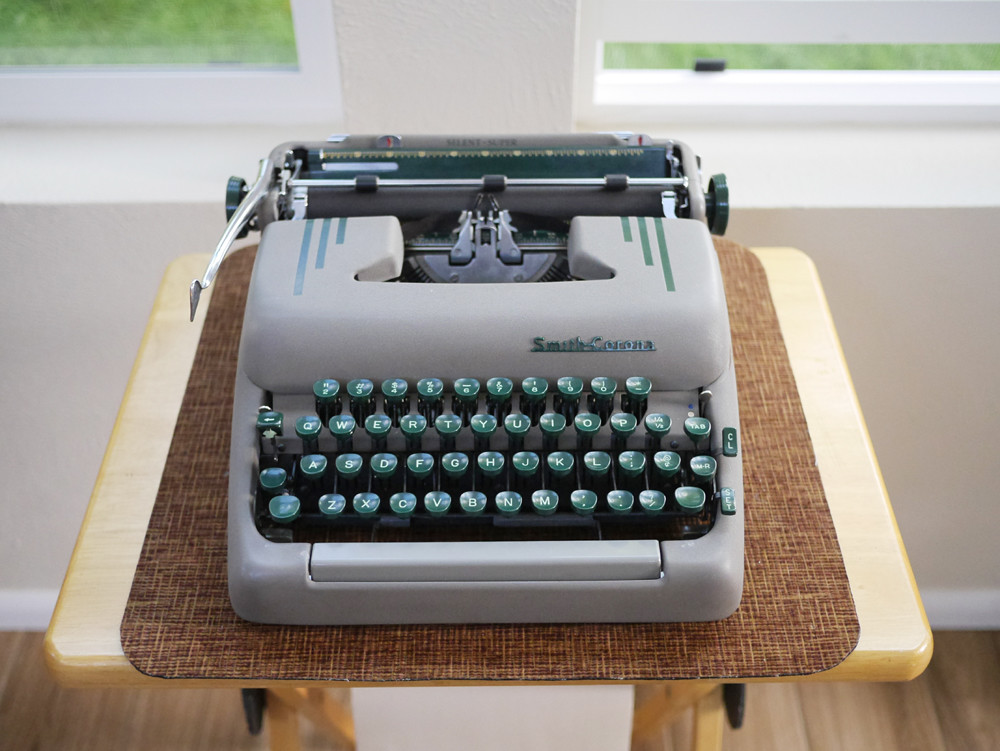
Smith-Corona Silent Super

The eleventh story in the chronology, "Some Future", is posted for the first time below. I composed it on the Smith-Corona Silent Super, a typewriter that is of the same ilk as the denizens of Losers Blend, for it too was rescued from a former existence of bohemia and the dregs of society, requiring plenty of work, and even now remains noticeably less-than-perfect, but therefore possesses a quaintness because of that troubled background. This is a reformed beatnik typer, yet still possesses the spirit of that Kerouac technology, despite all the work I've put into reforming it into some model of middle-class Americana. It possesses a free spirit, always reminding me of its scars and troubles, as is fitting for a beat typer. One should always respect one's beat typer, for they are the artist-typers of our culture, the ones we should grab first when we wish to channel our inner Muse and capture onto ink and paper a bit of the whimsy of the aether.


"Some Future"
by Joe Van Cleave

Bill threaded the scooter between traffic and rows of parked cars, finding the ramped curb where Harold the store clerk rolled his dollies of produce from the double-parked delivery trucks, early in the morning. Finding his favorite spot on the sidewalk between the newspaper box and light pole, Bill lifted the seat and extracted cable lock and shoulder bag, securing the rig as he'd always done, then headed halfway down the block to Losers Blend, indicated by the mess of tables and chairs on the wide, brick sidewalk, filled with mostly an assortment of college students, street people and hipsters posing as the former. The smell of hand rolled cigarettes and vaporizers filled the autumn air, unseasonably warm.

The aroma of fresh ground coffee, garlic and cayenne pepper from the kitchen greeted him as always, a comforting familiarity in his otherwise hectic existence. "Morning, Todd."

"Morning, Bill. The usual?"

"Yea. And the Times. I'm feeling rich today." Bill didn't always read the news, but sometimes he made exceptions.

Coffee and paper in hand, he made his way to the corner table, ordinarily cluttered with a mess of magazines and sections of yesterday's paper, a catch-all that the old crew knew was actually Bill's reserved table in disguise. He quickly gathered up the detritus of old news and stacked them, in one graceful heave, into the spare chair, then sat down, neatly arranging his coffee, shoulder bag and paper.

Just in time, Maggie, the new gal, brought him his breakfast. "Here you are. Can I get you anything else?"

"Just keep the coffee coming, thanks."

"Well, we normally don't do refills, it's serve yourself."

"I know. But then again, nobody's come here as long as I have, and it's become a kind of tradition, one that Marty started, years ago."

"Oh, you're the special customer. I see. Sure, no problem."

"Special customer? No, not really. I just like tradition, that's all. Otherwise nothing special at all about me."

As Maggie turned to leave, Bill realized his special status as the closest friend to the late founder of Losers Blend was a soon passing phase, one that would be lost to the changes that time brings. Just as cultures evolve, the old Losers Blend would soon be forgotten.

He didn't exercise his special status out of some ego-driven motivation, but as a way of remembrance, or so he liked to tell himself. Remembrance for the way things used to be, for the special person Marty had been, and for their special relationship, forged by a bond that only comes from drastic circumstances. Though he didn't want to think about those dark times, he also didn't ever want to forget. That was the whole point of the messy table in the corner, the one Marty used to sit at during his breaks from the kitchen, back when Losers Blend was just starting and the idea of a bohemian coffee shop was an oddity to middle class sensibilities.

Digging into his breakfast, the chile was as hot as ever, the one thing, aside from the good coffee, that hadn't changed with Marty's passing. Pausing with elbow on table and forkful at mouth, Bill could still recall, as if it were just yesterday, when they'd first met.

Bill's had been a hard childhood, with his mother dying when he could barely walk and then his dad's years of struggle with drink. He'd been passed around from one family member to another, first his grandparents, then an aunt, then another aunt, until he was sixteen and decided enough was enough and he ran away, to start his adult life a few years earlier than his peers, whom he didn't know, having moved from city to city and school to school, always the loner, the outsider, the new guy.

At eighteen he tried to join the Army but failed the entrance exam. People told him you had to be pretty dumb to fail the Army exam, as dumb as a box of rocks. For a while he started to believe it himself, until one day when he found himself on a bus stop bench voraciously reading a discarded paperback novel and suddenly looked up and the world around him looked different from what it had been a half hour earlier, as if those words printed in that grimy, dog-eared novel had been a key that unlocked something deep inside him, like shedding a thin veneer that'd covered his eyes and obscured the truth. Ever since then, he'd been on a journey of discovery, bouncing around from one situation to the next but always with his mind set forward, to some future that only he could see, a future anyone else who knew him at that time would be hard pressed to imagine could ever circumvent the situation he'd been in then.

And then he met Marty, a fellow vagabond like himself, and at once they both knew they'd found brothers in each other, the family they didn't have. Marty and Bill hung out together, ran the streets together and did whatever they could to get by, sometimes doing things they knew were trouble, but justifying it with the reason that they were desperate, and desperate people had to do what they had to do. Survival was the motto on the streets.

But Marty and Bill weren't dumb. They knew enough of the streets and the people on them to know that once you fell to the allure of the bottle or the needle or the pipe, you were a goner; that the way forward and up would be much harder. And they both shared a common vision for the future, one in which they both could keep a bit of their present freedom while somehow making it in life, threading that narrow needle's thin gap between slavery to The Man and succumbing to the flesh.

Bill suddenly realized he'd been staring out the window, the food that had once been on his fork now staining the front of his shirt, and Maggie had refilled his coffee while he'd been away in his private reverie. And this was how he came to understand that he'd crossed over some crucial milestone in life, when instead of all his energy being consumed in striving for a seemingly unattainable future, he spent more and more time recalling a past that was even more unattainable. The future was certain to happen, though maybe not the future one hoped for; but the past was gone forever, its only evidence distant memories and some artifacts, like bones unearthed and preserved in our private museums, memories of the kind one finds prodded into surfacing from the dark pond of life by snapshot photos in crusty old albums.

The morning rush now over, Todd was busying himself with cleaning up and preparing for the noon rush when he noticed Bill standing at the counter. "Need a refill?"

"No, Todd, thanks anyway. I'll be going now. And the table in the corner, you should clean off those old newspapers, I'm sure somebody'd like to use it."

"Later, Bill."

But Bill didn't answer, or didn't hear him. He exited out the grimy glass door into the morning light, bag on shoulder, without looking back, his face set on some future only he could see.

Labels: , , , ,

Tuesday, September 06, 2016

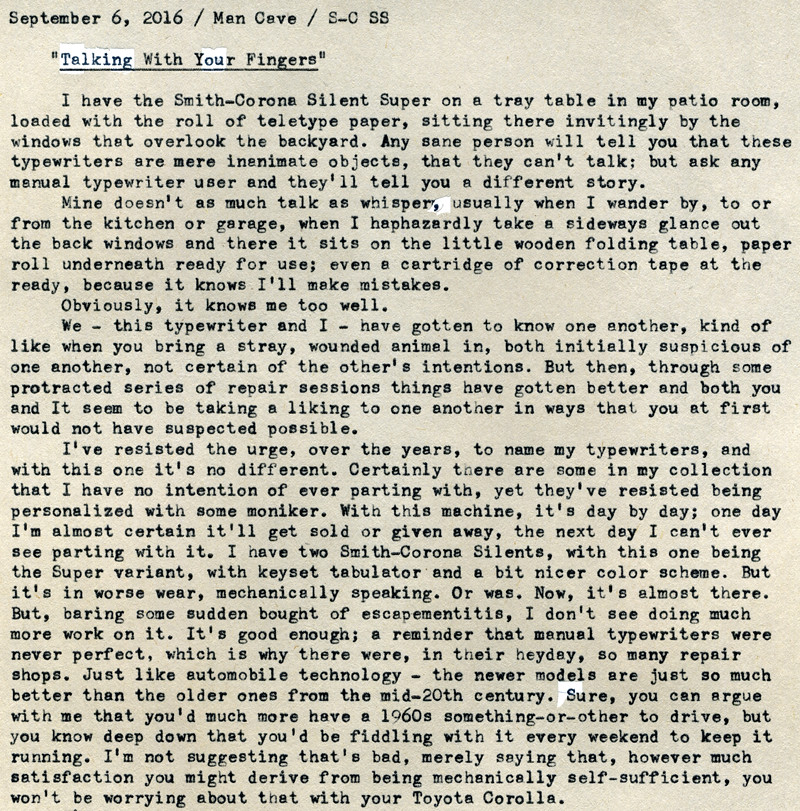
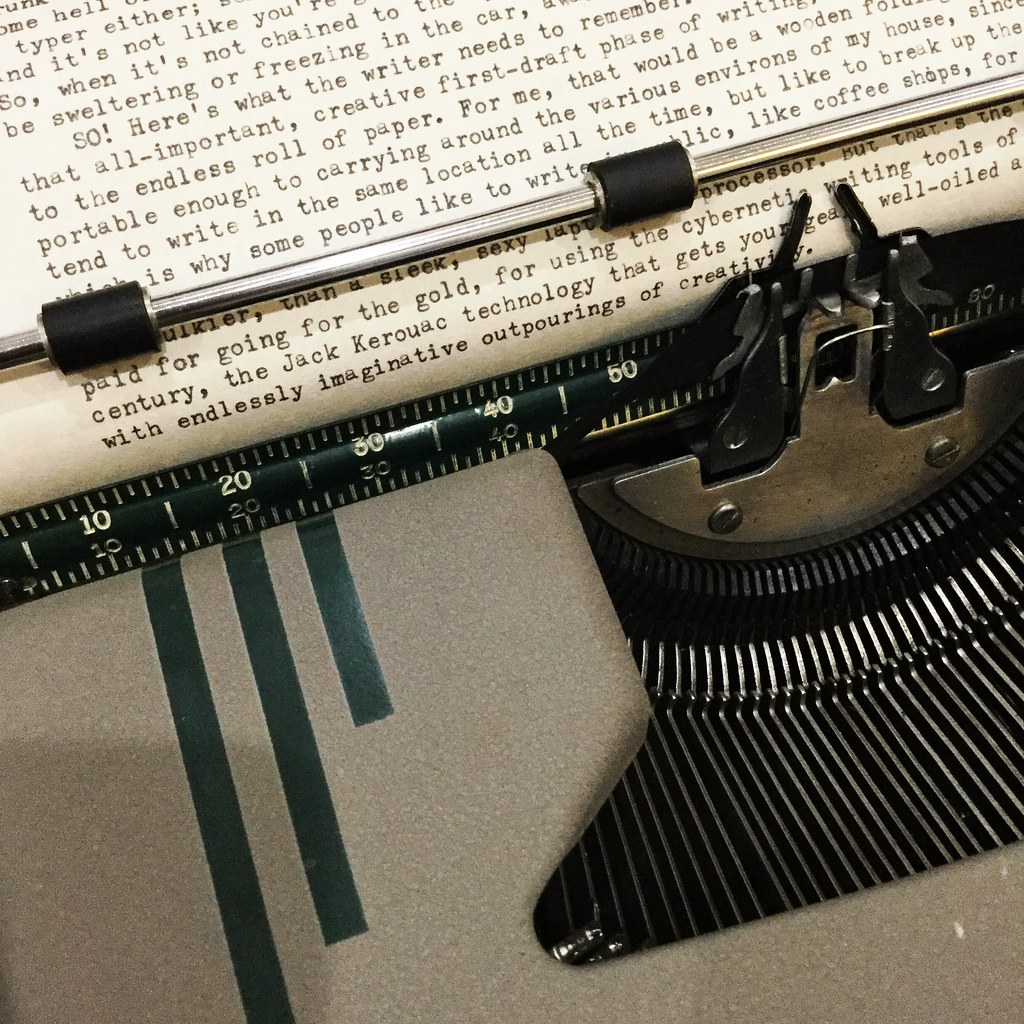
Talking With Your Fingers

P1010007a
Typecast190
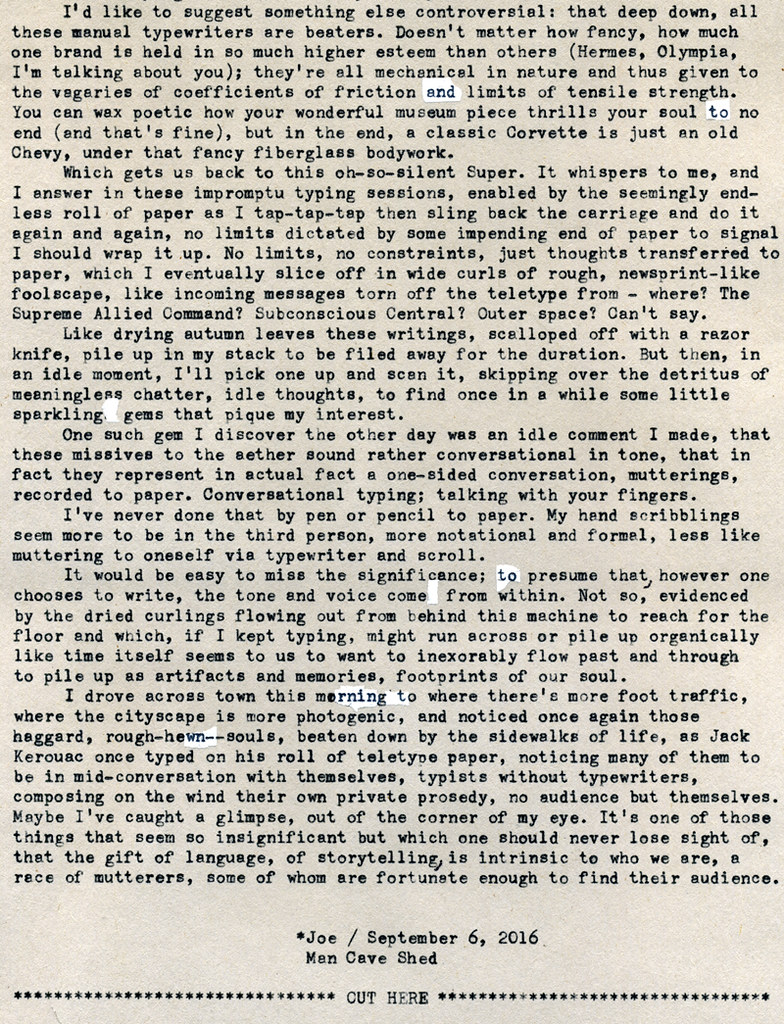
Beater Typer
Typecast191

Post-Script: The reference in that last paragraph to Kerouac's On The Road was unplanned, but perhaps inevitable, given the nearly identical method of composition. I've read On The Road numerous times, but never in the context of it being a work specifically wrought onto teletype paper via manual typewriter, in some manic act of marathon muttering. Perhaps a reread is warranted.

I find the smaller font size of the Silent Super to be ideal for this kind of writing, as it seems more like letter-writing, more personable, requiring an up-close read, an intimate squint into one's own soul.

Misspellings and typographic errors courtesy of the author.

Labels: , , , , , ,

Tuesday, February 16, 2016

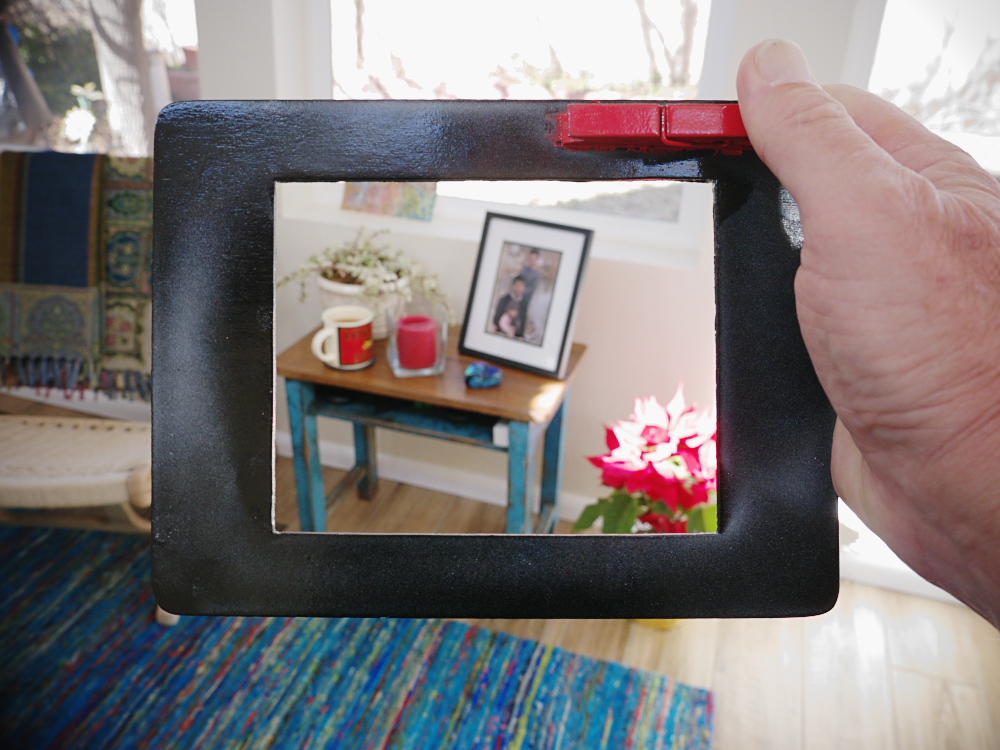
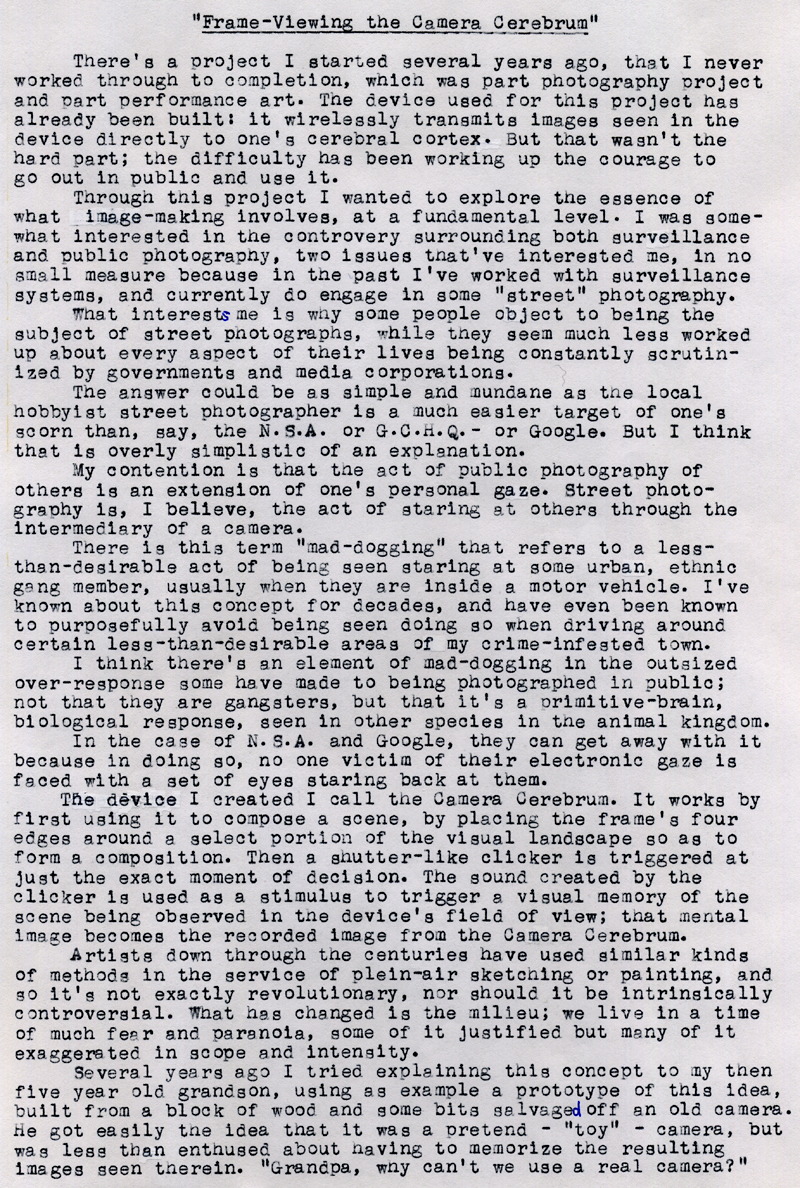
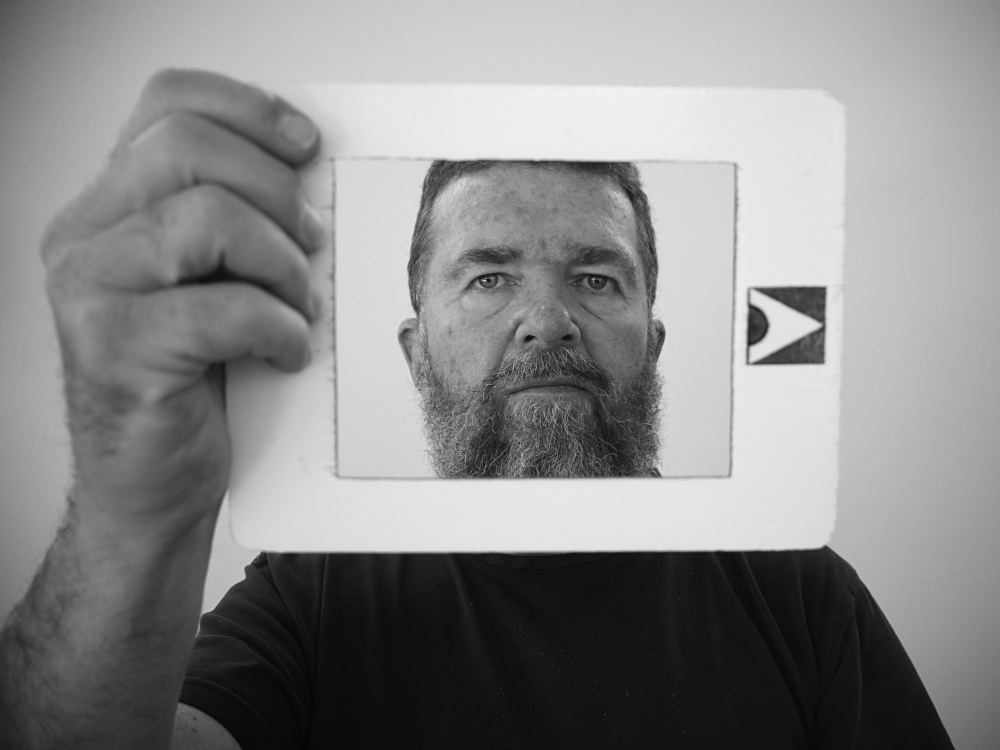
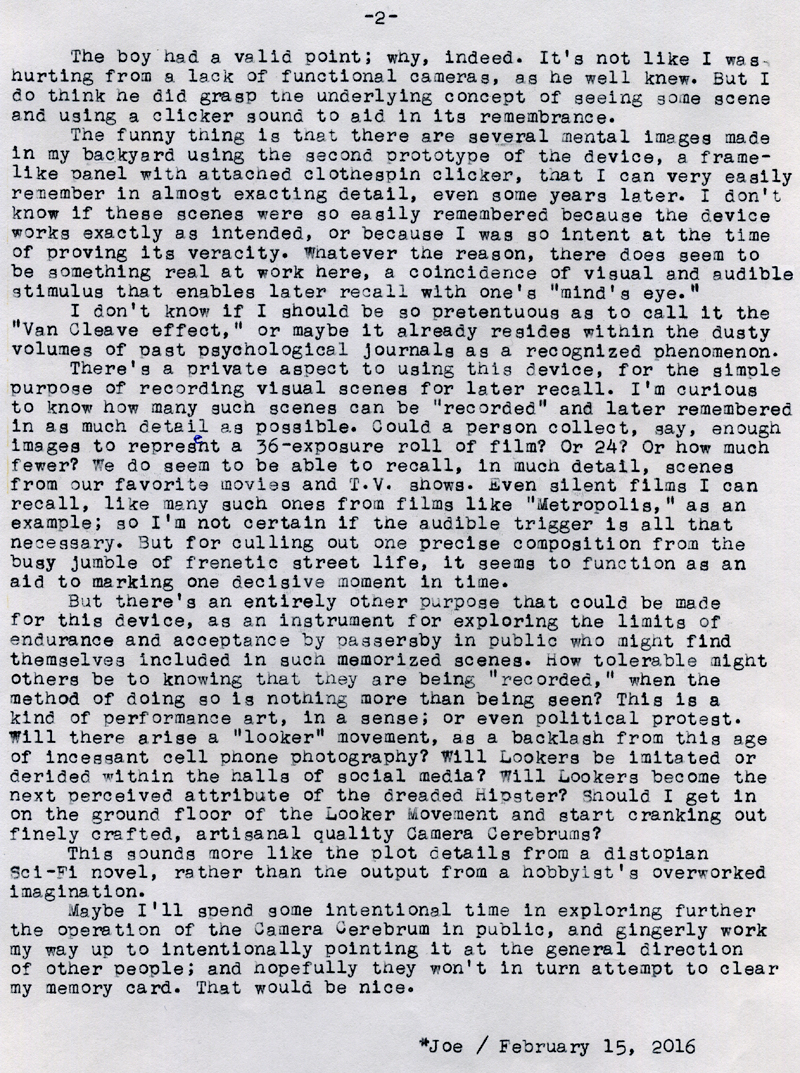
Frame-Viewing the Camera Cerebrum

P1110747a
Typecast139
P1110754a
The Watcher being watched - illustrating the two-way nature of public photography

Typecast140

Post-Script: I've blogged about this before, some years ago (though I haven't included a link), and discussed it a bit on the F295 pinhole discussion forum at one point. I see a connection between what I've termed "frame-viewing" and plein air painting or sketching in public, the difference being that, in this case, the only record of the image is internal to the "fauxtographer" himself. So in theory it should be a pastoral enterprise, innocent enough, indicative of the higher intentions of a learned and sophisticated culture. Yet it is bound to remain controversial, if for no other reason than the fact that humans aren't the only species who exhibit a physical reaction to being gazed upon by another. It is this fact, of a biological response, that should preface all other discussion around "street" or other forms of public photography, or even surveillance.

My trepidation over pursuing further the public phase of this project is based on my personality trait of desiring to avoid all confrontation. That is why I would never make a real good street photographer, or even photojournalist, even though I've amassed a sizable portfolio of urban landscape and documentary images; they've mostly been devoid of the direct human presence.

I can also easily see the common-sense aspect to many people's objection over being publicly gazed upon, since in our present culture there's an ever-grayer line, and increased fear, between valid public image-making, and voyeurism or even exploitation. I don't think this project is intended to address or in any way dispel these concerns, either, for that is not my interest.

What does interest me is the relationship between the photographer, the subject, the camera device and, in the case of recordable images, the resulting photograph itself. I think these complex relationships inform much of the greatest publicly-situated photographs from the 20th century. I do find it fascinating that this simple framing device is able to provide some fresh insight into this ongoing subject, hopefully contributing to some ongoing dialog about the relationship between imagery and observation within our culture.

It is very possible that we desire to gaze upon others because in doing so we also see ourselves in them. That might help explain the continuing yet inexplicable popularity in the "selfie" as a photographic genre, whereby the technology has sufficiently advanced to the point of enabling a continual self-photography, a magic mirror we hold up to ourselves. It is also possible that none of this is entirely novel, since mirrors have been around for millennia.

Photos via Lumix G5. Typecast via Corona 4.

PPS: I should also make mention that back several decades ago there were viewing devices very much like this frame (but without the clicker device), manufactured and sold for use by large format photographers as an aid in culling out potential compositions. In use, the photographer would traipse around the rugged wilderness with viewing frame attached to a neck lanyard, without the bother of lugging along his entire camera, tripod and other gear. The viewer would be set up to simulate the same angle of view and format aspect ratio as the camera and lens being employed. When a potential scene was found, notations would be made in a notebook, after which the photographer could return at a later time, with his entire kit in tow, to make the exposure.

PPPS: After some concerted blog searching, here are all the past articles I could find that pertain to this project, either directly or by inspiration. You can see that the roots of the camera cerebrum go back at least as far as 2007.

http://joevancleave.blogspot.com/2013/03/camera-cerebrum.html

http://joevancleave.blogspot.com/2013/03/mental-photography.html

http://joevancleave.blogspot.ie/2009/07/fauxtography-revisited.html

http://joevancleave.blogspot.ie/2008/02/fauxtography-and-icons.html

http://joevancleave.blogspot.ie/2008/01/photography-and-surveillance.html

http://joevancleave.blogspot.ie/2007/04/cryptostenography-in-panoptic-culture.html

Labels: , , , , , , ,