 I
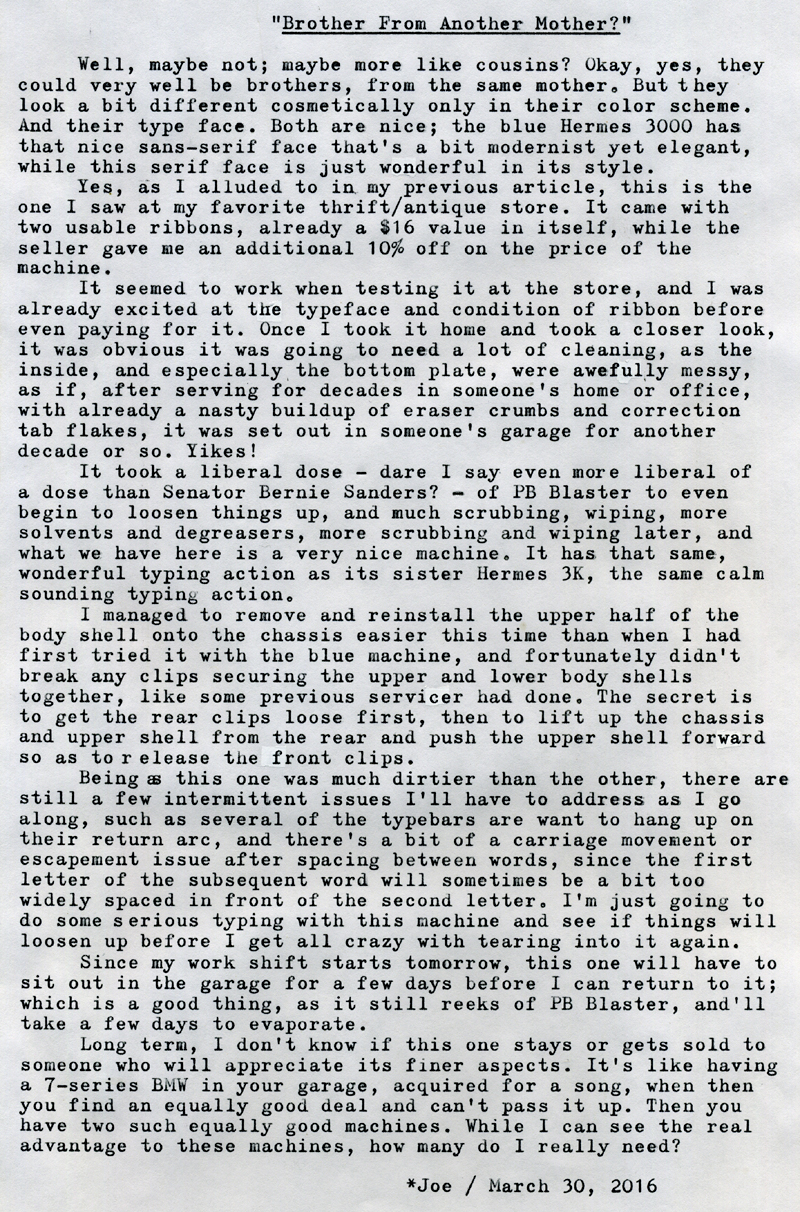
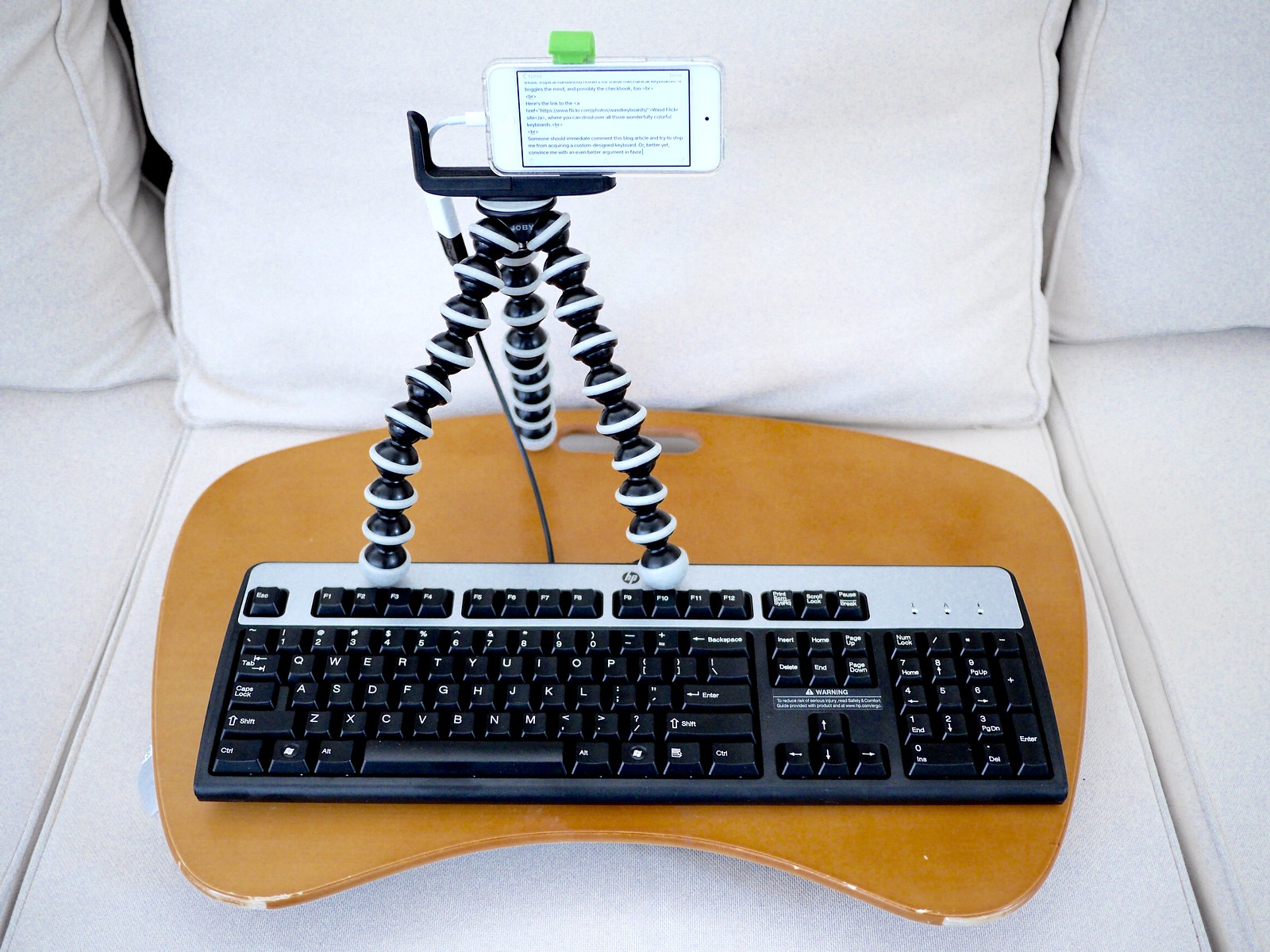
I'm doing this crazy techno-mashup that's not supposed to work, and that's likely to infuriate both the digerati and the Typosphere, which is to plug a standard USB-wired PC keyboard - one of those wide decks that's about the size of a miniature skateboard, minus the wheels and trucks, that has the function keys and ten-key-pad off to the right, so far off to the right that if you were using a mouse with your right hand your right elbow would be in the next county, and you'd certainly be showing signs of carpel tunnel - into my little iPod Touch, via its standard USB adapter.
No, it's not one of those sleek, Apple-looking wireless keyboards with those rubbery chicklet keys, that advertises you're somewhere in the 21st century; no sir, this is one of those clacky desktop keyboards that shouts "1980." Actually, it's not that cool; just a standard HP keyboard from the last decade. But where to mount the tiny iPod Touch so as to make this a practical writing rig?
My wife, smart as she is, immediately knew the solution, which was to employ the lap desk. So now I'm seated in the backyard, under our big tree, on a cloudy, late Summer's day, with this big keyboard and the tiny Joby Gorilla Pod holding the dinky iPod Touch. At least the black-and-white theme of the HP keyboard matches the tripod's. Not that fashion statements matter at this late date.
This little iPod has a very small battery, smaller than an iPhone's, so battery life is an issue. When I'm not actually needing to be connected to WiFi I set it to airplane mode; and now with this wired keyboard I also don't need to be wasting more battery juice with blue tooth turned on.
How I found out about using a standard USB keyboard on an iOS device is because I was on one of those Internet fixations the other day, researching so-called "60%" mechanical keyboards, and came across a keyboard discussion forum (you knew there'd be such a thing, right?) where this was mentioned.
I have this hate/hate relationship with full-sized keyboards, the ones with 110 or so keys and all those extra keys off to the right; that, if you're a touch-typist like me, with your fingers on the home row, your hands are centered about 1/3 of the way over from the left side of the keyboard. Which is an issue with certain workstation setups, like just about every one in the factory where I work, that equip each station with just enough room for one of these wide behemoths, and position the monitor over the middle of the thing, so that us touch-typists can't have the alphanumeric keys and monitor centered in front of them; and also us right-handed mouse users are relegated to a very non-ergonomic position. I've taken to mousing left-handed while at work, just to take the strain off my right shoulder and wrist.
I don't use those ten-key-pads off to the right; I never worked in a grocery store as a clerk, back in the days before barcode scanners, when the clerks would pick up the can of beans out of your cart with one hand, read the price on the little sticky paper label and, without looking, key in the price on the cash register with the other hand. I remember in high school the math department had classes that taught students how to be fluent in touch entry on adding machines and cash registers and such. It would be only a decade or two after that and such skills would be entirely obsolete.
The desk in my office is one of those big cherrywood colored, Scandinavian-styled corner units. You'd think I'd have plenty of room, but with all the clutter I like to accumulate, such as scanner, printer and a plethora of books and papers, a full-sized keyboard is kind of a nuisance. There's also a typewriter on the desk, but that doesn't count as clutter, of course. What I really want is a smaller keyboard.
A practical person would go down to the nearest big-box retailer and pick up for cheap a medium-sized keyboard, one without the ten-key-pad off to the right, but one that still has the top row of function keys and the navigation keys on the right. But I'm not a practical person; especially after I discovered so-called "60%" keyboards, ones that only have the alphanumeric keys and the few additional ones immediately adjacent, no function or navigation keys; instead, they use a program key that accesses three other key mapping layers.
These tiny keyboards seem to be popular with geeks who like to attend gaming conferences and don't want to travel with their full-sized keyboards, that are as big as their skateboards. Also, there's this popular fascination with mechanical keyboards, that I suspect any typewriter fanatic could appreciate, much like the way a film photographer can appreciate Fuji digital cameras that appear somewhat film-camera-like.
While IBM model-M keyboards enjoy a legacy of being the standard in mechanical keyboards, the big name in mechanical keyboard switches these days has been Cherry, and they have a full line of such switches, each with a different kind of feel (detent or linear, with a variety of force settings), that are identified by color. Cherry Blue switches are the most clicky feeling, and the loudest, with the Cherry Browns being more subtle, followed by the Cherry Clear switches. Since keyboard touch, as any typewriter fanatic can tell you, is such a personal thing, buying into such an exotic keyboard should not be done without first a bit of research. Luckily, there are sample switches you can buy. I just ordered, from Wasd Keyboards, a 6-key Cherry sampler, that I hope will give me more information before I embark down the road of acquiring a custom mechanical keyboard to my liking.
There is also, as with any technological field of interest, more exotic keyboards and switches. Some of these Japanese magnetic reed switch keyboards have attracted interest, like the way that denizens of local coffee shops like to denigrate Starbucks as being "so corporate." The more exotic the better, like small lines of exotic Japanese denim jeans, ones that are so pricey that you can't afford to wash them. There's also an interest in legacy keyboards by many young folks, with pre-PC mainframe keyboards and early Apple models in high demand.
Stylistically, I'm somewhat attracted to the control consoles of nuclear command centers and other military computer systems, like what you'd see in the film "War Games," or what we saw, earlier this year, when we visited the Titan II Missile Museum, south of Tucson, Arizona. "Don't press the red key, that launches the missile." It would be so cool to have a keyboard with a red key that said "Launch," or maybe "Apocalypse Now."
I'll probably buy my keyboard from Wasd, because they offer this spectacularly personalizable 61-key keyboard where you can choose the color of each key - yes, think about that for a second: each key can be customized with whatever color you choose, even artwork - along with your choice of labels. They have a Flickr account where you can view, in jaw-dropping color schemes, all the hundreds of custom keyboards they've fashioned for customers.
Some of these color schemes directly remind me of the pre-Personal Computer era, when mainframes were controlled by these colorful banks of switches. Certainly, some of the designs are a bit too much, like alternating the color of every other key, just to be different; but other color schemes seem simultaneously practical and beautiful.
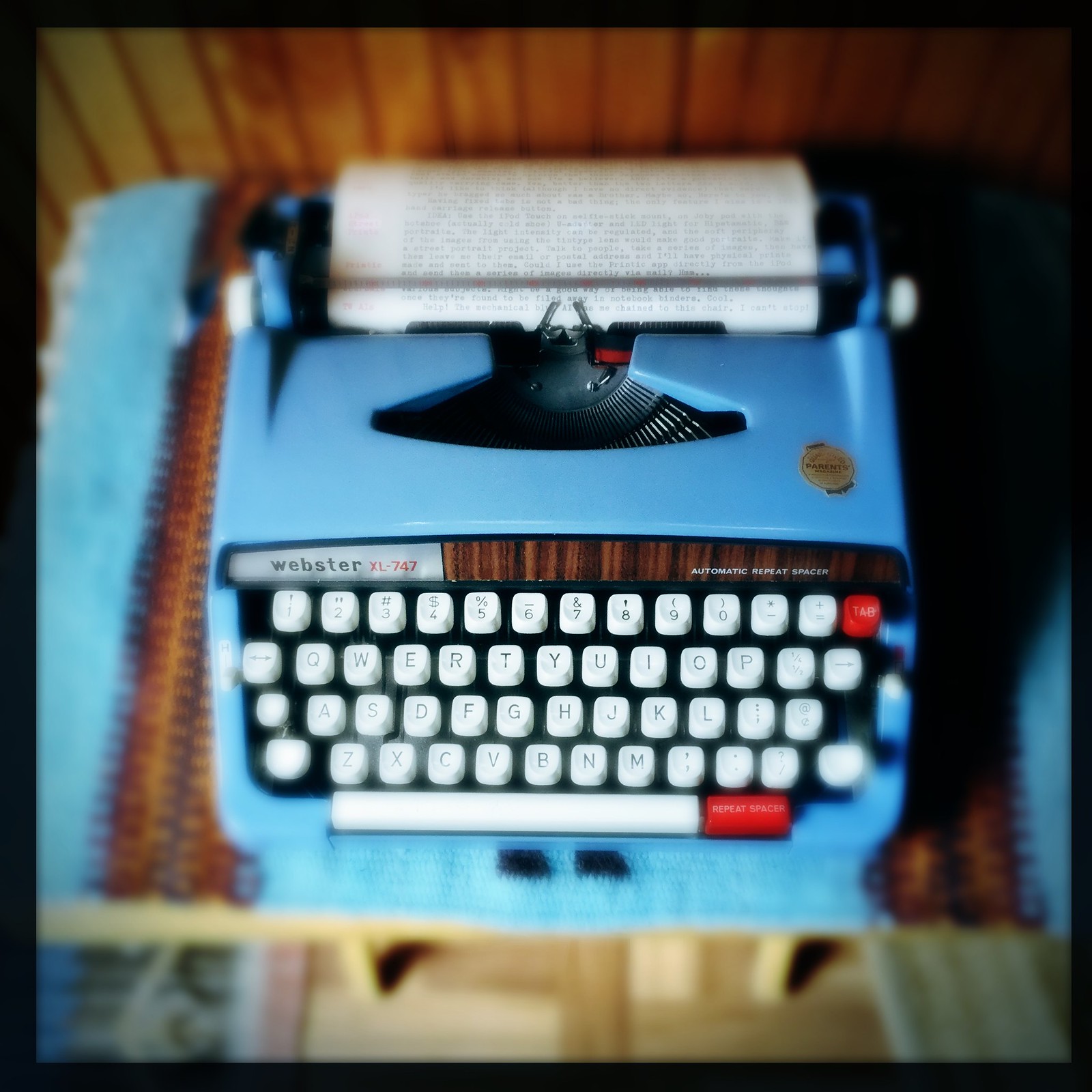
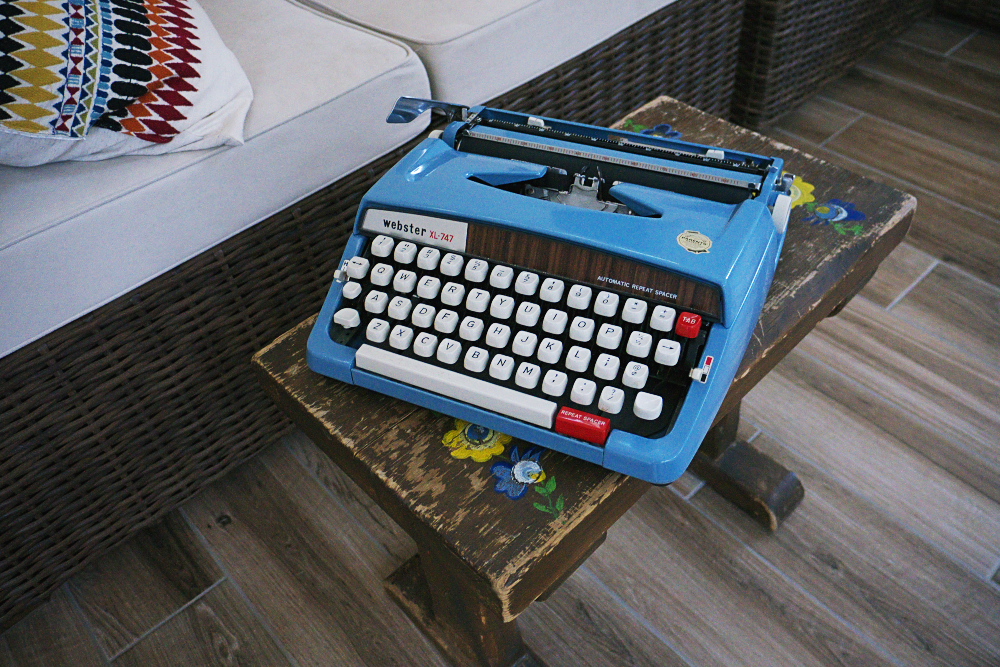
I was seated at this same spot in the backyard yesterday, typing on my robins egg-blue Webster XL-747 typewriter, with white keys, bold black labels and the red tab and repeat spacer keys, when it struck me that this would make a dandy color scheme for a custom keyboard. I'm thinking the letter keys would be white with large, black labels centered on the keys; the number row would be robins egg blue and the surrounding keys (control, shift, caps, tab, escape, enter, backspace) would be bright red. Not red, white and blue for patriotic reasons, but in honor of this wonderfully pretty typewriter from the 1970s.
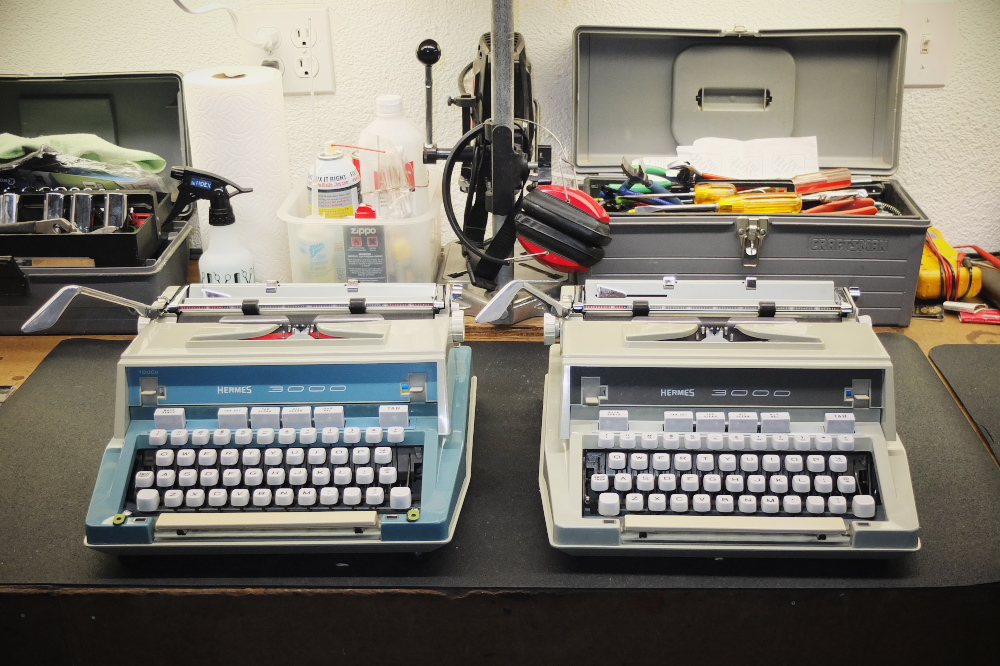
I must not be alone in my appreciation of the color schemes of manual typewriter keys, because I also saw a photo of an all-green 60% keyboard, inspired by the Hermes 2000/3000 line of typewriters.
This fascinates me, that manual typewriters could serve as design inspiration for modern-day, tech-savvy computer geeks and gamers; people who are decidedly not part of the Typosphere and typewriter blogging community. Sometimes you have to step outside of your own cultural community to see the wider picture of how much typewriters have inspired and informed the culture at large.
Which reminds me, on a side note, that I walked into a Goodwill store about ten minutes after someone found an Olympus SM-3, in burgundy trim, for $5. She was kind enough to let me take a peek inside that wonderfully round carrying case, but I couldn't talk her out of her intended purchase. Which is fine, since I have 11 typewriters, and this will be her first. Spread the wealth. But still, such a nice machine for five bucks. It boggles the mind, thinking about all those potential great bargains I've missed by not being on constant patrol of the thrift stores. Best not to think of it, since I've been reminded repeatedly, by She-Who-Must-Be-Obeyed, that I have enough typewriters for now. Uh huh.
This combination of clacky keyboard and iPod Touch reminds me so much of the Alphasmart line of word processing keyboards. I've visited their Flickr site many times, and read many of the discussion threads, but can't recall mention of this easy way to simulate an Alphasmart system with an iOS device and standard USB keyboard.
I'm thinking that another way to incorporate a miniature 61-key keyboard, in a personalized color scheme, with an iOS device would be to build some little bracket device that attaches the iPod Touch right behind the keyboard, elevated at a convenient viewing angle.
Oh, did I mention that there are also wooden (yes, wooden - think exotic tropical hardwood) holders for these mechanical keyboards? It boggles the mind, and possibly the checkbook, too.
Here's the link to the
Wasd Flickr site, where you can drool over all those wonderfully colorful keyboards.
Someone should immediate comment this blog article and try to stop me from acquiring a custom-designed keyboard. Or, better yet, convince me with an even better argument in favor.
Labels: Hermes, hybrid typewriters, Tucson, typewriter collecting, typewriter renaissance, Webster XL-747, word processors