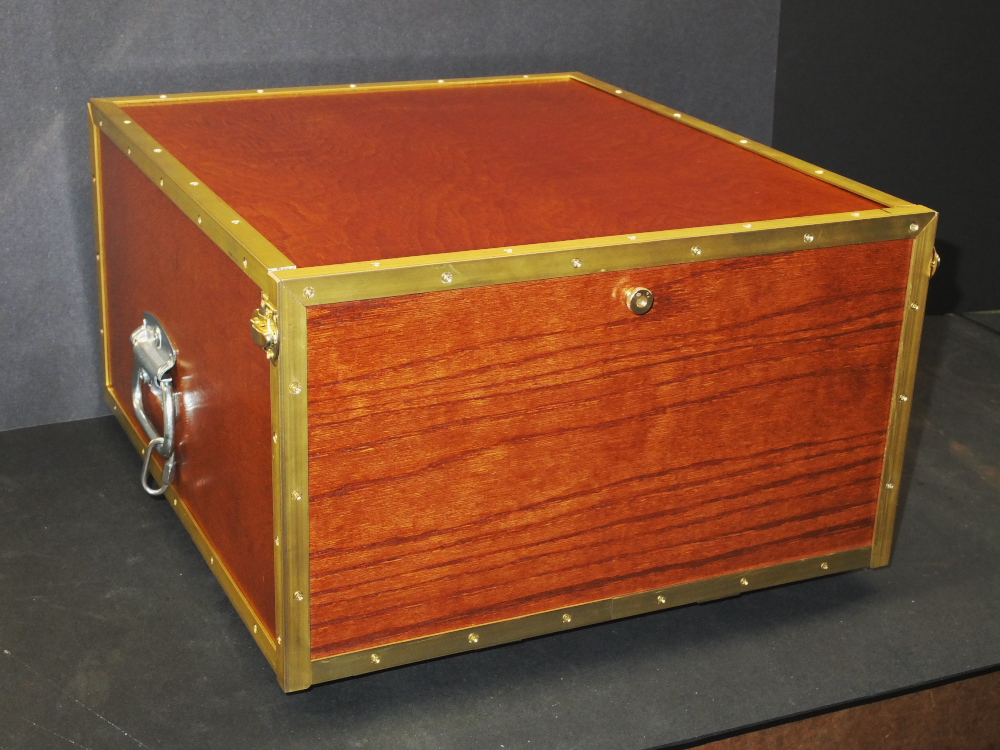
Nekkid-Riter Storage Box + More
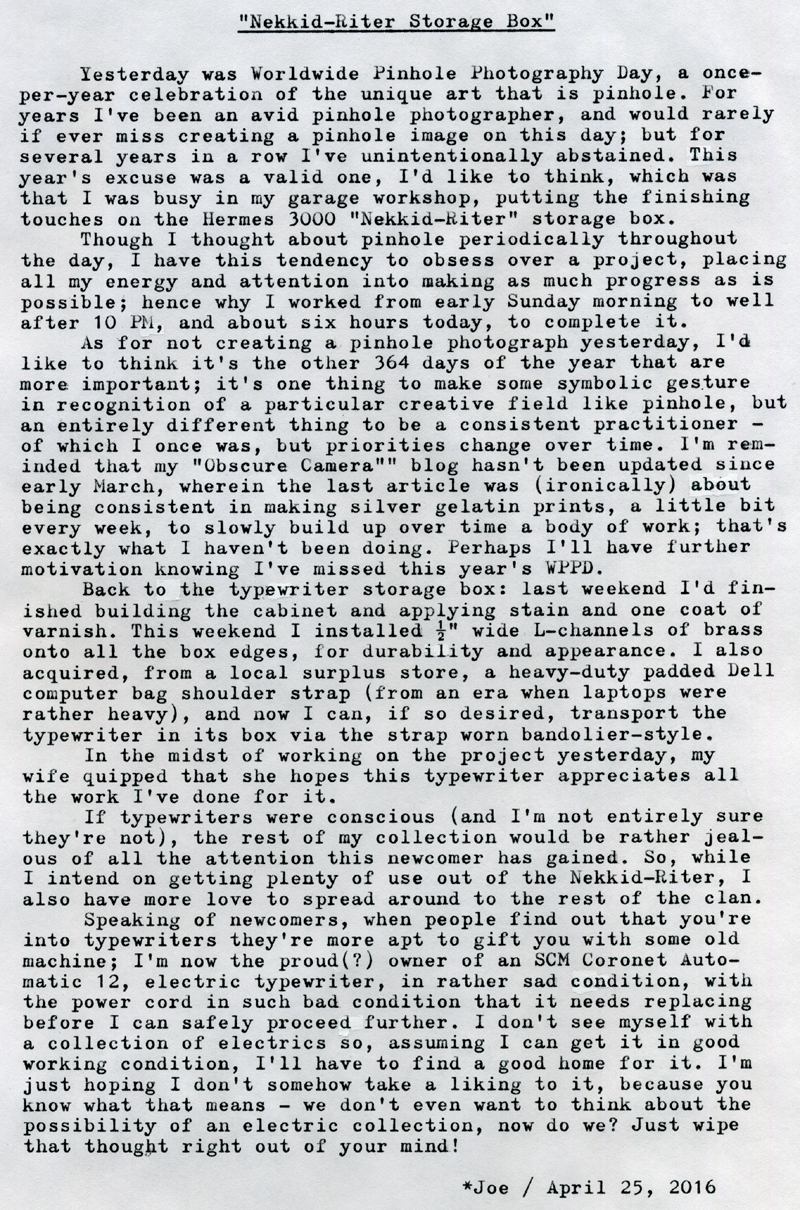
Post-Script: Typecast via Hermes 3000 Nekkid-Riter. I wrote that last paragraph partly in jest, earlier today after having completed the storage box for the Nekkid-Riter. But later on, I decided to take a look at the electric Coronet Automatic 12. I used an old extension cord to replace its original power cord (that was spliced in two places, badly frayed and with an intermittent open near the plug). Upon powering it on, lo and behold it works! I spent the next hour or two cleaning, degreasing and lubricating. The insides are still not entirely clean, since I only hit the critical areas where debris and residue might affect the machine's operation, rather than spotlessly cleaning every surface.
The carriage rails were grinding, so a thorough cleaning, degreasing and re-oiling has smoothed it out nicely. I spent a lot of time cleaning the type slugs with alcohol, swabs and toothpicks, the result being that, with its new ribbon, it types very nicely. The body and storage case were filthy, so plenty of window cleaner, swabs and paper towels were consumed, but the results are enticing.
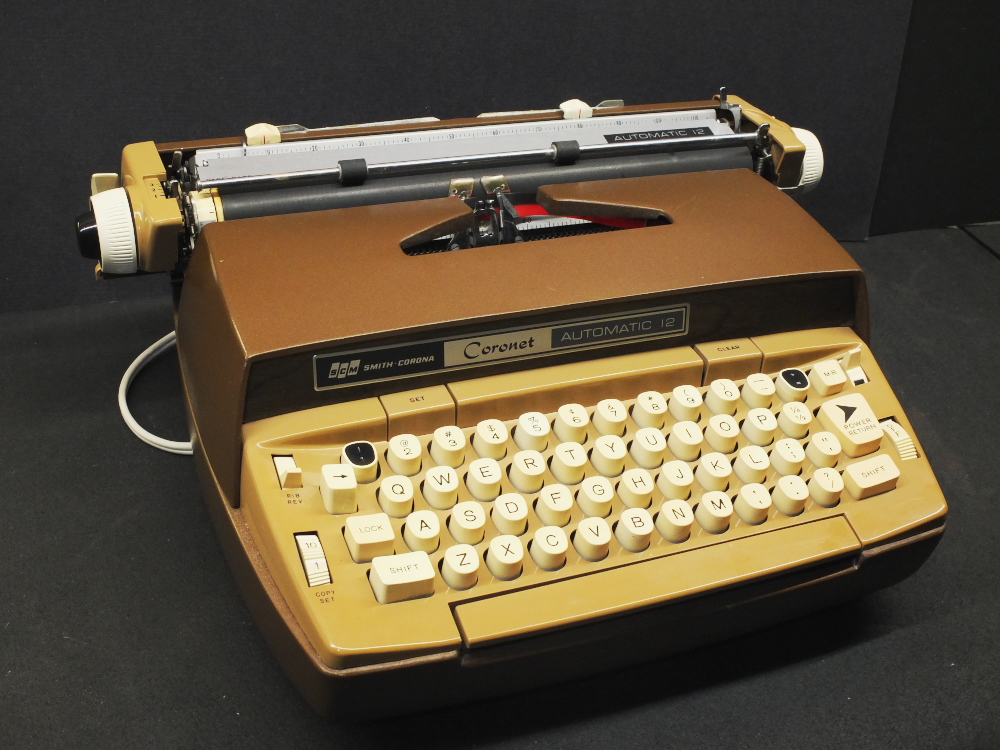
I'm not certain I like the chocolate-brown color, but I suppose it's less drab than that of my older Smith-Corona Silent. I was originally thinking about calling it the "Brown Streak," from its speedy operation and color, but my wife, in her wisdom, convinced me that this term might be misconstrued as being somewhat scatological. Yes, it's a fast typer; darned if I can't throw words on paper at a speedy clip. This is certainly an office workhorse machine, but it's rather loud; I can only imagine what an office of these machines sounded like, back in the mid-20th century. I suppose if the room were clouded in cigarette smoke (which they often were), it might dampen the racket. Actually, it's not quite as loud as my brother's Hermes 10 electric (that, you might recall, is on permanent loan to the Guild Cinema).
The rear, hinge-side of the case is badly rusted. It looks like it sat up on end in a wet environment. This is one of the few circumstances where I had no qualms about applying some WD-40, followed by a wire brush and plenty of paper towels. It's better than it was, certainly.
So, am I going to keep it? I suppose ... if someone were to twist my arm ... perhaps. I can imagine if, needing to put some high volume of words down on paper at a speedy clip, and the noise were no objection, having one electric typewriter wouldn't be so bad, especially one having the wide carriage and ergonomics of this series of SCM, and with a standard cloth ribbon. But that's it! No electric collection for me, no sir!
Here's a glamor shot of the new clan member. I still need a name for it, something combining its chocolate appearance with speedy operation. It does have that two-tone espresso/coffee look, so perhaps some caffeine-themed name would be appropriate. Jitters? Hmm ... I'll think more about it.
Labels: Guild Cinema, Hermes, Hermes 3000, Nekkid-RIter, pinhole, SCM, SCM Coronet Automatic 12, smith-corona silent, typewriter collecting, typewriter names, workshop, WPPD
posted by Joe V at 8:50 PM
5 comments