Monday, August 03, 2020

Looking Up

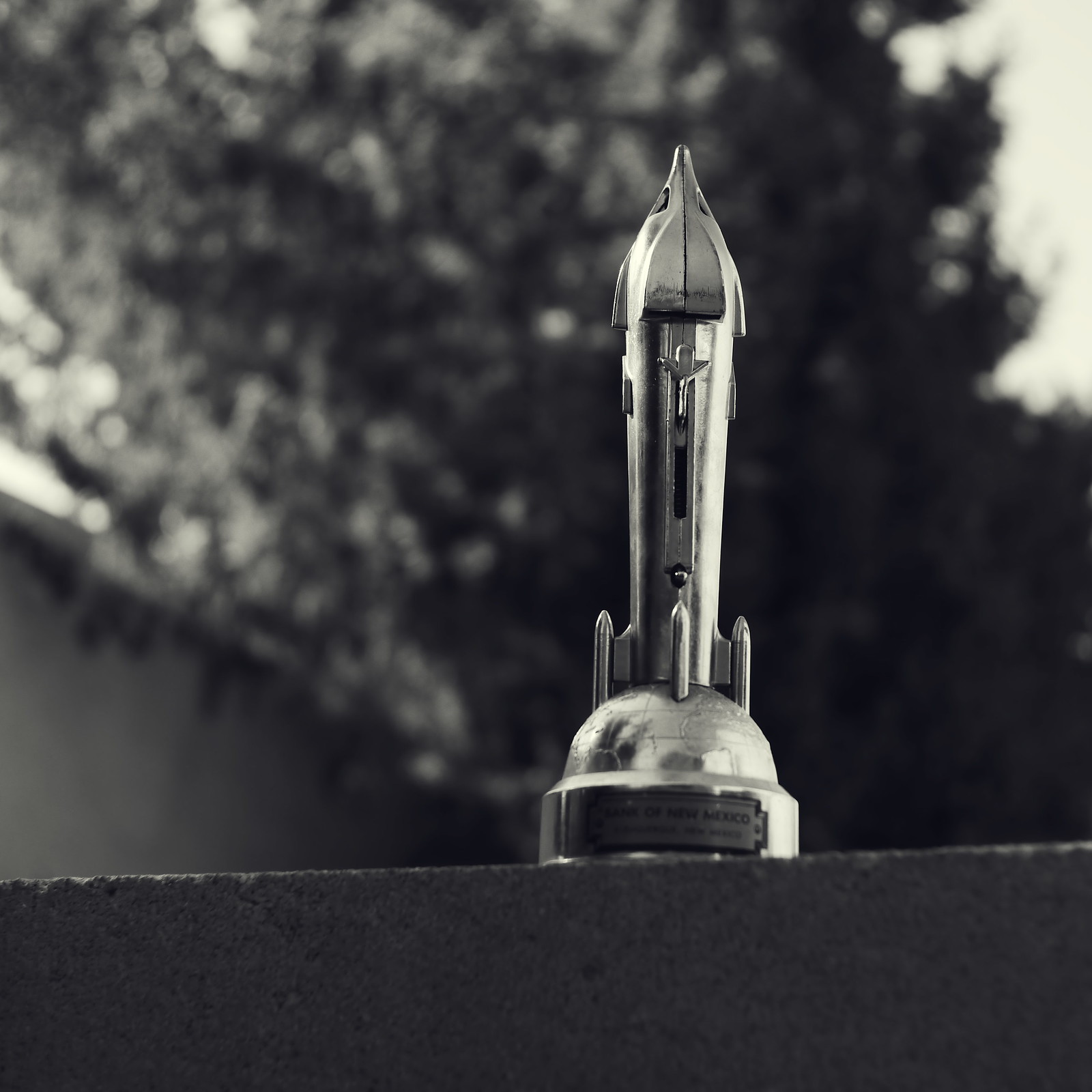
P1020093a
Back to Space
It was sometime in the very early 1960s when Dad brought home these rocket banks. He worked out on Sandia Base, at a place called D.A.S.A. - Defense Atomic Support Agency, Field Command, Cataloging Department; later renamed D.N.A - Defense Nuclear Agency. He set up the system that catalogs the parts for the nation's "special weapons." Years later, sometime in the 1990s or early aughts, I met some of the ladies who still worked in his same department, they said the system he set up was still being used.

In the geography of the Cold War, Sandia was a place where the "physics packages," designed by Los Alamos and Livermore, were turned into practical, field-ready weapons, safe enough to be handled by soldiers and sailors with high school diplomas and rugged enough to withstand the abuse of deployment.

Dad was a meticulous documenter. He balanced his checkbook to the penny, using his clearly legible printing, which featured little details like horizontal serifs on the loops of the capital "J". I can imagine this worked well for the kind of career he had with that secretive government agency.
Parker Ballpoint

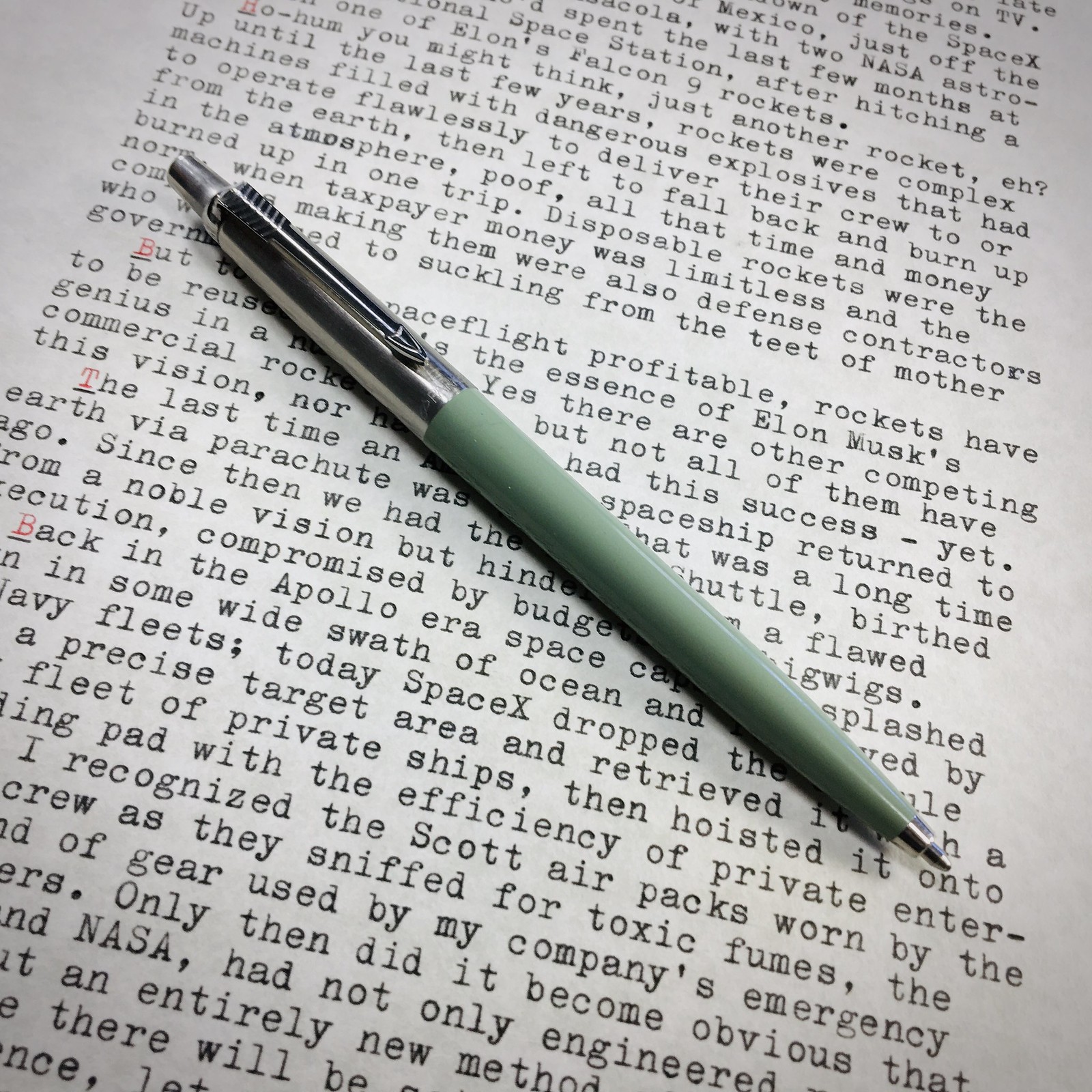
Dad always used these Parker ballpoint pens, with the brushed metal rear half and pastel colored plastic front. There was often one in his shirt pocket, or clipped to that checkbook that was always balanced to the penny. This one's mine, but I think he had one in this very same color. I don't use it that often - part of the problem of being a pen collector - but keep this one mainly because of Dad.

Bank of New Mexico had a branch office on the Base, which was where Dad got these rockets banks from. There's a vertical slot on the side of the bank, and a part above it that looks somewhat like the middle of a peace sign, inverted; or a crucifix with broken arms. There's a lot to unpack in these symbols; I'll leave that up to you.

A coin could be nestled into those broken crucifix arms, then the bank cocked by pulling the fixture down along the slot. When the button below the slot was pressed, it would shoot the coin up into the nosecone of the rocket - clank! - and the coin would rattle down into the bottom, preserved for that future college education. We loved watching the coins being shot into the bank much more than the idea of saving for our education. Go figure.

The base of the bank can be unlocked using a simple key, which we'd long ago lost, but a bent paper clip works well. I think my two brothers each still have their rocket banks. These weren't just fun toys for us to play with, but they also served as tokens representing the fact that we were very interested in the space program of the 1960s. I was born in '57, coming of age around the time of Apollo, and remember well our space infatuation.

My middle brother and I would play astronaut at Grandma's house. We'd set up the card table against the sofa. The card table was taller than the cushions of the sofa, so we'd lie on our backs under the table with our legs up on the sofa cushions, in that reclining position common to astronauts. We'd enhance the effect by covering the table with a large blanket, enclosed as if in our tin capsule, then play with pretend control dials we'd taped to the underside of the table. We do a countdown, then one of us (usually me, because I was the younger) would stand outside the pretend capsule and rock the table back and forth while spewing rocket-like sounds and droplets of sputum, the latter unintentional but common to overly-energetic young lads.

Later, we realized our pretend capsule wasn't realistic enough, so my middle brother and I commenced to build our own capsule in our grandparent's back yard, using aged lumber from a pile out by the shed near the alley.

DSCF4472a
My grandparents former house at 112 Edith St. NE in Albuquerque, now a law office.

The pile of lumber, I only learned more recently, came from circa 1929, when Grandpa had leased the ranch land to some businessmen who made an Indianapolis-style dirt racetrack, with wooden bleachers and a tall wooden fence that surrounded the 160-acre property, located near where the corner of Central and Wyoming are now. When the Depression hit hard, the racetrack went bankrupt and left Grandpa with an abandoned property. He built a shack of wood to live in, and dismantled the wooden structures and sold them off to make spare cash. With the remnants of that lumber we - my middle brother and I - made a go-cart and space capsule, in the late 1960s. From Google Earth you can still see remnants of the south turn of the oval racetrack, now located on Base property, between the Officer's Club and the north fence line adjacent to the Wyoming Gate entrance. After WWII the government had annexed part of Grandpa's ranch land to expand Sandia Base.

The capsule we built resembled a Gemini-style conical shape, built on a circle of boards as a base, with the sides of the conical capsule made of boards leaned up together, teepee-style. More bits and bobs were used to decorate the inside of the capsule to our liking. We'd have launches during every weekend visit to our grandparents, where my brother would lie on his back in the capsule and I'd shake it while roaring and spewing forth my boyhood energy, imagining him soaring into the sky on a column of flame and smoke. Later on we'd try making our own rocket engines from wooden kitchen match heads, but they only were good for smoke bombs.

One summer evening before dark there were flashlights flickering up the alley behind the backyard, then police officers entered the yard and questioned the adults assembled therein, a family reunion of sorts. Had they seen the escaped convict they were searching for? Nobody saw the escaped convict, but the officers made sure to search inside Grandpa's shed, and the conical Gemini-style space capsule, just to be certain no one was hiding. Years later I'd imagine that escaped convict, hiding in the spaceship, ready to blast off from earth to some better place.

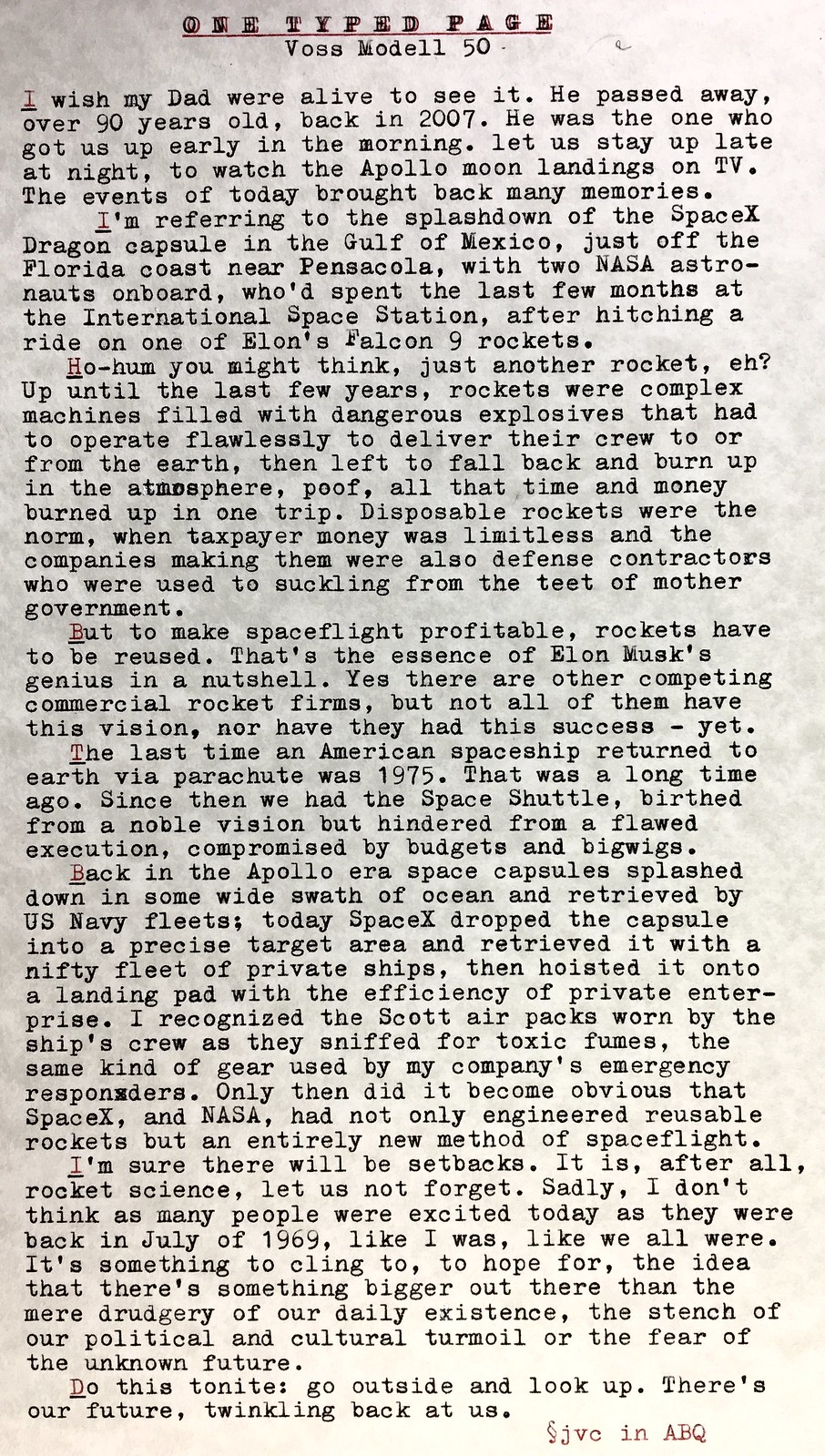
These are the kinds of memories that come flooding back when I watch notable space events, like this week's return of the SpaceX Crew Dragon capsule from orbit. My oldest grandson doesn't seem much interested, not many kids his age seem to be. I suppose it's an artifact of my generation's era, whatever happens during one's formative years seems to make a lasting impression. If there's to be a permanent and expanding space program it's going to require a permanent fanbase of supporters who petition their congressional representative to allocate the funds. As it was, Apollo was cut short by the economic ravages of Vietnam and the Cold War. Maybe our choices are endless wars, or space exploration, but not both? Maybe. In the meantime, keep looking up.

Labels: , ,

Wednesday, March 15, 2017

Personal Discoveries and Barry's Folly

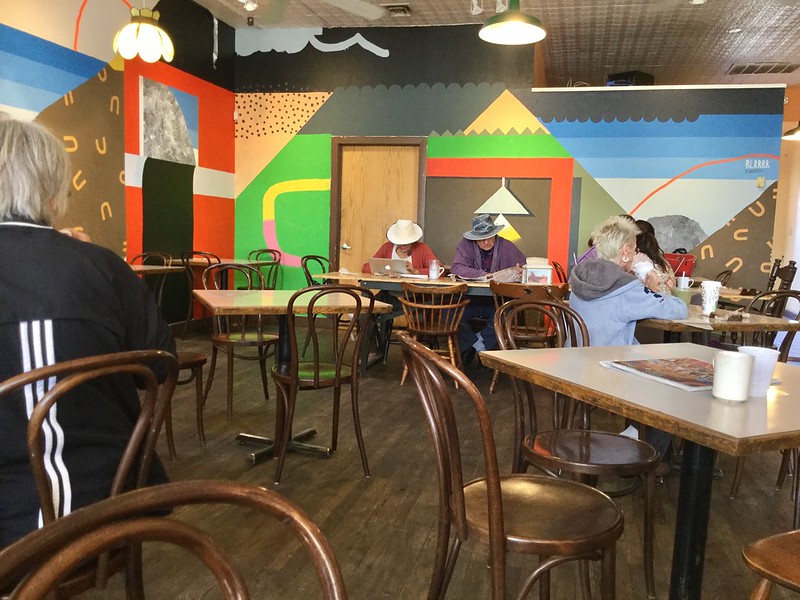
Aging Hippies at Winning Coffee
Ageing Hippies at Winning Coffee

Is there some universal law that dictates when a person first makes a personal discovery? What if that discovery involves a public venue, like Winning Coffee Company, in the University Neighborhood of Albuquerque? These things are like wings you don't even know you've put on, they've become so comfortable. In the case of Winnings, I can't now recall how I first heard of it, or from whom, or the circumstances of my first visit. All I know for certain is that there came a time, in the mid-aughts, when I began spending many a morning at Winnings, eating breakfast, drinking coffee and writing in a journal.

The circumstances of how these places come to be are mysterious, or so I'd like to pretend. In fact, some one or group of people had the vision to start this business, in 1996; but that's not what this story is about. The story I'd like to tell is that Winnings is as unlikely of a hangout for creatives as one can ever imagine in this dry, dusty southwest city, seemingly perpetually insulated from the balance of civilization by many hundreds of miles of badlands and years of history.

If Beatnik culture were a "Thing," let us presume, and someone with the vision and aptitude to make a buck off the declining entrails of mid-20th century American Beatnik culture were to have a free hand in fashioning a simulacra of that culture, they could do no better than start at Winnings, study what it is and what it is they do, and try to franchise the results far and wide.

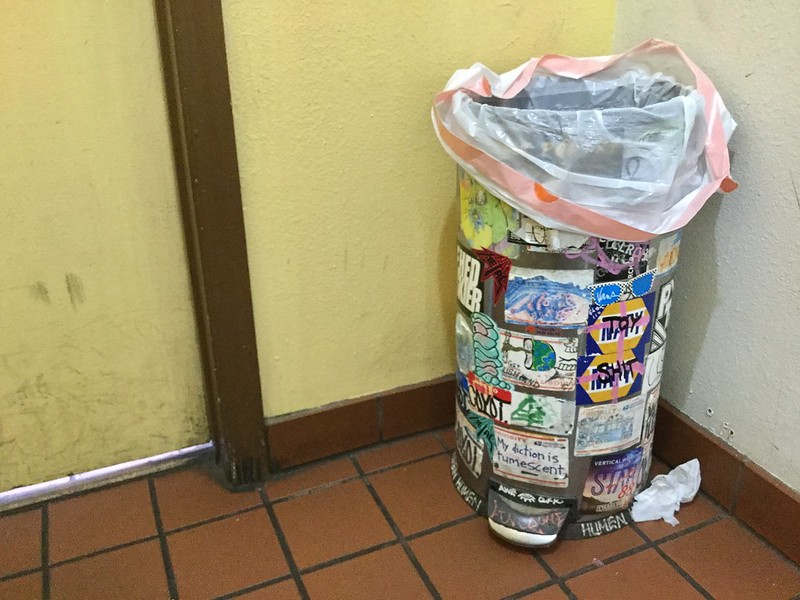
Men's Room Trashcan at Winning Coffee
Simulacra of Decrepitude

You'd need, at the very least, an aroma of cumin and cayenne wafting from an ancient-looking kitchen, just as mood music fills the modern spaces of Starbucks out in Suburbia. You'd need some corporate specification defined for how intense the aroma becomes, along with how to simulate the decrepitude of years of caked-on paint, crazed plaster walls and tin ceilings in some state of disarray. An exacting simulacra of decrepitude, canned and marketed for the suburbanites in newly built communities of cracker mansions out by the Interstate, neatly set down in their precise rows of grids, enticing them to drive their SUVs down to the strip mall and experience a bit of inner-city, beatnik funkiness distilled down to its essential ingredients. Employee personal hygiene would be optional, in order to preserve the aroma of the unkempt philosopher, specified in the corporate policy manual, which also mandates faded bell-bottom denim, braided beards and bandanas securing greasy locks. Most essential would be the front patio, where tables and chairs offer a convenient place for revolutions to be fomented in billowy clouds of hand-rolled cigarette smoke; local ordinances would require special exemptions, palms would need to be greased. We have money to make, boy!

Of course, no true revolutions will arise from our imaginary chain of faux-beatnik coffee shops (Now Nationwide!), only harmless little pretend ones; for the affluence of American Suburbia is predicated on the notion of keeping one's head to the grindstone of Corporate America, doing as one's masters might dictate, and don't rock the boat.

On October 1, 2011, (un)Occupy Albuquerque, a protest group loosely inspired by the then ongoing and worldwide Occupy Movement, began a weeks-long protest and occupation of Yale Park, across Central Avenue from Harvard Drive, the location of Winning Coffee, which became for participants a de facto support triage, with food, drink and moral encouragement. For myself, Winning had by now also become my own personal triage, a place from which to escape middle-class suburbia and it trappings. I'd visit almost every week, notebook and camera in hand, simultaneously inspired and also desiring to capture on film a fleeting essence of the ephemeral. Like capturing fairies on glass plates, how does one capture the essence of a culture defined primarily by the negative space of protest and opposition? It's like that old optical illusion: is it a pair of faces or a candlestick?

I think it always comes back to that most essential approach, storytelling. People are intrinsically interested in the lives of other's, especially if those others come from a different walk of life. I've always felt a bit out-of-place visiting Winning Coffee because of the imagined disparity between my station in life (middle-class suburbanite) and those Winning regulars closer to the streets. And yet, as I've come to know some of them, I've found a richness in their diverse backgrounds that is wholly unexpected and irreplaceable.

Some of these people I've gained only a casual familiarity with, enough to catch a mere glimpse into their psyche, but enough to serve as inspiration for fictional characters in a series of short stories based on Losers Blend, the parallel universe fictionalized version of Winnings.

It's been many months since I've visited Winnings; their coffee roaster guy quit and we'd begun buying beans elsewhere. It's been several years since I was a regular enough visitor to spend hours there writing, or visiting with fellow patrons. So it came as some shock to learn this week that they are having financial difficulties, brought about by the Albuquerque Rapid Transit project, which has resulted in the entirety of Central Avenue being torn up, disrupting traffic, parking and shopping for miles. The project has earned the scorn of most every business along Central, known by its initials ART; but there's nothing art-like or redeeming about it. The Mayor, Richard Barry, heavily promoted it as a way to begin transitioning the city's transportation infrastructure away from being so automobile-centric; a noble cause. But instead of placing it in a part of town most needing mass transit - the suburbs of the densely-packed northeast heights - he instead located it along the one thoroughfare already better served by bus lines than any other. So while the city might call it ART, I call it Barry's Folly.

It will take several more years before the project is concluded, and funding has not even been appropriated for any more than the initial demolition phase currently underway. Neither was the public given an opportunity to directly vote to determine the project's future, but it was instead mandated from the top, down. Theoretically, a democratic society works by the government working for the people, not the other way around.

There is the very real prospect that, even if the project is successfully completed, those areas of downtown, the University District and Nob Hill who were to benefit so directly from the transformation will be burned-out, boarded-up shells of their former vibrancy, a zone of economic blight brought about by the reality that the cure was worse than the illness; that in attempting to revive the city's core through infrastructure improvements they've killed off those essential but delicate economies of small businesses which make up most of this city's commercial liveliness; the very opposite of what Mayor Barry promised. Unique places like Winning Coffee might very likely cease to exist.

Conspiracy theorists might even conjecture this was their intention all along, so that real estate could be bought up cheaply and sold off to new corporate clients waiting in the wings.

This morning we had a late breakfast at Winnings, a hearty burrito filled with eggs, potatoes, green chile sauce and cheese; and their wonderfully rich lattes. Bradley, the bookseller, was there, setting up shop in the corner nook by the coffee roasting machine. He has a younger assistant who does the heavy lifting of setting up and tearing down, whom I asked how the books are organized, and the answer I got revealed once again the rich diversity of this crowd, as he told me that they're organized by genre: beat authors here, soviet realists there, feminist lit over yonder, Latin American fantasists over there. Only at places like Winnings will you find the guy with the strong back also has a strong mind for literature.

As we entered through the front door (there's also a rear entrance from the alley) the regulars were seated outside at the patio tables, while the big oval table inside by the order line had the usual old guys, the knights of the round table I call them, including the one who always sports some puffy-sleeved shirt and black vest, with black top hat. As we stood in line waiting to place our order, I overheard one of them inform the others "One of the Chicago Seven is now a stock broker."

I'm hoping Barry's Folly will fail to have its full sway, and that these unique venues like Winning Coffee will survive and prosper. In the meantime, Bradley informed me that the new coffee roaster guy now has his act together, and so perhaps next week, when our stock of beans begins to run low, I'll make a drive down to the University District, brave the construction barricades, have breakfast and perhaps do a bit of writing. Maybe I'll take a portable typewriter, sit out on the front sidewalk tables, sip my coffee and pound inky words into paper, the aroma of hand-rolled smokes wafting in the breeze.

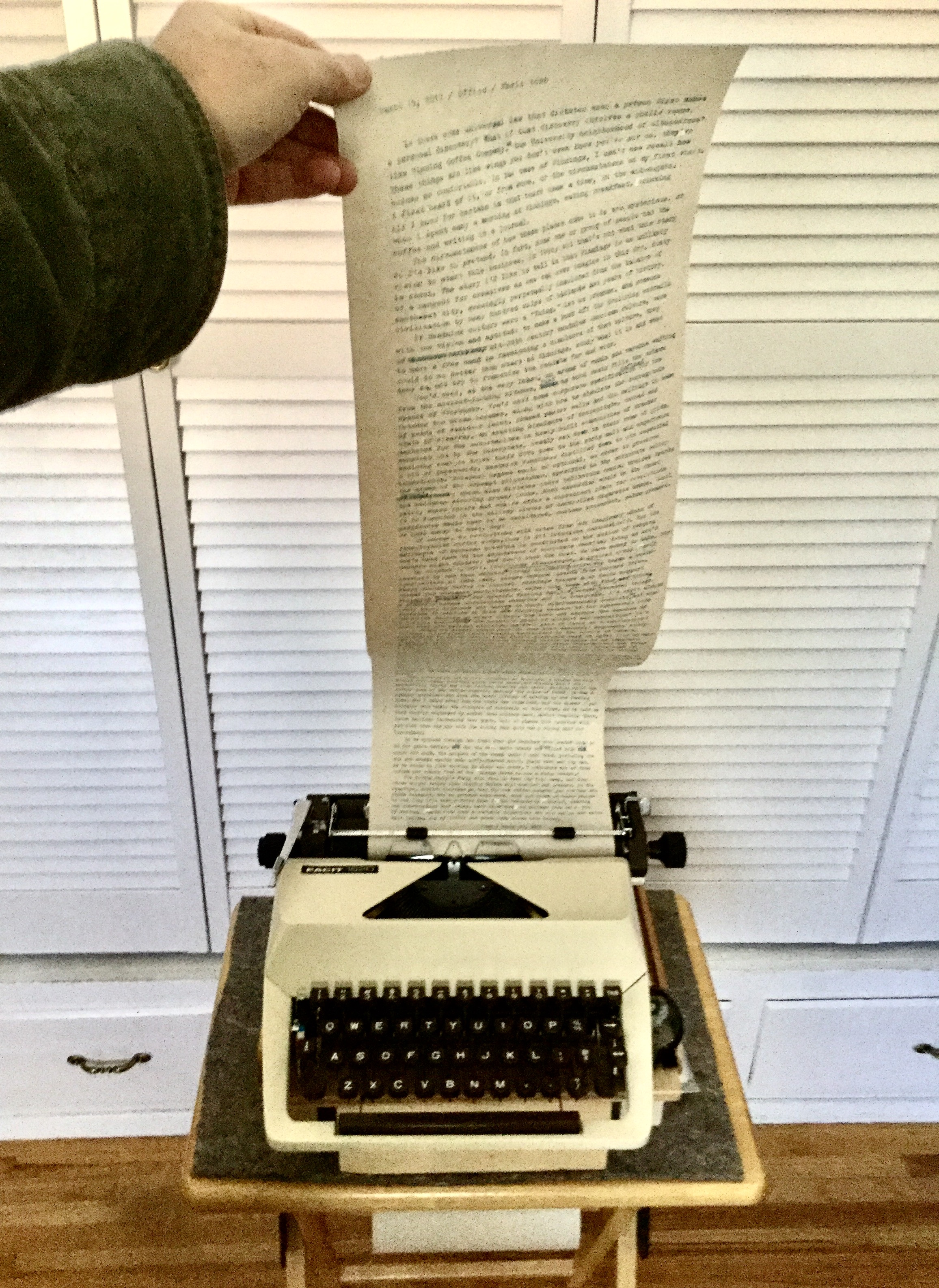
Post-Script: I enjoyed writing the first draft of this piece on the teletype paper roll using the Facit 1620. Spaced at 1.5 lines, the piece came to 31 inches.

'Personal Discoveries' Rough Draft, Facit 1620 and Teletype Roll

Labels: , , , , , , , ,

Sunday, November 13, 2016

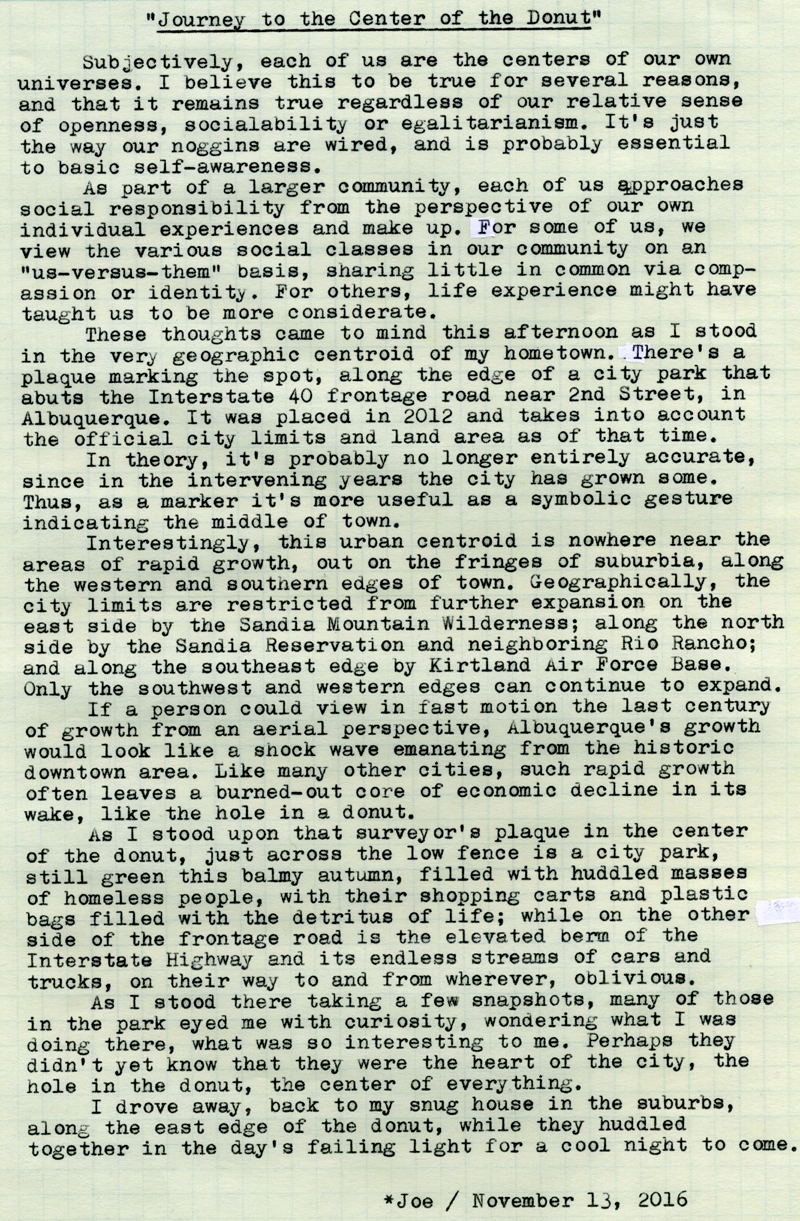
Journey to the Center of the Donut

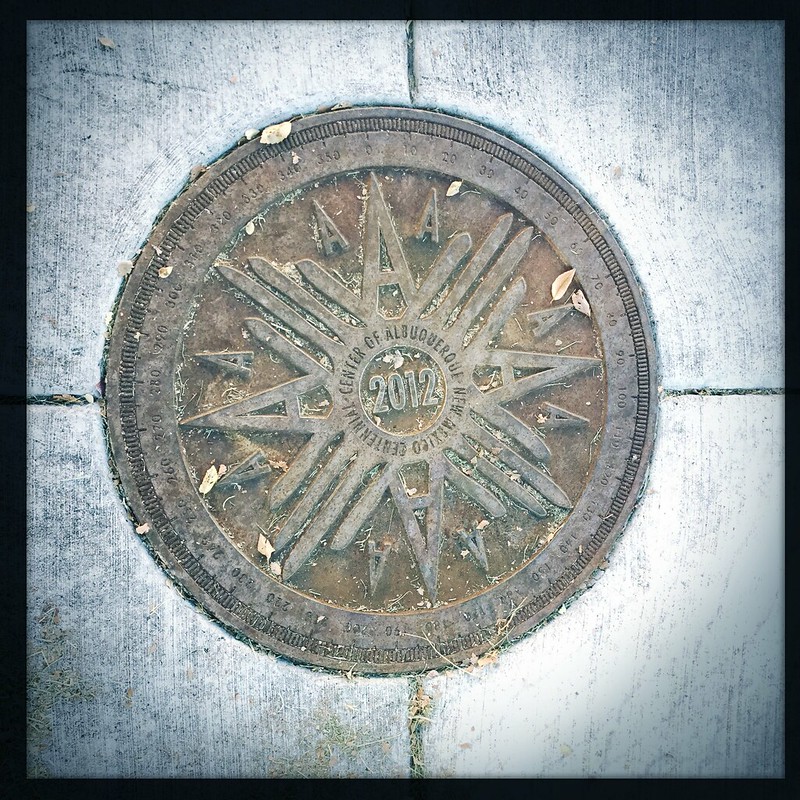
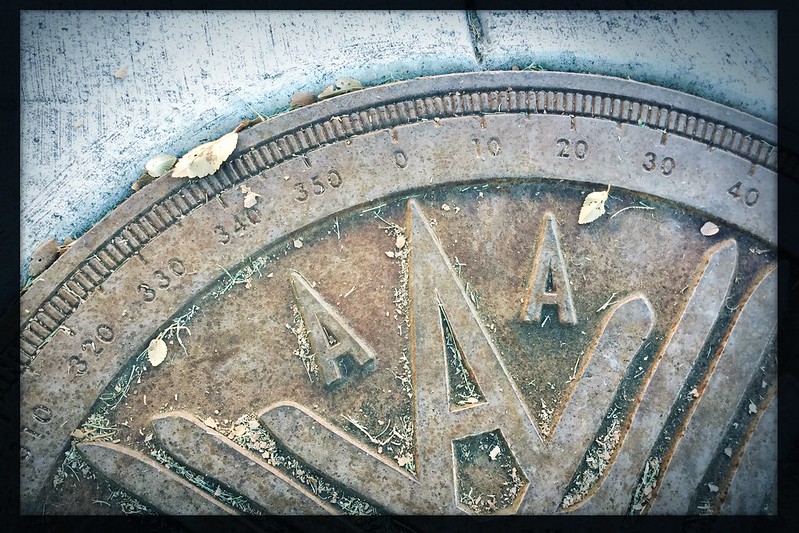
Center of Abq
Typecast197

Post-Script: Bonus Image:
Center of Abq

This city park was once the location of an historic steam locomotive from the days of the Santa Fe Railroad, when Albuquerque was the site of a major locomotive repair facility. That engine, once viewable by the public for free in the park, is in the process of being restored and resides elsewhere.

Typecast via Olivetti Underwood 21.

Labels: , , ,