Monday, June 08, 2020

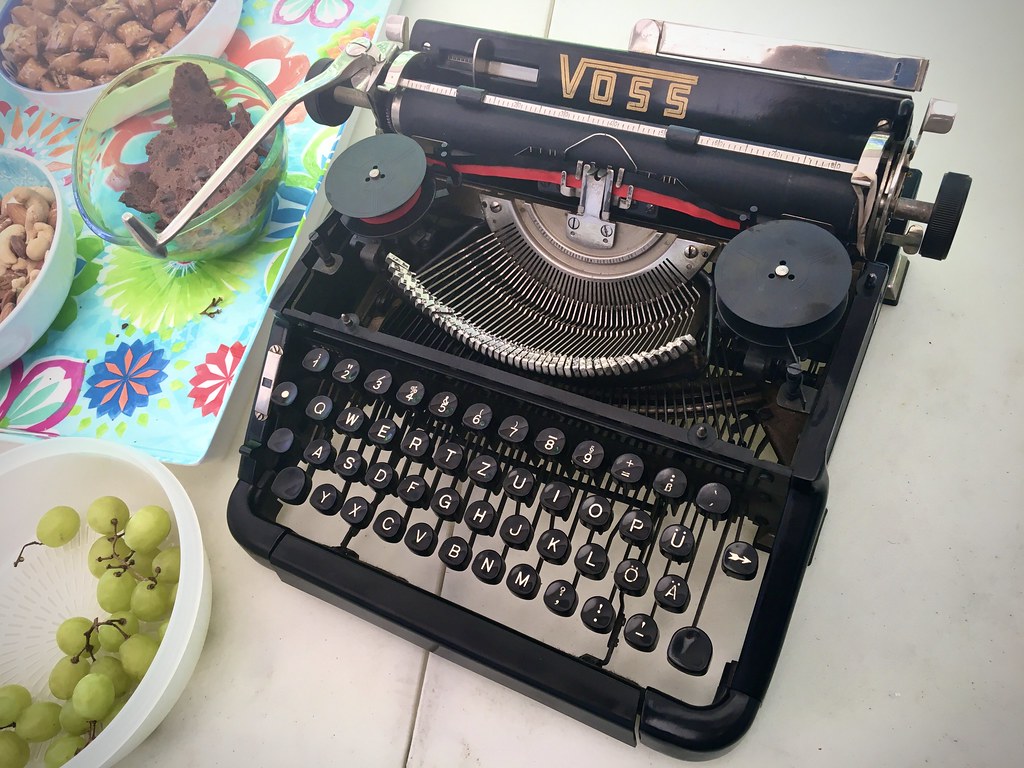
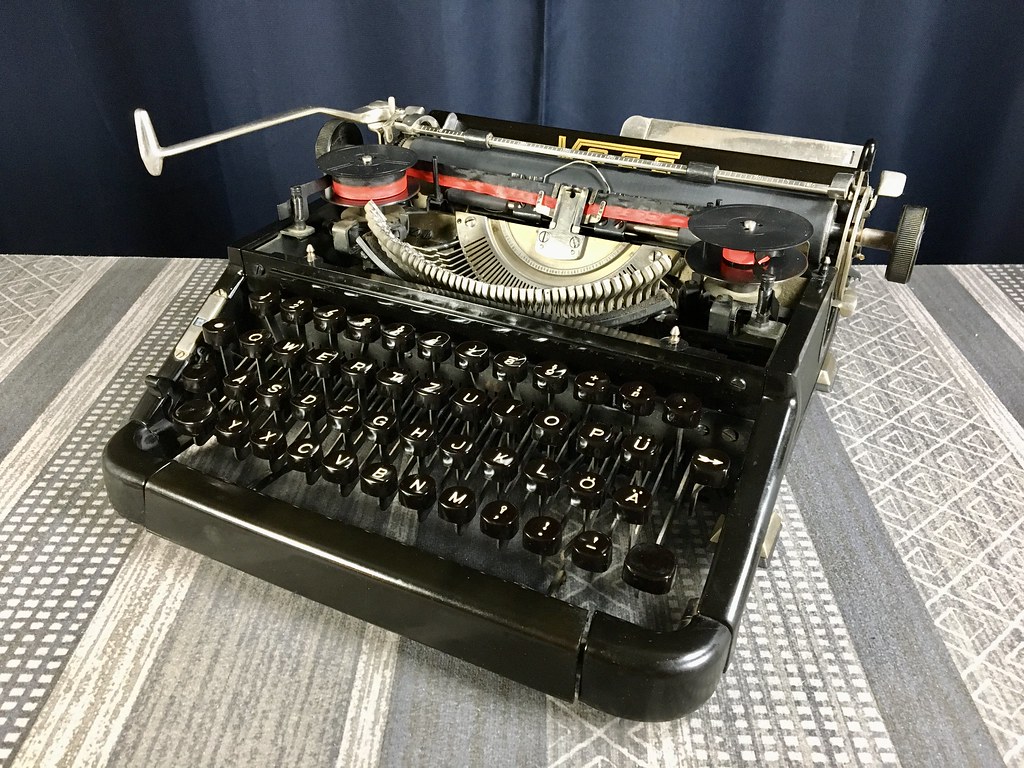
Voss Modell 50

Voss Modell 50, circa 1952
Voss Modell 50

Voss Modell 50
Voss Modell 50
This machine was from John Lewis, our local typewriter shop. It was going to be used as a parts machine for repairing a newer Voss De Luxe owned by Kevin, but John managed to fix the De Luxe without robbing any parts off this older machine. John offered it to Kevin for a song, and now it's mine.

Mechanically this older Modell 50 and the newer De Luxe are very similar, they feature the same escapement mechanism for example (which, by the way, is replete with numerous adjustments), but the carriage on the De Luxe is different, especially around the paper bale. And of course the styling between the two models is different. This Modell 50 is rather masculine in appearance while the De Luxe is rounded and curvy. They also reversed the location of the back space and carriage release controls between the two models; Kevin's De Luxe was made in 1958, while my Modell 50 was made in 1952. And a sticker on the back of the De Luxe indicates it was marketed in the United States by a subsidiary of Voss, whereas on my older machine there's a paper sticker indicating Schultheis & Lenzen, Buromachinen, Koln-Aachener Str.15-17 (my apologies for not using the correct German punctuation marks.)

Aside from several cracked Bakelite panels and the hardened rubber parts, the only other issue is the springs for the paper bale are broken and missing, they are flat spring steel and only the ends remain where they were secured under mounting screws on either end of the bale. This type of spring steel can be brittle. My simple solution was to route a rubber band around from behind the right side of the carriage to the right front finger of the paper bale; it now gives plenty of pressure onto the paper.

Aside from needing more superficial polishing, I'm seriously thinking about making a ribbon cover. It won't have the same curvy shape as the original, but should be functional. It will be made from wood, and I hope to successfully seal and finish the wood into a glossy black appearance to match the rest of the machine.

There's an even earlier version of this machine, with round keys and a more conventional space bar. This is more of a hybrid machine, sporting a pre-WWII conservative appearance yet featuring modern plastic key caps.

This is one of those machines I didn't know I needed. In practical terms I don't need another typewriter; but now that it's mine, and I've put some work into it, I can say it's starting to feel like one of the family. It also has a stablemate cousin, the Triumph Norm 6 with a similar German/Hungarian keyboard. As I indicated in this piece, I have little problems typing with a QWERTZ keyboard, since I'm not a pure touch-typist on manual machines and therefore will periodically look at my fingers as I type, and make a mental note to be on the lookout for the letter "Y" so as to ensure I hit the correct key and not the "Z".

Labels: , , ,

Tuesday, September 03, 2019

Ten Forty, Good Buddy

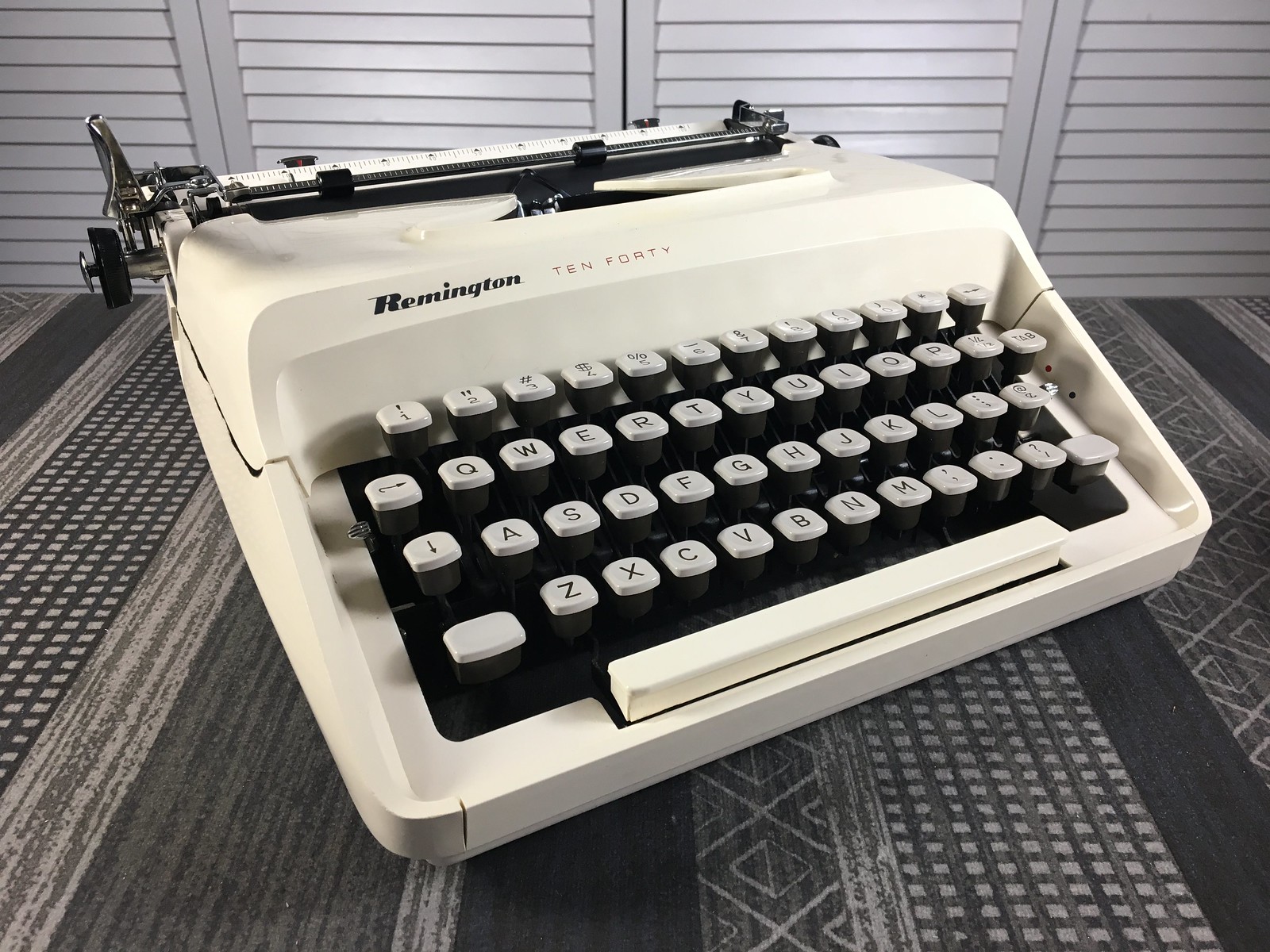
Remington Ten Forty
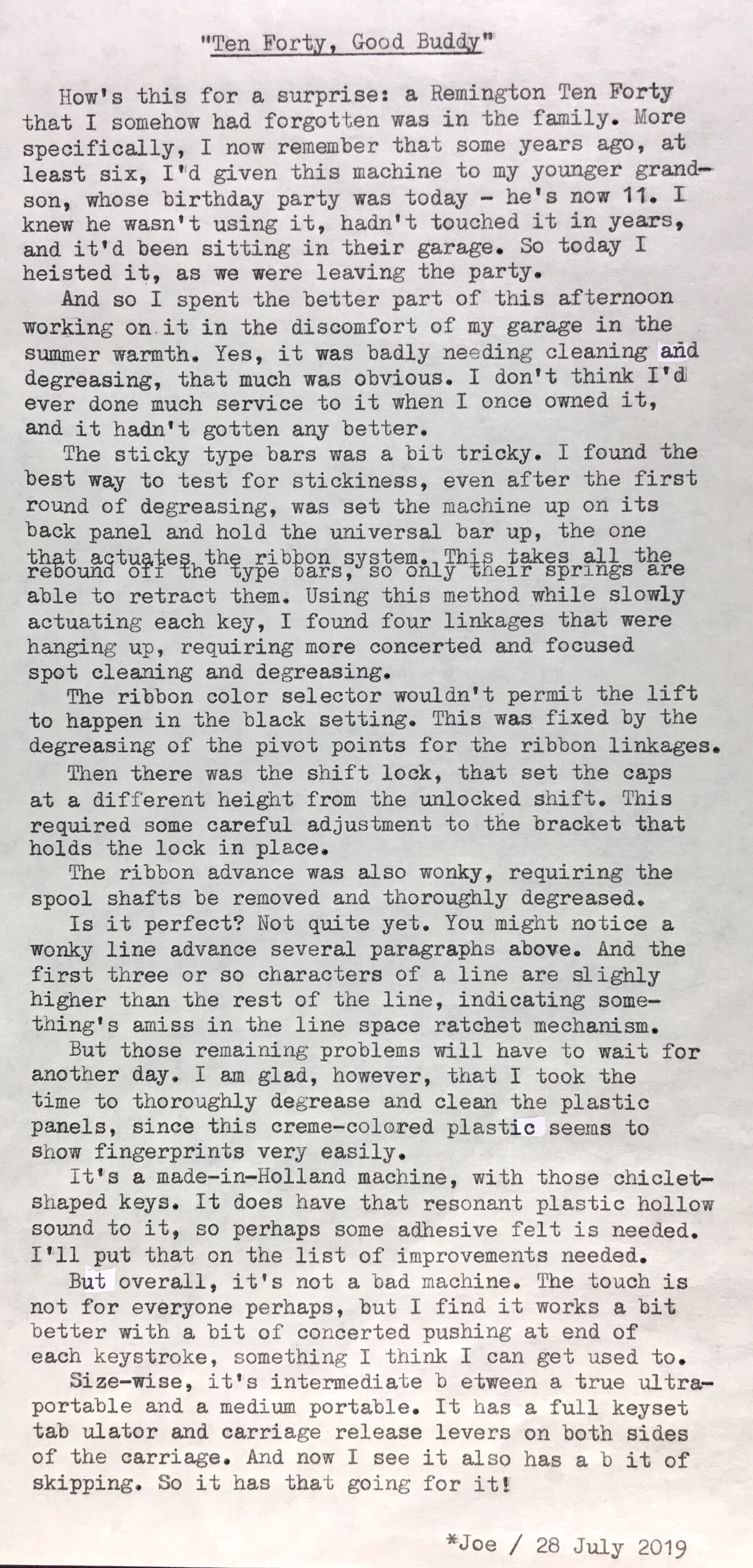
“Ten Forty, Good Buddy”

Post-Script: I think this was a good choice for the young lad, even if he doesn't use it much. And I like the idea that, even though it's "his," I get to share it with folks in public typewriter events. Because sometimes you don't want to take your finest machines out in public and let just anyone fiddle with it, especially in a busy meeting where you can't easily keep an eye on what's going down. Neophytes often are well meaning but can, if not careful, mess up an otherwise fine machine.

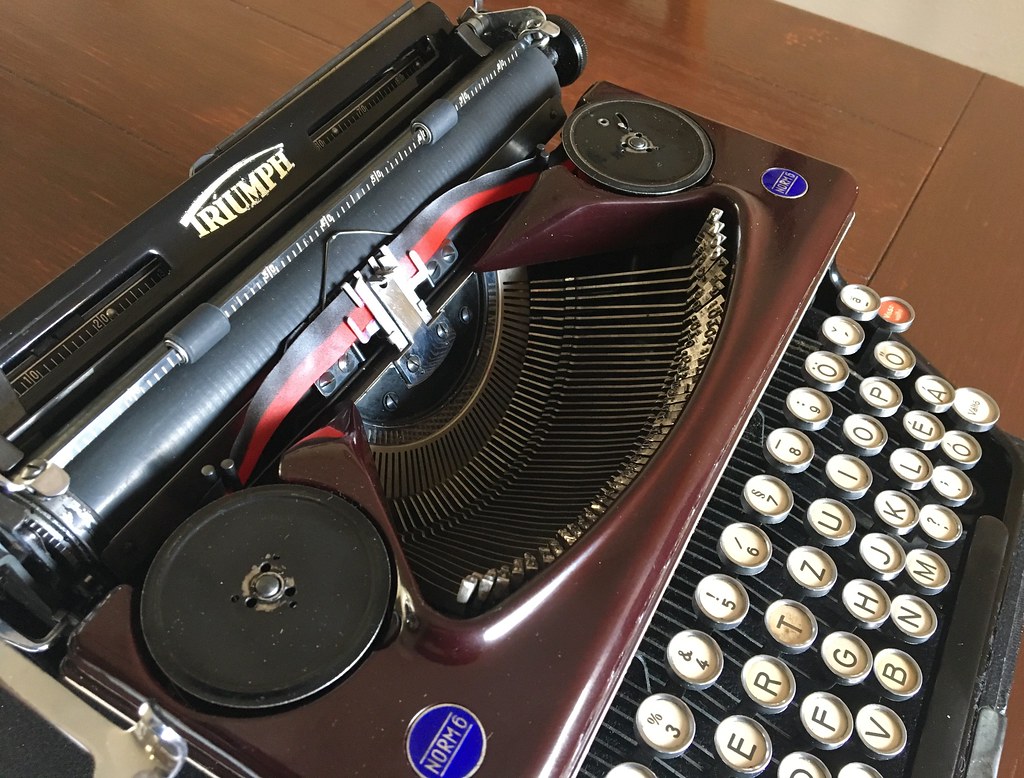
Triumph Norm 6

This gets me to the subject of my Triumph Norm 6. It'd been in the closet for a few months, and this week I took it out to do a spell of writing, when I discovered to my dismay that about half the type bars were totally frozen stuck. I brought it out to the workbench in the garage and discovered the frozen type bars were actually rusted. Somehow, moisture had gotten into the segment, unbeknownst to me, and rusted the type bars. It took considerable effort to free them and remove most of the rust. Unfortunately, many of the linkages under the type bars show signs of rust, also. I wonder if some acidic soft drink didn't get spilled inside, as I wouldn't expect water to do this kind of damage, especially in our dry climate where liquids quickly evaporate.

My wife and I were trying to remember when it was last used, but am not certain. Another reason to keep the rare or fragile machines home, and bring more of a beater to public gatherings. Which implies ... you therefore have to assemble a small fleet of beater typers just for that purpose. Just a few weeks ago I acquired another Smith-Corona Silent-Super, just for that purpose - or perhaps to sell to a member of the Society. I haven't yet started on cleaning it up, but it looks like everything is functional, though the platen is rock hard. Which isn't a problem, really, since they're so easy to remove and ship off to JJ Short & Sons. The cool thing about this machine is it came with all the ephemera, including owners manual, typing guide, even the little printed display tag that hung from the return lever via a string. I'll have to scan this stuff and get it sent to the Rev. Munk.

My wife also reminded me that this issue with the Triumph is a lesson to periodically bring out all your machines from storage and give them a good round of testing, then document any issues that need addressing.

Labels: , , ,

Wednesday, March 27, 2019

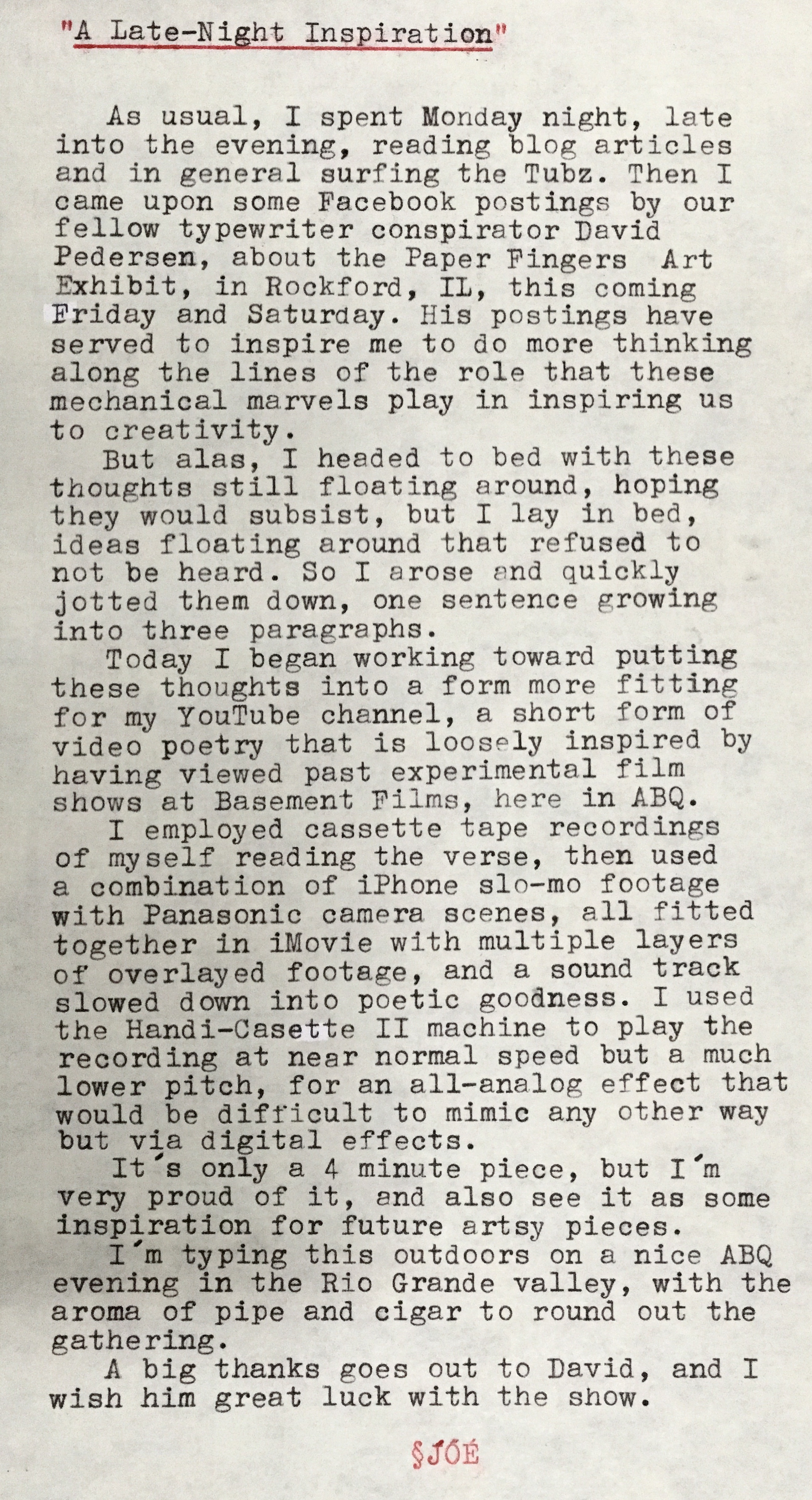
Late Night Inspiration

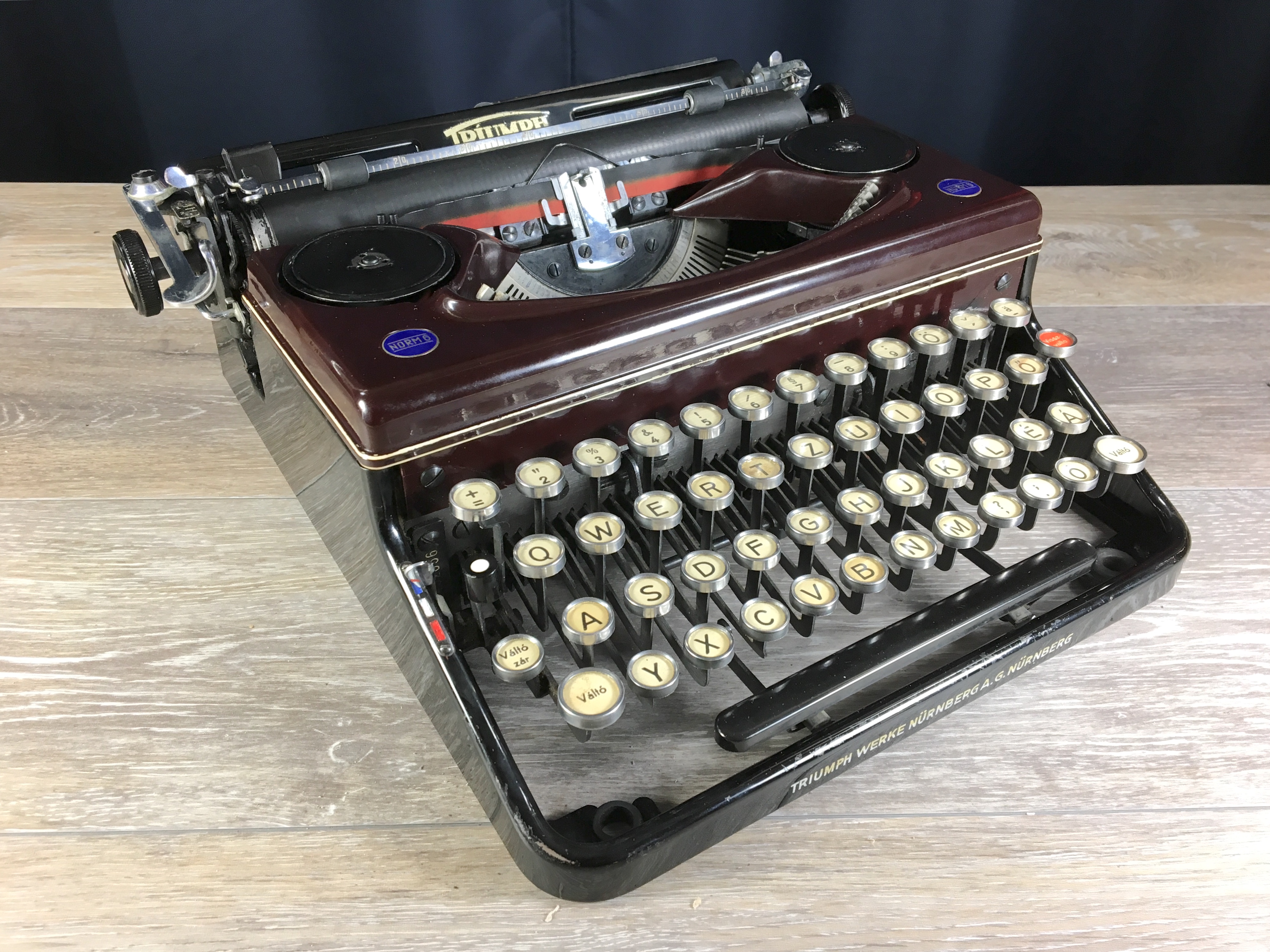
Triumph Norm 6


Post-Script: I had a blast making this video, and learned a few more things about using iMovie. Many thanks to the positive comments.

I wrote this typecast while enjoying the balmy spring evening with Kevin Kittle. Good friends and typewriters go together, especially if all four - us and our spouses - each had a typewriter.

The typecast was "scanned" using the panoramic mode of my iPhone 6s. I quickly shot it on the kitchen island, lit by afternoon window light and a skylight overhead. A quick crop and edit, and uploaded to Flickr in just a few minutes. I like that it has decent resolution, and none of the pincushion distortion that comes from using the phone's native camera app. As long as you hold the phone steady and move it over the subject at an even rate, it seems to work well enough.

Labels: , ,

Monday, March 04, 2019

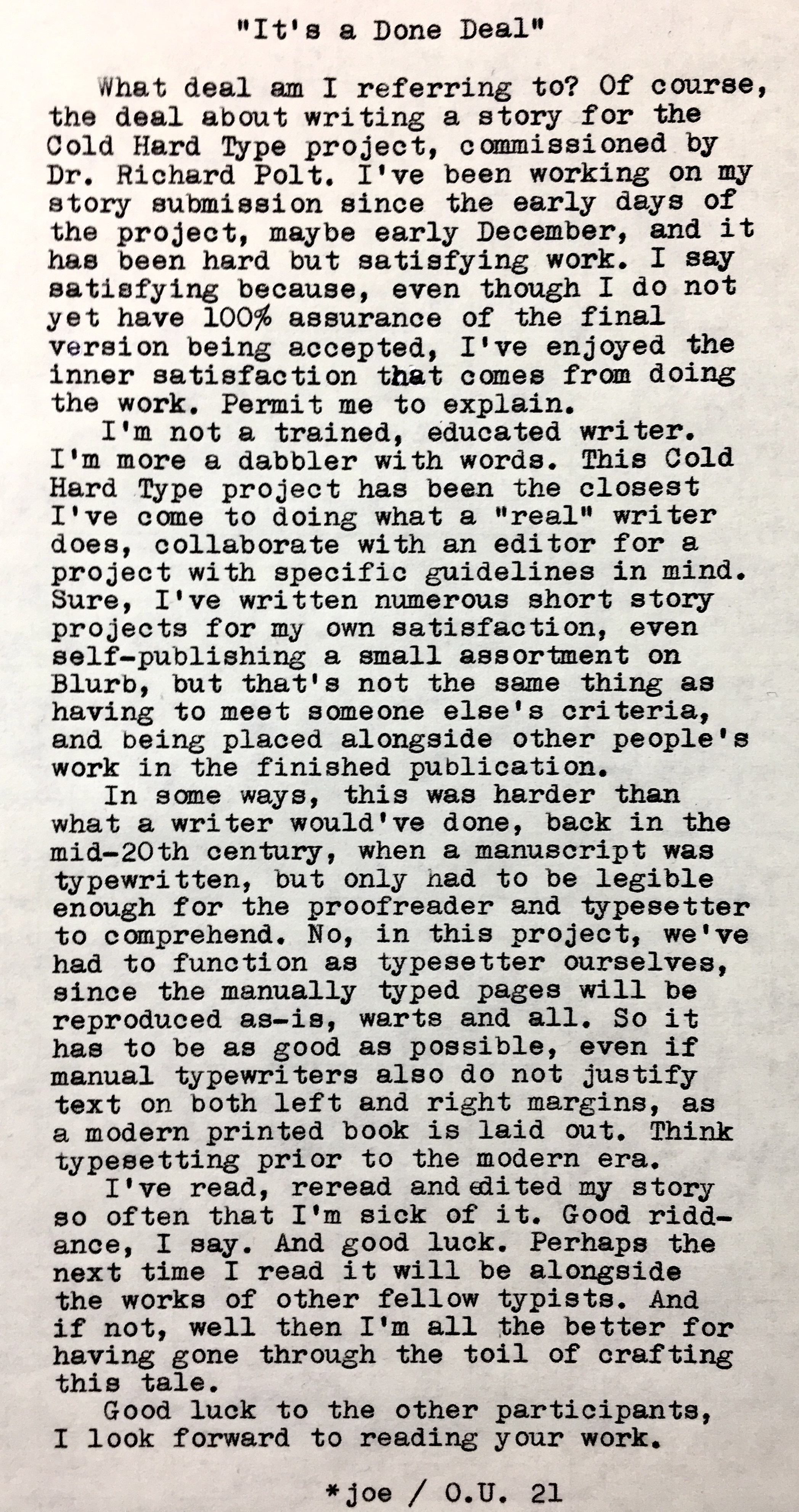
It's a Done Deal

Typewriter Play
It’s a Done Deal

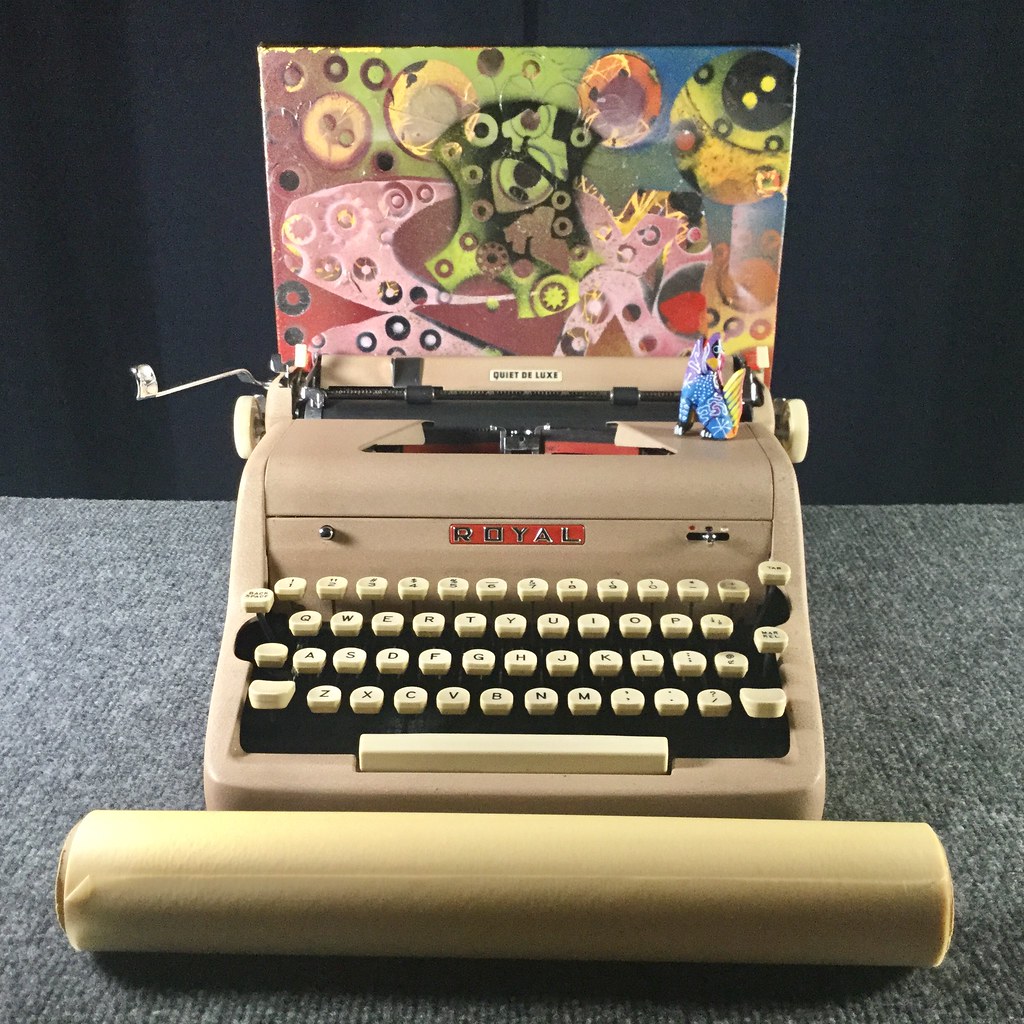
Post-Script: I did the final typing of the story on Adobe Rose, the Royal QDL, seen above. Though it had a partly used silk ribbon, I ended up swapping out the ribbon mid-story for the fresh ribbon Bill Wahl had installed in my Hermes Rocket. Also, the type alignment of the Royal isn't perfect, though it hasn't bothered me in the past; but for some reason I felt self-conscious about it, thinking the imprint needs to be as "professional" as possible. And then I was reminded by John Lewis, my local typewriter repairman, whom I visited this morning, that it's a manual typewriter after all - it's not supposed to look perfect! I like John's fresh perspective on things.

I suppose if I knew for certain that the story was top-notch, I'd be less worried about the aesthetics of its typewritten appearance. Oh well.

Today I placed a visit to Rust is Gold Coffee, to touch base and remind them that our ABQwerty Type Writer Society will be meeting there this coming Sunday, at 12:00 noon. I brought my Triumph Norm 6, upon which to type a few notes, and they loved the machine, especially considering they are a motorcycle-themed coffee shop, and there's a connection between the German Triumph typewriter firm and the British Triumph auto/motorcycle company. I permitted Sara to take some photos of the machine, for use in marketing their coffee shop. She's the gal I'd sold one of my Royal Mercury machines to, and I'm happy to announce that she's been doing lots of typing on it, even taking up virtually permanent space on her kitchen table. She loves typing on it, says there's something about a manual typewriter that brings out the creativity in her. I'm pleased that she's finding good use for the machine.

This typecast was done via iPhone 6s, instead of my flatbed scanner. I've used an iPod Touch previously, usually while on vacation, away from my scanner, and the results have been marginal. But I like what the iPhone produces, at least under my bright video table lights. Gives me less reason to rely on the scanner.

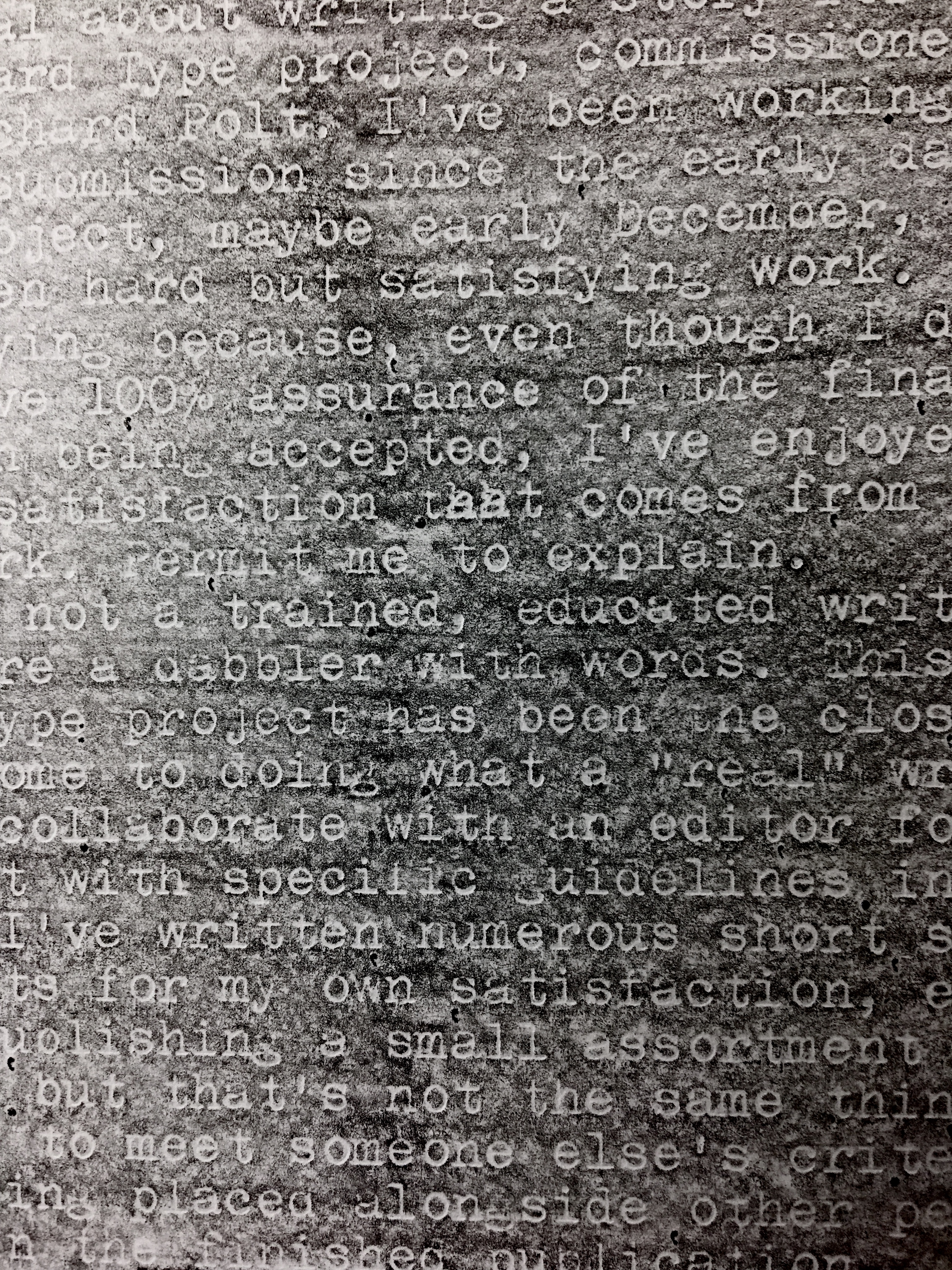
I'd used a backing sheet of paper while typing this piece in the Olivetti Underwood 21, and I noticed afterward that I could see the imprint rather distinctly in the backing sheet. So I took a no.2 pencil and did a rubbing, to reveal the imprint thusly:

Backing Sheet Pencil Rubbing

I've boosted the contrast of the image a bit, but in person the rubbing is very readable, which gives me pause to consider that, in the event typewriter ribbons become scarce in the future, a charcoal rubbing might suffice. Not exactly steganography, since you can easily see the imprint with adequate side-lighting, but an interesting effect. I need to try this again with just one sheet of paper in the stencil mode, and rub with a real charcoal pencil.

I was reminded yesterday that I'm now in two cassette tape letter exchanges. I need to remember to bring a recorder with me when running errands, so as to take advantage of location sounds that make such taped letters so much more interesting.

With the help of one of my YouTube viewers I've found a solution to the problem of why I couldn't post comments to blogs hosted on Blogger, on my Mac computer. The reason had to do with a setting in Safari browser dealing with cross-site tracking. Yesterday I did a typewriter blog comment blitz, catching up on many blogs I've wanted to comment but couldn't.

Earlier in this post I mentioned placing a visit to John Lewis's shop. He has a pristine, fully restored Underwood No.5 for sale. The black paint shines, all the decals are virtually new, the nickel/chrome trim is immaculate, the key top legends are fully redone - and the platen is freshly recovered. I took it for a test typing, and boy was I impressed, I can truly touch-type on it with ease, and the spacing of the keys is ideal for my hands. If it sounds like I'd like to buy it, you're correct. But he's asking a pretty penny for it, considering all the work he's put into it, and that it's been professionally restored. Still, what a temptation. One obstacle for me is where to put it, since, unlike portables, these don't have cases. I'd have to find a permanent writing location. Or, like I've done with my Burroughs Comptometer, that's too large to store permanently on my desk, I found a high-quality plastic box with a gasket-sealed lid. I lined the box with foam rubber, secured the calculating machine in a plastic bag and secured it inside the dust-proof box via the gasket-sealed lid, so it can be stored in less than ideal conditions when not in use. I'd have to find a similar solution for the Underwood, were I to acquire it. There's also the little matter of explaining all this to my better half. But, at least she's been bitten by the typewriter bug, with her claiming ownership of the Olympia SM3, so perhaps there's less convincing needed than I think. Do I really need another typewriter? No. Do I need this Underwood 5? Yes!

PPS: Be sure to check out this typewriter-themed blog, Madam Mayo. There's a link to her older blog that goes all the way back to 2006. Nice to find more typewriter bloggers.

Labels: , , , , , , , , ,