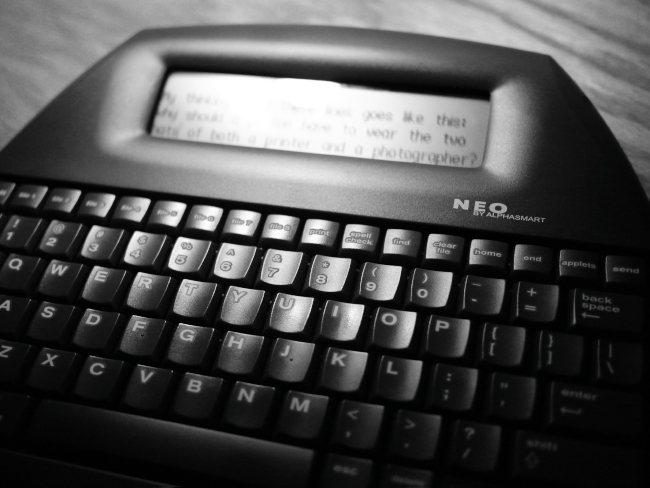
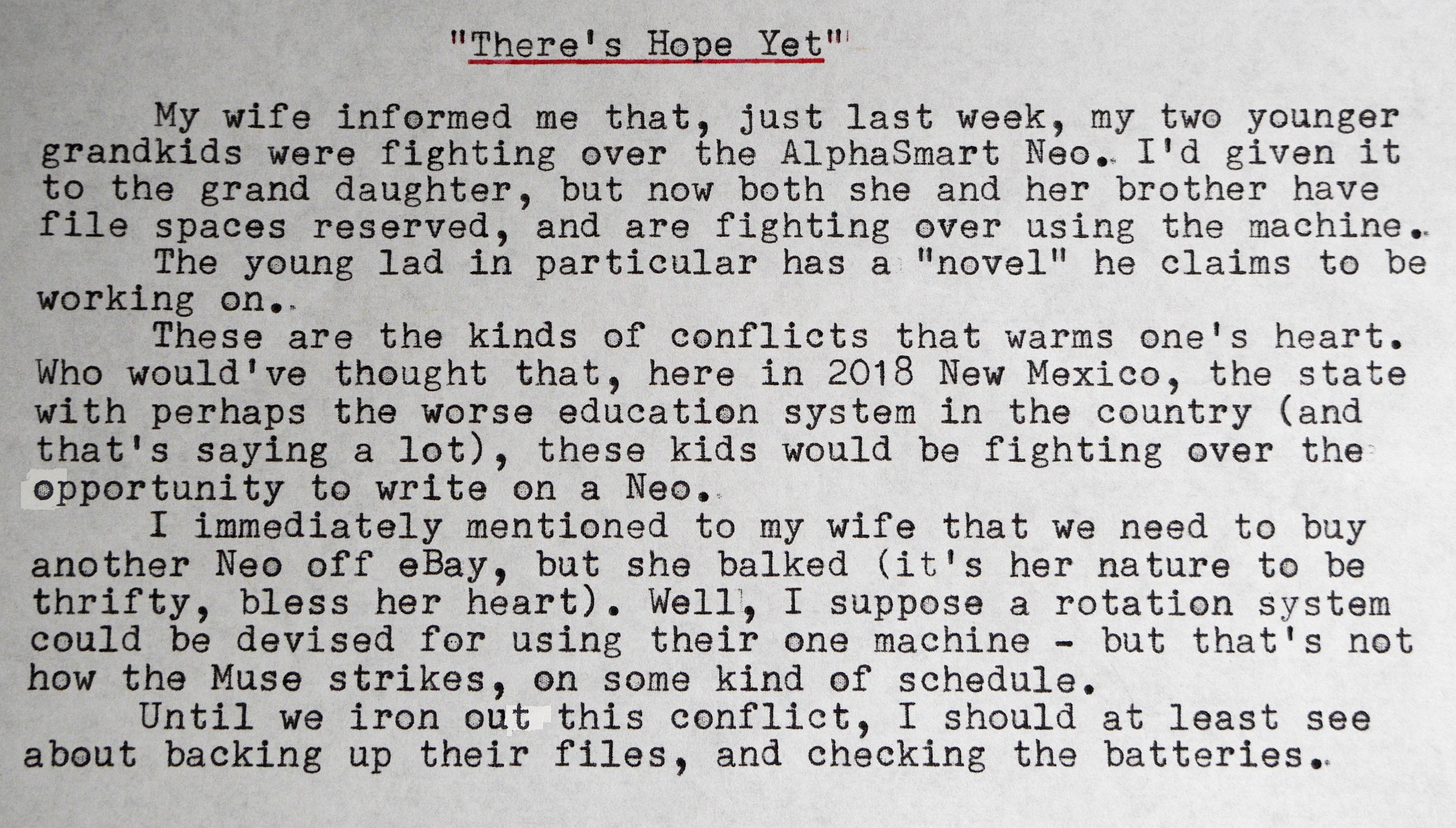
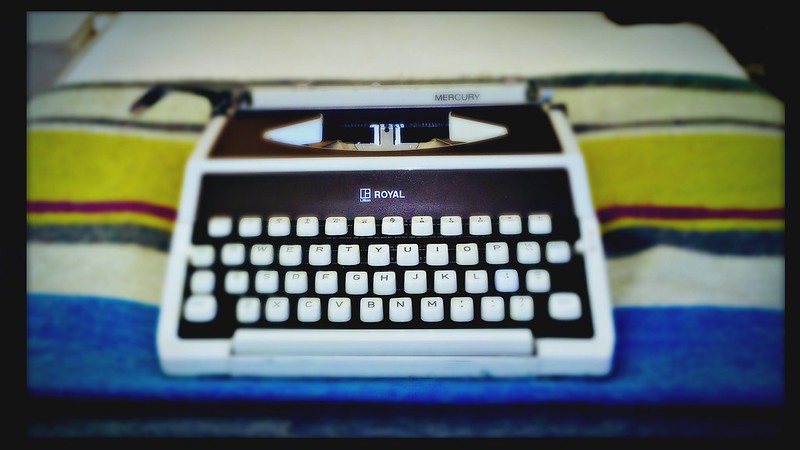
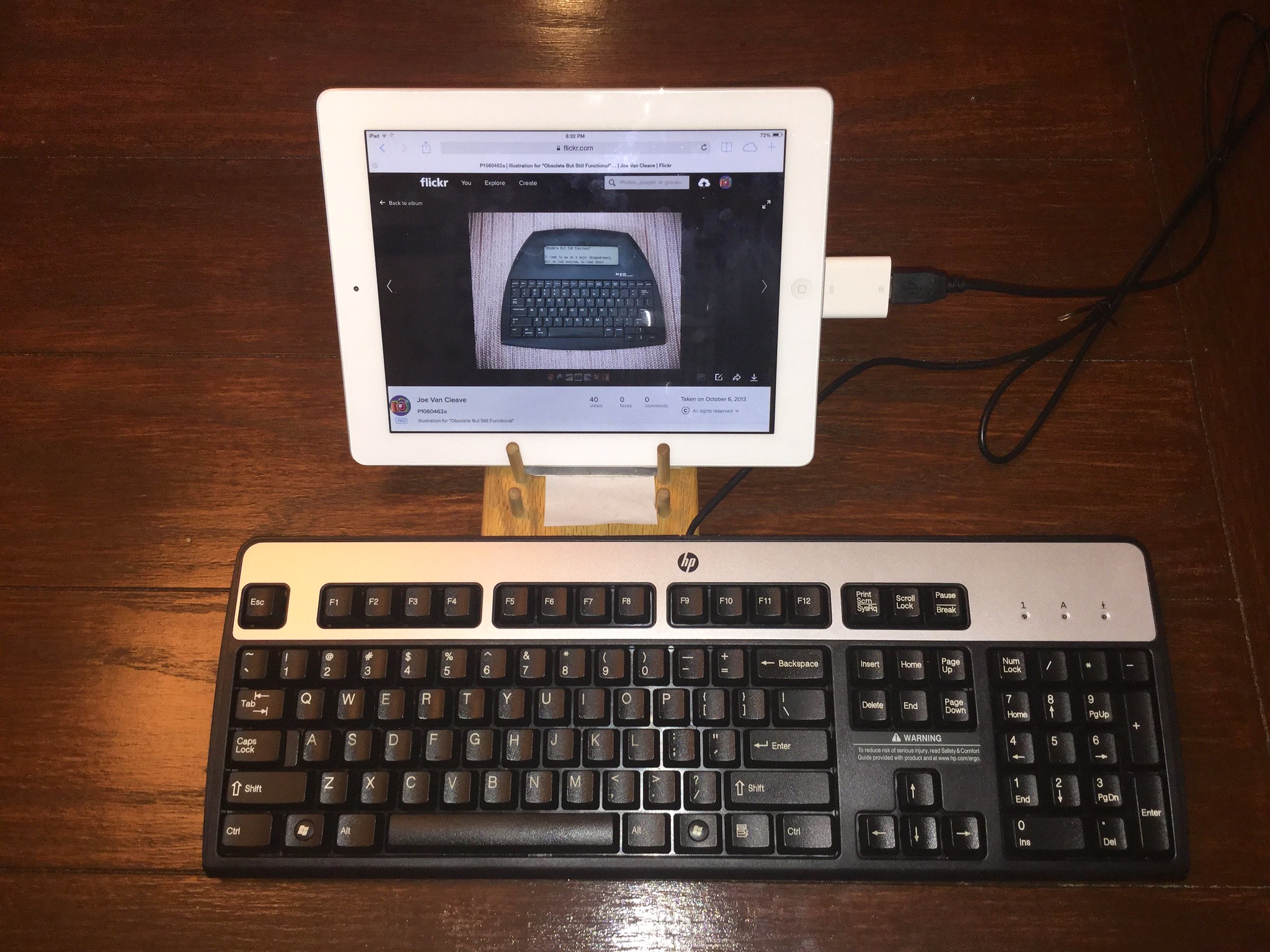
Post-Script: On the subject of the AlphaSmart, there's been some discussion recently on the Flickr AlphaSmart forum about alternative devices that offer a similar non-distractive work flow with a great keyboard and battery life. So far, you can't beat a used Neo on eBay (or wherever).
I'm wanting to start making more impromptu blog entries, spur of the moment, off the top (or side, or wherever) of my head. This motivation was prompted by a recent blog entry by Ted Munk, who spoke of the apparent decline of typewriter blogs, from their heyday in the mid- to late-aughts. Part of this is that blogging in general is in decline; but also our attention is being redirected to social media. I wonder also if mobile platforms are just more cumbersome for both consuming and creating blog content.
Whatever the reason, I've decided to get my act together. I know with my focussed concentration on YouTube these last few years, my blog now plays second fiddle. Whereas it once was the primary medium into which my creative thinking was expressed, it's often been used to just advertise a new video over on YouTube; there's rarely new content expressed herein.
There are often little thoughts that break the surface of my consciousness, not big enough to warrant a full-blown (or even half-blown) video production, but something worth tossing into the pond of public discourse in the Typosphere. Little thoughts that might prompt further discussion about things. Or just little observations that might, for no other purpose, serve as entertainment for a few brief moments. These often have been discarded or abandoned. But perhaps they deserve to be preserved here in. The life of the blog doesn't have to be just big articles. There's also little snippets and observations. It is a log, right? A web log.
My older blogging methods were rather meticulous about using a flatbed scanner for type-casts, to eek out the last bit of quality in those images; I've always wanted those images to look like ink on paper, where you see not just black letters floating against a nondescript white background, but you also see the texture, wrinkles and folds of the paper itself. But having to fire up the scanner is often a chore, and chains me to the office computer.
Lately, I've been trying to photograph these pieces, either with the camera in my iOS device, or using a dedicated digital camera. The challenge is always the light, especially evenness of illumination. Even the least bit of shading, from one side to the other, is exaggerated once the levels are tweaked in post-processing. Like today's example; I had flood lamps on either side of the sheet, with a white reflector card helping to even out the exposure. Even so, you can detect that left-to-right shading.
I've decided, on this matter of photographing type-casts, that perfect is the enemy of good enough. It needs to be legible, for certain. Good contrast between the background paper and the ink. It needs to be sharp, both in focus and lack of motion blur. But a bit of geometric distortion (key-stoning, from shooting off-axis; or pincushion) is okay I think. We're not archiving documents for the Library of Congress.
I like more and more the way Ted Munk makes his type-casts, with narrow typed columns and hence large letters on screen. Very legible and readable.
I keep threatening to make a dedicated copy stand for these pieces; perhaps that's the way to go, so I can guarantee even lighting. But would that end up being just as involved as firing up the flatbed scanner? I'd still have to import the images into my computer from the camera and do some post-processing, like levels, rotation and cropping. Well, by using a camera to digitize them, I have the option of not only importing them to my computer but also to my iOS device where I could do the post-process and upload to Flickr, as an alternative method. The only place where the copy stand would be impractical would be blogging while on the road.
Okay, enough about the minutia of the process. What's important is to make the process streamlined, efficient and effortless enough that one (this one) can focus on doing it as often as possible. With results that are "good enough." You might not always like what you read, but hopefully you'll come back more often and visit, to see what I've been up to.
You stand in line at Customer Service, adjacent to the entrance. Nearby there's a cloistered foyer-like area between two sets of automated doors, where shopping carts are corralled, awaiting their customers like steeds their cowboys. Next to Customer Service, in front of the automated doors, in an open area seemingly too empty, representing potential wasted retail square footage, not even a display kiosk, stands a security officer. He appears to be just a few years out of high school. Fresh-faced, tall and skinny; hardly intimidating to the type of person who might be inclined to commit crimes on the property.
I'm here in Customer Service because I need to exchange an item purchased the previous week. There are three people in line ahead of me. Behind the counter, a middle-aged lady is tending to the line while two others are seemingly supervising, at least according to their badges. Behind them, there is a sign on the wall with the eery message Blood Disposal, below which is a dispenser of biomedical hazard bags. Adjacent is a return bin labeled Celebration. I find myself amused by the dichotomy of this found phrase, Blood Disposal Celebration. This could be a good band name, or title of some experimental video. These are the thoughts that come to you while waiting in line at the neighborhood Walmart Customer Service.
Other than the blue vests and ID badges, it would be difficult to tell the employees apart from the customers. There is a kind of default civilian attire on display by both classes, casualness bordering on grungy, a kind of grunge so authentic as to make the most acute culture-maven pine with jealousy. I ponder the dichotomy of the fashion-conscious who seek out authenticity in appearance by appropriating the cultural artifacts of a socio-economic strata completely foreign to them. Here, the casual grunge is not an affectation but an artifact of hard economic reality. I ponder that thought, as I slowly shift my weight from one foot to the other, and back again, tending to a careful balance between impending impatience and a purposeful attempt at keeping my attitude at bay, taking the high road, reminding myself that standing in line is a rather normal anti-activity for dense populations in the civilized world. I remind myself that I am an accomplished line-stander from way back, so far back as to pre-date the terms "old school" and "back in the day". This too shall pass, I tell myself. The line barely moves. I can almost sense the lights momentarily dimming, but am not certain; maybe it's just me. I have visions of cloaked, huddled masses of Slavs, partly obscured by sleet and snow, standing in some Soviet bread line, grim determination their only solace. Perhaps it's not that bad, I tell myself. Or maybe, I ponder, perhaps the Customer Service line at the neighborhood Walmart is our own kinder, gentler form of Soviet bread line. I find a strange comfort at that thought. The line still barely moves.
Eventually, as each customer is attended to, their returned items are packaged in one of those ubiquitous gray plastic Walmart bags - the kind that eventually become part of the landscape, snarled around tumbleweeds in an adjoining vacant lot - which are then stapled shut and tossed in the appropriate bin behind the Customer Service desk, piled high with other identical gray plastic bags, for some other nameless, faceless soul to restock. I can't imagine what it would be like to have the job of restocking; and yet, if you walk into any 24-hour Walmart, late at night, you might be witness to those ghastly silhouettes of the doomed, frantically restocking shelves. You wonder what form of hell this must be, what crimes were committed that this punishment would be meted out upon these tortured souls; until you suddenly realize their labor is self-inflicted, fueled by hard, cold economic reality. Jobs are hard to come by, out here in the badlands. I check my watch and the second hand has barely moved. Other people behind me in line are twiddling at their phones. Me, I have a flip phone and try not to feel too superior.
It's almost my turn at the Customer Service desk, and another employee is making subtle motions implying a second station might be readying to open; you never can be too certain about these things - only God and the shift manager know for certain, and neither are telling. Should it open while I'm still in line, I'll have to decide which station to choose.
Each choice has some risk. If I choose the newly opened station, does that signal my impatience with the middle-aged lady at the first station? That I'm meting out my exasperation by snubbing her? Or, if I choose her station instead, does that mark me as stoic and inflexible; that, damn it, I made my choice and I'm sticking with it? Is it a signal to the other employee that they took their own sweet time opening up a second station, ignoring us poor saps in line, so to hell with you? Yes. Maybe. Actually I'm not certain, but now it's becoming less important because there's only one guy in front of me, with a shopping cart containing some partially wrapped contraption-like thing that looks entirely out of place here, like it could not possibly have been sold in a Walmart, but instead some secondhand junk truck stop bazaar, something long and gangly and coiled up, with a tinge too much patina and wear to have been purchased recently new. I begin imagining some gang of thieves who hock their booty at the neighborhood Walmart Customer Service in exchange for cash or credit. I begin imagining some one-offramp town near the interstate highway where the local Walmart has put all the other local businesses into receivership; and everything that every person in town owns and wears, aside from major appliances and automobiles, is purchased under that one roof, and how can they, like the tall, gangly security guard man-child, tell if a customer has shoplifted if everything they're wearing, from shoes to jewelry, was purchased there? I begin thinking of a wallet or purse stuffed to overflowing with receipts for everything one wears. I begin thinking about thermally printed cash register receipts and their intrinsically short lifespan before the paper begins to fade. I begin thinking that perhaps this is intentional, as I gaze into that internal maw of limitless conspiracy musings. I purposefully have to shut the door on my inner paranoia.
The guy in front of me, he's struck up a conversation with a lady in front of him, who I thought was his wife but now I'm not so certain, their intimacy seemed too overt for having just met in line; but then I begin to wonder, how long have we actually been in line, that they had time to become acquainted and intimate, and is this the new form of dating venue, instead of singles bars, meeting someone in the Customer Return line, and suddenly I realize I'm next in line and I have to make my choice.
It is only ten minutes later but feels like a lifetime. I'm now walking out through the automated glass doors into the bright daylight, partially filtered by clouds and a blustery, cold wind, into the vast parking lot that faces toward the south, my favorite direction because the vista is so sun-lit, so replete with possibility and the warmth of hope. I think I know which row I parked in, but suddenly don't recognize the rear of my vehicle until I'm almost upon it. I begin to notice that many of the vehicles around me look newer, fancier, except for some stand-out beaters that now sport a new-found patina of appreciation. I press the button on my key fob and that familiar chirp reminds me that my errands are not yet complete, but that I have survived for another day the Customer Service line at the neighborhood Walmart, and I am perhaps the better for it, but am not entirely certain.
There was a particular moment at yesterday's ABQ Type-Out, while standing under the shade of the portal in front of Pennysmiths Paper, being interviewed by a local television news crew, when I had to formulate an answer to the question of "why typewriters." I answered that it was their ability to provide a non-distractive writing experience, a quip rather rattled off the top of my head, but which in retrospect was probably the right line to use.
There are many diverse reasons why a person, in the year 2017, might want to use a typewriter, and thus there isn't just one correct answer to that question. I'm not even certain now whether that was the best answer for myself. Is that really why I type, because I'm so easily distracted? I'm actually not sure.
In theory, the idea that typewriters provide a non-distractive writing experience and thus by implication can make you a better writer is at best an assumption and at worst a straw man argument. There are many competent professional writers who seem to possess the self-discipline required to use computers for writing, among them people like Stephen King. Perhaps the real problem here is not the lack of typewriters, but just an issue of discipline. If a person can't shut off the Internet browser and hunker down in a Word document, maybe there are deeper issues at play.
For example, I know of one writer who uses typewriters, and is constantly on Facebook, morning to evening. First thing in the morning will be posts including some meme about staying out of the way until after that first cup of coffee. Then will come posts of memes about writing, how hard it is. Later will be something about how little progress has been made on that book, and how it's such a struggle. On and on it goes like this, all day long, into the evening when will still be more posting to Facebook, either about typewriters, or coffee, or the writing life and that ongoing struggle to get the book done.
I think I know the problem, and it isn't Microsoft Word; and typewriters aren't going to fix it. Just get the heck off the damned Internet and Facebook, and hunker down and write.
Yes, I do believe typewriters can provide a quality of writing experience different from computers; an intentionality of purpose and a laser-like focus. But let's not kid ourselves. Being a writer is a discipline as much as a skill. By discipline I mean a purpose-driven life, not merely the image of a bootcamp drill sergeant, barking for you to get down and give him fifty more pushups. I mean the kind of discipline you'd see in some lone craftsperson, toiling away in the obscurity of their silent studio to the acclaim of no one but themselves. Constantly honing and refining their craft. Removing the distractions from their life that would prevent their continuous improvement.
Too many would-be typewriter users try to justify their typewriter hobby with the idea that, by writing with typewriters, they will achieve some level of writing they'd otherwise not reach through more conventional means. Maybe they're obsessed by the image of the beret-clad typist, holed away in his flat on the Left Bank, typing and smoking to the sounds of jazz and a steaming espresso machine. Romantic, yes. Realistic, no.
I think it's okay to collect and dabble with typewriters without feeling the need to somehow justify owning them under the pretense that they'll somehow make you a better writer. What might actually make you a better writer is to spend less time on the Internet and Facebook, jibber-jabbering about typewriters, and get down to the serious business of writing. Pen, typewriter, computer - whatever works for you. But toying with typewriters isn't writing. It's toying with typewriters for the sheer joy that typewriters provide. There's nothing wrong with that, no guilt trip needed. Just enjoy typewriters, collect them, whatever. But don't pretend like they're a substitute for the real work required to be a good writer.
Am I saying that typewriters can't be used by serious writers? No. Far from it. If that's what works for you, then keep doing that. But don't shoe-horn typewriters into your work flow just because you're romantically enamored with the concept of writing by typewriter. It might just not work for you. Sure, go ahead and try it. Build a realistic working methodology that includes the typewriter, than use that for a while. Examine the process, see what's working and what's not, then make adjustments. And if, in the course of making those changes, you find typewriters no longer work for you, then ditch them from your writing methodology. Don't just keep using them because you somehow feel obligated because you've labelled yourself as "that typewriter writer".
Mankind, we're a tool-making species. That's what distinguishes us from other animals, discounting the chimpanzees who fish termites out of their nests with a stick. We could probably do that too, if we had the appetite for termites. I think the crucial idea here is we need to be wielding the tool, not having the tool wield us. We need to be in control, to make the choices.
Constant refinement and tweaking of our creative process is just part of being a creative person. It comes with the territory. If you aren't curious about "what if," then you aren't alive enough to call yourself a creative. The crux of creativity is curious exploration. You see something, you prod and poke at it, like that chimp with his termite stick, and see what happens. You observe the results, then modify your prodding technique, or find a better stick, until you see improvements. And on it goes.
Back to the scene yesterday at the Type-Out. We had us some darned nice termite sticks. Portables, medium-sized machines, larger uprights. Manuals and electrics, spanning a range of ages from the WW1 era to the 1970s; from the tiny Hermes Rocket to the hefty IBM Electric and Olympia SG1. Sticks, big and small, a diverse collection able to satisfy the aesthetics of even the most discerning typist. I didn't feel then, and don't now, the need to justify typewriters. That's usually the first thing people ask when they find out you use typewriters. "Isn't it so difficult to use?" "Aren't computers so much easier?" "Gawd, why would you want to use a manual typewriter when a computer is so much better." On and on the complaints go. And that's fine. People can just complain, no sweat. Everyone to their own opinion. But in their complaining, let it be known that most of these people don't understand why it is that we do use typewriters.
As an analogy, let me use classic automobiles. "Why would you want to commute to work in that old thing? It doesn't even have air conditioning, it barely gets off the line, it sucks gas and the brakes are shoddy." Yes, all that is true. Yet people collect antique automobiles and are thrilled to own them, to tinker with them, to polish them and take them out for a Sunday drive. But you won't find them commuting to work in them on Monday morning, that's not why a person collects antique automobiles. And much the same with typewriters. We enjoy tinkering with them, polishing them, getting together with other, like-minded typewriter owners, even take them out for a spin and write with them once in a while. But few are willing to take them to the office and use them, in the way that computers have replaced typewriters. Things have changed, the old order has been replaced with the new, and with those changes typewriters are used in new ways. Back in their day, Model A Fords were the working man's family transportation. The horseless carriage. A practical improvement upon the equine variety. And since then, people who still have Model A Fords use them differently. They are no longer one's daily commuting car or family runabout, but are classics, to be preserved and honored and cherished and tinkered with and fussed over. And driven on Sundays, slow and smooth like, not with the efficiency of that latest Toyota Camry, but with purposeful, deliberate intention, enjoying the experience for experience's sake.
So go ahead and write that Great American Novel with your Smith-Corona. Or drive cross-country with that Model A. But do so knowing the journey won't be the same as with that slick word processor or Toyota. You won't be cruising the Interstate at 85mph, pulling over for a quick Big Mac and fill-up, then back on the highway. Your's will be the backroads of life, more purposeful but also more pedantic. You won't be measuring your progress in sizable chunks of the continent devoured in one day's time. You'll more likely be going from one small town to another, one small piece of writing to another, savoring along the way each nuance of the road, each paragraph and new phrase laid down on fresh paper. It'll be a real adventure, not just a quick jaunt out to the coast. But along the way you might discover something you'd otherwise miss if you took the Toyota.
The single biggest mistake I saw people making at the Type-Out was attempting to touch-type. We forget what it was like before rubbery keyboards and slick software took all the toil out of typing. Then, it took training, weeks and months and years, before you could call yourself a competent typist. Now, people are expected to sit down at a computer and, with virtually no training at all, produce professional output. Bam, whiz, whir and it's done. There's good reason why the image of the old newspaper reporter, banging away on his typewriter with two fingers, his cigarette ash dangling precariously, is so persistent. It's because that old two-fingered technique, as denigrated as it has been over the decades, is so efficient at producing error-free, quality copy. In the end, you'll write quicker using two fingers, given the reality that mistakes will require correction, or even retyping of the entire document. The tortoise over the hare.
"But, but..." you'll exclaim. "My typing teacher drilled into us the importance of touch-typing, yada, yada, yada..." Yea, I remember that, too. Actually, the thing I remember the most from high school typing class, being one of the few boys present, were all the pretty girls. But this ain't 1971 and you aren't learning electric typewriters so you can get a secretarial job. Nosirree. This is 2017, and I'm telling you that those old gin-reeking reporters knew what they were doing when they pecked away on their writing irons with two fingers. They didn't have time to stop and correct, and maybe they had a carbon underneath and weren't about to correct the second copy, too. They had to get it right the first time, error-free.
And here's another thing you might want to think about before criticizing those two-fingered monkeys. Carpal Tunnel Syndrome wasn't a "thing" until computer keyboards. Put that in your pipe and smoke it, will you! I think this is an important point. Touch typing on flat keyboards all day is bad for you, plain and simple. Just because you CAN, because the finger force required to operate a rubbery keyboard is so light, doesn't mean you SHOULD. Where I work, at a major Fortune 500 corporation, the issue of ergonomics and at-risk keyboard behavior is a big deal. People go out on MLOA (medical leave of absence) because of wrist injuries. The company looses money, people's lives are upended, they live with pain and suffering and take a long time to heal. Touch typing might be quick (but is it, really; consider how often you quickly backspace and retype over mistakes, just because you can, hare-like, when you could pedantically and accurately two-finger type with no mistakes and fewer wrist-injuring keystrokes, tortoise-like), but is it safe?
A deeper question might be, do we really need the speed offered by touch-typing on a slick rubbery keyboard? The typical keyboardist rushes through their document, constantly rat-a-tat-tating with the backspace key to erase those frequent mistakes, then stopping suddenly to discover the whole damned paragraph makes little sense because the speed of thought is so much slower than their fingers, and then fondle the mouse and click, highlight, drag and drop words and phrases here and there, having to revise and edit the whole ugly thing until it resembles, somewhat, a well-written piece. Alternatively, you could slowly, methodically think your way through a piece, carefully two-fingering those words into place, in the end requiring less editing and revision and in the process giving your wrists a well-needed break. Take it easy, write slowly and carefully - that's the fastest, safest way to write.
The best thing about typewriters as tools for the writing process is that they teach us to slow down, just slightly faster than the speed of thought, and think before typing, then type slowly, carefully and safely. They also teach us the value of ink on paper, about paper as a valid form of archive and backup, as a way to document the writing process.
I've no real bug about manual typewriters being intrinsically better than electrics, other than their portability and reliability, and the economy of their ribbon system. Actually, given the reality of manufacturing in 2017, a newly designed typewriter, aimed at the enthusiast writer, might look more like a hybrid between electric daisy-wheel plastic wedge and AlphaSmart Neo. For my aesthetics, it would have a standard-width carriage, accepting paper no wider than standard letter sized. Forget those ginormous wedges that took up a majority of one's desktop. It should have a simple and reliable print mechanism, like a daisy-wheel system, but be quick in response to keyboard inputs, with little or no latency. For my needs, it wouldn't require spell check, a thesaurus or even a correcting ribbon and memory system. It would preferably have a cloth ribbon that auto-reverses, for economy over print quality. I can imagine ways to make a cloth ribbon system that advances and auto-reverses, even on a daisy-wheel system, while being designed elegantly simple, using tiny solenoids or stepper motors. It would have a great-feeling keyboard, like the AlphaSmarts have. It needn't be much wider than a Neo, just a bit deeper and thicker to account for the print mechanism. It could be controlled by something like an Arduino board. And it could be lithium-ion battery powered for portability, along with household AC. An electronic typewriter aimed at the enthusiast writer market, not the professional office. A writer's tool that accepts paper as a valid medium for the initial stages of the writing process, but does so nimbly, economically and portably.
Alas, but one can only dream. Back in the 1980s, when I had a Smith-Corona daisy wheel wedge, the thing I liked about it was the quality of imprint from its carbon film ribbon. And the thing I didn't like about it was the frequent replacement cost of those same carbon film ribbon cartridges, which were one-time-use only. I recall that's the thing that motivated me into getting my first manual, some gray Royal with the red badge logo that unlocked the ribbon cover. Yes, I liked the economy of its ribbon; but no, I didn't like the low-quality cloth ribbon imprint. Today, I feel differently. I'm okay with cloth ribbons and their imprint quality, because I harbor no presumptions about a typed page being the equivalent of a professionally printed document. I understand better the place that typewriters have in my writing life. They're like that point-and-shoot film camera. The negatives might be gritty and grainy, but they're raw and real and physical.
These are the things that resonate with me after the Type-Out: answering the question of WHY? Dealing with those issues of intention, and the writing process, and the discipline of being a writer. Dealing with the ergonomics of manual typing, and finding what works best for one's self. And electric typewriters, especially those 1950s-era Smith-Corona Electrics that are small and sexy and so easy to work, with economical cloth ribbons.
I'd like to briefly mention that fellow conspirator Kevin Kittle and I will hopefully be getting together soon to do an in-depth video review of his newly acquired Godrej, recently arrived from India.
Thanks too for all the hard work Kevin put into the organizing the Type-Out; and a hearty shout-out to the staff at Pennysmiths Paper for their support.
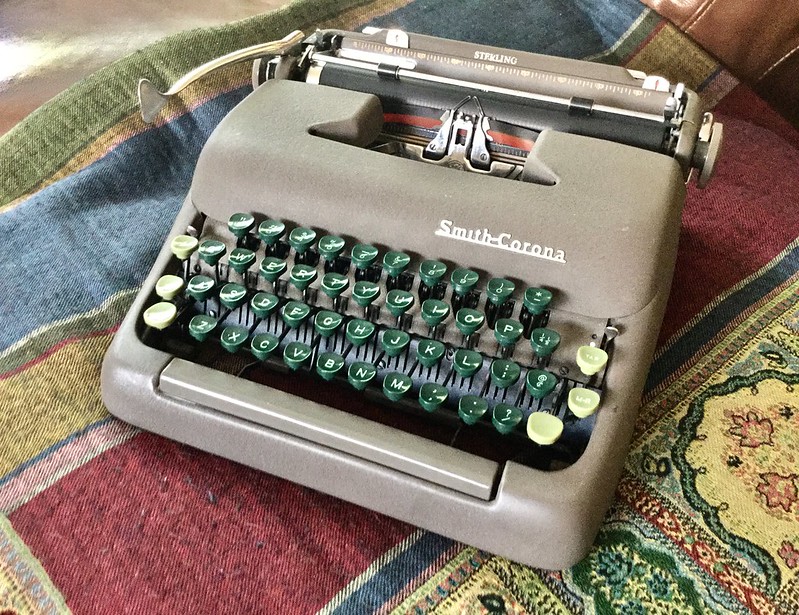
After the Associated Press article on the typewriter revival came out several weeks ago, some people took notice that I live in the local area, including a lady named Sandy, who had in her possession her mother's Smith-Corona Sterling. No, I don't need another typewriter, but this one has an italic typeface. Sandy called me last week, inquiring if I'd care to take it off her hands, and I agreed for her to come over Sunday and I'd take a look at the machine.
I've always been amused by the styling of machines from this era, with their muted colors (or lack thereof) in drab grays and browns, with just a hint of excitement from the two-tone green keys. Automobiles from the same era were similarly adorned in muted color schemes; was it because of some intrinsic modesty, or simple economics? Even the shape of these 5-Series machines reminds me of late-1940s cars, with their rounded curves.
The machine turned out to be entirely functional, excepting the end-of-line bell wasn't working, caused by a bent bracket. And it was very dirty inside, evidence of having never been serviced. Her mother purchased it in 1949 from a small town in Kansas, though it lacks a dealer sticker.
It took me hours and hours to get it adequately cleaned and adjusted. Years of eraser debris had accumulated inside, enough to pit and stain some of the metal surfaces. Extensive cleaning with naphtha and alcohol took care of most of the grunge, however.
The type slugs were caked with old ink and grease, the worse I've seen, and took an extensive session with toothpicks, toothbrush and alcohol to render clean.
Luckily, I have Ted Munk's Typewriter Repair Bible for these 5-Series Smith-Coronas, for I went through the machine, checking in turn each adjustment. It actually wasn't too bad. The right side of the space bar sat lower than the left, which required reforming (i.e. bending) the support arms to get it flush with the body panels, while ensuring adequate travel to trip the escapement, with room to spare. The four screws that hold the space bar to their brackets needed to be loosened and the space bar adjusted to be square to the opening in the body panels.
The other adjustment needed was the tripping point of the type bars. They should trip the escapement to advance the carriage one space when the type slugs just approach the front of the type guide. With this machine, the escapement wouldn't trip until the type slugs were almost in contact with the ribbon. The adjustment involved bending an arm in the escapement mechanism.
As is common with these machines that've never been serviced, some additional degreasing in the slots of the segment were required for some of the type bars, which would subsequently hang up while test typing. I've found that, even if you think the machine is fully functional, you need to do some extensive test-typing to iron out those intermittent problems that remain. I find using disposable mascara brushes, with alcohol, to be a good way to clean the slots of the segment.
I like this italic type face; it's the first in my collection, and the main reason why I purchased this machine. I think it'll be a good letter-writing machine, which is what the lady's mother did, as evidenced by what she told me, and the observation that the right margin was set inward so as to correspond to the width of letter-writing paper.
The Sterling is at the lower end of the 5-Series line. It lacks the end-of-line indicator found on the left end of the platen roller in the higher-end Silents; has fixed tabs with metal slugs that can, if so desired, be set to one's liking; and the platen roller is not easily removable without unscrewing the right carriage cover and loosening a nut.
This machine has a bit more of a mechanical clanking sound to it than the Silents in my collection. Perhaps it's due to being a lower-end model; or because the thin rubber washers originally located on the body panel screw holes have all dissolved into tar. I'll have to find some replacements at the hardware store.
I don't really need another machine in my collection, unless it were highly desirable. This is my third 5-Series machine, which I'll probably keep just for the italic type face. But if I had the opportunity, I'd certainly pick up the little Sky Writer, one of the best ultra-portables.
What I'm thinking of doing with some of these "surplus" or redundant machines in my collection is to donate them to a local school classroom, should I be able to locate a teacher so inclined. I don't want to incur the expense and risk of shipping them out of town, otherwise I'd sell them online.
I think this is a reasonable approach to maintaining a working collection of typewriters, while not permitting them to get out of hand and control my life. As you learn over time your personal preferences, you can adjust your inventory accordingly. Fixing these surplus machines up, then passing them on to others who'd like to experience the manual typewriter lifestyle is our responsibility as aficionados. It certainly beats having them be discarded to the landfill, or be victims of the key-choppers.
One bonus item of Ephemera included with the typewriter was a generic plastic typewriter cover. It's beige in color and in great condition, though lacks any Smith-Corona branding, so I'm thinking it was sold along with the machine by the shop in Kansas. It turns out this cover is large enough that it will serve as a usable cover with even larger machines in my collection, such as the Hermes 3000. Were I of the mind to, and adequately equipped with sewing machine, it'd be nice to use this cover as a template for making colorful cloth covers for sale. I'm just not certain I want to get in the typewriter cover business. But maybe a small sewing machine is in my future. Perhaps.
Post-Script: Written via Alphasmart Neo at my local cigar store lounge. I didn't feel like walking back home in the afternoon heat lugging a typewriter, even a small portable.
Here's my video about this new typewriter to my collection:
There was a time yesterday, as I was attempting to finalize a video for upload to YouTube, that I thought it was all over, this idea of using a simple iPod Touch device as my main tool for video production. I've been trying to keep from having to use my old desktop PC as a video production platform, for a number of reasons. One, it's an older platform; two, the software is outdated; three, I don't know of a video production solution for PCs that is as simple, stable and elegant as is iMovie on the iOS devices; four, a mobile solution means that I can, if so desired, continue to create and publish videos while on the road, which I can't do with a desktop PC.
Apple's mobile platform is pretty stable and mostly well-thought out in design. But the main nagging problem with these iOS devices, and why I recently purchased this newer iPod Touch with twice the memory capacity as my older iPad2, is that their internal memory cannot be expanded, and file transfers are pretty limited. My older iPad was becoming a problem as a useful tool for video production, because its limited free memory meant I had to keep productions below a certain size. Since I've been using this new iPod Touch, I haven't had much of a problem. Until yesterday.
Since purchasing the little iPod, I had installed Hipstamatic, a photography app, and iAWriter, for use as a writing tool. Other than those two, the iPod remained as it was purchased. You wouldn't ordinarily think that merely installing two more apps would make all the difference in the world with the way the device performed, but it certainly did. Without enough internal memory, all of those raw video clips that get imported during a project take up so much room that there isn't enough left over to finalize and upload a project; this was the problem I was seeing yesterday.
I knew I had to keep Hipstamatic, since I use it to create my thumbnail still photos that get attached to the videos seen on YouTube; these thumbnail images need to be less than 2Mb in order to upload successfully to YouTube; the default camera app for iOS creates images too large, with no way to downsize their files, while Hipstamatic offers lower-res version. So I deleted iAWriter, which freed up enough room to permit yesterday's video project to be completed and uploaded. Having to delete this dedicated text editing app was a disappointment, since I had hopes of being able to use the little iPod also as a writing tool, along with the recently acquired mechanical keyboard, as a sort of replacement AlphaSmart Neo.
But actually, I discovered I could still make it work for writing, as a form of electric typewriter. Permit me to explain.
Yesterday morning I made a motorcycle ride down to my favorite coffee shop, Winning Coffee, and had a cuppa while conversing with a table of regulars, while also getting a bit of writing done. I had brought with me the mechanical keyboard in its cloth carrying pouch, along with the iPod Touch, its wooden holder and the necessary cable and adapter. It turns out that the entire rig will fit easily inside the cloth pouch, making it a very mobile writing solution.
The piece I was working on was nothing earth-shattering, just notes for how I wanted to complete another writing project. Once I returned home, I began shooting scenes for a video, and thought nothing about the piece I was writing. Once the problems with the iPod's memory began to occur, before I could think more clear-headed I had deleted the iAWriter app and with it the piece I had written. No great loss, for in the process of writing it I had formulated most of the ideas in my head for that project. Sometimes writing for me serves as a way to simply organize one's thoughts, in the way that the slogan for Field Notes pocket notebooks is "I'm not writing it down to remember it later, I'm writing it down to remember it now."
But something I had done the night before became a clear direction forward in this writing adventure, which was that I had sat down, late at night, with the older iPad propped up on my knee and mechanical keyboard in my lap, and I had written an impromptu essay, which I immediately printed out to paper via my wireless, network-connected printer. The idea being that, in my experience, paper has served me as a much more reliable archive than has digital media, and using a digital system to ultimately create a printed-to-paper (using stable laser printing) document would be an interesting mashup of old and new methods.
What I only knew afterward was that what this system really begins to resemble is a wirelessly connected version of an electric typewriter. Without the additional iAWriter app, there is still the native Notes app, and also Pages, a built-in, full-featured word processing app. So there are writing solutions still available to me on the iPod, for when I don't want to carry the larger iPad. Type it up, connect to my wireless printer and get a laser-printed hardcopy.
I had decided, once I acquired the mechanical keyboard, to make the older iPad a dedicated writing tool, since I'm no longer using it for video editing, and it still has plenty of memory capacity for text files. Whereas the newer iPod Touch I'd use primarily as a video editing and still photo tool. After yesterday's experience, I'm going to have to stick with this plan going forward. The temptation is always to try and shoehorn as many additional apps as possible into these devices, to turn them into general-purpose tools, when in fact their limited memory capacity means, especially for memory-intensive applications like video, they have to remain dedicated to that single purpose.
Android Angst
Now, I do have a Dell Android tablet device, which up to now I haven't found entirely useful except as a web surfing platform. But it does have a decent screen size, and an expandable memory capacity via a micro-SD card slot, which I had yet to test. I spent a large portion of today working to get the Dell tablet into a usable video editing platform; and work it was indeed.
First I had to find a video editing app. Unlike iOS devices, Androids don't come with a default video editor. There are gazillions of them available for Android on their App Store, so it's hard to decide which one to choose, but I found one that had a decent review and a trial version for free, with a reasonable price for upgrading, if I so chose, to the full-featured version. Once it was installed and I familiarized myself with its basic features I shot some test footage on my Panasonic GH3, with the intention of testing the file transfer protocol, editing, finalizing and transfer process to an external micro-SD card.
With the raw footage shot on the GH3 I had to figure out how to transfer the footage to the tablet. The camera has a micro-USB-to-USB cable, while the Dell tablet takes a standard Android connector, whose cable also terminated to standard USB. So I figured all I had to do was find a female-to-female USB adapter and I'd be in business. Wrong.
After running around town and finally finding such an adapter, it turns out that the camera doesn't see the tablet at all, when the two are wired together. Great.
Then I remembered that the GH3 has WiFi connectivity, which I'd never used. After fiddling with it, the tablet would see the WiFi signal from the camera but couldn't transfer the files. So I went to the Android store and found, after two tries, a Panasonic app that talks to the GH3. With that installed on the tablet I was able to transfer the video files wirelessly. Which sounds sophisticated but isn't; I'd rather have it work via cables, because wireless means the transfer is slower, and it eats batteries faster in both camera and tablet.
So finally I got the files transferred to the internal memory of the Dell tablet, and off I went making the test movie using the new video editor. With the free version, I discovered I couldn't finalize in 1080P mode, and it also wouldn't see my micro-SD card. So I figured that, since I liked the editor well enough, it was worth purchasing, and perhaps the upgraded version would solve all those problems.
But the App Store wouldn't take my PayPal, no matter what I tried. I ended up having to figure out another way to complete the transaction, but finally I had the full-featured editor installed. And while it unlocked the full resolution feature, it still wouldn't see my micro-SD card.
The strange thing about this is that in the Dell's settings it sees the SD card and how much memory it has available, but none of the apps can access that card. After several more hours of fiddling around and reading discussion forums online about this problem with these Dell tablets, it turns out there was one type of file manager app for Android that might work, which I installed, and low and behold I could finally use it to transfer video clips and finished movies from the tablet's internal memory to the external card.
I tested this feature by first re-rendering the test project at full resulution, then transferred the finished test movie to the card, after which I deleted the original off the tablet's internal memory, along with the entire project from the video editor. So I had the raw camera footage on the internal memory, and the finished production on the external card. Then I started a new video project, and when I went to surf the library of video files to import to the timeline, there was the SD card and the finished test production. Success!
During these tests I also had the tablet connected via USB to my desktop PC, and I could see via Windows Explorer how the files were being moved between the tablet's internal memory and SD card, as an additional means of confirmation.
I started this project early in the afternoon, and got to this point of success by 9 PM. Only six hours of my life gone, but now - in theory, anyway - it looks like I now have an 8" Android video editing tablet that works with my Panasonic camera and can move files between its internal memory and an external micro-SD card. Which implies, in theory at least, that I shouldn't have memory capacity issues going forward. So tomorrow I intend on testing this out with a for-real video project, to be uploaded to YouTube (that feature has yet to be tested, however). We'll see how that goes.
All of this work to get these "simple" mobile devices to function for specific purposes like writing and video editing could have been avoided with the application of enough money to purchase some nice video editing-friendly laptop computer, like a Mac Book. But that's not how I roll. I'd prefer to keep my system as simple as possible, to get as much as I can out of the tools at hand, to find a way to do things in a bit more of a personally satisfying manner.
All of this system engineering has confirmed my suspicions, that in general the Apple iOS platform really is superior, in the sense of being well though-out and stable in performance but also, due to design philosophy on the part of the late Mr. Jobs, purposefully hobbled for doing more intensive, computer-like functions like freely moving files around and being able to expand its memory. Whereas Android is more like a Microsoft product in the sense that, while it gives you more freedom, it comes at the cost of being glitchy, unstable and not well thought-out as an integrated platform; you have to cobble together various applications to get it to do what you want.
I suspect this article is way too long, and boring, for most of my regular readership, since it doesn't involve, directly at least, typewriters or film photography. But it does serve to illustrate that these complex and imperfect systems can be configured to one's liking, if you are willing to expend the necessary effort to find creative ways to work around the intrinsic limitations.
Today I want to discuss writing methods. By the term 'writing' I don't mean the art of putting words together, but instead the mechanics of how that's done.
Real writers, those who financially sustain themselves through writing or the teaching of writing, might dismiss this overt emphasis on the mechanics of the process (at the exclusion of creative content) as the dabbling of the amateur; more like street-level scribbling.
But to us street-scribblers, the mechanics of writing are all important, at least as a way of getting over the distractions that come from an ill-thought-out writing system, which is a prerequisite for good writing: get rid of all the encumbrances and roadblocks in the way of one's writing process and the rest will follow suit.
Real writers should have learned early on, as a matter of course in the development of their professional writing skills, the importance of finding and honing their personal kit of tools and methods that enable that creative flow. But for us street-level scribblers, we're always in school, and the streets are our daily lecture series, so we're constantly learning and refining.
The problem for us amateur scribblers is that it's all too easy to confuse the needs of our future writing skills with the necessary but much less important refinement needed to our physical toolkit; similar types of conundrums are evident in the world of photography, where the fledgling confuses the desire for a better camera or lens with what's really needed, that being refinement and development in one's technical and creative skills. So let this serve as reminder that however useful new toys might serve to help refine one's writing toolkit, they ain't gonna make you the next Great American (or insert your nationality of choice) Novelist. But you probably knew that already.
I must confess that I'm a gadget freak, like many males of my age; yet I also admit that I have yet to find an effective way to get over that fundamental blind spot in my personal development. It's probably an artifact of our culture, which sounds like a convenient excuse. Tools, toys, kit, gadgets - they're all fine, and relatively easy to acquire if one is of a sufficient middle-class lifestyle; but harder to acquire are the real skills required of a creative person. This means a protracted period of intense personal development; a lot harder than clicking on some button on Amazon and charging the expense to one's credit card. If only transforming one's mind were that easy.
I suspect this is a problem experienced by many people in our consumer-oriented culture, the expectation that real personal development can be acquired like some mass-marketed product. But ask anyone who's attempted such a personal journey and you'll soon find out that this is a matter common to our humanity throughout recorded history. Education, a true education, is most difficult to acquire, and takes a lifetime.
As to the matter at hand, the making of an effective writing system, this will differ for each individual. At one extreme, many people like the convenience of incorporating the entirety of their writing process, from first-draft brainstorming to the finished electronic document, contained within one system, the computer; and often that computer is a laptop, for reasons of convenience and portability. At the other extreme are people who prefer the hand-wrought crafting of words by pen, pencil or typewriter onto paper, only later to be developed into a finished electronic document. There are also many others whose personal writing system falls somewhere in between these two extremes, the choice often resulting more from personal circumstance and habit than any particularly specific philosophy or bent.
Such habits can be formed through a process akin to superstition, like the way that some sports athletes make preparation using a specific set of pre-game routines or articles of clothing; not because they actually believe there to be some supernatural connection between that particular method or object and the outcome of the game, but more like whatever seems to be working for them, they're not going to change it; keep as much as possible the same and perhaps success can be made more likely. Superstition, or a more effective psychological strategy? Hard to say; perhaps a little of both. Writers have been known to be a superstitious lot, frequently sticking to whatever works (like an obsolete word processor from the 1970s, or that old typewriter) because writing is hard and mysterious and why mess with what's working?
For myself, what has worked for me in the past - and by "worked for me" I mean been able to eliminate distractions and produce effective and creative writing, is both handwriting, either by means of mechanical pencil or fountain pen, and other methods like keyboarding into distraction-free text editors and also manual typing. Is this some magic formula? No; merely working out the application of past experience to future projects. I suspect the "magic" that comes from using these various successful writing methods is because of the confidence they inspire; the knowing that what worked for me in the past will again work for me in the future. It's more a trick of psychology, which is the realm within which all writers blocks originate. The mind is mysterious and unfathomable, its depths yet to be plumbed; especially the creative mind; which is why I consider the act of creativity to be the one essential test of true artificial intelligence.
But knowing that my past successes don't entirely hinge upon one specific set of tools or methods, perhaps I can find other methods that work equally well, or better. That is the approach I'm using with this recent endeavor of employing mechanical computer keyboards with iOS devices. There are many kinds of mobile electronic devices that can host writing applications, everything from Mac or PC to Android or iPad tablets. And bluetooth keyboards also seem to abound, though they lack that preferred mechanical feel. But knowing that some of my best writing experiences involve keyboards that exhibit a particularly satisfying mechanical feel (including both AlphaSmarts and manual typewriters), this new approach tries to synthesize the very best of that mechanical keyboard feel with the advantages of a modern and relatively error-free operating environment, like iOS.
Portability is also of essence to my preferred writing system, for I've found, over the years, that I'm not a static writer, but prefer a variety of places within which to write; hence whatever device I'm employing must be small and lightweight enough to be conveniently carried with me from place to place, even if those places are merely located in and around my neighborhood coffee shop or backyard shed. Over the years I've worked with a number of portable typewriters and, while they are effective tools for creative work, are not as convenient as a more portable device like keyboard and tablet; and are often less than welcome in an enclosed public space, due to their operating noise. For this reason, I've chosen a so-called "60%" sized mechanical keyboard, one that's about the same size as the keyboard of a mechanical typewriter, encompassing a mere 61 keys in total. The feel of this keyboard is every bit as good as, perhaps even better than, that of the AlphaSmart Neo - which is saying a lot; one reason being that, at the time of order, one can choose from a selection of six different Cherry MX keyswitches, thus the feel of the keyboard can be customized for one's personal liking. Mechanical keyboards, of the type I'm using, are now gaining popularity with a wider user base of writers, outside of their original gamer and programmer sub-cultures.
This is perhaps the fourth article I've written in recent weeks on this subject of mechanical keyboards employed along with electronic tablet devices. I've been typecasting - writing, scanning and posting mechanically typed prose to my blog - for almost a decade, which I don't foresee terminating any time in the future; but there is a convenience factor at work here with this new toolkit, the ability to, at a moment's notice, pick up iPad and mechanical keyboard, go somewhere, anywhere, and type out some thoughts, complete with spell checking and embedded HTML markup language, ready to be pasted to a blog template or elsewhere.
I recently went back into my archives of journal books in order to gain a deeper sense of my personal writing history, and what I found was that there's this huge gap, somewhere in the mid-aughts, after I'd supplanted hand-written journal books for various experimental and electronic writing systems, such as Palm-based portable devices and others, and before I'd begun typewriter journalling and blogging more consistently in the later aughts. I attribute this gap in my writing history not to a falling off of my writing activity but because these experimental systems simply hadn't worked out all that well as archiving systems. This mainly had to do with the way I'd managed (or mismanaged) backups to my computer system; but many of those writings are gone forever. It's clear that whatever writing methods one chooses, the stability and security of those documents is essential.
Contrast this with the fact that I have a sizable archive of paper-based writings which, although residing in the physical realm and therefore susceptible to the vagaries of both time and moth, seem to have weathered the digital storms just fine. I think what many of us tend to forget in this regard is that digital media are essentially physical in nature: there's some physical media within which the code resides, and that physical media- magnetic, optical or electronic - is often more fragile than the paper it was intended to replace.
I'm not suggesting that we go out with pitchforks in hand and burn down all the server farms; far from it. I think cloud-based backups, especially for relatively tidy files like text documents, are practical alternatives for us becoming our own IT specialists with home-based systems. But another practical backup alternative is to maintain paper documents. Having that irreplaceable story printed to paper has saved my bacon more than once. Yes, paper does take up room, and large boxes or notebooks of paper documents can be rather heavy. But so too is an article of furniture; I'd like to think of that physical archive of my essential work, printed to paper, to be like the furniture of the mind.
And so I'm suggesting that my mechanical keyboard + mobile iOS writing system will also be outputting a printed copy to paper; especially for writings such as personal journal entries, essays and stories, that are not immediately posted to the Internet, as would be the case with blog articles (which will be supported for perpetuity as long as the likes of Google remain viable businesses). Big Brother's IT department is well-suited for archiving my public writings, while my private work I think will be best backed up on paper. Had I done this back in the mid-aughts, I'd still have all of those personal journal entries.
I'll also continue to create works direct to paper via typewriter, pen or pencil. They're all essential, they all work for me, they each have unique attributes and purposes. But I find a good mechanical keyboard and writing app to be faster than hand writing and just as effective. Neither am I suggesting that I'm going to be abandoning typewriters any time soon. There are peculiarities to the experience of writing via a typewriter that are unique, and can spur uniquely creative results. Typewriters these days I don't see as effective tools for the final stages of editing a work into a finished piece, because word processors simply move text around so much easier. But for those early, creative phases of writing few things can match the typewriter for its ability to somehow pull out of the writer's guts the essence of what that piece will soon become. Hence the old saw about choosing the right tool for the right job. Luckily for me, I now have one more good tool in my writing toolbox.
Some Thoughts on Electronic Typewriter Alternatives
I uploaded a video today describing the usefulness of the AlphaSmart Neo, text-editor based keyboard device, as an alternative to the direct typewriter experience. This idea will come as no surprise to people who are already familiar with these paperless, electronic writing tools, but for others who aren't, this might come as a shock, even blasphemy. I offer no apologies, only my personal viewpoint to the contrary.
In the video, I explain my feelings as to the essence of what the writing-with-a-typewriter experience is all about, for me. To some, it might have to do with the pre-computer legacy of the typewriter, or to others it might be the mechanical, direct ink-to-paper aspect of typewriters. Those are all valid reasons to prefer typewriters to other forms of writing methods, ones to which I can heartily attest as an incurable typewriter fanatic.
But for the actual experience of writing using a typewriter, I find these three aspects most unique and attractive: 1) Non-distractive writing; 2) Mechanical interface; 3) Single-purpose use. There are other aspects of typewriters worth appreciating, but these three I feel capture in essence what many others, throughout the past decades, have expressed as their primary reason for preferring typewriters over other forms of writing.
It is helpful to remind ourselves that, for a long period of time, typewriters were the only form of mechanized writing accessible to the common person. Certainly by the 1960s there were a handful of writers who gained access, through special circumstances, to word processor programs hosted on mainframes or mini-computers; but it wasn't until the mid- to late-1970s that the personal computer platform became sufficiently capable and affordable for access by the mainstream public as a writing device. Once that happened, writing technology was quickly transformed.
Interestingly, we really didn't hear much about computer-based word processors being a distraction to the writing experience until personal computer platforms became sufficiently capable to host other, more distractive, features such as games and the Internet. This has become most notable since the advent of widely available wireless Internet accessibility.
I'd like to argue in favor of mechanical keyboards connected to distraction-free text entry systems as being essentially typewriter-like. Broadly speaking, if a computing platform, dedicated to a word processor or text-entry program, is not typewriter-like, then electric typewriters shouldn't be considered as typewriters either. An early personal computer, lacking distractive software other than a few 8-bit graphic games, and connected to a mechanical-feeling keyboard and line printer, is essentially an electric typewriter in function, that lacks the compactness of a predecessor technology such as the IBM Selectric, whose components fit all in one package instead of scattered over the work surface of a desk. Was an early word processor computer overly complex? Yes, certainly. Ungainly? Yes, without doubt. Non-portable? Other than the Osborne luggable computers and their ilk (which lacked a built-in printer), yes. But were they functionally like electric typewriters? Certainly; and would also permit text editing.
By the time we get to the 1980s and the daisy-wheel electric typewriter, some of which offered limited text editing via a single-line LCD screen and memory buffer, we have what is essentially the mess of an early word processor personal computer, keyboard and printer, that would have otherwise covered the entire working surface of an office desk, all jammed into one small enclosure; light and small enough to lug around, but still requiring to be plugged into an electric outlet to function.
So, I think it's fair to say that electric typewriters, though different in some respects to manuals, deliver a genuine typewriter writing experience; and I will also argue that any technology that delivers a sufficient similarity of writing experience should be considered electric typewriter-like.
I know what you skeptics are thinking, this guy's trying to use convoluted logic to convince himself that computers are typewriters and therefore should be considered the same. Actually, no. I've written with both typewriters and computers, as have many of you. Computers are fine for final polish of a document; and considering that there are few publishers left who will accept manuscripts in typescript form on paper, a writer has little option but to, at some point in the writing process, employ that demon computer.
But few of us are writers; fewer still are published. Yet what's most important in those crucial early stages of the writing process is to employ tools that reduce distraction and focus the writer to the task at hand. Non-distractive systems, in whatever form they be, are often preferred. Does that mean all professional writers use non-distractive systems like typewriters in some part of their writing process? Probably not; I'd wager that many writers whose output is measured in several books per year have disciplined themselves to using computers as their preferred writing tool, without falling into the pitfalls that computers can offer, simply for the efficiency of the word processor. It's a matter of discipline and focus. For the professional, it's their livelihood at stake; of course they'd be able to figure out how not to be tempted by Instagram, Twitter and YouTube cat videos.
For a person like me, a typewriter fanatic and also fledgling, amateur writer, I find advantage to both typewriter and word processor. It's the foibles of the computer platform that host most word processor applications that gets me. For many of us, we've found devices like the AlphaSmart text editing keyboards to be almost ideally suited to that early writing phase, due to its non-distractive nature, portability, excellent feeling keyboard and world-class battery life. We should remind ourselves that even 1980s-era, line-editing, electric daisywheel typewriters had within their innards some form of micro-processor. Certainly the AlphaSmarts do, too. So I think it's fair to say that computers, in the most broad application of that term, are not intrinsically writer-unfriendly. Rather, it's the crudeness of general-purpose computer operating systems that draws the ire of typewriter aficionados like myself and others.
It would be nice if devices like the AlphaSmart Neo were still being manufactured, but they aren't. I purchased mine in 2010, for under $100. At that time, laptop computers with all their distraction were selling for around ten times that amount. Today, a person looking for a dedicated electronic writing experience that offers a text file output has few alternatives. One such alternative is to purchase a used Neo online, and risk receiving someone's broken device with no factory support, other than software uploads from Renaissance Learning. Another alternative is the Hemingwriter device, but it, though costly, is less capable than an AlphaSmart, as it lacks text edit capability. A third option is someone on Etsy selling what he calls a Write-O-Tron, an Arduino-based dedicated word processing system built into a wooden cigar box, that costs about the same as the Hemingwriter.
I would like to propose another alternative, one that lacks some of the advantages of the AlphaSmarts but does offer a distraction-free writing experience (with one cavaet) and an excellent-feeling, truely mechanical keyboard. That is to pair a true mechanical keyboard with a small iOS tablet device like an iPad Mini or, better yet, iPod Touch.
I'm working on building such a system. This piece was written with the first iteration, that being a full-sized desktop computer keyboard (one I had laying around in storage) paired with an old iPad 2 sporting the IAWriter app. I'm going to be replacing this large keyboard with a so-called "60%" mechanical keyboard (that should be arriving this week), and the iPod Touch I've already been using for editing photos and videos.
If you had to purchase this system new (I already had the iPad 2 and old desktop keyboard, so their cost was essentially free), you'd spend about $250 for a 32GB iPod Touch and about $100 for a true mechanical keyboard (or a lot less for a larger, standard desktop keyboard); still somewhat less than either the Hemingwriter or Write-O-Tron, but with much more capability. Or maybe you already have an iPhone; all you need is the mechanical keyboard, and the discipline to put it into "airplane" mode for a few hours (the secret to non-distractive writing on iOS devices).
Yes, you can get Bluetooth wireless keyboards for iOS devices; but these lack the feel of a true mechanical keyboard (remember that typewriter-like writing experience we're after?) and being wireless means they'll end up sucking the battery life out of your iOS device. Keep your iOS device in "airplane" mode and the Bluetooth turned off and its battery will last for many hours, sufficient to get your writing done for the day. And using a smaller, "60%" keyboard means full-sized mechanical keys in a much smaller, more portable package.
An AlphaSmart Neo isn't a replacement for a true typewriter, because direct mechanical type to paper is an experience unique unto itself. I'll never get rid of my typewriter collection (though its numbers might fluxuate up or down over the years); likewise, I hope to have my Neo for many years into the future, because it's such an excellent portable first-draft writing tool. But being electronic, and no longer manufactured or supported, means I need to find some kind of functional alternative. I think a mechanical keyboard mated to an iOS tablet device might be that alternative. I'll keep you posted on my findings.