Typewritten Cartoons
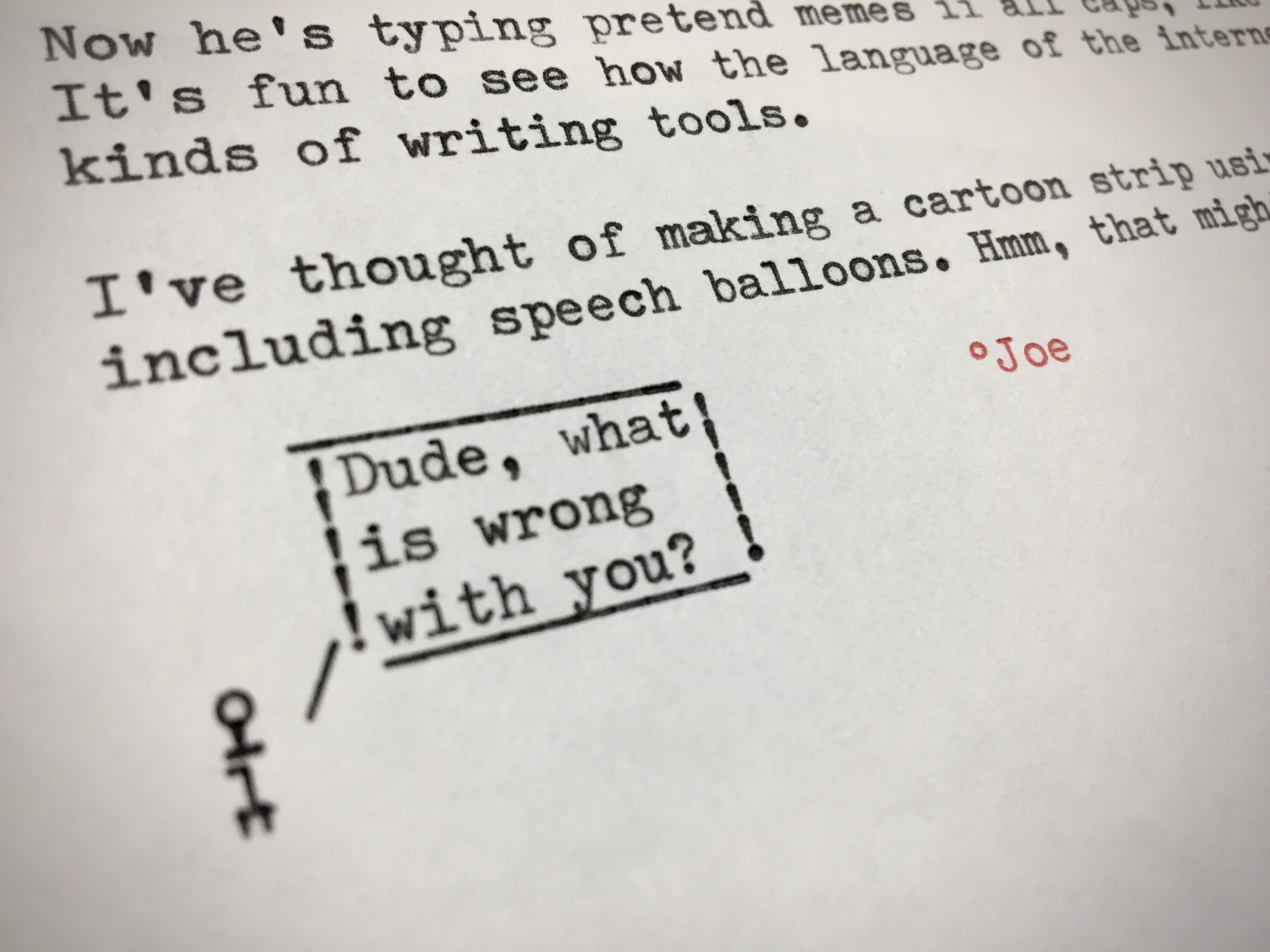
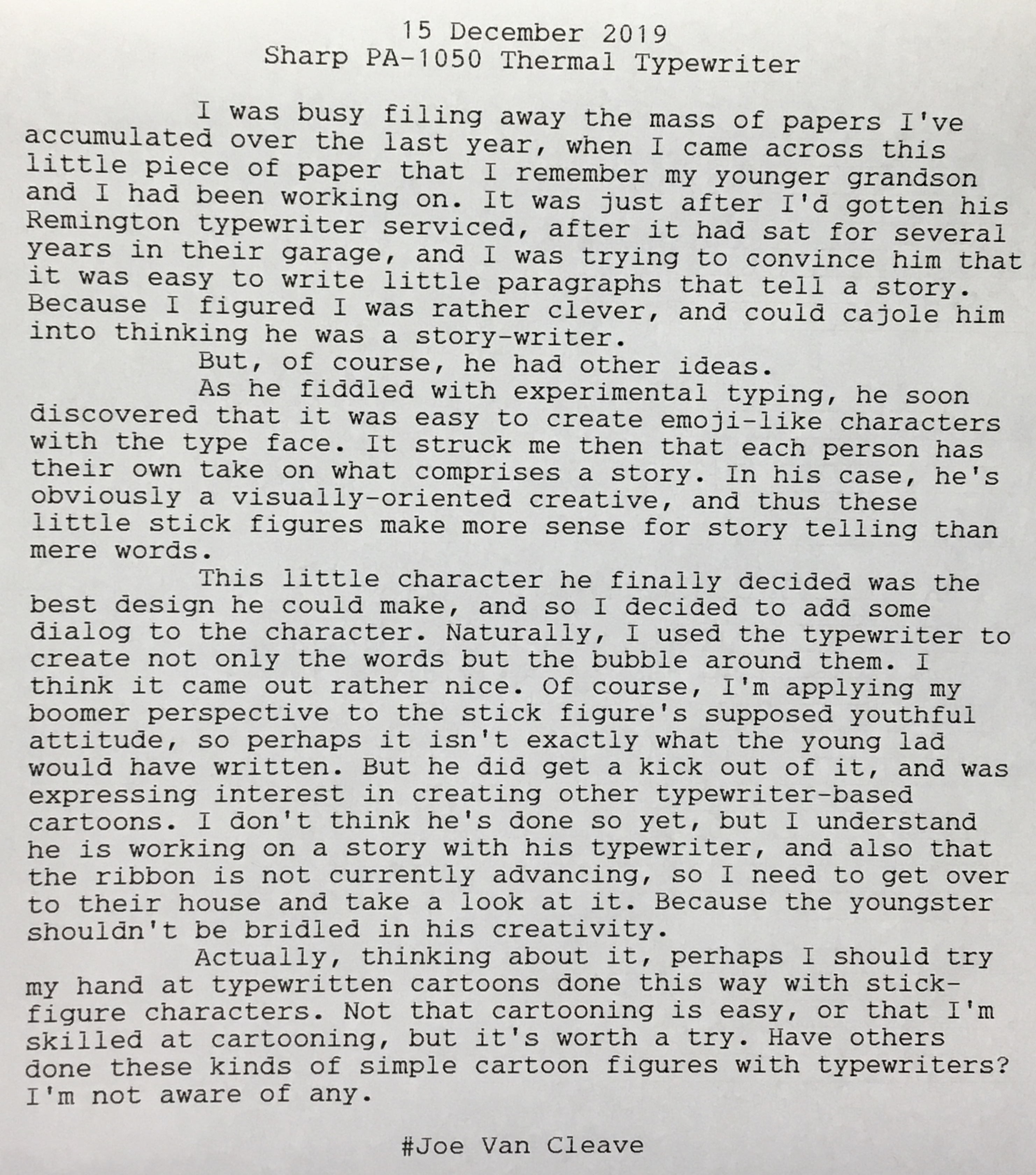
Naturally, I had to sit down at my Torpedo 18 last night and work on my own typewritten stick figures. While it's easy to make faces, forming an entire body takes a bit more doing. Here are a sampling of various figures, and some suggestions as to who these characters might be.

It soon became apparent that what was missing was an inverted "V", to form the legs of the classic stick figure. But my typewriter had merely a standard typeface. What to do? Simple: invert the paper and type the character upside-down, then remove the paper, roll it back in right-side-up, and continue with typing the dialog. Here's a sampling of my first attempts at creating upside-down stick figures. I've drawn boxes around each one I like, with handwritten notation next to each describing the order of the typed characters.

And here's my crude attempt at placing these figures into a cartoon-like context. I wonder if, perhaps five years from now, the "snowflake" comment will even make sense to readers of this blog. Gosh, I hope not!

These typewritten cartoon figures are directly related to the smiley emoticon characters first derived from text-based computer code. The main difference here is that, with the manual typewriter, I have the ability to overlap characters, combining them into new forms, while also playing with the line advance. Not that this couldn't have been done with early computer code - perhaps a program could have been written to directly control the printer's head, instructing it to move one character backward and overprint a new character over an older one. So, even though our lowly manual typewriters usually produce only monospaced text, we have direct control over their placement.
I dabbled briefly with cartoons, back in the 1980s, with a local group of creatives who called ourselves S.W.A.C. - Southwest Association of Cartoonists. Our leader was a gent named Tom Ebelt, and one of our members was New Yorker cartoonist Danny Shanahan, who lived at that time in the village of Corrales, just northwest of ABQ. He subsequently moved back to New York. I've followed Danny's career since then, and in fact have one of his original pieces, that didn't get published in the New Yorker.
I enjoy the New Yorker's cartoon caption contest, though I'm terrible at thinking up good captions. But what amazes me about good cartoons is it's usually all about the writing, not the drawing. Take the typical New Yorker piece, perhaps a couple sitting at home in front of the television. Without a caption, it's just a cartoon couple on their couch. But with a witty line or two it becomes magic, taking on a life of its own.
That's why I think these typewritten cartoons have some potential. The "art" work is about the most primitive you can get, reminding me somewhat of the Basic Instructions cartoon and how artist Scott Meyer uses computer-generated images to piece together his panels; the difference being that in the case of typewritten cartoons the figures are typeset from a predetermined typeface, rearranged in a creative manner. What makes or breaks typewritten cartoons is the writing itself. Not that I'll necessarily be doing more of these anytime soon, but perhaps I'll post more of these as they strike me, and providing they're of sufficient quality. We shall see.
But how about you: do you make typewritten cartoon figures? I'd like to hear from you. Leave a comment below.
Labels: cartoons, Torpedo 18, Type-A-Sketch, typewriter art
posted by Joe V at 7:57 AM
8 comments