Monday, May 11, 2020

The Thing Transformed
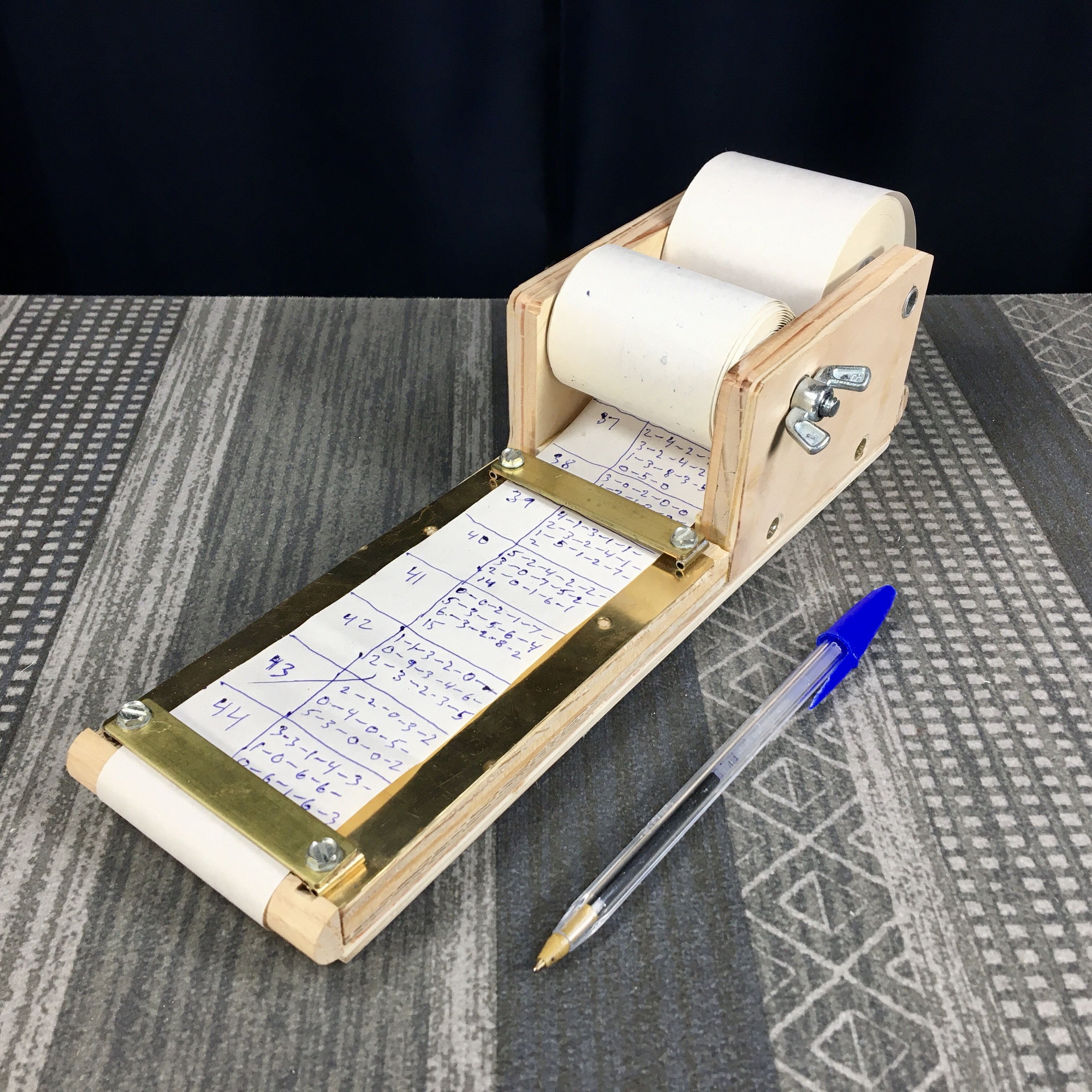
The Thing — Paper roll note-taking holder, latest version.
The Thing Transformed

No, the thermal Sharp PA-1050 typewriter prints lines just fine. I'm using the iPhone's panorama mode to scan this over-24-inch-long piece, and handholding it as I move it causes these wonky artifacts. I need to make a dolly that moves the iPhone smoothly across the tabletop. Also, maybe less coffee?
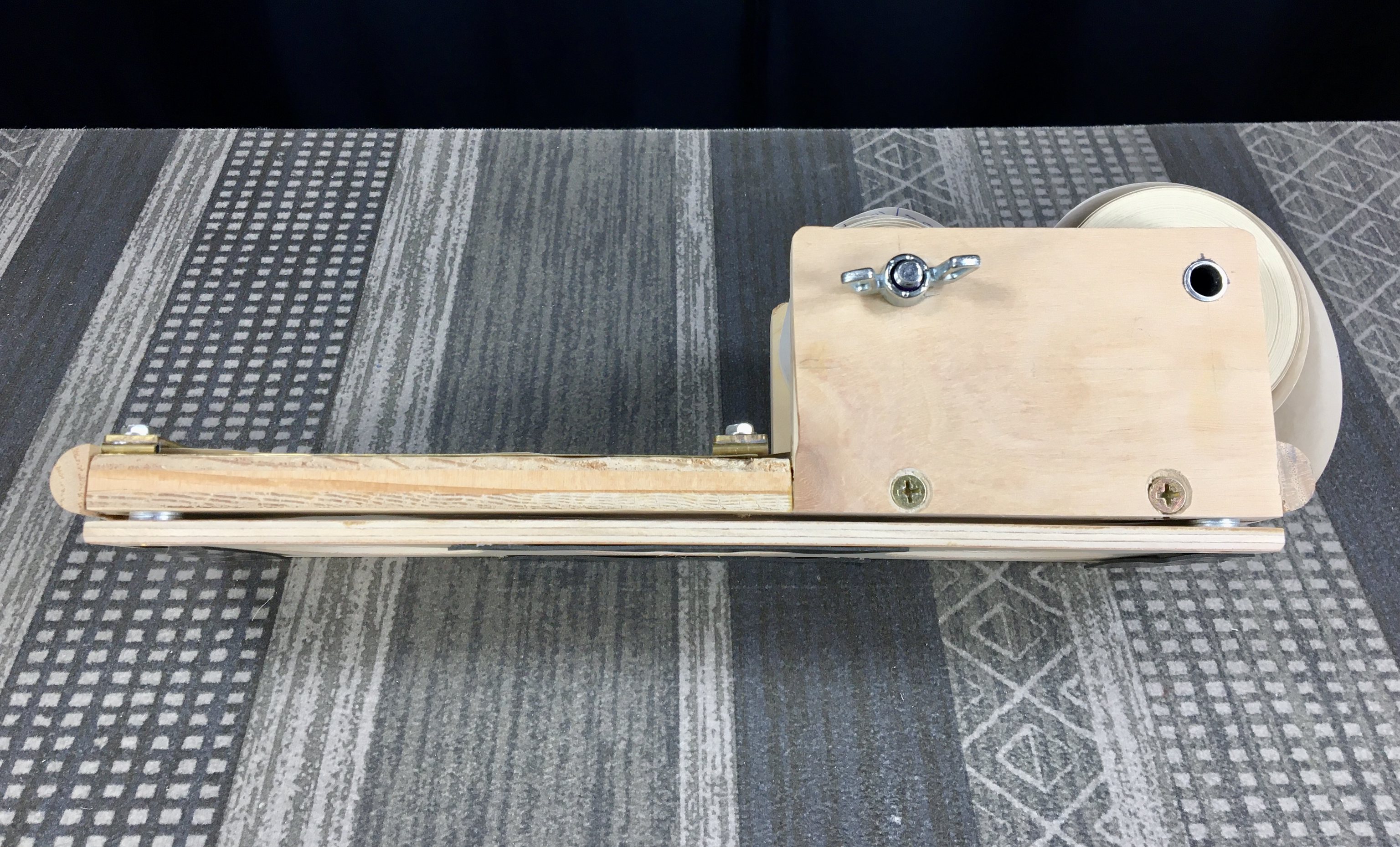
The Thing — Paper roll note-taking holder, latest version.

Side view (above). Note the narrow gap between the main plate and bottom, where the paper feeds under the unit from the supply spool in back to the writing surface and take-up spool up front. The supply spool free-wheels on the aluminum rod, whereas the take-up spool is driven by turning the wing nut. Note the half-round dowels at the front and rear edges for the paper to make a smoother bend around.

The Thing — Paper roll note-taking holder, latest version.

Underside (above). Note the access holes for feeding a fresh roll of paper. And the non-slip rubber pads.

Kitchen Paper Roll Note-Taker

For reference (above) is the note-taking roll holder I made for my wife. Simple design, the roll free-wheels on the aluminum tube. The thin brass rod is for the paper to roll underneath. Note the brass plate that serves to keep the paper flat while providing for a tear-edge. The version I made for my sister-in-law is very much the same. To replace the paper, the aluminum tube is pressed out with a pen cap, and fits snuggly into the holes drilled in the side brackets.

Let's get back my comment above, about using the iPhone's panorama mode for "scanning" this long piece, thermally-typed on a roll of fax paper. Panorama mode is intended for the user to hold the phone vertically in portrait orientation and slowly rotate around a scene; the phone's software stitches together a mega-sized image, much larger in pixel size than the native camera could achieve on its own. In fact, a standard flatbed scanner would also be of little use for these long sheets of paper.

In use as a makeshift scanner, I'm instead moving the phone in a line along the length of the scroll of paper. In order to have a distortion-free image I need to move the phone at a constant speed, without it tilting up, down or sideways. And, in order to achieve even exposure along the length of the paper, I need to lay it on my video table with lights ablaze. For this shot I clipped the paper sideways to a board and tilted it at an angle toward the phone; the phone in portrait orientation needed to be pointing down at an angle perpendicular to the paper, then be moved smoothly along its length at a constant speed without changing the angle. Not easy to do. In the future I need a fixture to help me do this better.

I'm one for the "elegant solution". Yes, I could cobble together a stepper-motor-and-Arduino system for moving a motorized dolly across the tabletop, or buy a video slider system, but I'm thinking of an elegantly simpler solution. First is a smooth surface that runs the width of the table, say made from spare hardwood flooring panels that happen to be in my storage shed. Next is a wheeled dolly to mount the phone onto via an adjustable ball-head mount. Then a thin wire (or string) that runs from the front of the dolly to a pulley at the side of the table, attached to the end of the string being a heavy weight, that pulls the dolly forward as the weight falls. To achieve constant speed another string is attached to the back of the dolly, around another pulley and onto a weathervane-style rotor. As the weight pulls the dolly, the weathervane rotor spins fast. Because of air resistance, the rotor can only spin at a constant speed, which helps to regulate the speed of the dolly's movement.

I first saw this method used in a Panasonic (Technics) cassette deck, back in the 1980s. Most cassette decks that had a slow-opening lid used a plastic dashpot (a cylinder and piston arrangement with a calibrated air hole) lubricated by synthetic grease, that made the lid, operated by a spring, open slowly - until the grease hardened or the rubber o-ring wore out, which was frequent. In the Technics deck, they use a draw spring attached to the door that wound around a shaft, like a windlass, that turned a 4-vane brass whirligig. The speed of the door was regulated automatically by the air friction of the whirligig spinning. I thought it was an elegant solution that proved to be much more reliable than the plastic cylinder and grease method used by other brands.

Or, another strategy might be to put a few extra lines every 11 or so inches, and photograph the scroll in sections; but that would involve preplanning, and I'm much better with spontaneity.

PS: What's all them numbers written on the paper roll? That's the subject of another blog article!

Labels: , , ,

Tuesday, July 17, 2018

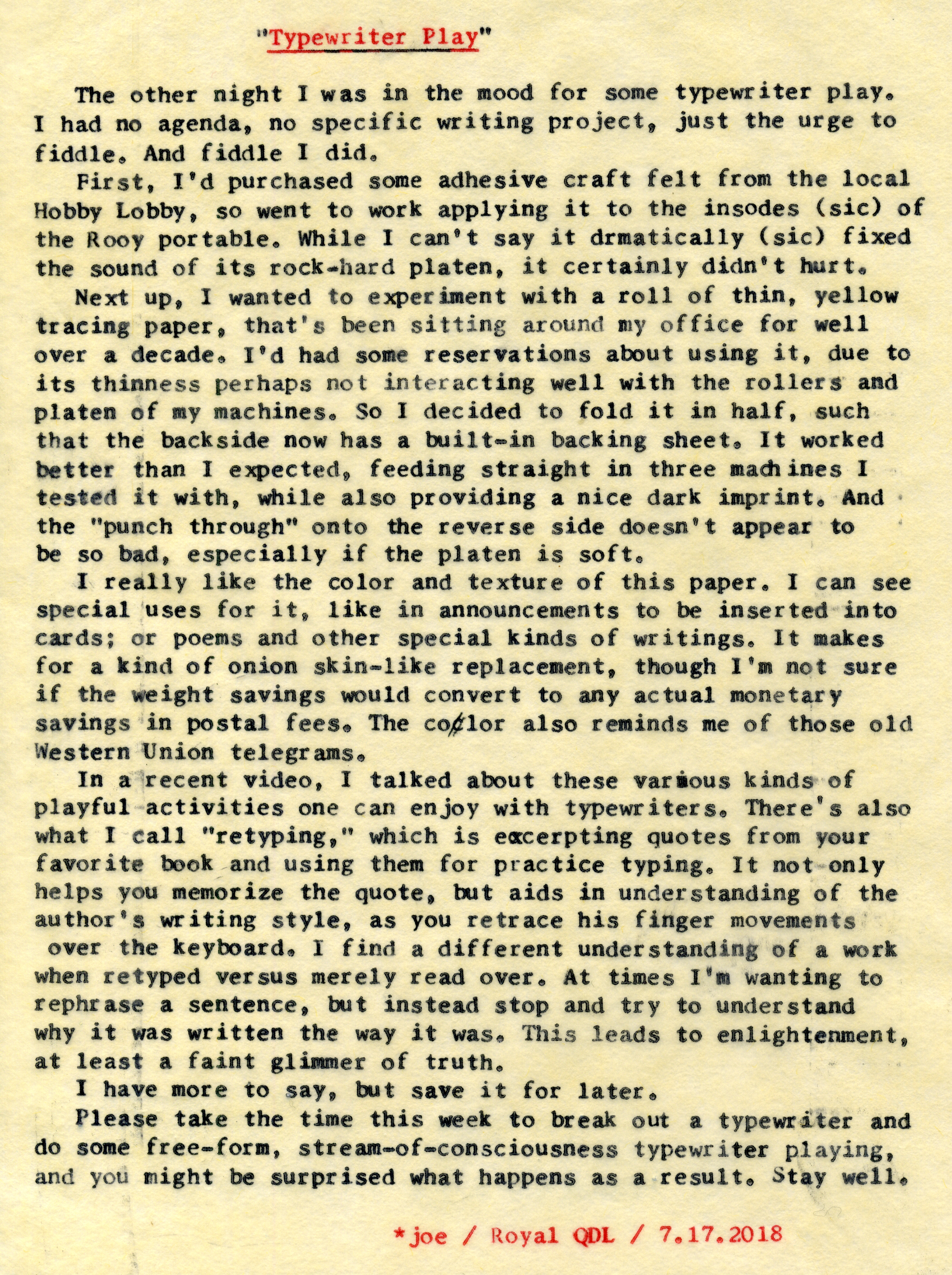
Typewriter Play

Typewriter Play
Typecast029

Post-Script: There's a lot more to say here about typewriter playing. They are indeed mechanical devices, which for many of us is an immediate inducement for further exploration. A lot of the magic of play comes from the power of words. Words fashioned into sentences have the power to fuel our imagination, through the power of language. Entire imaginary worlds can come into existence through language.

Typewriters are also vintage devices. They are foreign to our common experience, unless you're like me, with various machines sitting around the house just as much for decor as useful writing tools. As newcomers to typewriters, our's is a generation that has to rediscover their magic, their utility, their limitations. In previous generations they were treated pretty much as pragmatic tools for one dedicated purpose - document creation. But that purpose has, by and large, passed them by, supplanted in large measure by word processing. And so these wonderful machines find new usefulness in ways not dreamt of by previous generations. Like street poetry writing, or blogging, or even percussive music. Thus, through play we can find new things to do with these mechanical marvels.

In this recent video I also touched on the importance of copying. Not just for retyping the works of others for practice and inspiration, but as an aid in learning how language is crafted by masters of the art. Austin Kleon has much to say about this, through his wonderful book Steal Like an Artist, and also his blog. Be sure to check out both.

Here's the recent video I made about typewriter play:


Typecast on yellow tracing paper via Royal QDL (a.k.a Adobe Rose)

Labels: , , , , , , , , ,

Wednesday, June 06, 2018

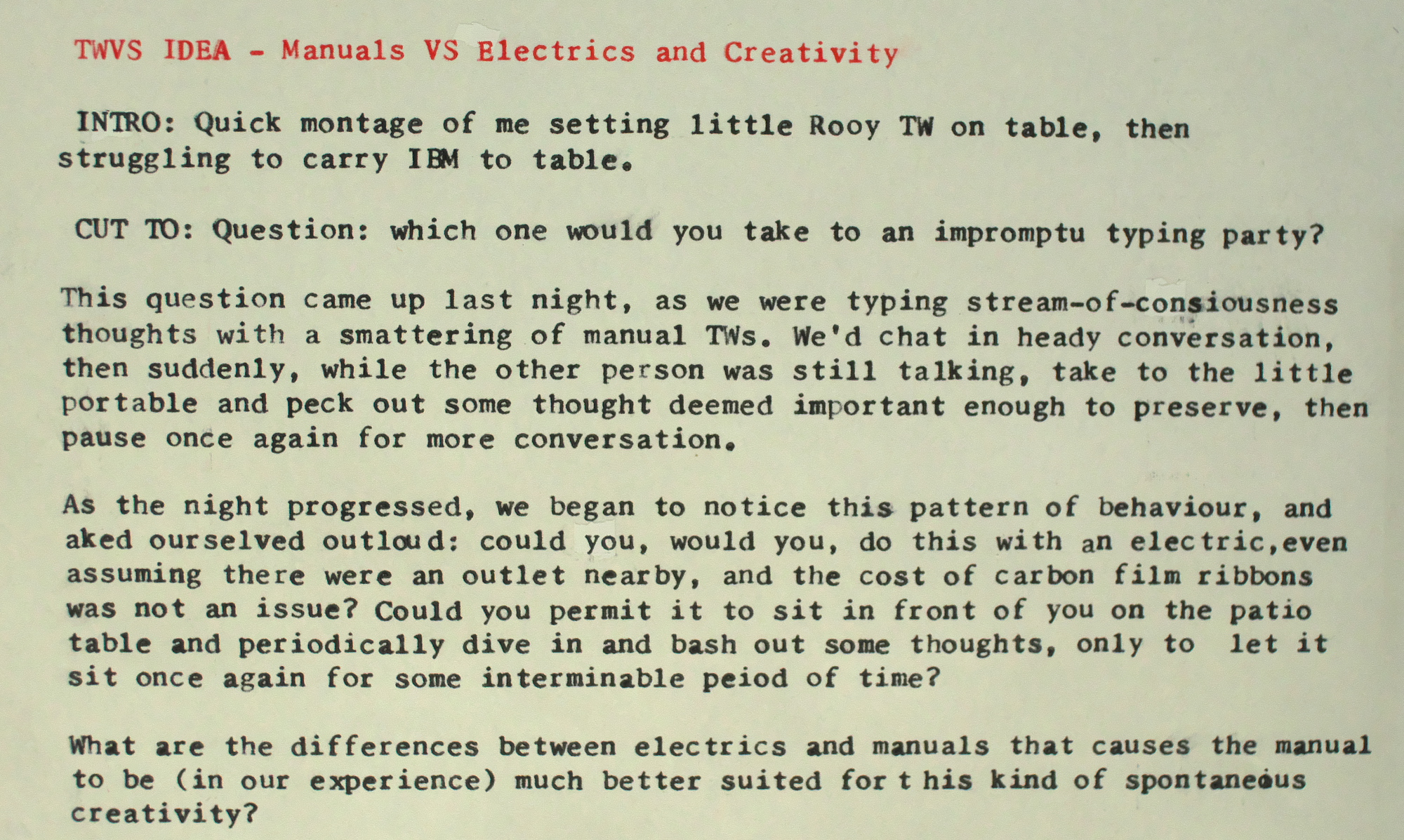
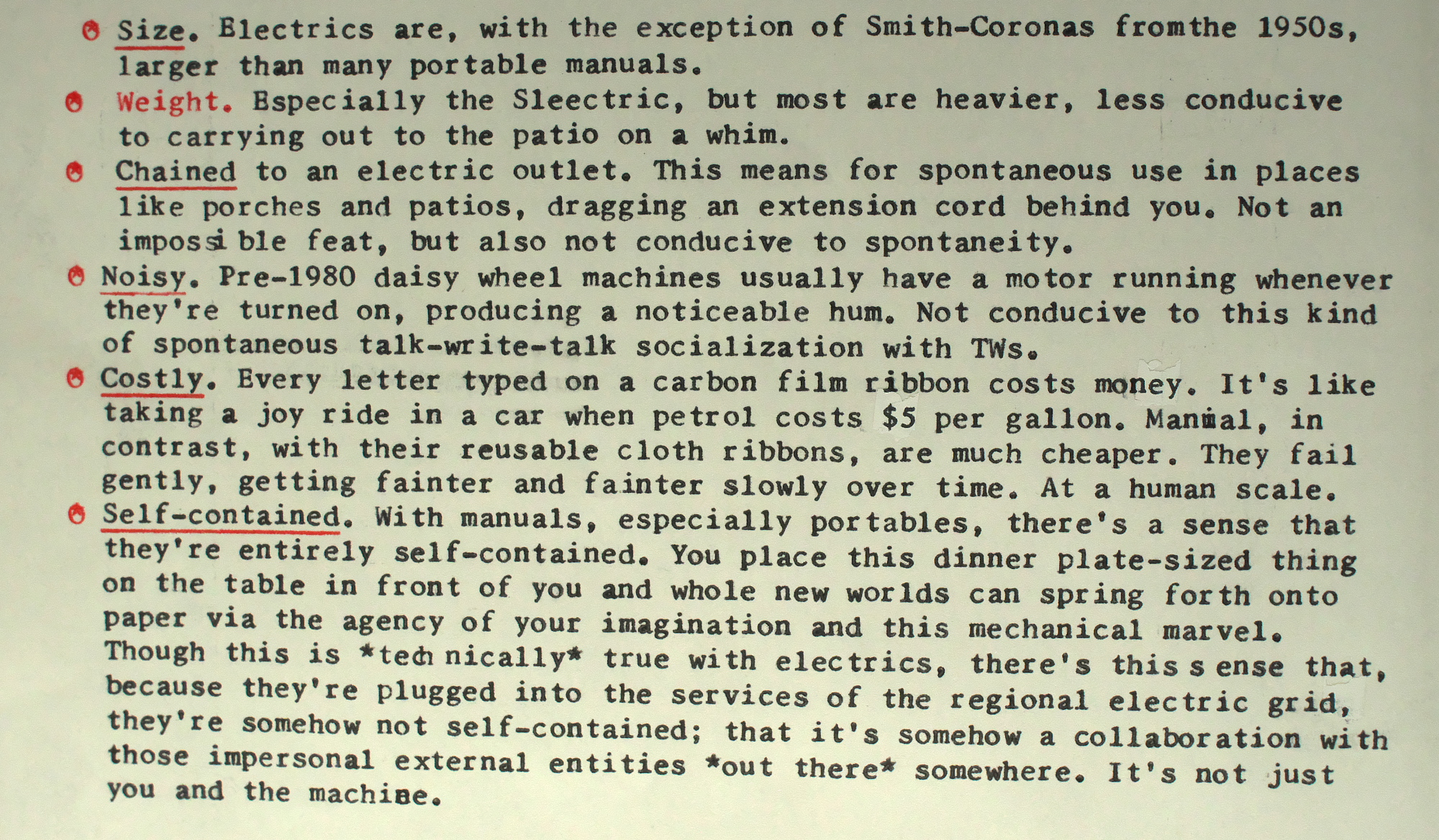
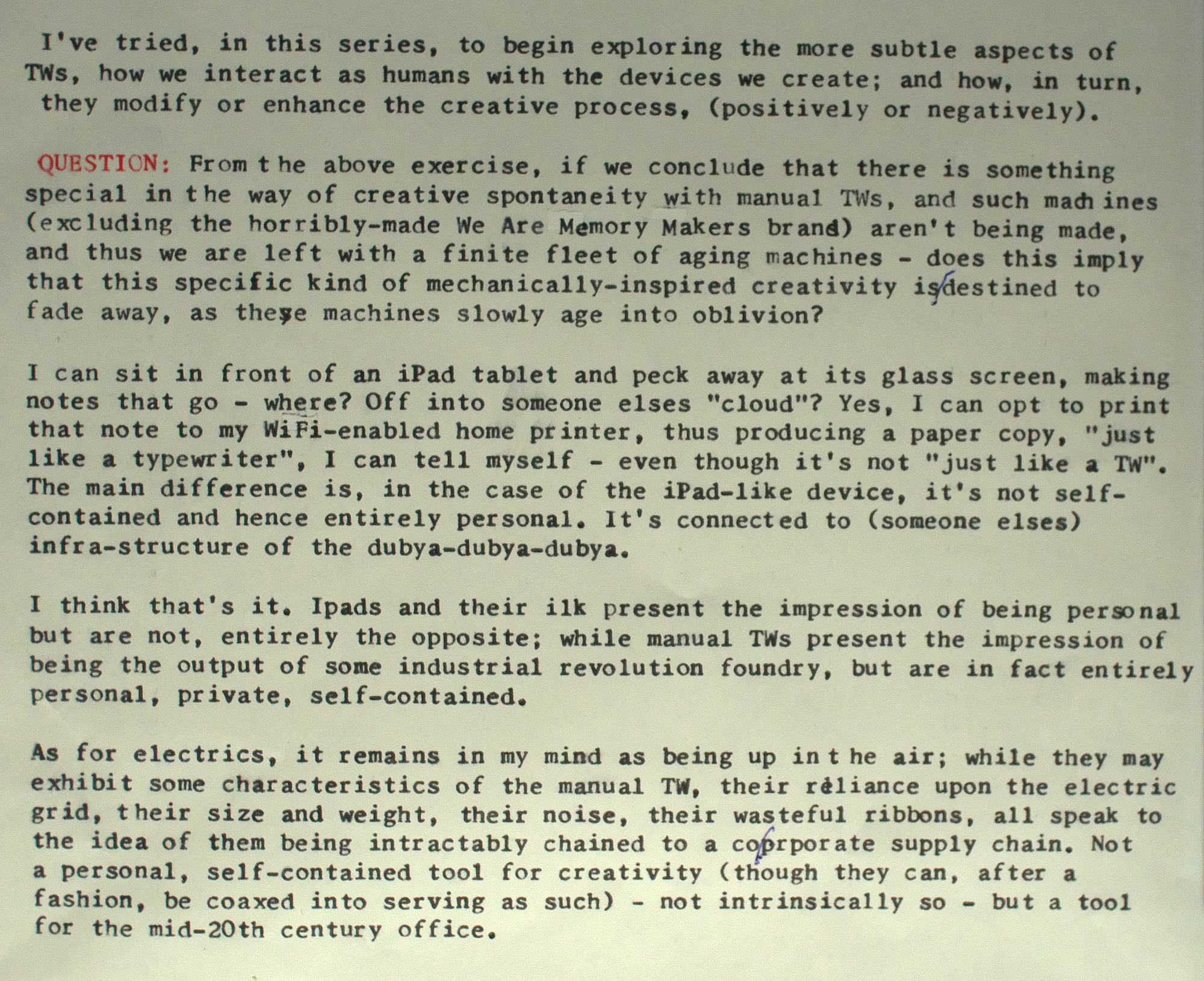
Manuals, Electrics and Creativity

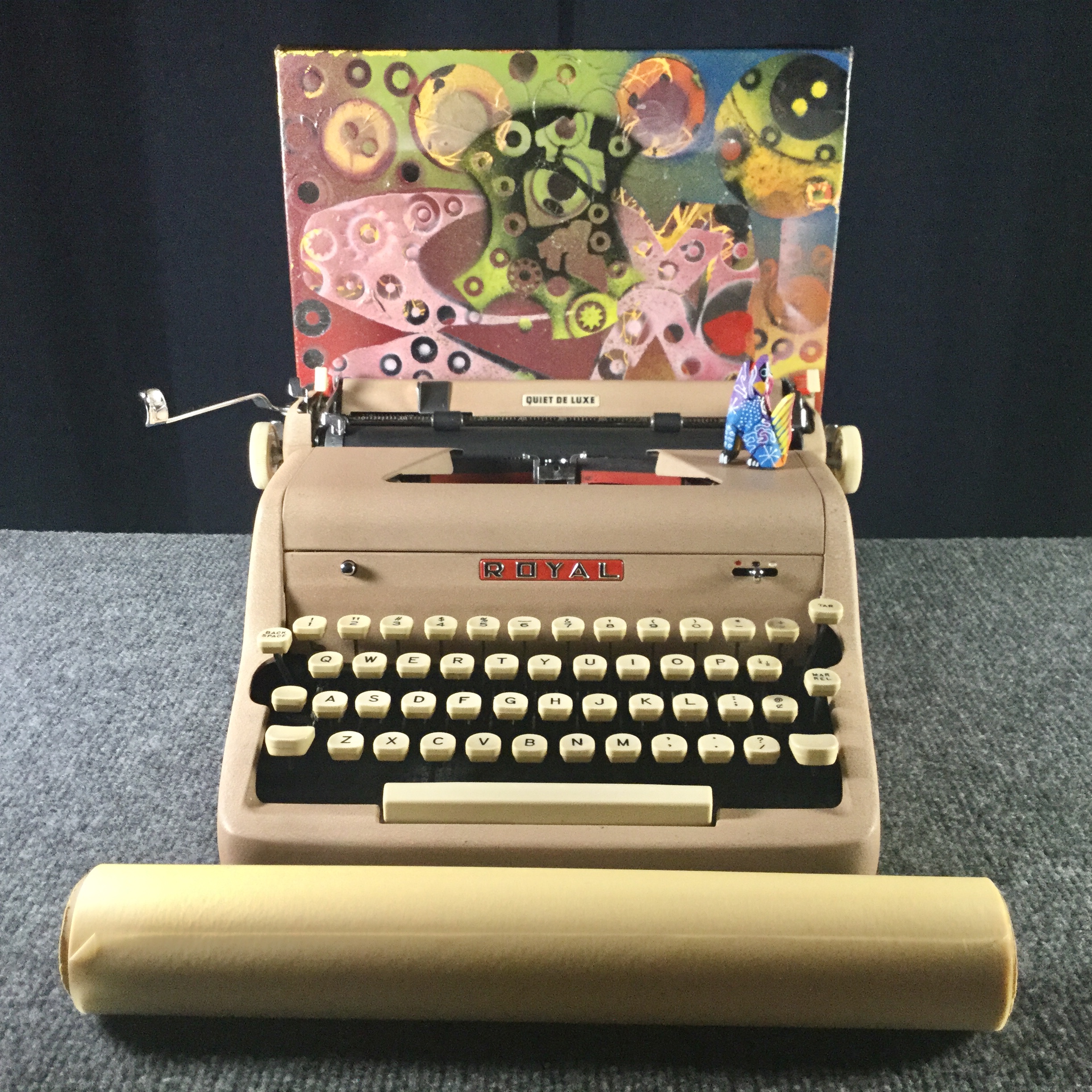
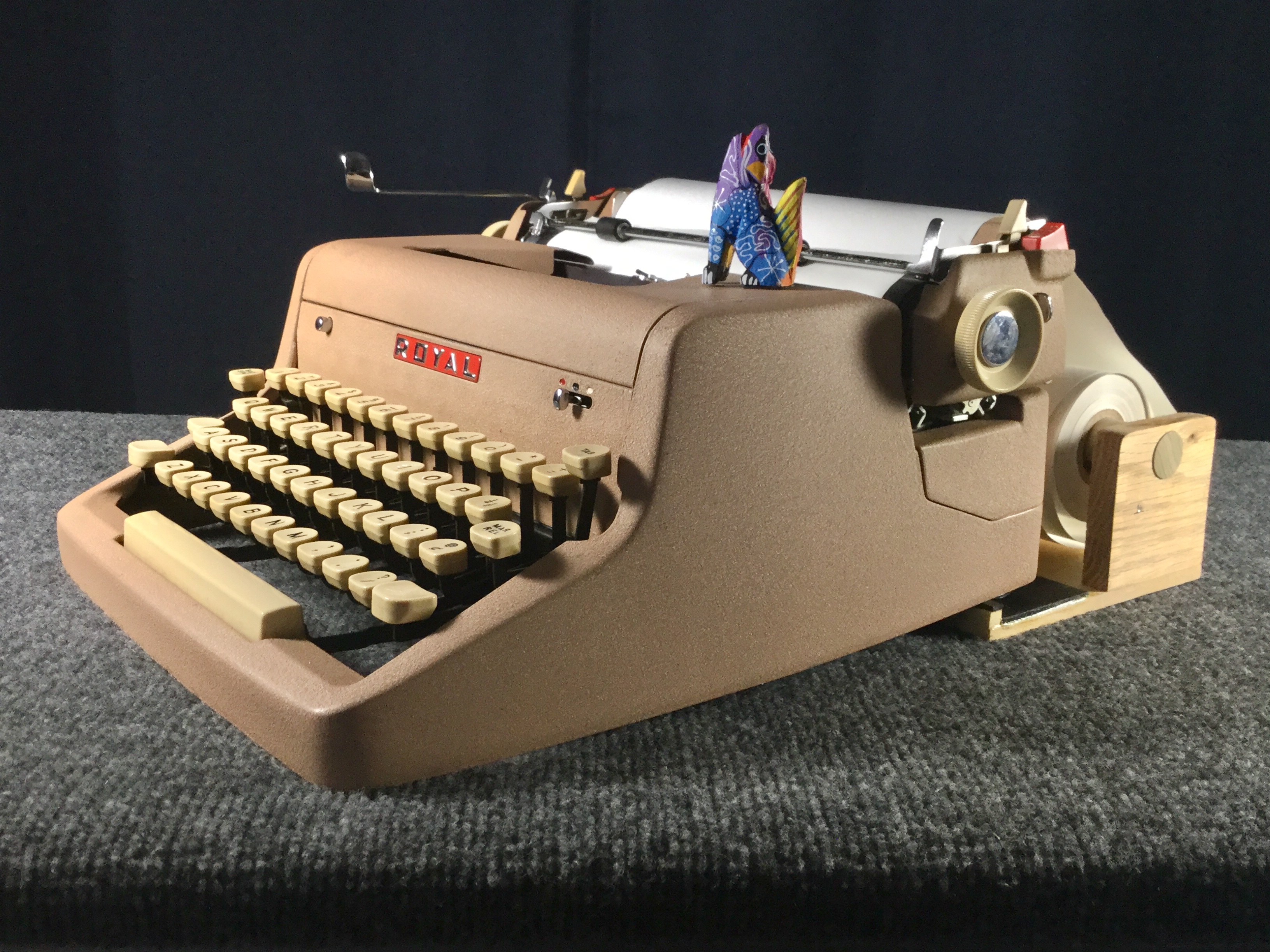
Adobe Rose, Howling Coyote, thermal fax paper and holder

See that lovely creature above? No, not the fake coyote, the Royal. Her name's Adobe Rose. I sat down at her this morning and typed out some extensive notes, in preparation for a video, on the subject of creative writing with manual and electric typewriters. I used the roll of thermal fax paper and liked the results. Very dark imprint, which she seems to do easily; better than many other machines in my collection. And a rather clear imprint for being elite-sized typeface.

But these thoughts didn't start today. They were the result of a late-night typing and socializing session I spent last night with fellow typewriter nerd Kevin.

In keeping with my renewed promise to blog more often ("Captain's blog, star date 60618.2"), I'm taking these raw video production notes and throwing them out to the typosphere - warts, typos and all. You can provide your own spell checking.

Being as how the piece was from one continuous roll, I've taken the liberty to divide it into three parts. Afterwards, you'll find a link (malicious advertising) to the resulting video. Enjoy.

Typecast022a
Typecast022b
Typecast022c

Labels: , , , , , , , ,

Monday, May 21, 2018

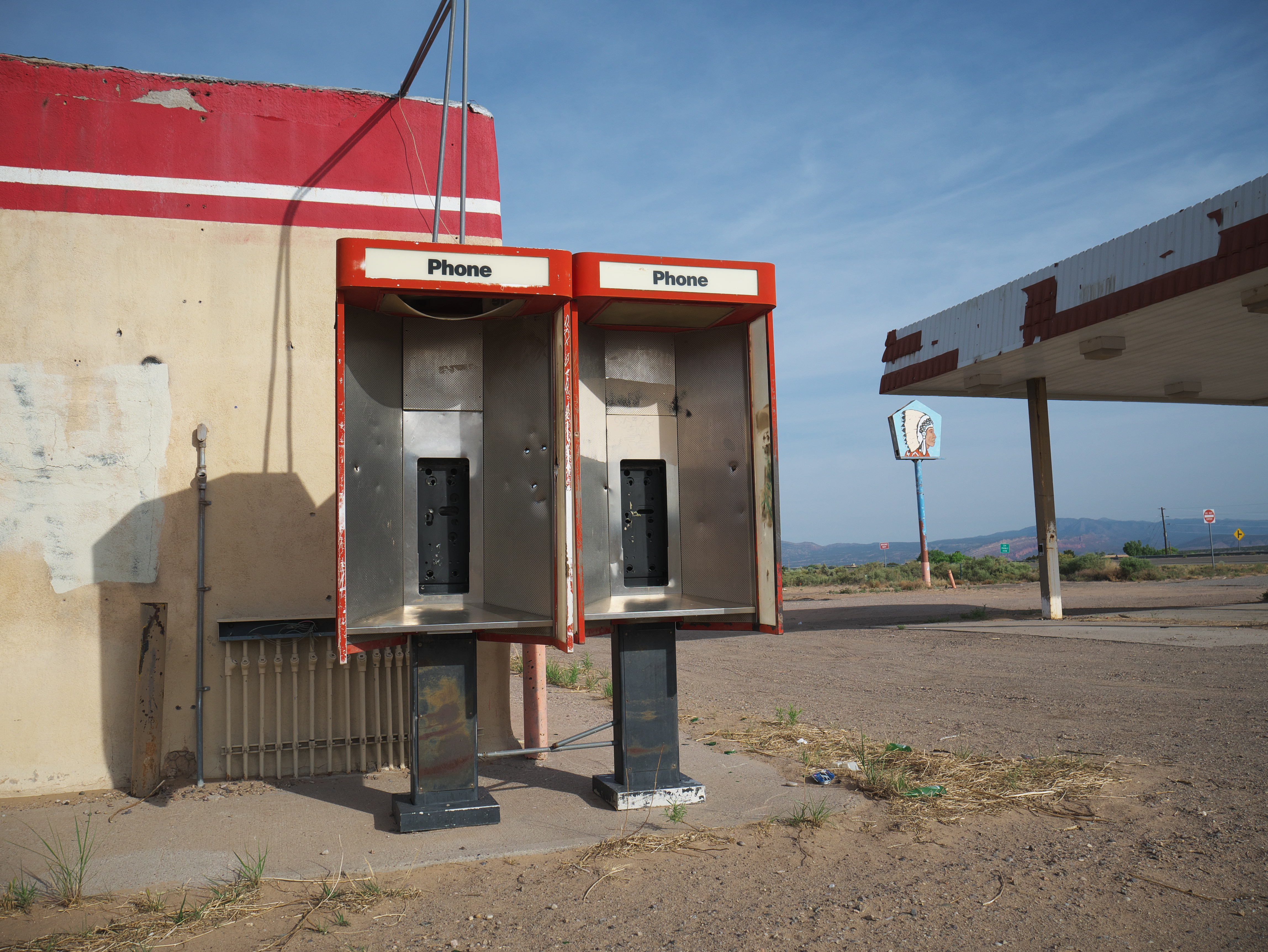
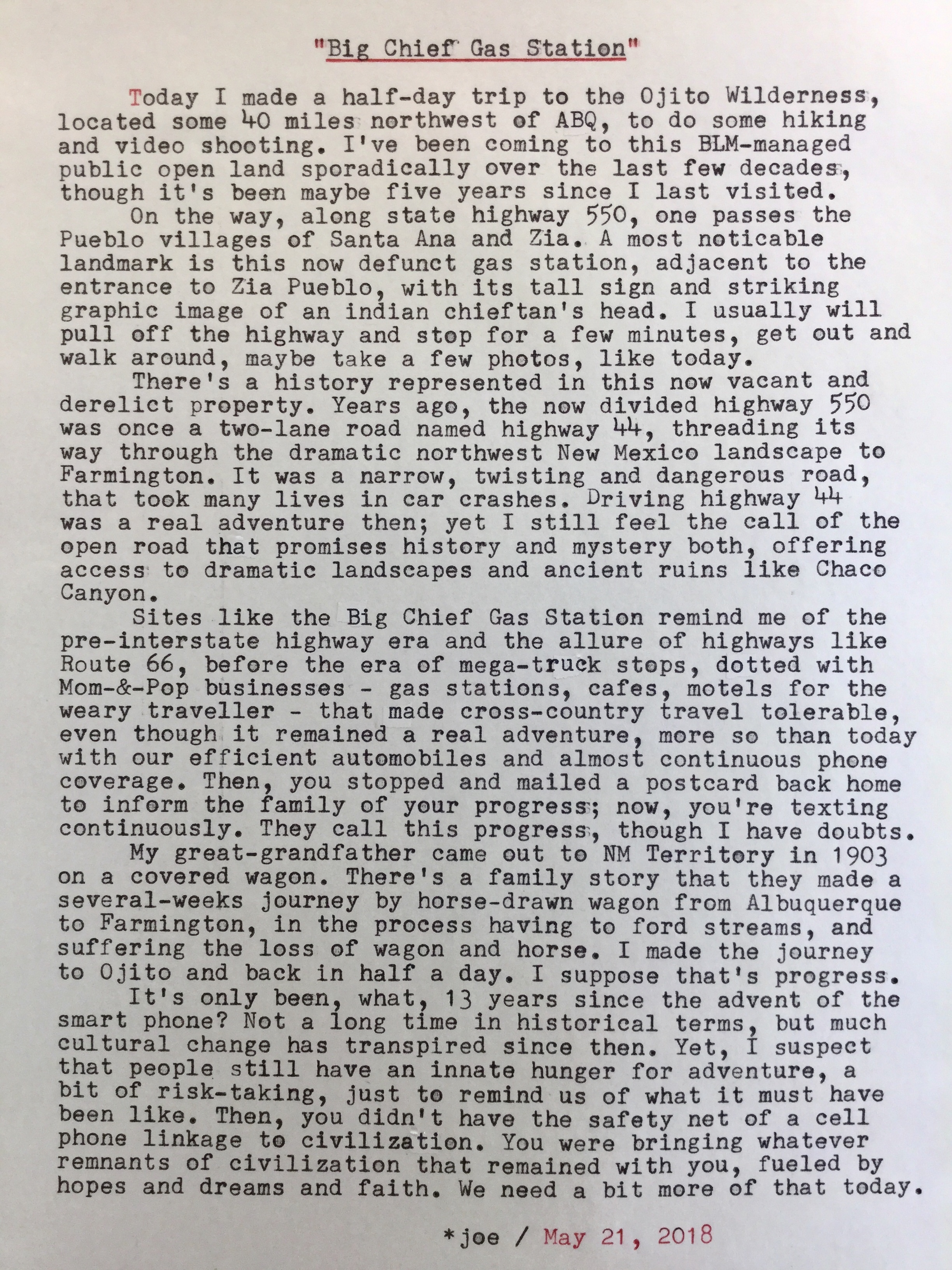
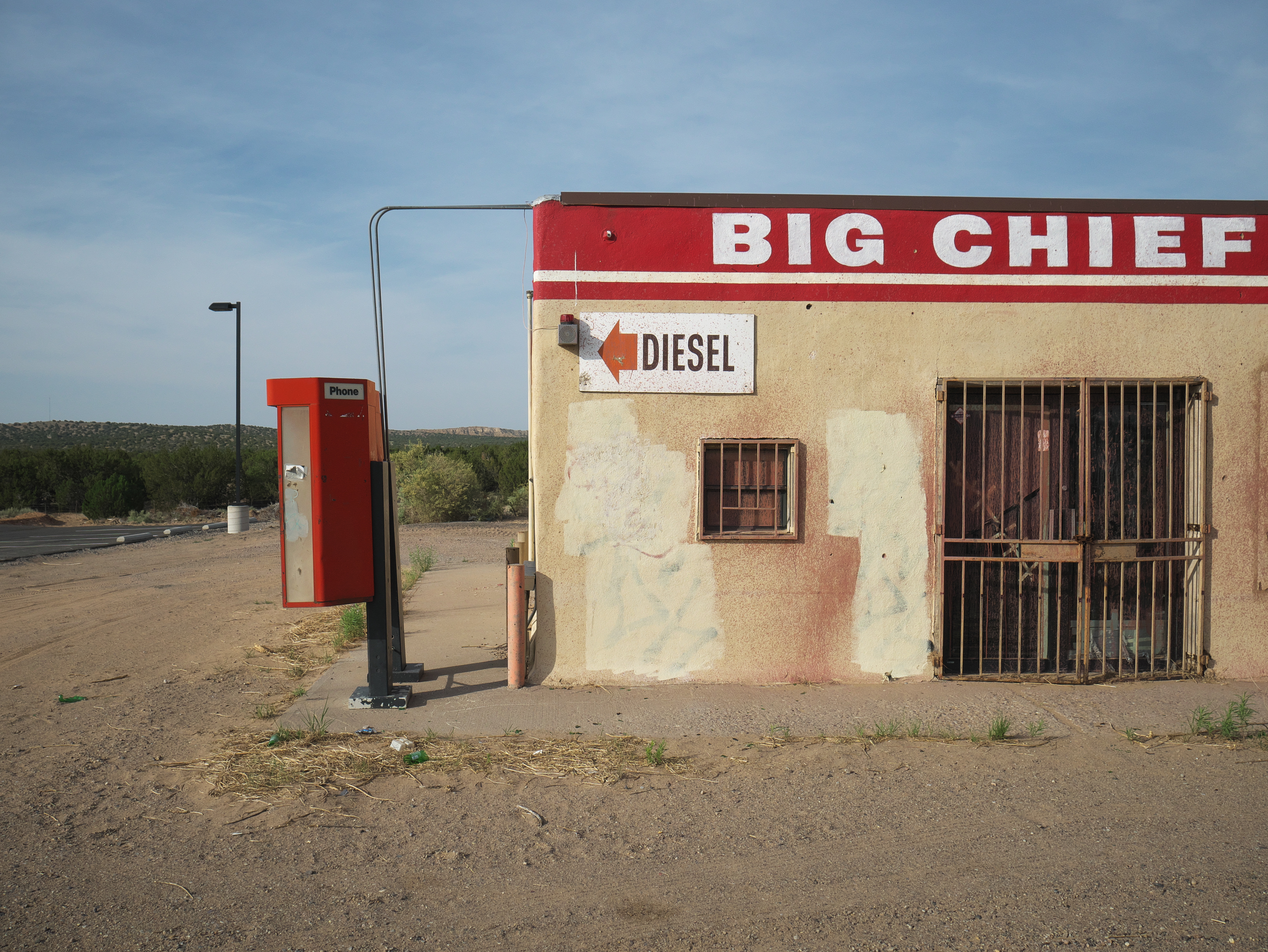
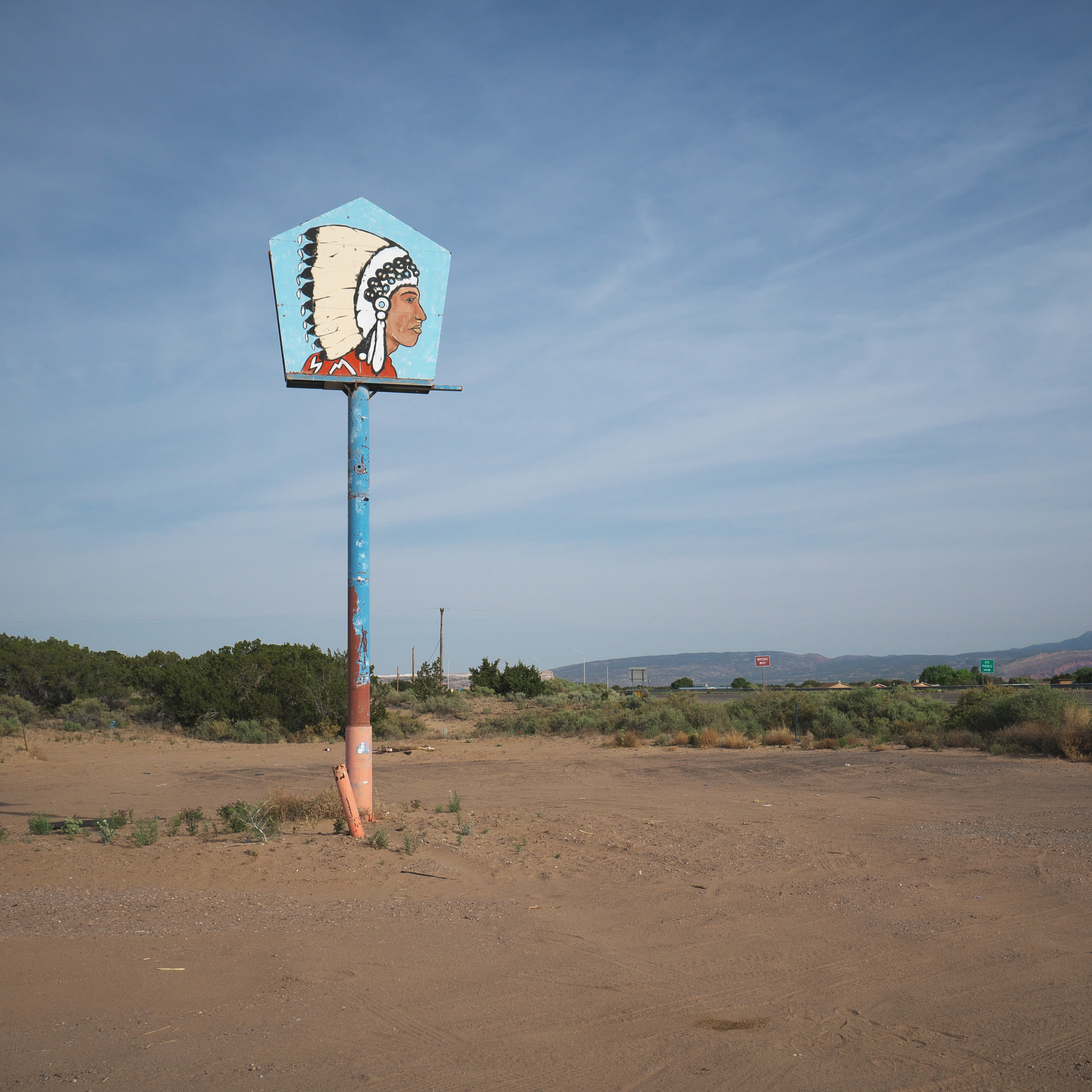
Big Chief Gas Station

P1010718
“Big Chief Gas Station”
P1010714
P1010711

Post-Script: Photos via Panasonic Lumix G7. I was also shooting video on my recently acquired Canon R800 camcorder. Yes, an actual camcorder. I'll be making a video about this soon. Here's the This is Not a VLOG video for today:


Typecast via Remington Quiet-Riter and roll of thermal fax paper.

Labels: , , , , , , , , ,

Thursday, August 17, 2017

Typing Scrolls Revisited


I'm certain I've blogged about this before. Using rolls of paper for typing, like the way that Jack Kerouac did with an early draft of On the Road, where he used a roll of teletype paper. Why a person would want to do so today has nothing to do with wanting to mimic the Beats. The Beat Movement is pretty much dead, last time I checked. And so are typewriters, except actually they're not; there's a revival in progress. Which is all the more reason to resurrect the idea of typing on a seemingly endless roll of paper - no more stopping in mid-thought to change paper. Just keep banging the keys and slinging the carriage back after the bell dings, and watch the paper pile up behind the machine on the floor; a more certain measure of one's writerly output.

Years ago, after this idea struck me (and inspired by a visit to the Palace of the Governors Museum in Santa Fe, which was hosting the On the Road manuscript scroll in its long glass-topped display case), I went in search of rolls of paper. Adding machine paper was too narrow, unless all you were interested in writing was short haiku poems. There were brown masking paper rolls, 6 inches wide, available at hardware stores; but I didn't want to type on brown paper. And there was white paper rolls in craft and art stores, but in widths much wider than the standard 8-1/2 inches.

After a bit of Internet searching I found a 6 inch wide roll of white paper, in 700 foot lengths, used for masking in the automotive painting industry. A local search found some at the Napa Auto Parts painting supply store. I ended up buying a damaged roll (the inner cardboard core was deformed) for less than half the price of new.

This paper I used for a time for typecast blogging. With the margins set to ~1/4 inch in from either edge, I could get long enough lines of text sufficient for this blog's template. But the paper was thin and crinkly, and didn't take ink all that well. I think, being engineered for painting, its surface was hydrophobic and hence repelled the ink, which would also easily smear. So after some time, I set that roll aside and looked for another solution.

A search on Amazon revealed rolls 8-1/2 inches wide of what was described as "teletype paper," but after receiving an order I found the quality of the paper was about the worse I'd ever seen. I should have known; I think Western Union quit the teletype business some years ago. Essentially like the very cheapest newsprint art paper, off-white and very fibrous, it doesn't take correction tape, and is mostly useful only for rough-draft writing where no one else will see the finished results. You wouldn't want to type that letter to dear old Aunt Mary with this stuff, or she'd take you out of her will.

This last week I once again found myself in the local big-box office supply retailer, when I happened across a roll of white "banner" paper 17 inches wide by 50 feet in length, for $5. It doesn't take a math whiz to figure out that 17 inches is twice 8-1/2, and I at once began thinking that perhaps my miter saw could cut it in half sufficiently neat to make the effort and cost worthwhile.

And yes, it was worth the cost, even the effort required afterward of cleaning up the garage because of the surprisingly messy cloud of shredded paper dust kicked up by the saw. But the cut was very smooth, and the resulting roll of 8-1/2 inch by 50 foot-long, white bond paper is nicely threaded up in the old Underwood Portable on the tray table, with the roll snuggled nicely between the scissor legs of the folding table using a piece of wooden broom handle. And a backup roll, from the other half, waits in the wings. $2.50 per roll is not a bad price. Maybe next time I'll do the cutting out of doors. Live and learn.

The paper takes typewriter ink very nicely, and has a very nice feel to it. I threaded up the paper in the machine so as to oppose the natural curl of the roll, hoping it helps in flattening it out. We'll see. Some of this paper, made from recycled pulp, can achieve a semi-permanent curl if left threaded around the platen too long.

So now I can say that my long search is over for an inexpensive source of good quality, white, typewriter-compatible paper rolls. I just need to set my butt down in front of that typewriter and start banging out some words. Which only I can do.

Labels: , , , , , ,