Tuesday, July 17, 2018

Typewriter Play

Typewriter Play
Typecast029

Post-Script: There's a lot more to say here about typewriter playing. They are indeed mechanical devices, which for many of us is an immediate inducement for further exploration. A lot of the magic of play comes from the power of words. Words fashioned into sentences have the power to fuel our imagination, through the power of language. Entire imaginary worlds can come into existence through language.

Typewriters are also vintage devices. They are foreign to our common experience, unless you're like me, with various machines sitting around the house just as much for decor as useful writing tools. As newcomers to typewriters, our's is a generation that has to rediscover their magic, their utility, their limitations. In previous generations they were treated pretty much as pragmatic tools for one dedicated purpose - document creation. But that purpose has, by and large, passed them by, supplanted in large measure by word processing. And so these wonderful machines find new usefulness in ways not dreamt of by previous generations. Like street poetry writing, or blogging, or even percussive music. Thus, through play we can find new things to do with these mechanical marvels.

In this recent video I also touched on the importance of copying. Not just for retyping the works of others for practice and inspiration, but as an aid in learning how language is crafted by masters of the art. Austin Kleon has much to say about this, through his wonderful book Steal Like an Artist, and also his blog. Be sure to check out both.

Here's the recent video I made about typewriter play:


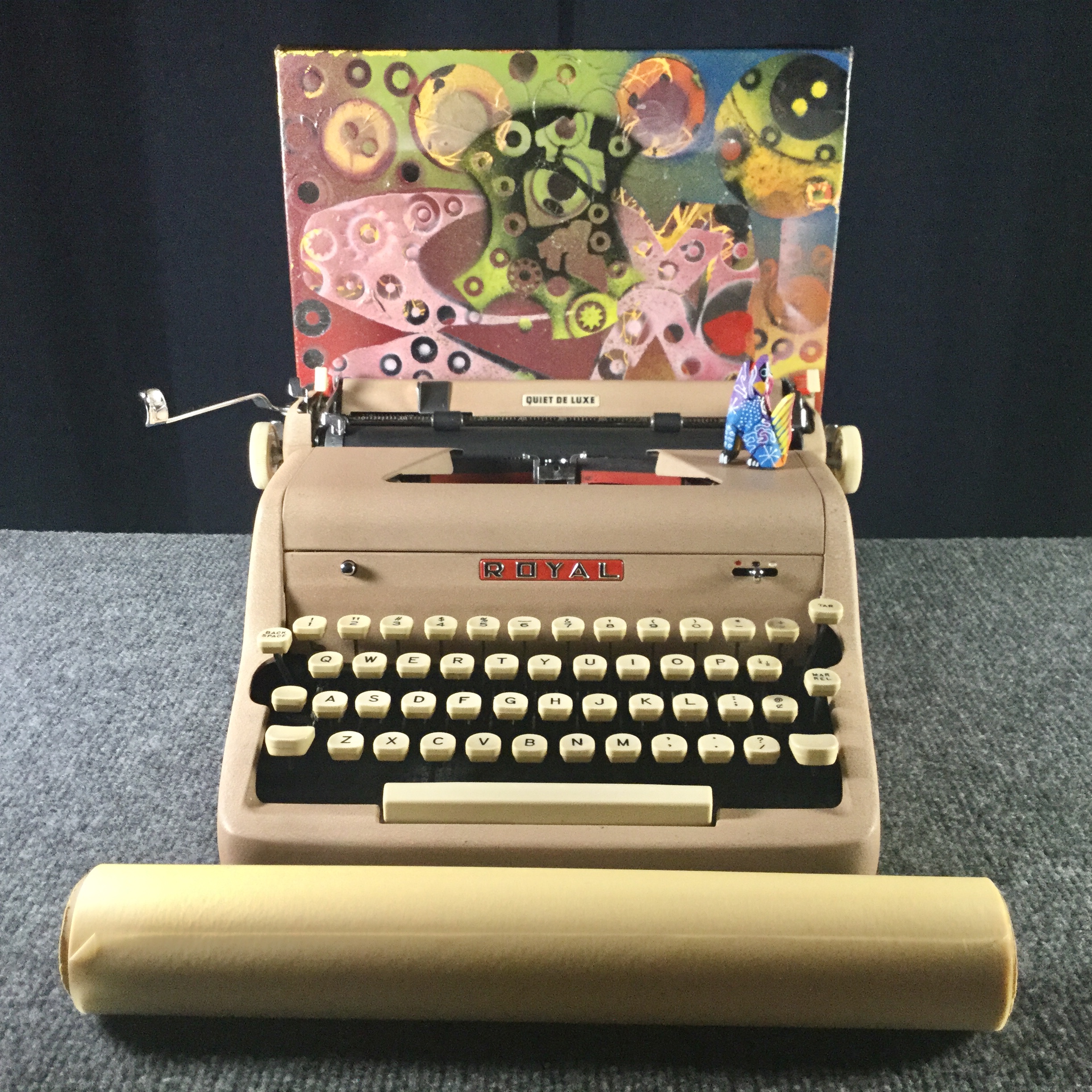
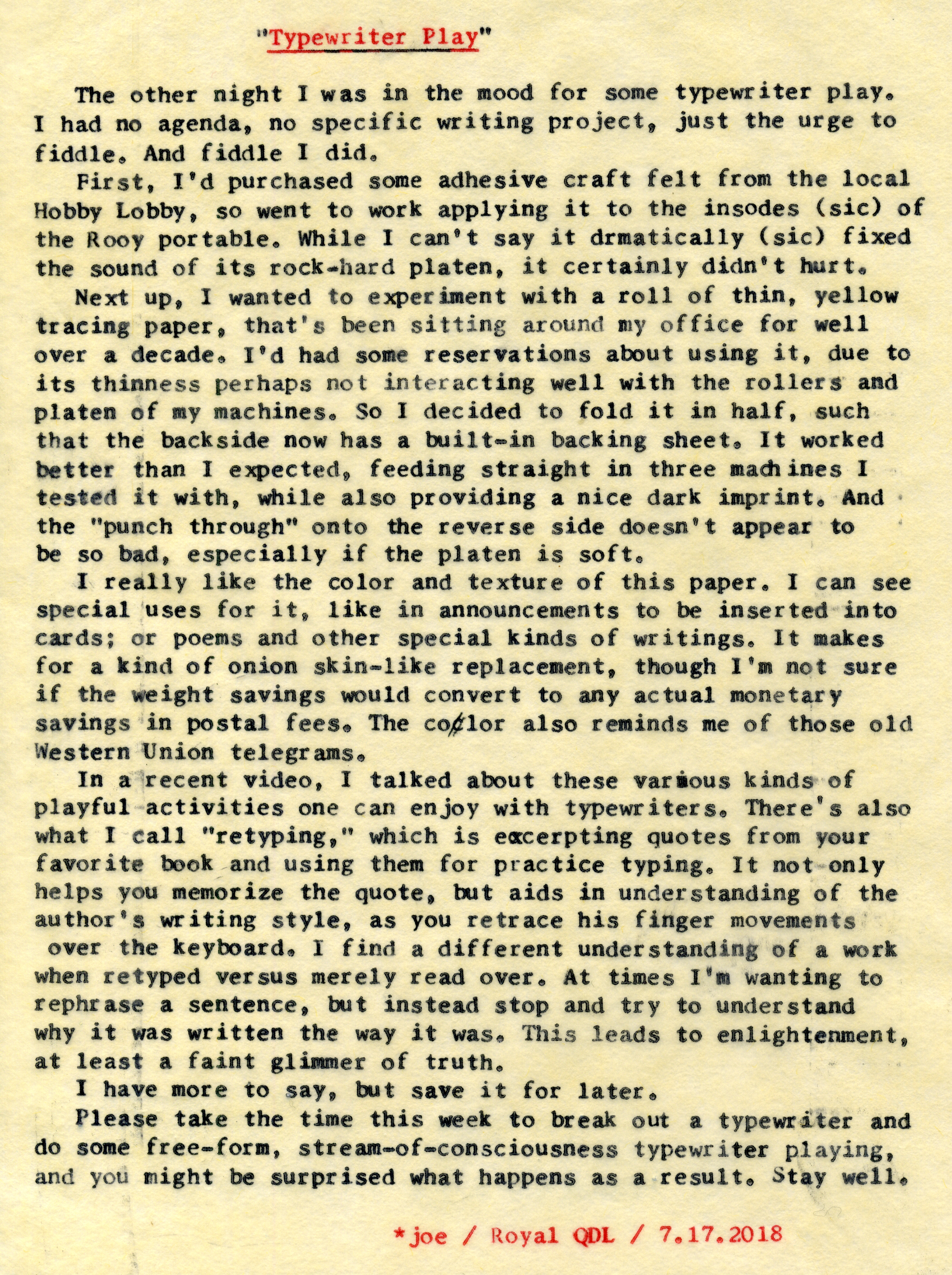
Typecast on yellow tracing paper via Royal QDL (a.k.a Adobe Rose)

Labels: , , , , , , , , ,

Thursday, August 17, 2017

Typing Scrolls Revisited


I'm certain I've blogged about this before. Using rolls of paper for typing, like the way that Jack Kerouac did with an early draft of On the Road, where he used a roll of teletype paper. Why a person would want to do so today has nothing to do with wanting to mimic the Beats. The Beat Movement is pretty much dead, last time I checked. And so are typewriters, except actually they're not; there's a revival in progress. Which is all the more reason to resurrect the idea of typing on a seemingly endless roll of paper - no more stopping in mid-thought to change paper. Just keep banging the keys and slinging the carriage back after the bell dings, and watch the paper pile up behind the machine on the floor; a more certain measure of one's writerly output.

Years ago, after this idea struck me (and inspired by a visit to the Palace of the Governors Museum in Santa Fe, which was hosting the On the Road manuscript scroll in its long glass-topped display case), I went in search of rolls of paper. Adding machine paper was too narrow, unless all you were interested in writing was short haiku poems. There were brown masking paper rolls, 6 inches wide, available at hardware stores; but I didn't want to type on brown paper. And there was white paper rolls in craft and art stores, but in widths much wider than the standard 8-1/2 inches.

After a bit of Internet searching I found a 6 inch wide roll of white paper, in 700 foot lengths, used for masking in the automotive painting industry. A local search found some at the Napa Auto Parts painting supply store. I ended up buying a damaged roll (the inner cardboard core was deformed) for less than half the price of new.

This paper I used for a time for typecast blogging. With the margins set to ~1/4 inch in from either edge, I could get long enough lines of text sufficient for this blog's template. But the paper was thin and crinkly, and didn't take ink all that well. I think, being engineered for painting, its surface was hydrophobic and hence repelled the ink, which would also easily smear. So after some time, I set that roll aside and looked for another solution.

A search on Amazon revealed rolls 8-1/2 inches wide of what was described as "teletype paper," but after receiving an order I found the quality of the paper was about the worse I'd ever seen. I should have known; I think Western Union quit the teletype business some years ago. Essentially like the very cheapest newsprint art paper, off-white and very fibrous, it doesn't take correction tape, and is mostly useful only for rough-draft writing where no one else will see the finished results. You wouldn't want to type that letter to dear old Aunt Mary with this stuff, or she'd take you out of her will.

This last week I once again found myself in the local big-box office supply retailer, when I happened across a roll of white "banner" paper 17 inches wide by 50 feet in length, for $5. It doesn't take a math whiz to figure out that 17 inches is twice 8-1/2, and I at once began thinking that perhaps my miter saw could cut it in half sufficiently neat to make the effort and cost worthwhile.

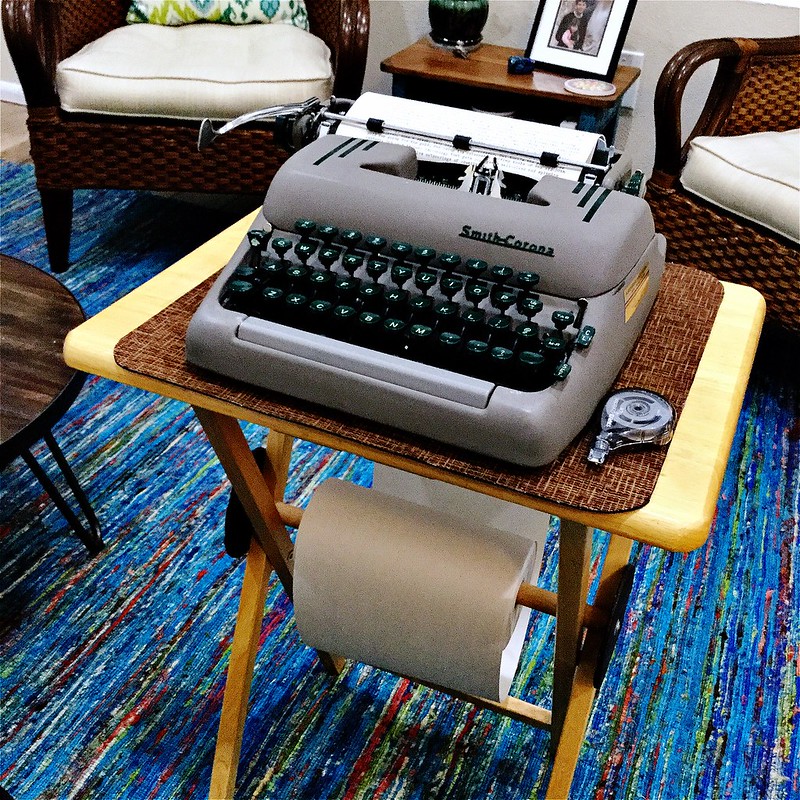
And yes, it was worth the cost, even the effort required afterward of cleaning up the garage because of the surprisingly messy cloud of shredded paper dust kicked up by the saw. But the cut was very smooth, and the resulting roll of 8-1/2 inch by 50 foot-long, white bond paper is nicely threaded up in the old Underwood Portable on the tray table, with the roll snuggled nicely between the scissor legs of the folding table using a piece of wooden broom handle. And a backup roll, from the other half, waits in the wings. $2.50 per roll is not a bad price. Maybe next time I'll do the cutting out of doors. Live and learn.

The paper takes typewriter ink very nicely, and has a very nice feel to it. I threaded up the paper in the machine so as to oppose the natural curl of the roll, hoping it helps in flattening it out. We'll see. Some of this paper, made from recycled pulp, can achieve a semi-permanent curl if left threaded around the platen too long.

So now I can say that my long search is over for an inexpensive source of good quality, white, typewriter-compatible paper rolls. I just need to set my butt down in front of that typewriter and start banging out some words. Which only I can do.

Labels: , , , , , ,

Sunday, October 30, 2016

To Stay on the Straight and Narrow

Poised to Write

Typecast195

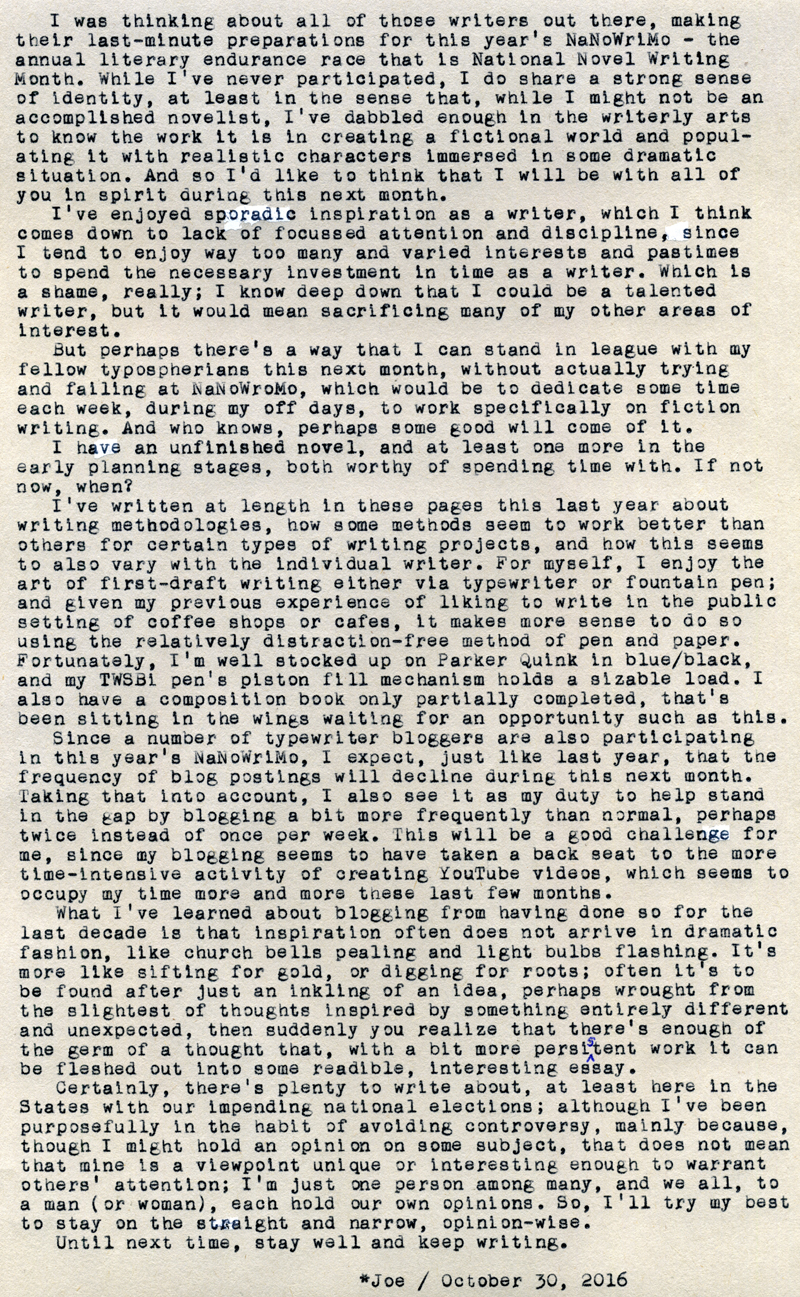
Post-Script: Do you remember, just a month or two ago, all the time I spent cleaning, adjusting, typing and typecasting with my more recently acquired Smith-Corona Silent Super? Well, this is its older stablemate, the venerable non-Super Silent, the one with the fixed tabs, and a bit more drab color scheme but in better mechanical condition. In terms of "haptics," this one feels every bit as good as the best mechanical typewriter, but is more compact in size than the larger Galaxy 12s or Hermes 3000s. And, being of elite-sized (smaller, 12 characters per inch), it just works better for me as a first-draft typer, especially with the seemingly endless roll of teletype paper threaded up. It is because of machines like this, situated in my patio room upon the tray table, ready to type up a storm, that I can, at a moment's notice, be creating words upon paper. An imminently practical, pleasurable writing instrument.

I've been taking a liking to this teletype paper. No, it's not a fine quality foolscap of rich vellum, it's instead more like rough, leathery, thicker newsprint. But I like the look it gives to printed words. They're meaty and physical. You can more easily see the ink impressed upon the paper's fibers. The paper's off-white tone looks like it's already aged half a century, like these freshly typed words could have been from a previous era; some sort of typewriter time machine at work, words from the present appearing as if they've come from the past.

The best part of using the roll of teletype paper is not having to thread up a fresh sheet of paper after an all-too-brief session of typing. No interruptions, just pure, nonstop writing pleasure.

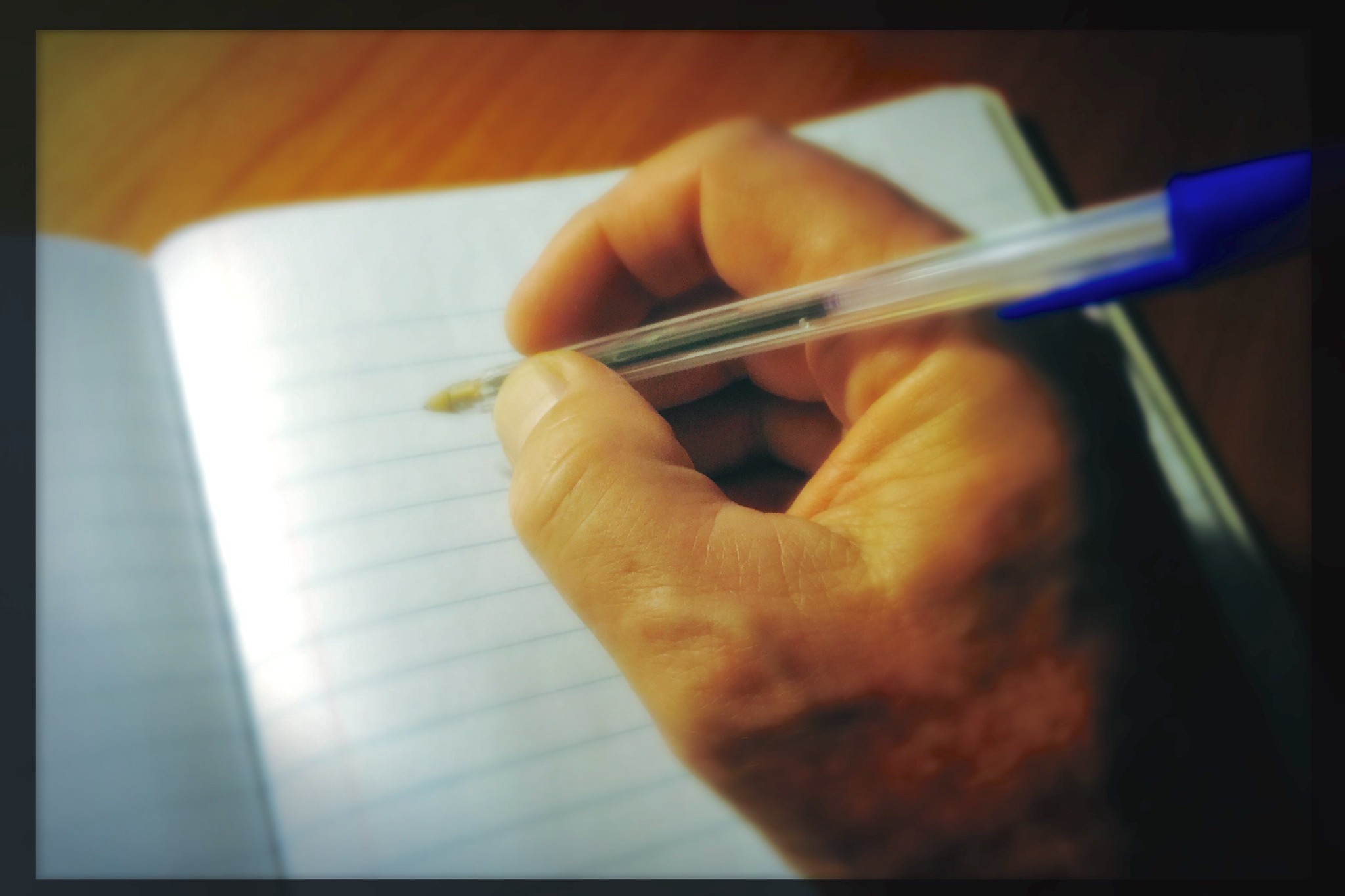
The top photo shows a Bic Cristal medium-point in blue ink, one of my all-time favorite writing instruments. If it weren't for fountain pens, this is what I'd be writing with. I've taken to liking these pens so much that I go out of my way to stay stocked up on them; the larger 1.6mm tip versions are also very nice writers. Oddly, they're rather hard to find at my local big-box retail stores. Luckily there's Amazon to the rescue.

Labels: , , , , , , , ,

Wednesday, August 17, 2016

Beater Typers

Kerouac Writing Technology

OKAY. I recently came to the realization that for the serious, or semi-serious, or sometimes-serious writer of prose, who chooses to compose first-drafts via the medium of mechanical typewriter, there are some things worth taking care with, while other things don’t matter so much.

One of those things not worth worrying about is the quality of imprint. These are to be typings that no one else in the entire universe, save for one’s estate trustee or poor offspring stuck with the duty of disposing of your life’s detritus, will ever see; unless you’re one of those few whose writings are of a caliber worth the attention of some university institution.

SO! Quality of imprint doesn't matter. What does matter are other things.

ONE! Legibility. The letters so printed need merely to be readable, so as to facilitate later transcription into one’s word processor for that lengthy, middle-period of revision. But they needn’t be printer- perfect.

TWO! The mechanics of the typewriter need only be sufficient for the job of putting down legible words on paper, to later be transcribed. Nothing camera-ready here. Nothing fit to be published or shared with others, just inked words on paper, that you alone will read.

THREE! Haptics need to suit the writer. All important, this issue of feel, for how the two individuals, the one machine and the one writer, meld into a more perfect cybernetic union, which is that all-important physical sensation of pleasure for the writer, doing the Lord's work of creating literature out of thin air, powered by nothing more than cheese burgers and beer, has everything to do with the success of the endeavor. Even if the machine has some serious issues (like this one, for example), if the feel of the thing - the haptics - are good (like this one, for example), then the fit is right for it to be that all-important first-draft writing machine.

NOW! I will make a pronouncement. That the best, prettiest, sleekest machine in one’s typewriter stable might not be the best suited candidate for the job of workhorse typewriter. Like that stable of fine cars in Jay Leno’s garage, you wouldn't want to use that rare, exotic sports car for one’s daily commute. Doesn't make sense. You leave the pretty stable queens to primp and preen and so be ready for Friday nights out on the Strip; meanwhile that worker’s machine does the daily grind of making a living.

FOUR! The dichotomy should be striking, that one could be found to be creating some dang fine piece of literature using that most humble of writing instrument; that what mattered wasn’t the punter’s concern of fancy paint and shiny nickel trim or brand name, but that this old, ugly junker was a humble tool; that the work of writing is what happens between one’s ears, then to be worked out in fits and starts upon some cantankerous, curmudgeonly clunker of a tin-plated typer. It’s the dichotomy between the humble status of the beater typer and the finery of the resulting work. BEATER TYPER: that’s something to be proud of, that one went out of their way to find and use the most beat of the beater typers as one’s daily workhorse, that’ll take you from point A to point B reliably, though perhaps not in style or fashion.

FIVE! Elite font size. You want to not only be using that nearly endless roll of teletype paper, but to fit the most letters on each line of type before the inevitable interruption of the carriage return.
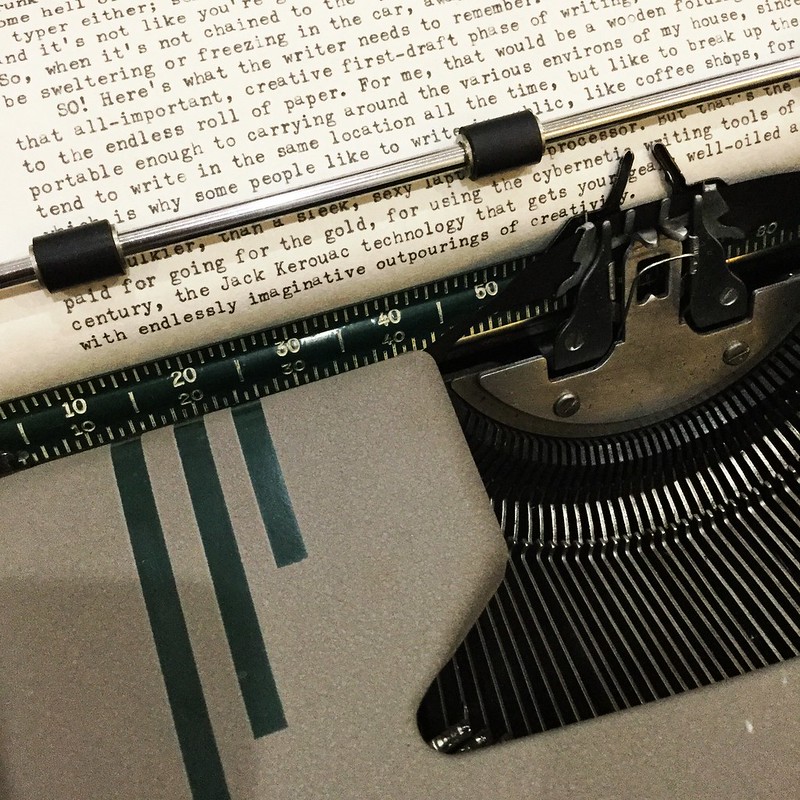
Beater Typer

SIX: TRUNK TYPER! You won’t always be chained to your nearly endless roll of paper, that Jack Kerouac-inspired technology, but might want to be out and about on short notice, for one never knows when inspiration might strike. It’s like lightning in that respect. So the Trunk Typer is the one you keep in your car at all times, year-round, come hell or high water. And it needn’t be that ultraportable, svelte runway model of a typewriter, regardless of how much you want to show her off. More apt would be a chunkier, middle-weight job, a serious working typer, a bit of a beater in appearance and performance but one that’ll get the job done. It’s not like you’re going to carry it very far ... it’s in your car, after all.

SO! Here’s what the serious typewriter-using writer should consider. That one’s writing station, during that all-important creative first-draft phase of writing, should be the typewriter chained to the nearly endless roll of paper. For me, it’s a wooden folding tray table, paper roll mounted underneath to a dowel rod between the table’s legs. It’s portable enough to easily move around various parts of my home, since I don’t always write in one spot, but like to break up the monotony.

Your needs might be different, I don’t know; but for getting yours gears well-oiled and spinning with endlessly imaginative outpourings of creativity, nothing beats a good beater typewriter well-suited to your person, where you don’t have to worry about every nagging issue (maybe it skips spaces or the letters aren’t even - but so what?), but it works well enough to easily put words down on paper that you alone will read. A beater typer is your true friend, your best friend, as a writer, because you have no higher expectation than it perform to that minimal requirement. It's imperfections are what makes it charming. After all, you’d be afraid to crank out a 50,000 word novel on your museum-grade cabinet queen, afraid you’d wear it out; but not so the beater typer, it has nothing left in life but to serve you, it's one true Master.

Typecast via beater Smith-Corona Silent-Super.

Labels: , , , ,

Tuesday, April 19, 2016

Typing Paper Musings

DSCF4916a
Typecast162
Mead001
Typecast163

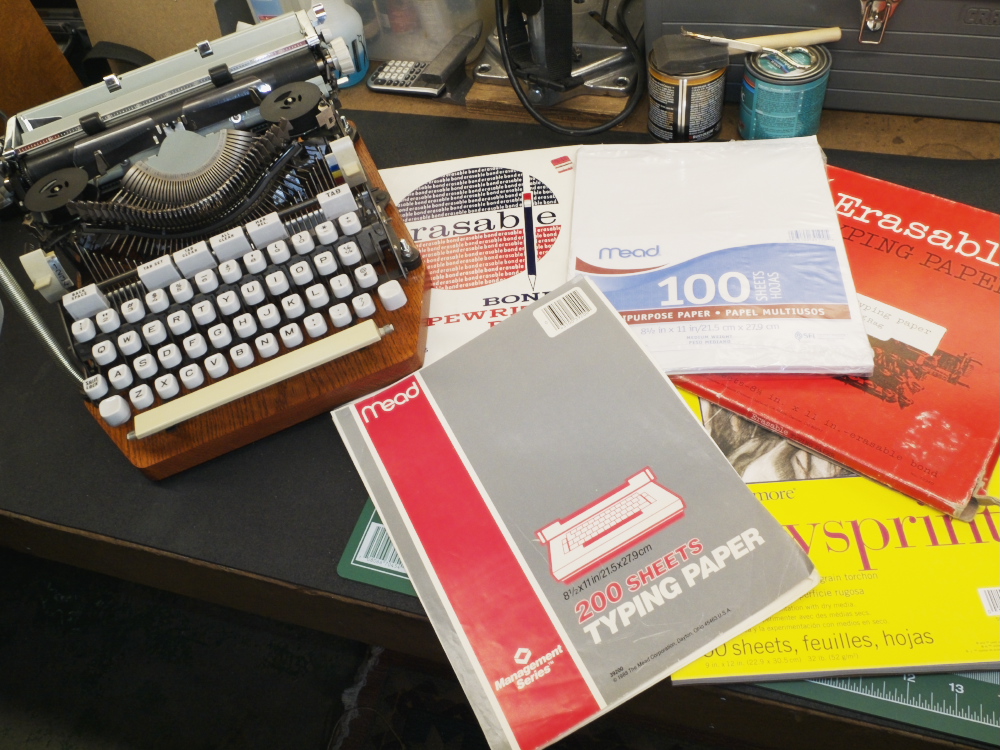
Post-Script: I'm certain that most every contemporary user of manual typewriters has some favored kind of paper, and can brag about its specific qualities. But until you've found, as I have, a pack of legacy-era "genuine" typing paper, in some thrift store perhaps, you don't know that most other kinds of paper pale in comparison. Know too that I'm not referring to "erasable bond" typing paper.

The typing papers I've found receive ribbon ink remarkably well; so well that they can transform an otherwise faint-printing machine into a bold typer - which thus serves to further reinforce my contention that the quality of paper is important to the typing experience.

These papers, while receiving ink so well, do so without being excessively thick or ragged. They appear thin and crisp, and thus roll through a typewriter's platen and rollers with ease.

I'm really surprised that quality typing paper has not received more attention from manufacturers looking for new niche markets to exploit. Imagine if film photographers enjoyed fondling their mechanical cameras but could care less what kind of film they used (read some posting on Rangefinder Forum, for example, and you'll see that photographers are a picky bunch). Most typists seem a bit more laid back, as if "whatever paper I find is okay with me" were the mantra.

Perhaps this serves as proof that typewriters are not as much a hipster affectation as we might expect, for if they were, we'd see a plethora of artisan-crafted typing papers to choose from. And that wouldn't be such a bad thing.

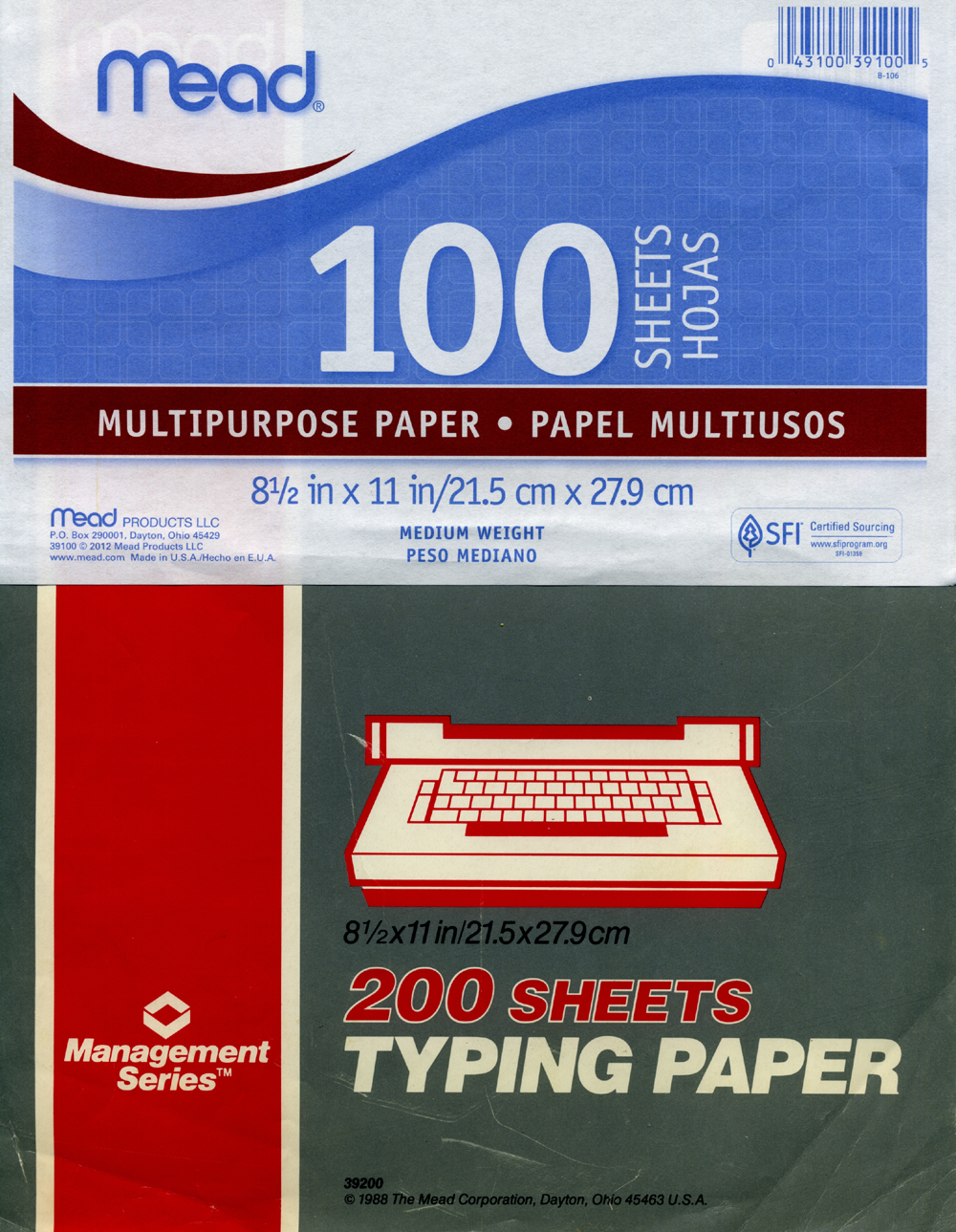
In the second photo, I've scanned the new Mead multipurpose paper, while below it is the lower half of the legacy Mead typing paper. Note the UPC code for both products differ only by one digit. If you search online for the new paper, most websites list results whose photos are actually of the older paper's label, which indicates to me that the product has only recently been re-branded.

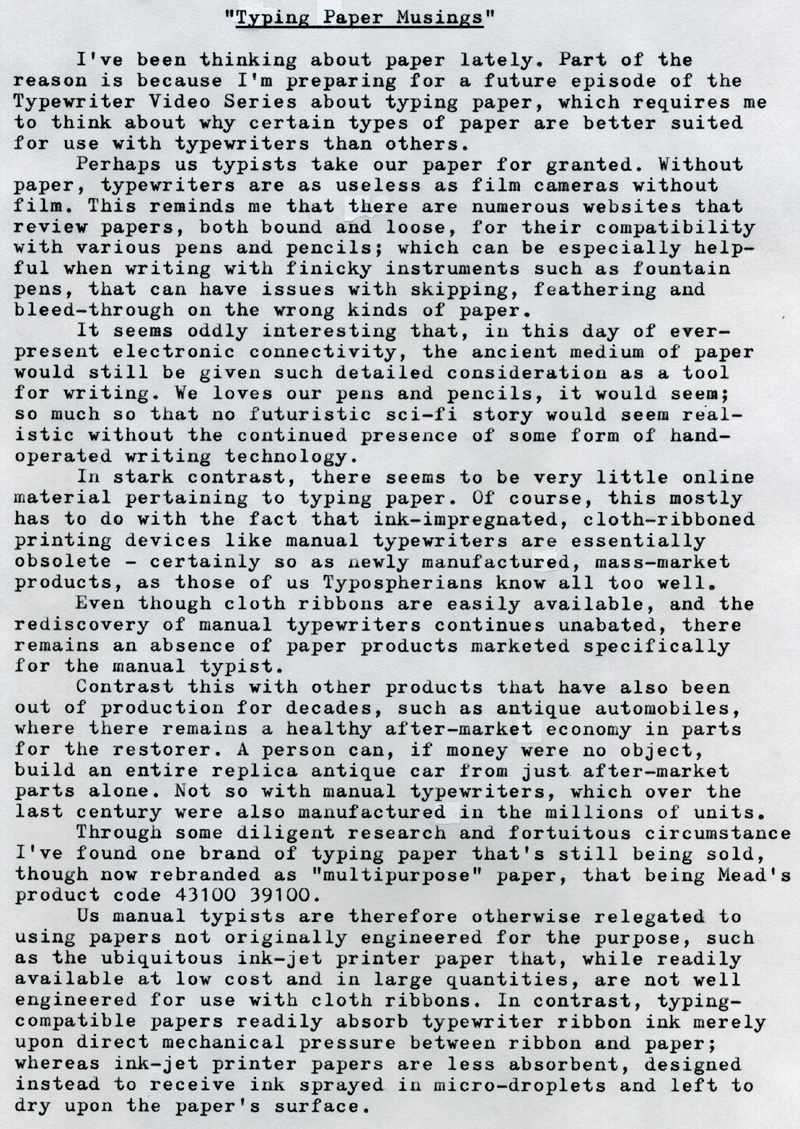
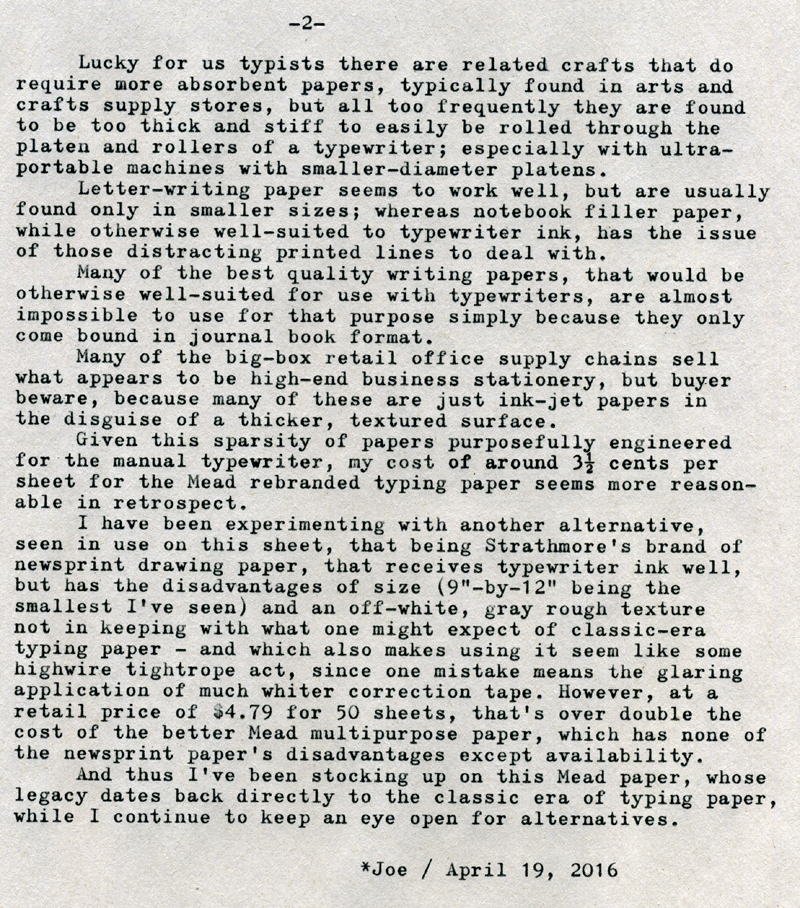
The first page of the piece was typed using the newer Mead paper, while the second page was typed using the Strathmore Newsprint art paper. It's a bit more gray than the scan might indicate, but seems to take ribbon ink rather well; and its toothiness seems to actually keep the type slugs clean, so it has that going for it. The downsides are the cost, the gray color which makes it difficult to hide any corrections, and the size.

Typecast via Hermes 3000 Nekkid-Riter. The storage box is essentially complete, so I'll post an article next week about it.

Labels: , , , ,