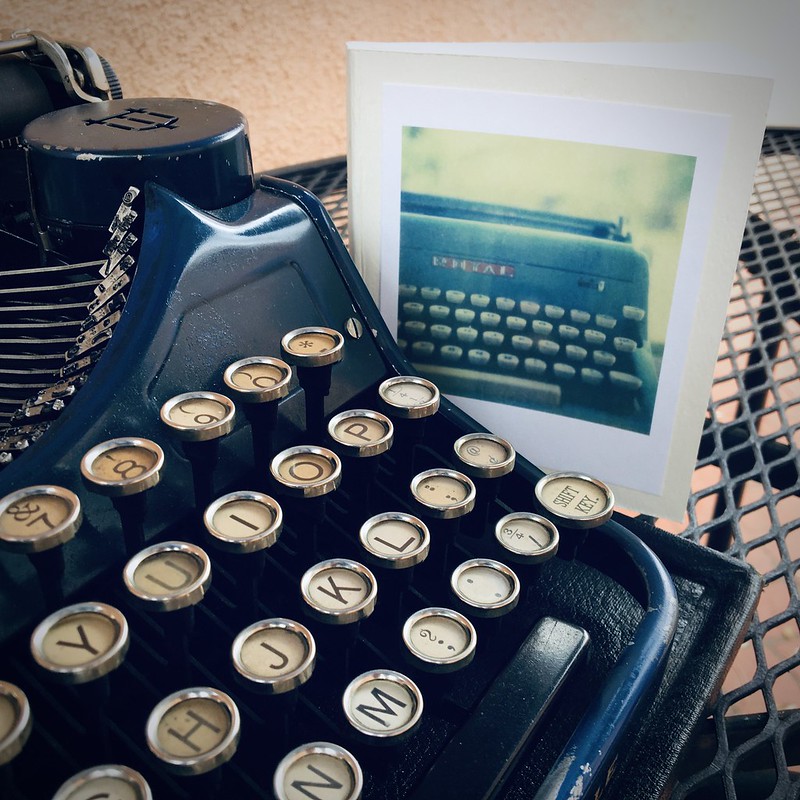
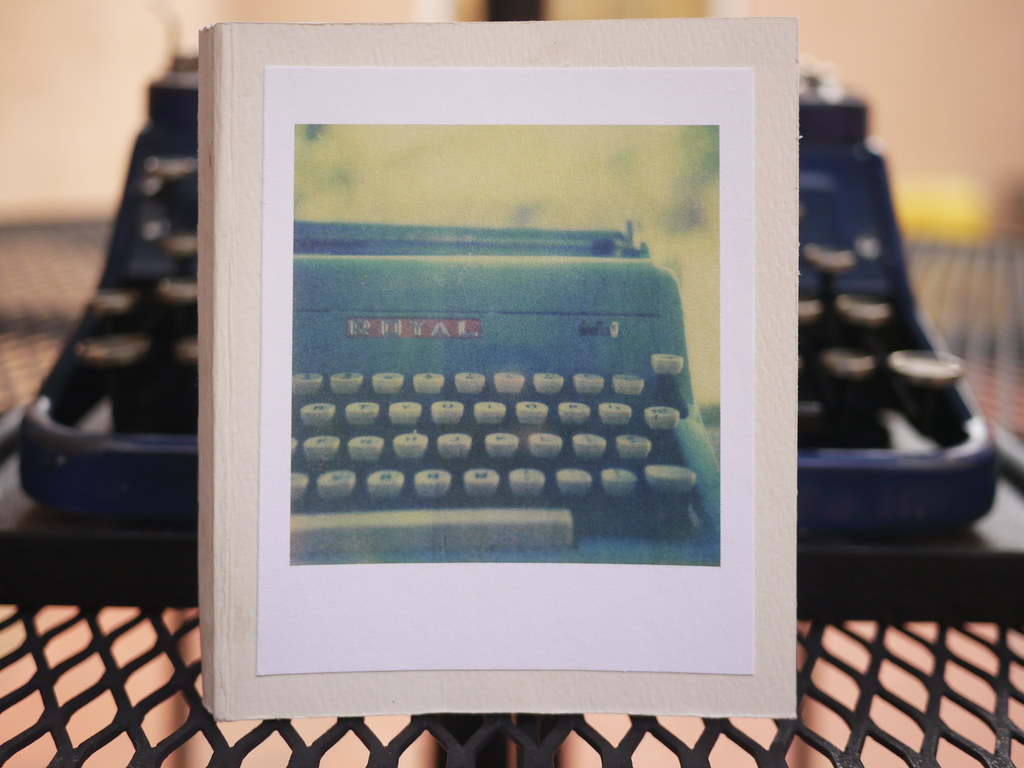
I have a box full of these typewriter-themed note cards, which would make good covers for more handmade notebooks. This also gives me incentive for collecting notecards and other printed ephemera for use as cover art for notebooks.
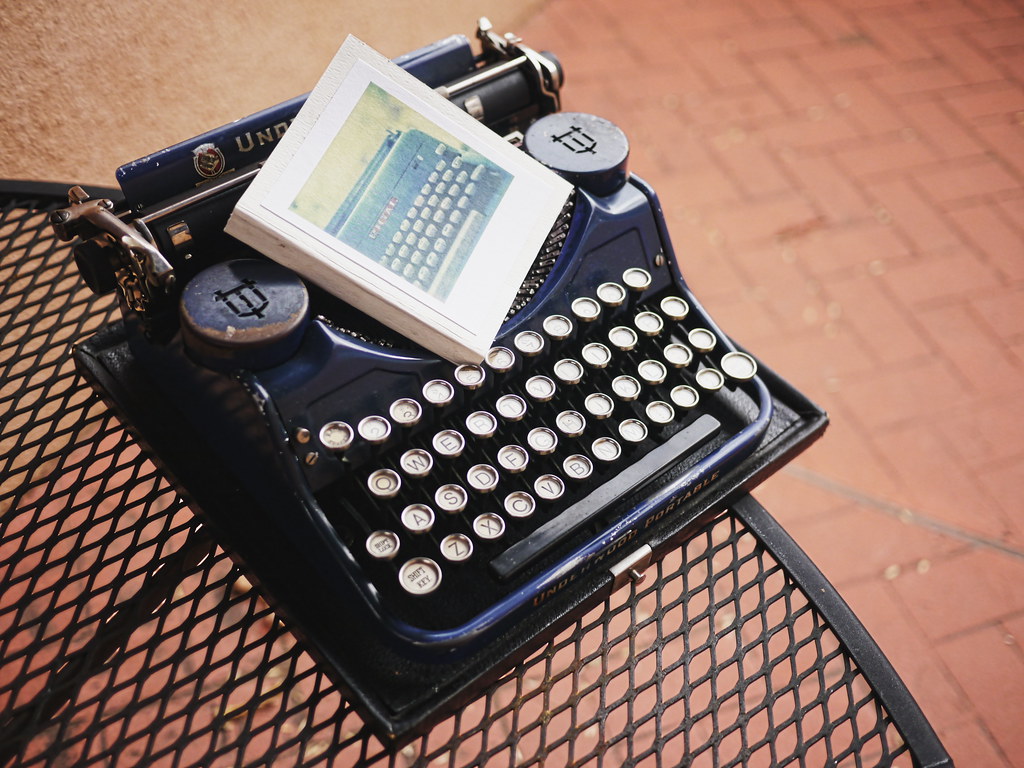
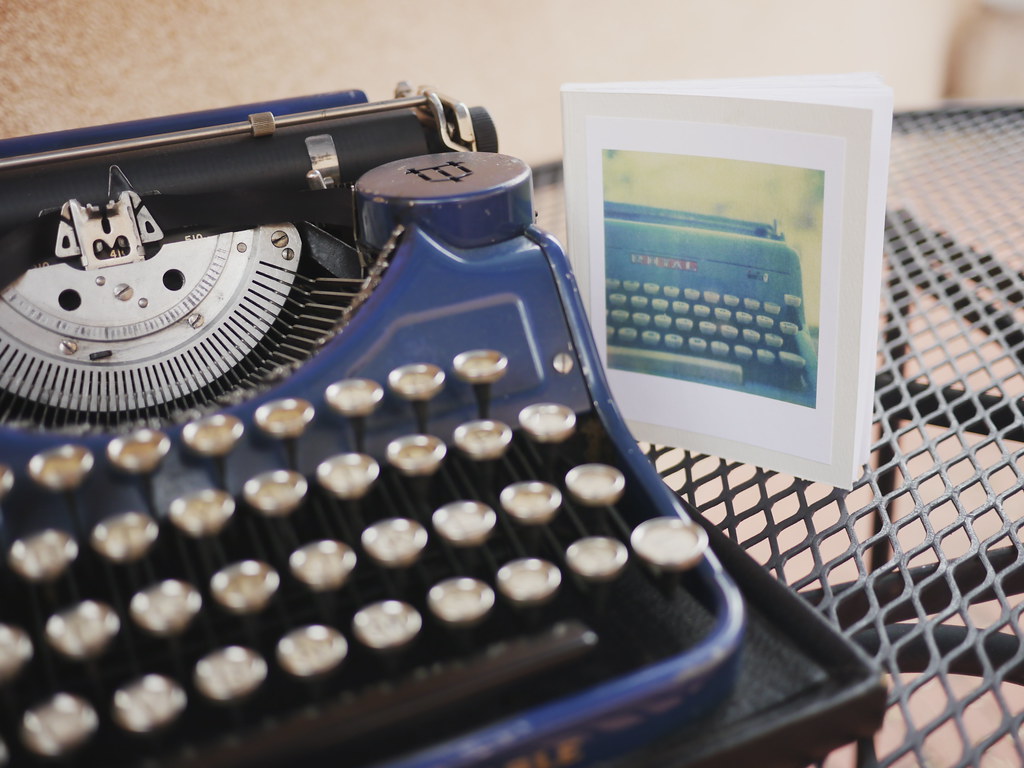
It's not difficult to see the photographic possibilities intrinsic to typewriter-themed notebooks when combined with old typewriters.
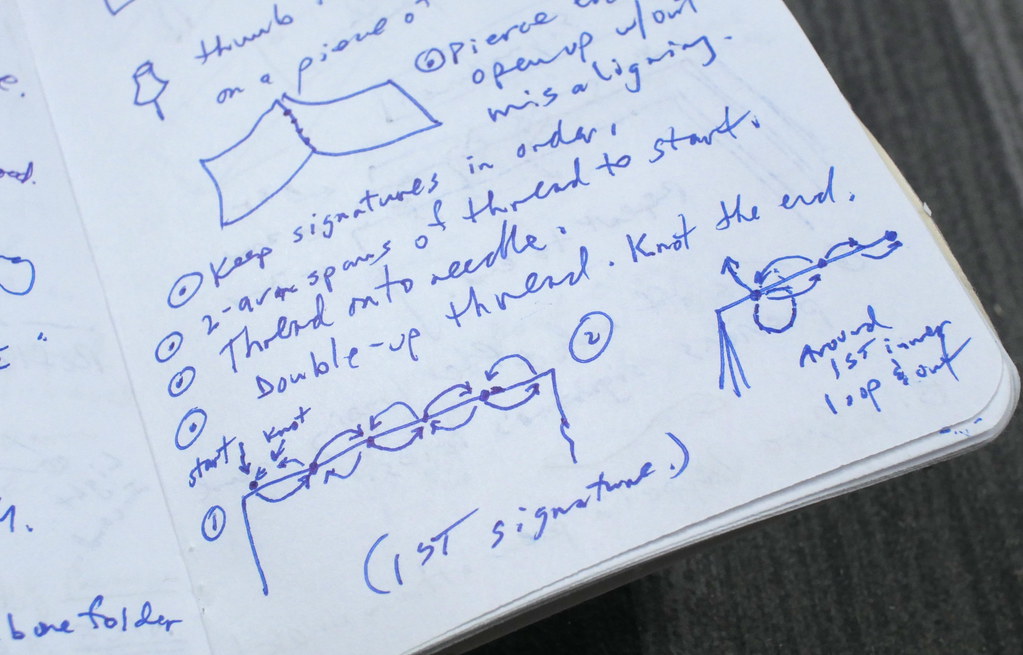
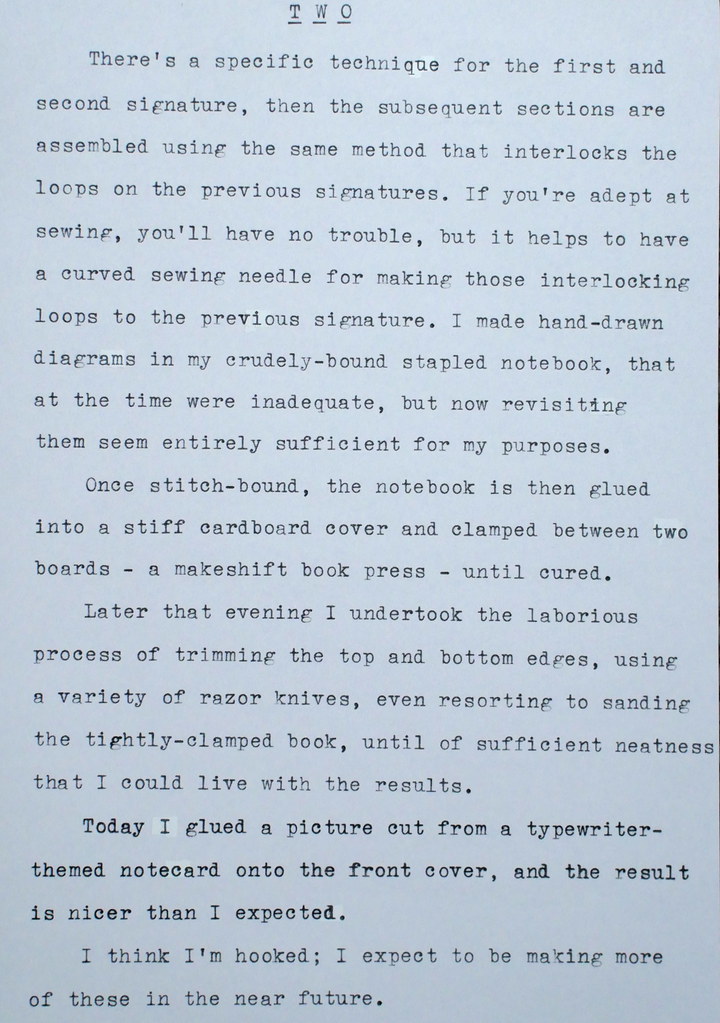
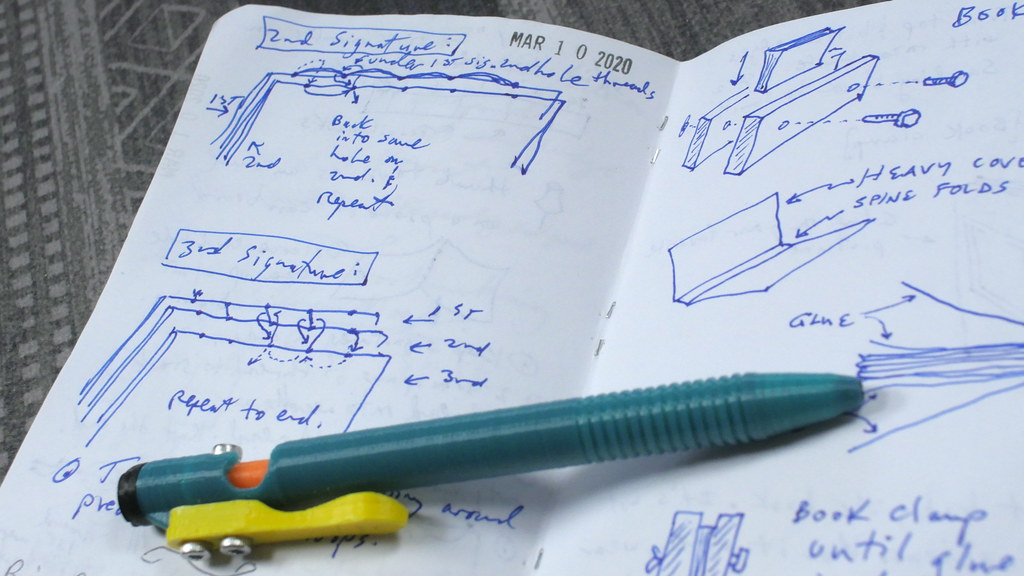
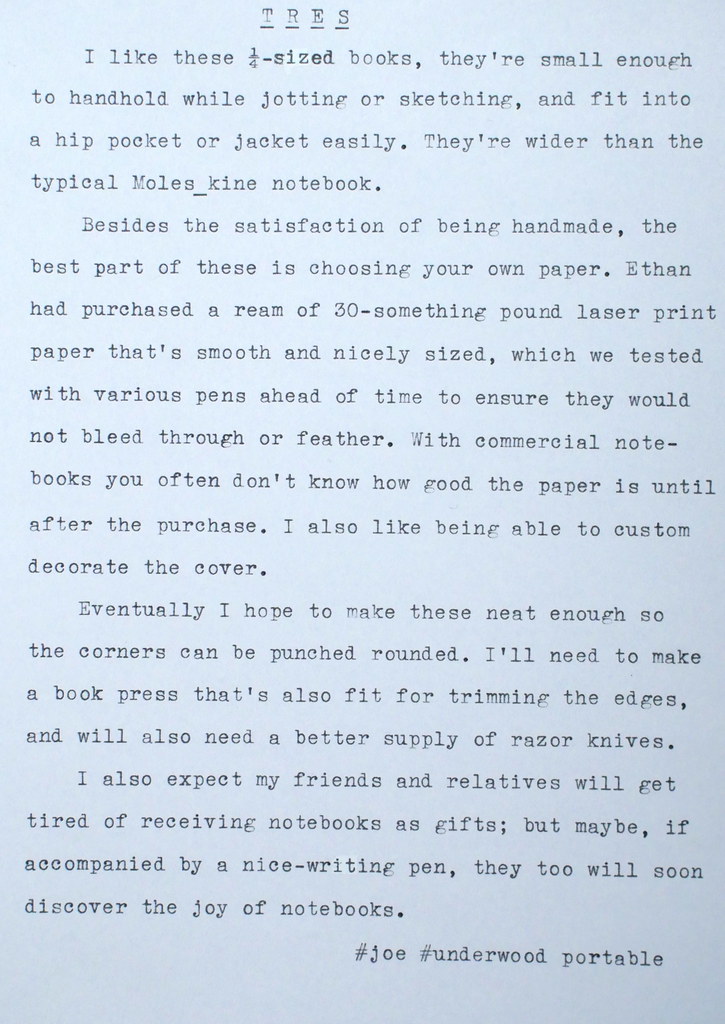
Regarding the handmade notebook, it has 100 pages, a nice size for extended usage. The paper has a nice weight and finish, good for gel and fountain pens. After my frustration with yesterday's assembly process, mainly due to fumbling with the hand stitching process, I was rather pleased with the results. Still, there's room for improvement.
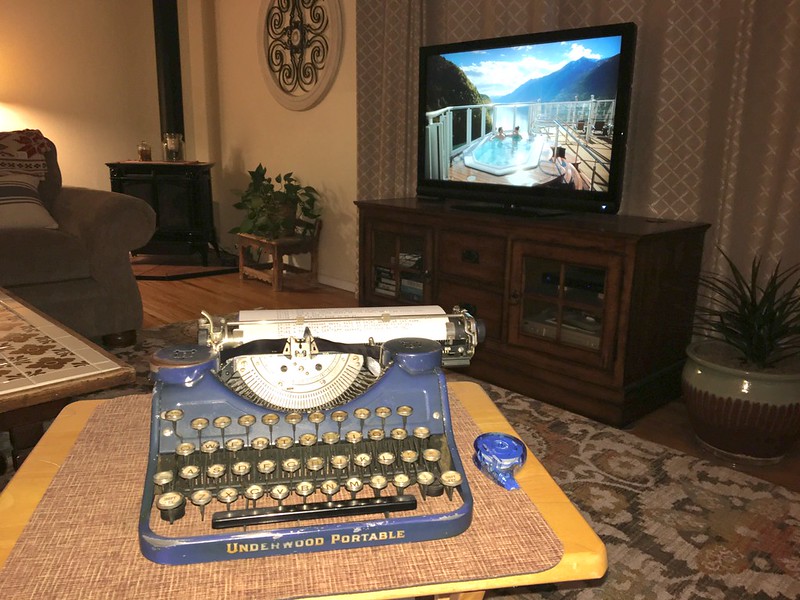
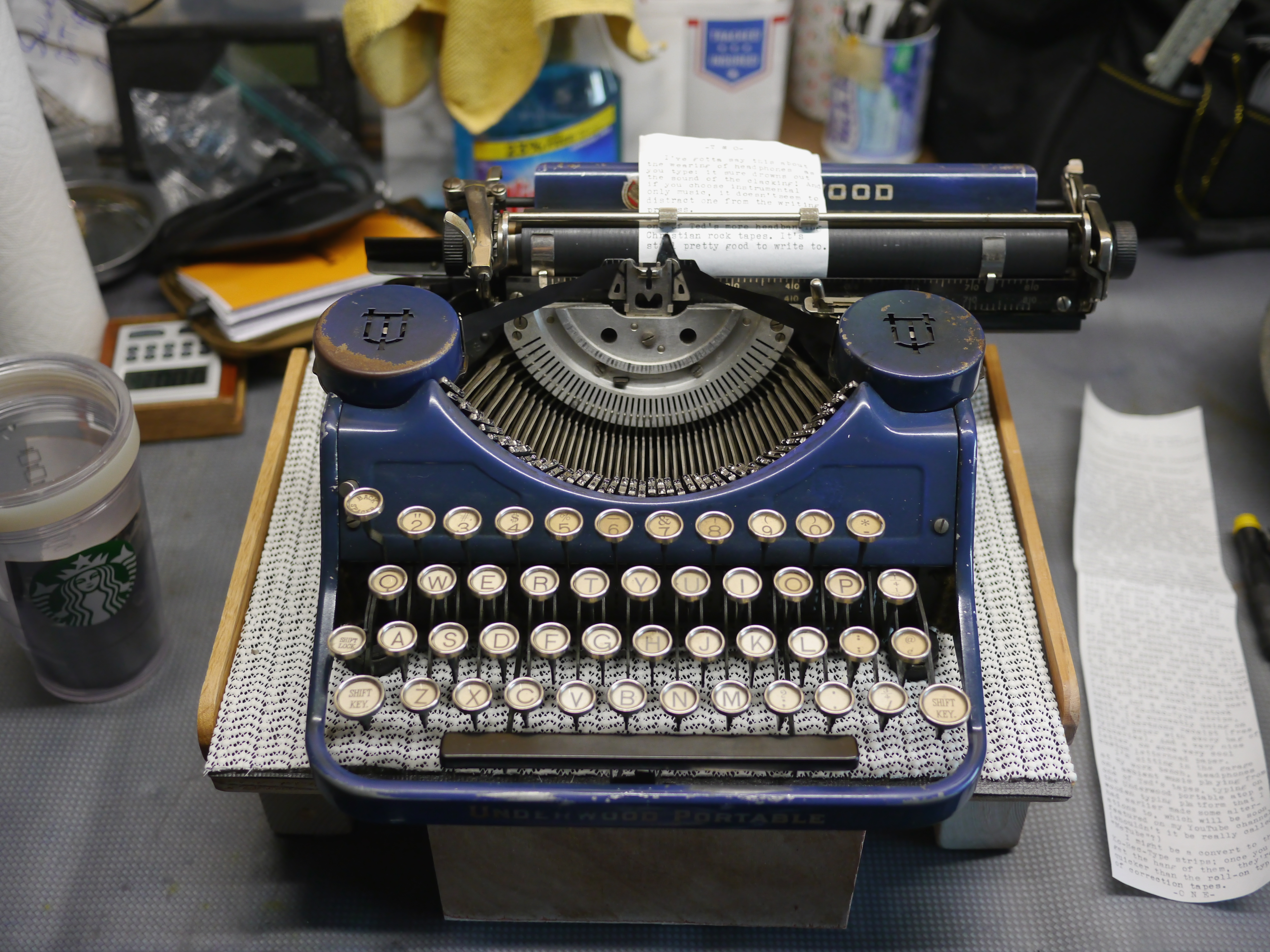
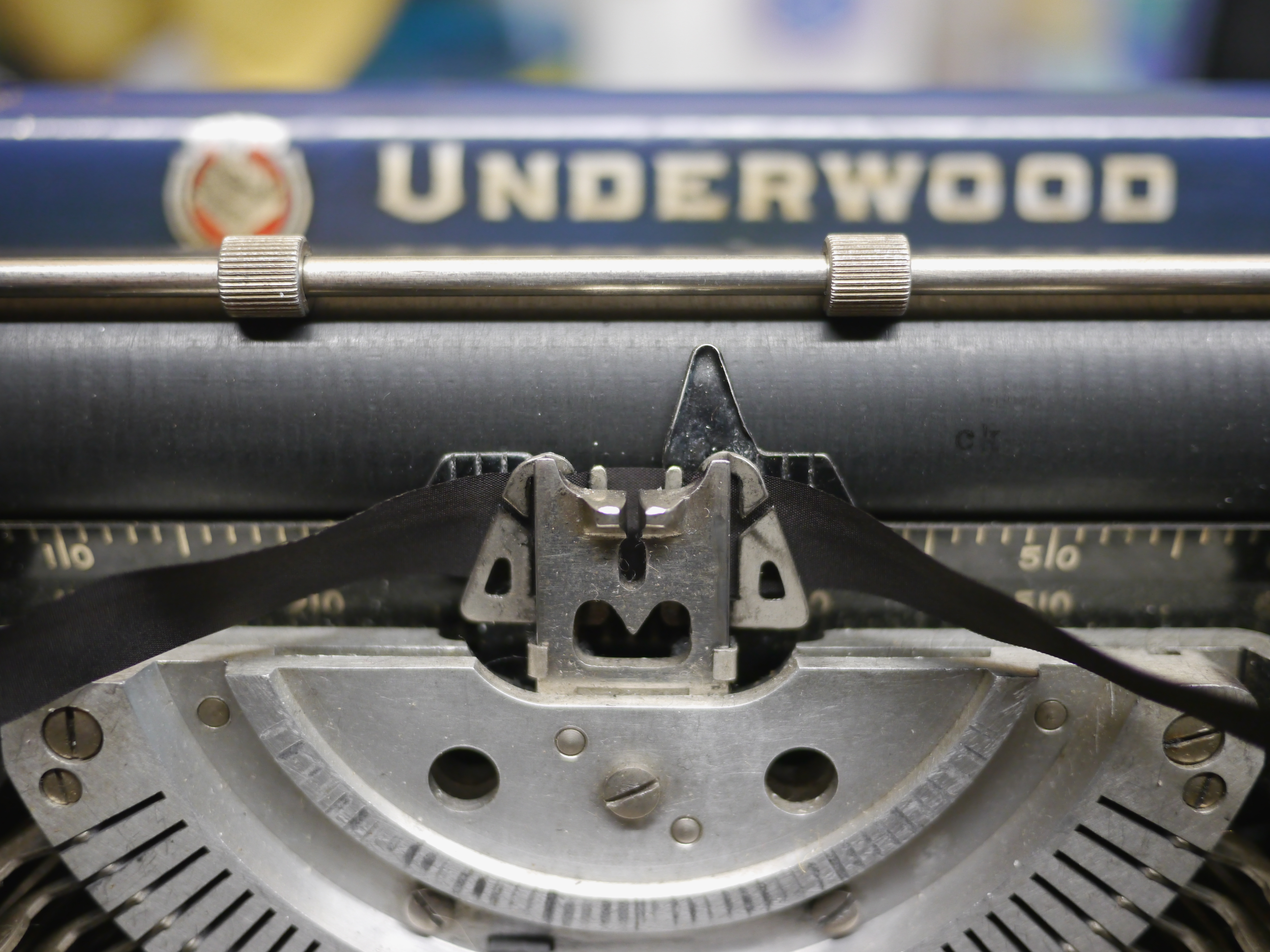
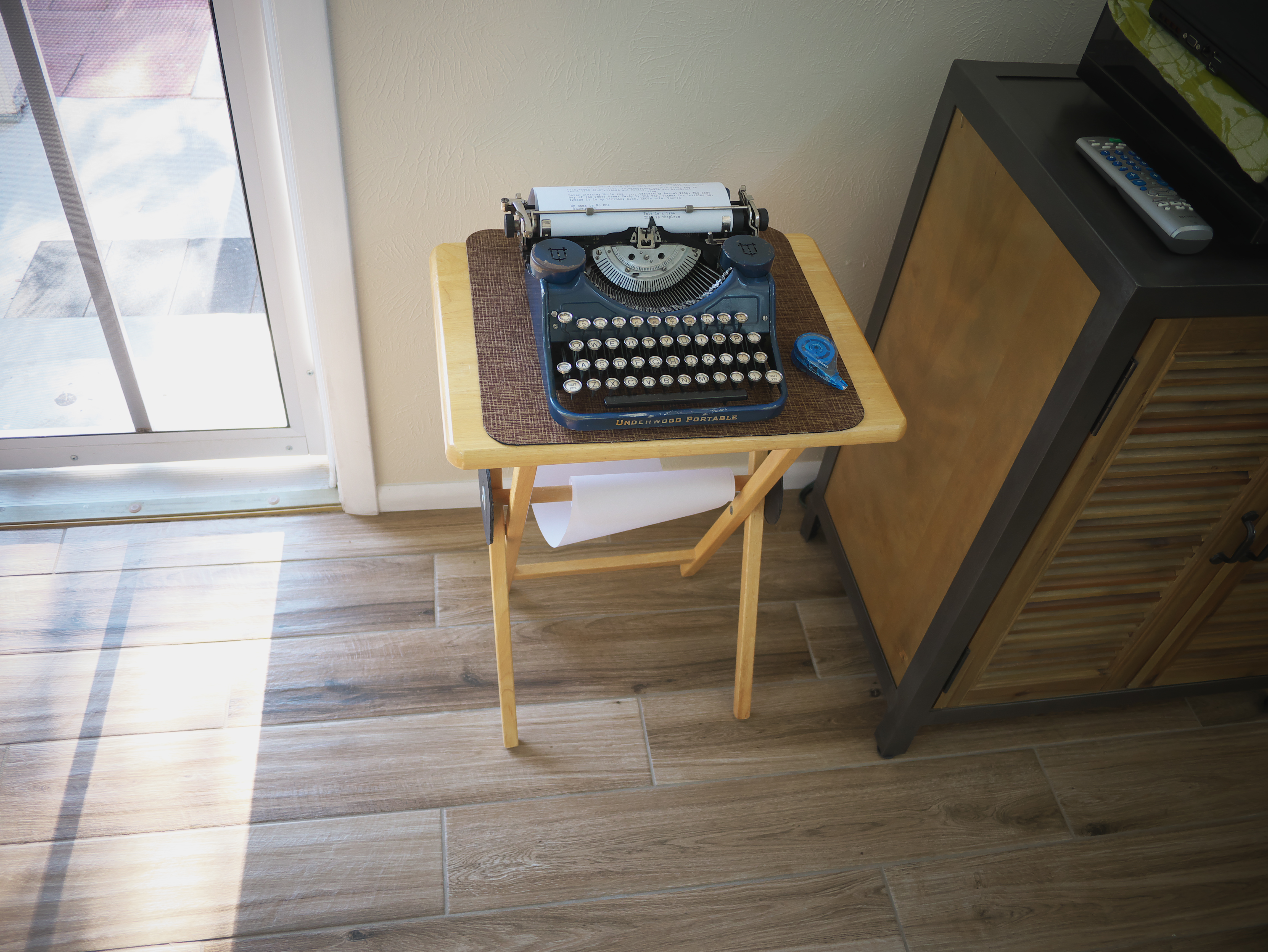
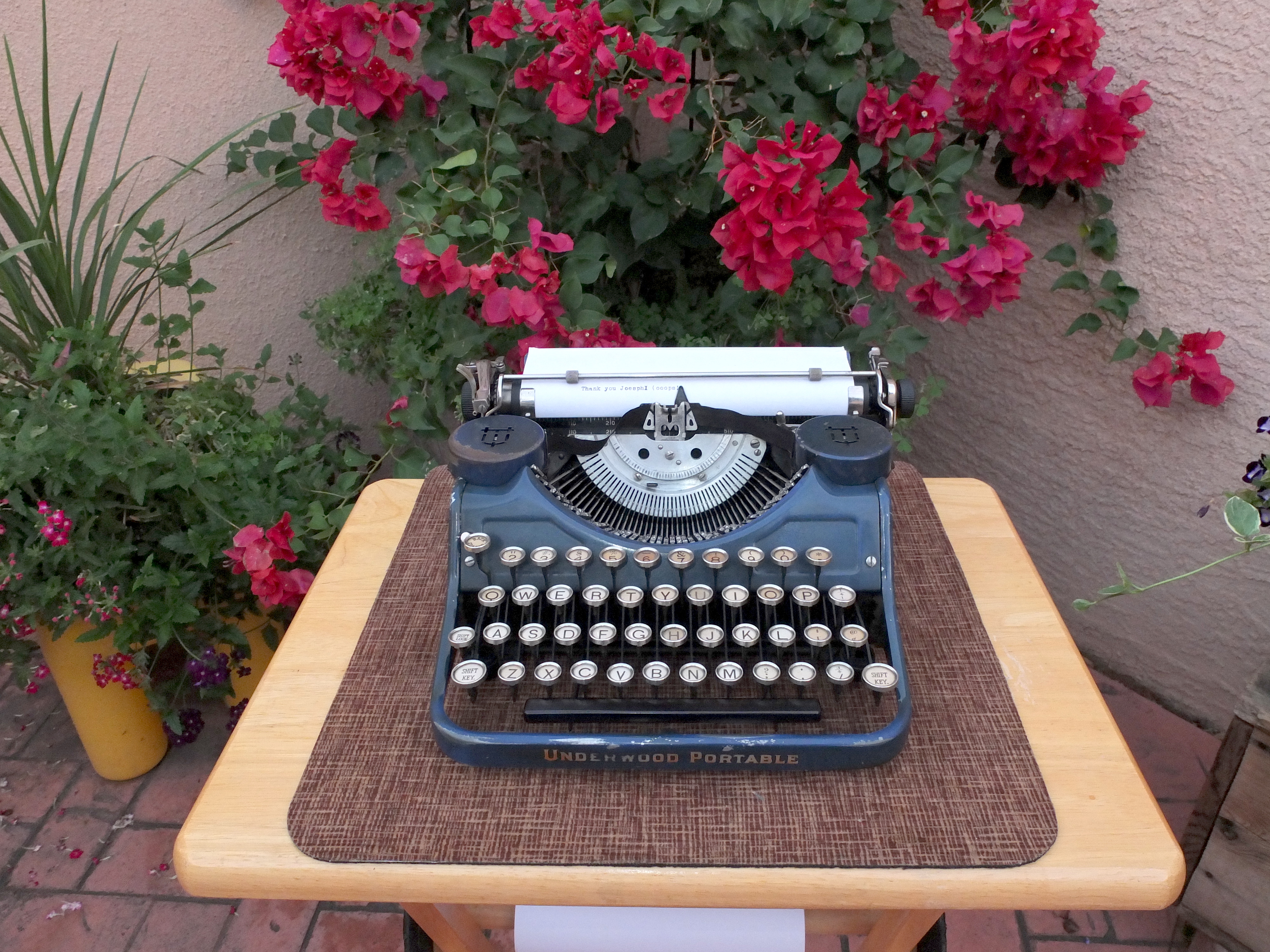
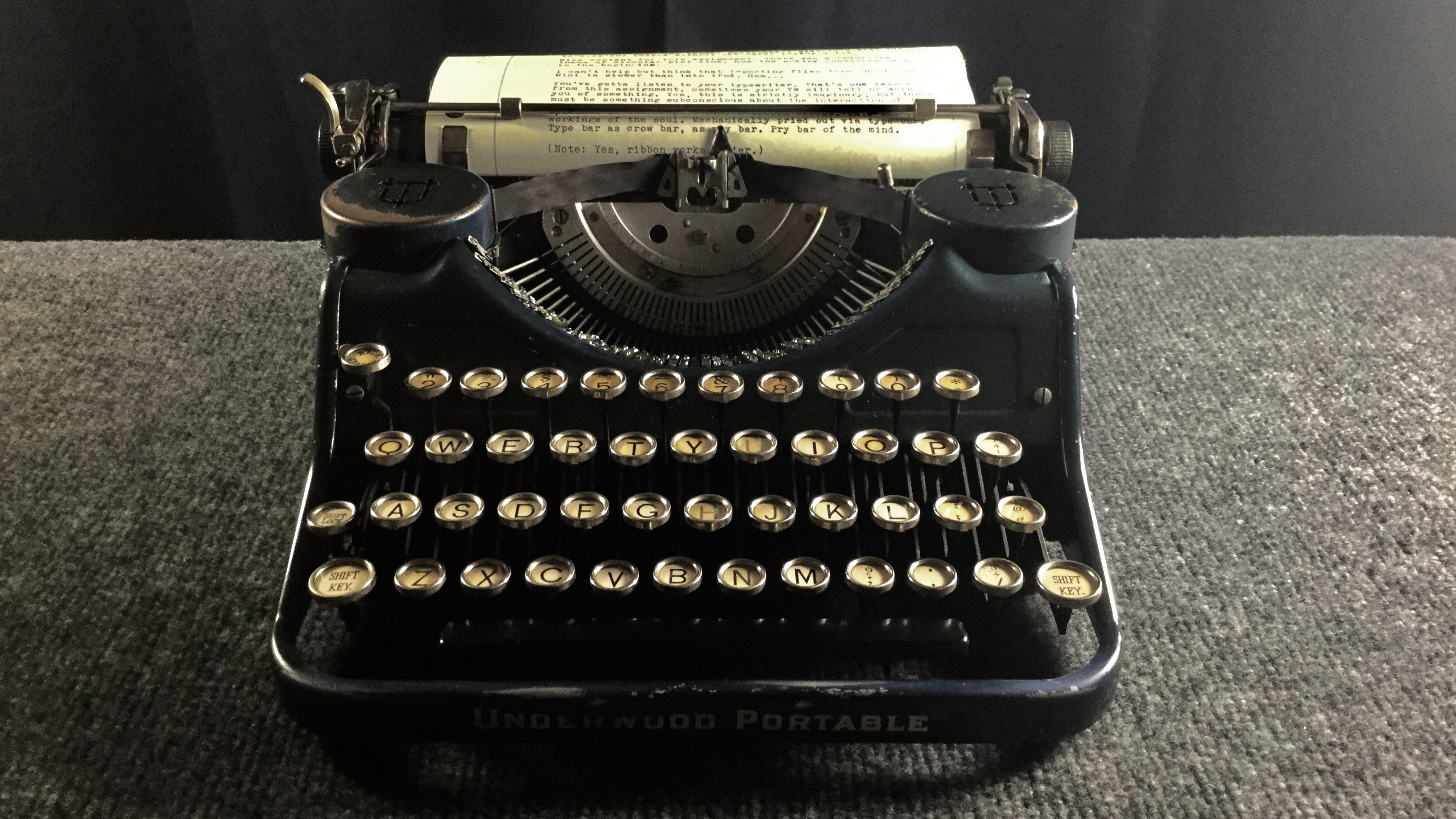
I keep the 1930 Underwood Portable on a small table in our patio room, handy for some quick grab-and-go writing on the front porch. This old machine has a great feeling action to the keys, and seems to be very reliable, aside from the occasional wonky ribbon advance when it gets near one end of the ribbon, which is why, when I'm actually writing with it, I remove the two ribbon spool covers (that have the nifty "UT" logo etched into them) so I can monitor the ribbon motion as I type. I've noticed in many old photos of writers with their typewriters, they often operated the machines with the ribbon covers removed. I recall seeing a more recent photo of Woody Allen at his Olympia, which he apparently still uses for writing, sans ribbon cover.
My intention this afternoon was to just sit in the front patio, type a blog article and smoke a cigar. Then I began to admire the typewriter together with the notebook, and soon the shutter bug in me got busy. I wonder if these beautiful old machines were designed to be this attractive, or is it merely an artifact of distance in time, the effect of nostalgia? I suppose there are some people who are attracted to the beige and grey boxes of 1980's computers with their minimalist modern styling, but they don't, in my opinion, hold a candle to an old typewriter.
Typecast via Underwood Portable onto Clairefontaine Triomphe paper.
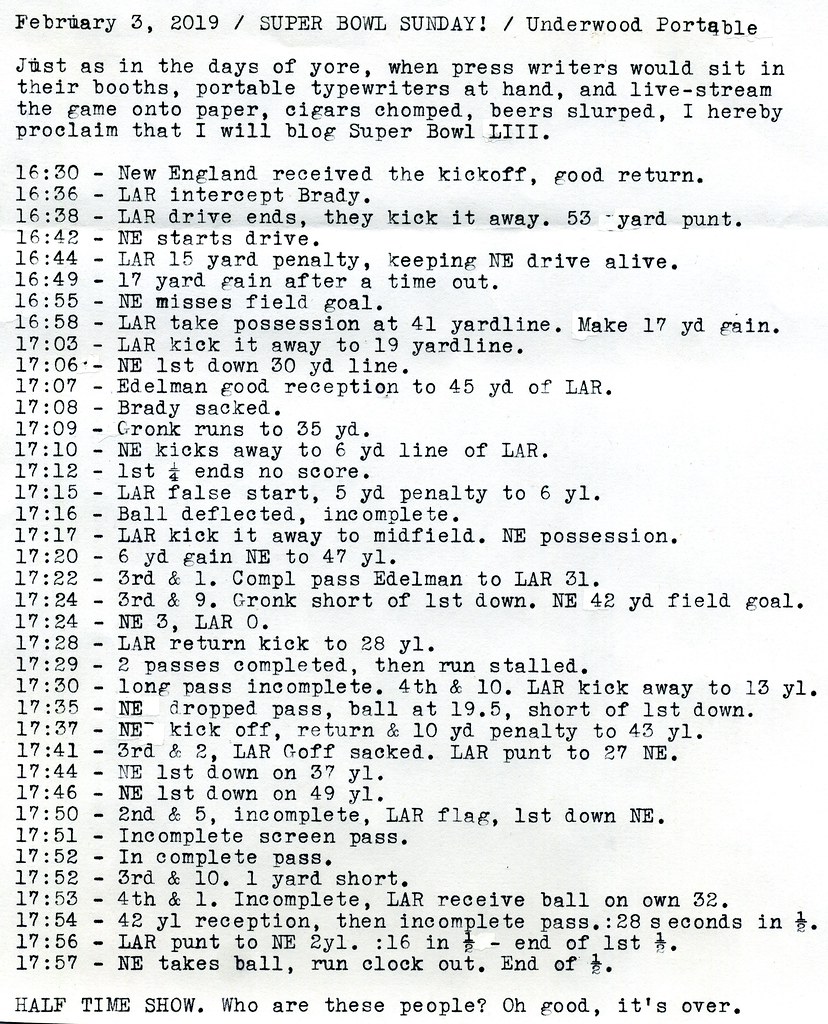
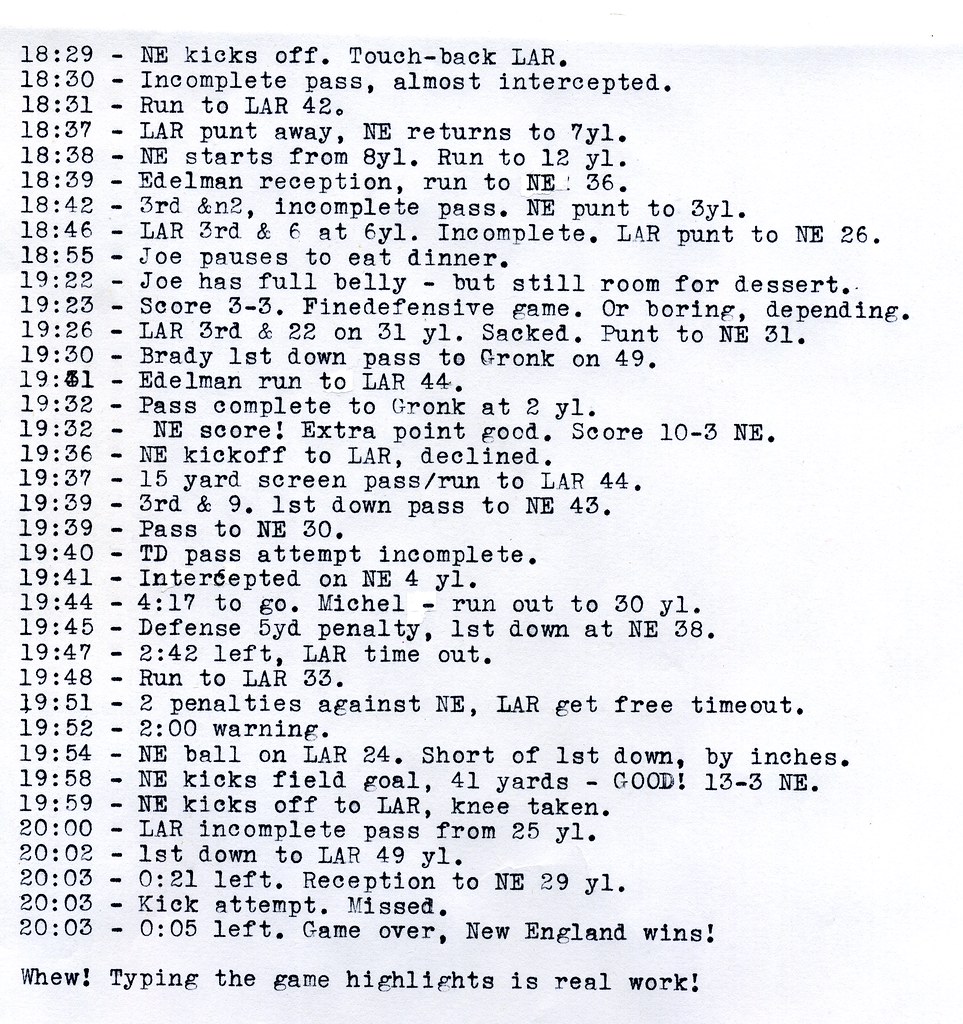
Post-Script: I'm no football fan, don't have a favorite team (except the 1980s-era San Diego Chargers), and didn't have any skin in this game. But I did think it would be fun to try my hand at fledgling sports-writer, 1930 Underwood Portable at hand, to see if I could keep up with the plays. I decided to log the game at local mountain time, instead of the game clock, as this would better illustrate how long one of these matches can last. Ostensibly 60 minutes of play time, it took 3.5 hours, including the halftime entertainment. It's interesting how frequently interrupted the game is with commercial adverts, but that's the NFL these days. Billions of dollars at stake, with the viewers being the product.
I certainly have a newfound respect for the sportswriter of old, sitting at their typewriters, furiously documenting the game. The real sportswriter actually understands the game, knows the players, can find a real story amidst the minutia of statistics, and thus can do a much better job than I. But hey, I got to spend time with family, enjoy food and drink, while typing in the midst of the television program - can't do that once my wife's "stories" come on!
Best of all, I found (or, rediscovered) another use for typewriters. I'm reminded of Robert Messenger, fellow typewriter blogger, who is the real thing - veteran sports writer, reporter and typist.
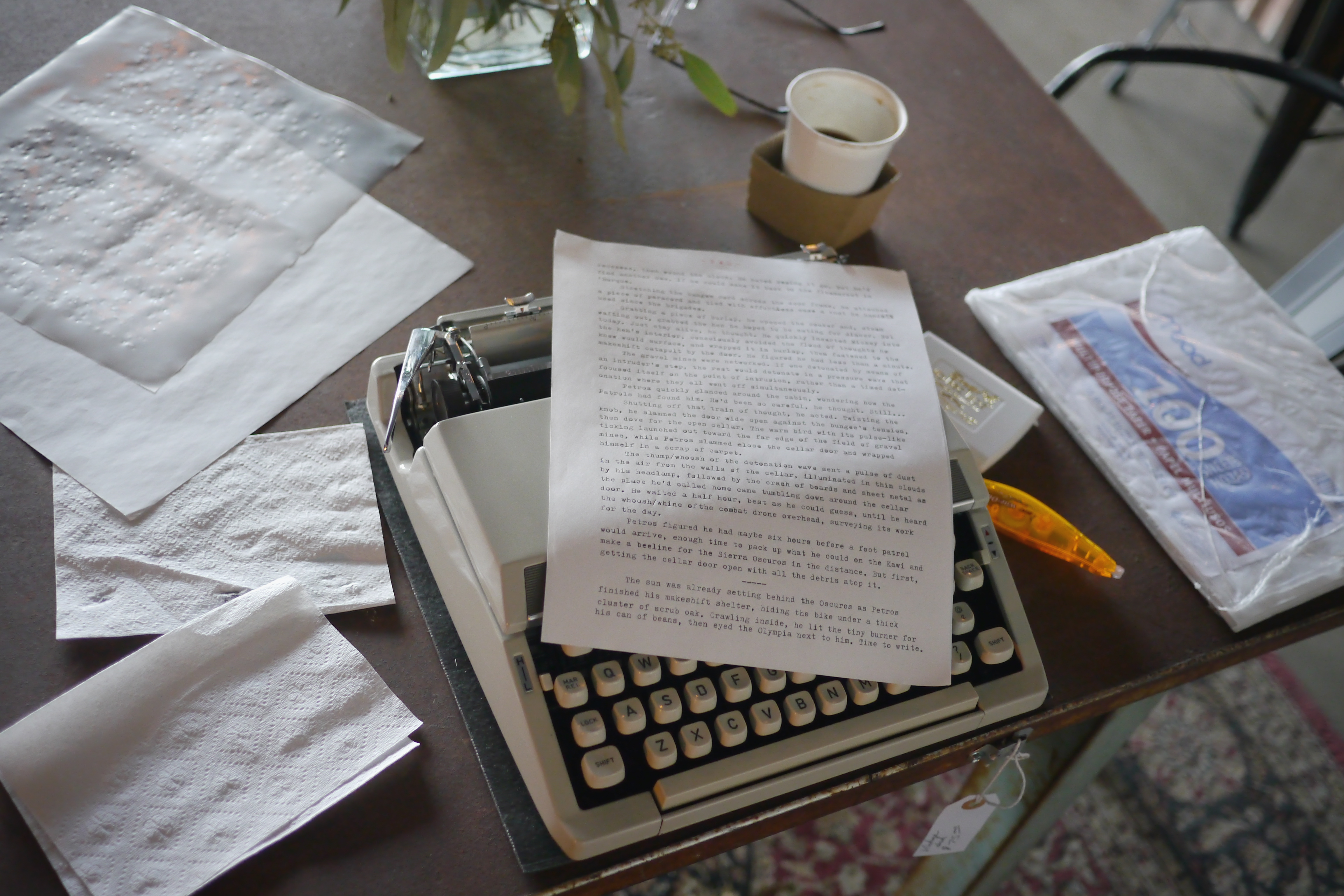
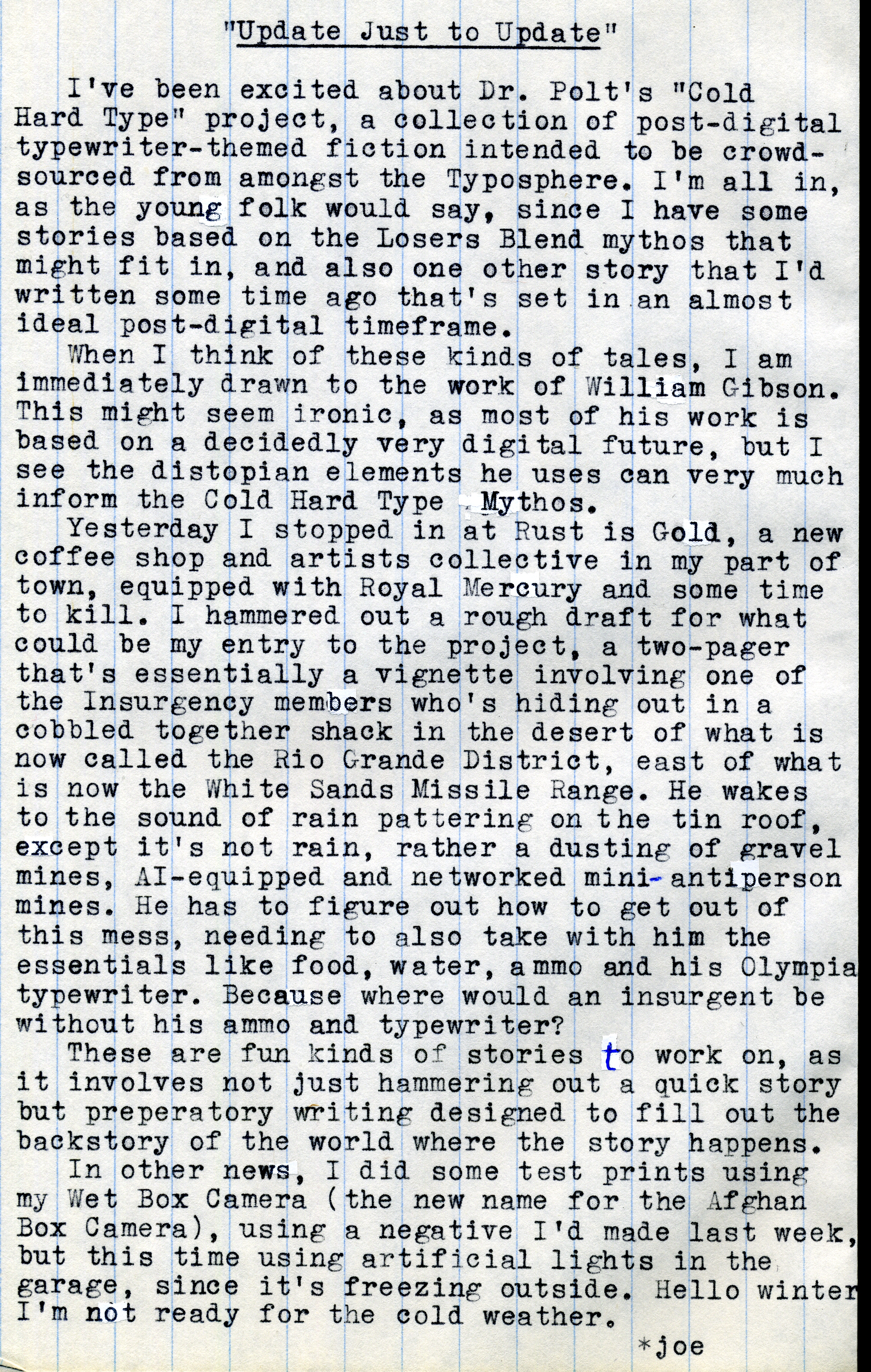
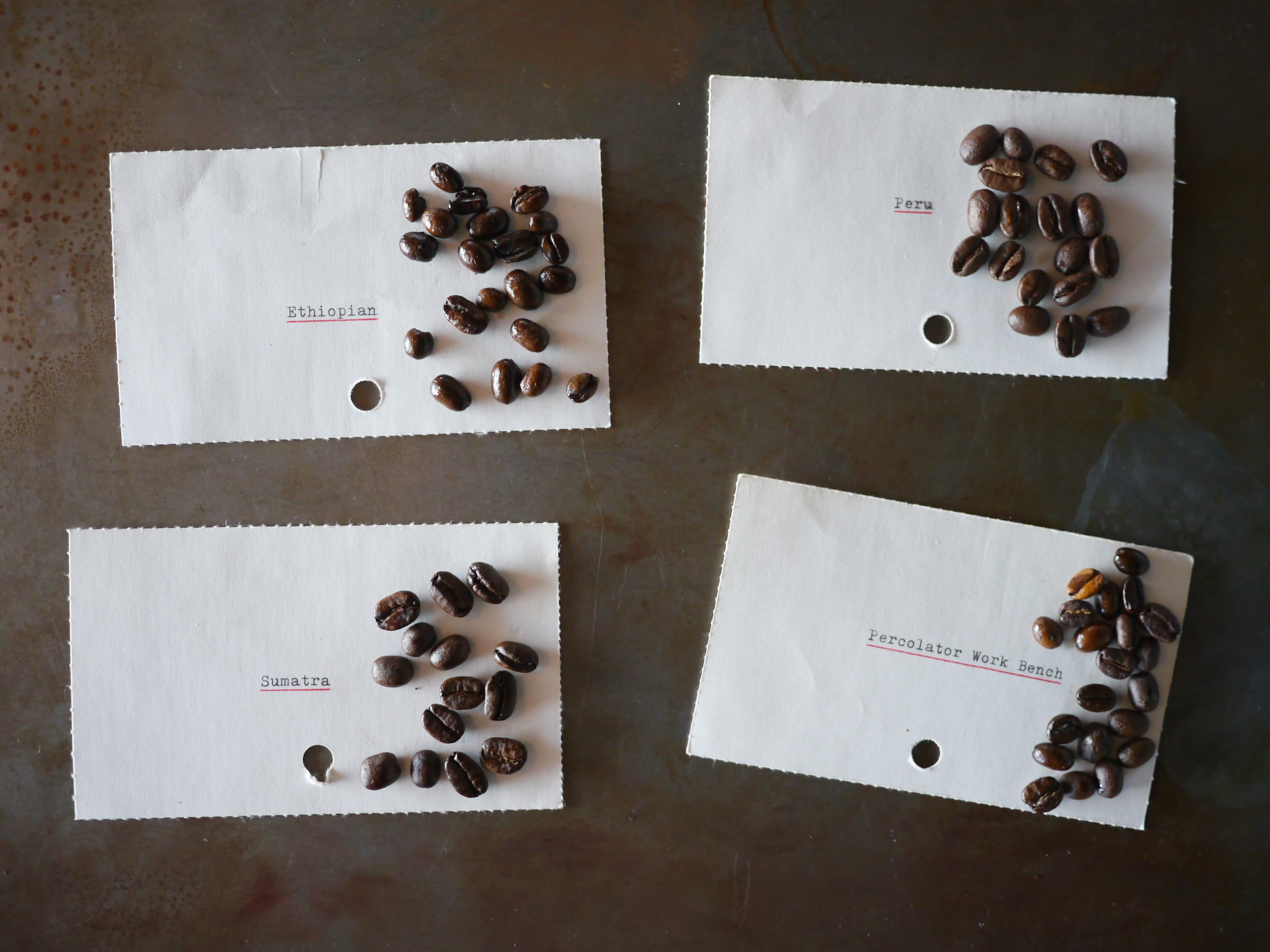
Post-Script: I had a pleasant distraction while writing my treatment for the Cold Hard Type project, which was that the co-owner of the Rust is Gold coffee shop asked me to type some index cards with names of coffee beans that they roast, for a photo shoot she was doing. I was happy to oblige.
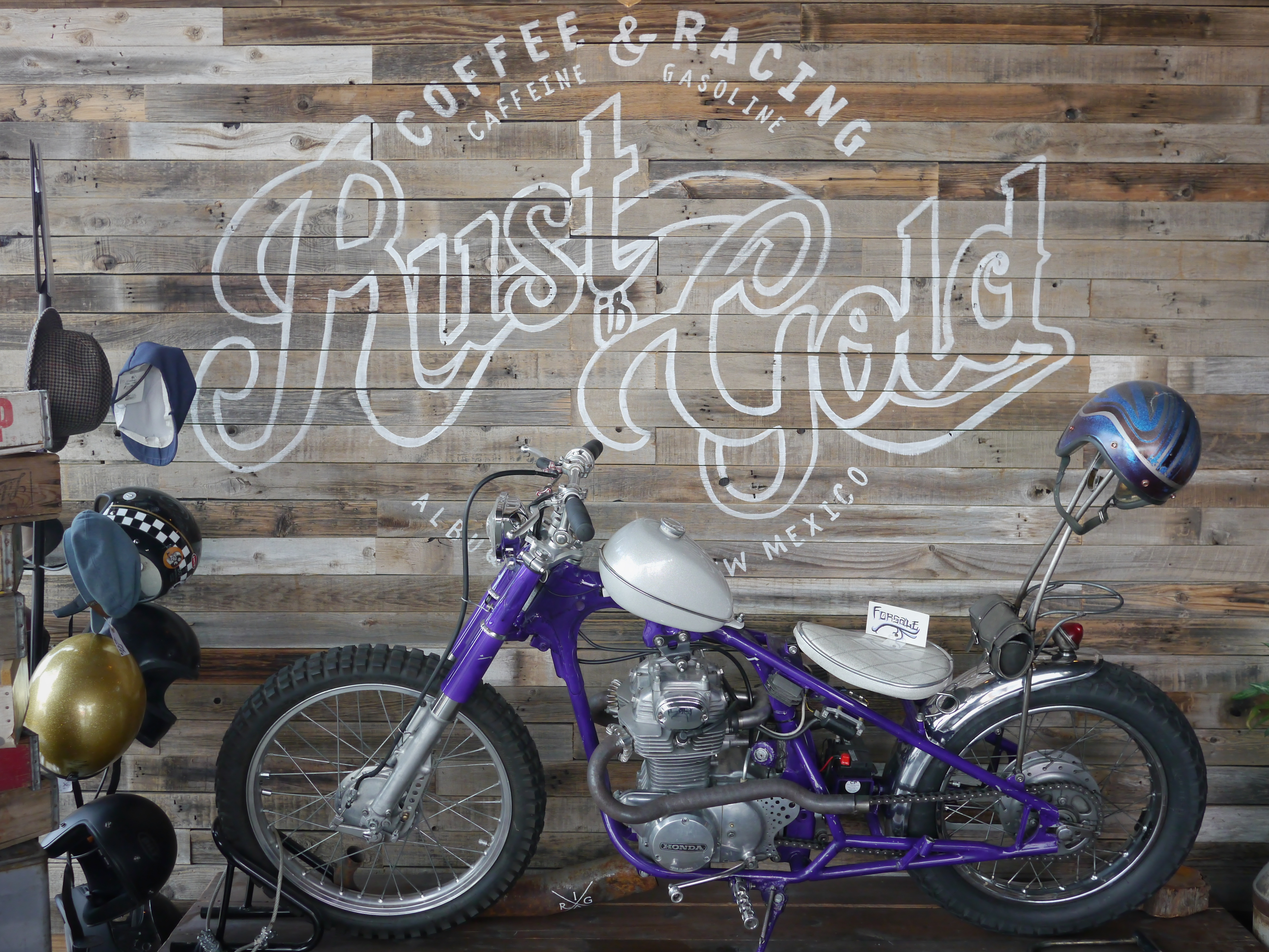
They have a cool motorcycle display, that changes every once in a while, as a local club meets there.
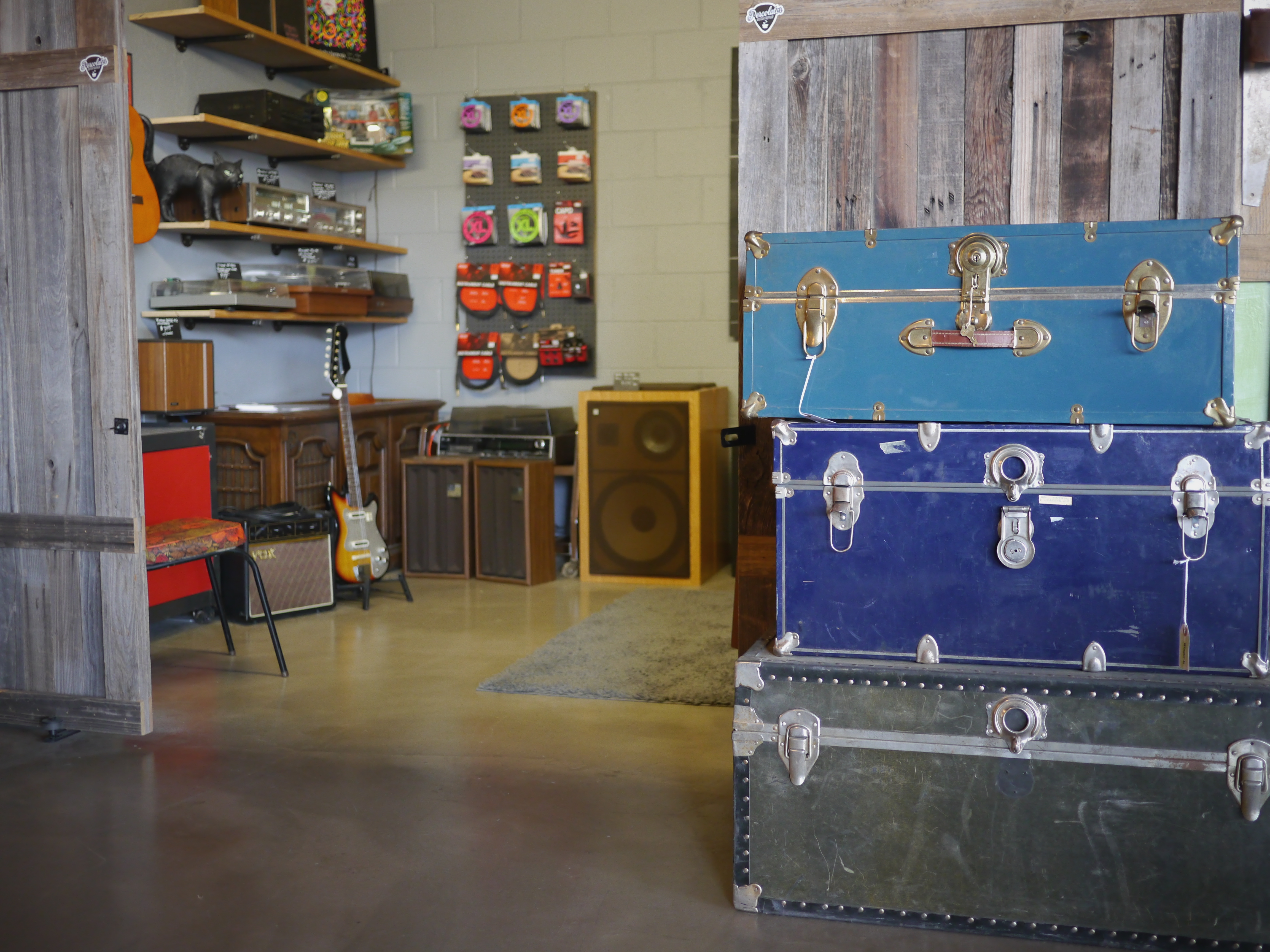
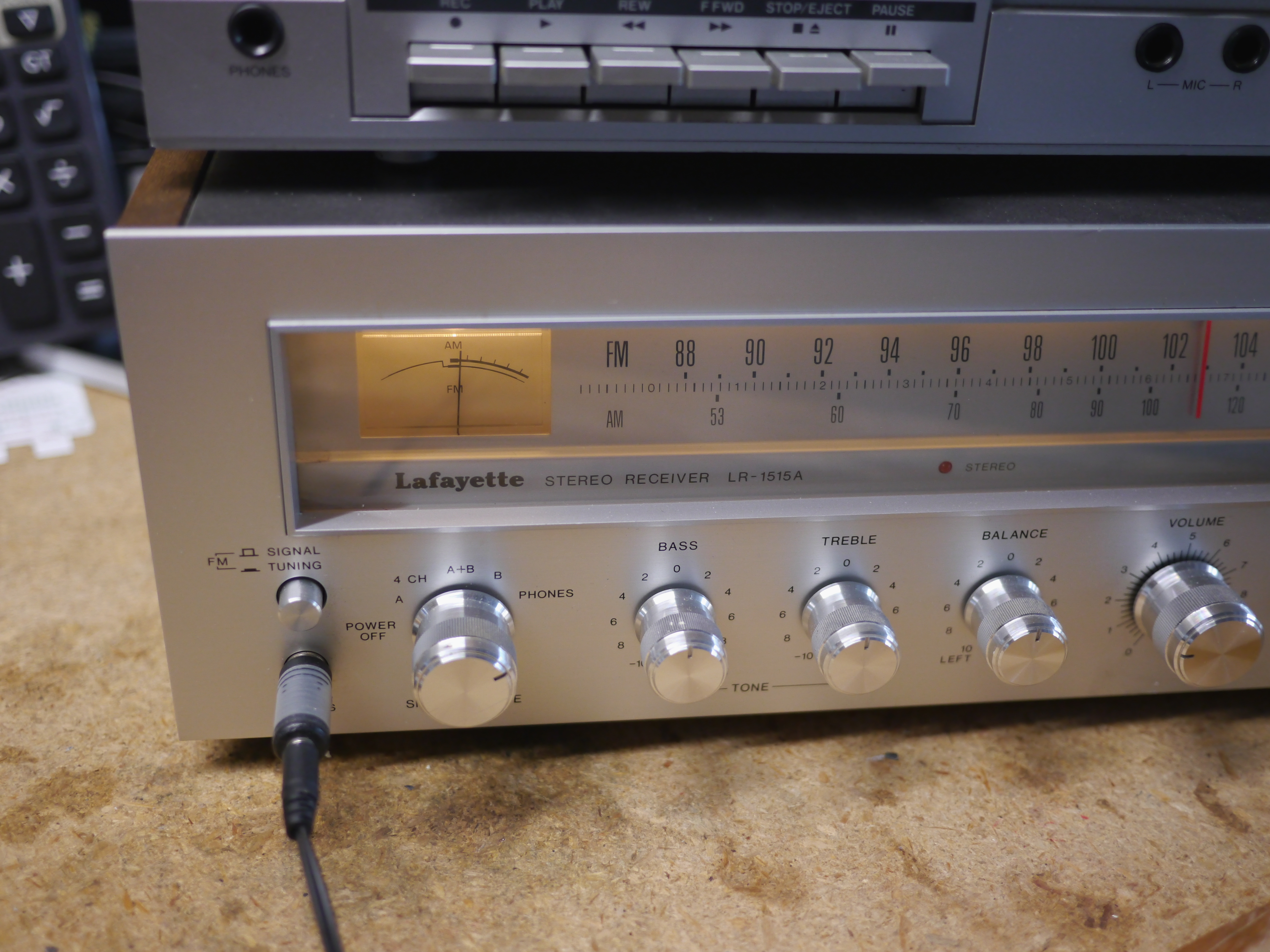
One of the adjoining booths sells '70s HiFi and guitar stuff. Pretty cool.
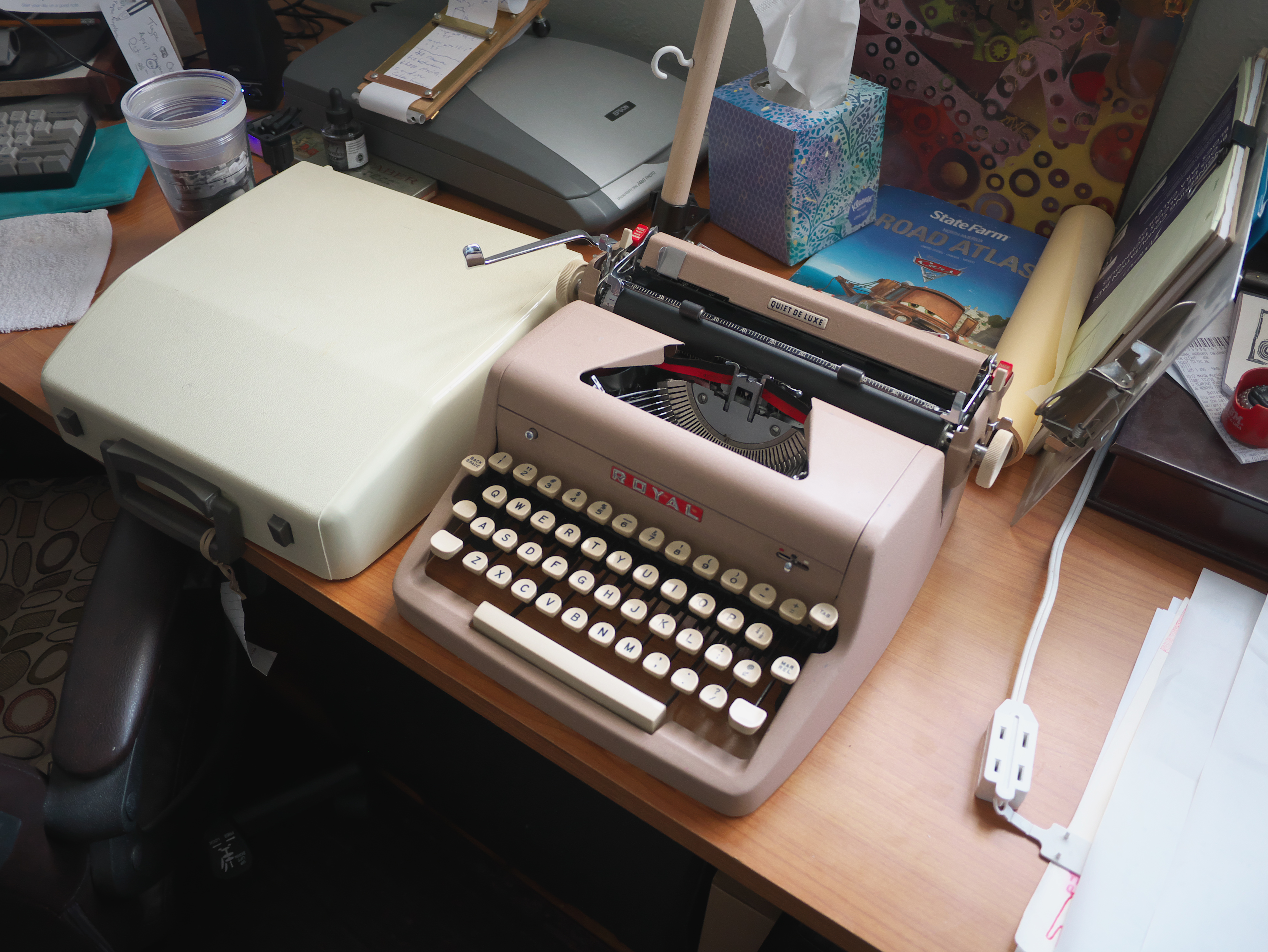
As you can see in the top photo, I wrote my treatment on the Royal Mercury (the more recent one I'd acquired), but this typecast today was written on the old Underwood Portable.
Yesterday, while working on the video about the typing platform, I pushed my office chair back and tipped over the folding tray table, with Underwood atop it, which crashed to the floor. Luckily it is hardwood with a rug on top. The machine doesn't appear harmed at all, which surprised me. Gotta be more careful!
The Underwood atop the typing platform on my workbench.
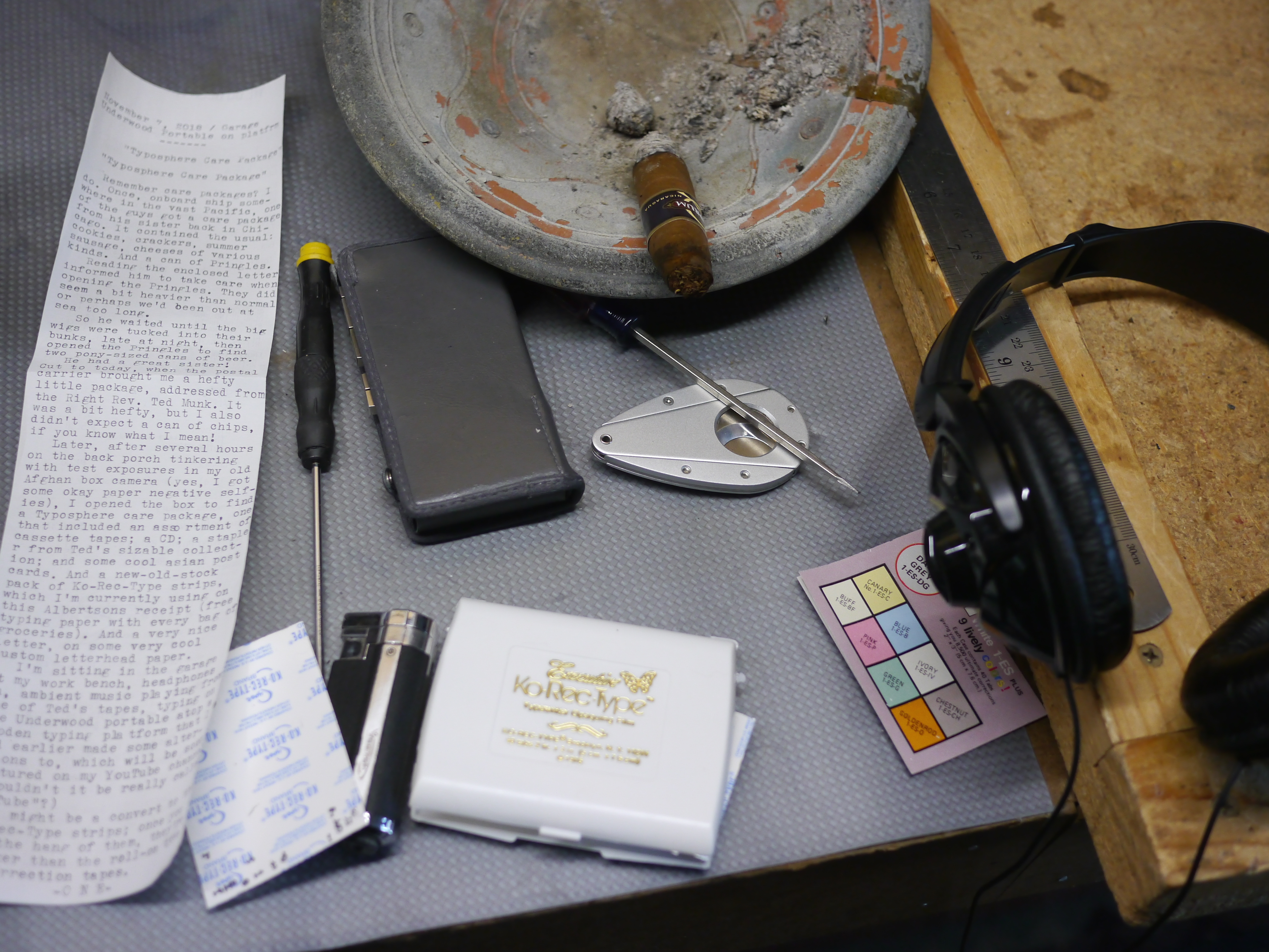
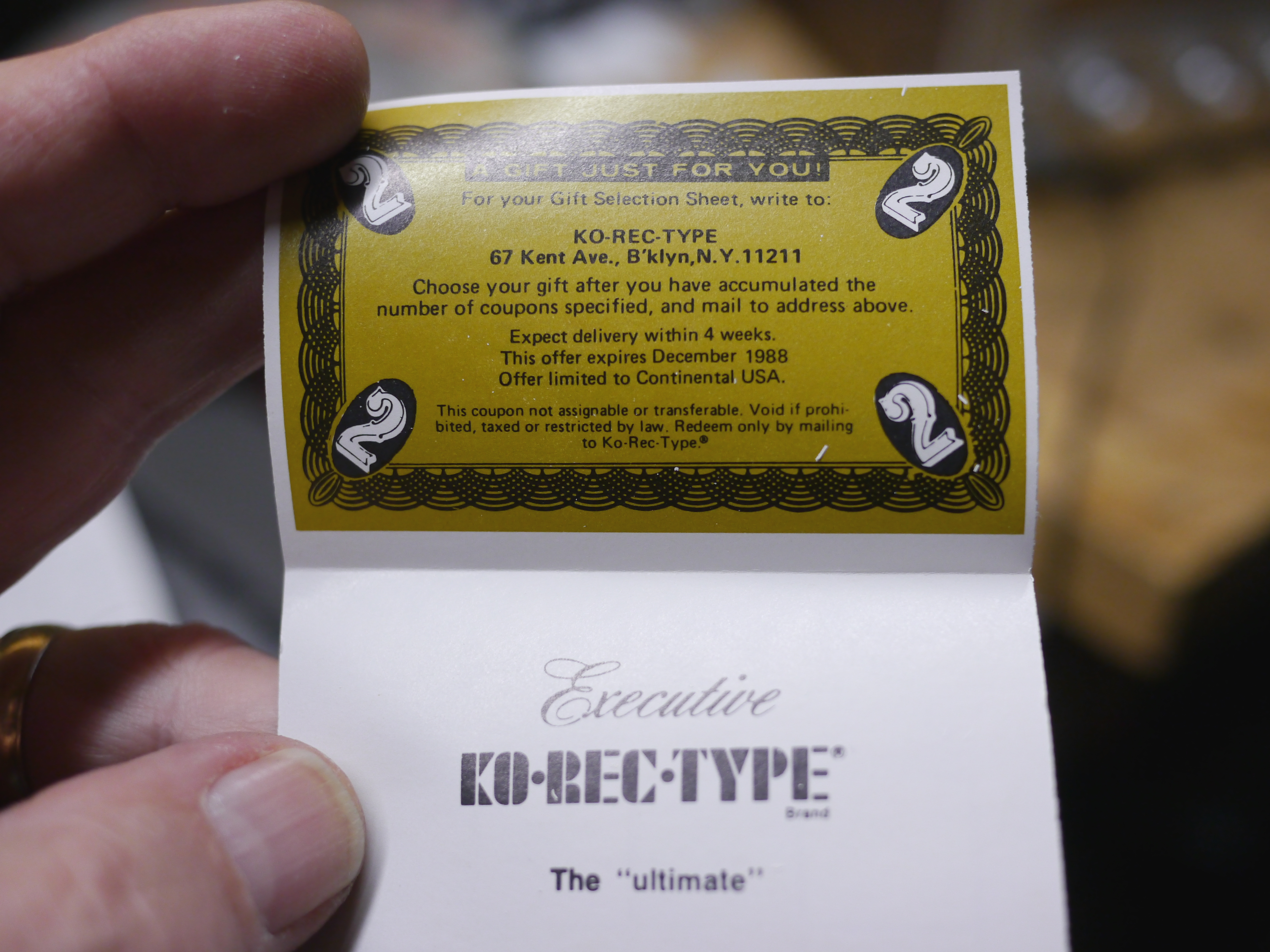
Ko-Rec-Type pack, Olympus Pearlcorder, headphones and cigar accoutrements. Had the garage door open to air it out while smoking. And a fan blowing.
I missed my opportunity to get a free gift from 1988!
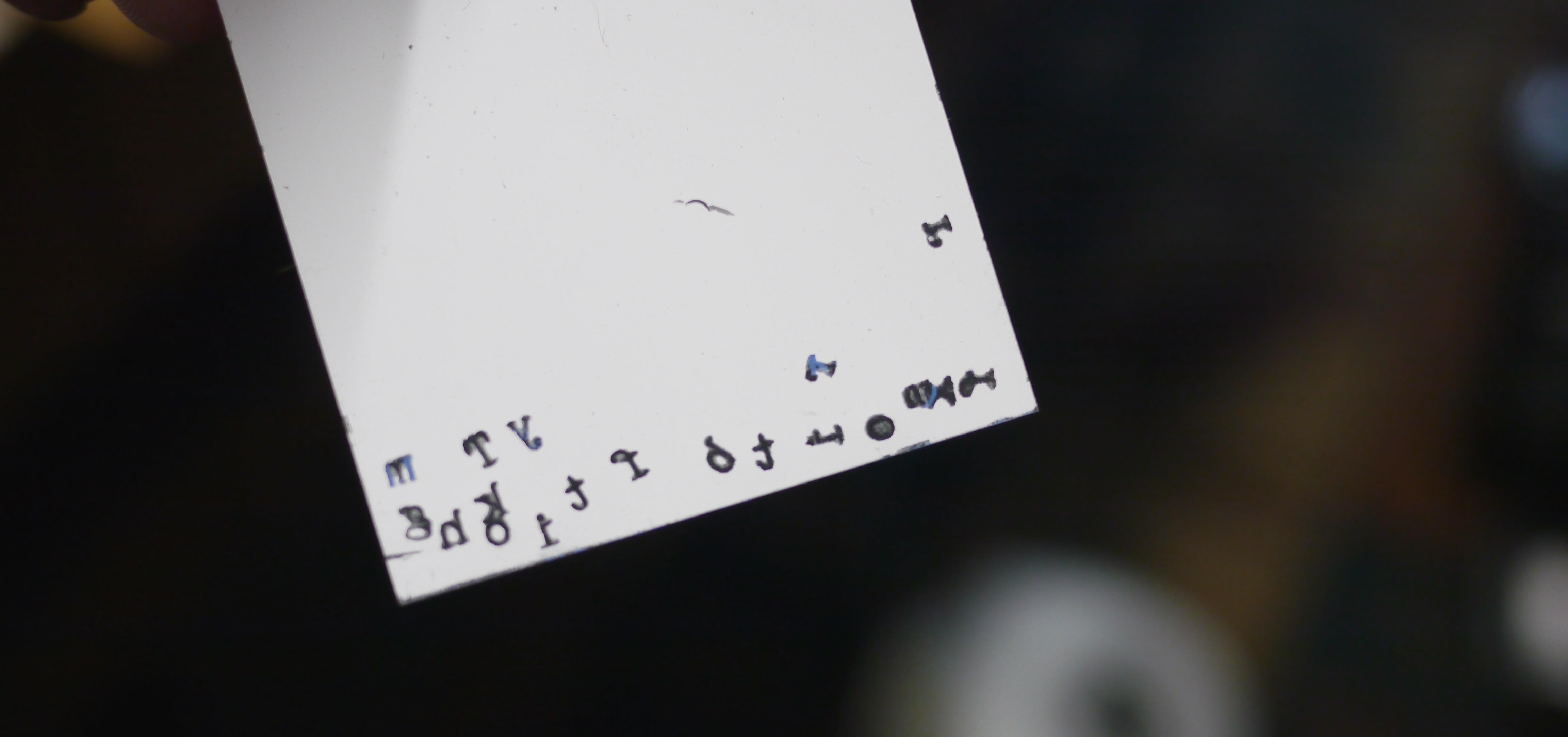
This must be where all the letters go that you type, when they don't show up on the screen!
Only a bit of residue from the Ko-Rec-Type. Mostly blows off with a can of compressed air. It goes down more reliably than those rolls of correction tape.
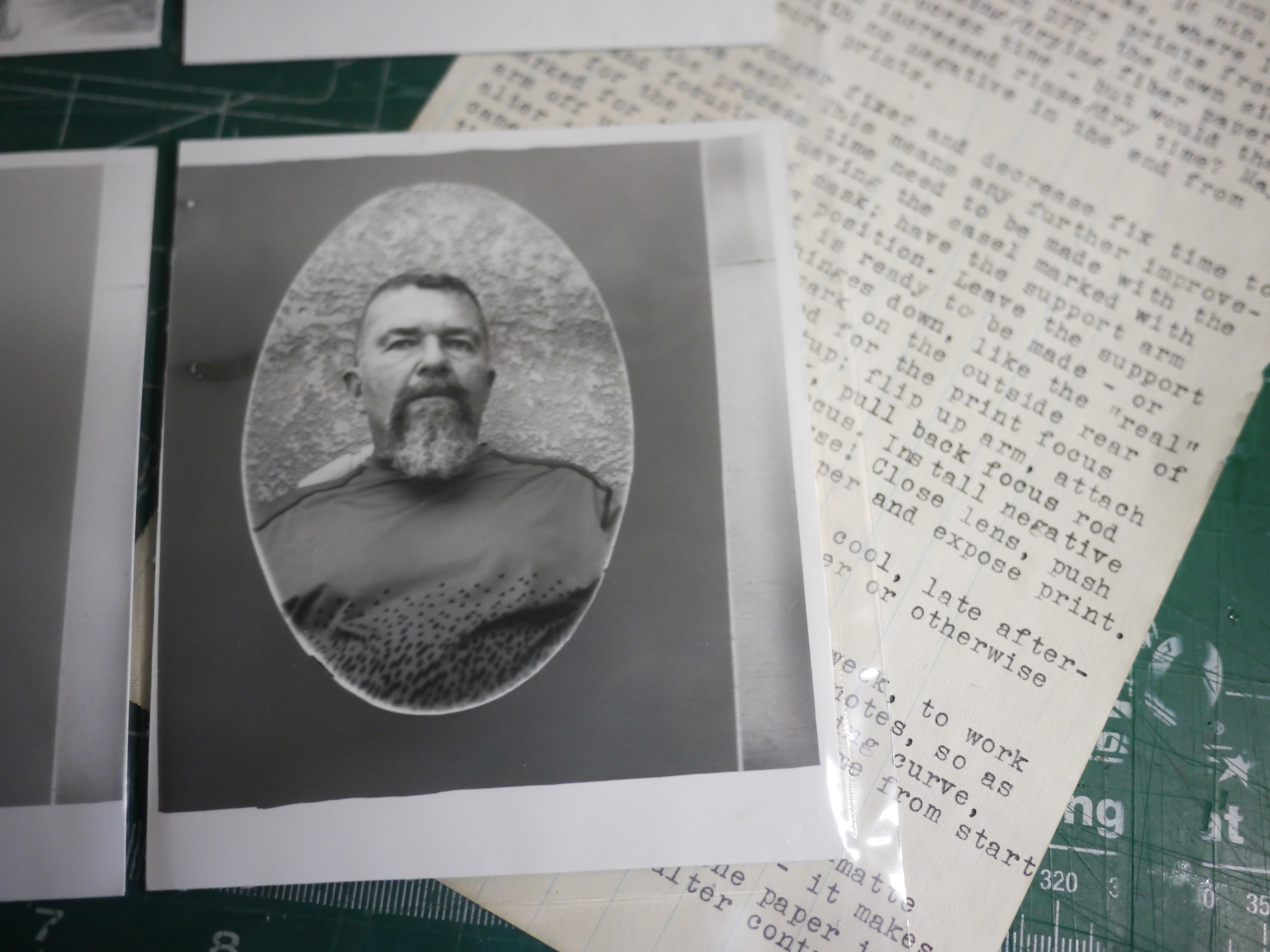
Some results from today's Afghan box camera testing, along with typewritten notes.
I'm thinking about an americanized name for these devices, other than "Afghan box camera", or "camera minutera". I kind of like "wet box camera".
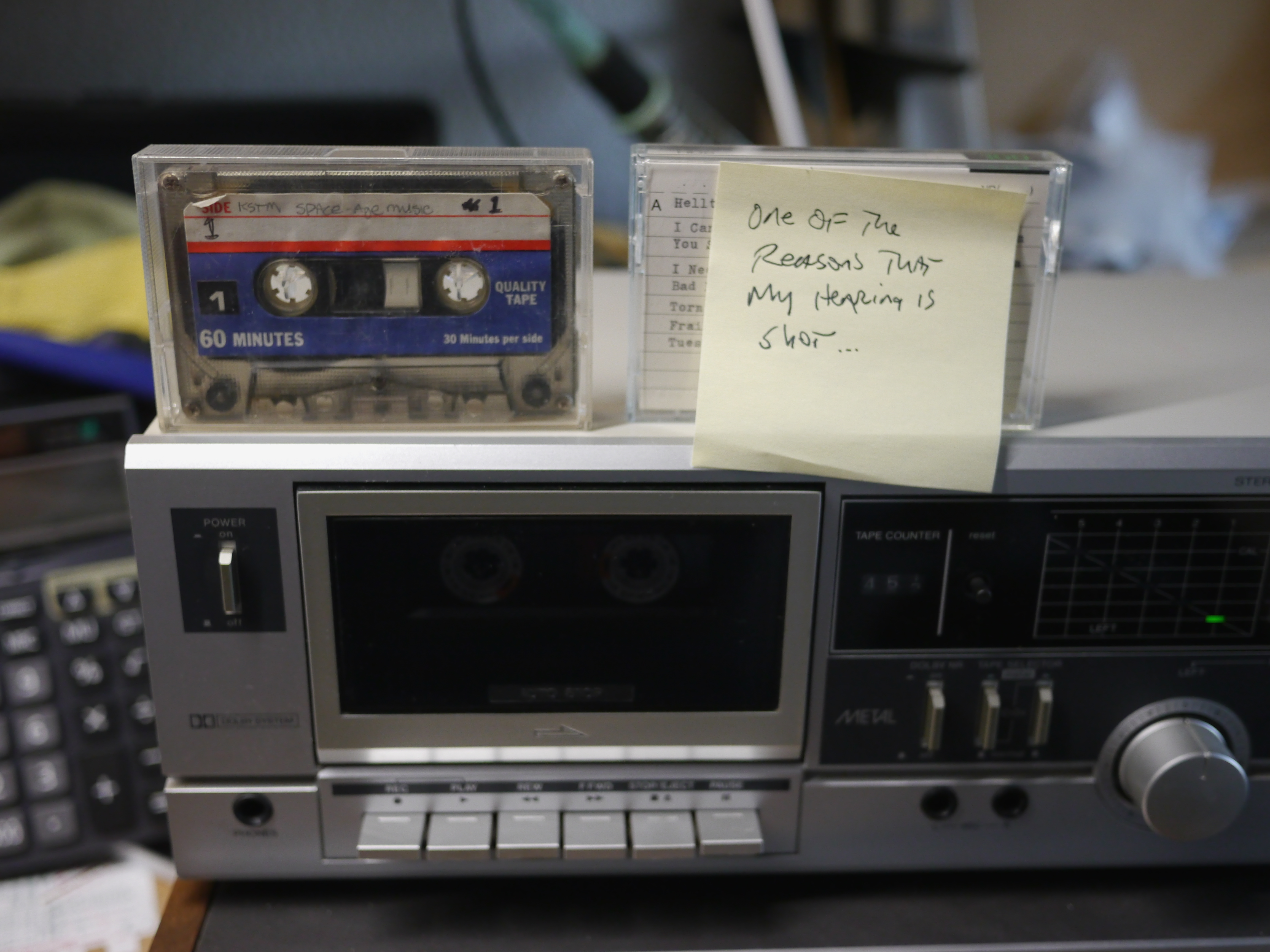
I considering getting a set of small bookshelf speakers for the garage, but had a good time today with Ted's tapes just wearing headphones. And I can blast it without bothering the neighbors, or my wife!
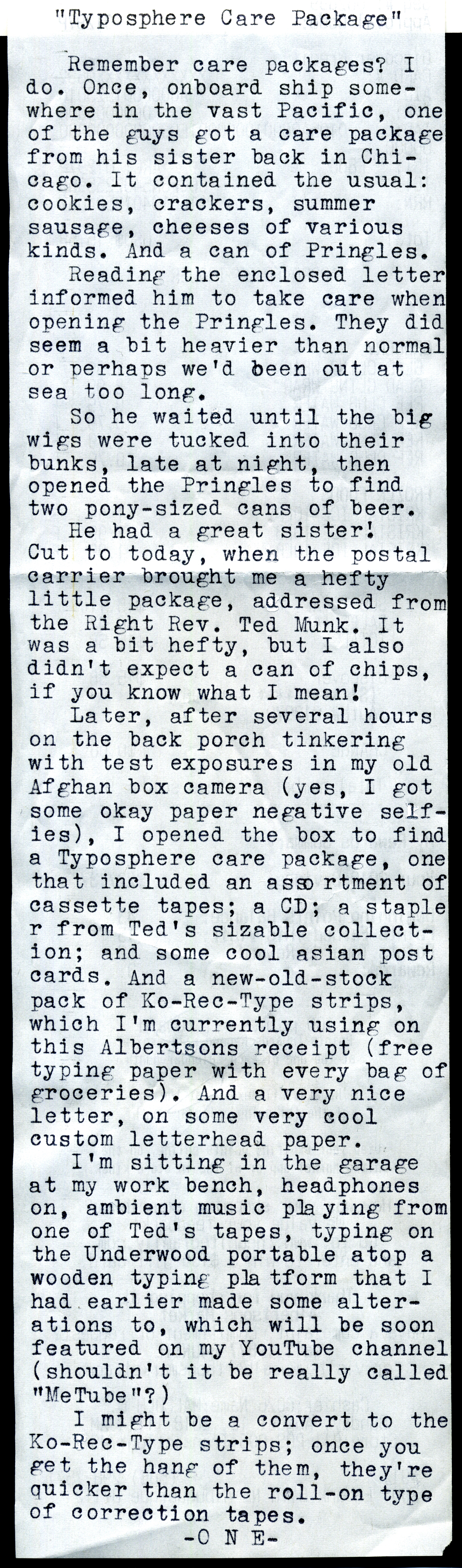
Thank you Ted for the care package. Now I'll have to get busy, acquire an analog video capture device and get you some footage of those experimental videos from the late '90s - early aughts. And maybe even an episode of "The Joe Show" from the late 1980s.
Post-Script: The niece's husband tried his hand at the little Olympia SF, and he blazed away using the middle finger of each hand. It turns out his first book was written, years ago, on a larger Olympia, using the same typing style.
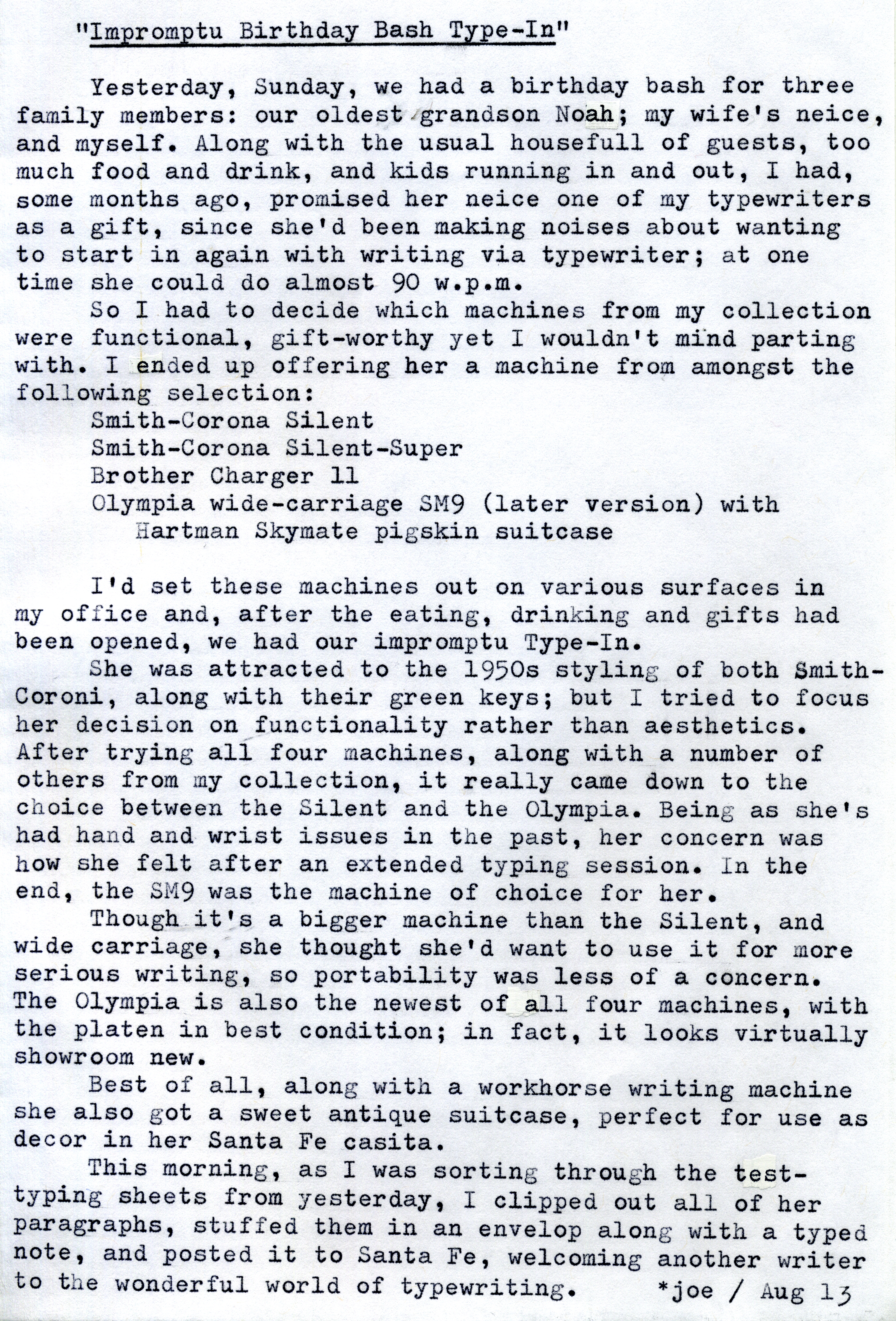
He asked her why a typewriter, isn't a computer more efficient. Her answer was something along the lines of wanting to get into typing again; she also has a desire to do some serious writing, and feels a typewriter would suit her best, as least in the initial phases.
They both live an hour up the highway in Santa Fe; I told her in my letter that should she need ribbons or other assistance, just call.
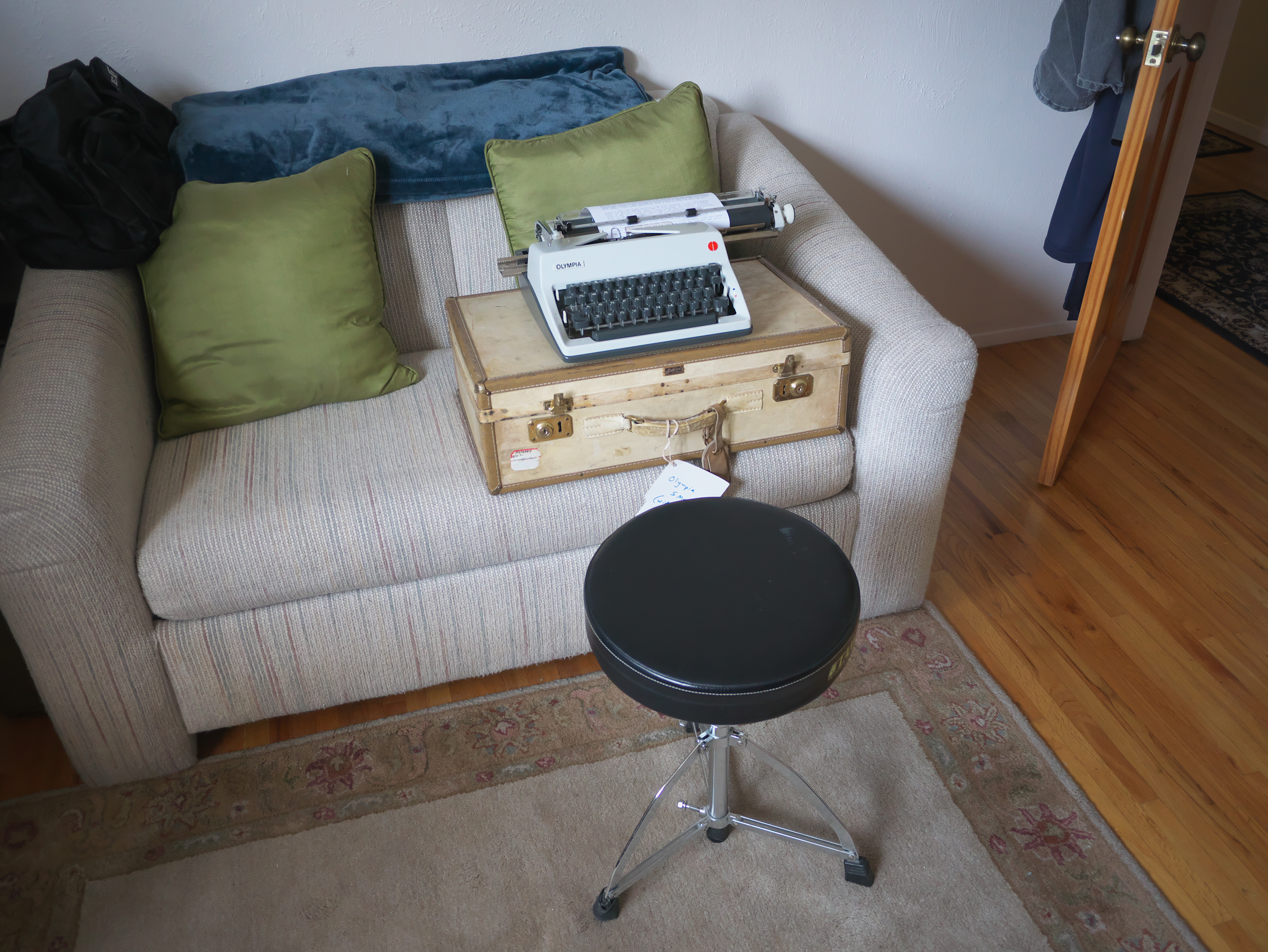
I think she made the right choice of the SM9 as a serious writing tool. Nothing wrong with the Smith-Coronas, except they're older, have seen a harder life.
I also had her try Adobe Rose, the Royal QDL, seen above next to the Brother Charger 11, which still had its lid attached, one of her other choices. Unless portability were her main concern, she was wise to steer clear of the Brother, as it's not nearly as easy to type on.
She made some interesting observations about the feel of the keyboards of these various machines. The spacing of the keys, and slope of the keyboards, has a lot to do with typing comfort, as she wisely discerned; to her, the SM9 felt easier than the Hermes 3000.
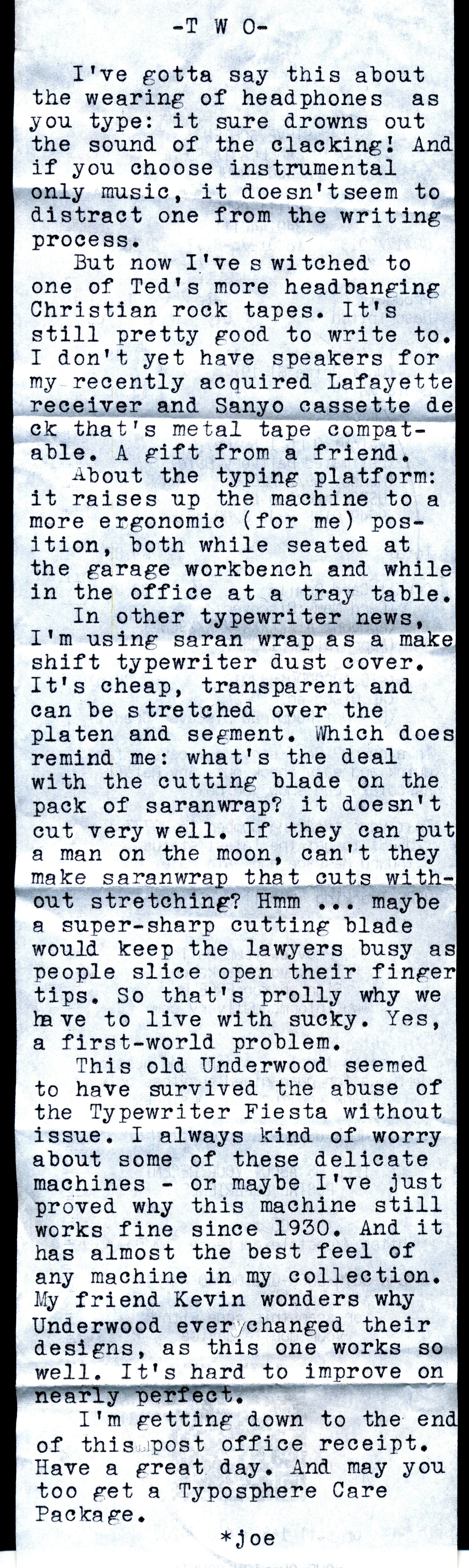
Above is the 1930 Underwood Portable with a roll of paper; we used it during the birthday party for people to type comments upon. Always a great machine to have handy.
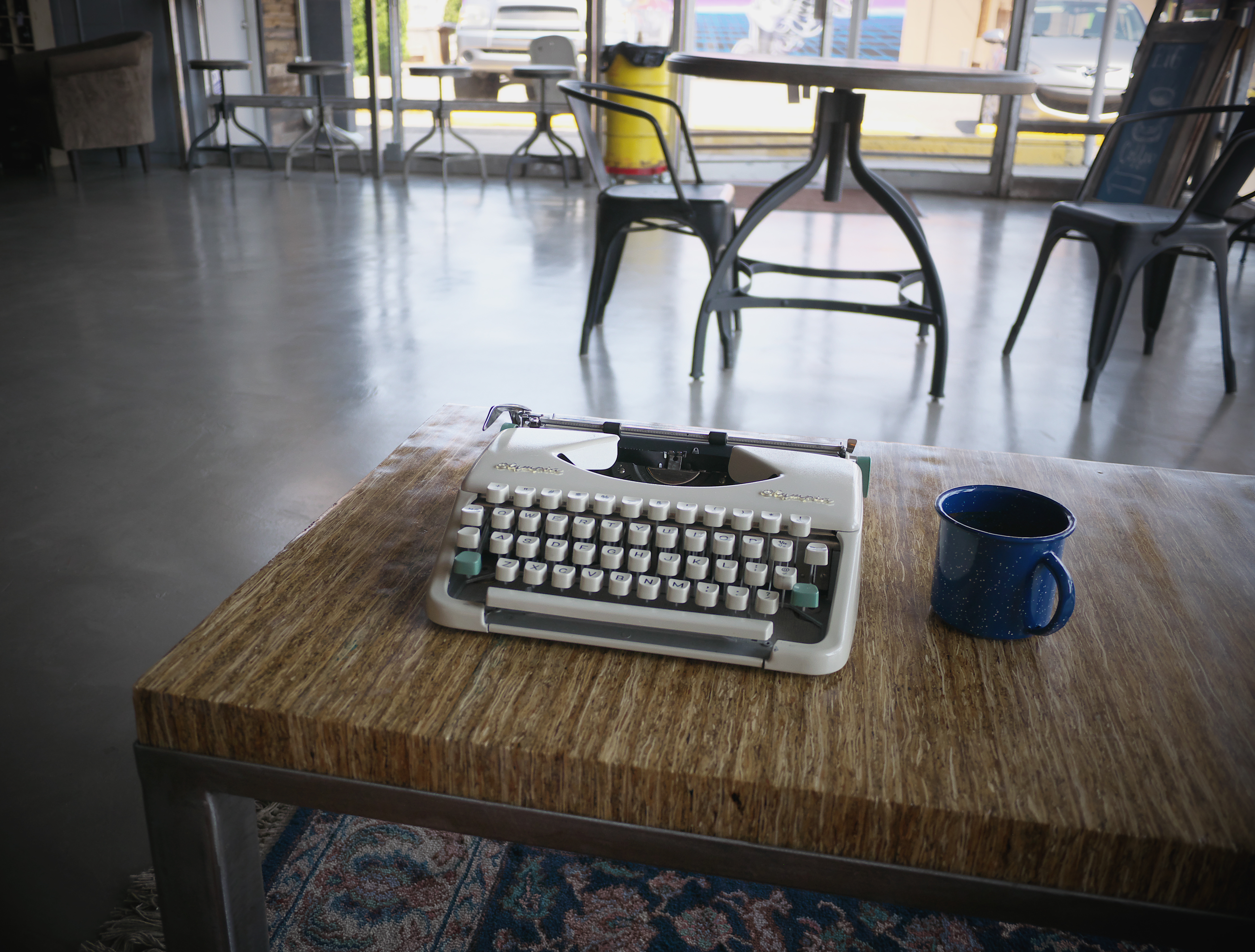
This morning I stopped in at Rust is Gold, a new coffee shop + artists collective, on Eubank near Constitution, with the Olympia SF, for some blog writing and coffee slurping. Fun was had, and I struck up a conversation with a fellow patron who was interested in the typewriter. I didn't have business cards with me, so typed him one on a scrap of paper.
Post-Script: I experienced one of those rare moments when, stepping outside the theater into the late-day's sunset, I beheld the New Mexico vista spread before me in that golden light, with thoughts from the film still bouncing around inside my head. Upon returning home I immediately brought this old but wonderfully functional 1930 Underwood Portable out into the front patio and proceeded to write as spontaneous of a movie review as I could manage, only finishing after dark to the light of an oil lamp.
There were four people in the theater for this showing, including my wife and I. This is not so much a comment on the film itself as it is on movie-going in general, in the year 2017, with all the other entertainment diversions to choose from. I understand people want to be entertained, want a distraction from their ordinary lives, which popular movies often provide. But this offering, while marketed as a documentary, I feel is more cerebral than most films since, as I indicate in the typecast, it's not as much about typewriters (which it also is) as it is about our relationship with technology; and a relationship that's constantly changing. It takes some thinking to get the gist of, which is perhaps not what people go to movies for. Maybe it takes too much effort to appreciate; but appreciate it I did.
Every criticism I'd read ahead of time about the film - the length, the lack of graphics introducing characters' names, the supposed lack of a unifying theme - I discounted before the film was half over. It doesn't take a student of film criticism to understand that superficial elements are often symbolic of deeper truths. The Eagles' song Hotel California, as I indicate in the typecast, isn't about the west coast hospitality industry; the song's title is a vehicle to something richer. Pink Floyd's The Wall album isn't about the masonry and construction industry, but symbolic of something deeper: the inner walls we erect. Similarly, California Typewriter isn't just about the superficial story of a struggling repair shop in 2017, but has undertones addressing the deeper issues of societal impact from technological change, and our relationship with changing technology over time, and the role of personal creativity. I liked it, and feel all the better for seeing it. I hope you do, too.
I'm certain I've blogged about this before. Using rolls of paper for typing, like the way that Jack Kerouac did with an early draft of On the Road, where he used a roll of teletype paper. Why a person would want to do so today has nothing to do with wanting to mimic the Beats. The Beat Movement is pretty much dead, last time I checked. And so are typewriters, except actually they're not; there's a revival in progress. Which is all the more reason to resurrect the idea of typing on a seemingly endless roll of paper - no more stopping in mid-thought to change paper. Just keep banging the keys and slinging the carriage back after the bell dings, and watch the paper pile up behind the machine on the floor; a more certain measure of one's writerly output.
Years ago, after this idea struck me (and inspired by a visit to the Palace of the Governors Museum in Santa Fe, which was hosting the On the Road manuscript scroll in its long glass-topped display case), I went in search of rolls of paper. Adding machine paper was too narrow, unless all you were interested in writing was short haiku poems. There were brown masking paper rolls, 6 inches wide, available at hardware stores; but I didn't want to type on brown paper. And there was white paper rolls in craft and art stores, but in widths much wider than the standard 8-1/2 inches.
After a bit of Internet searching I found a 6 inch wide roll of white paper, in 700 foot lengths, used for masking in the automotive painting industry. A local search found some at the Napa Auto Parts painting supply store. I ended up buying a damaged roll (the inner cardboard core was deformed) for less than half the price of new.
This paper I used for a time for typecast blogging. With the margins set to ~1/4 inch in from either edge, I could get long enough lines of text sufficient for this blog's template. But the paper was thin and crinkly, and didn't take ink all that well. I think, being engineered for painting, its surface was hydrophobic and hence repelled the ink, which would also easily smear. So after some time, I set that roll aside and looked for another solution.
A search on Amazon revealed rolls 8-1/2 inches wide of what was described as "teletype paper," but after receiving an order I found the quality of the paper was about the worse I'd ever seen. I should have known; I think Western Union quit the teletype business some years ago. Essentially like the very cheapest newsprint art paper, off-white and very fibrous, it doesn't take correction tape, and is mostly useful only for rough-draft writing where no one else will see the finished results. You wouldn't want to type that letter to dear old Aunt Mary with this stuff, or she'd take you out of her will.
This last week I once again found myself in the local big-box office supply retailer, when I happened across a roll of white "banner" paper 17 inches wide by 50 feet in length, for $5. It doesn't take a math whiz to figure out that 17 inches is twice 8-1/2, and I at once began thinking that perhaps my miter saw could cut it in half sufficiently neat to make the effort and cost worthwhile.
And yes, it was worth the cost, even the effort required afterward of cleaning up the garage because of the surprisingly messy cloud of shredded paper dust kicked up by the saw. But the cut was very smooth, and the resulting roll of 8-1/2 inch by 50 foot-long, white bond paper is nicely threaded up in the old Underwood Portable on the tray table, with the roll snuggled nicely between the scissor legs of the folding table using a piece of wooden broom handle. And a backup roll, from the other half, waits in the wings. $2.50 per roll is not a bad price. Maybe next time I'll do the cutting out of doors. Live and learn.
The paper takes typewriter ink very nicely, and has a very nice feel to it. I threaded up the paper in the machine so as to oppose the natural curl of the roll, hoping it helps in flattening it out. We'll see. Some of this paper, made from recycled pulp, can achieve a semi-permanent curl if left threaded around the platen too long.
So now I can say that my long search is over for an inexpensive source of good quality, white, typewriter-compatible paper rolls. I just need to set my butt down in front of that typewriter and start banging out some words. Which only I can do.
Post-Script: I had to do a bit of tinkering with the Underwood Portable, as it seems the ribbon advance was a bit wonky. It liked to prematurely reverse direction midway through the lefthand spool. I found the margin release linkage was interfering with the left spool auto-reverse mechanism, which required "reforming;" and I also adjusted the heights of the spool drive shafts, so they would turn freer. To test out my work, I began typing nonsense on a scrap of paper, but then decided to take advantage of this opportunity and not be as wasteful of ink, so moved the operation out to the Man Cave Shed and began some more premeditated writing, ribbon covers removed. Thus far, my work seems to have been useful, but I haven't gotten entirely to the end of the ribbon to test the reverse from the left spool.
I also added one more turn of tension to the spring motor, and the carriage return feels entirely normal. Not that I was experiencing any issues with lighter tension, but I didn't want to induce any problem in the future.
I also typed a piece of remembrance concerning my dad, whose birthday would have been on August 8. I'll use this for Typing Assignment No.6; which reminds me, I forgot to post the blog article accompanying the video, so I'll get that out today also.
Post-Script: This whole project began as an inspiration, late at night, sitting at my office desk with Underwood Portable at my side. These machines indeed are tools for writing inspiration, especially this kind of writing that's imaginative and, being fiction, doesn't have to conform to reality.
Since I needed a photo to adorn the beginning of this article, I figured a pinhole image would be needed, in order to get sufficiently close to these garden ornament ants. I used a little cardboard pinhole camera I'd built some years ago, with a 4" square format and wide angle of view (about 1.5" focal length). I attached a rectangular wooden base to my tripod, already fitted with 1/4-20 tripod bushing, and clamped to that a larger sheet of old plywood. This served as a mobile foreground stage, which I could move around my yard and adjust its framing with the tripod's head. A 25 second exposure in bright sun was made onto pre-flashed grade 2 RC paper. Inversion of the tones was done in the Preview app on my Mac. I really need to get some more full-featured photo editing software, but that'll involve spending some money and doing a bit of research.
Post-Script: This is not to imply that there is no craft-like skill involved with the more contemporary methods of image-making, but traditional methods are intrinsically craft-oriented, dealing as they do with physical material.
I loved Harman's Direct Positive Paper, and do hope they get the bugs ironed out of their manufacturing issues. Going forward, I do need to consider, when dealing with still-life and landscape subjects, returning to large format sheet film which, though more costly, can yield wonderful results, including the possibility of enlargements.
Typecast via Underwood Portable 4-bank. Check out the latest video about this machine.
Post-Script: As it turns out, we had attempted to radio the Pakistani ship on an international hailing frequency prior to the collision; they responded but only too late, and attempted to navigate the gap between what they thought were the lights of two smaller ships, but was actually the darkness between our bow lights and superstructure. Despite their size, it seems you can hide an aircraft carrier, in the glum of a dark and stormy Arabian Sea night.
Subsequent to this event, the US Navy installed a navigation lighting mast on all its carriers, a tall pole fixed to the starboard catwalk between bow and superstructure, to serve as a visual indication that this is one huge ship, not two smaller vessels.
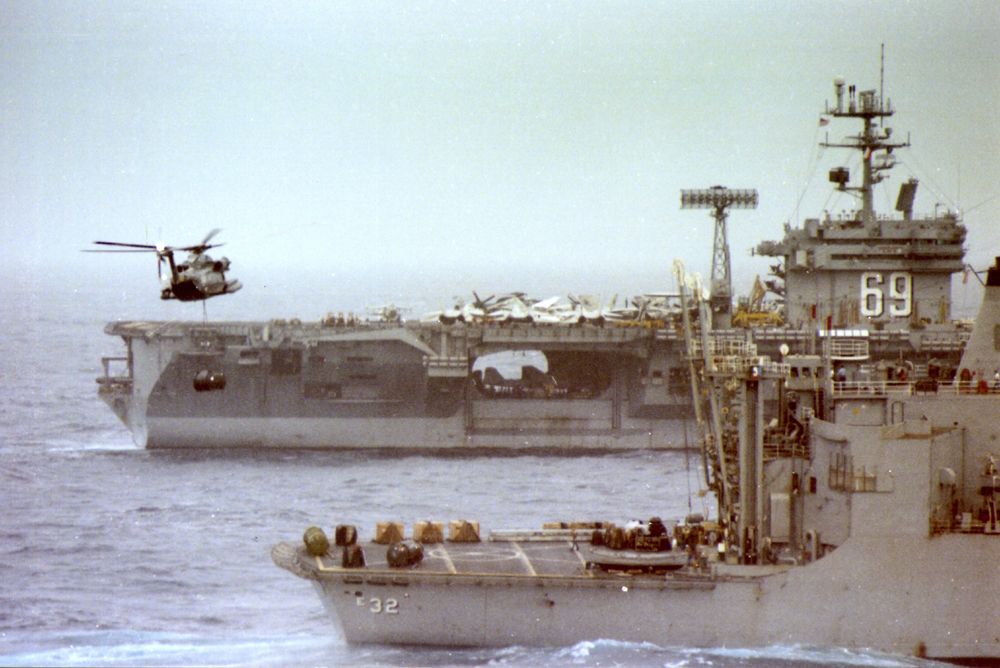
The freighter ship ended up being towed back to Karachi via US Navy oceangoing tug, and financial recompense was made. Our port Terrier missile radar antenna was retrieved from the deck of the freighter. The four-foot hole in our ship, high above the waterline and just below the flight deck, was merely a superficial wound; we remained at sea for several more weeks before turning east and returning to Subic Bay for repairs.
Captain McCarthy, one of the best skippers I served under, it is said didn't make the rank of Admiral because of this event, but did become a Commodore and served as head of the Naval Academy. His voice can be heard if you tour the USS Midway museum, in San Diego bay.
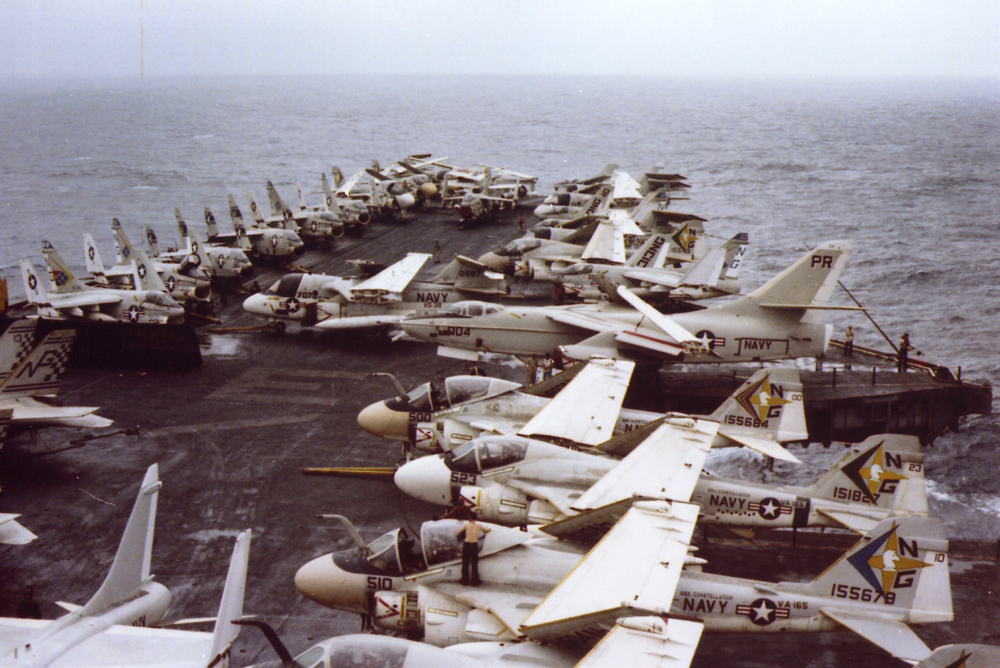
If you visit little old landlocked Albuquerque, you should visit the National Museum of Nuclear Science and History, formerly know as the National Atomic Museum and once located, prior to 9/11, on Kirtland Air Force Base. In the parking lot of the museum you will see a blue and white Terrier Missile launcher. This is because these systems were capable, as was the Connie's, of being nuclear armed. At the time of the collision, it was said that the Connie's was the last nuclear-certified Terrier system left in service. These employed a W30 1kt nuclear warhead and had a range of something like 40 nautical miles; designed in the atmosphere of nuclear idealism in the mid-1950s, before the advent of ICBMs, when it was thought that virtually every conventional tactical weapon could be nuclear armed. That was a different time.
Today, sold to a salvage company for $1, the Connie is being cut apart for scrap metal in the Galveston shipyards, while the governments of the United States and Iran remain at odds over their respective views of national sovereignty. Meanwhile, events like these that transpired during those long, dark nights of the Cold War remain but sea stories old men tell their grandkids.